
Cash flow forecasting is a rolling forecast of expected cash inflows and outflows used to predict future liquidity, typically combining a 13-week weekly view with an ongoing 12-month horizon. Founder-led businesses with $10M to $100M in revenue can't afford to skip it because growth can consume cash faster than profit, leaving payroll, suppliers, taxes, and debt payments exposed.
You may recognize the pattern. Sales are strong, the backlog is full, and the income statement shows a healthy margin. Yet the bank balance keeps tightening because customers pay later than expected, inventory arrives before orders ship, and payroll clears before the next major collection lands. The question you're trying to answer isn't just, “Are we profitable?” It's more urgent: When will cash become tight, how severe will the gap be, and what action should we take before it affects operations?
That's what cash flow forecasting answers. It turns payment timing, operating commitments, and financing decisions into a forward-looking liquidity system that leadership can use every week.
Table of Contents
- The Cash Surprise That Nearly Killed a Growing Business
- Defining Cash Flow Forecasting for Founder-Led Companies
- Direct Versus Indirect and Short Versus Long Horizon
- Building the 13-Week Rolling Cash Flow Model
- Working Capital Drivers Behind Every Forecast
- Why Shorter Forecasts Often Beat Longer Ones
- Best Practices Tools and Fractional CFO Implementation
- Your First 30 Days of Better Cash Visibility
The Cash Surprise That Nearly Killed a Growing Business
A $40M specialty contractor won two major projects and did what growth usually demands. The owner added crews, purchased inventory, and committed resources before the projects generated meaningful collections. Revenue accelerated, but accounts receivable stretched to 78 days, while a $310K retainage payment remained unreleased for 90 days.
Payroll cleared on Friday. By Wednesday, the operating account was overdrawn.
The owner hadn't misread the sales pipeline. The business had a timing problem. The company earned revenue under accrual accounting, but the bank account only recognized cash when customers paid. The owner learned three weeks too late that revenue growth and cash in the bank weren't the same thing.
Practical rule: A profitable project can still create a liquidity crisis when labor and materials leave the bank account before customer cash arrives.
Cash flow forecasting exists to expose that timing gap early. The FDIC's explanation of cash flow and forecasts distinguishes cash flow as the movement of cash into and out of a business over a period from a forecast, which estimates the business's future cash position. That makes forecasting a forward-looking operating discipline, not a bookkeeping report.
For a mid-market operator, the forecast should answer three questions:
- Shortfall date: When does available cash fall below the amount needed to operate safely?
- Gap depth: How low does cash go under the current assumptions?
- Recovery period: When do expected collections or financing restore liquidity?
The Government Finance Officers Association recommends an ongoing forecast horizon of at least 12 months, divided into monthly sections for most organizations and weekly or daily sections for larger, more complex operations, as reflected in the FDIC reference material. A founder-led company needs that longer view for hiring, inventory, subcontractor payments, expansion, and debt planning.
But the 12-month view shouldn't replace a near-term operating model. It should sit above a rolling weekly forecast that tells the owner what needs attention now.
Defining Cash Flow Forecasting for Founder-Led Companies
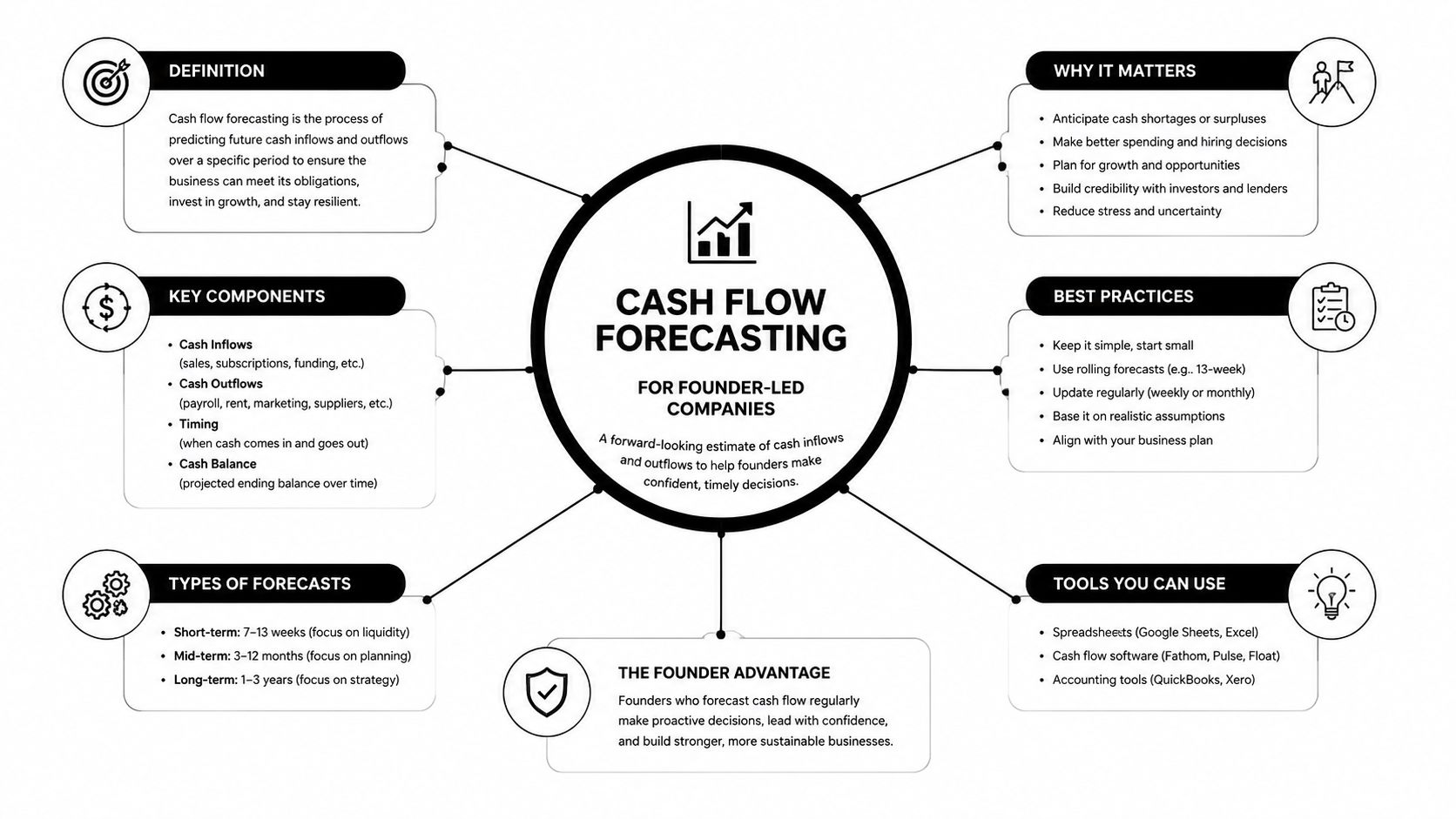
Cash flow forecasting is a rolling forecast of expected cash inflows and outflows used to predict future liquidity. It starts with the cash available, estimates when money will enter and leave the bank, and calculates the resulting balance for each future period.
For a founder-led business between $10M and $100M in annual revenue, this discipline separates a profitable-on-paper company from one that can reliably make payroll. The business has usually outgrown gut-feel cash management, but it may not need a full FP&A department or a $250K controller hire. A well-governed forecast gives the leadership team a practical liquidity system without adding an entire finance function.
The model should connect cash timing to decisions such as:
- Hiring: Can the business support additional payroll before the related revenue arrives?
- Vendor terms: Which supplier payments can be sequenced without damaging relationships?
- Capital expenditure: Can the company purchase equipment while preserving its minimum cash buffer?
- Credit capacity: How large should a revolving line be, and when might the business need to draw it?
- Covenant management: Could the timing of collections or debt service create pressure before month-end reporting shows it?
The direct method is usually the right foundation for near-term liquidity. It lists expected customer receipts and actual cash disbursements, such as payroll, vendor payments, taxes, debt service, and capital expenditures. The indirect method starts with accrual net income and adjusts for non-cash items and working-capital changes. Direct forecasting tells the operator what will hit the bank account, while indirect forecasting explains how reported profit converts into cash.
The cash flow forecasting guide from AmbitionCFO can help organize the practical modeling process.
Direct Versus Indirect and Short Versus Long Horizon
Use the direct method when the decision depends on the date cash moves. Use the indirect method when the decision depends on the relationship between profit, working capital, and long-term cash generation.
A contractor deciding whether to release a vendor payment this Friday needs a direct forecast. A distribution company evaluating whether its growth plan generates cash over the next year can use an indirect bridge alongside the operating plan.
| Method / Horizon | What It Answers | Best For | Refresh Cadence |
|---|---|---|---|
| Direct, daily or weekly | Which receipts and payments affect liquidity, and when? | Payroll, vendors, taxes, debt draws, and near-term decisions | Daily or weekly |
| Indirect, monthly or annual | Why does accounting profit differ from cash generation? | Budgeting, strategic planning, and financial statement alignment | Monthly or quarterly |
| Rolling 13-week | When will a cash gap begin, how deep will it be, and when will it recover? | Near-term working-capital management | Weekly |
| Rolling 12-month | Can the business fund growth and obligations across the operating cycle? | Hiring, inventory, capex, debt, and expansion | Monthly |
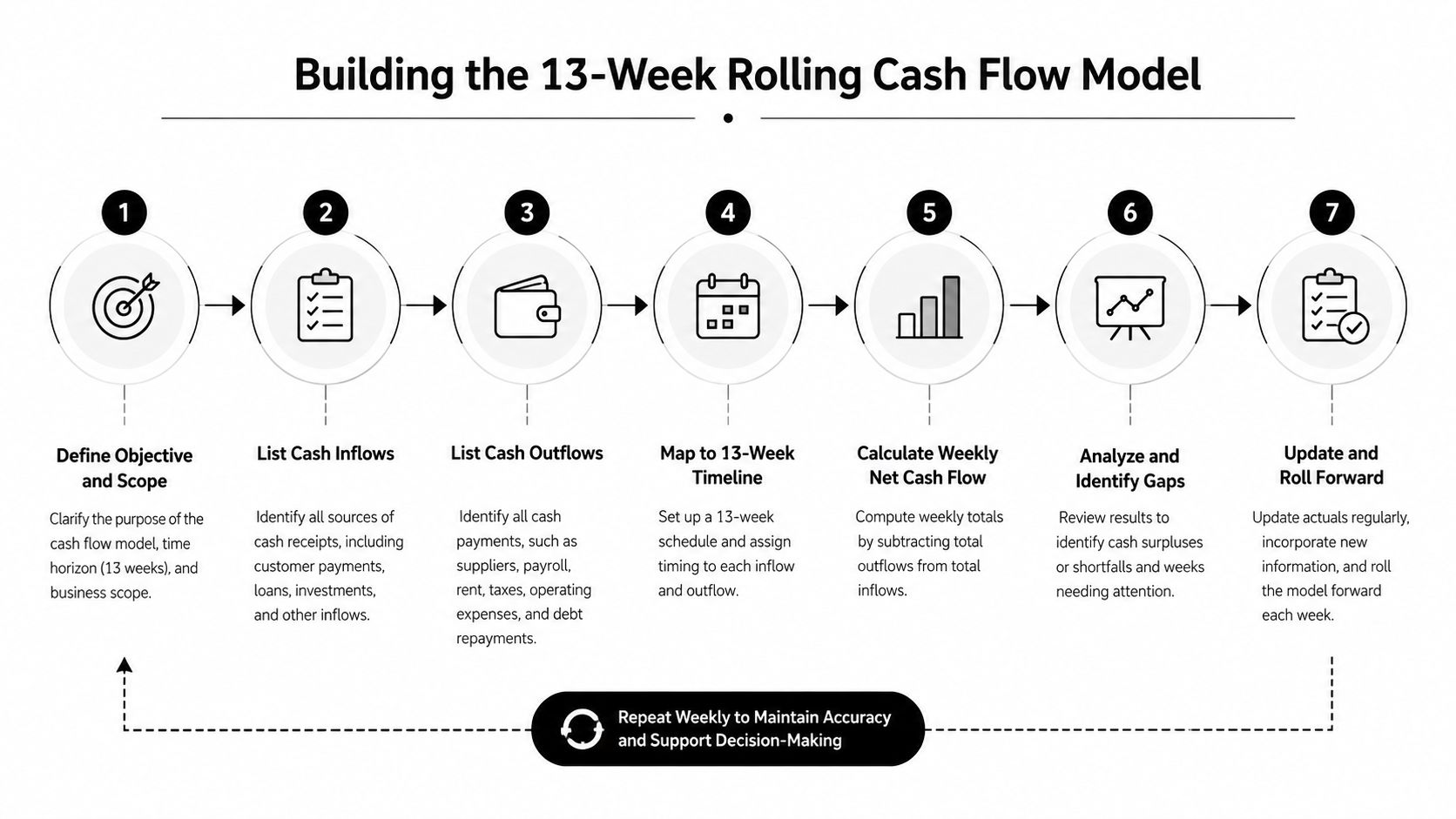
A 13-week rolling forecast uses weekly buckets. When the current week closes, replace its forecast with actual cash activity, move the remaining weeks forward, and add a new week at the end. The window stays constant, so leadership always sees approximately three months ahead, as described in this explanation of 13-week cash flow forecasting.
Build it in this order:
- Start with the reconciled opening bank balance.
- Add expected receipts by week, not by accounting period.
- Add every committed disbursement by the week it should clear.
- Calculate the closing balance for each week.
- Flag the first shortfall, the lowest balance, and the recovery week.
- Assign an owner to each major assumption.
The forecast doesn't need perfect precision in week 13. It needs dependable visibility in the next few weeks, where payment sequencing and collections decisions have immediate consequences.
Building the 13-Week Rolling Cash Flow Model
A useful 13-week model begins with the opening cash balance, then tracks money expected to physically enter or leave the bank. The direct method is appropriate because the model is designed for liquidity decisions, not accrual reporting, as outlined in this guide to the 13-week cash flow model.
Create weekly columns and include lines for:
- Customer collections
- Retainage and contract deposits
- Other operating receipts
- Payroll and payroll taxes
- Vendor and subcontractor payments
- Rent, insurance, and operating expenses
- Tax remittances
- Loan principal and interest
- Capital expenditures
- Owner distributions and other financing activity
Every Friday, the finance owner should pull bank actuals, replace the completed week's estimates, update open receivables and payables, and add a new week 13. On Monday, leadership should review the revised forecast and decide whether any action is required.
The model's most valuable outputs are diagnostic:
- Earliest shortfall date: The first date when projected cash violates the operating threshold.
- Deepest negative balance: The largest funding requirement under the selected scenario.
- Gap duration: The number of weeks until expected receipts restore liquidity.
Those outputs give the founder a response window. The business might accelerate collections, defer discretionary spending, sequence vendor payments, or draw on a credit facility. The decision becomes deliberate instead of reactive.
Working-capital assumptions drive the weekly schedule. Days Sales Outstanding, or DSO, estimates how long customers take to pay. Days Inventory Outstanding, or DIO, estimates how long inventory remains tied up. Days Payables Outstanding, or DPO, estimates how long the company takes to pay suppliers. The cash conversion cycle is calculated as DIO + receivables days − payables days, according to this working-capital metrics explanation.
For a practical starting point, use a founder's rolling cash flow template and adapt the categories to your bank accounts, payment terms, and operating calendar. The 13-week cash flow resource from AmbitionCFO provides another framework for structuring the weekly process.
Working Capital Drivers Behind Every Forecast
A forecast becomes useful when it translates operating behavior into cash dates. DSO, DIO, and DPO aren't finance decorations. They tell you when the bank account will feel the consequences of sales, purchasing, and payment decisions.
DSO focuses on collections. A professional services firm may show revenue as soon as work is delivered, but the forecast must place the expected receipt in the week the client is likely to pay. The owner should review invoice status, approval dependencies, disputed balances, and customer payment history instead of assuming contractual terms equal actual behavior.
DIO matters most in distribution and inventory-heavy operations. Inventory purchases create an immediate cash outflow, while the related sale may not produce cash until the product ships and the customer pays. The forecast should connect purchasing plans to expected shipment and collection timing.
DPO governs supplier cash timing. Extending payment terms can protect liquidity, but using suppliers as involuntary lenders eventually harms availability, pricing, or trust. Model the agreed payment schedule and identify exceptions explicitly.
| Industry | Typical DSO | Typical DIO | Typical DPO | Cash Conversion Cycle | Impact of 5-Day Improvement |
|---|---|---|---|---|---|
| Construction | Project and retainage timing | Materials held before installation | Subcontractor and supplier terms | DIO + receivables days − payables days | Earlier collections can reduce near-term funding pressure |
| Distribution | Customer credit and collection behavior | Inventory velocity | Supplier terms | DIO + receivables days − payables days | Faster inventory movement can release operating cash |
| Professional services | Client billing and approval timing | Usually limited inventory | Contractor and operating terms | DIO + receivables days − payables days | Faster approvals can improve weekly liquidity |
The requested five-day improvement should be modeled as a timing scenario, not presented as a guaranteed dollar outcome. The cash released depends on receivables, inventory, payables, and transaction volume. Use the accrual-to-cash guidance from AmbitionCFO to connect reported performance to actual liquidity.
A longer forecast doesn't automatically improve decision quality. If the assumptions behind collections, inventory, or supplier timing are weak, extending the horizon only creates more room for false confidence.
Why Shorter Forecasts Often Beat Longer Ones
A polished annual budget can be strategically useful and operationally stale. Payroll, supplier invoices, customer approvals, project milestones, and debt payments move on a cadence that a static annual plan rarely captures.
For near-term liquidity, the 13-week model is more actionable because it keeps weekly obligations visible. The forecast accuracy research covering short and long horizons cites average 13-week accuracy of approximately 87%, compared with 72% for annual forecasts. Those figures aren't a promise for your business, but they illustrate the core trade-off. Forecast uncertainty compounds as the horizon expands.
A longer view still matters. The GFOA recommendation for an ongoing 12-month forecast gives leaders visibility for structural decisions, while the weekly model handles immediate cash execution. Keep both, but don't confuse their purposes.
A short forecast buys decision confidence. Scenario planning buys optionality.
Use three cases:
- Base case: Collections, payroll, purchasing, and operating expenses follow the most supportable assumptions.
- Downside case: Major customers pay later, project milestones slip, or inventory purchases arrive earlier.
- Stress case: Multiple adverse timing events occur together, requiring financing or material spending changes.
Measure the forecast instead of arguing about whether it feels close. The forecast accuracy benchmarks identify MAPE, forecast bias, and directional accuracy as useful metrics. They also note that short-term targets are often near 90% to 95% accuracy, while annual forecasts can vary by 15% to 25% from actuals.
For a $10M to $100M company, a fractional CFO can embed this operating discipline without adding full-time FP&A headcount:
- Refresh actuals on a fixed weekly schedule.
- Tie assumptions to specific cash drivers.
- Review variance by owner and root cause.
- Run base, downside, and stress scenarios.
- Track liquidity decisions alongside margin and operating KPIs.
Best Practices Tools and Fractional CFO Implementation
The tool matters less than the operating discipline. A dashboard fed by stale AR, incomplete AP, or unreconciled bank data will produce a polished mistake.
Start with four habits:
- Weekly refresh: Replace completed forecast periods with actual cash activity and roll the window forward.
- Driver-based assumptions: Tie collections to customer behavior, payroll to the staffing schedule, purchasing to inventory needs, and subcontractor payments to project milestones.
- Scenario planning: Maintain base, downside, and stress cases so the leadership team knows what would trigger action.
- Variance analysis: Separate timing differences from true forecast error and track bias, not just absolute variance.
Choose tools based on the company's complexity. A spreadsheet can work when one person owns the model, the bank structure is manageable, and the data is reconciled. An ERP or accounting platform becomes more useful when it can connect AR, AP, payroll, inventory, debt, and bank activity. A dashboard layer should surface the opening balance, projected minimum cash, shortfall week, collections risk, and major commitments without forcing the owner to inspect every formula.
| Best Practice | What It Prevents |
|---|---|
| Reconciled opening cash | Building every projection on an unreliable starting balance |
| Weekly actual-versus-forecast review | Repeating the same timing and assumption errors |
| Named owners for assumptions | Finance carrying operational information alone |
| Separate scenarios | Treating one optimistic plan as a certainty |
| Driver-level variance analysis | Fixing totals without addressing the underlying cause |
| Version control | Conflicting models and untraceable changes |
Implementation should reflect the industry. In construction, connect inflows to billing milestones, retainage, job costs, and subcontractor schedules. In distribution, connect purchasing and cash use to inventory movement, customer collections, and supplier terms. In professional services, connect billing, work in progress, utilization, contractor payments, and client approval timing.
A fractional CFO can build the template, train the finance operator, and establish the meeting rhythm. The model should then feed margin analysis, KPI dashboards, capital decisions, and exit planning inputs. AmbitionCFO provides fractional CFO services that include cash flow management, forecasting, KPI reporting, margin analysis, and exit planning for founder-led businesses.
If your business has outgrown basic bookkeeping, review fractional CFO support for startups and growing companies to understand where strategic finance work can sit between a bookkeeper and a full-time CFO.
Your First 30 Days of Better Cash Visibility
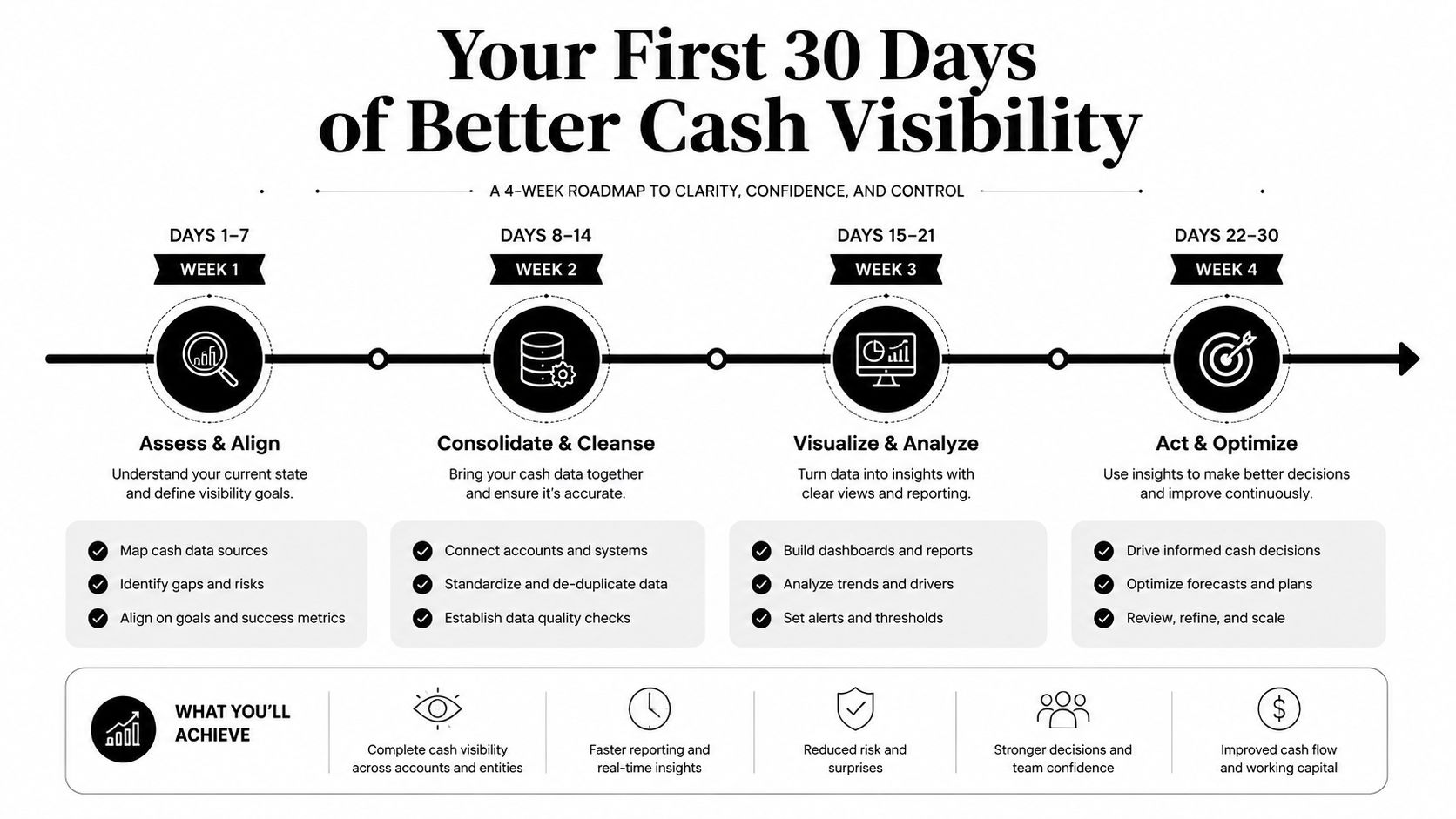
Don't wait for a cash crisis to build the model. The first month should create a dependable baseline and a repeatable decision rhythm.
Days 1 through 7
Pull the last 90 days of bank activity, AR aging, AP aging, payroll schedules, tax obligations, debt schedules, and planned capital expenditures. Reconcile the opening cash balance and identify which receipts and disbursements are expected rather than merely recorded in the accounting system.
Days 8 through 14
Build the 13-week template. Use eight inflow lines, including AR collections, retainage, deposits, and other receipts. Use twelve outflow lines, including payroll, payroll tax, vendor payments, loan service, taxes, rent, insurance, operating expenses, capital expenditures, and other committed payments.
Lock the assumptions sheet. Each major input should have an owner, a source, and a clear explanation of what would cause it to change. A forecast that nobody owns becomes a spreadsheet someone updates only after the problem appears.
Days 15 through 21
Run base, downside, and stress scenarios. Identify the earliest shortfall week, the required revolver capacity or AR action, and the operating decisions that could reduce the gap. Document the trigger for each action, such as accelerating a specific collection, deferring discretionary spend, or changing the payment sequence for a noncritical vendor.
Days 22 through 30
Schedule a 30-minute weekly Monday meeting with the leadership team. Publish a one-page liquidity snapshot showing projected cash, major receipts, major disbursements, shortfall risks, and decisions required. Connect the forecast to margin and KPI reviews so it remains part of operating management rather than becoming a finance-only file.
The liquidity management framework from AmbitionCFO can help you structure those decisions. Start this week by pulling the bank activity, AR aging, AP aging, and payroll schedule, then build the first four weeks before expanding to the full rolling horizon.
AmbitionCFO helps founder-led construction, distribution, and professional services companies build rolling 13-week cash flow models, improve forecast discipline, connect liquidity to margins and KPIs, and plan for growth or exit. Visit AmbitionCFO to discuss the cash visibility gaps your leadership team needs to solve next.