

You're looking at a profitable income statement, a healthy backlog, and a bank balance that can't cover the next payroll. Your controller says the business earned money. Your operations team says customers haven't paid, inventory had to be purchased ahead of demand, and vendors are waiting for checks. The question isn't whether the company is profitable. It's where the profit is trapped before it becomes cash.
That gap is normal under accrual accounting. Revenue is recorded when it's earned, and expenses are recorded when they're incurred, regardless of when cash changes hands. Cash accounting records income when received and expenses when paid, as explained by the IRS guidance on accounting methods. Converting accrual to cash is the process of turning that timing difference into an operating model you can manage.
Table of Contents
- Why Your Bank Balance and Profit Never Match
- The Balance Sheet Adjustments That Actually Move Cash
- A Worked Example With Journal Entries and Excel Formulas
- Rolling the Bridge Into a 13-Week Cash Flow Forecast
- Tax and GAAP Traps When You Switch or Stay Hybrid
- The Bigger Cash Lever Most Owners Miss
Why Your Bank Balance and Profit Never Match
A project-based company can post a profitable month and still delay a vendor payment. Customers were billed, revenue was recognized, and the margin looked healthy. Meanwhile, one customer has not paid, another invoice is awaiting approval, and materials for the next phase were purchased before the next milestone arrived.
That result usually reflects timing, not a bookkeeping mistake. Accrual accounting records economic activity before settlement. Accounts receivable grows when invoices go out without collections. Inventory grows when purchases precede sales. Accounts payable grows when suppliers fund the gap. Those balances shift cash timing while leaving reported accrual profit unchanged for the period.

Name the missing number
The missing number is the working-capital cash impact. It shows how much cash operations consumed or released as receivables, inventory, payables, prepaids, and accrued liabilities changed.
Start with net income, then adjust for non-cash expenses and balance-sheet movements. Higher receivables reduce cash relative to accrual revenue. Higher payables increase cash because the company incurred costs before paying them. The indirect cash flow method formalizes this bridge, but owners need the operating cause behind each movement, not only a completed statement.
That cause should connect directly to working-capital levers. Rising receivables points to weaker collections or a longer DSO. Rising inventory points to higher DIO and cash committed before delivery. Rising payables can extend DPO, while retainage delays collection even after work is complete. Build the conversion so each adjustment feeds the forecast, rather than treating it as a year-end accounting exercise.
A foundational empirical study on accrual-to-cash conversion found that, for firms whose accrual innovations reverse within one year, a $1 increase in working-capital accruals translated into about $0.95 of cash flow in the following fiscal year. The practical lesson is clear. Short-lived accruals may convert to cash over a 12-month horizon, but their timing still affects liquidity, covenant pressure, and collection planning. See the foundational accrual-to-cash conversion study.
Owner's rule: Profit measures whether the work creates economic value. The cash bridge shows whether the company can fund delivery until collection.
A profit and loss statement alone cannot explain the bank balance. Pair it with a financial reporting framework for owner decisions and map each adjustment to DSO, DIO, DPO, or retainage. Companies operating in or serving the UAE can also use guidance on managing cash flow for Dubai SMEs when setting collection and payment controls.
The Balance Sheet Adjustments That Actually Move Cash
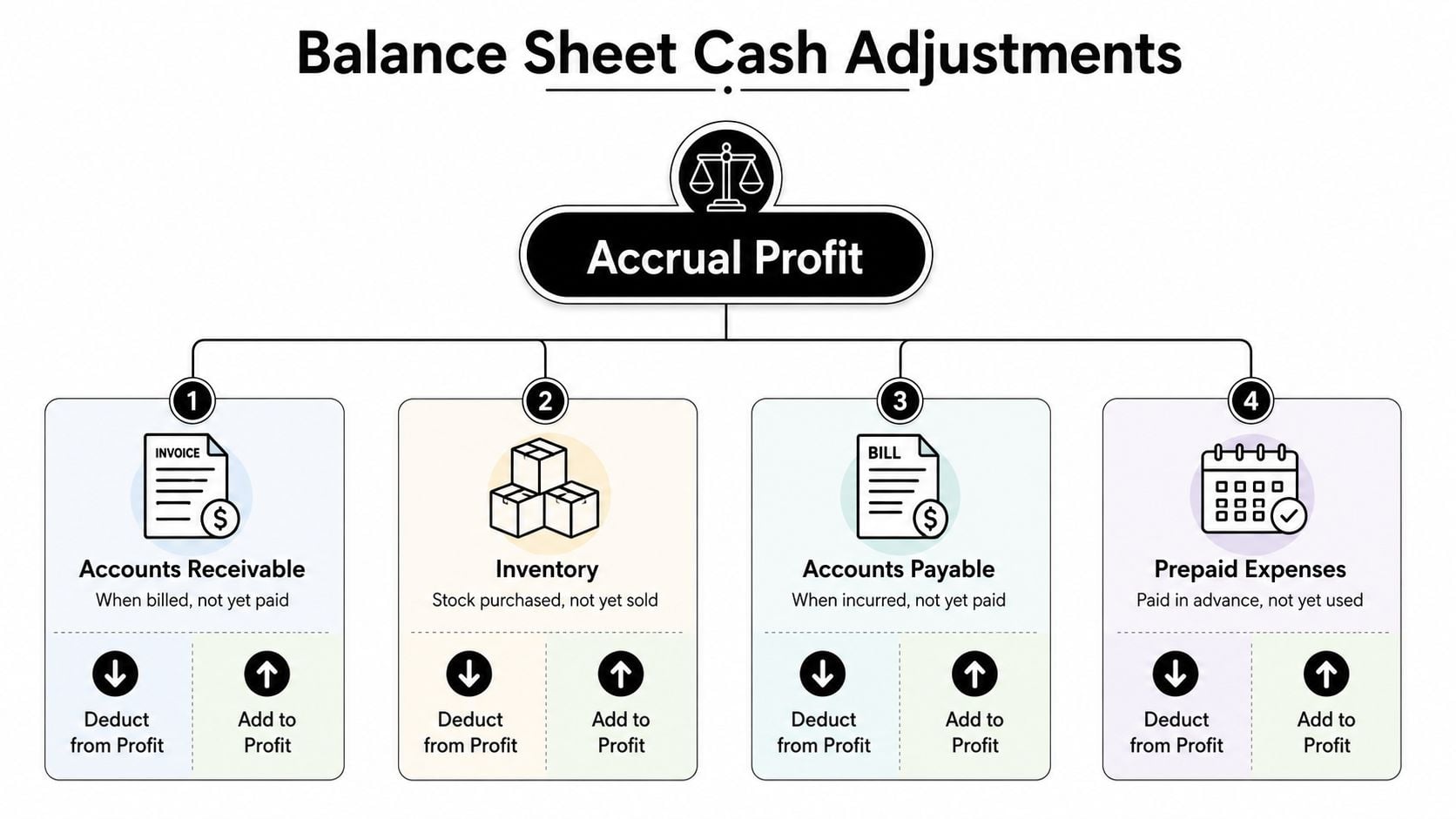
Before building formulas, classify every balance-sheet account by its cash behavior. Don't treat the trial balance as a list of accounting labels. Treat it as a map of cash commitments, delayed receipts, and non-cash entries.
Start with operating assets
- Accounts receivable: A higher ending AR balance means more recognized revenue remains uncollected, so subtract the increase from accrual profit. The conversion entry generally debits revenue or a conversion account and credits AR when removing uncollected activity from a cash view.
- Allowance for doubtful accounts: This is a valuation estimate, not a cash receipt or payment. Reverse the non-cash provision when converting profit, then separately model actual write-offs and collections.
- Unbilled revenue: If the company recognized revenue before issuing an invoice, the balance represents economic performance without a cash collection. Remove the increase from the cash view and inspect the billing process.
- Inventory: An inventory increase consumes cash because purchases occurred before the related sale. Add back the increase in inventory as a use of cash, while inventory sold flows through cost of goods sold.
- Prepaid expenses: Cash was paid before the expense was recognized. Add the increase in prepaids to the cash-use calculation, because the income statement has not yet captured that payment.
- Fixed assets: Equipment and other capital purchases are real cash outflows, even though depreciation spreads the accounting expense over time. Subtract capital expenditures separately from operating cash.
- Depreciation: Depreciation reduces accrual profit without creating a current-period cash payment. Add it back in the operating bridge, then keep capex visible below operating cash.
The inventory aging report helps separate useful stock from cash sitting in slow-moving items. That distinction matters more than reporting the ending inventory balance.
Then scan liabilities and financing
- Accounts payable: A higher AP balance means the company has incurred costs without paying vendors. Add the increase to cash relative to accrual profit, but don't stretch terms so far that suppliers interrupt service.
- Accrued expenses: Accrued payroll, bonuses, taxes, and other liabilities represent costs recognized before payment. Add increases to the bridge and schedule the actual payment date.
- Deferred revenue: Cash received before revenue recognition is a cash inflow that accrual profit hasn't fully recorded. Add the increase to the cash view, then track the future delivery obligation.
- Loans: Loan proceeds increase cash without increasing revenue. Principal repayments reduce cash without reducing operating profit, while interest belongs in the expense bridge according to the reporting method.
Use the indirect bridge for reconciliation, but use a direct schedule for decisions. A manager can act on “customer payment expected next week” or “vendor payment due Friday.” A vague net working-capital adjustment doesn't tell anyone what to do.
The core operating formula is CCC = DIO + DSO − DPO, where DSO measures collection speed, DIO measures inventory holding time, and DPO measures supplier payment timing. The cash conversion cycle calculation and formulas provide the mechanics, including AR divided by credit sales for DSO, inventory divided by COGS for DIO, and AP divided by COGS for DPO.
A Worked Example With Journal Entries and Excel Formulas
Use a sample month to make the bridge auditable. Assume a construction-influenced operating business with monthly accrual profit that includes $180,000 of revenue, $120,000 of cash-basis operating costs before the listed adjustments, and $10,000 of depreciation. The numbers below are an illustrative template, not a reported case study.
The business billed $40,000 that remains in AR, recorded $15,000 of retainage within receivables, paid $8,000 of prepaid insurance, accrued $12,000 of payroll not yet paid, and recorded $10,000 of depreciation. AP increased by $20,000. The cash bridge must identify which entries change timing and which entries never represent operating cash.
| Accrual Line | Accrual Balance | Conversion Entry (Dr/Cr) | Excel Formula |
|---|---|---|---|
| Accounts receivable increase | $40,000 | Dr Revenue, Cr AR | =AccrualRevenue-ARIncrease |
| Retainage receivable | $15,000 | Dr Revenue, Cr Retainage Receivable | =CashRevenue-Retainage |
| Accounts payable increase | $20,000 | Dr AP, Cr Expense | =AccrualExpense-APIncrease |
| Prepaid insurance paid | $8,000 | Dr Prepaid Insurance, Cr Cash | =CashExpense+PrepaidIncrease |
| Accrued payroll increase | $12,000 | Dr Payroll Expense, Cr Accrued Payroll | =CashExpense-AccruedPayrollIncrease |
| Depreciation | $10,000 | Dr Depreciation Expense, Cr Accumulated Depreciation | =AccrualProfit+Depreciation |
Read the directions carefully. The AR and retainage balances reduce cash revenue because the income statement includes work that hasn't produced a deposit. The AP and accrued payroll balances reduce current cash payments because the company hasn't settled those costs. The prepaid insurance payment does the opposite, cash left the bank before the income statement recognized the full expense.
Build the bridge in Excel
Set up one row for each balance-sheet movement and use beginning and ending balances where possible:
- Cash revenue:
=AccrualRevenue-(EndingAR-BeginningAR)-(EndingRetainage-BeginningRetainage) - Cash vendor payments:
=AccrualCOGS-(EndingAP-BeginningAP) - Cash payroll:
=AccrualPayroll-(EndingAccruedPayroll-BeginningAccruedPayroll) - Cash operating expenses:
=AccrualOperatingExpense+(EndingPrepaids-BeginningPrepaids) - Operating cash proxy:
=CashRevenue-CashVendorPayments-CashPayroll-CashOperatingExpenses - Cash after non-cash add-back:
=AccrualNetIncome+Depreciation-ARIncrease-RetainageIncrease+APIncrease+AccruedPayrollIncrease-PrepaidIncrease
For this month, the working-capital bridge reduces accrual profit by the $55,000 combined increase in AR and retainage, adds $32,000 from AP and accrued payroll, subtracts the $8,000 prepaid payment, and adds back $10,000 of depreciation. That produces a cash-versus-accrual difference of $21,000 before capex, debt principal, and taxes, based solely on the listed adjustments.
Keep retainage separate. If you bury it inside total AR, the collection forecast will look better than reality because retainage often follows a different release process from ordinary invoices. For owners also tracking merchant cash advances, a resource on master MCA accounting can help distinguish financing movements from operating cash.
Rolling the Bridge Into a 13-Week Cash Flow Forecast
A monthly conversion explains what happened. A 13-week cash flow forecast tells you whether the business can survive what happens next.
Build the forecast from the bank balance forward. Each week should contain opening cash, customer receipts, vendor payments, payroll, taxes, debt service, capital expenditures, and ending cash. Don't forecast revenue and assume cash follows. Schedule receipts by customer, invoice, retainage status, approval stage, and realistic payment date.
Make the forecast operational
For each open receivable, assign a collection week. Separate ordinary billing from retainage and milestone invoices. A profitable construction job can still create a shortfall if the team books earned revenue before the customer approves the billing package.
For outflows, use the accounts-payable aging and payment calendar. Add payroll dates, recurring insurance payments, equipment purchases, lease obligations, and scheduled principal payments. Depreciation doesn't belong as a cash payment, but the equipment purchase that created the depreciation does.
Forecast discipline: Every projected receipt needs an owner, a customer, and a week. Every projected payment needs a due date and a decision-maker.
The bridge and the forecast should reconcile to the cash flow statement. Start with accrual net income for the indirect reconciliation, add back depreciation and other non-cash items, then apply the actual changes in AR, retainage, inventory, prepaids, AP, and accrued liabilities. Separately reconcile investing cash, such as capex, and financing cash, such as loan proceeds and principal payments.
Use a simple weekly layout:
| Forecast line | Week 1 | Week 2 | Week 3 |
|---|---|---|---|
| Opening cash | Prior week ending | Prior week ending | Prior week ending |
| Customer receipts | Scheduled collections | Scheduled collections | Scheduled collections |
| Vendor and inventory payments | Approved payments | Approved payments | Approved payments |
| Payroll and taxes | Calendar-based | Calendar-based | Calendar-based |
| Debt service and capex | Scheduled items | Scheduled items | Scheduled items |
| Ending cash | Formula result | Formula result | Formula result |
The 13-week cash flow forecast model follows this direct-method logic, converting accrual-based books into the weeks when cash will move. Review it weekly with the owner, operations lead, and whoever controls collections. A forecast that sits untouched in Excel is not a control system.
Tax and GAAP Traps When You Switch or Stay Hybrid
Do not change the company's tax accounting method because cash reporting makes the bank balance easier to read. Management reporting and tax reporting solve different problems. Keep accrual financials when job profitability, lender reporting, buyer diligence, or forecasting depends on earned revenue, incurred costs, and working-capital balances. Use the cash view to manage liquidity, not to replace the operating picture.
A tax-method change generally requires approval and reporting on Form 3115. It may also create a Section 481(a) adjustment, which prevents income or deductions from being omitted or counted twice when recognition changes. Have your tax professional review the transition before you post a permanent change to the books. The adjustment should tie to the same working-capital schedules used in your cash bridge, including receivables, inventory, payables, and retainage where applicable.
Hybrid methods need a deliberate design
A hybrid method can use accrual inventory accounting while applying cash treatment to other income and expense categories. That design affects DIO and the timing of vendor cash, so inventory-heavy businesses cannot treat conversion as an AR and AP cleanup. Review the IRS accounting method guidance, then document the method assigned to each material category and the forecast line it feeds.
An accidental hybrid creates unreliable margins and tax estimates. Cash revenue, accrual payroll, partially adjusted inventory, and financing payments buried in operating expenses can produce books that look reasonable while misrepresenting cash conversion.
Set the reporting package before changing entries. Keep the accrual management view for lenders, investors, and potential buyers, and maintain a separate cash forecast for liquidity. Document the method, prepare transition schedules, test the Section 481(a) impact with your CPA, and align close procedures with financial reporting best practices. That gives the owner a forecast-ready model instead of a one-time conversion exercise.
The Bigger Cash Lever Most Owners Miss
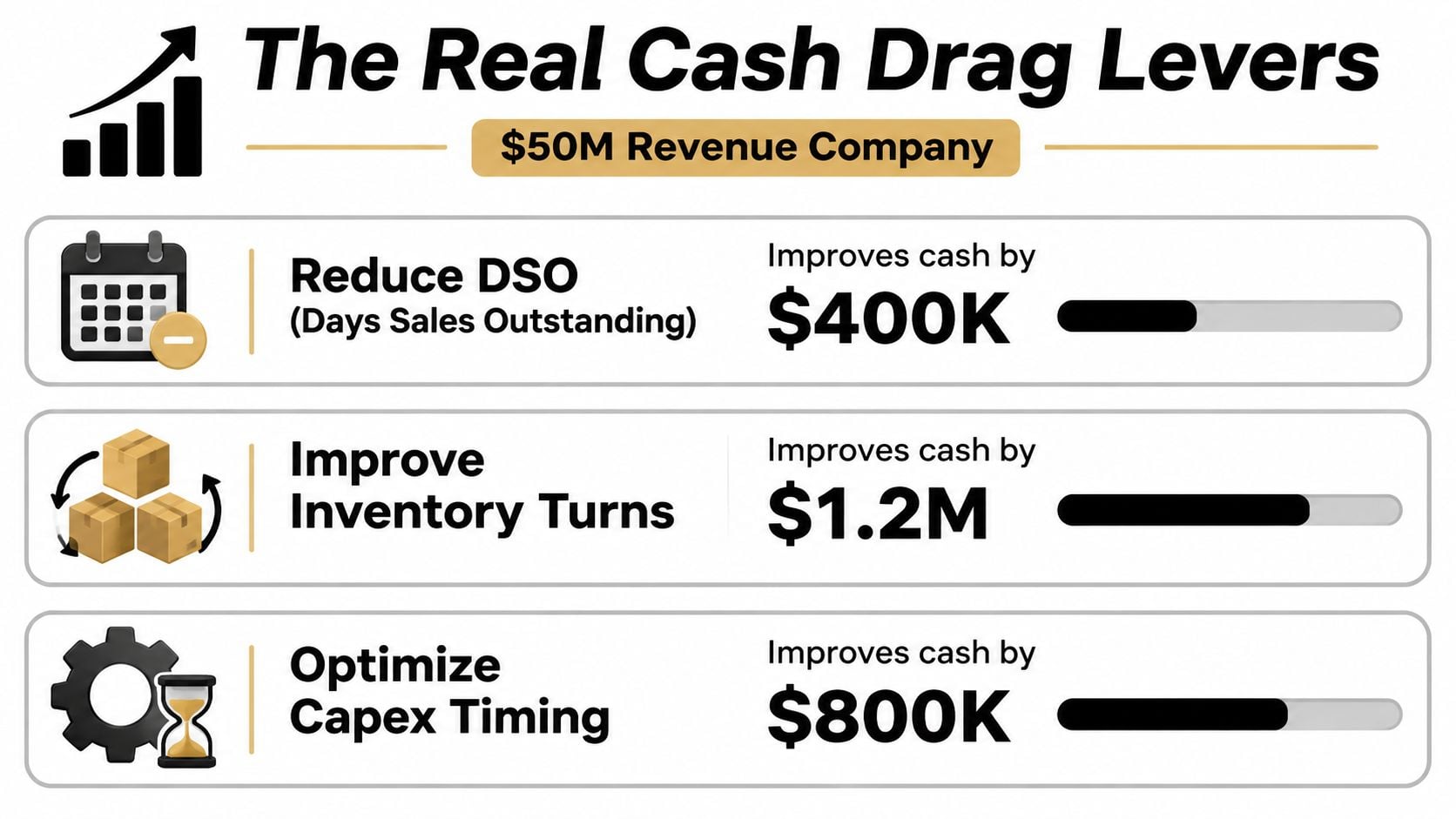
Most owners attack DSO first. Faster invoicing and tighter collections matter, but they're not always the largest cash lever. In construction, distribution, and project-based services, inventory timing, retainage, supplier terms, and capex can consume more cash than a modest improvement in invoice collection.
The cash conversion cycle gives you the diagnostic: CCC = DIO + DSO − DPO. DSO consumes cash as customers take longer to pay. DIO consumes cash while inventory sits unsold. DPO funds operations while suppliers wait for payment, provided the terms remain commercially sustainable.
Historical data shows why the opportunity is material. Research covering 1975 to 2016 reported that the annual median cash conversion cycle fell from 101.66 days in 1975 to 49.98 days in 2016, a reduction of 51.68 days, or 50.84%. The same source reported a median of 78.68 days in 1989 and 50.05 days by 2001, suggesting that much of the improvement occurred before the 2000s and later flattened. See the historical cash conversion cycle benchmark.
Diagnose the leak before changing policy
Use this short review:
- Receivables: Which customers create the longest delay, and how much of AR is retainage or unbilled work?
- Inventory: Which items are essential for service, and which purchases are growth bets that haven't converted into sales?
- Payables: Which vendors can support better terms without jeopardizing supply or job completion?
- Capex: Which purchases are mandatory now, and which can move without damaging delivery capacity?
Industry context matters. Professional services are often cited at roughly 5 to 20 CCC days, construction at about 30 to 65 days, and wholesale and distribution at about 35 to 70 days, according to the industry working-capital benchmarks. Construction benchmarks cited there also place median DSO around 55 to 75 days, with top performers near 40 to 55 days, while median DPO is around 40 to 55 days and CCC around 45 to 80 days. Treat these as directional comparisons, not automatic targets, because retainage, billing cadence, and contract approvals change the economics.
Your next cash project should target the largest controllable balance, not the most popular advice. Use this cash flow improvement guide to turn the diagnosis into a collection, inventory, supplier, or capex action plan.
AmbitionCFO helps founder-led businesses build forecast-ready cash models, including 13-week cash flow forecasts, working-capital analysis, margin reporting, and capital decision support. Visit AmbitionCFO to discuss the accrual-to-cash bridge with a fractional CFO and identify the operating lever that deserves attention first.