

Seventy-three percent of privately held U.S. companies plan to transition within the next decade, representing a $14 trillion transfer opportunity, according to the Exit Planning Institute's 2023 National State of Owner Readiness survey. The question isn't whether your company will eventually face a transition. It's whether you'll build a transferable business before the market, your family, or your own timeline forces the decision.
For a founder running a $10M-$100M company, CEPA exit planning isn't paperwork. It's the disciplined work of separating personal wealth from the company, reducing dependence on the owner, improving the quality of earnings, and creating several credible paths to liquidity. The work should show up in your quarterly leadership meetings, financial dashboards, hiring decisions, and capital allocation choices long before a buyer sees a confidential information memorandum.
Table of Contents
- What CEPA Exit Planning Actually Means for a Founder
- The Three-Readiness Model Behind Every CEPA Exit Plan
- Discover, Prepare, and Decide
- Value Drivers and KPIs That Move Your Exit Multiple
- Five Mistakes That Kill CEPA Exit Plans Before They Start
- Your 3 to 10 Year Exit Roadmap
- Frequently Asked Questions for Owners Starting CEPA Exit Planning
What CEPA Exit Planning Actually Means for a Founder
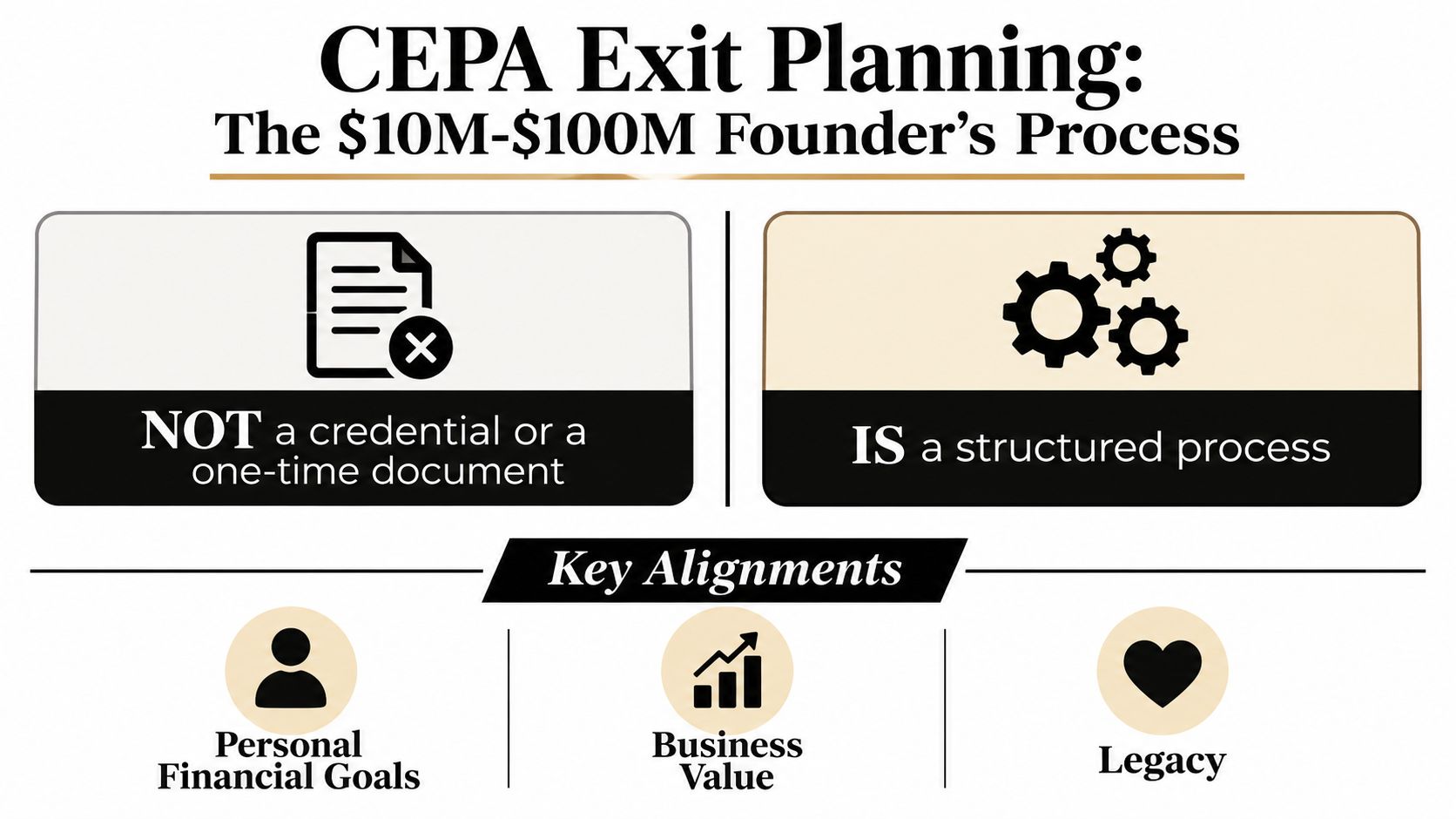
CEPA stands for Certified Exit Planning Advisor. The credential matters because it gives advisors a common framework, but the practical value of CEPA exit planning comes from the process, not the initials. The process aligns three things that founders routinely manage separately: personal financial goals, business value, and the eventual transfer event.
The urgency is easy to underestimate. The Exit Planning Institute reported growth from 180 Certified Exit Planning Advisors in 2013 to more than 5,000 in 2024, while its history page reported service to 4,000+ CEPAs and 20,000+ advisors worldwide by 2023. That expansion reflects a large owner-transition market, not a passing advisory trend. Lighthouse Consultants guides exit strategies in a way that also reinforces the central point: owners need to think about the route, not just the destination.
CEPA planning will not guarantee a buyer, eliminate taxes, or manufacture value from weak economics. It also won't replace sound legal, tax, valuation, or transaction advice. What it does is give the owner a structured way to identify risk early and make the business easier to transfer.
The operating window founders overlook
The most valuable work usually happens years before a transaction. Exit-planning guidance recommends starting at least three years before a sale or transition, and many roadmaps use a 3-10 year horizon to improve readiness before entering the market (Stonehouse Investment Management's exit roadmap). That runway gives you time to document processes, build management depth, reduce customer concentration, improve reporting, and make your personal plan realistic.
The value of a private company depends on more than a headline EBITDA figure. Buyers underwrite the durability of that EBITDA, the transferability of operations, and the risks they'll inherit after closing. Your quarterly cadence should therefore answer three questions:
- Personal: What do I want my life and liquidity to look like after the transition?
- Financial: What amount of capital, income, and risk tolerance does that outcome require?
- Business: Could the company perform if I stopped making daily decisions?
If the answer to the last question is no, you don't have an exit plan yet. You have a founder-dependent asset with a future transaction aspiration.
The Three-Readiness Model Behind Every CEPA Exit Plan
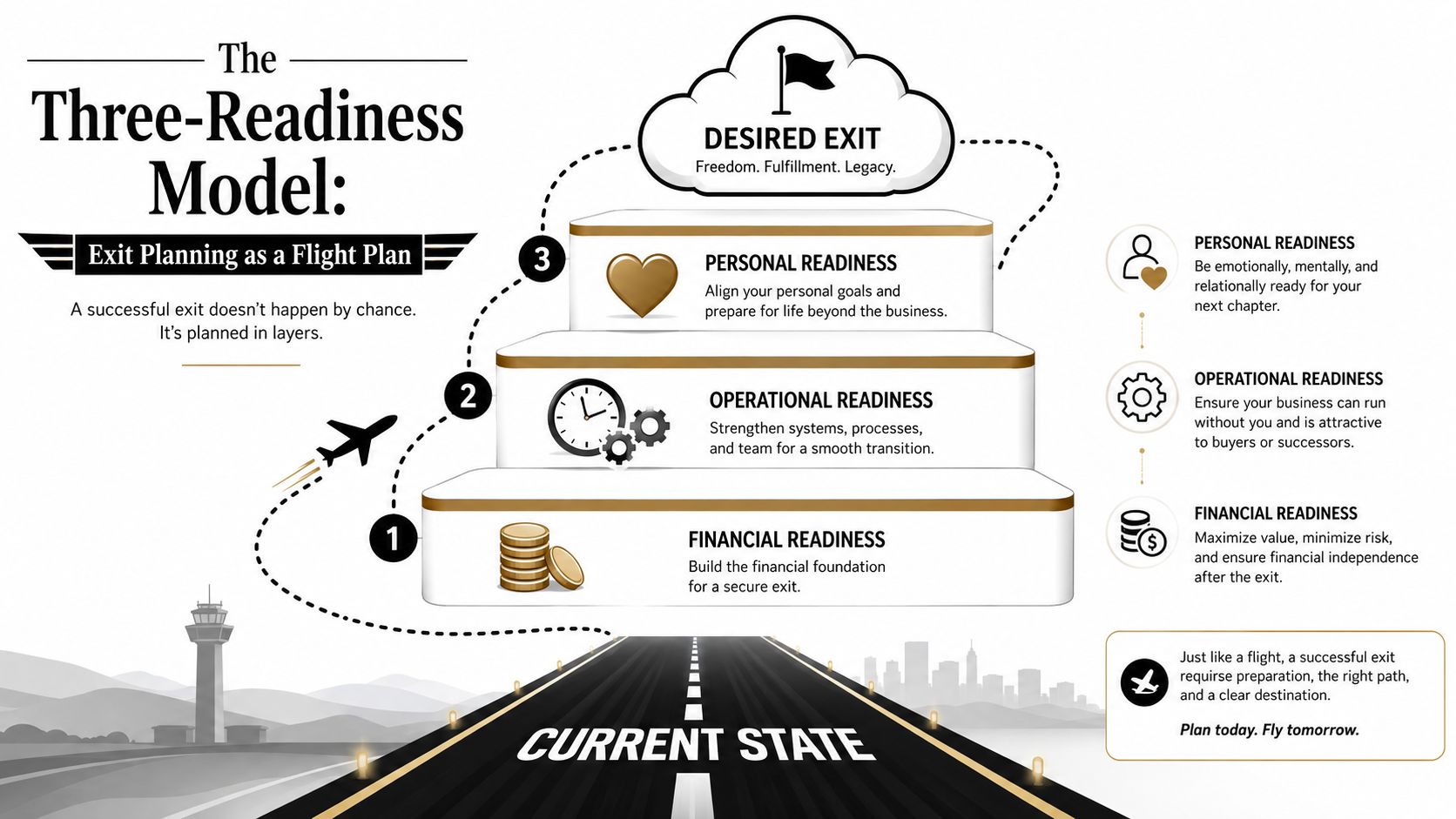
Exit planning is a flight plan, not the flight. A flight plan identifies the destination, fuel requirements, route, weather risks, and alternatives. It doesn't move the aircraft. The owner and leadership team still have to execute each operating decision that makes the destination reachable.
The same logic applies to the three-readiness model: personal, financial, and business readiness. A strong balance sheet doesn't solve a founder's lack of direction after the sale. A clear personal vision doesn't solve a company whose cash flow collapses when the owner leaves. A capable management team can still face a failed transition if the owner hasn't built enough personal liquidity or addressed ownership and tax structure.
Personal readiness
Personal readiness defines what you're exiting to, not merely what you're exiting from. It includes your desired use of time, family priorities, investment responsibilities, identity after ownership, and tolerance for ongoing involvement. A founder who says, “I want out,” but still expects to approve every major decision hasn't defined a workable transition.
Your personal financial strategy belongs here as well. You need to know how the proceeds, salary replacement, retained ownership, or installment payments fit your next chapter. Without that work, a sale price can look successful while failing to fund the life you intended.
Financial readiness
Financial readiness means the company's financial profile can withstand scrutiny. Buyers and successors need consistent revenue recognition, credible margins, defensible add-backs, useful forecasting, and reporting that explains performance without a founder translating every number.
The Exit Planning Institute's Value Acceleration Methodology connects business value, personal financial planning, and personal goals with the transition. Its CEPA program overview describes the methodology as a way to help owners build more valuable companies, strengthen personal financial plans, and align those goals with a transition.
Business readiness
Business readiness is transferability in operational form. It includes management depth, documented standard operating procedures, customer diversification, recurring or repeatable revenue, and decision rights that don't terminate at the owner's desk.
For a deeper treatment of the ownership transition itself, review this guide to succession planning for a small business. The key principle is simple: transfer risk lives in the gap between the three forms of readiness. Your plan fails at the weakest leg.
Discover, Prepare, and Decide
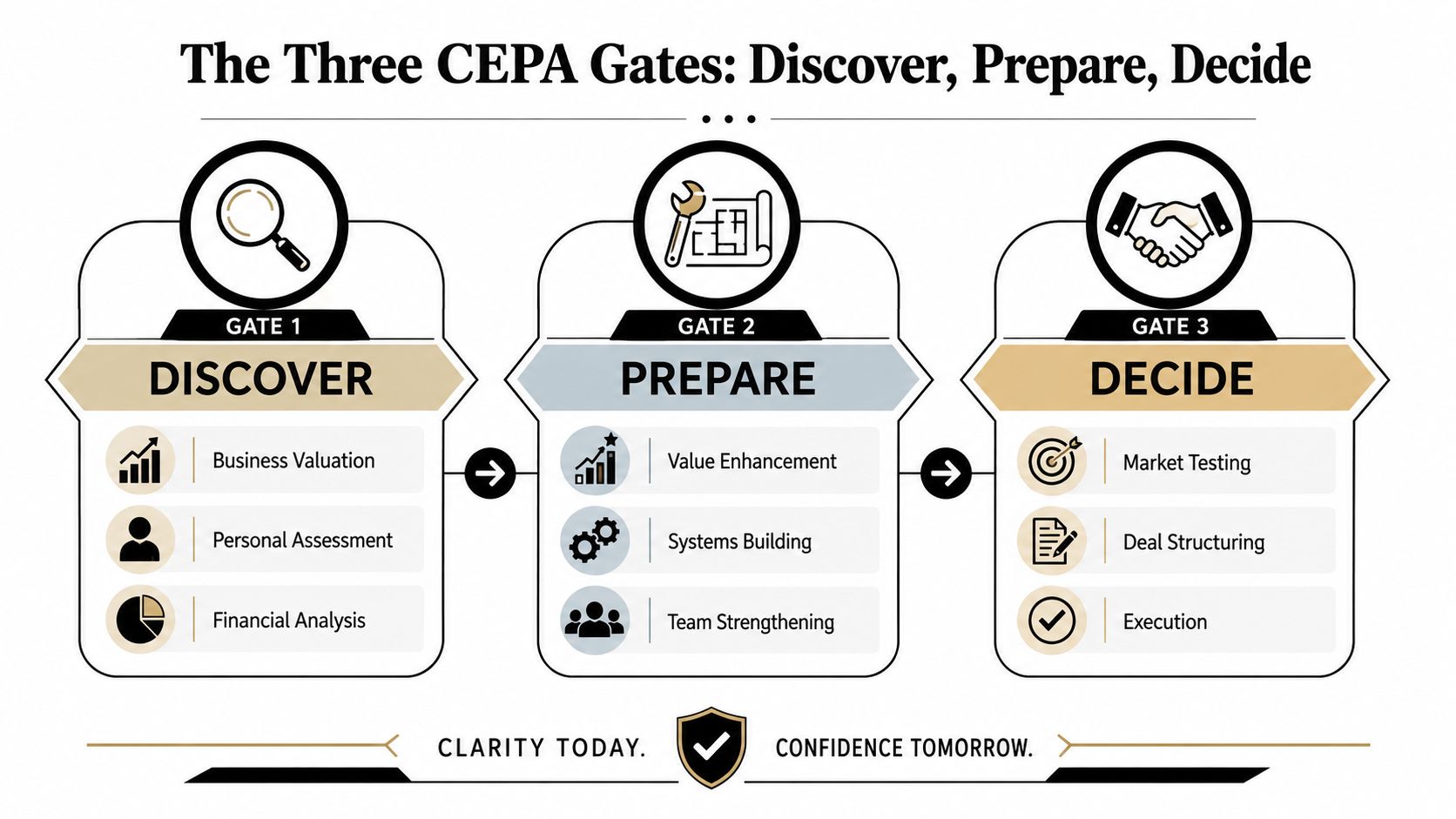
The CEPA framework uses three named gates: Discover, Prepare, and Decide. Treating them as a sequence helps, but treating them as a recurring management cadence creates the primary advantage. Each quarter, the owner should revisit the gaps, assign actions, and measure whether the company is becoming easier to transfer.
Discover asks what you actually own
Discover begins with a business valuation and parallel assessments of personal, financial, and business readiness. The deliverables should include:
- Baseline valuation: Establish the company's current value and identify the assumptions supporting it.
- Owner objectives: Write the desired timing, role after transition, liquidity needs, and legacy priorities.
- Financial diagnosis: Review revenue quality, gross margin, working capital, cash conversion, debt, and EBITDA adjustments.
- Transferability audit: Identify decisions, customer relationships, processes, and approvals that depend on the founder.
Success at Discover isn't a polished binder. It's an uncomfortable but usable gap list. If your largest customer relationship belongs exclusively to you, or your job-level margins can't be reconstructed from the general ledger, the assessment should say so.
Prepare turns gaps into 90-day work
Prepare is where most plans either become operational or die. Use focused 90-day sprints with one accountable owner, a defined deliverable, and a financial or operational measure. One sprint might redesign job-cost reporting. Another might transfer key customer relationships to a sales leader. A third might create a weekly cash forecast and a formal approval matrix.
The goal is not activity. It's evidence of improvement. A construction company should know margin by job and change-order performance. A distributor should understand customer profitability, inventory exposure, and supplier dependence. A professional-services firm should track utilization, realization, client concentration, and the depth of relationships below the founder.
Practical rule: If a preparation initiative doesn't change a decision, a KPI, or a documented process, it probably isn't preparation.
Decide selects the transition path
Decide is the point where you choose between advanced value creation and moving toward an exit event. The possible paths include a third-party sale, an internal transfer, a hybrid structure, or an ESOP-style transaction. The decision should follow the readiness work, not replace it.
A transaction advisory team can help coordinate diligence, deal structure, and execution, but the operating foundation must exist first. Transaction advisory services become more effective when the financial story is already coherent and the leadership team knows how the business runs without the founder.
Value Drivers and KPIs That Move Your Exit Multiple
Founders often ask how to maximize sale price. I'd start with a sharper question: what would make a buyer less nervous about owning this company? Buyers pay for durable earnings, understandable risk, and a business that can keep operating after the ownership change.
The fractional CFO's job is to turn those ideas into operating metrics. Recurring revenue, customer concentration, gross margin by service line or job, management depth, and clean EBITDA adjustments should appear in a dashboard that leadership reviews regularly. The financial metrics every business owner should track become exit metrics when they explain transferability, not just historical performance.
| KPI | Founder-Dependent | Transferable | Why Buyers Care |
|---|---|---|---|
| Revenue quality | Revenue relies on one-off work and personal relationships | Revenue is repeatable, recurring, or supported by durable contracts | Buyers can underwrite future revenue with greater confidence |
| Customer concentration | A few customers create material exposure | The company has diversified relationships and account ownership | Concentration can create immediate post-close risk |
| Gross margin | Management sees blended margin without job or client detail | Leaders understand margin by job, service line, or client | Buyers need to know which revenue actually produces profit |
| Owner dependence | The founder approves sales, pricing, hiring, and delivery decisions | Managers own decisions, relationships, and operating results | A buyer doesn't want to purchase the owner's job |
| EBITDA quality | Add-backs are inconsistent, personal, or weakly documented | Adjustments are supported by records and a clear reconciliation | Clean earnings reduce diligence disputes and price adjustments |
What good preparation looks like
Start by building a monthly KPI pack that ties operational drivers to reported results. Show gross margin by job or client, bridge changes in EBITDA, track recurring revenue separately from project revenue, and identify the decisions that still require founder approval.
Then document the evidence. A standard operating procedure that nobody follows has little value. A management report that reconciles to the general ledger and drives a weekly decision is far more persuasive.
Clear reporting also reduces diligence friction. When buyers can validate revenue, margins, working capital, and add-backs quickly, they have fewer reasons to demand holdbacks, earnouts, or other protections. No dashboard guarantees a higher multiple, but weak documentation gives buyers a rational reason to discount the value you claim.
The same analysis applies to internal succession. A successor needs a company whose economics are teachable, measurable, and manageable without relying on the founder's memory.
Five Mistakes That Kill CEPA Exit Plans Before They Start
Exit plans fail when owners wait for a buyer before preparing the business. The gap is widespread. A Canada-focused CFIB study found that 76% of business owners planned to exit within the next decade, yet only 9% had a formal succession plan (CFIB's succession research).
The U.S. gap is substantial too. An independent 2024 report cited by EPI found that 78% of owners still did not have a formal transition team, while approximately 80% of net worth was tied up in the business (EPI's 2023 owner-readiness resource).
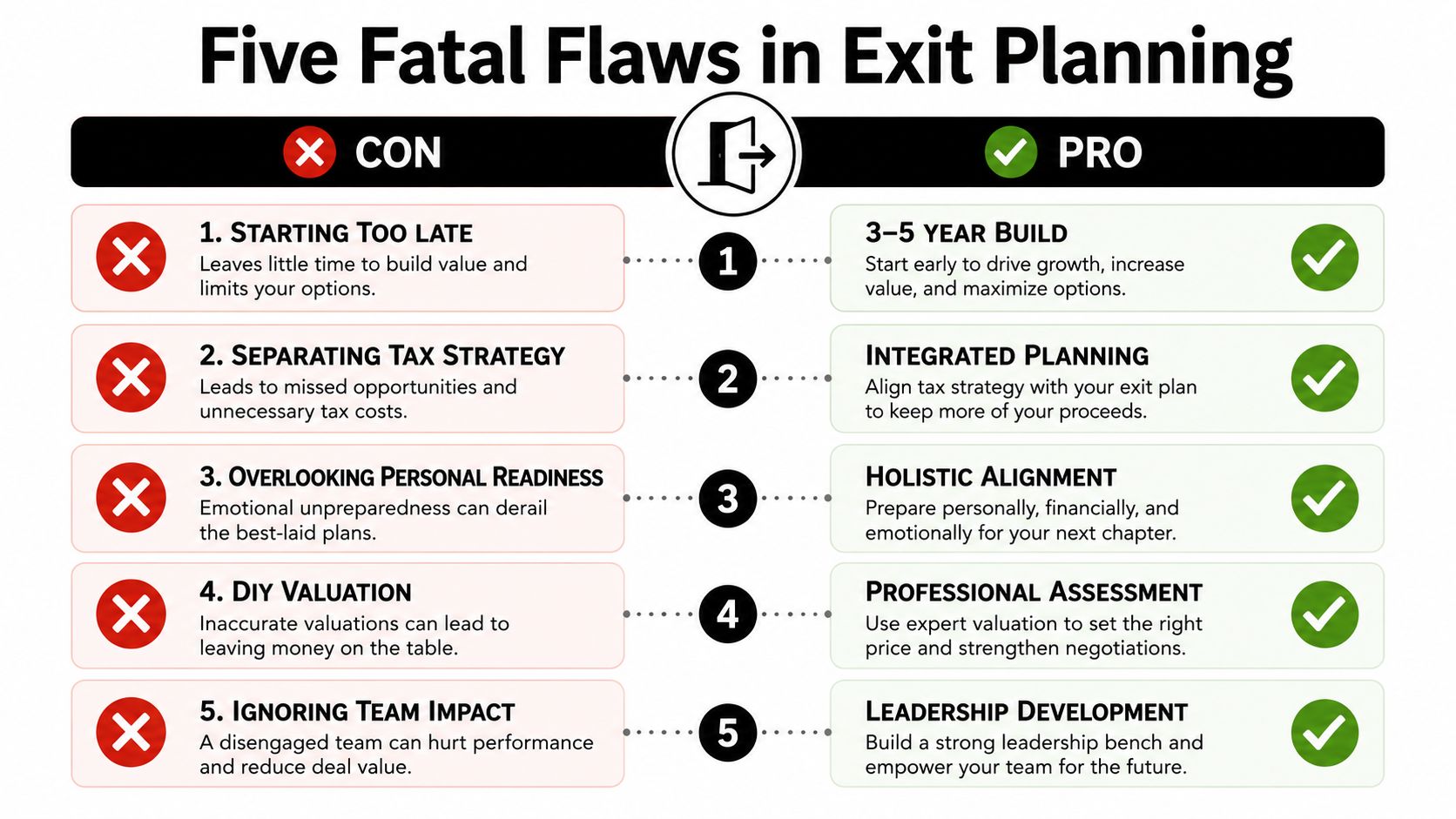
1. Starting too late
Symptom: You bring in advisors during the transaction year and discover that the owner still controls sales, pricing, hiring, and customer retention.
Root cause: You treated exit planning as a deal process rather than a value-building operating cadence.
Corrective move: Start quarterly reviews now. Establish a baseline valuation, run an owner-dependence audit, and assess financial quality within the next 90 days. The preparation guidance cited earlier recommends a 3-5 year preparation period (Brown Plus on exit-planning readiness). Track gross margin, recurring revenue, and the owner-dependence ratio each quarter, then assign an owner to every improvement.
2. Separating tax strategy from succession
Tax structure, ownership transfers, timing, and capital strategy affect one another. Isolating them can produce an efficient transaction that fails to support the intended transfer.
Corrective move: Model a third-party sale, internal transfer, and hybrid path with your tax and legal advisors before choosing a structure. Align tax planning with succession and capital strategy, beginning 2-5 years out (Wipfli on exit tax strategy).
3. Running a beauty contest too early
Calling buyers before the business is ready distracts leadership and exposes weaknesses under pressure. Market testing belongs after management depth, reporting, and process documentation can withstand diligence.
4. Ignoring owner-dependence metrics
Symptom: Everyone says the company can operate without you, yet nobody can identify who owns key decisions.
Corrective move: Measure founder approvals, founder-sourced revenue, customer relationships with no second contact, and processes without a documented owner. Reduce that dependency through delegated authority and quarterly accountability.
5. Confusing an LOI with a plan
A letter of intent sets out a proposed transaction framework. It does not replace a succession plan, personal financial strategy, or continuity plan.
Corrective move: Before signing, document transition responsibilities, working-capital expectations, earnout mechanics, retention risks, and your post-close role. Review those commitments quarterly until the transaction closes.
Your 3 to 10 Year Exit Roadmap
Your roadmap should be specific enough to paste into a planning document and review at every quarterly meeting. The dates are not promises. They're decision windows that keep preparation from becoming a last-minute project.
Years 10 through 7
Build the personal financial plan and establish a baseline valuation. At the same time, conduct an owner-dependence audit. List every approval, relationship, forecast, and process that stops when you stop.
Create a simple quarterly scorecard:
- Revenue quality and recurring revenue
- Gross margin by job, client, or service line
- Customer concentration
- EBITDA reconciliation and add-backs
- Founder approvals and relationship ownership
- Management coverage for critical functions
Years 7 through 5
Strengthen management depth and shift relationships from the founder to the company. Build KPI dashboards that connect operational activity to cash and profitability. If the company sells projects, analyze margin at the project level. If it sells services, measure client economics and delivery capacity.
This is also the stage to test whether managers can operate with defined authority. Delegation isn't a title change. It's a measurable transfer of decisions with accountability for results.
Years 5 through 3
Document core processes, expand margins where the economics justify it, and review the ownership and tax structure with the appropriate advisors. A useful long-term financial plan should connect cash generation, reinvestment, debt reduction, distributions, and the expected transition.
Run quarterly 90-day sprints. Each sprint should name the owner, baseline, target, and proof of completion. Don't allow “improve reporting” to remain an initiative. Specify the report, the reconciliation, the meeting, and the decision it supports.
Years 3 through 1
Prepare diligence-ready financials, organize the data room, activate the transition team, and confirm the selected path. Your company should be able to explain its revenue, margins, working capital, customer retention, management structure, and add-backs without relying on oral history.
A fractional CFO embedded with the owner and leadership team can support this cadence through 13-week cash flow modeling, margin analysis by job or client, financial reporting, forecasting, and KPI dashboards. AmbitionCFO offers that type of fractional CFO and CEPA-based exit-planning support for founder-led businesses preparing for transitions within a multi-year horizon.
Book a working session with a CEPA-led advisory team now. Baseline the Discover gate before the calendar turns your preferred transition into a forced decision.
Frequently Asked Questions for Owners Starting CEPA Exit Planning
How many years before an exit should I start?
Start while the exit remains optional. Formal guidance supports beginning at least three years before a sale or transition, and a 3-10 year horizon gives you time to correct weaknesses rather than defend them during diligence. Treat CEPA planning as a quarterly operating cadence, not a document prepared once before a transaction.
If you are already inside that window, act on incomplete information. Run the Discover gate, establish a baseline, and select the few operating issues that can materially improve cash flow, gross margin, recurring revenue, or your owner-dependence ratio.
Should tax and succession strategy be planned together?
Yes. Coordinate them from the start, while assigning technical work to the right advisors. Entity type, share transfers, state-level exposure, installment structures, and the intended successor can change the practical outcome.
Model the alternatives before choosing a path. A third-party sale, internal transfer, and hybrid structure each impose different requirements for ownership, financing, control, and the founder's continuing role. Your financial model should show how each option affects distributions, debt service, taxes, and personal liquidity.
Can I pursue a partial exit instead of selling 100%?
Yes. Exit planning can include partial liquidity and a staged transition. One ESOP example describes an owner selling 30 percent, continuing to run the business, and receiving note payments over time (The Owner's Shortlist on an ESOP exit).
Define what changes after the partial sale. Set governance, decision rights, valuation mechanics, payment obligations, and conditions for future liquidity in writing. The transaction should reduce founder dependence and clarify control, not preserve the same operating risk under a new ownership structure.
Which metrics show whether the company is becoming transferable?
Review the metrics that expose reliance on you each quarter: founder approvals, founder-owned customer relationships, recurring revenue, customer concentration, gross margin by job or client, management coverage, and the quality of EBITDA add-backs.
Add an owner-dependence ratio to the dashboard, based on the decisions, relationships, and revenue that still require your involvement. Test whether another executive can explain the numbers, produce the forecast, and reconcile performance without oral history. Owners seeking structured leadership routines can also explore a content strategy cohort.
AmbitionCFO provides fractional CFO support and CEPA-based exit planning for founder-led companies working on cash flow, margins, reporting, and transition readiness. A working session can establish the Discover baseline and turn the next quarter into a measurable operating plan.