
You're probably in one of two places right now. You've either started thinking seriously about selling, buying, or merging, or someone brought you an opportunity and now you're wondering whether your numbers, operations, and leadership bench will hold up under scrutiny.
That's the moment when a lot of owners make an expensive mistake. They jump straight to the deal. They hire the transaction team, open a data room, start talking valuation, and assume the rest will sort itself out. It usually doesn't. Buyers don't pay top dollar for potential they have to untangle. They pay for clarity, durability, and confidence.
If you want the best outcome, you need to separate transaction readiness from transaction execution. Those are not the same job. One builds value before the deal. The other protects and closes value during the deal. Most owners focus on the second one first. That's backwards.
Table of Contents
- Are You Ready for Your Business's Next Big Move
- What Transaction Advisory Services Really Are
- The Transaction Process Step by Step
- The Critical Mistake Most Owners Make And How to Avoid It
- How a Fractional CFO Maximizes Deal Value With Case Studies
- Your Next Step Toward a Successful Transaction
Are You Ready for Your Business's Next Big Move
A founder gets a call from a competitor. A private equity group asks for an introductory meeting. A key employee wants to buy in. A family transition suddenly becomes real. On paper, these all look like good problems. In practice, they expose every weak spot in your business at once.
The first questions usually sound simple. What is the company worth. How fast can we move. What will a buyer ask for. Will the business keep performing if I step back. Those questions aren't answered by instinct. They're answered by disciplined financial and operational work.
That's why transaction advisory services matter. They've become standard in serious deals because the stakes are too high for guesswork. This isn't a niche service anymore. Transaction advisory services were valued at USD 25 billion in 2024 and are projected to reach USD 45 billion by 2032, growing at a 9% CAGR, according to this market projection on transaction advisory services.
What this means for an owner
If the market for transaction advisory services is growing that quickly, it tells you something important. Smart buyers and sellers aren't walking into deals with loose reporting, fuzzy add-backs, and undocumented assumptions. They're using specialists because complex transactions punish unprepared operators.
Practical rule: If a deal would materially change your life, treat preparation like an operating discipline, not a last-minute project.
Here's the part most owners miss. Transaction support doesn't just help you survive due diligence. It helps you understand what a buyer will see before the buyer sees it. That gives you bargaining power. It also gives you time to fix what can still be fixed.
If you're starting to think about an exit, acquisition, or ownership transition, begin with a planning mindset instead of a deal mindset. A useful place to start is this guide on a stress-free business exit roadmap. It's the right frame before you assemble the deal team.
The real question you're trying to answer
You're not really asking, “Do I need help with a transaction?”
You're asking, “Is my business ready to command the outcome I want?”
That's the right question. The rest of this article answers it directly.
What Transaction Advisory Services Really Are
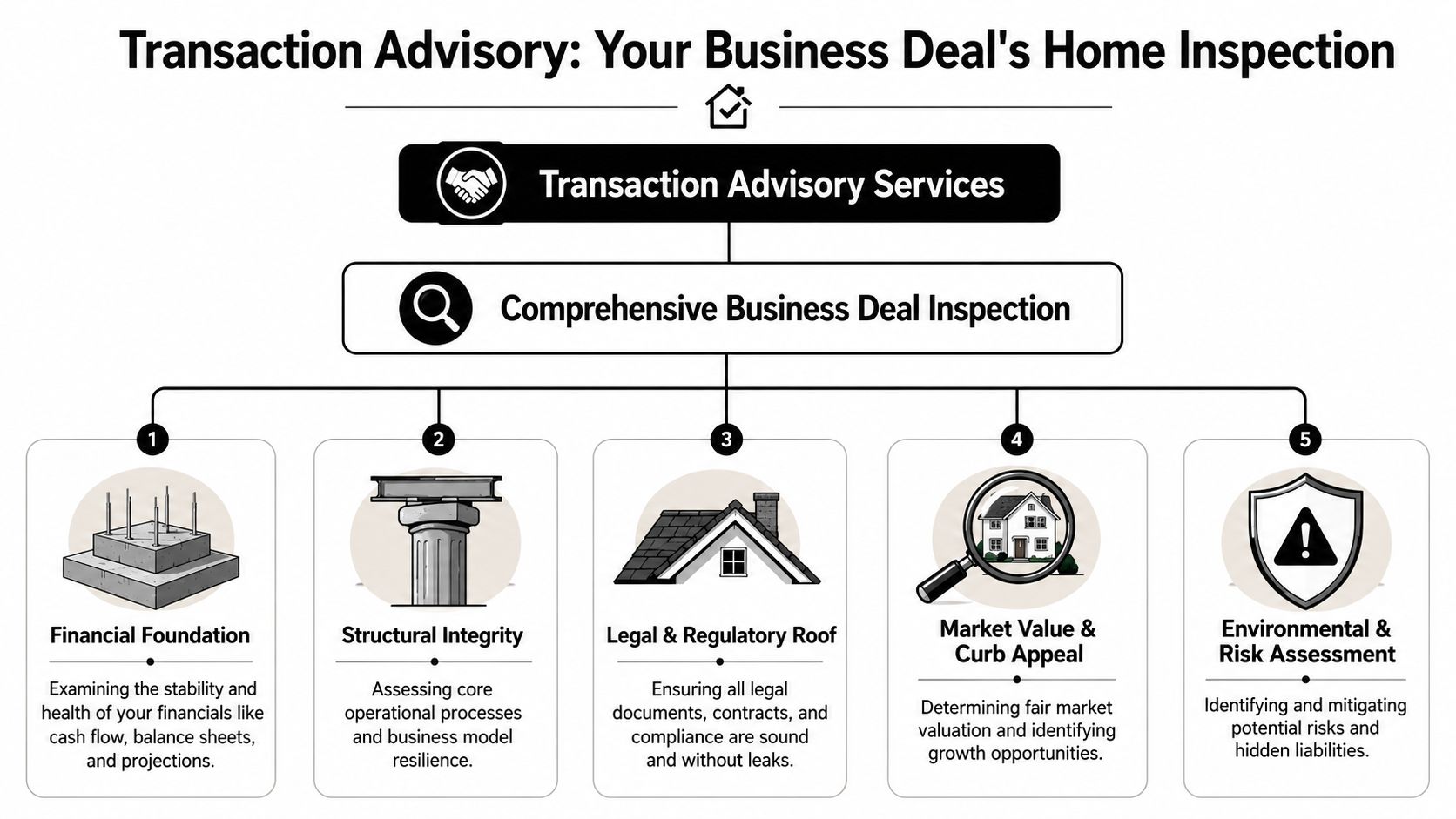
The easiest way to understand transaction advisory services is this. They're a home inspection for your business deal.
If you were buying a building, you wouldn't rely on a seller's summary and a handshake. You'd inspect the foundation, roof, wiring, drainage, permits, and any hidden defects that could turn a good-looking asset into a money pit. A business deal works the same way.
Think of it like a deal inspection
A transaction advisor examines the business behind the headline numbers. They pressure test earnings, working capital, deal structure, risks, and the mechanics that determine who gets paid what, when, and under which conditions.
That's why strong financial reporting matters long before a deal starts. If your monthly reporting package is inconsistent, late, or dependent on manual cleanup, every diligence question gets harder. Tighten that now with these financial reporting best practices for growing companies.
Here are the core parts of that inspection.
What buyers and sellers are actually paying for
Financial due diligence and Quality of Earnings
This is the foundation. Buyers want to know whether your earnings are real, repeatable, and supported by operations. Sellers should want the same answer before a buyer starts redefining the story for them.
A Quality of Earnings, or QoE, analysis strips out one-time revenue and non-recurring expenses so EBITDA reflects actual economic performance. Houlihan Lokey's description of QoE work notes that this process isolates non-recurring items and helps prevent valuation inflation by identifying EBITDA margin distortions.
That matters because owners often present adjusted earnings that make sense internally but won't survive diligence. A buyer will challenge owner perks, unusual bonuses, project timing, customer concentration effects, capitalized costs, and revenue that arrived at the perfect time for the story. If you haven't cleaned that up first, you lose credibility fast.
A clean QoE doesn't just defend value. It shortens arguments.
Valuation support
Valuation is not a spreadsheet trick. It's the disciplined translation of business quality into a defendable number.
A transaction advisor helps frame the earnings base, normalize cash flow, identify risk factors, and show what a buyer is buying. For recurring revenue businesses, that can get even more specific. Miller, Rabl & Pizzimenti's SaaS-focused transaction advisory page describes four pillars of QoE for recurring revenue companies: confirming ARR or CARR, scrubbing gross punitive churn, calculating gross margins, and understanding key SaaS metrics.
Even if you're not in SaaS, the lesson holds. Buyers don't reward vague performance. They reward metrics they can trust.
Deal and tax structuring
Many owners leave money on the table by focusing only on headline price. Price matters, but structure often decides what you keep and when you receive it.
A transaction advisor models mechanics such as purchase price allocation, tax attributes, earn-outs, asset versus stock structures, and escrow terms. DMJPS explains this transaction modeling work as a way to determine the most tax-efficient architecture for the client.
If you've never sold a company before, you need experienced help. A strong offer with weak structure can produce a disappointing result.
Post-transaction integration
This is the part that gets ignored because everyone is tired by closing. That's a mistake.
If the deal closes and operations wobble, value leaks immediately. Systems don't sync, leaders overlap, customers get nervous, and key employees start taking calls. Strong transaction advisory work includes planning for what happens after the signatures.
A good post-close plan answers practical questions:
- Who owns Day 1 decisions
- Which KPIs must stay visible
- What services continue temporarily under a TSA
- How cash, approvals, and reporting will work during transition
A deal isn't successful because documents were signed. It's successful when the business performs through the handoff.
The Transaction Process Step by Step
Most owners are uneasy about transaction advisory services because they don't know what the process will feel like. That uncertainty creates delay. It also causes rushed decisions later.
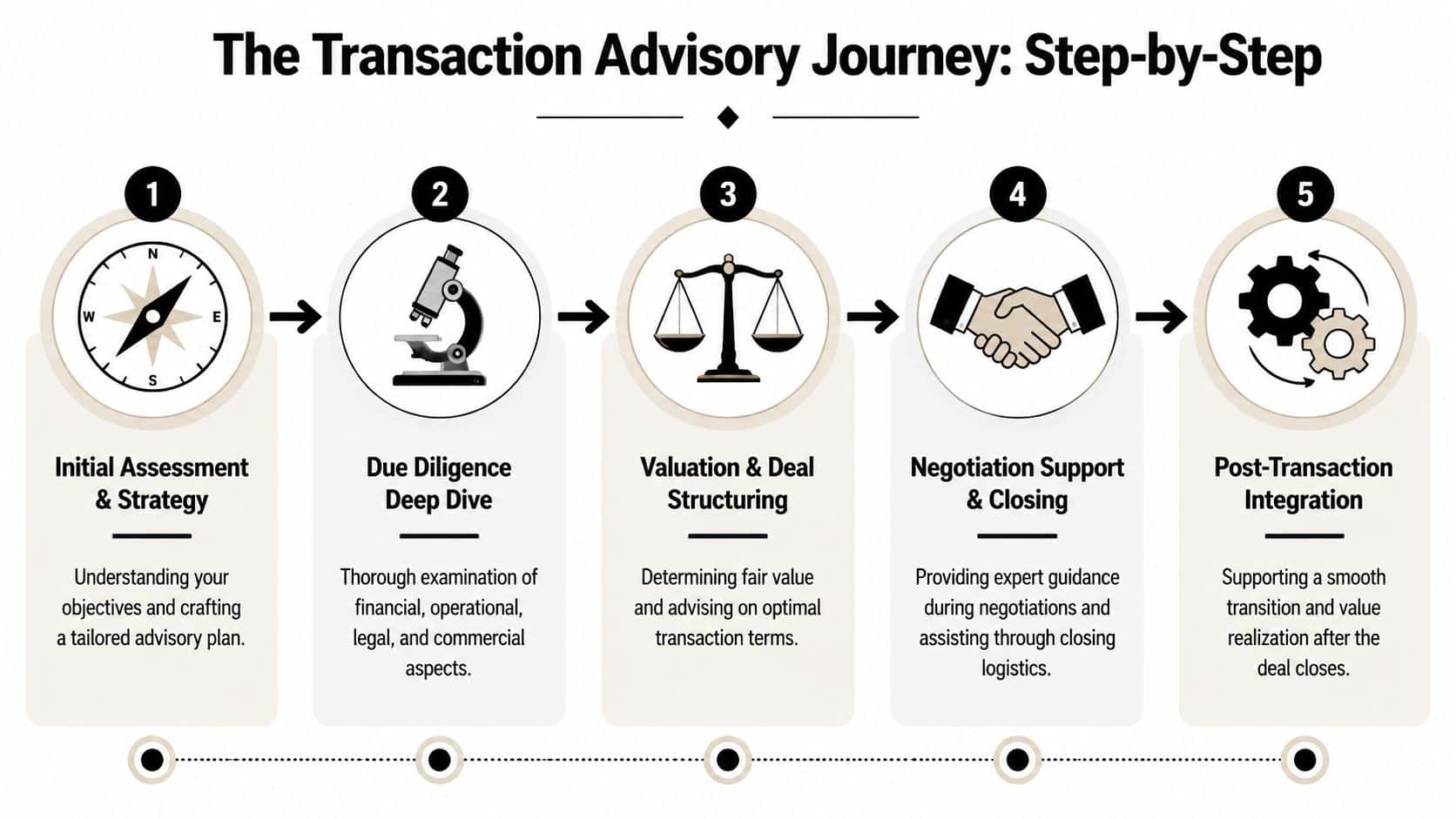
The process is usually more orderly than people expect when the business is prepared and leadership responds quickly. Here's what the engagement typically looks like.
What happens first
Engagement and scoping
The first step is defining the transaction and the objective. Are you selling a majority stake, buying a competitor, restructuring ownership, or preparing for a future exit? The answer changes the work.
At this stage, the advisor will ask for baseline materials such as financial statements, customer concentration detail, organizational structure, debt schedules, and key contracts. They're trying to understand where the likely friction points will be.
Your role is simple but important. Be direct. If customer churn is rising, say it. If margins dropped because of one contract, explain it. If a key manager is planning to leave, don't bury it.
Data gathering and diligence prep
Once scope is clear, the heavy lifting starts. This usually means a data room, document collection, and a disciplined review of financial and operational records. Buyers hate missing support. Sellers should hate it too.
If you need a practical place to start organizing diligence materials, use this M&A due diligence checklist for owners. It helps you see what experienced counterparties will want before they ask for it.
If your team can't find contracts, reconcile key balances, or explain margin swings quickly, the issue isn't diligence. The issue is readiness.
This is also where the owner learns how exposed the business is to informal processes. A controller who “just knows” how things work is not a substitute for documented reporting logic.
A short video can help if you want a visual walk-through of how the advisory journey typically unfolds.
What happens in the middle
Analysis and reporting
After the documents are in, the advisor translates raw information into findings. They'll identify trends, adjustments, red flags, and decision points. For a seller, that often means surfacing issues before a buyer weaponizes them. For a buyer, it means deciding what the target is really worth and what protections are needed.
Common outputs include:
- Normalized earnings views that distinguish recurring performance from noise.
- Working capital observations that show whether the business needs more cash than the headline suggests.
- Risk summaries covering liabilities, concentration, contract concerns, or weak controls.
- Deal structure implications that affect taxes, escrow, and payment timing.
Negotiation support
Good advisors don't just produce reports. They help you use them.
During negotiation, the findings shape the purchase agreement, purchase price adjustments, representations, indemnities, and any earn-out logic. In this phase, facts gain influence. A well-supported point can preserve value. A weakly supported point turns into concession.
What happens after closing
During post-close execution, many teams relax too early. Post-close execution decides whether value is preserved or lost.
CohnReznick's transaction advisory guidance describes a 100-Day Plan with 30-day intervals and a dedicated Integration Management Office, or IMO, focused on Day 1 readiness, value creation initiatives, and Transition Services Agreement negotiations. That structure matters because the handoff after closing is operational, not theoretical.
A practical 100-day plan should cover:
- Leadership decisions: Who owns finance, operations, customer communication, and approvals on Day 1.
- Reporting continuity: Which KPIs, dashboards, and close routines must continue without interruption.
- TSA boundaries: Which services continue temporarily, who performs them, and when they end.
- Cash discipline: How collections, payments, and working capital will be monitored during the transition.
Closing is a legal event. Integration is a management event.
If you're the seller and staying on for a transition period, this part deserves more attention than it usually gets. It's where reputations are protected and surprises are contained.
The Critical Mistake Most Owners Make And How to Avoid It
Most owners think transaction advisory services should be their first call when an exit is on the horizon. I disagree.
If your business isn't prepared, hiring execution-focused deal advisors too early can be a waste of time and money. You end up paying for diligence, valuation conversations, and market outreach before the business is positioned to support the story you want to tell.
Readiness comes before execution
There are two distinct phases in a successful transaction.
Transaction readiness is the work that makes the business more valuable before it goes to market. That includes cash flow visibility, margin improvement, KPI discipline, cleaner reporting, and a management structure that doesn't revolve around the owner.
Transaction execution is the work that gets the deal done once the business is ready. That includes diligence, structure, negotiation support, and closing mechanics.
Owners confuse these all the time. The result is predictable. They hire for execution when they still need readiness.
The data backs that up. A 2024 Deloitte middle-market survey found that 62% of business owners planning exits within 5 years hire transaction advisors too early, sacrificing the 2 to 3 years of financial modeling needed to boost valuation, according to this discussion of the readiness gap in middle-market transactions.
That's the central mistake. You don't improve value by showing up to the deal earlier. You improve value by building a better business before the deal starts.
A practical comparison
| Attribute | Fractional CFO (Readiness) | Transaction Advisor (Execution) |
|---|---|---|
| Primary goal | Build value before a deal | Protect and complete value during a deal |
| Time horizon | Typically long-range and operational | Deal-timed and transaction specific |
| Core work | Cash flow modeling, KPI dashboards, margin analysis, financial reporting, forecasting, exit planning | Diligence, deal structuring, negotiation support, transaction analysis |
| Main question answered | How do we become more valuable and easier to buy | How do we close this transaction on favorable terms |
| Best time to engage | Years before a transaction or when strategic options start forming | When a transaction is active or imminent |
| Typical owner mistake | Waiting too long to install discipline | Hiring too early before the business is ready |
| Output | Better economics, cleaner reporting, less dependency on the owner | Better process control, fewer surprises, stronger deal mechanics |
What to do instead
If your likely transaction is still ahead of you, treat the next stretch as an operating improvement window. Focus on the items buyers always test, even if they ask for them in different language.
Start here:
- Build a 13-week cash flow model: Owners often know their profit but not their cash timing. Buyers care about both.
- Get margin visibility by job, product line, or client: If you can't explain where profit really comes from, a buyer will apply a discount in their head long before they say it out loud.
- Clean up monthly reporting: Close consistently. Reconcile key accounts. Standardize KPI definitions.
- Reduce owner dependence: Buyers pay more for businesses that can perform without heroic founder intervention.
- Create a forward view: Budgeting and forecasting matter because buyers are purchasing future cash generation, not your nostalgia about last year.
This isn't glamorous work. It is the work that changes outcomes.
Owners don't lose value only because buyers negotiate hard. They lose value because the business isn't ready to defend itself.
A transaction advisor is critical when the deal is live. But if you engage them before you've built reporting discipline, profit clarity, and cash confidence, you're asking the wrong specialist to solve the wrong problem.
How a Fractional CFO Maximizes Deal Value With Case Studies
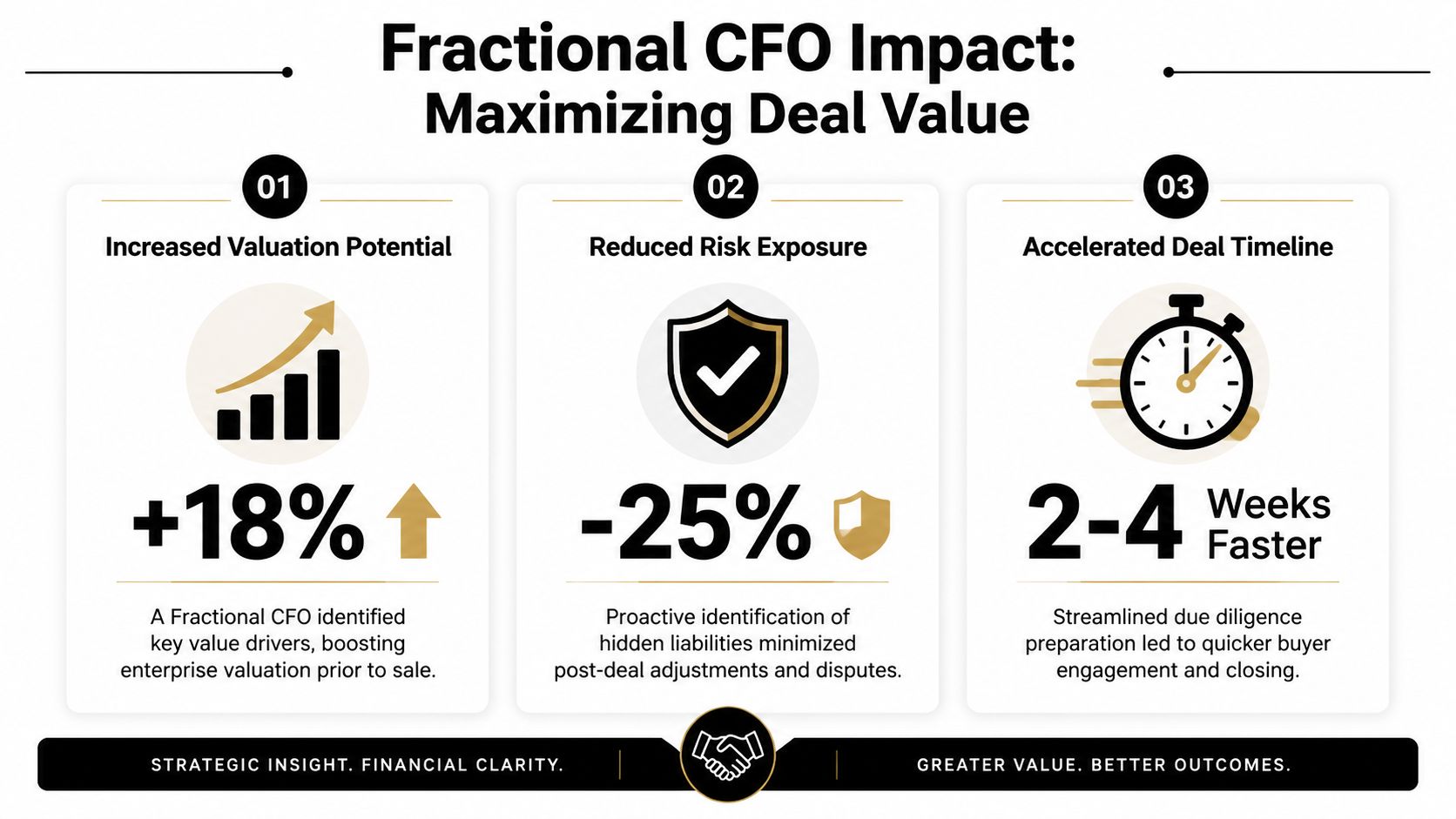
The readiness work gets dismissed because it's less visible than a signed LOI. That's shortsighted. Buyers may talk about strategic fit, but they still underwrite cash flow, risk, and execution. A fractional CFO addresses those before the market does.
The post-close reality makes this even more important. A 2025 McKinsey report on M&A outcomes found that 70% of middle-market deals fail to realize projected value within 18 months due to poor integration, as cited in this discussion on the post-transaction gap for middle-market sellers. That should change how owners prepare. Maximizing value isn't just about sale price. It's also about protecting continuity after closing.
For a broader view of where a fractional CFO fits in that process, this overview of the role of fractional CFOs in business mergers and acquisitions is worth reading.
Construction company with weak job margin visibility
A construction owner says the company is profitable, but every explanation depends on adjusted statements and instinct. Some jobs are strong. Some aren't. Change orders are tracked inconsistently. Work in progress reporting is technically there, but management doesn't trust it enough to use it for decisions.
A fractional CFO starts by tightening job costing, standardizing margin reporting by project, and aligning backlog review with cash forecasting. That work doesn't create a transaction by itself. It creates a business that can explain its earnings without hand waving.
The practical outcome is straightforward. When a buyer asks why margins move from quarter to quarter, management can answer with contract mix, timing, labor performance, and collections detail. The buyer spends less time doubting the numbers and more time evaluating the business.
Distribution company with working capital problems
This company looked healthy on the income statement but was constantly tight on cash. Inventory planning lagged reality. Receivables aged unpredictably. Vendor payments were often timed by urgency instead of a forecast. In a transaction, those issues usually surface as working capital disputes, purchase price pressure, or both.
The fractional CFO builds a 13-week cash flow model, ties it to receivables and payables behavior, and highlights where inventory decisions are absorbing cash without enough return. Management finally sees the gap between accounting profit and operating liquidity.
That matters because buyers don't just buy EBITDA. They buy the cash conversion behind it. If your business needs more cash than expected to sustain operations, the buyer will factor that into the deal structure, closing adjustments, or transition requirements.
Good readiness work turns “Why is cash always tight?” into a management answer instead of a buyer concern.
Professional services firm with owner dependent economics
Professional services companies often look attractive until the buyer realizes the owner drives rainmaking, client retention, hiring decisions, and delivery escalation. The firm may be profitable, but it's not yet transferable.
A fractional CFO helps leadership unpack the economics by client, partner, service line, and utilization pattern. Then management can separate firm value from owner heroics. Maybe the issue is pricing inconsistency. Maybe client profitability is weaker than the top line suggests. Maybe too much knowledge sits with one person.
The deal benefit comes from making the business more institutional. Better dashboards, clearer accountability, stronger forecasting, and defined performance measures make the firm easier to underwrite and easier to integrate.
What these examples have in common
None of these businesses needed a pitch deck first. They needed clarity.
That's the difference between readiness and execution in real life:
- Readiness fixes weak visibility before diligence starts
- Readiness gives management better answers under pressure
- Readiness reduces surprises that damage trust
- Readiness supports smoother transition after close
Transaction advisory services are still essential. But their best work happens when the underlying business has already been prepared to stand up to scrutiny.
Your Next Step Toward a Successful Transaction
You don't need to guess what kind of help you need next. You can diagnose it quickly if you ask the right questions.
If your business is considering a sale, acquisition, recapitalization, or succession move, the decision isn't “Should I get advice?” It's “Which kind of advice fits the phase I'm in?”
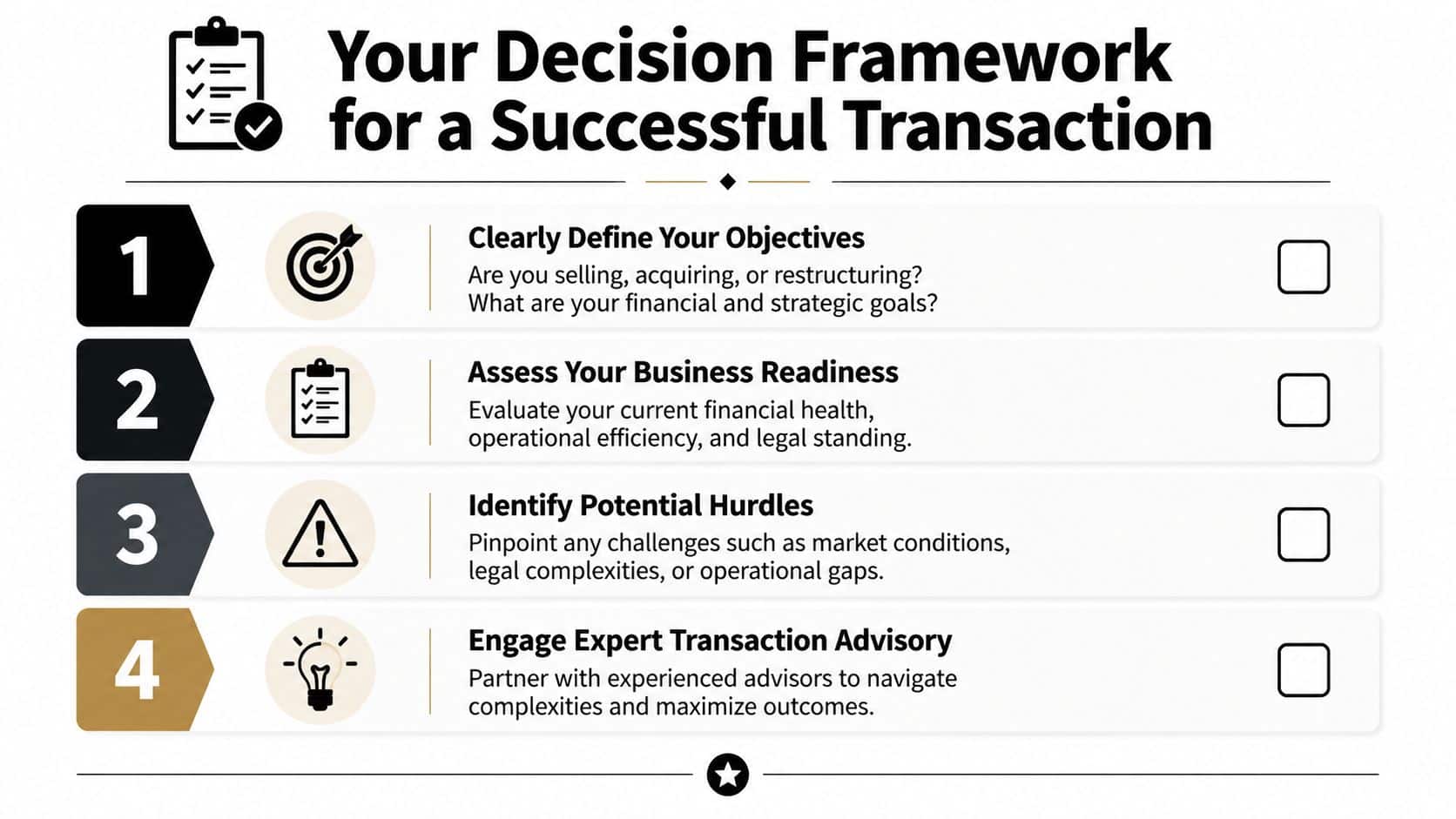
Use this decision framework
Ask yourself these four questions.
What is the event I'm planning for
Is this a likely exit, a tuck-in acquisition, a partner buyout, or a family transition? If the event is still years away, you are almost certainly in a readiness phase.
Can I explain my earnings clearly
If revenue quality, margins, add-backs, or working capital drivers still require a long verbal explanation, you need readiness work before execution support.
Can my team run the business without me in the middle of everything
If major customer relationships, approvals, pricing, or hiring still run through the owner, buyers will see key-person risk.
Are my reporting and forecasts decision-grade
If management doesn't trust the numbers enough to run the company with them, a buyer won't trust them enough to underwrite a premium outcome.
Choose the right advisor for the phase you are in
Use this simple test.
You likely need readiness support first if:
- Your exit is on a multi-year horizon
- Cash flow is still reactive
- Margins by job, line, or client aren't obvious
- Monthly reporting takes too long or changes after the fact
- You want to improve value before going to market
You likely need transaction execution support now if:
- There is an active buyer or target
- You're assembling diligence materials for a live process
- LOI terms, structure, or working capital mechanics are being negotiated
- You need support through closing and post-close handoff
If you're trying to estimate the business impact of stronger finance leadership before a transaction, this guide on fractional CFO ROI for growing companies will help you think through the decision.
The right advisor at the wrong time is still the wrong advisor.
A simple owner worksheet
Use this quick worksheet with your leadership team.
| Question | Yes | No | Action if No |
|---|---|---|---|
| Do we have monthly financials we trust? | Tighten reporting and close process | ||
| Do we know which customers, jobs, or service lines drive profit? | Build margin reporting | ||
| Do we have a rolling cash flow forecast? | Implement a 13-week cash model | ||
| Can we explain unusual revenue or expense items cleanly? | Prepare normalization support | ||
| Can the business perform if the owner steps back? | Strengthen team structure and accountability | ||
| Are we preparing for a live transaction right now? | If yes, add execution support |
If you check “No” on several readiness items, don't rush into a deal process. Fix the business first. That is often the fastest route to a better outcome because it reduces friction before the market starts asking hard questions.
Strong transactions don't start with paperwork. They start with a business that knows its numbers, understands its cash, and can defend its story.
If you're planning a transition in the next 3 to 10 years and want to improve value before you enter a deal process, talk with AmbitionCFO. The firm works with founder-led businesses in construction, distribution, and professional services to strengthen cash flow, reporting, forecasting, profitability, and exit readiness so owners go into major decisions prepared instead of exposed.