

You're probably asking a blunt question right now: what is the value of my private company if I had to defend it to a buyer today?
Most owners answer that question with a rough multiple, a gut feel, or whatever their CPA mentioned over coffee. That's not enough. A buyer doesn't pay for effort, longevity, or founder optimism. A buyer pays for transferable cash flow, clean reporting, and governance that lowers risk.
I see the same pattern over and over. A founder has built a solid company, revenues are meaningful, and profits look decent. Then diligence starts. The buyer finds founder-dependent sales, sloppy add-backs, undocumented processes, transfer restrictions, and financials that can't survive scrutiny. The headline value drops fast.
If you want a better outcome, stop treating valuation like a one-time math exercise. The value of a private company is shaped by financial performance, yes, but also by structure, control, marketability, and how easy the business is to run without you. If you need a primer on smaller-company sale prep, this guide on how to value a small business for sale is a useful companion.
Table of Contents
- Introduction to Private Company Valuation
- Understanding Key Valuation Concepts
- Exploring Valuation Approaches
- Adjusting Earnings with Add-Backs
- Accounting for Discounts
- Benchmarking Multiples by Industry and Size
- Worked Valuation Examples
- Common Mistakes and Next Steps for Owners
Introduction to Private Company Valuation
A founder in the middle market usually reaches valuation mode for one of three reasons. They want to sell. They want to bring in a minority investor. Or they're making a major decision and realize they don't know what the business is worth.
That uncertainty matters more than most owners realize. Private companies aren't fringe assets. The total enterprise value of private business wealth in the United States reached $14.1 trillion in 2018, nearly double the $7.0 trillion estimated by official reports, highlighting that private companies are the dominant form of U.S. corporate capital according to this research summary on private business wealth in the U.S..
The issue isn't whether your company has value. It does. The issue is whether that value is visible, defensible, and transferable.
Practical rule: If a buyer has to “figure out” your business during diligence, they'll price in risk and pay less.
Owners who get strong outcomes usually know four things before they go to market:
- Their normalized earnings
- Which valuation method a buyer is likely to use
- Which discounts will hit the deal
- Which governance fixes can raise value before the process starts
That's where CFO-level discipline changes the result.
Understanding Key Valuation Concepts
What buyers mean by value
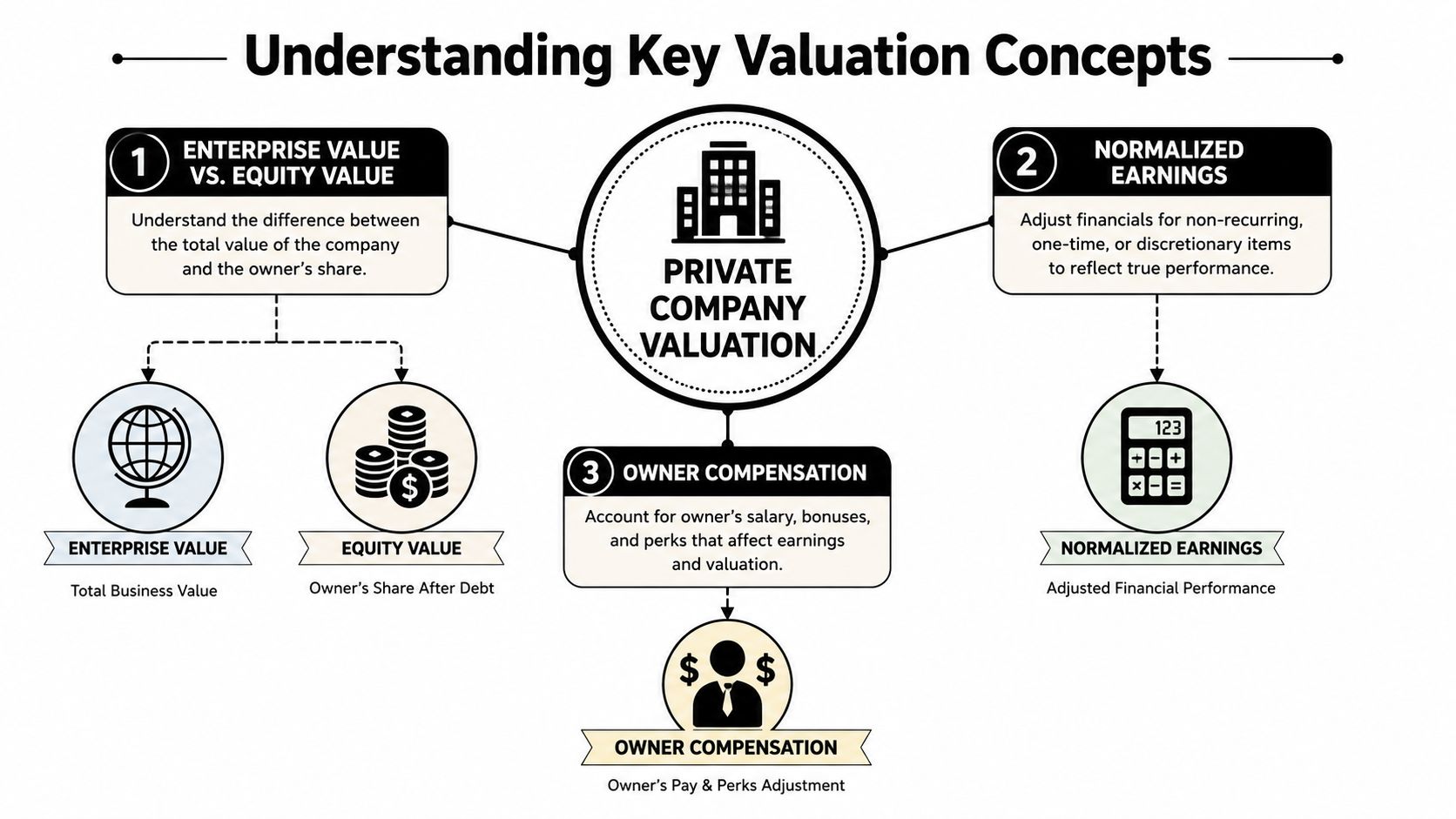
Most owners use “company value” as if it means one thing. It doesn't.
Enterprise value is the value of the operating business. Think of it as the price tag on the machine itself.
Equity value is what the owner keeps after debt and debt-like items are dealt with. Think of it as what's left in your pocket after the business obligations are settled.
That distinction matters because buyers often negotiate off enterprise value, then adjust the final proceeds based on debt, working capital, and other balance sheet items.
A second term owners need to understand is marketability. Public shares can be sold quickly. Private shares usually can't. That lack of liquidity changes price. It also explains why a private company can't just borrow a public-company multiple and call it a day.
The earnings number has to be cleaned up
The next concept is normalized earnings. That means restating financial performance so a buyer sees the recurring earning power of the business, not the noise created by owner behavior or one-time events.
That usually includes reviewing:
- Owner compensation that sits above or below market
- Personal or discretionary expenses run through the company
- One-time legal or consulting costs that won't recur
- Non-operating items that don't belong in the core business
If the buyer is looking at a smaller owner-operated company, they may focus on Seller's Discretionary Earnings (SDE). If they're looking at a more established middle-market company, they'll usually care more about EBITDA, which means earnings before interest, taxes, depreciation, and amortization.
Buyers don't pay for reported earnings. They pay for believable earnings.
There's also a control issue. A controlling interest usually has more value than a minority stake because control changes decision rights, distributions, and exit timing. If you're selling less than full control, value can shift materially even if the business hasn't changed.
A simple way to think about the framework is this:
| Concept | What it answers |
|---|---|
| Enterprise value | What is the business worth as an operating asset? |
| Equity value | What does the owner actually receive after obligations? |
| Normalized earnings | What does the business really earn on a recurring basis? |
| Marketability and control | How easy is the ownership interest to sell, and what rights come with it? |
If you miss any one of those, your number will be wrong.
Exploring Valuation Approaches
DCF works when forecasts deserve trust
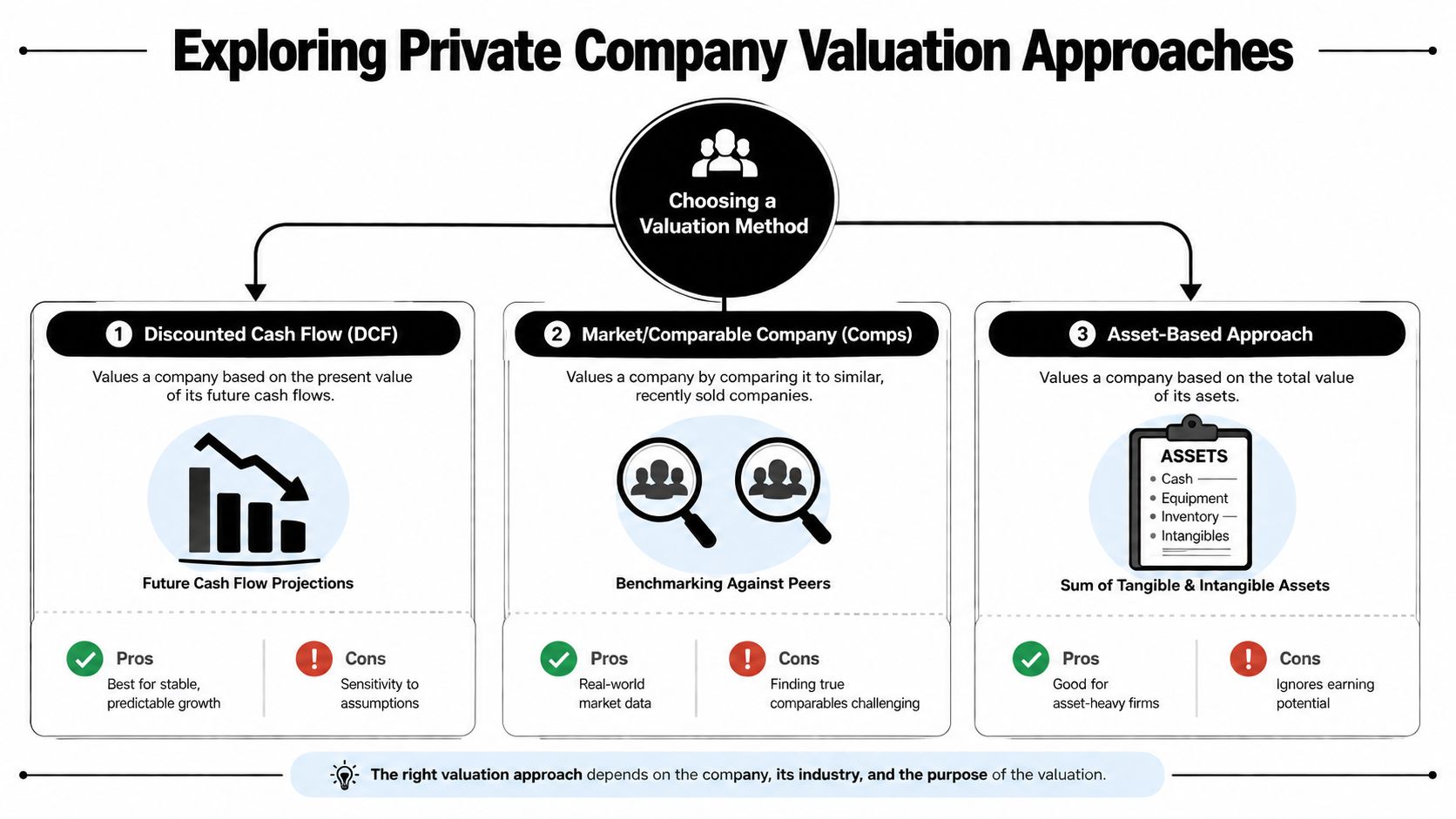
A Discounted Cash Flow, or DCF, values the business based on expected future cash flows discounted back to present value. The discount rate is typically Weighted Average Cost of Capital (WACC), and terminal value is often calculated using the perpetuity growth formula described in this private company valuation overview.
DCF can be useful when your company has predictable cash generation, strong forecasting discipline, and a clear view of the next several years. It's especially helpful when recent transactions don't offer good comps.
But don't romanticize DCF. It's only as good as the forecast. If your budget is a wish list, the DCF is fiction.
Market comps are what most owners actually face
For many founder-led companies, especially in the lower middle market, buyers lean hard on market evidence. For private companies in the $3M–$50M enterprise value range, the market approach using EBITDA multiples from comparable transactions is the most commonly applied valuation method, reflecting actual buyer-paid prices according to this summary of private company valuation methods.
That's why comparable transaction work matters more than most owners think. You need to know what businesses like yours sold for, how the earnings were defined, and what made the buyer comfortable paying that price.
If you're preparing for a process and need support around buyer readiness, diligence prep, and deal-side finance coordination, transaction advisory services can help frame the work even if formal valuation is handled by a separate specialist.
Asset-based value matters in specific situations
The asset-based approach values the company based on its assets minus liabilities. It's not the first tool I'd reach for in a healthy, cash-generating operating company. It becomes more relevant in capital-intensive businesses, companies with weak earnings, or situations where the assets themselves drive buyer interest.
Here's the side-by-side view that matters:
| Method | Best use | Main inputs | Weak spot |
|---|---|---|---|
| DCF | Stable, forecastable businesses | Cash flow projections, WACC, terminal assumptions | Very sensitive to assumptions |
| Market comps | Companies with usable comparable deals | EBITDA, transaction multiples, peer set | True comparables can be hard to find |
| Asset-based | Asset-heavy or underperforming businesses | Asset values, liabilities | Can ignore earning power |
A disciplined CFO doesn't ask, “Which method gives me the highest number?”
A disciplined CFO asks, “Which method will a serious buyer believe?”
Adjusting Earnings with Add-Backs
Owners love add-backs until they have to defend them. Then the problem shows up fast.
An add-back is not a creative storytelling tool. It's an adjustment that removes expenses that are non-recurring, non-operating, or clearly discretionary so the buyer can see the business's true earnings power. If you overreach, you lose credibility.
What counts as a real add-back
Reasonable add-backs often include:
- One-time legal expense tied to a specific event that won't repeat
- Owner perks that a market-rate operator wouldn't continue
- Personal expenses incorrectly run through the business
- Non-recurring consulting or cleanup costs with clear support
Weak add-backs usually have one of two problems. They recur more often than the owner admits, or they're really just normal operating costs.
If you can't document an add-back with a ledger trail, invoice support, and a plain-English explanation, don't expect a buyer to accept it.
A simple normalization workflow
Use this process:
- Start with reported EBITDA: Pull the trailing earnings from clean financial statements.
- Review owner compensation: Separate market pay from excess compensation or unusual benefits.
- Strip out one-time items: Legal disputes, isolated projects, or unusual costs may qualify.
- Remove non-business spending: Personal items should come out if they are clearly discretionary.
- Build a support file: Every adjustment should have a source document and short rationale.
Here's the important part. Once you've cleaned up earnings, value moves directly with that earnings figure. For private companies with consistent earnings, applying an 8x EV/EBITDA multiple to $5 million in EBITDA yields an enterprise value of $40 million, as illustrated in this private company valuation example.
That's why sloppy reporting is expensive. A buyer doesn't just haircut one bad expense classification. They question the whole earnings base.
A practical owner checklist helps:
| Review item | What to verify |
|---|---|
| Compensation | Is owner pay adjusted to a market-based level? |
| Legal and consulting | Was the spend truly one-time? |
| Personal spending | Is there a clear non-business element? |
| Documentation | Can every adjustment be tied to records? |
If your close process is messy, fix that before you talk valuation. These financial reporting best practices are a good place to tighten the basics.
Accounting for Discounts
Many owners often get blindsided. They see a public-company multiple and assume their private business should command something similar. It won't.
Illiquidity is only the starting point
When valuing private companies against public peers, analysts apply a liquidity discount of 25% to 35%, meaning a 12x public EV/EBITDA multiple becomes about 8.4x for a private firm after adjusting for illiquidity, based on this valuation methodology explanation.
That single adjustment is enough to reset expectations. But illiquidity isn't the whole story.
Governance and shareholder rights also matter. Professor Damodaran's valuation slides show that private companies with open external shareholder structures are valued 6.5% higher than closed ones, removing strict transfer restrictions increases share value by about 5%, built-in exit options can create a 10% valuation uplift, and controlling interests have an 8% lower discount compared with non-controlling shares.
That means structure affects value. A lot.
What owners should change before a deal
If you want a higher value of a private company, stop acting like discounts are fixed laws of nature. Some are self-inflicted.
Focus on these moves:
- Review transfer restrictions: Overly tight restrictions can reduce perceived share value.
- Clarify exit mechanics: Buy-sell language and practical exit paths matter.
- Separate control from confusion: If voting rights are murky, buyers and minority investors get cautious.
- Reduce key person risk: If all major decisions route through you, discount pressure rises.
Here's the mistake I see most. Owners negotiate price before they fix structure. That's backwards. Governance changes are usually cheaper than trying to claw back value in the final round of negotiations.
Benchmarking Multiples by Industry and Size
Owners always ask for a “normal multiple” for their industry. That's the wrong question. There isn't one clean market number waiting for you. There's only a defensible range based on the right comp set.
How to build a usable comp set
Start with businesses that match you on the factors buyers care about:
- Business model: Construction, distribution, and professional services don't trade the same way.
- Earnings quality: Recurring revenue, job margin consistency, and customer concentration all matter.
- Company size: Smaller firms usually face different buyer pools than larger ones.
- Transferability: A business that runs on systems is worth more than a business that runs on the founder.
For middle-market owners, comparable transaction work is usually more useful than broad public-company screens. That's because private deal data reflects what buyers paid for businesses with similar scale, control, and liquidity profile.
If you want sharper internal benchmarking before any sale conversation, these financial metrics every business owner should track will help you compare your operating profile against what buyers typically scrutinize.
A practical benchmarking table
Use ranges as a starting point, not a verdict.
| Industry | EV/EBITDA Multiple Range |
|---|---|
| Construction | Varies by backlog quality, project mix, margin consistency, and management depth |
| Distribution | Varies by customer concentration, inventory discipline, gross margin stability, and supplier risk |
| Professional services | Varies by founder dependence, recurring client work, utilization, and leadership bench |
That table is deliberately qualitative because broad ranges without a verified comp set are usually misleading. The useful exercise is not guessing a market multiple. It's identifying what would move you toward the high end of your likely range.
A comp set is only useful if a buyer would agree that the companies belong in the same conversation.
Worked Valuation Examples
The fastest way to understand valuation is to walk through the mechanics with simple examples and then ask where the risk sits.
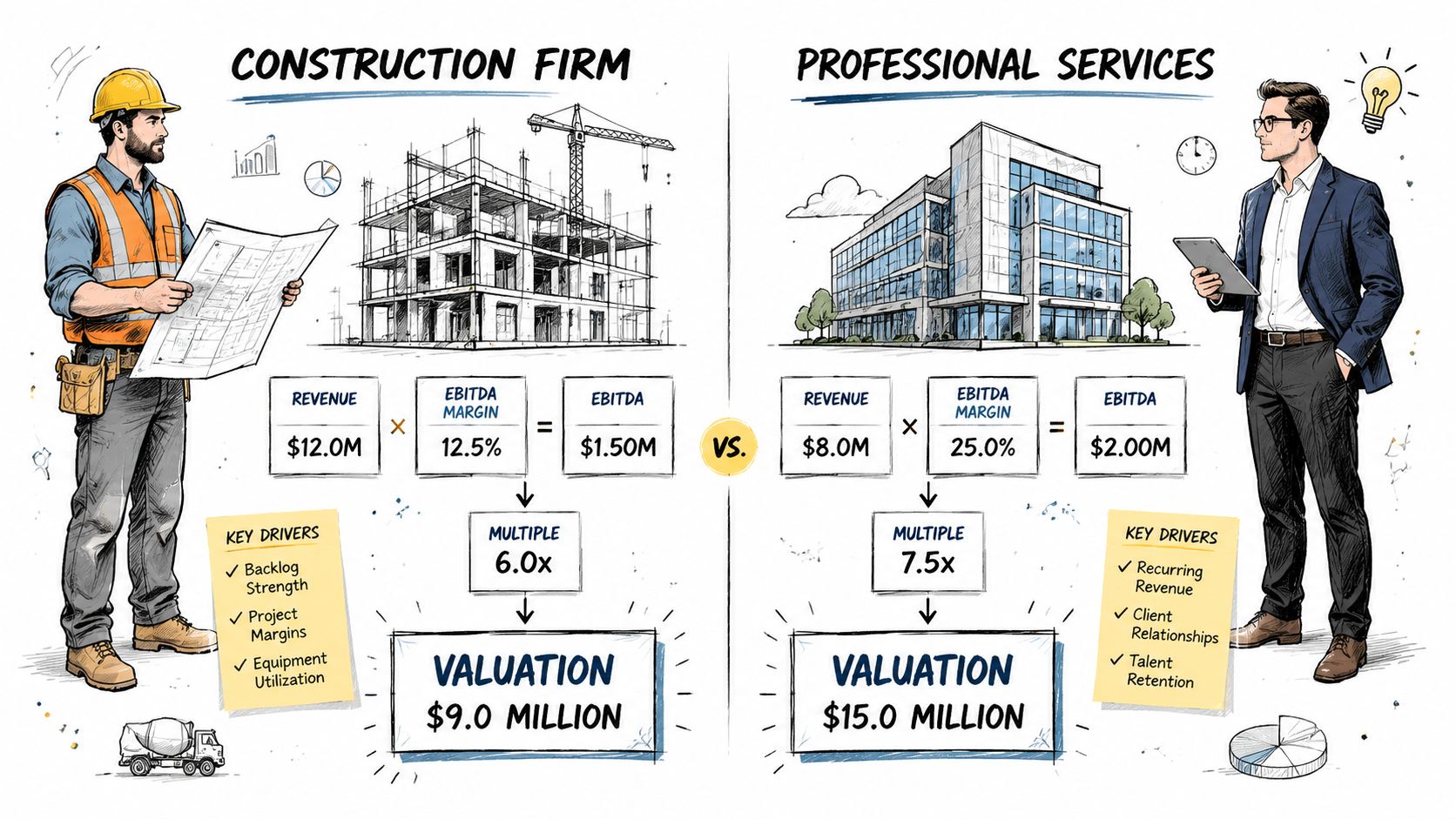
Construction firm example
Assume a founder-led construction company with $10M in revenue. We'll keep the valuation mechanics qualitative because the verified data set doesn't provide a transaction-specific multiple for this exact scenario.
Start with reported EBITDA. Then review the P&L for owner compensation issues, personal spending, and one-time costs. In a construction business, I'd also test whether equipment-related costs, project overruns, or unusual owner travel are operational in nature or really cleanup items.
If the financials show stable normalized EBITDA, a buyer will usually anchor on a market approach using transaction comps. Then the buyer asks harder questions:
- Does the company depend on the founder for estimating or client relationships?
- Is there a second layer of management?
- Are job margins tracked credibly by project?
- Can the buyer trust backlog quality?
If the answer to those questions is weak, the multiple pressure starts. Even if historical profits look fine, the buyer may underwrite future earnings more conservatively because transferability is weak.
Professional services firm example
Now take a professional services company with $100M in revenue. At this size, buyers still care about normalized EBITDA, but they also care about client concentration, rainmaker risk, utilization, and leadership depth.
A market approach may still be relevant, but a DCF becomes more credible if the company has strong forecasting discipline and repeatable cash generation. In services, that credibility depends on whether revenue sits with the founder or with institutional relationships.
Here's the core contrast:
| Issue | Construction firm | Professional services firm |
|---|---|---|
| Primary diligence risk | Project execution and backlog quality | Founder-held relationships and team retention |
| Normalization focus | Owner perks, one-offs, project cost clarity | Compensation alignment, client profitability, leadership costs |
| Value pressure point | Inconsistent field execution | Revenue tied to specific partners or founders |
This walkthrough is worth watching if you want another angle on business valuation mechanics.
The lesson in both examples is the same. The value of a private company doesn't rise because you say the business is strong. It rises when earnings are normalized, risk is reduced, and the business can perform without heroic founder intervention.
Common Mistakes and Next Steps for Owners
The biggest valuation mistakes are boring. That's why they're so costly.
Owners rely on unadjusted earnings. They run personal items through the business. They assume a buyer will “understand.” They keep decision-making centralized. They ignore shareholder agreement terms until a transaction is on the table. Then they act surprised when the buyer discounts value.
The founder-dependence issue is the one I'd fix first. Dependence on the founder often leads buyers to underwrite significantly lower earnings, causing normalized earnings without operational independence to be worth 20% to 40% less than theoretical models suggest, according to this discussion of transferability and founder reliance.
Do these five things now:
- Build a second layer of management so customer, delivery, and finance decisions don't bottleneck through you.
- Document operating procedures for estimating, sales, delivery, collections, and reporting.
- Clean up earnings support so every add-back can survive diligence.
- Review governance documents for transfer restrictions, control issues, and exit mechanics.
- Create a decision-grade forecast so buyers see a business run with discipline, not instinct.
If you're serious about monetizing value in the next few years, start with an exit planning approach for business owners and work backward from the buyer's risk list, not your preferred headline multiple.
If you want help turning messy financials, founder dependence, and governance blind spots into a more defensible sale story, AmbitionCFO works with founder-led businesses on forecasting, reporting discipline, margin visibility, and exit readiness so owners can improve value before the market prices the business for them.