
You're probably looking at a purchase order right now. A new excavator. More trucks. A warehouse system. Maybe a software rollout that promises better throughput. On paper, the simple payback looks acceptable, so the deal feels safe.
That's where owners get themselves in trouble.
If your business lives and dies by timing of cash, and construction and distribution businesses usually do, then “How fast do I get my money back?” isn't enough. The key question is how fast do I get my money back in today's dollars. That's the difference between a capital decision that tightens your cash position and one that earns its keep.
The discounted payback period formula gives you a harder, more useful answer. It forces you to value future cash inflows properly instead of pretending Year 4 dollars are equal to cash sitting in your account today. If you're already managing borrowing bases, equipment financing, vendor terms, and a rolling forecast, you need that realism.
Table of Contents
- Your Next Big Investment Decision
- What Is the Discounted Payback Period
- The Discounted Payback Period Formula Explained
- How to Calculate Discounted Payback Period Step by Step
- A Worked Example A New Equipment Purchase
- DPB vs Payback Period vs NPV Which Tool to Use
- Putting It All to Work In Your Business
Your Next Big Investment Decision
A lot of owners start with the same logic. “If this machine pays for itself fast enough, I should buy it.” That logic feels practical because it is practical. You do need to know when your cash comes back.
But simple payback hides a dangerous assumption. It treats every future dollar as if it has the same value as a dollar you hold today. For a cash-flow-sensitive company, that's sloppy thinking.

If you run a construction firm, maybe you're adding equipment to take on bigger jobs. If you run distribution, maybe you're looking at trucks, racking, or systems to support a new contract. In both cases, the decision isn't just about earnings. It's about whether the investment fits your near-term liquidity, debt load, and working capital cycle.
That's why I'd put this metric right next to your cash flow forecast process. A capital purchase can look smart in an annual budget and still create pressure inside a weekly cash model.
A project can be profitable on paper and still be badly timed for your business.
Owners usually don't need more theory. They need a decision tool that answers three practical questions:
- How long is cash at risk: You need to know when the investment stops being a drag on liquidity.
- How much confidence do I have in the timing: Early cash inflows matter more than later ones.
- Does this fit my business horizon: If you may sell, transition, or refinance before the money is recovered, the investment may be wrong even if it sounds strategic.
The discounted payback period formula does exactly that. It doesn't replace judgment. It sharpens it.
What Is the Discounted Payback Period
The discounted payback period tells you how long it takes for an investment to earn back its upfront cost after you adjust future cash inflows for the time value of money. In plain terms, it answers a harder and more useful question than simple payback. When does this purchase repay your business in today's dollars?
That distinction matters a lot in owner-led companies. If you run construction or distribution, cash arriving in year four does not help much when you are covering payroll this month, buying materials next week, or carrying a line of credit through a slow quarter. A project can look attractive on paper and still tie up cash for too long.
Simple payback misses that risk. Discounted payback puts a penalty on delayed returns, which is exactly what you should want when liquidity is tight and timing matters.
For business owners tracking capital discipline alongside day-to-day performance, this belongs with the financial metrics every business owner should track. A truck, system upgrade, or equipment purchase should be judged by what it does to cash recovery, not just profit.
What the metric is really telling you
This metric is not just a finance textbook definition. It is a screen for timing risk.
If two projects both return your original investment in four years under a simple payback view, but one produces stronger cash flow early and the other pushes more of the return into later years, discounted payback will favor the first one. That is usually the right answer for a business that needs flexibility, may need to refinance, or cannot afford to wait years for relief.
Use it to pressure-test decisions like these:
- Equipment purchases: Will the machine repay its cost fast enough to justify the financing strain?
- Fleet additions: Will the new truck throw off cash early, or are you counting on revenue too far out?
- Warehouse or system upgrades: Will the investment improve cash generation soon enough to support the rest of the business?
The terms that matter
You do not need a finance degree for this. You need the right inputs and the discipline to use realistic assumptions.
- Initial investment: The upfront cash outlay for the asset, project, or expansion
- Cash inflows: The future cash the investment is expected to generate or save
- Discount rate: The rate you use to convert future cash into present value. This should reflect your cost of capital, return hurdle, or financing reality
- Present value: What each future cash inflow is worth today
- Cumulative discounted cash flow: The running total of those discounted inflows as they work toward recovering the initial outlay
One point deserves emphasis. The discount rate is not a technical detail. It shapes the answer. Set it too low and a marginal project looks safer than it is. Set it too high and you can reject a purchase that would have strengthened your business.
A formula reference from Scribd's discounted payback period document shows the core present value step as Actual Cash Inflow / (1 + i)^n, where i is the discount rate and n is the period number.
That is why discounted payback is useful. It gives you a more realistic recovery date, which leads to better capital decisions when cash flow matters as much as profit.
The Discounted Payback Period Formula Explained
You are deciding whether to buy a new machine, add delivery capacity, or open another yard. The question is not whether the project pays back eventually. The question is when your business gets its cash back after the time value of money is applied.
The formula in plain English
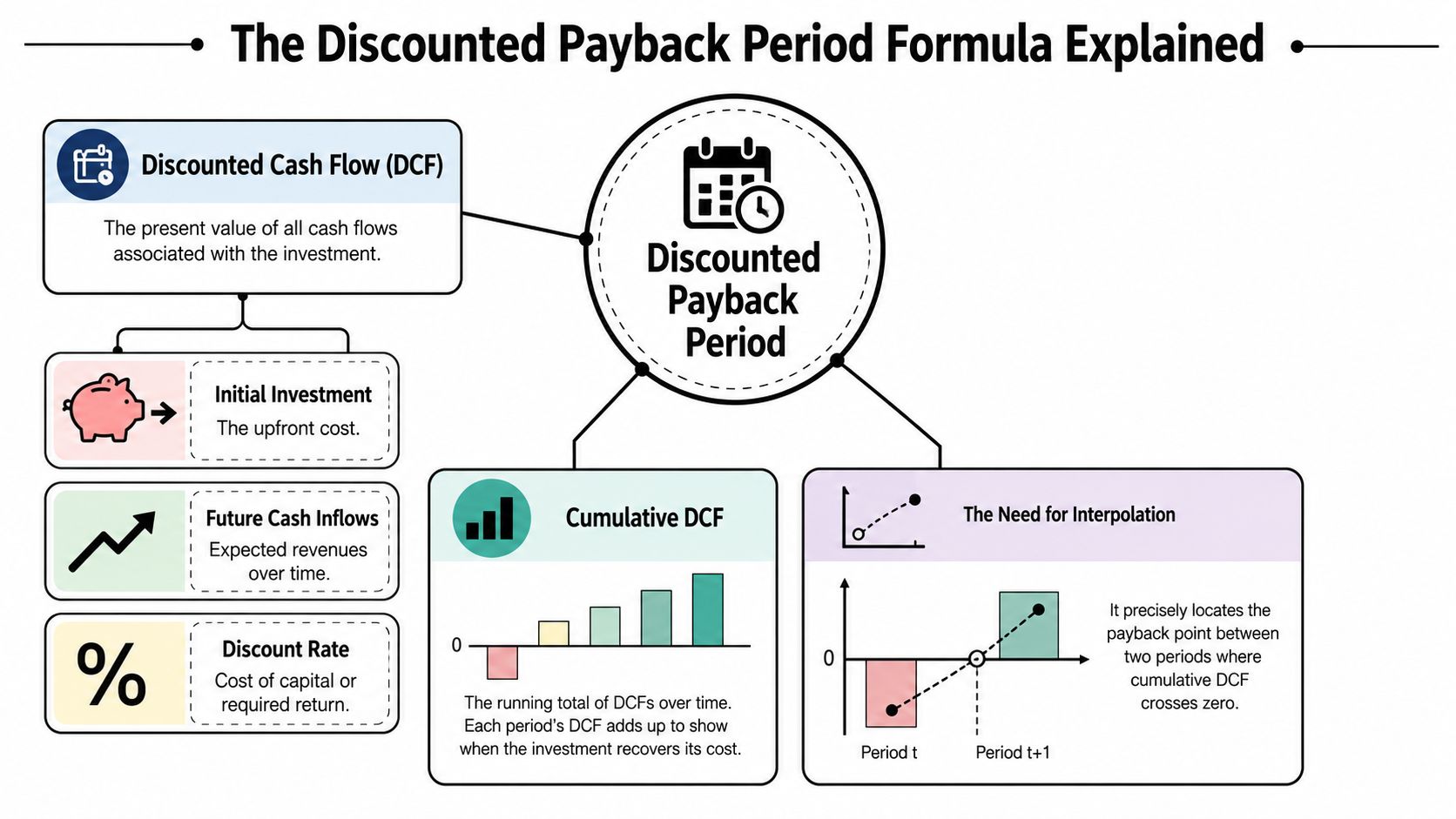
Discounted Payback Period = Year before DPB occurs + (Cumulative Discounted Cash Flow in year before recovery ÷ Discounted Cash Flow in year after recovery)
That exact formula is stated in Wikipedia's discounted payback period entry.
For an owner-led business, each part answers a practical question.
| Part of the formula | What it means for you |
|---|---|
| Year before DPB occurs | The last full year where the project still has not paid back your upfront cash |
| Cumulative discounted cash flow in year before recovery | The amount you are still short at the end of that year, after discounting the inflows |
| Discounted cash flow in year after recovery | The discounted inflow that finally closes the gap |
The formula uses interpolation. That means you estimate how far into the recovery year the payback point happens.
That detail matters more than many owners realize.
If you run a construction company, a distributor, or any business that lives and dies by working capital, the difference between payback in March and payback in November is a real operating issue. It affects debt capacity, covenant headroom, and whether you can fund the next hire, truck, or inventory build without squeezing the rest of the business.
Why the fractional year matters
A whole-year answer is too blunt for real decisions. If your model says a project pays back in year 4, you still do not know whether cash pressure eases early enough to support the next busy season.
The interpolation step fixes that. You take the unrecovered balance at the end of the prior year and divide it by the discounted cash flow in the recovery year. The result is the fraction of that year needed to finish paying back the investment.
Here is the practical takeaway. A project with a discounted payback of 3.2 years is very different from one at 3.9 years, even though both may look like "about four years" in a quick conversation. For a cash-sensitive business, that gap can decide whether the investment fits your forecast or puts strain on payroll, inventory, and line availability. If your assumptions are still rough, build a tighter financial forecast for your business before you approve the spend.
Use the formula to get a decision-grade timing answer, not a classroom answer. That is the point.
How to Calculate Discounted Payback Period Step by Step
If you are deciding whether to buy another excavator, add warehouse capacity, or expand your fleet, the worksheet matters less than the discipline behind it. You need to know when your cash comes back after adjusting for the cost of capital and the risk of waiting.
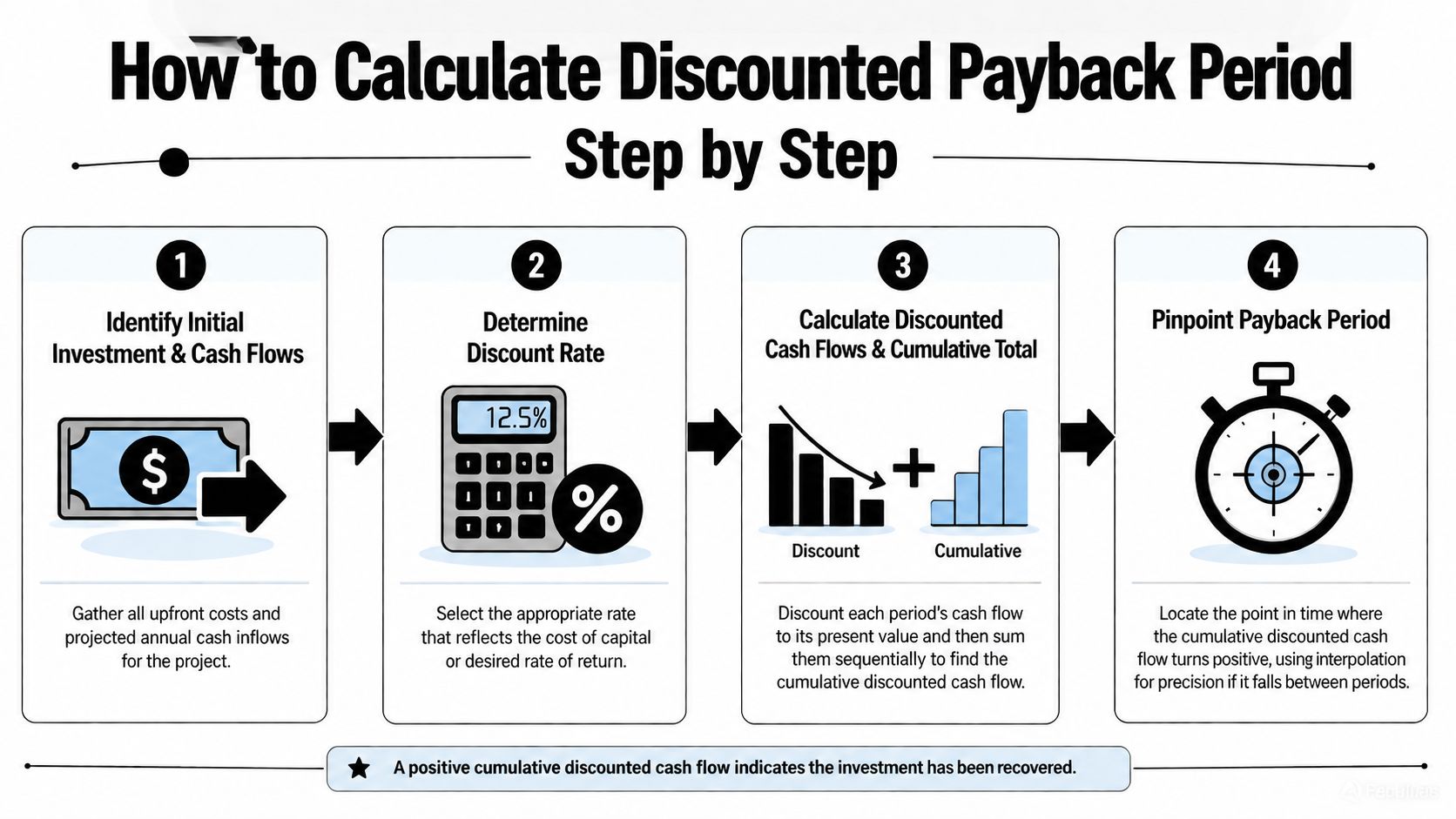
Build the model in Excel or Google Sheets. Keep it plain. One row per period, one discounted cash flow per row, one cumulative running total. Then calculate the fraction of the recovery year so you can see the actual timing, not a rounded estimate that hides cash pressure.
Step 1 and Step 2
Start with four inputs: the upfront investment, expected cash inflows by period, the number of periods, and your discount rate.
Choose the discount rate with intent. For an owner-led business, this is not a filler assumption. It should reflect what the project really costs your business in financing, risk, and lost flexibility. If a project ties up cash that you may need for payroll, inventory, or bonding capacity, your rate should reflect that reality. If your assumptions still need work, put the project into a business financial forecast built for capital planning.
Use this formula for each period's discounted inflow:
Discounted Cash Inflow = Actual Cash Inflow / (1 + i)^n
Then calculate the discounted inflow for every year or month in your model. Do not skip periods. Do not mix nominal cash flows with discounted ones in the same running total.
This walkthrough helps if you want to see the logic explained visually.
Step 3 and Step 4
Once you have each discounted inflow, add them cumulatively starting with the initial outflow as a negative number. Your target is the first period where the cumulative total turns positive. That is the payback window.
Then calculate the exact point inside that year or period:
- Find the last negative cumulative total: This is the amount still unrecovered at the end of the prior period.
- Take the discounted inflow from the next period: That is the cash flow that closes the gap.
- Divide the unrecovered balance by that discounted inflow: This gives you the fraction of the period needed for recovery.
- Add that fraction to the prior period number: That gives you the discounted payback period.
A simple worksheet structure looks like this:
| Column | What to include |
|---|---|
| A | Year or period number |
| B | Actual cash inflow |
| C | Discount factor |
| D | Discounted cash inflow |
| E | Cumulative discounted cash flow |
For construction and distribution businesses, the result offers significant value. A project may look fine on total return and still create a cash squeeze if recovery comes too late in the cycle. Late payback can crowd out inventory buys before peak season, tighten line availability, or force you to delay the next equipment purchase. That is why you should calculate discounted payback in the same model you use to manage cash, debt, and operating capacity.
A higher discount rate pushes payback farther out. Projects with back-loaded returns get hit hardest. If most of the payoff shows up late, treat that as a financing decision as much as an investment decision.
A Worked Example A New Equipment Purchase
You are about to sign for a $100,000 machine because the crew says it will save time and increase output. In construction or distribution, that decision does not live on a spreadsheet alone. It hits your cash balance, your borrowing base, and your ability to fund the next job, truck, or inventory buy.
Here is the example. A company buys equipment for $100,000 and expects $30,000 in annual cash inflows. The discount rate is 10%.
The numbers year by year
As shown in this numeric discounted payback example, the discounted cash flows look like this:
| Year | Actual Cash Inflow | Discounted Cash Flow | Cumulative Discounted Cash Flow |
|---|---|---|---|
| 0 | -$100,000 | -$100,000 | -$100,000 |
| 1 | $30,000 | $27,273 | -$72,727 |
| 2 | $30,000 | $24,793 | -$47,934 |
| 3 | $30,000 | $22,539 | -$25,395 |
| 4 | $30,000 | $20,490 | -$4,905 |
After year 4, you are still $4,905 short on a discounted basis.
That matters.
A simple payback view would make this purchase look close to recovered. Discounted payback shows your capital is still tied up longer than many owner-operators expect. If your business runs tight on working capital, that gap can create real pressure. It can limit inventory purchases before a busy season, reduce flexibility on payroll-heavy projects, or force you to stretch your line of credit at the wrong time.
If you make decisions like this often, get a second set of eyes on the assumptions behind the model, not just the math. Strategic CFO services for small business help you test whether the equipment improves cash generation or just adds fixed cost and financing pressure.
What the result tells you
Start with the practical takeaway. This purchase has not paid back within four years after applying your required return. For an owner-led business, that is a capital exposure issue, not an academic footnote.
If the project ends before cumulative discounted cash flow turns positive, the discounted payback period is undefined. In plain English, the investment never earns back its cost at your hurdle rate within the period you modeled.
That does not mean you automatically kill the deal. You might still approve it because the machine removes a bottleneck, shortens job cycles, reduces subcontractor dependence, or protects customer service levels. But approve it for those reasons. Do not call it self-funding if the numbers say otherwise.
That is the discipline most businesses need.
Before you sign, ask three blunt questions. Will this purchase return cash fast enough to protect liquidity? Does it still work if receivables slow down or gross margin softens? What gets delayed if this machine takes longer to pay back than planned? Those are the questions that keep growth from turning into a cash squeeze.
DPB vs Payback Period vs NPV Which Tool to Use
You are about to approve a truck, a saw line, a forklift fleet, or a warehouse expansion. The wrong tool will give you the wrong answer fast.
Here is the practical way to separate them. Payback tells you how soon cash comes back. Discounted payback tells you how long your cash is tied up after you account for the return your business needs. NPV tells you whether the investment adds value over its full life. If you run a construction firm or distribution business, that difference matters because payroll, inventory, fuel, and debt service do not wait for a long-term payoff.
A quick side by side view
| Tool | What it tells you | Biggest strength | Biggest weakness | Best use |
|---|---|---|---|---|
| Simple payback period | How quickly raw cash inflows recover the investment | Fast and easy to explain | Ignores time value of money and ignores value after payback | Quick initial screen |
| Discounted payback period | How long it takes to recover the investment in present-value terms | Better view of liquidity risk and timing | Still ignores cash flows after payback | Risk-focused capital review |
| NPV | Whether the project creates value over its full life | Best measure of value creation | Requires stronger assumptions and more care | Final investment decision |
Simple payback is fine for triage. Use it to kill obvious bad ideas quickly.
Do not stop there. A simple payback result can look attractive and still put your business under pressure if margins slip, collections slow down, or the project needs more working capital than expected. Discounted payback is better for owner-led companies because it forces you to ask a harder question. How long can your business carry this investment before it earns its keep?
My recommendation
Use the three tools in sequence.
- Use simple payback to screen the deal: If recovery is already too slow on an undiscounted basis, you usually do not need more analysis.
- Use discounted payback to judge liquidity risk: This is the key filter when cash flow is tight, debt covenants matter, or your backlog can swing quarter to quarter.
- Use NPV to make the final call: A project can pay back slowly and still be worth doing. It can also pay back quickly and still destroy value if the later cash flows disappoint or the upfront cost is understated.
For construction and distribution companies, discounted payback often deserves more attention than finance teams give it. These businesses live with uneven cash cycles. One delayed customer payment, one inventory build, or one bad job can change the cost of tying up capital. If a project only works under a simple payback view, treat that as a warning sign.
NPV should still decide the final yes or no. But discounted payback tells you whether you can survive long enough to enjoy that value. That is the difference between a smart expansion and a self-inflicted cash squeeze.
If you want a better framework for evaluating decisions like this, review how a finance leader measures fractional CFO ROI on capital decisions. The goal is not prettier spreadsheets. The goal is better decisions before your money leaves the bank.
Putting It All to Work In Your Business
You feel this section in real life when a lender tightens terms, a customer pays late, or a big job runs over budget right after you commit to new equipment. At that point, the spreadsheet stops being academic. It becomes a cash test.
Discounted payback helps you decide whether your business can recover its cash fast enough to stay flexible. That matters more than many owners admit, especially in construction and distribution where working capital swings can hit hard and with little warning.
Where owners get this wrong
Owners usually miss in two places.
First, they round the answer and move on. That creates a false sense of precision. If your payback lands somewhere in the middle of a year, use the fractional-year calculation and get the timing right. If you are planning around debt service, equipment financing, seasonal inventory buys, or a thin cash cushion, a rough estimate is not good enough.
Second, they treat discounted payback like the final verdict. It is a timing tool. Use it to judge recovery speed and liquidity pressure. Then make the full investment decision with the rest of the picture in view.
What to do before you approve the spend
Before you sign the purchase order or commit to the expansion, run through a short decision check:
- Pressure-test the cash flows: Tie revenue assumptions to actual sales capacity, labor availability, pricing, and collections.
- Set a discount rate you can defend: Use a rate that reflects the actual cost and risk of the project, not a placeholder from an old model.
- Calculate the exact payback point: Whole-year math is too blunt for a cash-sensitive decision.
- Compare recovery timing to your actual constraints: Match it against loan terms, owner goals, backlog visibility, and how much cash the business can afford to tie up.
- Make sure operations can support the plan: A machine that pays back on paper can still strain the business if hiring, maintenance, or inventory needs show up faster than expected.
That discipline separates controlled growth from expensive optimism.
If your business lives with uneven billing, retention, freight costs, supplier prepayments, or large inventory positions, put discounted payback into your standard capex review process. You do not need a more complicated model. You need a clearer answer to one question. How long will your cash be tied up, and can your business handle that without creating stress elsewhere?
If you want help pressure-testing a major equipment purchase, expansion plan, or exit-timing decision, talk with AmbitionCFO. We work with founder-led companies that need sharper cash flow visibility, stronger forecasting, and decision support that goes beyond basic accounting.