

You're probably feeling a version of this right now. Sales are up. Your team is bigger than it was a year ago. The P&L says you're making money. Then your controller or bookkeeper tells you cash is tight, payroll is coming, and a large customer still hasn't paid.
That disconnect is where founder stress spikes. You can be profitable and still get blindsided by cash timing. That's why liquidity management matters. It's not a bank term or a treasury buzzword. It's the discipline of making sure your business has the cash to operate, absorb surprises, and keep growing without panic decisions.
This guide is built for founder-led companies in the $10M to $100M revenue range. If that's your business, the answer usually isn't “raise more money” or “cut everything.” It's better visibility, tighter operating discipline, and a system that tells you what's coming before it hits. If you've been fighting recurring cash pressure, start with these cash flow problems and solutions and then build the playbook below.
Table of Contents
- Your Profitable Company Can Still Run Out of Cash
- Why Growth Is the Greatest Liquidity Risk
- The 13-Week Cash Flow Forecast Your Business Needs
- Three Levers You Can Pull to Improve Cash Flow Today
- Building Your Liquidity Dashboard with Key KPIs
- Industry Specific Liquidity Strategies
- Your 90-Day Liquidity Management Roadmap
Your Profitable Company Can Still Run Out of Cash
A founder lands a strong quarter. Revenue looks good. Gross margin looks healthy. Hiring is underway. Then two large customers pay late, inventory arrives early, and payroll hits before the cash does. On paper, the company is fine. In the bank account, it's not.
That's the core problem. Profit is not cash. Profit lives on your income statement. Cash lives in timing. If your money is tied up in receivables, inventory, retainage, prepaid costs, or growth spending, you can post a profit and still have a liquidity problem.

Liquidity management means controlling that timing. You're making sure cash is available when obligations come due, not just hoping the monthly financials look strong enough to cover it. For banks, the discipline is formalized through the Liquidity Coverage Ratio, which requires enough high-quality liquid assets to cover 100% of projected net cash outflows over a 30-day stress period under global standards and U.S. enforcement by the OCC. For operating companies, the practical parallel is maintaining a cash buffer measured in buffer days, with many frameworks recommending 3 to 6 months of operating expenses, or about 90 to 180 days, as a baseline reserve according to the OCC liquidity framework.
What liquidity management means in plain English
It means you know three things every week:
- What cash you have now
- What cash is scheduled to come in
- What cash is committed to go out
If you can't answer those clearly, you're operating on optimism.
Practical rule: If payroll, rent, suppliers, taxes, and debt service depend on “a few payments coming in soon,” your system is too loose.
A healthy business doesn't wait for the bank balance to become a crisis signal. It tracks cash early, updates assumptions often, and acts before the squeeze shows up.
Why Growth Is the Greatest Liquidity Risk
Growth-stage companies are the most exposed to cash pressure because growth consumes cash before it produces stability. You hire ahead of revenue. You buy inventory before you sell it. You extend terms to win larger customers. You invest in capacity before collections catch up.
That's why many founder-led businesses hit their worst cash stress during their best sales periods. The issue isn't decline. The issue is speed.
Growth stretches working capital
Working capital is the cash tied up in day-to-day operations. When sales rise, so do receivables, inventory needs, and operating commitments. If those rise faster than collected cash, your business gets squeezed.
A simple example looks like this:
| Growth move | What happens operationally | What happens to cash |
|---|---|---|
| You win bigger customers | They ask for longer payment terms | Cash arrives later |
| You expand product lines | You carry more stock | Cash gets trapped in inventory |
| You hire for demand | Payroll rises before collections do | Cash leaves before revenue converts |
| You open capacity | Fixed costs increase | Margin may improve later, but liquidity tightens now |
This is exactly why a founder can feel “busier and more successful” while the bank account gets more fragile.
For companies in this middle market range, financial forecasting has to catch up to operational complexity. If growth is outrunning visibility, this guide on the hidden costs of rapid growth and financial forecasting for growing businesses is worth reading next.
Too much cash is also a mistake
Most founders understand the risk of too little cash. Fewer think seriously about the cost of too much idle cash.
Data shows firms often hold 2 to 3 months of revenue as a cushion when industry benchmarks suggest 3 to 6 months of operating expenses is the better benchmark, creating what I'd call a profitability penalty through idle capital, according to this analysis of liquidity management challenges.
That distinction matters. Revenue is not expense. If you anchor your cash reserve to revenue instead of operating expenses, you can end up hoarding more cash than the business needs for resilience. That lowers returns and limits investment in the things that drive enterprise value.
Excess cash can protect you, but it can also hide lazy decisions. The right target is a disciplined reserve, not a vague comfort balance.
The founder takeaway
Liquidity management isn't defensive. It's how you grow without losing control.
Your job isn't to stockpile cash blindly. Your job is to hold the right buffer, know when cash gets tight, and use working capital intentionally. Founders who do that make better hiring decisions, negotiate from strength, and avoid emergency borrowing.
The 13-Week Cash Flow Forecast Your Business Needs
You can be profitable on paper and still hit a cash wall in six weeks. I have seen founder-CEOs approve hires, commit to inventory, and greenlight marketing spend because the P&L looked healthy, only to discover payroll was about to squeeze the bank account. A 13-week cash flow forecast prevents that mistake.
If you build one financial tool this quarter, build this one.
A rolling 13-week forecast gives you weekly visibility into cash receipts, cash disbursements, and your lowest projected cash point. That matters more than a static budget because liquidity problems show up in timing first. In growth-stage companies between $10M and $100M in revenue, timing drives risk.
The 13-week model became standard after companies learned the hard way that annual planning did not give enough short-term control. As Ramp explains in its piece on liquidity management strategy and metrics, the format works because it gives you enough forward view to make course corrections while staying close to real cash activity.
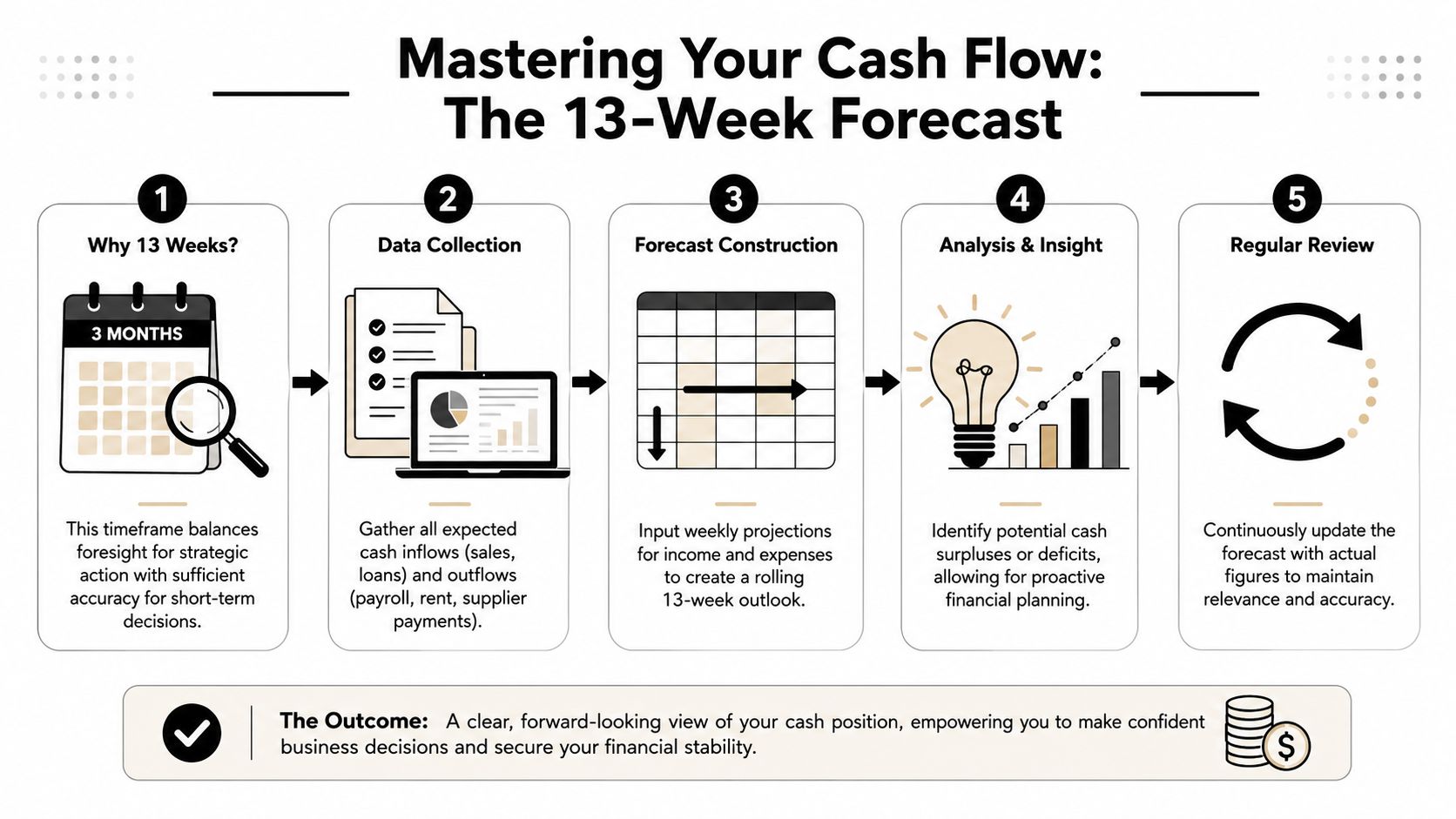
Why 13 weeks works
Thirteen weeks is long enough to catch a problem before it becomes a crisis and short enough to forecast with discipline. You can see collections slow down, payroll pressure build, vendor payments bunch up, or tax obligations hit before they force a bad decision.
It also matches how a founder should run the business. Weekly cadence. Weekly accountability. Weekly tradeoffs.
For most companies, 13 weeks covers the operating cycle that matters most. Customer receipts come in. Payroll clears. vendors get paid. Recurring overhead hits. Debt service and taxes show up. You get a practical window into what cash will do, not what the budget said it might do.
If you want a stronger starting template, use this guide on how to create a cash flow forecast.
What goes into the model
Keep the model simple enough to update every week and specific enough to support decisions. Include:
Opening cash balance
Use available cash. Strip out restricted cash and wishful thinking.Expected inflows by week
Customer collections, financing proceeds, tax refunds, owner contributions, and any other cash receipts with a realistic timing assumption.Expected outflows by week
Payroll, taxes, rent, debt payments, supplier payments, software, insurance, capex deposits, commissions, and one-time obligations.Net weekly cash movement
Weekly inflows less weekly outflows.Ending cash balance
This becomes the next week's opening balance and tells you where liquidity gets tight.
That is enough to start. Founder-led teams often bury the model under too many tabs, too many scenarios, and too much detail. Build the first version fast, then improve forecast accuracy through weekly reps.
Your forecast is a management tool, not a finance exercise. If it does not change decisions, it is not doing its job.
Here's a quick visual on the process:
How to run it every week
Review the forecast every week. No exceptions. Compare actual cash movement to last week's forecast, update timing assumptions, and identify the lowest projected cash balance across the next 13 weeks.
Your weekly review should answer five questions:
- What changed since last week
- Which receipts slipped
- Which payments moved up
- Where the cash low point now sits
- What actions you need to take this week
The model proves its value. It tells you whether to slow hiring, push a purchase order, pull harder on collections, delay discretionary spend, or arrange financing before you need it. It also helps you avoid a different mistake: holding too much idle cash. If your forecast shows a durable buffer above your operating reserve, you can put that capital to work instead of accepting the profitability penalty of excess cash.
A simple worksheet you can use
Use this weekly layout in your spreadsheet:
| Line item | Week 1 | Week 2 | Week 3 | … | Week 13 |
|---|---|---|---|---|---|
| Opening cash | |||||
| Customer receipts | |||||
| Other inflows | |||||
| Payroll | |||||
| Supplier payments | |||||
| Rent and overhead | |||||
| Taxes and debt service | |||||
| Other outflows | |||||
| Net cash movement | |||||
| Ending cash |
Roll the model forward every week. If you stop updating it, you lose control.
Three Levers You Can Pull to Improve Cash Flow Today
Once the forecast shows where cash gets tight, you need action. Most founder-led companies have three immediate levers inside working capital. Receivables. Payables. Inventory.
For firms in the $10M to $100M revenue range, a rolling 13-week cash forecast should be paired with liquidity optimization that includes ABC analysis for inventory and negotiated accounts payable terms, while taking early payment discounts only when the annualized savings exceed your cost of capital, according to this guidance on how liquidity management strengthens businesses.
Pull the receivables lever first
This is usually the fastest way to improve liquidity.
If customers pay slowly, your business is financing their operations. Fix the process before you blame the customer. Send invoices immediately. Clean up disputes fast. Make sure the invoice matches the PO, contract terms, and billing milestones. Give customers easy payment options. Escalate past-due balances consistently.
Use this short checklist:
- Invoice faster. Don't wait until month-end if the work is done today.
- Tighten collections cadence. Follow up before due dates, not only after they're missed.
- Remove friction. Customers delay payment when paperwork is incomplete or approvals stall.
- Segment accounts. Your largest balances deserve direct founder or finance attention.
If you want a practical set of tactics, review these ways to improve cash flow.
Slow collections are rarely just a sales problem. They're usually a process problem.
Use payables strategically, not emotionally
Many founders pay vendors early because they want to be “good partners.” That's fine when cash is abundant. It's careless when liquidity is tight.
You should know every supplier's agreed terms, actual payment habits, and strategic importance. Then pay with intent. Extend dates where appropriate. Hold to agreed terms. Take early payment discounts only if the math works.
A practical decision rule:
| Scenario | Better move |
|---|---|
| Supplier offers an early payment discount | Take it only if annualized savings beat your cost of capital |
| Terms are net and relationship is stable | Pay on the agreed due date |
| Vendor is critical and supply is tight | Protect the relationship, but negotiate structure |
| Cash is temporarily squeezed | Communicate early, don't surprise the vendor |
The mistake is treating every vendor the same. Your key supplier, your office coffee vendor, and your software auto-renewal should not get identical treatment.
Inventory is often the silent cash drain
If you carry stock, liquidity management is impossible without inventory discipline. Founders often focus on revenue velocity and ignore how much cash is sitting on shelves.
ABC analysis helps. It separates high-value items from everything else so your team puts tighter controls on the inventory that matters most. Pair that with safety stock logic based on lead times and variability, then challenge every item that keeps absorbing cash without supporting sales or service levels.
Three useful questions:
- Which items tie up the most cash
- Which items move slowly but keep getting reordered
- Which items are operationally critical versus habitually stocked
A company doesn't need inventory perfection. It needs fewer bad inventory decisions.
A direct operating playbook
If cash is tight this week, do this in order:
- Call the top overdue customers
- Review all payments due in the next two weeks
- Separate must-pay from can-delay
- Freeze avoidable inventory buys
- Update the 13-week forecast with today's reality
That sequence works because it changes cash timing fast. You're not waiting for accounting to close the month. You're managing liquidity in real time.
Building Your Liquidity Dashboard with Key KPIs
A forecast tells you what's coming. A dashboard tells you whether the business is getting healthier or weaker. You need both.
The right dashboard is not a giant pack of finance metrics. It's a short list of indicators you can review weekly and understand quickly. Key liquidity metrics to track regularly include the current ratio, quick ratio, and operating cash flow ratio, and dashboards should set minimum thresholds that trigger action when those metrics decline, according to this overview of business liquidity management metrics.
What to track every week
Use a one-page scorecard. If your dashboard needs a meeting just to explain the dashboard, it's too complicated.
Your Essential Liquidity KPI Dashboard
| KPI | What It Measures | Formula | Good Target |
|---|---|---|---|
| Current Ratio | Whether current assets can cover current liabilities | Current Assets / Current Liabilities | Above 1.0 |
| Quick Ratio | Whether you can cover short-term obligations without relying on inventory | (Cash + Marketable Securities + Accounts Receivable) / Current Liabilities | 1.0 or higher |
| Operating Cash Flow Ratio | Whether operations are generating enough cash to cover short-term obligations | Operating Cash Flow / Current Liabilities | Above 1.0 |
| Buffer Days | How long your cash can support operations | Total Cash Balance / Average Daily Operating Expenses | Aligned with your reserve policy |
For a broader scorecard, this article on the financial metrics every business owner should track is a useful companion.
How to use the dashboard
Don't just calculate the ratios. Set thresholds and define the response.
For example:
- If current ratio drops below your floor. Review upcoming liabilities and timing pressure.
- If quick ratio weakens. Check whether inventory is masking a short-term cash issue.
- If operating cash flow ratio falls. Look at collections, margin quality, and payment timing.
- If buffer days compress. Slow discretionary spending and revisit the weekly forecast assumptions.
A KPI without a trigger is trivia. A KPI with an action plan is management.
One more point. Ratios don't replace direct cash visibility. They support it. If your dashboard says things look fine but your 13-week forecast says cash gets tight in two weeks, trust the forecast and investigate the disconnect.
Industry Specific Liquidity Strategies
Generic liquidity advice breaks down fast when it hits the actual operating model. Construction, distribution, and professional services all create cash pressure in different ways. Your tactics should match that reality.
Construction
Construction businesses feel liquidity stress early because cash timing is tied to project milestones, retainage, mobilization costs, and change order delays.
The first rule is to map cash by job, not just by company. A profitable backlog can still hurt liquidity if billing lags, retainage stacks up, or materials are purchased far ahead of reimbursement. Review invoicing discipline at the project level. Push approved change orders into billing fast. Track underbillings aggressively.
A strong weekly cash review in construction should focus on:
- Upcoming payroll tied to active jobs
- Material deposits and subcontractor draws
- Milestone billing dates
- Retainage release timing
- Any project that is consuming cash faster than it converts to billings
The founder mistake here is trusting revenue recognition more than collections.
Distribution
Distribution companies usually don't fail from lack of sales. They get squeezed when inventory and supplier terms drift out of alignment with demand.
Your liquidity strategy should start with product-level visibility. Which SKUs absorb the most cash. Which vendors can support better terms. Which items turn slowly but still get repurchased because nobody challenges the reorder logic.
Good operators in distribution treat inventory as cash in another form. They don't let buyers optimize only for fill rate while finance absorbs the carrying cost. Forecast demand tightly, segment inventory by value and movement, and renegotiate terms where supplier concentration creates risk.
Professional services
Professional services firms often look asset-light, but liquidity can still be messy because revenue is lumpy, utilization moves, and invoicing discipline varies by partner or project lead.
Your first focus should be billing speed. Work completed but not invoiced is one of the easiest ways to create unnecessary cash pressure. Your second focus should be client profitability. Some clients produce revenue but absorb so much labor, rework, or delay that they weaken cash.
Watch for these patterns:
- Large WIP balances that don't convert quickly
- Partners or team leads delaying invoices
- Projects with scope creep and weak change control
- Overreliance on a few clients with slow payment behavior
In services, utilization and billing discipline often matter more to liquidity than founders realize. Strong revenue with poor invoicing habits still creates a cash problem.
Your 90-Day Liquidity Management Roadmap
Monday morning. Payroll clears on Wednesday, a large customer pushes payment into next month, and your controller says cash is still "fine" because the P&L looks strong. That is how founder-led companies walk into a cash squeeze they should have seen weeks earlier.
Your first 90 days should fix that. The goal is simple: build a weekly cash operating rhythm around a 13-week forecast, make decisions from it, and stop carrying more cash than your business needs. Excess cash feels safe, but it has a profitability penalty. It drags returns, masks weak working capital habits, and keeps you from putting capital to work.
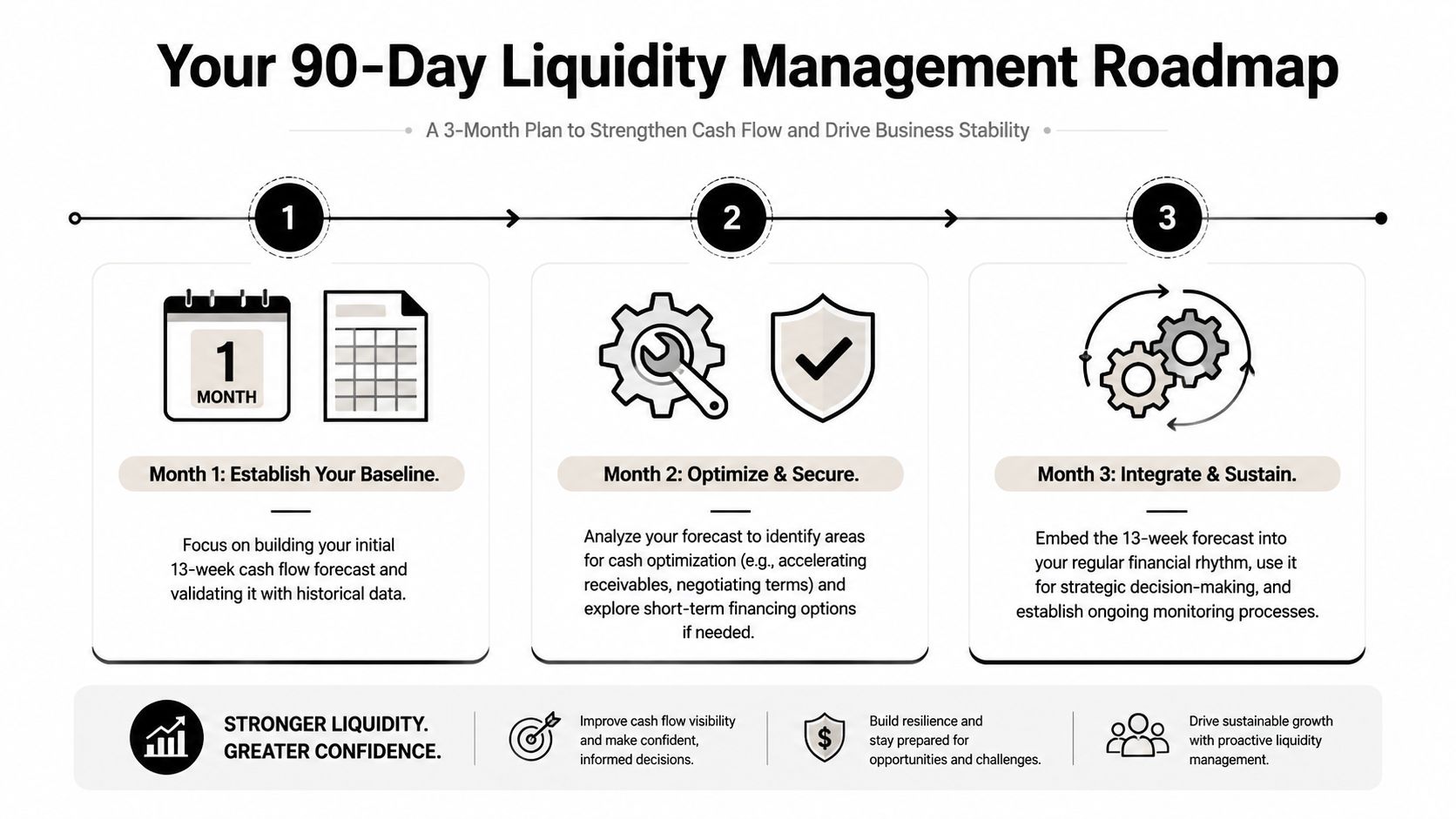
Month 1 to Month 3 priorities
Month 1
Build your first 13-week cash flow forecast and tie it to actual cash receipts and disbursements. Keep it simple enough to update every week. Then set a 30-minute weekly cash meeting with finance, sales, and operations. If the people who create the cash movements are not in the room, your forecast will drift fast.
Month 2
Choose two actions that change cash now. One on collections. One on disbursements. Then build a small dashboard that sits next to the forecast every week. Track forecast accuracy, beginning and ending cash, overdue receivables, payables due by week, and any item that can create a surprise swing in the next 30 days.
Month 3
Turn the model into a decision tool. Add base, downside, and upside scenarios. Stress test late customer payments, earlier inventory receipts, slower bookings conversion, margin compression, and one-time cash needs. Set a minimum cash threshold for your business and define the actions you will take if the forecast drops near it.
Mistakes that wreck the process
The most common failures are operational:
- Building the forecast in a silo. Cash moves across sales, operations, payroll, purchasing, and finance. One owner cannot keep it accurate alone.
- Updating monthly instead of weekly. Growth-stage companies do not have the luxury of slow visibility.
- Ignoring small forecast misses. Variances show you where your assumptions are weak and where accountability is missing.
- Treating the forecast like an accounting report. Use it to make decisions on timing, terms, spending, and hiring.
- Holding cash without a target. Define how much liquidity you need, why you need it, and where excess cash should go.
For a founder-led company in the $10M to $100M range, this is the playbook. Weekly visibility. Fast reconciliation. Clear cash thresholds. Direct action when the forecast changes.
If your business has outgrown reactive cash management and you want a practical system built around weekly visibility, operating discipline, and founder-level decision support, talk to AmbitionCFO. They work with founder-led companies in the $10M to $100M range to build 13-week cash flow models, KPI dashboards, and decision-ready forecasting without the cost of a full-time CFO.