

You're probably feeling one of two things right now. Either sales look decent but the bank balance keeps getting tighter, or cash is coming in and you still have this nagging sense that the business isn't getting healthier.
That tension is the core issue behind most cash flow problems and solutions. Owners often treat every shortage as a collections problem, then miss the harder truth. Sometimes the problem is timing. Sometimes the business is leaking profit. If you don't know which one you're dealing with, you'll pull the wrong lever and make things worse.
I've seen this most often in construction, distribution, and project-based companies. A contractor wins work, books revenue, staffs the job, buys materials, and then waits to get paid. A distributor grows sales, adds inventory, extends terms, and suddenly discovers growth is eating cash. The fix isn't motivational. It's operational and financial.
Table of Contents
- Is It a Cash Problem or a Profit Problem
- Build Your 13-Week Cash Flow Forecast Today
- Immediate Fixes to Stop a Cash Flow Bleed
- Long-Term Strategies for Bulletproof Financial Health
- Smart Financing to Fuel Growth and Manage Covenants
- Know When to Call for Help A Fractional CFO Decision Guide
Is It a Cash Problem or a Profit Problem
The first question isn't “How do I get more cash?” The first question is “What's broken?”
A founder usually comes in describing symptoms. Payroll feels tight. Vendors are calling. The line of credit keeps getting tapped. That's like walking into a doctor's office and saying you're tired. Useful, but not enough for a diagnosis.
Start with symptoms, not assumptions
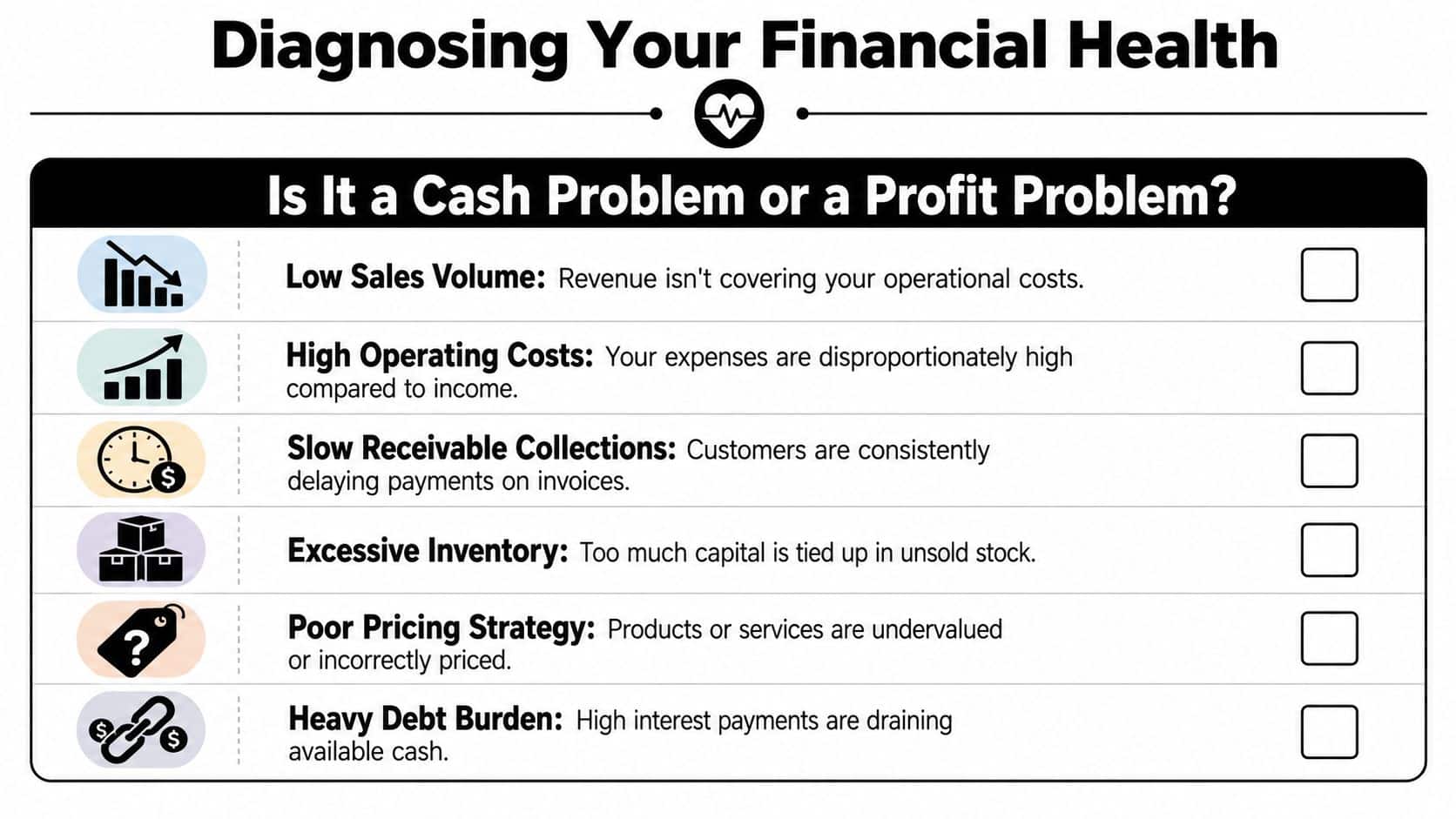
A cash problem is usually a timing problem. You're making sales, but cash arrives later than expenses leave. Construction firms deal with this constantly because labor, subcontractors, and materials get paid before the customer payment clears. Distributors get hit when inventory lands before customers pay their invoices.
A profit problem is different. The business might still generate cash for a while, especially if you're borrowing, collecting deposits, delaying payments, or riding old backlog. But underneath that, every sale may be producing too little margin. That means the business isn't just short on cash. It's slowly losing ground.
Many owners miss the difference because cash can hide a bad model for longer than it should. Some guides ignore the cash flow survivor, meaning a business that has cash movement but still has hidden losses. In one example, health systems reported $48.4 billion in revenue leakage in 2025 despite improved cash flow, which shows that cash movement alone doesn't prove financial health (HealthLeaders on revenue leakage and cash flow).
Cash is a symptom tracker. Profit tells you whether the business model works.
Use a simple diagnostic checklist
Run this checklist before you touch financing, cost cuts, or pricing.
- Check gross margin by job, product, or client. If one crew, one customer segment, or one product line consistently underperforms, you likely have a profitability issue.
- Review pricing discipline. If you “won” work by discounting, absorbed extra scope, or failed to pass through cost increases, don't call it a cash problem. That's a margin problem.
- Look for receivables drag. If invoices are accurate and profitable but customers pay late, you've got a timing issue.
- Inspect inventory and work in progress. In distribution and construction, too much cash gets trapped in stock, materials, and WIP that isn't converting fast enough.
- Scan for revenue leakage. Credits, write-downs, missed change orders, billing delays, freight errors, rebate mistakes, and unbilled work destroy results.
A quick way to test your diagnosis is to ask three blunt questions:
| Question | If the answer is yes | Likely issue |
|---|---|---|
| Are sales increasing but cash still tightening? | Growth is consuming working capital | Cash timing |
| Are you busy but still not seeing strong margins? | Work may be underpriced or inefficient | Profitability |
| Are you borrowing just to cover normal operations? | Core economics may be weak | Often both |
Why this distinction changes the solution
If timing is the issue, then collections, payment terms, and forecasting will help. If profitability is the issue, debt won't save you. It will just buy time while losses continue.
That's why I like comparing actual results against plan at the customer, department, or job level. A disciplined budget vs actual variance analysis forces you to separate “we're waiting on cash” from “we never priced this correctly in the first place.”
For many owners, that's the turning point. They stop chasing symptoms and start treating the cause.
Build Your 13-Week Cash Flow Forecast Today
If you don't have a 13-week cash flow forecast, you're driving with the windshield painted black. Monthly financial statements matter, but they're too slow for a cash squeeze. Cash needs a weekly tool.
This is the most practical answer to cash flow problems and solutions because it shows what hits the bank, when it hits, and whether you have enough room to operate. It's not an accounting exercise. It's a survival tool.
What belongs in the forecast
Start with actual bank cash on hand. Then build week by week.
Include cash coming in:
- Customer collections
- Deposits for new projects
- Expected progress billings that will be paid
- Any financing proceeds already approved
Include cash going out:
- Payroll
- Rent
- Taxes
- Debt service
- Vendor payments
- Insurance
- Equipment payments
- Owner draws, if they're happening
Leave out non-cash items. Depreciation doesn't belong here. Accrual entries don't belong here. Revenue you hope to book doesn't belong here unless it turns into a believable collection date.
A simple weekly structure you can use
Here's the worksheet structure I recommend:
- Beginning cash balance
- Cash receipts this week
- Total cash available
- Cash disbursements this week
- Ending cash balance
- Minimum cash threshold
- Gap or surplus
For a distributor, that might mean listing expected collections by customer and major inventory purchases by due week. For a contractor, it means mapping payroll runs, subcontractor payments, equipment needs, and expected owner billings.
The value comes from discipline. A 13-week model shifts focus from accounting revenue to actual cash, and mapping AR aging buckets can improve collections. Businesses using dynamic systems can reduce Days Sales Outstanding by 15 to 20% by improving visibility and follow-up (Sage on the 13-week cash flow model and DSO reduction).
If you need a cleaner model structure, use a financial forecast framework built for decision-making. Don't overcomplicate it. The right model is the one your team updates every week.
Practical rule: If a line item won't change a payment decision in the next 13 weeks, it probably doesn't belong in the model.
How to keep it useful
A forecast dies when owners turn it into a wish list. Keep it grounded in evidence.
Use these rules:
- Tie collections to named invoices. Don't put in one lump number called “AR.” Break it into what you expect from specific customers.
- Use AR aging buckets. Current, 30, 60, and 90-plus days tell you where cash is likely to slip.
- Update every week. This is a rolling model. Drop the week that just ended, add a new week at the back, and compare forecast to actual.
- Flag decision points. If cash dips below your minimum threshold in week 4, act in week 1, not week 4.
- Run scenarios. Best case, base case, and worst case will force better decisions on hiring, inventory, and capital spending.
Here's a stripped-down example of what matters:
| Week | Beginning Cash | Collections | Disbursements | Ending Cash | Action |
|---|---|---|---|---|---|
| 1 | Current bank balance | Named customer receipts | Payroll, rent, vendors | Calculated balance | None or monitor |
| 2 | Prior ending cash | Confirmed inflows | Scheduled outflows | Calculated balance | Delay nonessential spend if tight |
| 3 | Prior ending cash | Expected progress billing receipts | Payroll and supplier due dates | Calculated balance | Push collections, extend terms |
| 4 | Prior ending cash | Conservative estimate | Known obligations | Calculated balance | Arrange financing if needed |
Most businesses don't fail because nobody cared. They fail because nobody had a credible weekly view of liquidity.
Immediate Fixes to Stop a Cash Flow Bleed
When cash is tight, don't start with philosophy. Start with speed.
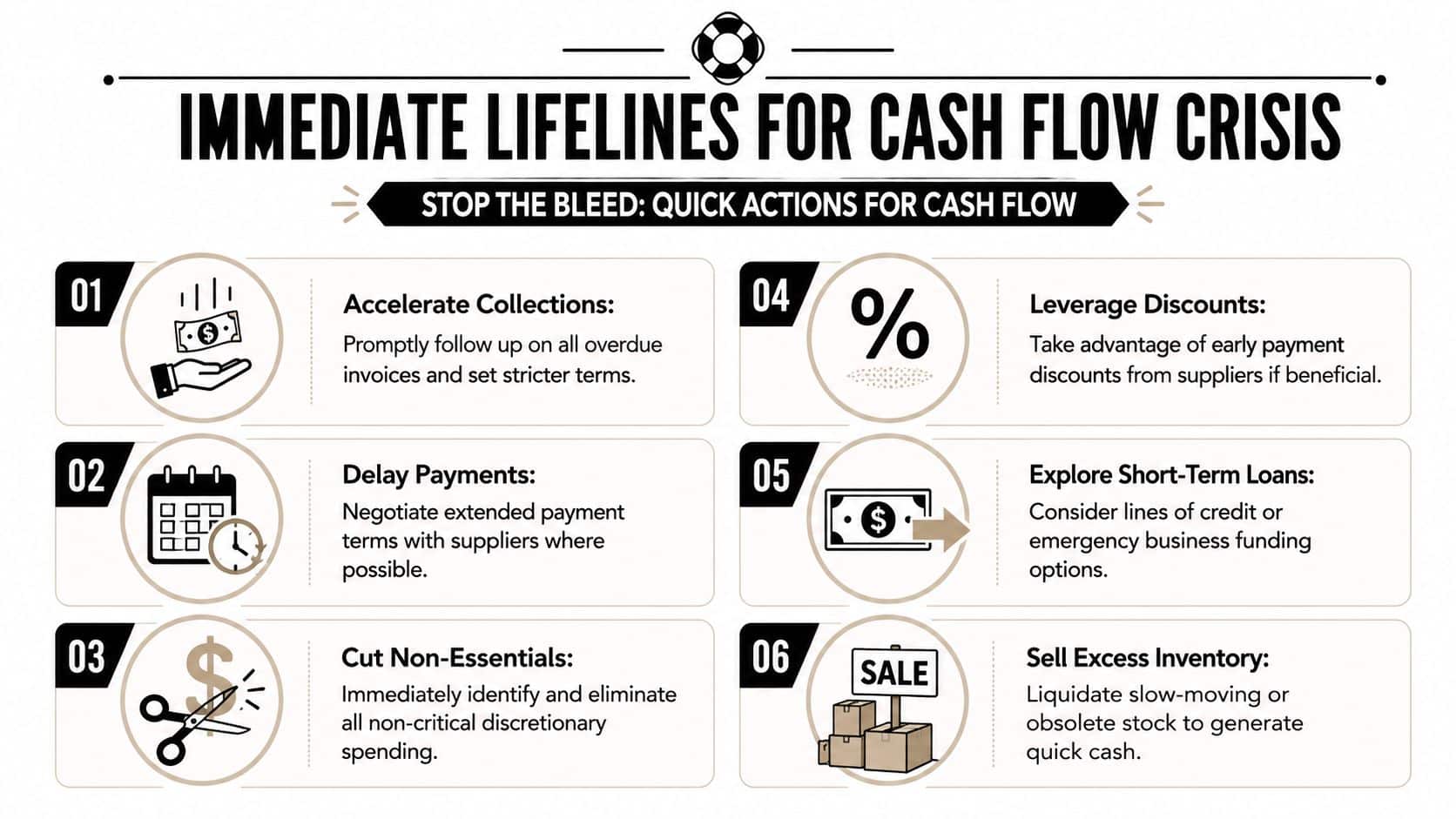
Some companies can buy themselves breathing room in a week by tightening receivables, stretching payables, and killing optional spend. That matters because the failure rate tied to poor cash management is brutal. One source notes that 82% of all business failures in 2019 were directly caused by poor cash management (Huntington on business failures caused by poor cash management).
Start with the visual below, then work the list.
Start with receivables
Collections is the fastest internal lever.
A lot of owners say, “Our customers always pay.” That's not the same as paying on time. If your customer pays in 52 days and your payroll runs every week, your business is financing their operations.
Take these steps this week:
- Call overdue accounts directly. Email is fine. Phone is better. Confirm the invoice was received, approved, and scheduled.
- Use digital invoicing immediately. Faster delivery and simpler payment options cut friction.
- Invoice the same day work is done. Delayed invoicing is self-inflicted damage.
- Require deposits on large projects. That is especially important for startups and project-based firms, where deposits and automated invoicing reduce the gap between delivery and collection (Techstars on deposits and invoice automation for startup cash flow).
Later in the week, watch this walkthrough if you want a practical reset on the mechanics.
Then work payables and spending
Don't pay vendors early unless there's a real reason. Cash in your account has strategic value.
A direct move that works is negotiating supplier terms from net-30 to net-60, while also using digital invoicing to accelerate customer payments. One source ties that kind of proactive management to the broader reality that 82% of small businesses fail due to cash flow problems (Paro on tactical cash flow actions and failure risk).
Do this now:
- Ask for term extensions. Good suppliers prefer a conversation over a surprise.
- Sort spend into critical and noncritical. Payroll, tax, and revenue-producing purchases stay. Nice-to-haves stop.
- Pause owner distributions. If the business is short on operating cash, taking money out makes no sense.
- Sell stale inventory. In distribution, dead stock is frozen cash.
If you want a broader tactical checklist, review these cash flow improvement actions for owners under pressure.
This week's triage checklist
Use this in order:
- Collect the top overdue invoices
- Delay nonessential payments
- Renegotiate major vendor terms
- Freeze discretionary spending
- Sell or return slow-moving inventory
- Update the 13-week forecast with real dates
- Decide whether you need temporary financing
If you're guessing at collections and paying bills by habit, you're not managing cash. You're hoping.
Long-Term Strategies for Bulletproof Financial Health
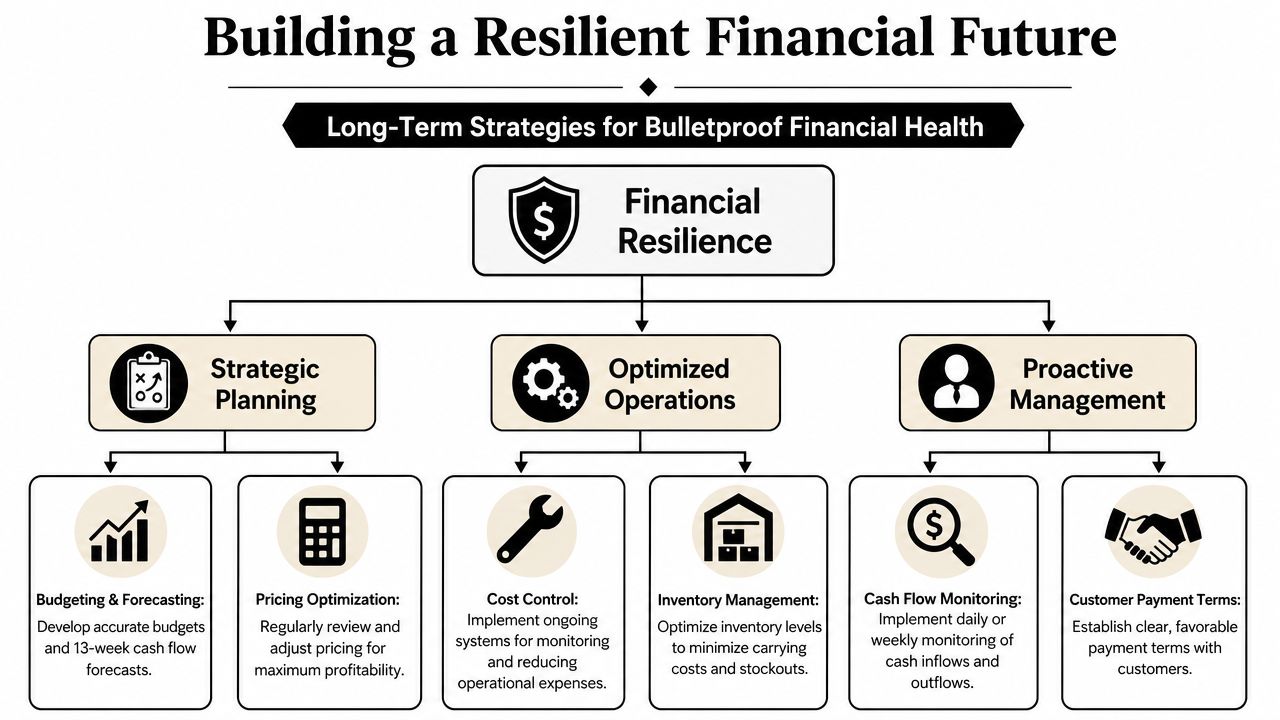
Emergency moves help, but they don't create resilience. Real financial health comes from systems that keep cash available without constant heroics from the owner.
That means fixing the operating model. Pricing has to work. Inventory has to turn. Budgets have to reflect reality. Cash reserves have to exist before the next problem shows up.
Build systems, not heroics
Start with pricing. If your gross margin isn't healthy, no amount of collections work will fix the business. In construction, this often means reviewing job estimates against final job costs. In distribution, it means checking margin by customer, SKU category, freight lane, and sales rep discounting behavior.
Then tighten inventory management. Many distributors think inventory equals strength. It often equals trapped cash. Stock the items that move and protect service levels, but stop treating every possible sale as a reason to buy more inventory.
Use budgeting and forecasting as a management discipline, not a year-end ritual. A useful budget tells department leaders what they can spend and what return they're expected to produce. If you need a stronger planning framework, build it into a long-term financial plan that links cash, profit, and growth decisions.
The reserve target most owners avoid
A lot of businesses say they want stability, then operate with almost no buffer.
That's reckless. For long-term stability, businesses should build a tiered reserve to cover one month, then three months, and eventually six months of operating expenses. That approach smooths cash flow during revenue dips and unexpected growth (Grow America on building one, three, and six months of cash reserves).
Use this progression:
- Stage one: Build one month of expenses. This keeps a normal delay from turning into a crisis.
- Stage two: Build three months. This gives you room for a downturn, a slow-paying customer, or a hiring mistake.
- Stage three: Build six months. This gives the owner real strategic flexibility.
Owners with reserves make better decisions because they're not negotiating from panic.
A practical resilience worksheet
Use this worksheet each quarter.
| Area | Question | Red flag | Action |
|---|---|---|---|
| Pricing | Are we reviewing margin by job, client, or product? | Discounts and overruns keep showing up | Reprice or exit bad work |
| Inventory | Are we carrying stock that doesn't move? | Cash tied up in old or speculative items | Reduce purchasing, liquidate stale items |
| Budgeting | Do managers know their spending limits and targets? | Surprises show up late | Tighten monthly review cadence |
| Reserves | How many months of expenses are liquid today? | Every disruption becomes urgent | Set automatic transfers to reserve |
At this stage, cash flow problems and solutions stop being reactive. The business starts acting like an operator, not a gambler.
Smart Financing to Fuel Growth and Manage Covenants
Financing isn't bad. Lazy financing is bad.
Use outside capital when the return is clear, the timing makes sense, and the structure matches the asset or opportunity you're funding. Don't use long-term debt to cover recurring operating losses. That's just a slower way to discover a broken business model.
Pick financing based on the asset you're funding
Here's the simplest rule I know.
| Need | Better fit | Why |
|---|---|---|
| Temporary working capital gap | Line of credit | Flexibility for short-duration timing issues |
| Equipment or vehicles | Term loan | Match repayment to useful life |
| Slow customer collections on strong invoices | Invoice factoring | Pull cash forward from receivables |
| Permanent margin weakness | Not debt | Fix pricing, costs, or client mix first |
For construction and distribution, invoice factoring can be a useful tool. It converts outstanding receivables into immediate cash at a 70% to 90% advance rate, which can cut the cash conversion cycle from 60-plus days to 2 to 3 days (HighRadius on factoring advances and faster cash conversion).
That can matter when a contractor lands a new project and needs labor and materials before the owner payment arrives, or when a distributor has to buy inventory ahead of customer collections.
A construction example
Take a contractor that just won a larger job. Payroll starts immediately. Materials need to be purchased. The customer pays on a billing cycle that lags the actual work.
There are three very different paths:
- Line of credit: Good if the gap is short and collections are reliable.
- Term debt: Bad fit if the need is really tied to project billing timing.
- Factoring: Potentially strong if invoices are valid, customers are creditworthy, and the business needs speed.
The right answer depends on what the cash is solving. If it's bridging a documented timing gap, financing can help. If the job was underbid and won't produce enough margin, financing just funds the mistake.
For growing firms, this is exactly where forecasting the hidden costs of rapid growth becomes critical. Growth can create strain faster than weak sales ever did.
Covenants matter more than owners think
Most owners focus on rate and payment. They should also focus on restrictions.
Covenants may require you to maintain certain financial conditions, limit additional debt, or restrict owner distributions. If you don't monitor those terms, you can trigger a problem even while making payments on time.
A few practical rules:
- Read every covenant before signing
- Track covenant metrics monthly
- Model compliance before taking on new debt
- Talk to the lender early if performance slips
A bad covenant breach can turn an ordinary cash issue into a lender problem. That's avoidable.
Know When to Call for Help A Fractional CFO Decision Guide
There's a point where grit stops being a solution. If your business is making bigger decisions than your finance function can support, you need stronger leadership around cash, profit, and planning.
This isn't about hiring help because things went wrong. It's about stopping preventable mistakes before they get expensive.
Signs you've outgrown basic finance support
Globally, 88% of small businesses face cash flow issues, but only 31% actively optimize it, and 29% of startups fail by running out of cash (Kaplan Group on global cash flow issues and startup cash failures). That gap is what reactive finance looks like.
Here's when a founder should stop winging it:
- You're between $10M and $100M in revenue. At that size, complexity usually outgrows a bookkeeper and a tax-only CPA relationship.
- You're making capital decisions without a model. Equipment, hires, expansion, and pricing changes need cash impact analysis.
- You can't explain margin by job, client, or product. That's a warning sign.
- You're planning an exit in the next 3 to 5 years. Buyers care about quality of earnings, systems, and predictability.
- The owner is still the shock absorber. If every cash issue lands on your desk, the business is too dependent on you.

What a good decision looks like
A strong finance leader doesn't just report numbers. They help you make better moves sooner.
That means:
- Building cash models before a crisis
- Diagnosing profit leaks instead of blaming cash alone
- Translating growth into working capital needs
- Helping the owner choose between patience, pricing, and financing
- Creating discipline across reporting, forecasting, and accountability
If you're unsure whether the timing is right, use this guide on when to hire a fractional CFO. It's a practical filter, not a vanity hire checklist.
The right time to add financial leadership is before the next big decision, not after the damage shows up in the bank account.
If your business is dealing with cash pressure, margin confusion, or growth that's stretching working capital, AmbitionCFO can help you diagnose the underlying issue and build a plan you can use immediately. That includes 13-week cash flow modeling, profitability analysis by job or client, forecasting, and strategic financial guidance for founder-led companies that have outgrown reactive finance.