
You're probably in one of two situations right now.
Your books are clean, your controller closes the month on time, and your CPA isn't complaining. But when you need to decide whether to add a sales team, buy equipment, open a location, or take on a big contract, finance goes quiet. You get historical reports, not decision support.
That's the core question behind FP&A vs Accounting. Do you need better reporting on what happened, or do you need a finance function that helps you decide what to do next? If your company is moving through the $10M to $100M range, that distinction matters a lot more than most founders realize.
Table of Contents
- Is Your Financial Team Looking in the Rearview Mirror
- Accounting Records the Past FP&A Builds the Future
- How Accounting and FP&A Compare in Practice
- When Your Business Needs to Hire for Each Role
- Analyzing the Cost and ROI of Your Finance Function
- How a Fractional CFO Delivers High-Impact FP&A
- Your Decision Checklist Is It Time for Strategic Finance
Is Your Financial Team Looking in the Rearview Mirror
A lot of founder-led businesses hit the same wall. Revenue grows, headcount grows, and complexity grows. Finance still runs on a monthly close, a P&L, and a few spreadsheets the owner updates when something urgent comes up.
That setup works longer than it should. Then it stops working all at once.
You feel it when cash gets tight even though sales look strong. You feel it when one project is profitable on paper but drains working capital in real life. You feel it when hiring decisions stack up faster than anyone can model the impact. At that point, you're not asking an accounting question. You're asking a strategic finance question.
Practical rule: If your team can tell you exactly what happened last month but can't show you what happens if revenue slips, payroll rises, or a major customer pays late, you don't have an FP&A function.
Accounting is still necessary. You need clean books, timely closes, reconciliations, and reporting discipline. If you don't have that, fix it first. Strong financial reporting best practices create the base layer every other finance decision depends on.
But don't confuse a solid accounting team with a complete finance team.
Founders often try to push their controller or accountant into a planning role without changing the function itself. Sometimes that person can stretch into it. Often they can't, because the work is different. One role is built for control and accuracy. The other is built for modeling, judgment, and decision support.
If you're scaling past $10M, the concern shifts from your accountant's proficiency to whether your business has outgrown a purely historical finance setup.
Accounting Records the Past FP&A Builds the Future
Here's the cleanest way to think about FP&A vs Accounting.
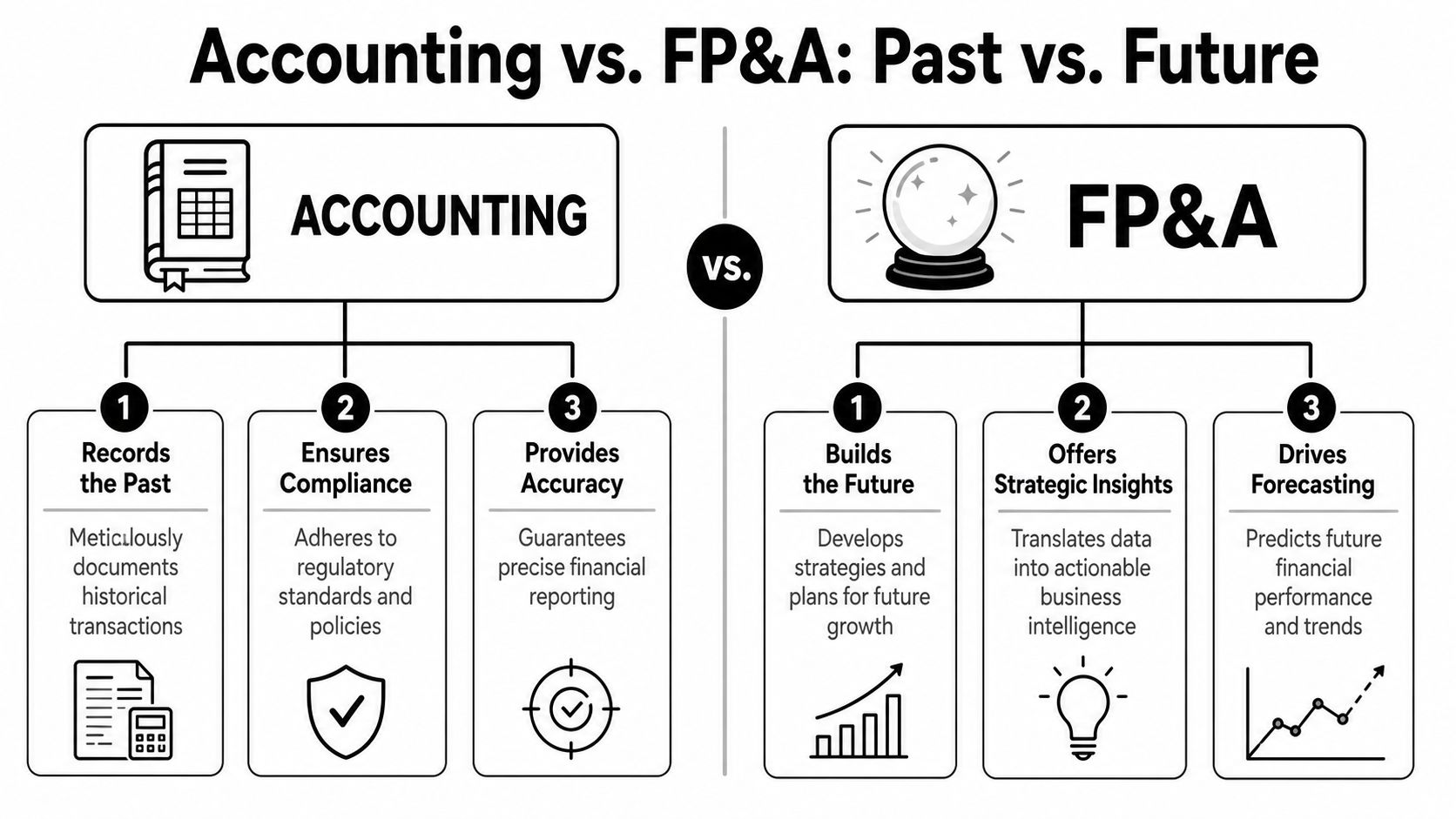
Accounting records verified transactions, closes the books, and produces compliant financial statements. FP&A uses that history to build budgets, rolling forecasts, and scenario models that help management make decisions. That distinction is laid out clearly in Workday's explanation of FP&A and accounting.
Accounting protects the integrity of the numbers
Your accounting team answers questions like these:
- What revenue did we recognize
- What expenses belong in this period
- Are the books closed accurately
- Are we compliant with GAAP or IFRS
- Can these numbers stand up to audit or tax scrutiny
That's valuable work. It's not optional. Without it, every forecast and every strategic decision sits on bad data.
Accounting is your scorekeeper. It tells you what happened, what you own, what you owe, and whether the record is reliable.
FP&A turns the numbers into decisions
FP&A asks different questions:
- What will cash look like over the next quarter
- Can we afford this hiring plan
- Which service line drives profit
- What happens if a major job starts late or margins compress
- How should we allocate capital
Many founders often stumble. They assume budgeting is just a more advanced accounting task. It isn't. Good FP&A is an operating tool. It connects the financial statements to the core drivers of the business, then tests what happens when those drivers change.
A simple example helps. Accounting tells you gross margin last month. FP&A asks why it moved, whether that move will continue, and what management should do about it. If you want to make those reviews useful, strong budget vs actual variance analysis is usually the first discipline to tighten.
Accounting tells you whether the books are right. FP&A tells you whether the plan is right.
Don't combine them in your head
In the org chart, both functions often sit under the CFO. In practice, they serve different purposes.
One is built around precision, compliance, and the close. The other is built around forecasting, scenario planning, and management decision-making. When a founder treats FP&A like “accounting plus extra spreadsheets,” the business usually gets neither function done well.
How Accounting and FP&A Compare in Practice
The difference gets clearer when you look at what each team does all week, what they produce, and what tools they live in.
Here's the founder-level version.
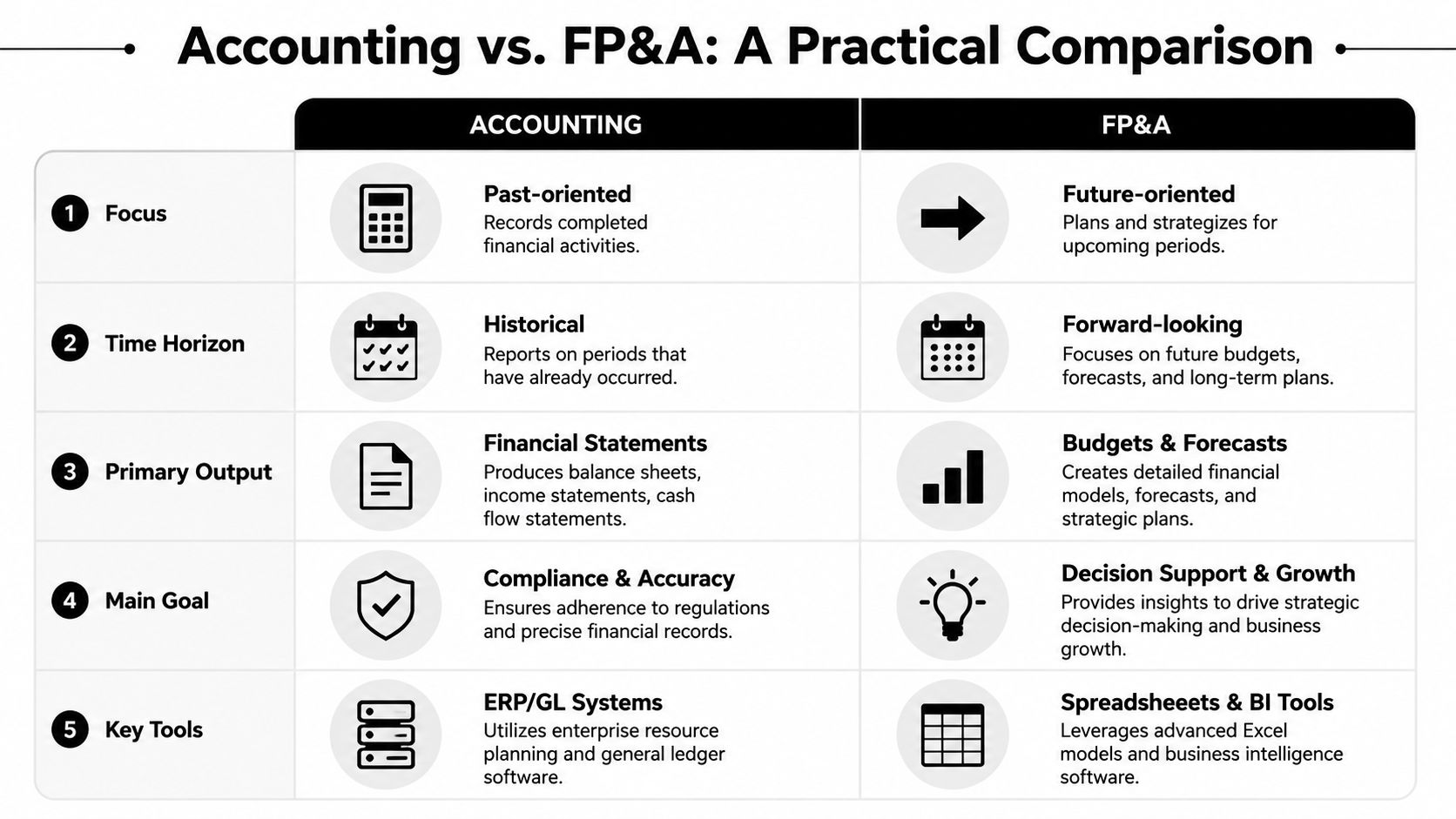
A founder level comparison table
| Area | Accounting | FP&A |
|---|---|---|
| Primary focus | Historical accuracy | Forward planning |
| Core objective | Compliance, control, clean close | Decision support, resource allocation |
| Typical outputs | Financial statements, reconciliations, tax support, audit support | Budgets, forecasts, KPI dashboards, scenario models, board reporting |
| Time horizon | Past and present | Future |
| Main stakeholders | Auditors, tax authorities, controller, CFO | CEO, CFO, operators, department leaders, board |
| Tolerance for ambiguity | Low | Higher |
| Questions answered | What happened | What's likely to happen and what should we do |
| Tool stack | ERP and general ledger systems | BI tools, planning platforms, advanced Excel models |
A practical tooling gap matters here. Accounting functions usually work inside transactional systems like SAP, Oracle, NetSuite, and QuickBooks, while FP&A relies on analytical tools like Power BI, Tableau, Anaplan, and complex Excel models for budgeting and forecasting, as outlined in this tooling comparison from Vinod Deenadayalan.
If you want your management team to use finance instead of ignoring it, track the financial metrics every business owner should track in a format tied to operations, not just the chart of accounts.
A useful career and market view sits in this interview as well:
Where teams usually get stuck
The biggest operational problem isn't just past versus future. It's translation.
Accounting may define revenue one way. FP&A may model bookings, ARR, margins, or headcount another way. If those definitions aren't aligned, leadership gets two different versions of reality. That's how founders end up in meetings debating numbers instead of making decisions.
Common breakdowns look like this:
- Revenue definitions drift when one team models gross figures and another validates net figures.
- Headcount gets muddled when operations, HR, and finance count different roles.
- Close timing creates friction when FP&A starts modeling before accounting is comfortable releasing final actuals.
Operator's warning: The report isn't useful if accounting can't validate the inputs and management can't understand the output.
The best finance teams solve this with a shared data dictionary and explicit handoffs. Someone needs to define what counts, what doesn't, and when actuals are final enough to support planning.
That sounds small. It isn't. It's the difference between a planning model leadership trusts and one they ignore.
When Your Business Needs to Hire for Each Role
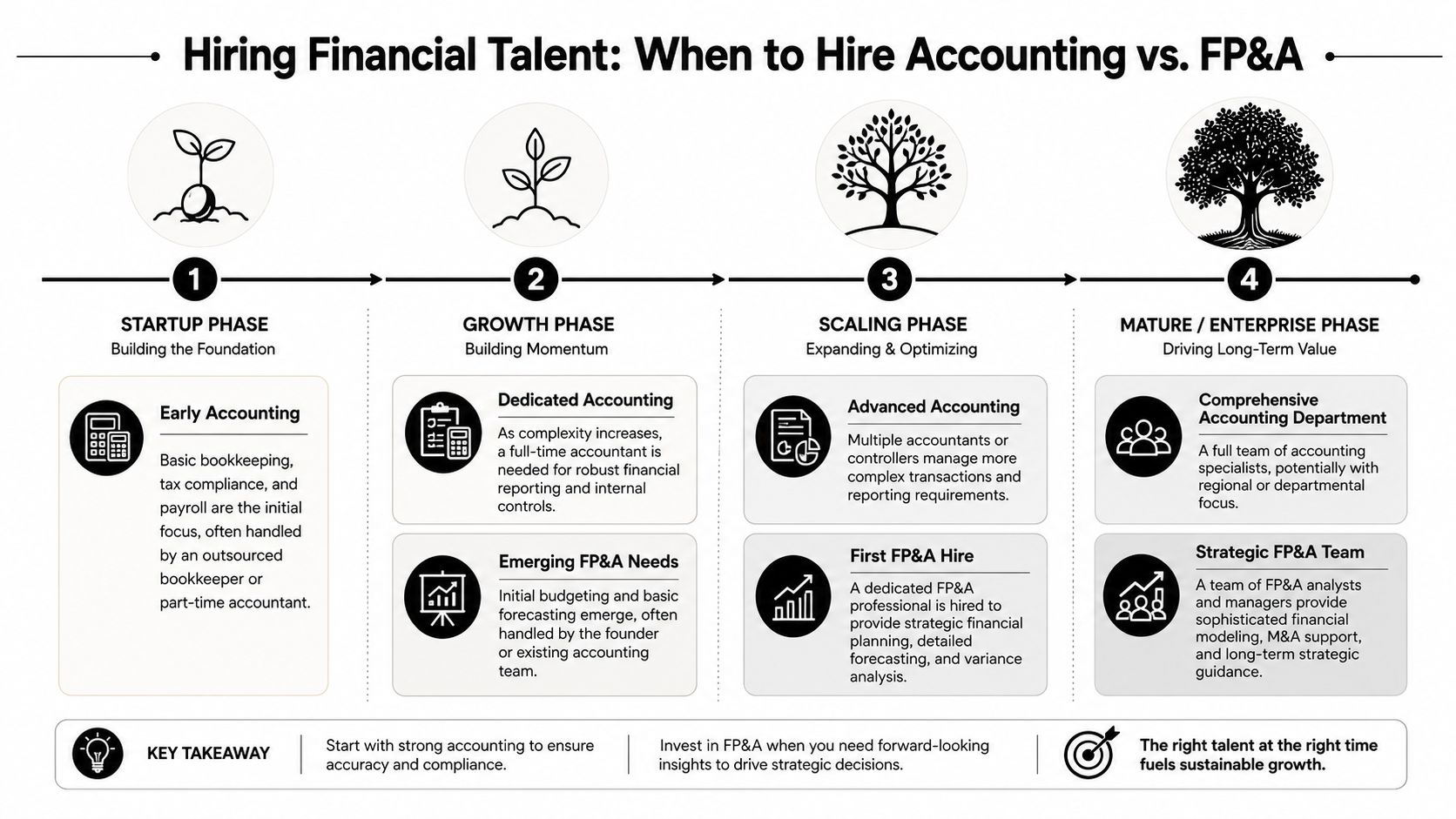
Founders ask the wrong question here. They ask, “Do I need FP&A?” The better question is, “What finance capability does my business need at this stage?”
For most companies, hiring follows business complexity, not vanity. You don't add finance layers because the org chart says so. You add them because the business starts making decisions that accounting alone can't support.
What accounting should own first
If your company is under $10M, a strong bookkeeper, accountant, or controller often covers what you need. The priorities are basic but critical:
- Clean monthly closes
- Cash discipline
- Payroll accuracy
- Tax compliance
- Reliable reporting
That's not glamorous. It's still the right order.
If the close is messy, receivables are disorganized, or the P&L changes after the fact, don't hire FP&A first. Fix accounting. Forecasts built on unstable actuals waste time and create false confidence.
What changes after 10 million
Once a business moves into the $10M to $100M range, the decision changes. There isn't a universal trigger that says, “At this exact size, accounting stops being enough.” In fact, Jirav's discussion of FP&A advisory for accounting firms notes that fractional CFO services have grown significantly over the past decade for companies that need CFO-level guidance without full-time overhead, while also noting that no major source pins down an exact threshold where accounting's historical focus becomes insufficient.
That matches what I see in the field. The key trigger isn't revenue alone. It's complexity.
You likely need dedicated FP&A capability when several of these show up at once:
Cash swings matter more
Construction, distribution, and project-based firms can look profitable and still hit liquidity pressure. If collections, inventory, retainage, or job timing move cash hard, you need forward-looking cash modeling.Margin visibility is weak
If you can't clearly see profitability by job, customer, channel, or service line, management is making growth bets without enough evidence.Big decisions stack up
Hiring, equipment purchases, pricing moves, expansion, and debt decisions all need modeling. Gut feel stops being efficient.Leadership needs monthly guidance, not just monthly reporting
Once department heads rely on finance to plan capacity and performance, accounting alone won't keep up.
If your finance team closes the month well but can't model the next quarter well, you're late on FP&A.
A full-time CFO or FP&A leader isn't always the first answer. Many founder-led firms are better served by a staged approach. That's why owners often look at when to hire a CFO only after they've identified which finance problems are strategic versus transactional.
Analyzing the Cost and ROI of Your Finance Function
At this juncture, founders either make a smart move or stall out.
They know they need better forecasting, better cash visibility, and sharper planning. Then they look at the cost of senior finance talent and decide to wait. That delay usually costs more than the hire would have.
What the market says about cost
There is a real pay gap between accounting leadership and FP&A leadership. According to the salary figures shared in this FP&A career discussion on YouTube, Accounting Directors typically earn between $100,000 and $180,000, while FP&A Directors typically earn between $145,000 and $250,000 or more, often with stock options at the higher end.
That spread exists for a reason. The market pays more for finance leaders who can connect performance, planning, and strategic decisions.
The same source also notes that entry-level accounting analysts typically earn $50,000 to $65,000, while FP&A analysts start at $67,000 to $85,000, and that approximately 20,900 job openings per year exist in the United States for FP&A talent. That should tell you something. Companies are buying decision support, not just recordkeeping.
What the return actually looks like
The mistake is treating FP&A like overhead.
Strategic finance should improve how you allocate labor, price work, plan capital spending, and manage cash. In a founder-led business, that usually shows up in a few concrete ways:
- You stop hiring off instinct and start testing headcount against revenue, gross margin, and cash capacity.
- You identify weak lines faster because reporting ties financial performance to operational drivers.
- You see cash pressure earlier instead of finding out after the fact.
- You make expansion decisions with a model instead of a hopeful narrative.
You don't need a perfect spreadsheet factory. You need a finance function that helps management avoid expensive mistakes and back profitable moves with evidence.
A simple decision frame works well:
| Question | If the answer is yes |
|---|---|
| Are major decisions happening without modeled downside risk | Add strategic finance |
| Are cash surprises disrupting operations | Build cash forecasting capability |
| Are leaders debating numbers instead of acting on them | Tighten reporting and planning ownership |
| Is the full-time cost too high right now | Use a fractional model first |
Founders who understand this stop asking, “What does it cost?” and start asking, “What bad decisions does this prevent?”
How a Fractional CFO Delivers High-Impact FP&A
For most companies in the middle market, the answer isn't replacing accounting. It's adding strategic finance on top of accounting.
That's where a fractional CFO model fits well.
Why this model works
Accounting is governed by external rules. FP&A isn't. As explained in this discussion of finance and accounting regulation, accounting is driven by frameworks like GAAP or IFRS, while FP&A is driven by management's internal planning needs. That flexibility matters because your leadership team doesn't need another compliance function. It needs a planning function shaped around the business.
A good fractional CFO doesn't come in to do bookkeeping, tax prep, or audit support. Your accounting team should already own that.
The value shows up in work like this:
- 13-week cash flow forecasting for short-term liquidity control
- KPI dashboards that connect finance to operations
- Budgeting and reforecasting tied to real business drivers
- Margin analysis by job, customer, or service line
- Scenario planning before hiring, borrowing, or expanding
If you're still unclear on the role, this breakdown of what a fractional CFO does is a useful primer.
What good execution looks like
The best setup is simple.
Accounting closes the books and delivers reliable actuals. Strategic finance takes those actuals, adds operating assumptions, and turns them into decisions management can use. The owner gets clarity without paying for a full in-house executive team before the business needs one.
Strong founders don't need more reports. They need better financial judgment built into operating decisions.
That's an important advantage of fractional FP&A leadership. It gives the company senior-level insight without forcing an early full-time executive hire.
Your Decision Checklist Is It Time for Strategic Finance
If you're still deciding between strengthening accounting and adding FP&A, use this checklist. It's practical and fast.
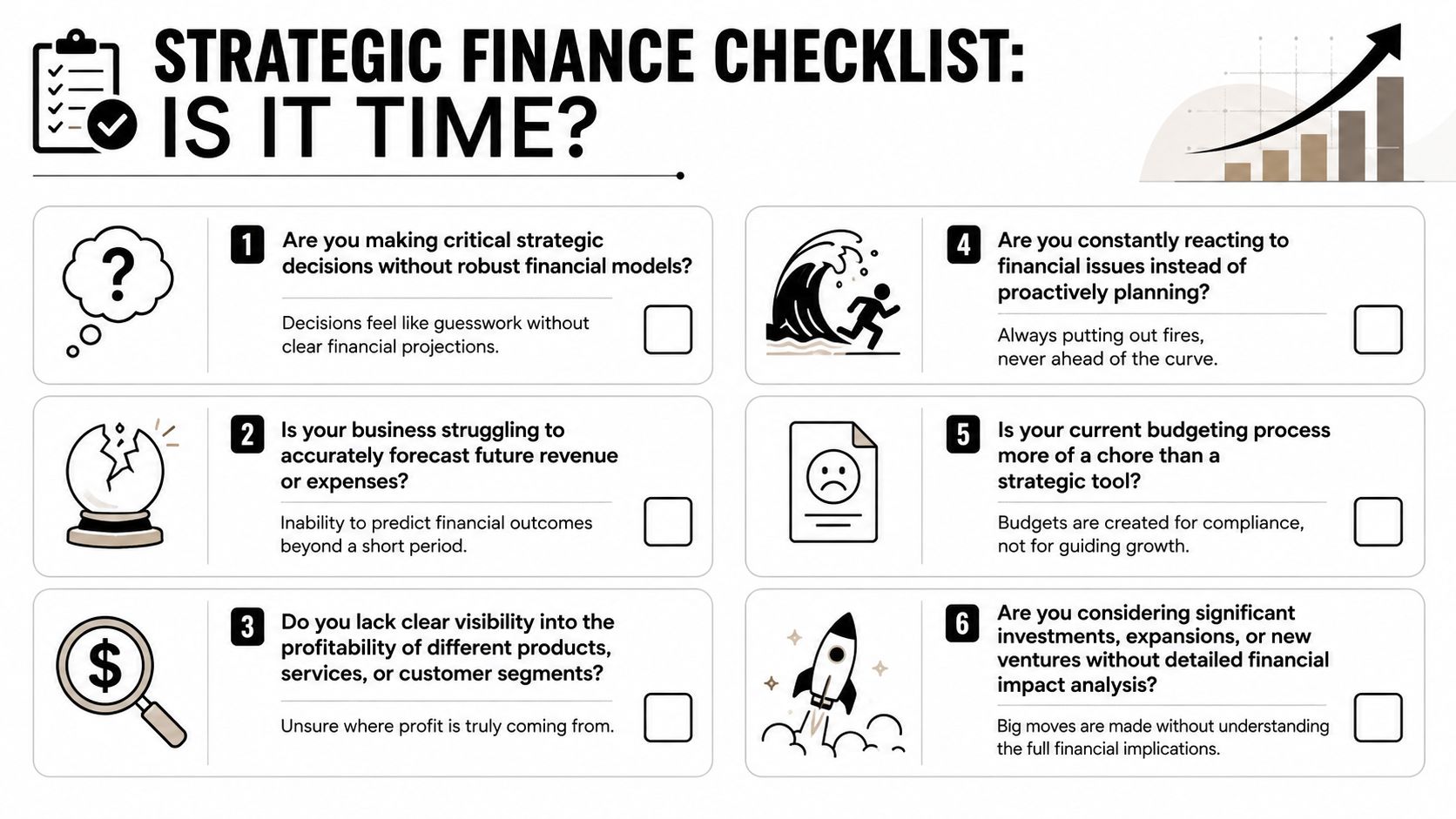
Use this checklist today
Answer yes or no.
Are you making major decisions without a financial model
If you're approving hires, equipment, expansion, or contract commitments based mostly on instinct, finance is behind the business.Can you forecast cash with confidence over the near term
If the answer is no, your reporting may be fine while your planning is weak.Do you know which jobs, clients, or service lines drive profit
Not revenue. Profit.Does budgeting help operators make decisions
If your budget is a once-a-year exercise that nobody uses, that's not FP&A. That's admin.Do department leaders trust the numbers enough to act on them
If every meeting turns into a debate over definitions, the finance handoff is broken.Are you preparing for growth, borrowing, or an eventual exit
Those moves need scenario analysis, not just clean books.
If you answered yes to several of those, you likely don't need “more accounting.” You need strategic finance layered onto the accounting foundation you already have.
The right next move is straightforward. Keep the books clean. Define the operating metrics clearly. Build a forward-looking cash and profit model. Then use it in management meetings every month.
If your business is in the $10M to $100M range and you need sharper cash flow visibility, better forecasting, and finance support for real operating decisions, talk with AmbitionCFO. They work with founder-led companies that have outgrown basic accounting and need senior-level financial strategy without the cost of a full-time CFO.