
Outsourced CFO services usually cost $3,000 to $10,000+ per month, versus $200,000+ for a full-time CFO, which is why many founder-led companies use this model to get senior financial strategy at a 60% to 80% lower cost. If your business is in the awkward middle ground where bookkeeping is covered but major decisions still depend on gut feel, outsourced CFO support is often the most rational next hire.
You're likely here because your company has outgrown clean monthly closes and backward-looking reports. Revenue is up, complexity is up, and the decisions in front of you are expensive. Equipment purchases, hiring plans, pricing changes, inventory bets, expansion, debt, and eventual exit planning all require more than a P&L review from your CPA.
That's where founders get into trouble. They buy something labeled “CFO” and get bookkeeping, tax coordination, and generic commentary instead of real financial leadership. The result isn't just disappointment. It's wasted spend, delayed decisions, and weak visibility into cash, margins, and business value.
This is the question you're trying to answer: what should outsourced CFO services cost, and how do you make sure you're paying for strategy instead of accounting work in disguise?
Table of Contents
- Is It Time to Hire a Strategic Financial Partner
- How Outsourced CFOs Bill Decoding the Pricing Models
- What Really Drives Outsourced CFO Costs
- Sample Pricing Scenarios What to Expect for Your Business
- Calculating the ROI From Cost to Strategic Investment
- How to Hire the Right Outsourced CFO
- Your Next Step Toward Financial Clarity with AmbitionCFO
Is It Time to Hire a Strategic Financial Partner
If you're running a founder-led business and your financial reports tell you what happened but not what happens next, you've hit the limit of a bookkeeping-led finance function. That's the point where owners start asking harder questions. Can we afford this hire? Which jobs or clients are producing margin? How tight will cash get if receivables slip?
The cost question is simpler than most firms make it. Outsourced CFO services typically cost between $3,000 and $10,000 per month, a 60% to 80% cost reduction compared to a full-time CFO whose total compensation often exceeds $200,000, according to Fractional CFO School's outsourced CFO pricing guide. For a founder who needs senior judgment without adding another executive salary, that's a practical move, not a compromise.
A real CFO partner doesn't replace your bookkeeper or your tax preparer. That person should turn financial data into decisions. Cash planning. Forecasting. Margin analysis. KPI discipline. Capital allocation. Exit readiness.
Practical rule: If your team closes the books on time but still can't answer “what happens to cash over the next quarter?” you don't have a reporting problem. You have a leadership gap.
Three signs usually show up at once:
- Cash surprises keep happening: Revenue may be fine, but timing risk is controlling the business.
- Big decisions lack modeling: Hiring, equipment, inventory, pricing, and expansion are getting approved without scenario analysis.
- Your finance support is backward-looking: The team can reconcile the past, but nobody owns the future.
If that sounds familiar, start with a CFO-level lens before you jump to a full-time hire. The economics usually work better, and the decision gets easier once you understand when to hire a CFO.
How Outsourced CFOs Bill Decoding the Pricing Models
Most founders compare proposals without first understanding how the billing model shapes behavior. That's a mistake. Pricing doesn't just affect budget. It affects responsiveness, scope discipline, and whether your CFO partner thinks like an operator or a task vendor.
Monthly retainers are usually the right fit
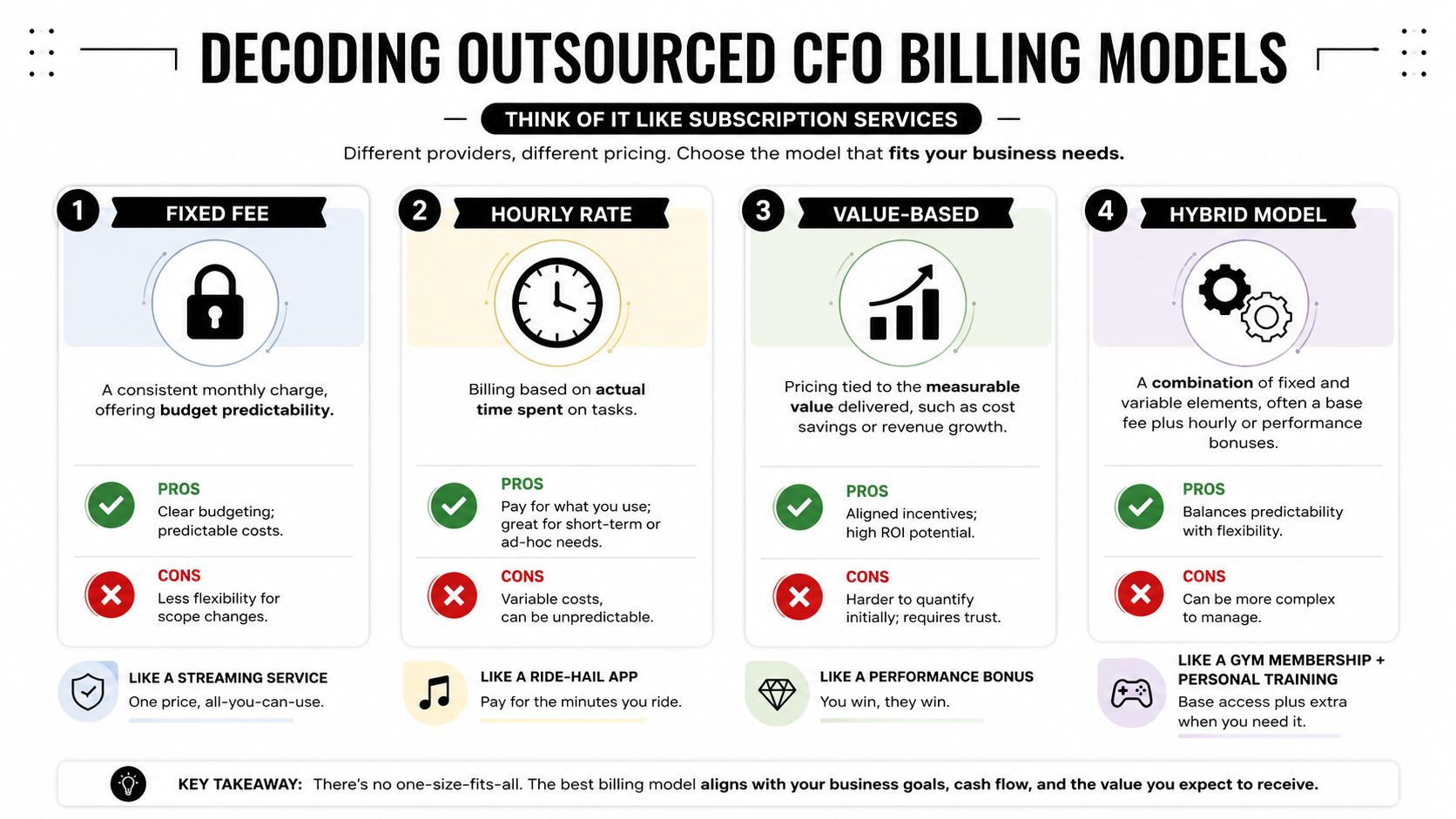
A monthly retainer works like a business-class subscription. You pay a fixed amount for ongoing access, recurring deliverables, and regular strategic involvement. For most companies in the $10M to $100M range, this is the cleanest structure because financial leadership shouldn't stop and start every time a question comes up.
Retainers work best when you need ongoing help with forecasting, KPI review, margin analysis, and leadership decision support. They also force both sides to define deliverables clearly.
Pros
- Budget clarity: You know what finance leadership costs each month.
- Better habits: Monthly review rhythms happen.
- More proactive support: The CFO has room to raise issues before they become expensive.
Cons
- Scope needs discipline: If the statement of work is sloppy, confusion starts fast.
- Not ideal for one-off needs: A single transaction or model build may not need a retainer.
When hourly and project pricing make sense
Hourly pricing is the pay-as-you-go version. It sounds flexible, and sometimes it is. But it can also encourage tactical requests over strategic ownership.
Senior CFO time usually runs $200 to $400 per hour, and firms often use fixed project fees for defined work. A detailed financial model can cost $10,000 to $35,000, according to The Expert CFO's guide to pricing CFO services. That structure makes sense when you need a specific deliverable and don't want retainer ambiguity.
Use hourly or project pricing for:
- Model builds: Annual planning models, cash scenarios, lender packages
- Transaction prep: Diligence support, cleanup before a sale process
- Short diagnostics: A focused assessment of margins, reporting, or cash controls
Here's the difference in plain English:
| Model | Best use | Watch out for |
|---|---|---|
| Monthly retainer | Ongoing leadership and decision support | Vague scope |
| Hourly | Limited, irregular needs | Unpredictable monthly bills |
| Project-based | Defined deliverable with an end point | No ongoing accountability |
A founder who wants a partner, not a spreadsheet mechanic, usually ends up with a retainer.
Where value-based and hybrid models fit
You'll also hear about value-based and hybrid models. Value-based pricing ties fees to the business impact created. In theory, that aligns incentives. In practice, many founders can't measure the impact cleanly enough at the start of the relationship to make this model easy to manage.
A hybrid structure combines a base fee with variable work. That can work well if your business has a stable monthly need plus occasional projects, such as a recurring forecast process plus ad hoc board materials or financing support.
The best billing model is the one that matches the way decisions happen in your business, not the one that looks cheapest in the proposal.
If you want a better read on scope before you evaluate price, review what a fractional CFO actually does. Founders who skip that step tend to buy the wrong service.
What Really Drives Outsourced CFO Costs
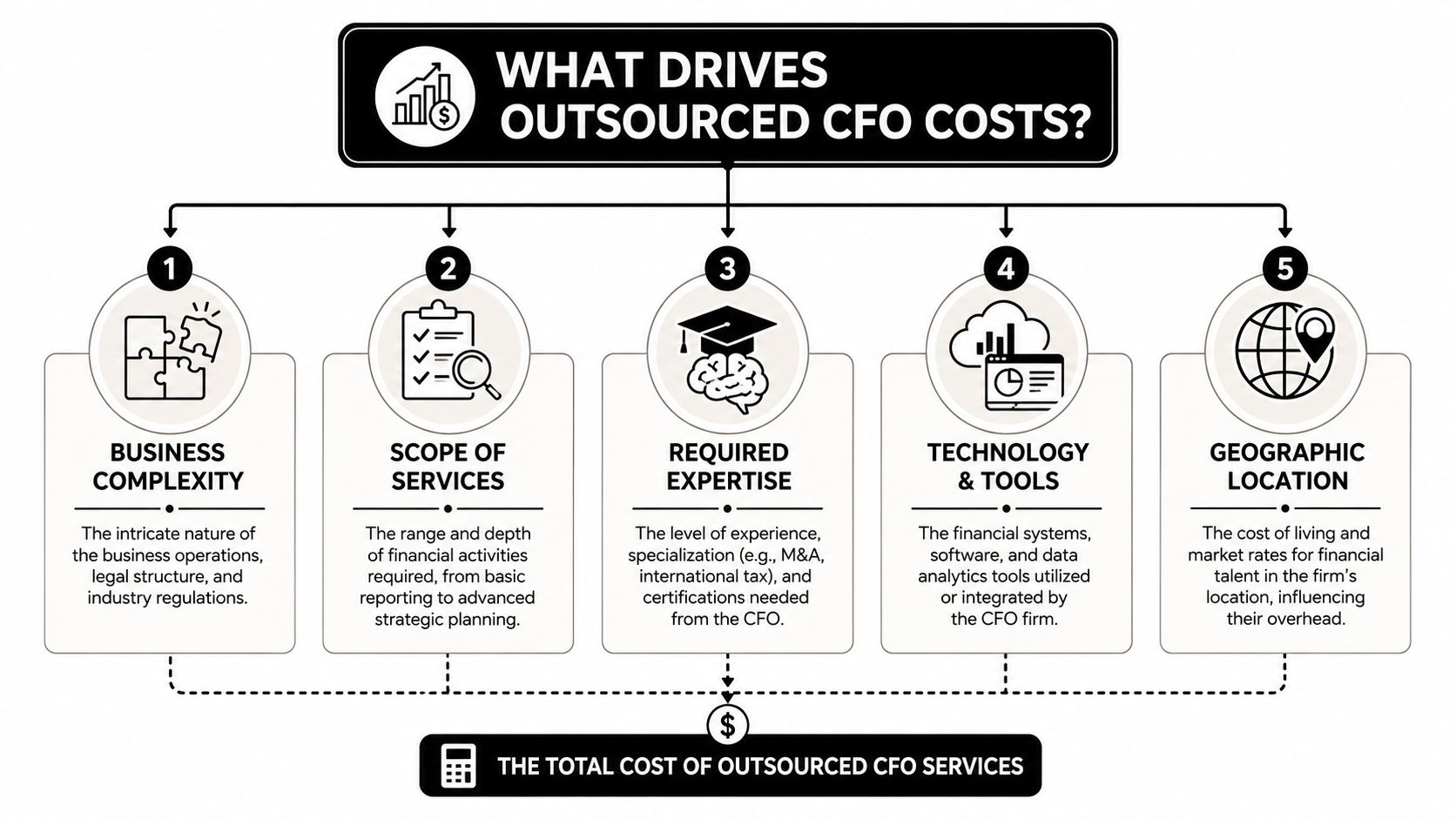
The monthly number on the proposal is just the surface. Two firms can quote very different fees for what sounds like the same service because the actual work is completely different.
Scope matters more than the title
The biggest pricing variable is scope. Not the title on the proposal. Not the logo on the website. Scope.
A true CFO scope includes forward-looking work: cash forecasting, budget variance analysis, scenario planning, profitability analysis, owner decision support, and in some cases exit planning. A bookkeeping scope includes transaction processing, reconciliations, and routine close support. Both matter. They are not the same service.
Many founders commonly overspend. The single biggest hidden cost is misaligned scope. Many outsourcing deals fail because founders pay for bookkeeping or tax prep bundled into a “CFO” package, potentially wasting $20,000 to $40,000 annually on services that don't deliver true strategic FP&A value, according to The Expert CFO's analysis of outsourced CFO pricing mistakes.
That hidden drain is worse than an overpriced retainer because it creates false confidence. You think you bought strategic finance leadership. Instead, you bought cleaner historical reports.
If the proposal spends more space on bookkeeping support than on forecasting, margin analysis, and decision support, it's not a CFO proposal. It's an accounting package with a better title.
Industry complexity changes the price
Industry matters because the financial questions change by business model.
A construction company needs job-level margin visibility, WIP discipline, billing position review, and cash planning tied to project timing. A distribution company needs working capital control, inventory decisions, gross margin analysis by product or customer, and tighter visibility into receivables. A professional services firm may need utilization, pricing discipline, and client profitability analysis.
The more your business depends on timing, job costing, backlog quality, or multi-entity complexity, the more senior judgment you need. That's why firms in construction and distribution often pay more than businesses with simpler operating models.
A few common cost drivers show up repeatedly:
- Operational complexity: Multiple entities, locations, or revenue streams increase the work.
- Decision cadence: Owners making frequent capital or hiring decisions need more active CFO involvement.
- Specialization: Industry-specific experience commands a premium because it shortens the learning curve.
- Leadership access: If the CFO attends regular owner meetings and drives decisions, price rises with value.
If your business is growing fast and finance still runs on disconnected spreadsheets, you're probably already paying for the problem through delay, confusion, and weak forecasting. That's why financial forecasting for growing businesses becomes a strategic issue, not an admin issue.
What a strategic scope should include
Before you approve a proposal, check whether the work changes decisions.
A strategic outsourced CFO scope should usually include:
- A rolling cash process: Not a static annual budget. A live view of short-term cash movement.
- Margin visibility: By job, client, product line, or business unit.
- Forecasting and scenarios: Hiring plans, pricing changes, debt capacity, expansion timing.
- KPI reporting: A dashboard the owner can effectively use.
- Structured leadership meetings: Real review cadence with action items.
A bookkeeping-heavy scope usually sounds different:
- Transaction support
- Reconciliations
- Basic monthly financial statements
- Tax coordination
- Compliance administration
None of that is bad. It's just not CFO work.
Sample Pricing Scenarios What to Expect for Your Business
You approve a proposal for "outsourced CFO" support. Ninety days later, you have cleaner monthly financials, reconciliations are caught up, and the same cash surprises still hit your desk. You did not buy CFO leadership. You bought upgraded accounting with a better title.
That mistake is expensive.
The budget question is not just how much outsourced CFO services cost. It is whether the scope changes decisions that affect cash, margin, and growth. If the work stops at reporting, the retainer is too high even at the low end.
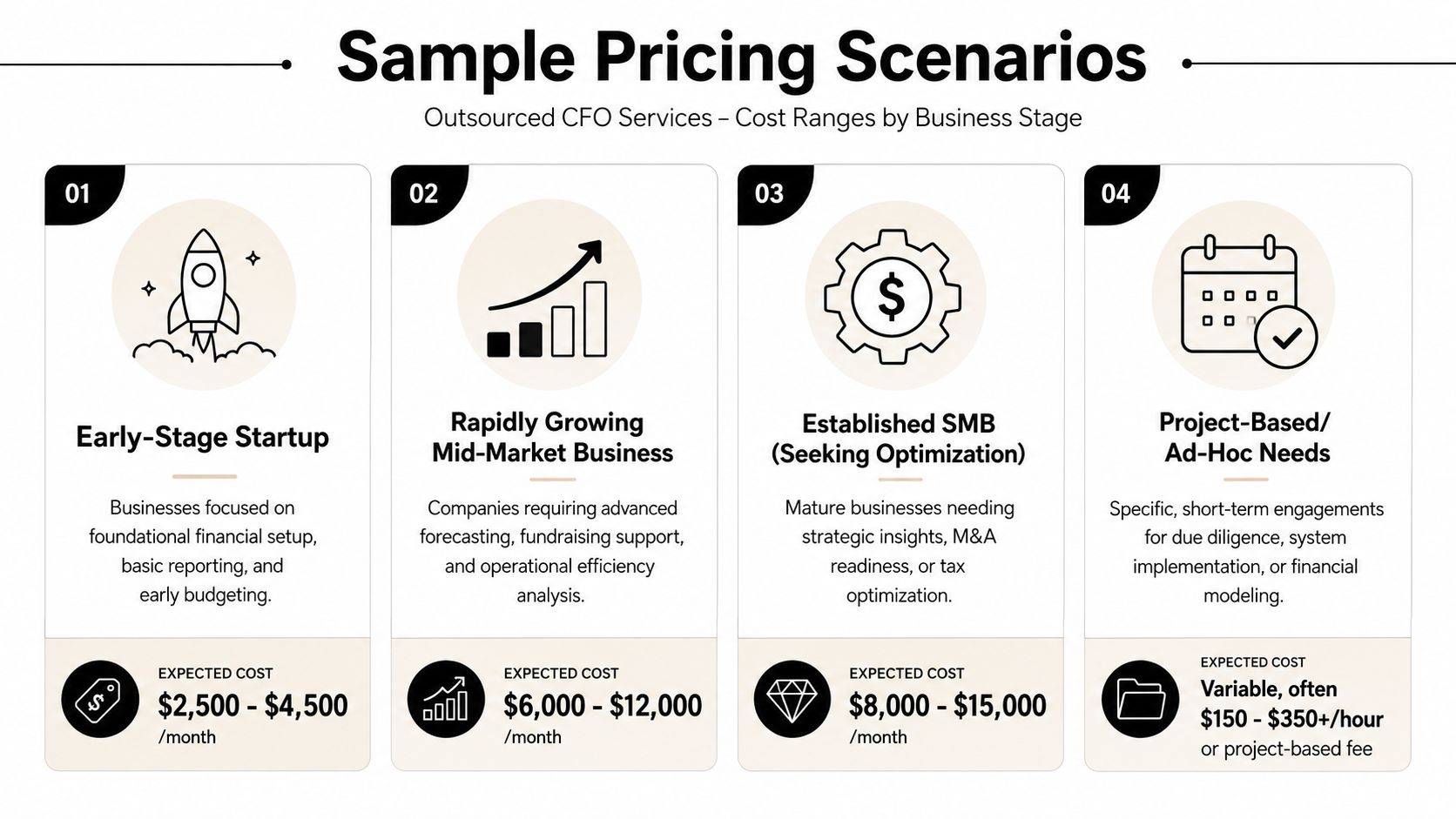
Use the scenarios below to sanity-check proposals. Focus less on revenue bands and more on operating complexity, decision cadence, and whether the provider is leading the financial agenda.
$15M construction company
The controller closes the books. The CPA handles tax. Jobs are active, backlog looks strong, and cash still gets tight at the wrong time. Equipment purchases, staffing additions, and billing delays are all hitting the business at once.
This company does not need more bookkeeping. It needs tighter cash discipline and faster job-level decisions.
WIP Insights notes that construction and distribution firms with $5M to $50M in revenue commonly pay $3,000 to $8,000 per month for outsourced CFO services, and that a typical $5,000 monthly engagement includes a 13-week cash flow forecast, margin analysis by job, and strategic owner sessions, according to WIP Insights' construction and distribution CFO cost guide.
Expected scope:
- 13-week cash flow forecast
- WIP schedule review
- Margin analysis by job
- Monthly owner strategy sessions
- Action list tied to billing, collections, and staffing decisions
Expected monthly cost:
- $3,000 to $8,000
- Around $5,000 if the provider is actively reviewing job economics and driving owner decisions
What should improve:
- Billing delays get exposed early
- Collections become a managed process
- Weak jobs stop hiding inside aggregate results
- Equipment and hiring decisions get tied to cash reality
If a provider at this level spends most of the month inside reconciliations and month-end cleanup, the scope is misaligned.
Later in the buying process, some owners compare startup-focused offers. That usually creates more confusion than clarity at this stage, but it helps to understand how fractional CFO services for startups differ from operational CFO support for a company with real field execution, backlog management, and working capital pressure.
$30M distribution company
This founder has a different problem. Revenue is solid. Cash conversion is sloppy. Inventory absorbs too much capital, customer margins vary more than expected, and the leadership team wants to expand before it has clear unit economics by customer, product line, or geography.
Founders often overpay for the wrong scope. A provider offers "CFO services" but spends the engagement producing board-style reports without owning the underlying decisions on pricing, purchasing, inventory turns, receivables, and forecast accuracy.
For a business like this, the monthly spend usually sits in the upper middle of the market because the work must stay close to operations. Preferred CFO's outsourced CFO services overview describes outsourced CFO support as a senior finance function used for forecasting, cash flow management, budgeting, strategic planning, KPI development, and lender or investor reporting. That is the right general shape for a distribution company with active inventory and expansion decisions.
Expected scope:
- Weekly or biweekly cash and working capital review
- Gross margin analysis by customer, product category, or channel
- Inventory and purchasing discipline tied to forecast demand
- Scenario modeling for expansion, debt capacity, and hiring
- Leadership meeting participation with clear financial action items
Expected monthly cost:
- Higher than a light-touch advisory retainer
- Usually justified only if the CFO is influencing operating decisions, not just reporting results
What should improve:
- Inventory buys get tied to cash and margin targets
- Customer profitability becomes visible
- Expansion plans get tested before capital is committed
- Leadership meetings shift from commentary to decisions
My recommendation is simple. If your distribution business is still debating SKU mix, freight recovery, customer pricing, or branch expansion, do not buy a reporting package under a CFO label. Buy decision support.
A low retainer with weak operating involvement usually costs more than a higher retainer with real financial leadership.
$12M professional services firm
The P&L says the business is healthy. Cash says otherwise. Senior staff are stretched, client mix is uneven, and hiring happens after delivery teams are already under pressure. Bonuses get discussed late because nobody trusts the forecast.
That is a classic founder-led services problem. The issue is not whether the books close on time. The issue is whether the company knows which clients create cash, which teams produce margin, and when capacity needs to be added.
DMG CPAs states that many small to midsize businesses in the $10M to $100M range use outsourced CFO retainers in the $5,000 to $7,500 per month range for 20 to 40 hours of senior finance support, according to DMG CPAs' outsourced CFO services overview.
This is usually the right fit when the owner needs:
- Better cash planning
- Client or service-line profitability analysis
- Hiring and compensation modeling
- More accountability in monthly leadership meetings
A weak scope in this category usually sounds administrative. Budget updates. Monthly reports. Variance summaries. A real CFO scope sounds different. Which clients are dragging margin. Whether hiring ahead of demand makes sense. Whether compensation plans reward the right behavior.
You can also watch a practical overview here before comparing proposals:
A simple budgeting worksheet
Use this before you take a sales call.
| Question | If yes | Budget implication |
|---|---|---|
| Do you need ongoing cash forecasting? | Regular strategic involvement | Lean toward monthly retainer |
| Do you need job, client, or product margin analysis? | Higher complexity | Expect mid to upper range pricing |
| Are you planning expansion, ownership transition, or major hiring? | More scenario work | Budget for deeper CFO scope |
| Do you mainly need a one-time model or cleanup project? | Defined deliverable | Consider project pricing |
One final test matters most. Ask the provider what decisions they will improve in the first 90 days. If the answer centers on cleaner reports, you are still shopping for accounting support. If the answer centers on cash timing, margin quality, pricing discipline, hiring pace, and capital allocation, you are talking to a real CFO.
Calculating the ROI From Cost to Strategic Investment
A founder signs a $10,000 monthly CFO retainer, then spends the next six months getting cleaner closes, updated dashboards, and bookkeeping oversight dressed up as strategy. The reports improve. The business does not. That is the core cost problem.
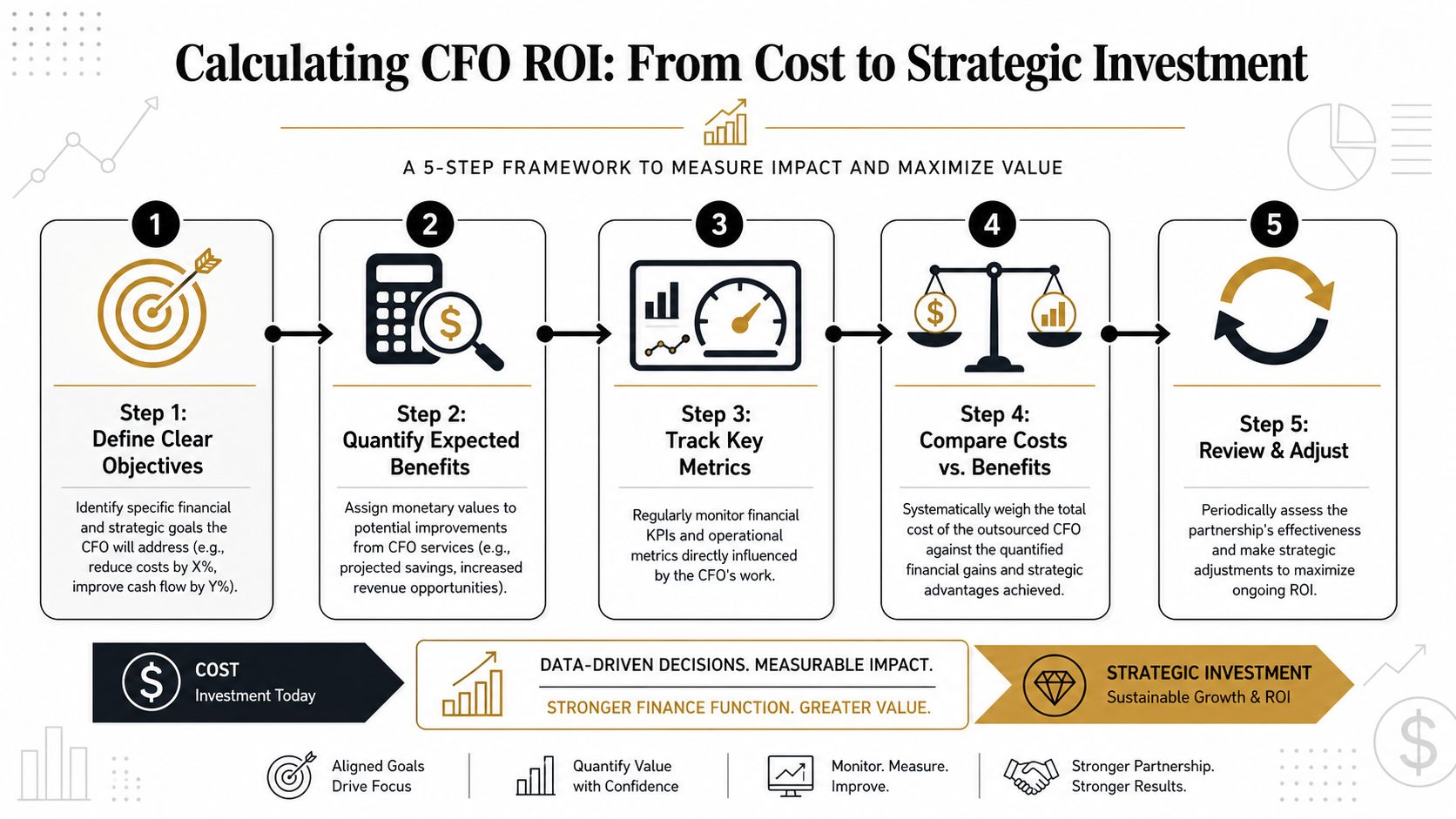
Founders in the $10M to $100M range should judge outsourced CFO cost by decision quality, speed, and financial impact. A monthly retainer can be an excellent investment. It can also be an expensive way to buy accounting support under the wrong title. If the scope does not change how you price, hire, forecast cash, manage working capital, or allocate capital, you are not buying CFO value.
Start there. Scope first. Fee second.
A practical ROI worksheet
Use a five-part review tied to business decisions.
Calculate the full annual spend
Multiply the monthly retainer by twelve. Add onboarding, model rebuilds, systems work, and any project fees outside the base scope.List the decisions this person should improve
Focus on decisions with real economic weight. Pricing changes, headcount timing, cash planning, customer or product profitability, inventory levels, debt use, and owner distributions.Put a dollar value on each decision area
Keep it grounded. A one-point margin improvement, a hiring delay that protects cash, faster collections, or lower inventory drag can justify the fee quickly.Measure operating changes every month
Track forecast accuracy, gross margin by segment, cash conversion, receivables aging, and how quickly the leadership team turns numbers into decisions.Review after one full operating cycle
One month proves nothing. One quarter shows traction. A full cycle shows whether the CFO improved the business or just improved reporting.
Here is the standard I use with founder-led companies:
- Cash visibility: Can you see cash pressure early enough to act with options still on the table?
- Margin control: Can you identify which customers, jobs, channels, or products create profit and which ones consume it?
- Resource allocation: Are hiring, inventory, and spending decisions tied to forecasted demand and margin, not gut feel?
- Founder time: Are you spending less time decoding reports and more time making high-value decisions?
A real CFO engagement should pay for itself through better choices, not administrative relief.
The outcomes worth measuring
The strongest returns usually show up in four places.
First, fewer expensive mistakes.
A CFO who tightens hiring pace, flags weak pricing, or exposes bad-fit customers can prevent losses that never appear as a line item called “savings.”
Second, stronger cash performance.
Better receivables discipline, cleaner forecasting, and smarter working capital management give founders room to choose instead of react.
Third, better margin quality.
Many businesses in this revenue range have acceptable top-line growth and weak profit discipline. A strategic CFO fixes that by showing where margin is earned, where it leaks, and what to change.
Fourth, better exit and lender readiness.
If you plan to refinance, raise capital, or sell in the next few years, financial clarity affects valuation, diligence friction, and buyer confidence.
That is why the ROI conversation should stay tied to outcomes, not title inflation. Paying CFO rates for controller or bookkeeping work destroys return. Paying for strategic finance that improves decisions creates return fast.
If you want a sharper way to assess that tradeoff, review this framework for fractional CFO ROI and business impact.
How to Hire the Right Outsourced CFO
A founder's biggest hiring mistake isn't overpaying. It's hiring a provider who talks like a strategist and operates like an accountant. The interview process should expose that quickly.
Questions that separate strategists from accountants
Ask direct questions. Good CFOs won't be offended.
Use this checklist in the first meeting:
“Show me how you build a 13-week cash flow forecast.”
If they stay high-level, keep digging.“How do you analyze margins in a business like mine?”
Look for specifics. Job, client, product, service line, pricing, labor mix, backlog, receivables.“What decisions do you expect to help me make every month?”
A strategist names decisions. A weak provider names reports.“What work do you not do?”
This question matters. Strong providers know their lane.“How do your meetings with owners run?”
You want cadence, action items, and accountability. Not vague “advisory access.”“What would be in the first ninety days?”
The answer should include priorities, not generic onboarding language.
A real CFO partner should sound operational. They should talk about cash timing, profitability, forecast assumptions, and tradeoffs. If they spend most of the call on bookkeeping cleanup or tax coordination, they're telling you what they really sell.
How to read the proposal before you sign
Most proposals hide the truth in the scope section. Read that part slowly.
Good signs:
- Clear recurring deliverables
- Defined meeting cadence
- Forward-looking analysis
- Specific owner decision support
- Written boundaries around bookkeeping and tax work
Red flags:
- “CFO” plus bookkeeping in one package
- No mention of forecasting
- No KPI or margin work
- No regular review process
- No explanation of what happens each month
You're not buying intelligence in the abstract. You're buying a rhythm of financial leadership.
One more point. Fit matters. The right outsourced CFO should be able to challenge your assumptions without turning every discussion into accounting jargon. If they can't explain the business implications of the numbers clearly, they won't help your leadership team act on them.
Your Next Step Toward Financial Clarity with AmbitionCFO
By this point, the answer should be clear. Outsourced CFO services cost less than a full-time executive hire, but the fee only makes sense when the scope is right. That's the central decision.
The wrong provider bundles bookkeeping under a CFO label and calls it strategic support. The right provider focuses on the work that changes outcomes. Cash flow visibility. Forecasting. profitability improvement. KPI discipline. Decision support. Exit preparation.
That distinction matters most for founder-led businesses in the $10M to $100M range. At that size, you've usually outgrown basic accounting support, but you may not need or want a full-time CFO on payroll. You need senior financial leadership that embeds with the owner and leadership team, stays focused on forward-looking decisions, and doesn't dilute the engagement with bookkeeping or tax work.
That's exactly where AmbitionCFO fits. The firm serves founder-led businesses in construction, distribution, and professional services. Led by John Myklusch, CPA, CEPA, AmbitionCFO focuses on cash flow management, profitability improvement, financial forecasting, and exit planning. The work includes 13-week cash flow modeling, margin analysis by job or client, financial reporting, budgeting and forecasting, KPI dashboards, and CEPA-based exit planning for owners preparing for a transition.
Just as important, the model is focused. AmbitionCFO does not provide bookkeeping, tax preparation, audit services, business valuation, or fundraising support. That means the engagement stays centered on the highest-value work for founder-led companies that need strategic finance leadership, not outsourced accounting with a better title.
If you're staring at reports that don't help you decide, if your cash position still feels reactive, or if you're planning growth or transition without a reliable financial model, the next move isn't another generic accounting package. It's a strategic CFO conversation.
If your business is in the $10M to $100M range and you need sharper cash visibility, stronger forecasting, and a clearer path to higher profitability or exit readiness, schedule a conversation with AmbitionCFO. You'll get a direct discussion about your current financial blind spots, what strategic CFO support should include, and whether the scope fits what your business needs.