

Are you spending too much time on spreadsheets and not enough on growth? Do you need a compelling financial story to win over investors, but lack the expert to build it? For a startup, high-level financial strategy is non-negotiable, but the $300,000+ annual cost of a full-time executive is often out of reach. This is the exact problem fractional CFO services for startups are designed to solve.
A fractional CFO is a part-time strategic partner who provides top-tier financial oversight and planning, giving you the expertise you need to scale, without the full-time price tag.
Your Startup's Secret Weapon for Scalable Growth

As a founder, your genius is likely in building products or winning customers, not necessarily in financial modeling or cash flow forecasting. Yet, these are the very things that determine whether your startup thrives or dives. Many founders find themselves staring at financial data, unsure how to turn it into a growth strategy or a compelling pitch for venture capital.
This is a critical stalling point. The traditional solution—hiring a full-time Chief Financial Officer (CFO)—is unrealistic for most early-stage companies. This is precisely why fractional CFO services for startups have become a game-changer, offering a flexible, powerful, and affordable alternative.
How is a Fractional CFO Different From an Accountant?
It's crucial to understand this distinction. An accountant is backward-looking; they record and report on what has already happened, ensuring accuracy and compliance. A fractional CFO is a forward-looking strategic partner to the CEO. They take financial data and use it to chart the course for the future, focusing on growth, strategy, and increasing enterprise value.
A fractional CFO’s job is to turn financial chaos into clear, actionable intelligence. They craft the financial story that hooks investors and build the operational roadmap that leads to sustainable growth.
Their work delivers high-impact strategic guidance that directly shapes your company's trajectory and valuation.
What are the Core Tasks a Fractional CFO Handles?
A great fractional CFO brings the strategic muscle of a full-time executive to your leadership team. They zero in on the financial activities that will move the needle for your startup.
Here are three areas where they provide immediate, tangible value:
Fundraising Support: They act as your fundraising quarterback, building investor-ready financial models, sharpening your pitch deck, and guiding you through due diligence to help you close rounds faster and on better terms. A successful Series A raise can increase a startup's valuation by 2-3x.
Cash Flow Management: Cash is the lifeblood of a startup. By implementing robust cash forecasting, they help you manage your runway, avoid cash crunches, and make smarter spending decisions. This can extend your runway by 2-4 months, buying critical time to hit milestones.
Strategic Planning: They translate your vision into a concrete financial plan. This involves setting key performance indicators (KPIs) and creating budgets that align with your growth targets, ensuring every dollar is spent with intention.
A fractional CFO is a force multiplier for your business. At AmbitionCFO, we provide this embedded partnership to give founders the clarity and leadership needed to navigate challenges and build a solid foundation for growth.
What a Fractional CFO Actually Does for Your Startup
A fractional CFO is not just a senior accountant. While an accountant focuses on historical compliance, a fractional CFO is your forward-looking strategic partner, translating raw data into a blueprint for growth. They build the systems, strategies, and investor narrative that turn your vision into a fundable, scalable business.
The demand for this strategic partnership is growing. In the U.S., the need for fractional CFOs is increasing at 103% year-over-year. This is part of a global BPO market expected to hit $525 billion by 2030. You can learn more about the rise of fractional leadership on nowcfo.com.
So, what does this look like in practice? It boils down to a few critical, high-impact functions.
How to Build an Investor-Ready Financial Model
A simple expense-tracking spreadsheet won't cut it with a Venture Capitalist. A fractional CFO's first step is often to build a dynamic, three-statement financial model that projects your revenue, expenses, and cash flow for the next 3-5 years. This is the foundation of effective fractional cfo services for startups.
This is a living tool that allows you to:
Run "What If" Scenarios: Instantly see the impact of key decisions. What happens to our runway if we hire two more engineers? What if customer churn increases by 10%?
Pinpoint Growth Levers: Understand which metrics—like customer acquisition cost (CAC) or lifetime value (LTV)—have the biggest impact on your bottom line.
Defend Your Valuation: Enter investor meetings with a data-driven story that backs up every number in your funding request.
Real-World Example: We worked with a SaaS startup whose model showed a 12-month customer payback period. Our detailed analysis revealed it was actually 18 months, a blind spot that would have caused a cash crunch in less than a year. This insight triggered a pivot toward higher-margin clients, extending their runway by six crucial months and saving the business.
How to Master Cash Flow and Extend Your Runway
For a startup, cash isn't just king—it's oxygen. A fractional CFO’s priority is to ensure you never run out by building a disciplined, forward-looking cash management system.
Practical Step: A fractional CFO will implement a weekly cash flow dashboard. This tool tracks every dollar in and out and projects your "zero cash date"—the exact day your funds are projected to run out. This visibility allows you to shift from reactive, fear-based spending to proactive, strategic decisions about hiring, marketing spend, and operations.
How a Fractional CFO Drives Your Fundraising Strategy
Raising capital is a full-time job. A fractional CFO acts as your fundraising quarterback, managing the financial side of the process so you can focus on selling your vision.
Here’s a step-by-step look at how they improve your outcome:
Refine the Narrative: They ensure the numbers in your pitch deck align perfectly with your financial model, creating a believable and airtight story for investors.
Manage Due Diligence: When an investor's team begins their audit, your fractional CFO provides swift, accurate answers and a well-organized data room, which builds immense credibility and speeds up the process by weeks.
Decode Term Sheets: They model the real-world impact of different deal terms, helping you understand how liquidation preferences and option pools will affect your cap table and future returns.
How to Engineer Scalable Financial Systems
The financial stack that supports a five-person team will collapse at fifty. A fractional CFO designs a "finance stack" built for scale, preventing the operational chaos that comes from outgrowing your internal systems.
A typical startup finance stack they build includes:
Accounting: A clean chart of accounts in a system like QuickBooks Online to produce investor-grade financials.
Payroll & HR: A platform like Gusto to handle payroll, benefits, and compliance as your team grows.
Expense Management: Tools like Brex or Ramp to empower team spending while maintaining financial control.
This robust infrastructure ensures your financial engine can handle hyper-growth, providing a solid foundation for scaling to your next milestone.
How to Calculate the ROI of a Fractional CFO
As a founder, every dollar must be justified. The key question is: "Is hiring a fractional CFO worth the investment?" The answer lies not just in cost savings, but in the tangible gains that fuel your startup's growth, fundraising, and valuation.
A full-time CFO in a major tech hub can cost over $300,000-$500,000 per year with salary, benefits, and equity.
However, the true return on investment (ROI) comes from strategic improvements, not just salary avoidance.
How to Measure Performance Gains from a Fractional CFO
The real value of a fractional CFO appears in your key business metrics. They actively improve your company's financial health by focusing on the KPIs that investors scrutinize.
Numeric Outcome: By analyzing your Cost of Goods Sold (COGS) and pricing, a fractional CFO can often identify opportunities to improve gross margin by 5-15%, making every sale more profitable.
Numeric Outcome: Through meticulous forecasting and disciplined cash management, they can extend your cash runway by 3-6 months, giving you critical time to hit milestones before your next fundraising round.
Numeric Outcome: By building accurate unit economic models, they help you optimize your Customer Lifetime Value (LTV) to Customer Acquisition Cost (CAC) ratio, aiming for a healthy benchmark of 3:1 or higher.
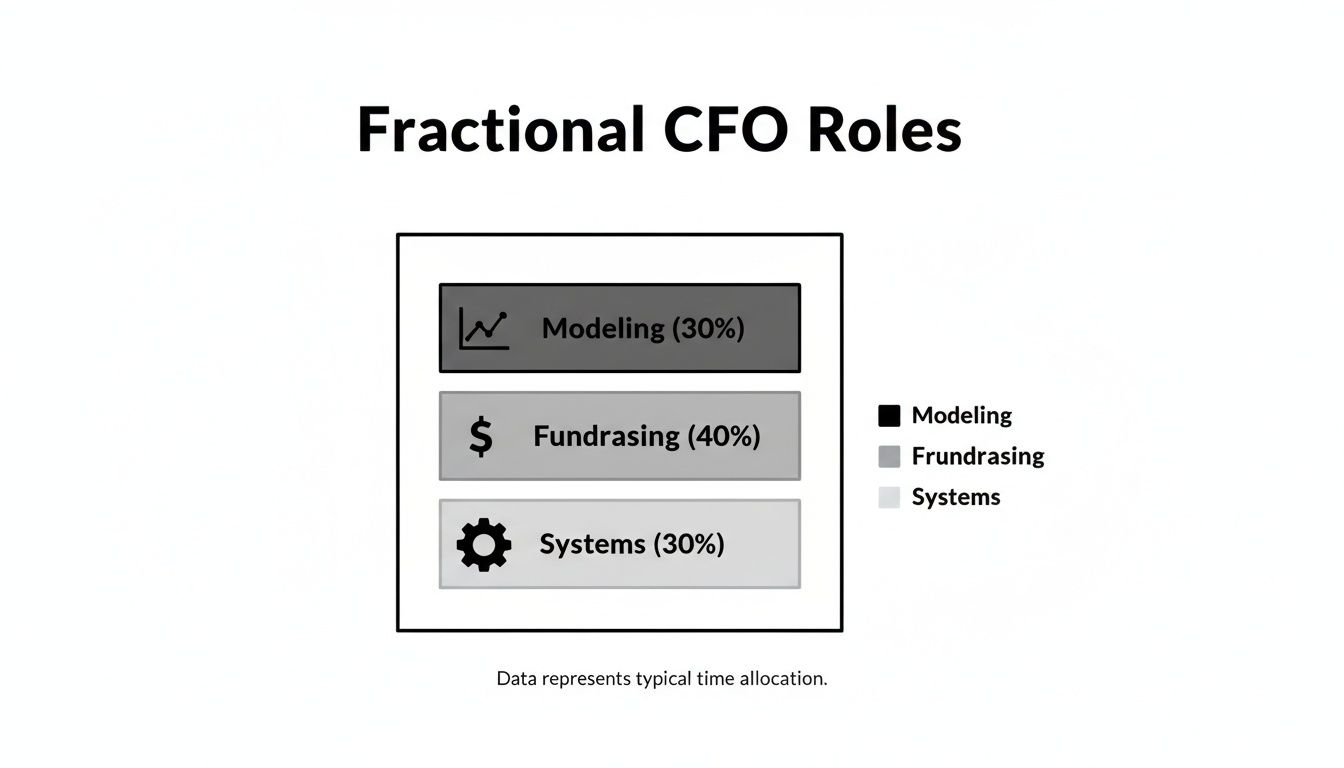
This chart shows the work is heavily weighted toward forward-looking activities that create enterprise value—not just backward-looking reporting.
A Clear Comparison of Financial Leadership Options
To see the value clearly, compare the different financial roles a startup can hire. Each serves a purpose, but only a fractional CFO provides strategic leadership at a price point that makes sense for a scaling business.
Financial Leadership Cost and ROI Comparison
| Attribute | Fractional CFO | Full-Time CFO | Bookkeeper/Accountant |
|---|---|---|---|
| Primary Focus | Forward-looking Strategy & Growth | Executive Leadership & Management | Historical Record-Keeping & Compliance |
| Core Value | Fundraising, FP&A, Scalable Systems | Team Building, Public Markets Prep | Transactional Accuracy, Tax Prep |
| Best For | Seed to Series B Startups | Late-Stage, Pre-IPO Companies | All stages for basic financial hygiene |
This comparison clarifies that a fractional CFO fills the critical gap between basic bookkeeping and an expensive executive hire.
Case Study in Action: A B2B SaaS startup preparing for its Series A had a disorganized financial model. After engaging a fractional CFO from AmbitionCFO, they rebuilt their forecast, uncovering a 15% improvement in gross margin and extending their cash runway by four months. Armed with this clarity, they raised their round 30% faster and secured a valuation 25% higher than their initial target.
The data supports this. While a full-time CFO can cost 1.0-3.5% of revenue, a fractional CFO reduces that to just 0.3-1.5% of revenue. This often results in a first-year ROI between 350-600% and a payback period of only 3-9 months, as detailed in these virtual CFO vs. full-time CFO financial metrics on customcpa.ca.
A fractional CFO is not a cost center; they are a revenue and valuation driver. The investment pays for itself many times over.
When Should My Startup Hire a Fractional CFO?
Timing is everything. Hire a strategic finance expert too late, and you risk making critical mistakes during peak growth. Hire one too early, and you burn cash on expertise you don't need yet. The right time isn't determined by revenue or headcount, but by the operational challenges you're facing.
If you find yourself saying "yes" to the following questions, it's a strong signal that you're ready for a fractional CFO.
Checklist: Key Triggers Signaling Your Need for a CFO
These are real-world scenarios that indicate your business's complexity is outpacing your financial management capabilities.
Are you spending over 15% of your week on financial tasks? As CEO, your time is your most valuable asset. If you are buried in spreadsheets and bookkeeping instead of focusing on product, customers, and team, you've become a growth bottleneck. This is a direct opportunity cost that slows your company down.
Is your financial model just a simple spreadsheet? A basic P&L tracker is not a strategic tool. Can your model show you the impact of a 10% increase in customer churn on your runway six months from now? If you can't run "what-if" scenarios, you are making decisions without full visibility. A fractional CFO builds a robust, three-statement financial model to serve as your decision-making command center.
Are you preparing for a Seed or Series A round in the next 6-9 months? Fundraising is a high-stakes process. Investors will scrutinize your financials, and amateur projections are a fast way to lose credibility. A fractional CFO quarterbacks the financial side of your fundraise, ensuring your numbers are bulletproof and your story is compelling.
Why Your Accountant Can't Play the Role of a CFO
A common and costly mistake is assuming an accountant can handle high-level financial strategy. They are fundamentally different roles with different goals.
Your accountant’s job is to look backward and ensure historical accuracy for compliance and tax purposes. A fractional CFO’s job is to look forward, using financial data to map out your growth, secure funding, and increase your company's valuation.
Thinking your bookkeeper can manage your venture capital strategy is like asking a car mechanic to pilot a fighter jet. This need for forward-looking strategy is why the finance and accounting outsourcing market is projected to grow from $46.168 billion in 2024 to $76.359 billion by 2033, according to reports cited by sources like nowcfo.com. This is a fundamental shift in how smart startups build their financial foundation.
Recognizing these triggers is a sign of success. Bringing in a fractional CFO isn't an admission of weakness; it's a strategic power-up to accelerate your growth.
How to Choose the Right Fractional CFO Partner
Hiring a fractional CFO is like choosing a strategic co-pilot. The right partner becomes a seamless extension of your leadership team, turning financial complexity into a competitive advantage. The wrong fit can create more problems than they solve.
To make the right choice, you need a framework for evaluating candidates based on their technical skills, industry experience, and strategic mindset.
Step 1: Evaluate Proven Industry Expertise
Your startup is not generic, and your CFO shouldn't be either. A finance expert from manufacturing won't instinctively understand the key metrics of a SaaS business, such as the LTV to CAC ratio or the nuances of monthly recurring revenue (MRR). You need a partner who speaks your industry's language.
Look for a fractional CFO with direct experience in your sector—SaaS, e-commerce, biotech, or fintech. This specialized knowledge means they can immediately benchmark your performance against competitors and identify industry-specific opportunities without a learning curve.
Step 2: Verify Their Fundraising Track Record
For most startups, fundraising is the primary goal. You need a partner with a proven record of helping companies like yours close funding rounds.
Ask specific questions during your evaluation:
What size rounds have you managed?
What types of investors were involved (angels, VCs, etc.)?
What was your exact role in the due diligence process?
Their track record is the best evidence of their ability to build investor confidence and navigate the fundraising process successfully.
A fractional CFO’s value is never more obvious than during a fundraise. Their ability to build a compelling financial story—and defend it under pressure—can directly influence your valuation and the terms you get.
Step 3: Assess Tech Stack Proficiency and Cultural Fit
Modern finance runs on a sophisticated software stack. Your fractional CFO must be fluent in the tools that help startups scale.
Essential Tech Stack Knowledge:
Accounting Systems: Deep experience with platforms like QuickBooks Online or NetSuite is non-negotiable.
FP&A Software: Familiarity with forecasting tools like Datarails or Cube is key for dynamic financial modeling.
Payroll & HR Platforms: Knowledge of systems like Gusto ensures efficient and compliant team management.
Beyond technology, cultural fit is paramount. This person will be in the trenches with you during stressful times. They must communicate complex financial concepts clearly and integrate into your company's rhythm.
Actionable Step: Use these pointed interview questions to assess their thinking:
Walk me through your process for building our first three-year financial forecast from scratch.
Describe a time you helped a startup navigate a cash crunch. What specific steps did you take?
How do you approach creating a board reporting package that provides actionable insights?
Their answers will reveal not just what they know, but how they think and solve problems, helping you make a confident decision.
It’s Time to Take Control of Your Financial Future
You now understand how a fractional CFO is not just a cost, but a strategic investment with a clear ROI that leads to better fundraising, smarter cash management, and a solid plan for growth. But knowledge without action is just trivia.
At AmbitionCFO, we don't just deliver spreadsheets. We become a part of your leadership team, focused on turning financial headaches into a competitive advantage. Our goal is to give you the strategic firepower to make bold decisions with confidence.
From Financial Stress to Clear Momentum
Think of us as a force multiplier for your vision. The constant stress of making payroll, managing investor expectations, and planning your next move can be translated into a clear, actionable roadmap.
You get the high-level financial leadership you need, freeing you to do what you do best: build your product, win customers, and lead your team.
Your next great idea deserves a solid financial strategy to back it up. A fractional CFO provides the framework to connect your vision to a fundable, scalable business model. This partnership is what separates startups that struggle from those that scale.
Your Next Step Is Simple
If you’re ready to break out of the reactive financial cycle and build a company that commands investor attention, the path forward starts with a single conversation.
Take that first step today. We invite you to schedule a no-obligation discovery call with our team. Let’s spend 30 minutes digging into your growth goals, identifying your biggest financial hurdles, and exploring how a partnership with AmbitionCFO can help you achieve your ambitious targets.
Frequently Asked Questions
Navigating strategic finance can be confusing. Here are answers to the most common questions we hear from founders.
Fractional CFO vs. Accountant: What's the Real Difference?
This is the most critical distinction. An accountant is your business historian. They look backward to record transactions accurately, handle tax compliance, and produce statements showing where money has been spent. This is essential work.
A fractional CFO is your financial architect for the future. They use historical data to build your growth roadmap. They focus on what's next: guiding strategy, securing funding, and preparing you for the journey ahead.
Your accountant builds the rearview mirror. Your fractional CFO builds the GPS and the dashboard that gets you to your destination.
How Much Time Will a Fractional CFO Actually Spend with My Startup?
The engagement is flexible and tailored to your startup's current needs.
Early-Stage & Steady State: This is ideal for high-level strategic guidance, board preparation, and financial model refinement.
Intense Growth Periods: During an active fundraising round or acquisition, the commitment can scale up to 40+ hours per month.
This flexibility is a key benefit. You get access to top-tier strategic expertise without the full-time cost, paying only for what you need, when you need it.
My Startup Isn't Making Money Yet. Do We Really Need This?
Yes, absolutely. In fact, bringing in a fractional CFO pre-revenue is one of the smartest moves you can make. This is when they lay the foundation that can determine your ability to get funded.
Before you earn your first dollar, a fractional CFO can:
Build an investor-grade financial model that tells a powerful, believable story.
Set up a clean, scalable chart of accounts to prevent future headaches.
Structure your cap table correctly from the start.
Getting these fundamentals right prevents costly mistakes and signals to investors that you are a serious, well-managed company worthy of their investment.
Ready to get the financial clarity and strategic leadership your startup deserves? The team at AmbitionCFO doesn’t just advise from the sidelines; we embed with you to turn financial complexity into your competitive advantage.
Schedule a no-obligation discovery call with our team and let's start mapping out your path to growth.
Composed with the Outrank tool