
You've built the business on judgment, speed, and grit. That works for a long time. Then one day you realize you're making payroll, pricing, hiring, and expansion decisions with a spreadsheet you don't trust, a cash balance that feels lower than it should, and a finance team that can tell you what happened last month but not what's likely to happen next quarter.
That's the core question behind when to hire a CFO. Not “Can I afford one?” The better question is, “Has my business become too complex to run on instinct alone?”
If you're a founder in construction, distribution, or professional services, this usually shows up in ordinary moments. You approve a big hire without seeing the full margin impact. You sign a contract without a clear view of working capital strain. You spend your Friday afternoon chasing answers about cash instead of leading the company. That's not a minor annoyance. It's a sign your business has outgrown gut-based financial management.
Table of Contents
- Has Your Business Outgrown Your Financial Gut
- Controller vs Fractional CFO vs Full-Time CFO
- The Quantitative Triggers For a CFO Hire
- The Hidden Triggers Your Founder Time and Exit Plan
- Calculating The Real Cost and ROI of CFO Leadership
- Your Playbook for Hiring and Onboarding a Financial Partner
- Take Control of Your Financial Future Today
Has Your Business Outgrown Your Financial Gut
A founder I meet often looks like this. Revenue is strong. The company is respected. Customers are paying. The team is growing. But the owner still acts as the unofficial CFO, reviewing invoices at night, asking basic cash questions on Monday morning, and making major decisions without a clean forward view.
That founder usually says some version of the same thing: “We're doing well, but I don't feel in control.”
That matters more than often recognized. You can survive with imperfect financial visibility when the business is smaller and simpler. You cannot scale that way for long. Once complexity rises, the cost of delayed decisions, bad pricing, weak cash planning, and sloppy reporting starts to pile up.
Practical rule: If you're carrying the financial model in your head, your company is already too dependent on you.
The symptom isn't always a crisis. Sometimes it's a quieter problem. You've got an accountant, maybe a controller, maybe an outside CPA. Books get closed. Taxes get filed. But nobody is building scenarios, pressuring assumptions, or translating the numbers into operating decisions.
That's when founders start searching for clarity on cash flow, margins, and the right metrics to run the business. If that's where you are, start with these financial metrics every business owner should track. You'll quickly see whether your current reporting helps you lead or just helps you look backward.
The decision to hire a CFO isn't about prestige. It's about removing guesswork from high-value decisions. If your business depends on your financial gut more than on a repeatable system, you're close to the point where real finance leadership stops being optional.
Controller vs Fractional CFO vs Full-Time CFO
Founders get this wrong all the time. They jump to titles instead of defining the problem.
Start with the actual gap in the business. Do you need cleaner reporting, better decision support, or daily executive finance leadership? The right hire depends on where your company is breaking.
The practical difference between the roles
A controller fixes accuracy, discipline, and consistency. This role owns the close, reporting, internal controls, and accounting process. If your books are late, your reporting is unreliable, or nobody trusts the numbers, start here.
A fractional CFO helps you make better decisions with the numbers. This role builds forecasts, tests assumptions, improves pricing and margin visibility, plans cash, and gives the founder a financial thought partner. If you want a clearer picture of the work involved, this breakdown of what a fractional CFO does covers the strategic scope.
A full-time CFO becomes necessary when finance leadership is part of the daily operating rhythm. That usually means more stakeholders, more moving parts, more capital planning, and more founder decisions that need senior financial judgment every week.
The line between these roles matters because many founder-led companies do not have a finance problem. They have a decision problem. Reports exist. Tax filings happen. The issue is that nobody is translating financial information into pricing changes, hiring plans, cash timing, acquisition decisions, or exit preparation.
CFO Excellence on staged CFO hiring describes a pattern that matches what works in practice. Companies often add fractional CFO support first, then move to a full-time CFO once senior finance leadership becomes a constant need rather than a periodic one.
Financial Leadership Roles at a Glance
| Role | Primary Focus | Key Activities | Best For | Typical Annual Cost |
|---|---|---|---|---|
| Controller | Accuracy and control | Close process, reporting, compliance, internal controls, accounting team oversight | Businesses that need stronger accounting discipline but not high-level strategic finance | Lower than CFO-level leadership, with wide variation by market and scope |
| Fractional CFO | Strategy without full-time overhead | Forecasting, cash flow planning, KPI design, margin analysis, decision support, leadership partnership | Founder-led businesses that need senior finance judgment but not a daily executive | Part-time executive cost, usually structured as a monthly retainer or project-based engagement |
| Full-Time CFO | Embedded executive leadership | Company-wide finance strategy, team leadership, board and lender communication, long-term planning | Companies with sustained complexity, larger finance demands, or daily executive finance needs | Full executive salary, benefits, incentives, and recruiting cost |
Here is the direct recommendation.
- Hire a controller if the accounting foundation is weak.
- Hire a fractional CFO if the books are clean but the founder still carries forecasting, cash planning, lender conversations, or margin decisions personally.
- Hire a full-time CFO if finance leadership has become a daily bottleneck for growth, capital strategy, or deal readiness.
That middle category gets missed. A lot of successful businesses are too complex for a controller alone and not complex enough for a full-time CFO. That is exactly where a fractional CFO creates the highest return. You get senior judgment before founder time gets consumed by financial management and before a weak finance function hurts valuation.
One more filter helps. If you want to sell in the next few years, the question changes. The issue is no longer whether the books close. The issue is whether your financial story is credible, repeatable, and transferable to a buyer. Controllers support that process. CFOs shape it.
The Quantitative Triggers For a CFO Hire
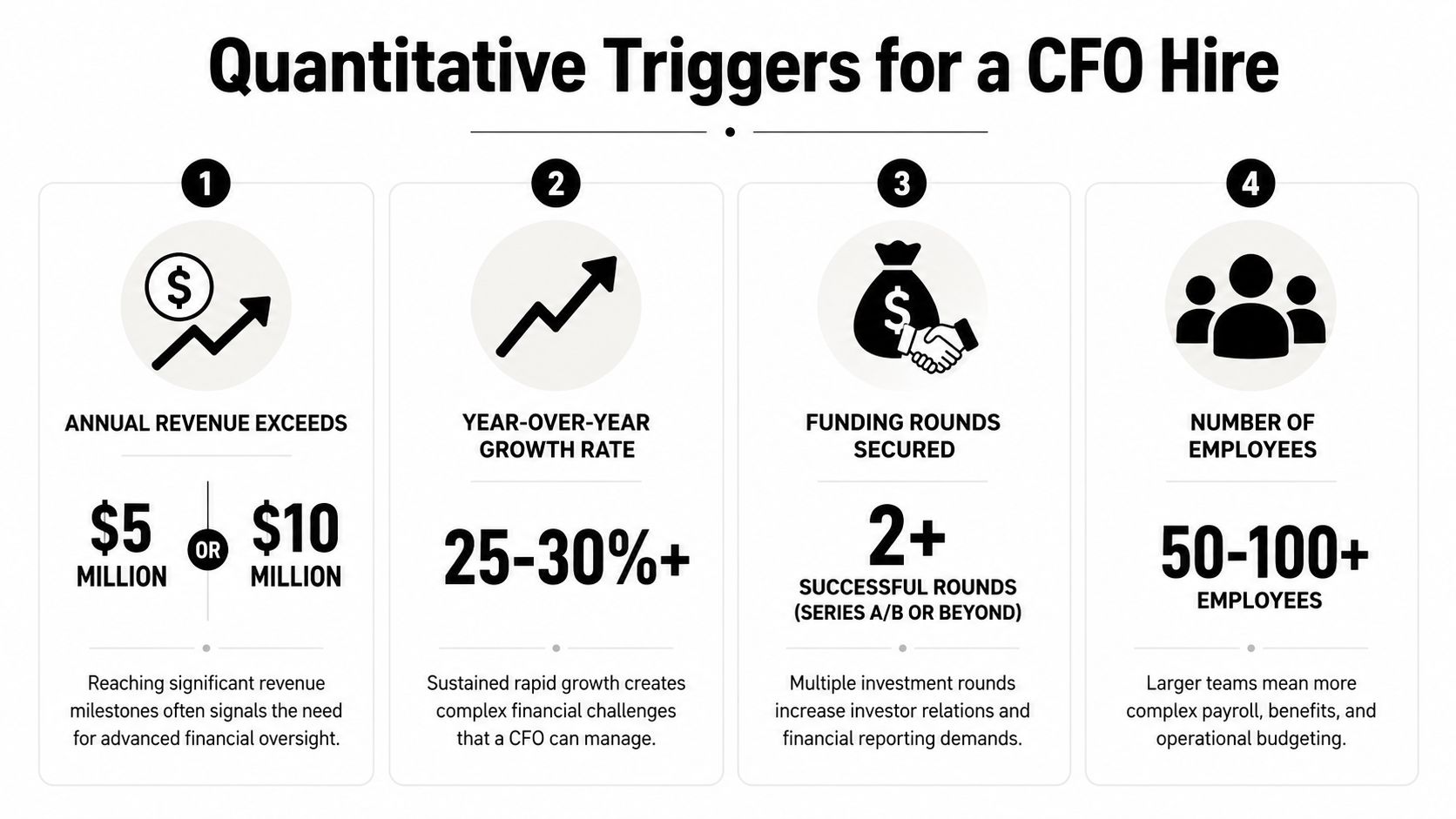
Numbers don't tell the whole story, but they do tell you when complexity is becoming expensive.
The revenue range that matters most
The cleanest quantitative benchmark is revenue. The most statistically supported milestone for a first senior finance hire is between $10M and $25M ARR, with 37% of Bessemer Venture Partners' CFO community identifying that range as the sweet spot, as summarized in this analysis of when to hire a CFO.
That range makes sense in practice. Around that point, founders usually start seeing the same pattern:
- Revenue is high enough that small margin mistakes become meaningful.
- Cash flow gets harder to predict because timing gaps widen.
- More departments start making decisions that need a financial lens.
- The owner can't personally quality-check every major move.
The same analysis notes that complexity often starts surfacing around $5M–$10M ARR, which is why many businesses feel strain before they technically “look big enough” for senior finance support. That's exactly why waiting until much later often turns the hire into a reactive move instead of a strategic one.
If you're already trying to build rolling visibility, a disciplined 13-week cash flow process is usually the first place a CFO-level operator creates immediate order.
Other hard signals that your finance function is late
Revenue is the easiest benchmark, but it isn't the only one. Several other measurable patterns tell you the same thing.
According to CDH CPAs on hiring a CFO, a fractional CFO is often the best fit between $1M and $25M in revenue, while a full-time CFO is typically justified at $50M to $75M for non-VC-backed companies, or at Series B with $20M+ ARR. That same review also notes that the average tech startup hires its first CFO at 100 employees.
That matters even if you don't run a tech business. Employee count is a proxy for complexity. More people usually means more budgeting pressure, more compensation decisions, more process gaps, and more room for misalignment between operations and finance.
Another concrete trigger comes from forecasting. CFO Pro Analytics' guide to CFO timing points to a simple signal: if your company is expanding, raising capital, preparing for an audit, or doubling in size, and you still can't make reliable cash flow projections across a 6–12 month window, you need a finance lead.
Here's the blunt version. If your company has any of the conditions below, your current setup is probably late:
- You're in the $10M to $25M range. That's the most supported point for a first senior finance hire, based on the Bessemer data summarized above.
- You've crossed into a larger headcount band. More people create more financial decisions and greater operational impact.
- You're managing multiple revenue streams. That usually breaks simple reporting.
- You're growing fast enough that old assumptions expire quickly. Last year's budget becomes useless faster.
- You can't defend your forward cash view. That is one of the clearest operational signs you've outgrown basic accounting support.
If revenue is rising but visibility is not, finance leadership is behind the business.
A quick self-check
Use this quick screen.
| Question | If the answer is yes |
|---|---|
| Are you in or near the $10M to $25M zone? | You're near the most common first senior finance hire point |
| Is forecasting still weak even though the business is growing? | Your accounting team may be too backward-looking |
| Are major decisions getting made without scenario modeling? | You need strategic finance, not just reporting |
| Has complexity grown faster than your finance bench? | A staged CFO model usually fits better than waiting |
This isn't about chasing a benchmark for its own sake. It's about identifying when scale starts creating financial drag. Once that drag shows up, the cost of delay is usually hidden in missed pricing discipline, working capital mistakes, and decisions made too late.
The Hidden Triggers Your Founder Time and Exit Plan
A founder closes the month, gets three different margin answers, spends Friday rebuilding the cash forecast, and still walks into Monday's leadership meeting without a clean view of what the business can afford. Revenue may look healthy. The finance function is already behind.
Founder bottleneck is a real metric
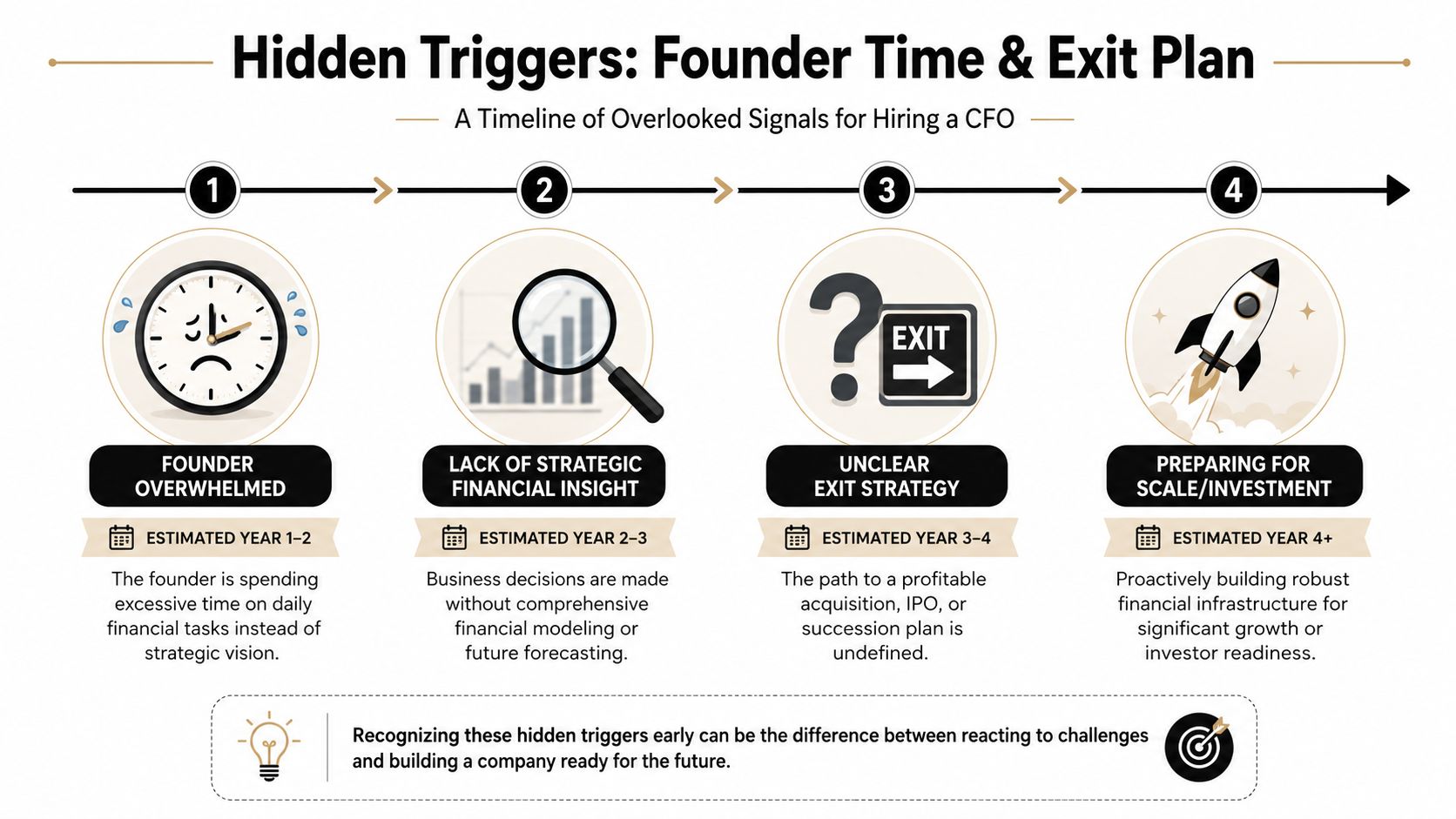
Revenue thresholds get too much attention. Founder time is often the better trigger.
If you are the one chasing reporting answers, rebuilding forecasts, sorting out cash questions, and translating numbers for the rest of the leadership team, finance depends too much on you. That limits growth and weakens decision quality. Your job is to judge tradeoffs and set direction, not stitch together financial clarity from scattered inputs.
According to Shiny's founder bottleneck analysis, when CEOs spend more than 20% of their time on financial puzzles instead of leading, a CFO is needed regardless of revenue. That standard is useful because it measures strain inside the business, not just size.
The pattern usually looks like this:
- Cash answers change by the meeting. You ask one question and get multiple versions of reality.
- Profitability is unclear. Pricing decisions rely on instinct because no one can explain margin by customer, project, or service line.
- Your leaders escalate basic finance questions to you. Department heads come for approval before the numbers are framed.
- Decisions stall. You delay hiring, inventory buys, or capital spending because downside scenarios are weak or missing.
Hire finance leadership when the founder becomes the reporting system, the forecast owner, and the final translator of financial truth. That is the point where delay starts showing up in margin leakage, slower decisions, and wasted executive time.
Exit planning starts earlier than most owners think
The second trigger gets missed even more often. Exit readiness.
If you expect to sell, recapitalize, transfer the business to family, or step back from day-to-day operations, CFO support should begin years before that event. According to Interim Execs on CFO timing for exit planning, owners in the $10M–$100M range should begin CFO engagement for exit readiness 3–5 years before the intended sale to build investor-grade financial infrastructure and CEPA-aligned metrics.
That timeline makes sense. Buyers pay for a business that produces clean numbers, predictable cash flow, visible margin drivers, and less owner dependence. They discount businesses where the founder has to explain every fluctuation personally.
If a transition is even a medium-term goal, start with a clear exit planning process for business owners. The value creation work happens long before a buyer asks for a data room.
A practical example
Consider a founder-led distribution company planning to sell in a few years. Revenue is solid. The books close. On the surface, nothing looks broken.
But margin swings by customer. Inventory levels are driven by habit instead of analysis. Reporting does not show what a buyer will ask first. The owner still carries too much of the financial story in their own head.
That company does not need better bookkeeping. It needs financial leadership focused on value creation and transferability.
A CFO with an exit lens will press on four questions:
- Which customers remain attractive after direct and indirect costs are fully loaded?
- Where is cash stuck in inventory, receivables, or payment timing?
- What will a buyer question immediately in the first review of financials?
- How much performance still depends on the founder's judgment and relationships?
Those questions should shape the business years before a transaction.
AmbitionCFO fits founder-led businesses in construction, distribution, and professional services that need hands-on cash flow modeling, profitability improvement, KPI reporting, and CEPA-aligned exit planning support without adding a full-time executive seat too early.
Calculating The Real Cost and ROI of CFO Leadership
A founder reviews payroll, approves purchases, answers lender questions, and tries to make a pricing decision from incomplete numbers. Nothing feels catastrophic, so the CFO hire gets pushed another quarter.
That delay has a cost. It shows up in missed margin, avoidable cash pressure, weak forecasts, and hours the founder keeps spending in finance instead of sales, operations, or succession planning.
What the investment actually looks like
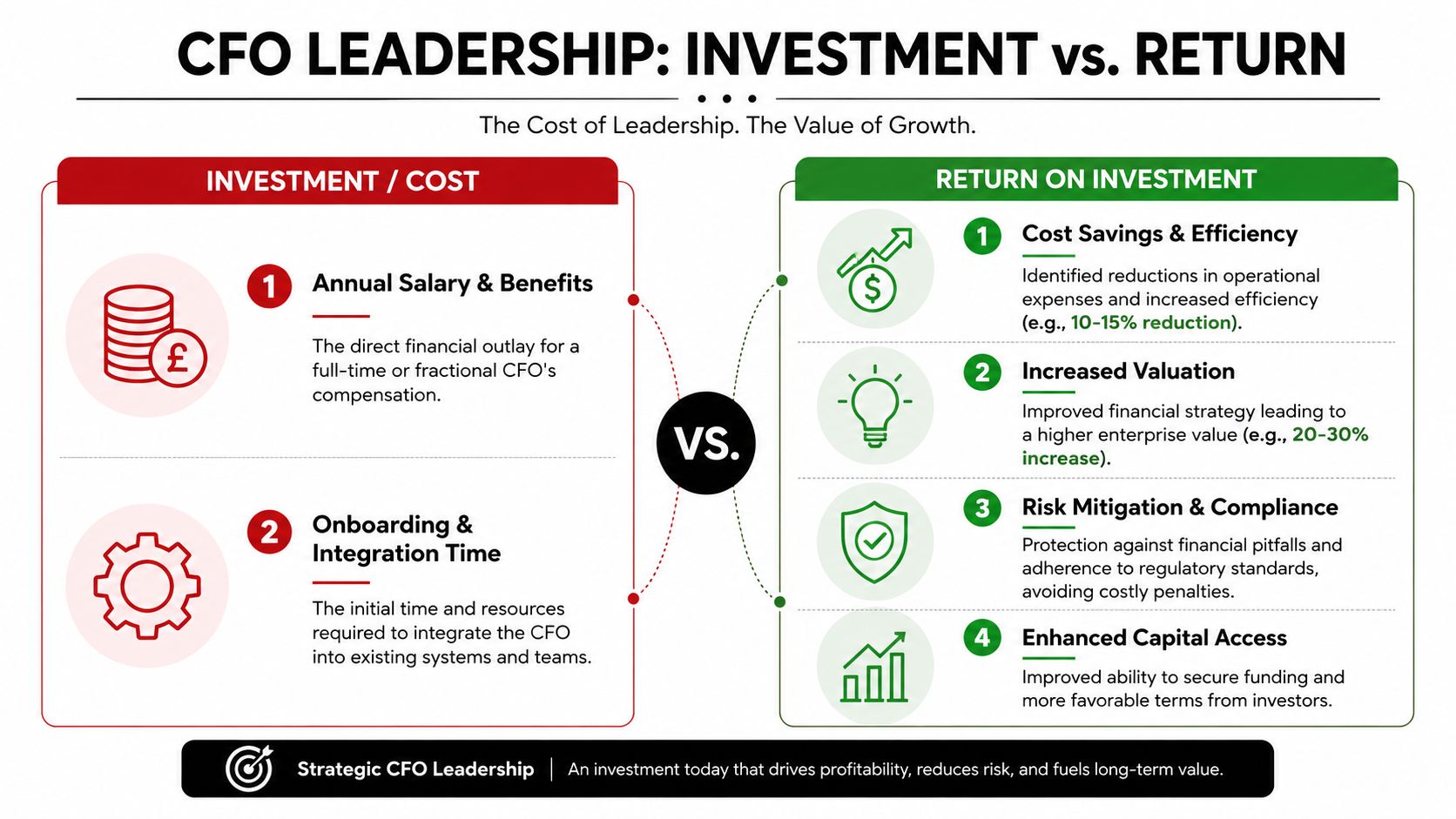
The decision is not just salary versus retainer. It is capability matched to the stage of the business.
A fractional CFO is usually the right first move for founder-led companies that need better forecasting, tighter cash management, sharper pricing analysis, and more credible reporting, but do not need a senior finance executive in the office every day. A full-time CFO makes sense when complexity stays high every week across financing, M&A, multi-entity reporting, or a larger leadership team that needs constant financial direction.
That is why a staged approach works so well. You get senior judgment without adding fixed overhead too early. You also get room to define the actual need before locking into a full-time executive hire.
If you want a more detailed framework, this guide on how to evaluate fractional CFO ROI breaks down the economics in practical terms.
Where the return actually shows up
Owners often look for one dramatic payoff. That is the wrong lens. CFO value usually comes from several improvements that stack up over time.
- Cash stops surprising you. A real forecast exposes shortfalls early enough to change collections, inventory purchases, or payment timing.
- Margin gets clearer. Customer, job, service-line, or product analysis shows where profit is thin and where price increases are overdue.
- Big decisions get tested before cash goes out the door. Hiring plans, equipment buys, debt service, and expansion scenarios get modeled with actual assumptions.
- Banks and buyers get cleaner information. Better reporting improves credibility in lending conversations and reduces friction in diligence.
- The founder gets time back. Fewer financial escalations land on the owner's desk because the business has a decision framework instead of constant improvisation.
The strongest ROI often comes from preventing bad decisions, not from heroic fixes after the fact. One underpriced customer segment. One inventory habit that ties up too much cash. One capital purchase approved without a clear payback. Those mistakes cost more than many owners expect.
There is also an exit value angle that gets ignored. If the founder remains the only person who can explain margins, normalize earnings, or defend working capital trends, the company is harder to transfer and harder to value well. CFO leadership helps turn financial knowledge into systems, reporting, and repeatable decision rules that survive beyond the owner.
Use a blunt test. If finance is taking too much of your week, if major decisions still rely on instinct because reporting is late or unclear, or if you want the business to be sellable in the future, the cost of waiting is already on your P&L.
Your Playbook for Hiring and Onboarding a Financial Partner
Knowing you need help isn't enough. You need to hire the right person, for the right scope, with the right start.
Start with this visual checklist.
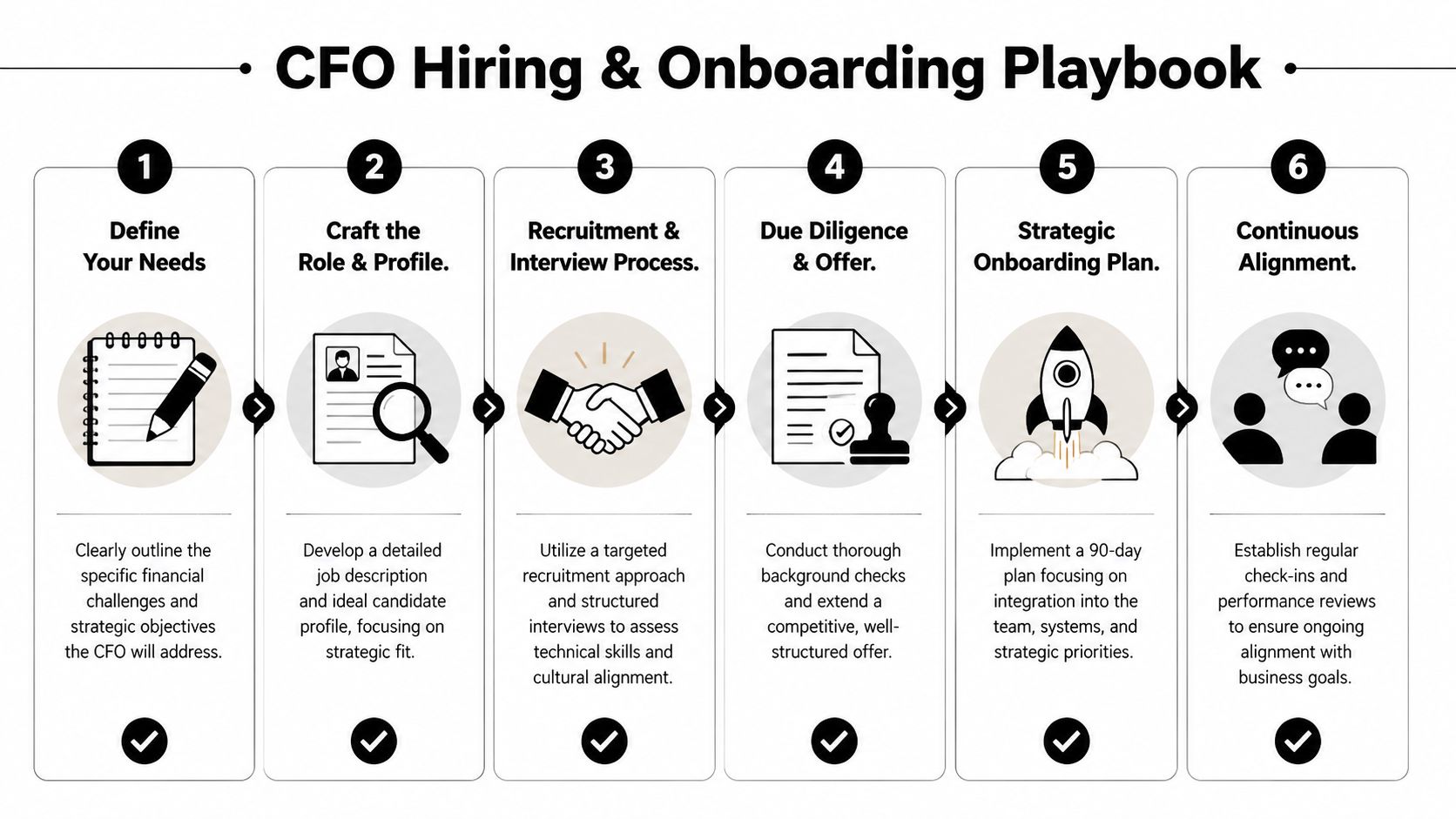
How to hire the right person
Most owners overemphasize technical résumé points and underemphasize operating judgment. You're not hiring someone to admire your financial statements. You're hiring someone to improve decisions.
Use this checklist.
Define the actual problem first.
Don't start with title. Start with pain. Is the issue cash visibility, margin inconsistency, reporting credibility, exit preparation, or founder overload? If you can't define the problem, you'll hire too broadly or too narrowly.Write a role around outcomes.
Good examples include building a reliable forecast, improving margin visibility by job or client, leading monthly financial reviews, or preparing the company for a transition. Bad examples are generic statements like “own finance strategy.”Test strategic thinking in the interview.
Ask questions that force applied judgment:- “Based on the financials we shared, what are the first two issues you'd investigate?”
- “How would you build our first cash flow forecast?”
- “What reporting would you put in front of me every month?”
- “Where do founders like me usually miss margin leakage?”
Look for communication, not just credentials.
A CFO has to translate complexity into operating choices. If a candidate can't explain a forecast clearly in conversation, they won't help your leadership team act on it.Watch for the wrong bias.
If every answer points backward to compliance, close process, and accounting rules, you may be talking to a strong controller rather than a strategic CFO.
This short video gives a useful overview before you start interviews.
What the first stretch should look like
A good onboarding process is not a welcome meeting and a login list. It's a structured transfer of business context.
Use this opening sequence:
- Access first: Give access to financial statements, budgets, bank reporting, debt agreements, customer or job profitability data, and org charts quickly.
- Leadership interviews next: Your CFO should meet the owner, operations lead, sales lead, and anyone responsible for delivery or project execution.
- Priority model third: Agree on the first priority. Usually that's cash flow visibility, margin clarity, or reporting discipline.
- Cadence immediately: Set a recurring leadership rhythm. Monthly is the minimum. Weekly is often better early on.
- Decision list: Keep a running list of pending decisions that need financial modeling.
A CFO should create momentum in the first stretch by narrowing uncertainty. If the work feels abstract, the scope is probably too vague.
Red flags during onboarding are easy to spot. Too much time spent cleaning presentation decks. Too little time spent understanding how the company makes money. Too much accounting language. Too little operating insight.
The right hire quickly helps you answer a few core questions: Where is cash going, where are margins slipping, and what decisions matter most right now?
Take Control of Your Financial Future Today
It is Monday morning. Your controller needs a decision on hiring. Sales wants a pricing exception. A lender asks for updated reporting. You are still the person holding all of it together because no one else owns the financial picture well enough to turn numbers into decisions.
That is the founder bottleneck. It hurts long before a cash crisis shows up.
By the time finance questions consume your week, the cost is already real. Forecasts stay weak. Pricing gets set by instinct. Margin leaks go unaddressed. Exit planning stays vague because the business still depends too much on you.
A CFO hire is not just a revenue milestone. It is a decision to stop running the company through founder memory and financial gut. If complexity is slowing decisions, tying up your time, or making the business harder to sell, the trigger has already arrived.
This matters even more in construction, distribution, and professional services. Cash timing is uneven. Margin pressure is constant. Buyer interest depends on how clearly the business can prove earnings quality, reporting discipline, and reduced owner dependence.
Make the decision based on what the business needs next. If the problem is accuracy and close discipline, hire for controllership. If the problem is forecasting, pricing, cash planning, lender strategy, or exit readiness, add CFO leadership. If the work is broad, constant, and strategic across the company, hire a full-time CFO.
If your business is in the $10M to $100M range and you want help deciding whether fractional CFO support is the right fit, contact AmbitionCFO. A discovery conversation should tell you, quickly, whether the next move is cleaner accounting, stronger financial leadership, or a sharper plan to build a more transferable company.