
You're likely in a familiar spot. Your construction company is doing real revenue. Jobs are moving. Payroll is heavy. Equipment decisions matter. You've got a bookkeeper, an outside CPA, and monthly financials that show up after the fact. But when you ask simple business questions, the answers get fuzzy.
Which jobs make money? Why does cash feel tight when revenue is up? Can you afford that next PM, estimator, or piece of equipment without creating a cash squeeze three months from now? Should you take the new contract, or will it drain working capital before it pays off?
That's the question you're really trying to answer: when does a growing business need CFO services, and what should those services do for the owner?
If you're running a business in the $10M to $100M range, this usually isn't an accounting problem. It's a financial leadership problem. Your CPA handles compliance. Your bookkeeper records transactions. Neither one is built to give you a forward-looking operating model for growth. If that gap feels expensive, it is. I wrote more about that in The Hidden Costs of Rapid Growth Financial Forecasting for Growing Businesses.
Table of Contents
- Your Business Is Growing But Are You Flying Blind
- What Exactly Are CFO Services for a Growing Business
- Fractional vs Full-Time CFO Which Model Is Right for You
- The Core Services That Drive Growth and Profitability
- The Tipping Point When Your Business Needs a CFO
- How to Find and Onboard Your Fractional CFO
- Stop Managing Your Books and Start Leading Your Business
Your Business Is Growing But Are You Flying Blind
A founder calls me after a strong quarter. Revenue is up. Backlog looks healthy. The team is busy. On paper, everything looks fine.
Then the genuine conversation starts.
He doesn't know which jobs are carrying the company and which ones are eating margin. He's making equipment decisions based on instinct and bank balance. His monthly financials tell him what happened, but they don't help him decide what to do next. That's the blind spot.
In a construction business, that blind spot gets expensive fast. You can win work and still hurt cash. You can add revenue and still lose margin. You can hire ahead of demand and create a working capital problem that doesn't show up until payroll, vendors, and project timing collide.
Most owners don't need more reports. They need reports that help them make better decisions before the money moves.
That's why CFO services for small business matter at this stage. Not because the business is failing. Because the business is too complex to run on rearview-mirror accounting.
Your bookkeeper is important. Your CPA is important. But their lane is different. They help you keep accurate books, close periods, and stay compliant. A CFO helps you answer questions like these:
- Can we fund growth without creating a cash crunch
- Which customers, jobs, or divisions deserve more resources
- What happens if collections slow, material costs rise, or a project gets delayed
- How do we build a financial plan that management can use
If you're in that awkward middle ground where you've clearly outgrown basic accounting support but don't need a permanent executive sitting in the seat full time, the solution usually isn't more bookkeeping. It's CFO-level strategy.
What Exactly Are CFO Services for a Growing Business
Most owners think finance support is one bucket. It isn't.
A bookkeeper records transactions. A controller keeps the accounting function clean and timely. A CFO turns financial information into operating decisions. That's the jump that matters.
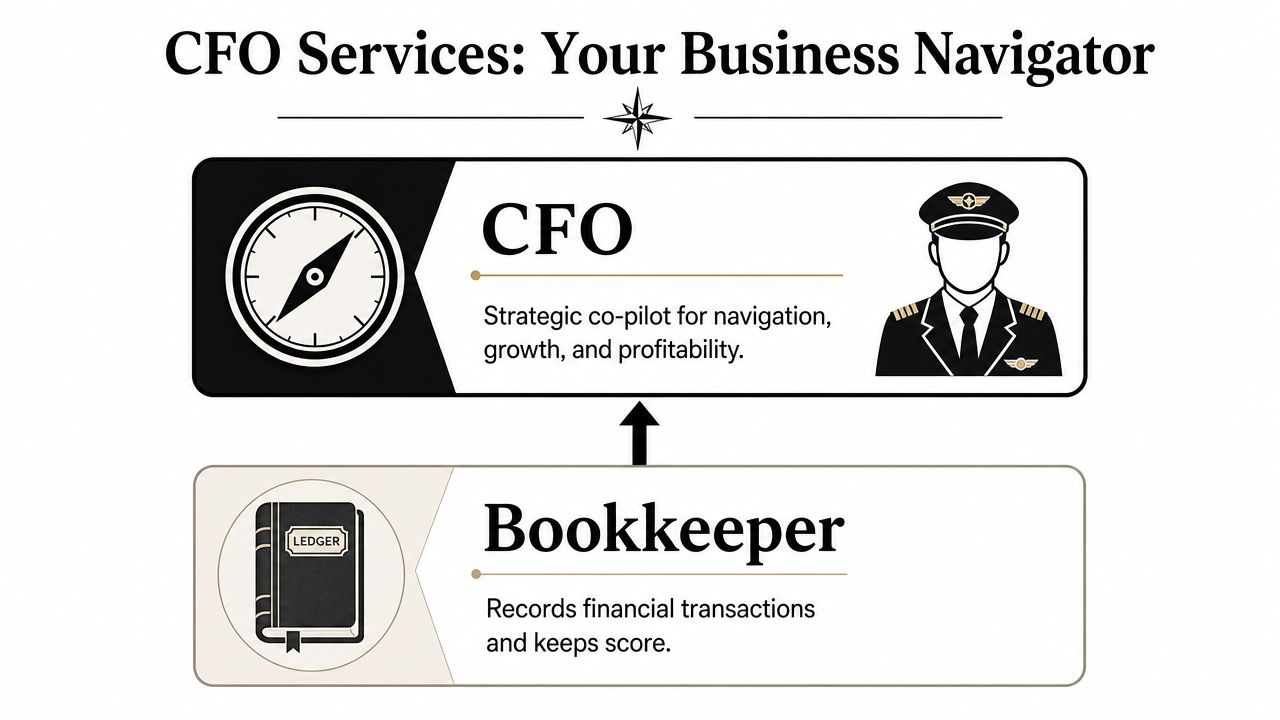
Your bookkeeper records history
Think of it this way. Your bookkeeper keeps score. Your CFO acts like a financial co-pilot.
The scorekeeper tells you revenue, expenses, and bank balance after the month closes. The co-pilot helps you manage pricing, hiring, equipment purchases, debt, working capital, and profit improvement while the business is moving.
That distinction matters because growth creates timing problems. Construction companies don't fail because someone forgot to code an invoice correctly. They get hurt because nobody modeled the cash impact of adding crews, stretching receivables, or taking on work with weak margin and ugly payment terms.
If you want a deeper breakdown of the role itself, read what a fractional CFO does.
The core jobs of a CFO
A strong CFO service engagement usually covers four things.
Cash flow management
Not checking the bank balance. Real visibility into what cash is likely to do over the coming weeks and months, and what decisions will improve it.Profitability analysis
This means knowing where margin is earned and where it leaks. In construction, that often comes down to job-level analysis, labor efficiency, change order discipline, and customer mix.Planning and forecasting
A CFO builds an operating plan the leadership team can use. That includes budgets, forecasts, and scenario models tied to hiring, backlog, equipment, and overhead.Risk mitigation
Every growth decision has financial risk. A CFO quantifies it before you commit.
Here's the practical payoff. Instead of saying, “I think we can afford it,” you start saying, “Here's the cash impact, margin impact, and downside case if we move ahead.”
Practical rule: If your financial team can close the books but can't model a major decision, you don't have a CFO function.
What FP&A means in plain English
You'll hear the term FP&A, which stands for financial planning and analysis. Don't overcomplicate it.
FP&A means using financial data to decide what should happen next. It answers questions like:
- What will cash look like if we hire two supers next quarter
- Which jobs are producing the best gross profit
- What happens if one large customer pays late
- How much overhead can the business carry without squeezing profit
That's what owners buy when they look for CFO services for small business. Not a title. Not a deck. They buy clarity.
And clarity leads to better decisions on contracts, staffing, equipment, pricing, and growth timing. That's the whole point.
Fractional vs Full-Time CFO Which Model Is Right for You
For a company in the $10M to $100M range, this decision is usually straightforward. You need senior financial judgment. You probably don't need it 40 hours a week.
A full-time CFO can make sense when your business has enough scale, transaction volume, complexity, financing activity, and internal finance staff to justify a permanent executive role. But most founder-led companies in this range aren't there yet. They need strategic leadership without another fixed executive cost.
The real difference is leverage
Here's the key fact. Full-time Chief Financial Officer positions for small and midsize businesses typically require an annual compensation of $200,000 or more, including salary, benefits, and overhead according to Peak Advisers on fractional CFO services for small business cash flow.
That's a major commitment. If you're a construction owner trying to protect cash and keep flexibility, that fixed cost matters.
A fractional CFO gives you access to the same type of strategic work without locking in a full-time executive hire. You get the forecasting, cash flow management, budgeting, and profitability analysis you need, but on a right-sized basis for the stage you're in.
Fractional CFO vs Full-Time CFO at a Glance
| Attribute | Fractional CFO | Full-Time CFO |
|---|---|---|
| Cost structure | Monthly retainer, part-time engagement | Full annual executive compensation package |
| Typical commitment | Focused involvement based on business needs | Ongoing full-time seat |
| Best fit | Founder-led companies that need strategy but not a permanent finance executive | Larger or more complex businesses that need daily executive finance leadership |
| Primary value | Forecasting, cash flow planning, margin analysis, decision support | Full executive leadership across finance and often broader organizational responsibilities |
| Flexibility | Easy to scale up or down as needs change | High fixed commitment |
| Hiring risk | Lower, because scope can start narrow and expand | Higher, because you're making a full executive hire |
Who should choose which model
Choose a fractional CFO if most of these are true:
- You've outgrown your CPA because you need forward-looking analysis, not just tax and historical reporting.
- Your profitability varies by job or customer and nobody is showing you that clearly.
- Your cash flow gets tight without warning even when sales look strong.
- You're making expansion decisions occasionally, not daily, so full-time executive coverage would be underused.
Choose a full-time CFO when the business needs constant executive finance leadership across departments, financing, systems, reporting, and people management. At that point, the company usually has enough size and internal complexity to justify the seat.
For most founders in your range, the smarter move is to buy the capability before you buy the permanent overhead. I break that return logic down further in Fractional CFO ROI.
The Core Services That Drive Growth and Profitability
If a CFO engagement doesn't change decisions, it's not doing much.
Value comes from a short list of services that directly affect cash, margin, and operating control. In construction, distribution, and professional services, the highest-impact work tends to center on visibility. Not more data. Better data, tied to actions.
Cash flow visibility changes how you run the business
A 13-week cash flow model is one of the most useful tools a growing contractor can have. It maps expected cash receipts and cash disbursements weekly, so you can see pressure points before they hit.
That matters because lenders, payroll, vendors, and project schedules don't care that your monthly P&L looked acceptable. They care whether cash is available when the obligation shows up.
According to FocusCFO's data on high-impact fractional CFO engagements, these engagements in construction, distribution, and professional services generate 15–25% improvement in gross margin through job-level or client-level margin analysis, and 13-week cash flow modeling reduces cash flow volatility by 30–40% while preventing 6–9 month cash shortfalls common in growth-stage firms.
That's not theoretical. It changes day-to-day decisions like:
- Whether to accelerate a hire
- When to order equipment
- Which receivables need executive attention
- Whether a new contract helps cash or strains it
If you can't see the next 13 weeks, you're managing risk with hope.
Margin analysis tells you where profit really comes from
Most owners look at company-wide gross margin and think they understand profitability. They don't.
You need job-level margin analysis. In some businesses, the better lens is client-level margin analysis. The point is the same. You need to know where profit is coming from after labor mix, material issues, project management time, and operational drag are considered.
A good CFO doesn't stop at “Job A is underperforming.” The work goes deeper:
- Which project type consistently beats estimate
- Which PMs manage labor more efficiently
- Which customers create the most billing friction
- Which work looks big on revenue but weak on contribution
That's where real growth happens. Not by chasing top-line volume. By shifting attention to the work that produces cash and margin.
If you want a sharper handle on the operating numbers that matter most, review the financial metrics every business owner should track.
Dashboards budgets and exit planning turn finance into action
Once cash flow and margin visibility are in place, the rest of the CFO toolkit starts working.
A KPI dashboard gives leadership a weekly or monthly operating view. In construction, that might include receivables aging, labor margin by job, backlog quality, overhead run rate, and billing conversion. The dashboard shouldn't be decorative. It should drive management conversations.
A budget sets the annual financial target. A forecast updates that target based on current performance. Owners need both. The budget gives discipline. The forecast gives realism.
Here's a practical video on how financial leadership should support growth decisions:
For owners planning a transition, a CFO also helps with exit planning. That doesn't mean selling tomorrow. It means getting the business financially ready so you have options later. AmbitionCFO, for example, works with founder-led companies on cash flow management, profitability improvement, forecasting, KPI dashboards, and CEPA-based exit planning for owners looking ahead to a transition window.
The common thread is simple. Good CFO services for small business create a tighter connection between financial information and management action. That's how growth gets more predictable.
The Tipping Point When Your Business Needs a CFO
The wrong question is, “What revenue level means I need a CFO?”
Revenue is easy to measure, so people obsess over it. But it's not the best trigger.
Revenue is not the trigger
The trigger is operational complexity. Paro's discussion of when small businesses need a CFO makes this point directly: for businesses in the $10M–$100M range, the need often arises when they're managing multiple jobs or clients with significantly different profitability, and they require tools like margin analysis by job or client and 13-week cash flow modeling for major capital decisions.
That tracks with what I see in the field. A relatively simple business can run longer without CFO support. A more complex business can need it earlier, even at the same revenue size.
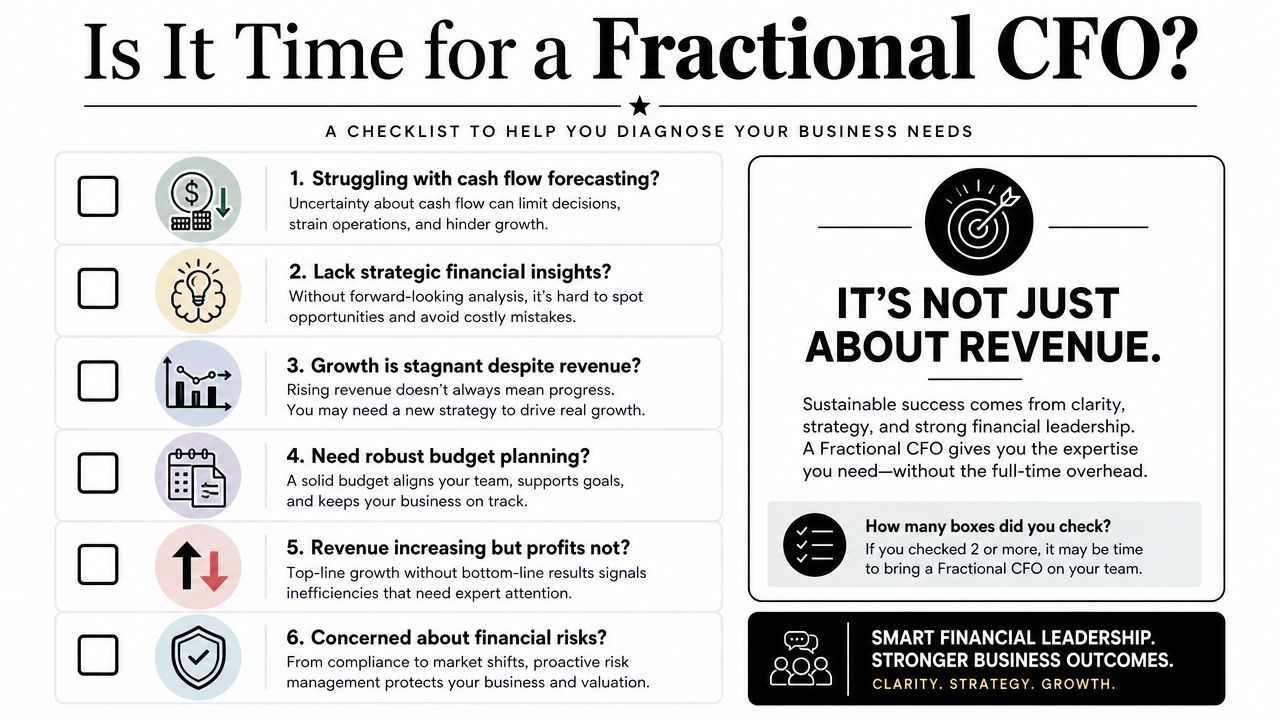
A practical diagnostic checklist
If several of these sound familiar, you're at the tipping point.
Major decisions rely on gut feel
You're deciding on equipment, hires, or new contracts without a usable financial model.Revenue is up but profit is murky
You can see sales activity, but you can't clearly explain why bottom-line performance isn't following.Cash keeps surprising you
The business looks healthy, then a timing issue hits and everyone scrambles.Job profitability is inconsistent
Some jobs feel productive. Others drain labor or create billing friction. You don't have a disciplined way to separate them.Your leadership team lacks one version of the truth
Operations, sales, and finance are all using different numbers.You're considering a transition in the next few years
If ownership transition is on the horizon, the financial story needs to get cleaner now, not later.
There's another practical point owners miss. A good CFO engagement doesn't take forever to prove itself. Companies that engage fractional CFO services typically see measurable financial returns within 3 to 6 months, driven by improvements in cash flow management, decision-making, and operational efficiency, according to CFO Pro Analytics on the power of fractional CFOs for small businesses.
That's why waiting usually costs more than acting. If this checklist sounds familiar, read when to hire a fractional CFO and compare your business against it objectively.
How to Find and Onboard Your Fractional CFO
Once you know you need help, the next mistake is hiring based on credentials alone.
A CPA can be useful. Industry experience matters. But what you really need is someone who can turn financial information into operating decisions inside a business like yours.
Start with budget and fit
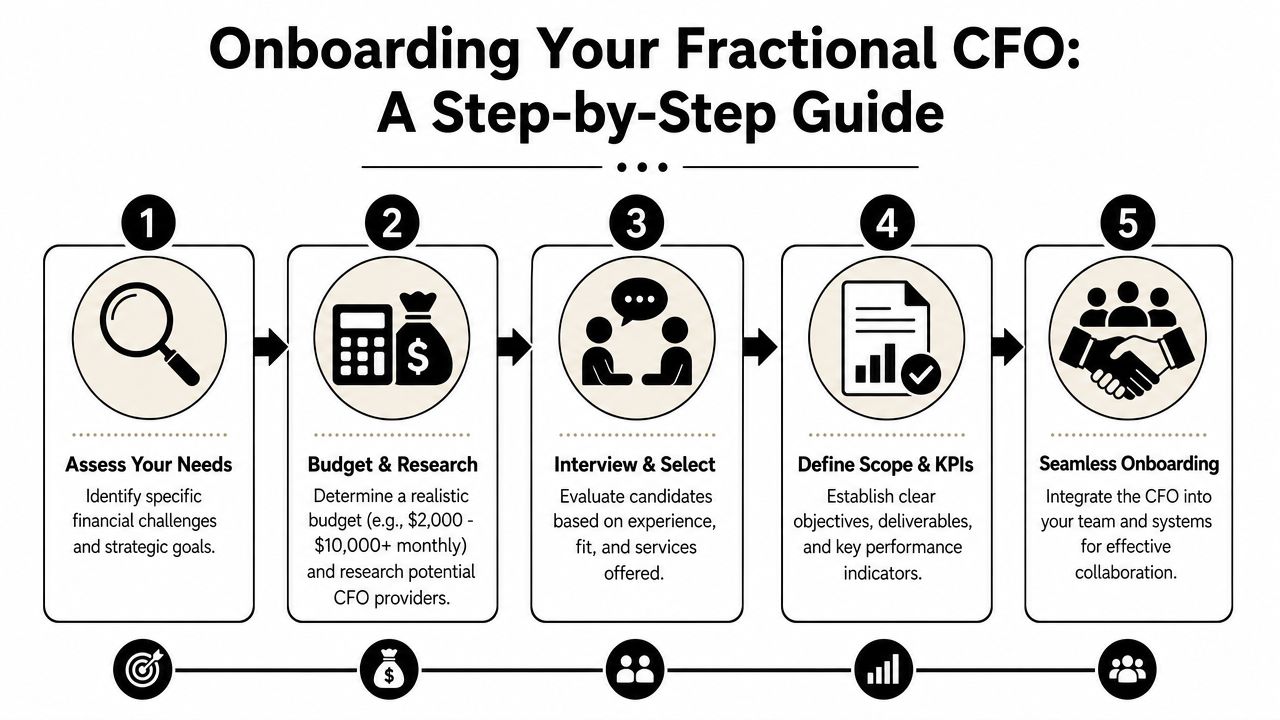
For most small businesses, fractional CFO services typically cost $3,000–$8,000 monthly and deliver executive-level financial strategy at 60–75% less than a full-time CFO whose total annual compensation exceeds $200,000, according to Primetrics on why more small businesses are turning to fractional CFO services.
That price range matters because it gives founders a realistic budget. It also frames the decision properly. You're not comparing the cost to doing nothing. You're comparing it to the cost of bad decisions, poor visibility, and carrying unnecessary fixed overhead.
What to look for before you sign
Don't make this selection harder than it needs to be. Use practical criteria.
| What to evaluate | What good looks like |
|---|---|
| Industry fit | They understand construction economics, not just generic finance theory |
| Cash flow skill | They can build and maintain a real 13-week cash flow model |
| Margin discipline | They know how to analyze job or client profitability |
| Communication style | They can explain financial tradeoffs clearly to owners and operators |
| Planning capability | They can build budgets, forecasts, and scenario models tied to decisions |
| Exit awareness | If transition matters, they understand planning for a future sale or ownership change |
Ask direct questions in the interview.
- Show me how you would analyze margin by job
- How do you build a weekly cash flow forecast
- What KPIs would you track for a construction company like mine
- How do you work with an existing bookkeeper, controller, and CPA
- What would the first ninety days focus on
You're not hiring a lecturer. You're hiring a decision partner.
Hire for judgment first. Tools and templates are easy to copy. Financial judgment isn't.
A clean onboarding process
A good onboarding process should feel structured, not vague. Here's a practical sequence.
Assess the immediate pain points
Identify the issues that are hurting decisions now. Cash visibility, margin leakage, poor reporting, weak forecasting, or all of the above.Review the data environment
Pull financial statements, job costing reports, AR aging, AP aging, backlog data, debt schedules, payroll detail, and any existing budgets or forecasts. If the accounting system is QuickBooks or NetSuite, make sure the reporting structure supports actual analysis.Set a short list of priorities
Don't start with ten initiatives. Start with a few. Most companies need weekly cash flow visibility, better reporting, and sharper profitability analysis first.Define deliverables and cadence
Decide what gets delivered weekly, monthly, and quarterly. Examples include a 13-week cash flow file, monthly KPI dashboard, rolling forecast, and leadership meeting support.Establish decision routines
Finance should show up in operating rhythm. Weekly cash review. Monthly results meeting. Quarterly planning session. If finance lives outside management cadence, it won't influence decisions.Measure the engagement by business outcomes
Not by activity. Better visibility, fewer cash surprises, stronger margin control, and more confident capital decisions are what matter.
A strong onboarding process gets the CFO embedded quickly enough to be useful, but disciplined enough not to create noise.
Stop Managing Your Books and Start Leading Your Business
If you're leading a $20M construction company, you don't need more bookkeeping. You need better financial control over the decisions that shape growth.
That means seeing cash before it gets tight. It means knowing which jobs create real profit. It means making hiring, equipment, and expansion decisions with a model in front of you instead of instinct in your gut. That's what CFO services for small business should deliver.
The shift is simple. Stop treating finance like a reporting function. Start using it as an operating tool.
I've seen what changes when that happens. A construction company improves job margins because leadership finally sees where labor performance and project mix are helping or hurting profit. A distribution company gains enough cash visibility to move forward on expansion because management can finally model timing and working capital with confidence. Those are the kinds of business outcomes that matter.
And the timing isn't abstract. Companies engaging fractional CFO services typically see measurable financial returns within 3 to 6 months, with gains driven by cash flow management, better decisions, and improved efficiency, as noted earlier in the article.
The owner who has the clearest numbers usually makes the better move.
If your business has outgrown the CPA-only model but you're not ready for a full-time CFO, don't wait for another surprise in cash, margin, or backlog to force the issue. Get the financial leadership in place before the next major decision, not after it.
If you want to pressure-test whether a fractional CFO is the right fit for your business, contact AmbitionCFO. Bring your biggest current decision, whether that's hiring, equipment, growth, or exit planning, and get clear on the numbers before you commit.