

Most advice on how to improve gross profit margin is too shallow to help a founder running a real business. “Raise prices” and “cut costs” sound fine in a workshop. They fail in the field because they ignore the core problem. You usually don't have a company-wide margin problem. You have a job problem, client problem, or product mix problem hiding inside an average.
That blind spot gets expensive fast. A distribution company can post a decent blended margin while one major account eats freight, rush handling, returns, and sales time. A construction firm can win more work and still feel poorer because the backlog is full of jobs priced off bad labor assumptions. A professional services firm can brag about utilization while one “strategic” client burns senior staff time at junior billing rates.
Gross profit margin matters because it tells you how much money is left after direct costs. The basic formula is (Revenue – COGS) / Revenue. But the formula is only useful if you calculate it at the level where management decisions take place.
Table of Contents
- Stop Looking at Your Overall Gross Profit Margin
- Diagnose Your True Profit Drivers with Granular Analysis
- Pull the Pricing Lever for Rapid Margin Improvement
- Systematically Engineer Lower Cost of Goods Sold
- Optimize Your Product and Customer Mix for Profitability
- Your Margin Improvement Playbook and KPI Dashboard
Stop Looking at Your Overall Gross Profit Margin
Founders love summary numbers because summary numbers feel controllable. One gross margin percentage on the monthly P&L looks clean. It also hides the truth.
Many businesses scale unprofitable work because nobody is measuring direct costs at the level of the work itself. That's why broad advice on how to improve gross profit margin misses the mark. American Express notes that 30–40% of SMB customer portfolios are unprofitable when direct costs are allocated correctly. If you're running a company in the $10M to $100M range, you should assume some of your revenue is hurting you until proven otherwise.
Revenue can go up while profitability gets worse
A construction company wins a large client with aggressive pricing, extra supervision, and constant schedule changes. Revenue jumps. The owner feels momentum. Then cash gets tight because field labor overruns the estimate and PM time never makes it into job costing.
A distribution company lands a big account that demands split shipments, custom packaging, and expedited orders. Sales celebrates. Finance sees margin compression a month later, if they see it at all.
A professional services firm keeps a legacy client because “they've been with us forever.” The team spends senior hours solving scope creep, but invoices stay flat. On paper it's revenue. In practice it's margin leakage.
Practical rule: If you only track company-wide gross margin, you're managing averages, not economics.
Gross profit margin is useful, but only in context
Gross profit margin measures the share of revenue left after cost of goods sold, or COGS. COGS means the direct costs required to deliver what you sold. In construction, that includes direct materials and direct labor tied to the job. In distribution, it includes product cost and often inbound freight. In professional services, it can include direct labor and contractor costs tied to delivery.
That company-wide percentage still matters. It just isn't enough.
What matters more is whether margin is healthy by:
- Client so you know who earns the right to get more attention
- Job or project so you can fix estimating and execution
- Product or service line so you stop pushing volume that doesn't pay
- Sales channel or segment so growth doesn't dilute profit
If you want a cleaner finance foundation before you do this work, start with the financial metrics every business owner should track.
Diagnose Your True Profit Drivers with Granular Analysis
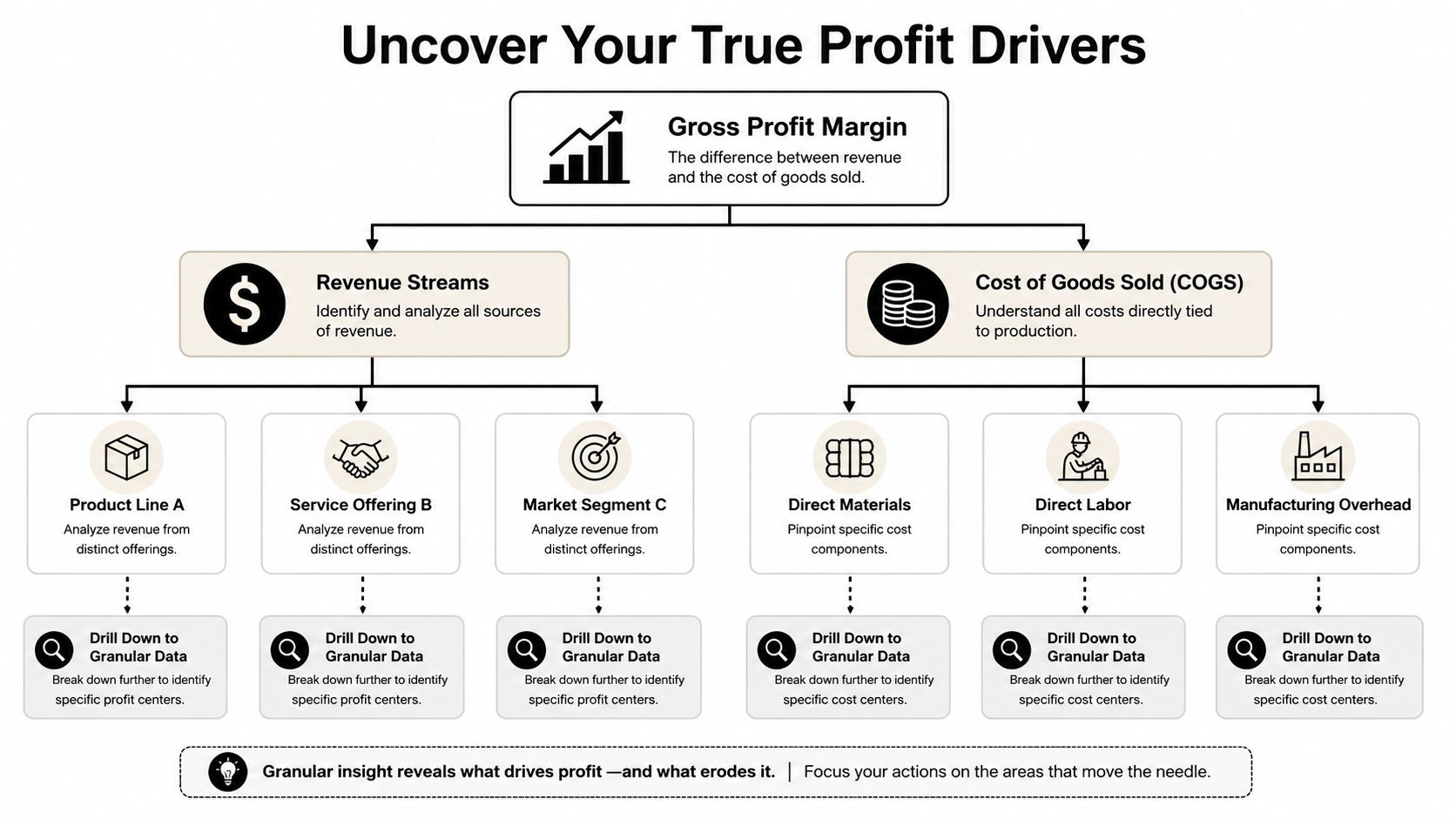
You can't improve what you lump together. The first job is to build a margin map of the business.
Define gross profit margin correctly
Gross profit margin is simple:
Gross Profit Margin = (Revenue – COGS) / Revenue
The mistake isn't the math. The mistake is where founders stop. They calculate it once at the company level and call it done.
You need the same formula at the unit that creates or destroys value:
- By client
- By job
- By project manager
- By product category
- By service line
- By location or branch, if those economics differ
That means direct costs have to be assigned correctly. If labor, freight, subcontractors, materials, or contractor expenses sit in broad accounts with no tie back to a client or job, your margin reporting is decorative.
Build a margin map by client job and product
Start with your last three to six months and build a simple analysis. Pull revenue and direct costs for each client, job, or product line. Don't worry about perfect allocation on day one. Worry about getting enough visibility to spot obvious profit drains.
Here's a simple example for a distribution business.
Example Gross Margin Analysis by Client
| Client | Revenue | COGS | Gross Profit | Gross Profit Margin |
|---|---|---|---|---|
| Client A | $1,000,000 | $650,000 | $350,000 | 35% |
| Client B | $800,000 | $680,000 | $120,000 | 15% |
| Client C | $600,000 | $360,000 | $240,000 | 40% |
This is why blended reporting lies. A founder might say, “We're around the mid-30s, so we're fine.” No, you're not. Client B is a drag on the whole company. If that account also consumes extra service time or working capital, it may be worse than the table suggests.
Healthy businesses don't just know their margin. They know exactly which jobs, clients, and products create it.
For a cleaner monthly review process, build this into your budget vs actual variance analysis. Margin should be reviewed against plan by segment, not only in total.
Use benchmarks the right way
Benchmarks are useful when they guide questions, not when they shut down thinking. Unleashed Software notes that most manufacturing, wholesale, and inventory-led businesses operate sustainably with gross margins between 30% and 40%, and construction or distribution firms typically target that 30–40% range. That same source points out that a 5% margin improvement can significantly boost net profitability.
That doesn't mean every client, job, or SKU should land in that range. It means your business model should be able to support itself there. The job of analysis is to find where you're below target and why.
Use these questions:
- Which clients are below your target margin?
- Which jobs miss estimate because of labor, materials, or scope creep?
- Which products sell a lot but contribute very little gross profit?
- Which salespeople discount too aggressively?
- Which locations or crews consistently perform better than others?
For a construction company, this often reveals estimating problems and poor field execution. For a distributor, it usually uncovers pricing inconsistency, freight leakage, and bad inventory decisions. For professional services, it often exposes underpriced retainers, unmanaged scope, and too much senior delivery time on low-fee work.
Pull the Pricing Lever for Rapid Margin Improvement
If you want the fastest lever on how to improve gross profit margin, start with pricing. Not random price hikes. Smart, selective pricing.
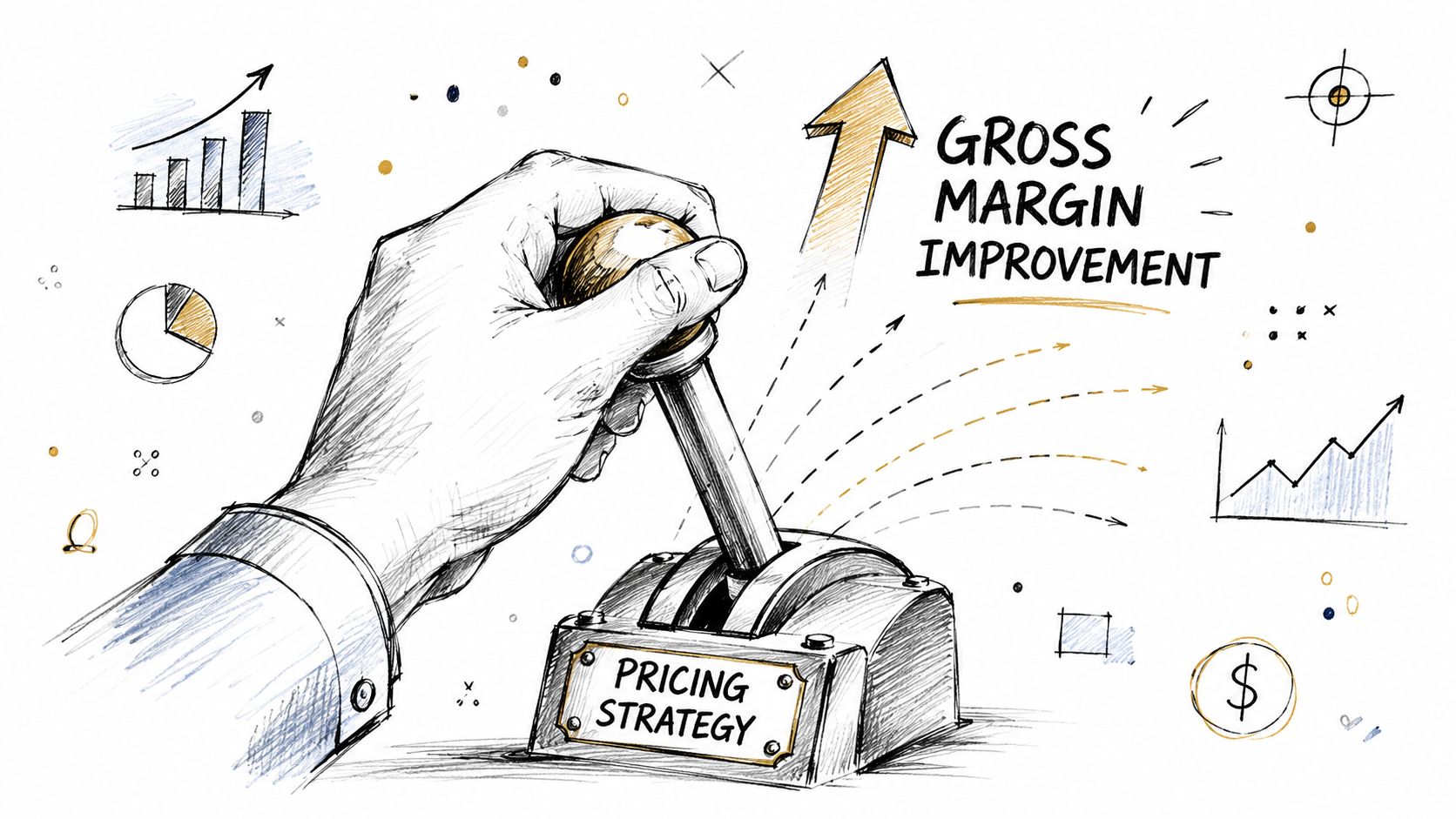
Founders usually underuse pricing because they overestimate customer sensitivity and underestimate the value they already deliver. They also hide behind cost-plus pricing because it feels objective. It isn't strategic.
Stop using cost-plus as your default
Cost-plus pricing asks, “What does this cost us, and what markup do we add?” That's easy. It's also lazy.
Value-based pricing asks, “What is this worth to the customer, and where do we have room to charge for that value?” That is the better question. It matters more in construction, distribution, and professional services than many owners admit.
A contractor solving schedule risk for a customer isn't selling labor hours alone. A distributor preventing stockouts and simplifying purchasing isn't selling boxes alone. A professional services firm reducing decision risk for a client isn't selling time alone.
Grow Good Roots reports that a 3–5% price increase on high-demand products can yield a 10–15% improvement in gross margin if cost structures remain stable. That's why pricing deserves executive attention. Small moves can create outsized results.
Pricing moves that actually work
Don't raise every price at once. Segment your pricing decisions.
- Top sellers first: Review your highest-demand products or services. If customers buy them repeatedly and compare less on price, they deserve immediate testing.
- Rush and complexity fees: Charge for accelerated turnaround, custom handling, expedited freight, after-hours work, and unusual reporting.
- Premium tiers: In professional services, create higher-value packages with faster response times, more access, or broader advisory scope.
- Unbundle underpriced extras: If site visits, revisions, storage, or project coordination are included by habit, price them separately.
- Requote problem accounts: If a client requires constant exceptions, price the exceptions.
A distributor might increase pricing on fast-moving SKUs with stable demand while holding prices on highly competitive commodities. A construction firm might add explicit pricing for change order administration, mobilization complexity, or compressed schedules. A services firm might stop burying partner access inside a flat monthly fee.
Raise prices where value is visible and service intensity is high. Leave commodity items alone unless you've tested elasticity.
Here's a useful way to view this:
| Situation | Bad move | Better move |
|---|---|---|
| High-volume, low-support product | Across-the-board increase | Test selective increase |
| Complex client with heavy service load | Keep legacy pricing | Add service or complexity fees |
| Premium offer with strong outcomes | Price from cost | Price from value |
| Low-margin bundled service | Leave bundled | Unbundle and price explicitly |
How to roll out price changes without drama
Most pricing failures come from poor execution, not from the idea itself.
First, decide where you have pricing power. That comes from demand, switching costs, service quality, speed, reliability, or expertise. Then change prices in a controlled way. Test on a narrow set of products, services, or clients. Watch volume, conversion, and gross margin by segment.
Give your sales team language. If they don't know how to explain the change, they'll discount it away.
Use simple communication:
- For clients who value responsiveness: explain the operational support and speed they receive
- For construction customers: tie pricing to schedule reliability, labor quality, and project coordination
- For distributors: tie pricing to fill rates, availability, and reduced procurement hassle
- For advisory or services clients: tie pricing to decision speed, senior access, and business impact
A short primer can help leadership teams frame these conversations:
One more rule. Never treat pricing as a one-time project. Review it monthly. If your costs, market position, and service model change, pricing should change with them.
Systematically Engineer Lower Cost of Goods Sold
Pricing is powerful, but you still need discipline on COGS. Too many founders treat direct costs like weather. They complain about them and move on. That's weak management.
You can engineer lower COGS if you attack the process, not just the purchase order.
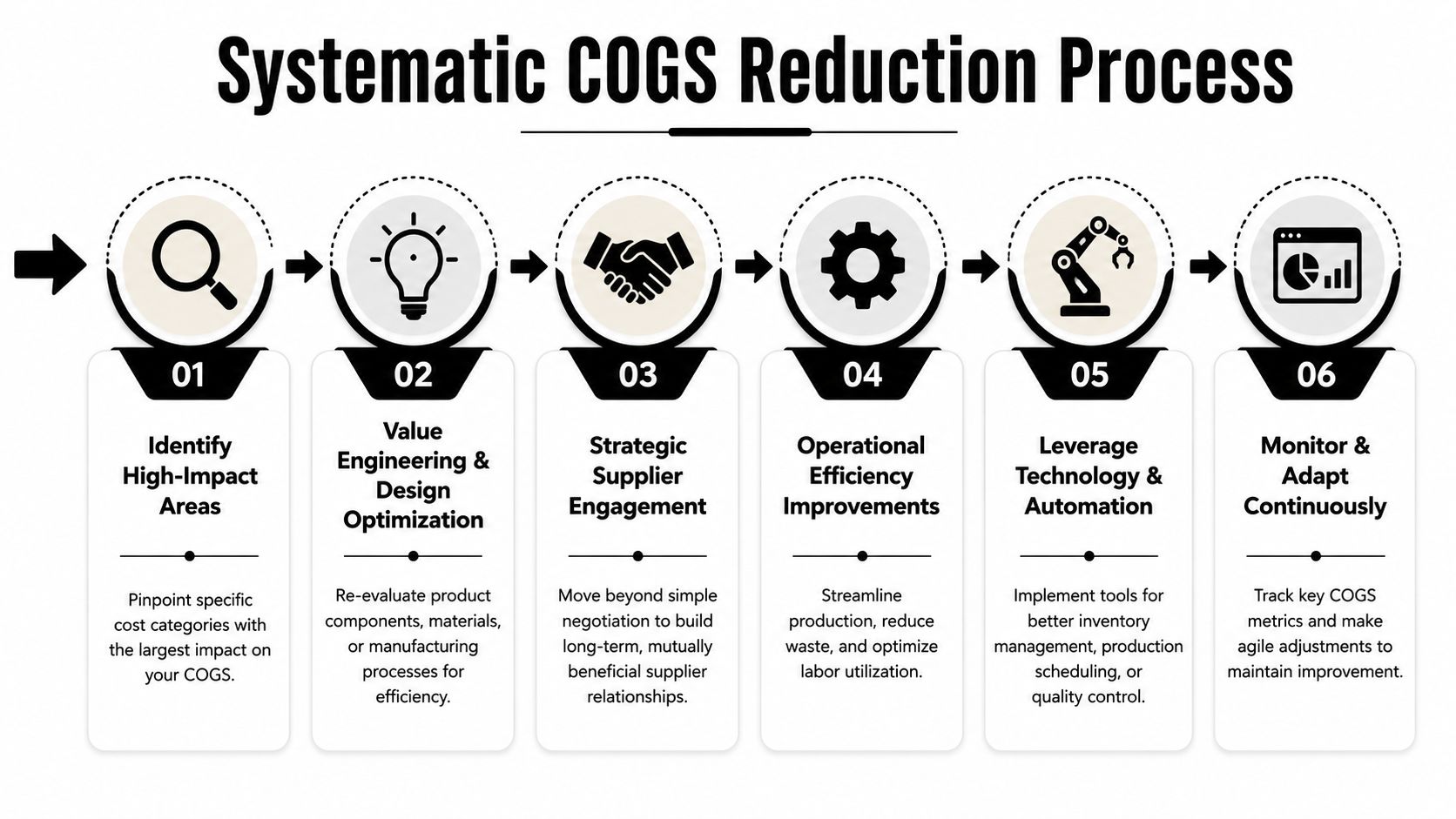
Attack the biggest COGS buckets first
Start by ranking your direct cost categories. In most founder-led businesses, the biggest levers are obvious once someone forces the analysis:
- Direct labor
- Materials or inventory purchases
- Subcontractors
- Freight and logistics
- Waste, scrap, or rework
- Field inefficiency or schedule slippage
Don't spread effort evenly. Fix the categories with the biggest dollars and the most repeatability.
For many construction and distribution firms, inventory carrying costs and purchasing discipline matter more than owners realize. Supplier terms, order timing, substitutions, and avoidable expedites all shape margin. If you haven't built a formal process for procurement review, you're probably accepting margin erosion as normal.
Construction and service businesses win through labor efficiency
Labor is often the cleanest margin lever because it's visible and controllable. Better planning, clearer scopes, cleaner handoffs, and tighter supervision lower direct labor cost without touching price.
Projul gives a simple example. If a crew completes quality work in 4 days instead of 5, labor costs for that job drop by 20%. That's not abstract finance. That's field execution converting directly into gross margin.
Look at the operational drivers behind that improvement:
- Estimating accuracy. Bad labor assumptions create bad jobs before the work starts.
- Crew planning. Idle time, poor sequencing, and waiting on materials kill margin.
- Change order discipline. Extra work without timely pricing destroys job profitability.
- Rework reduction. Quality issues turn direct labor into wasted labor.
If you run a project-based business, get serious about construction job costing. Without it, you're arguing about profitability after the money is gone.
You don't need miracles in the field. You need fewer wasted labor hours, fewer handoff errors, and faster correction when a job slips.
Distribution businesses win through procurement and inventory discipline
Distributors usually have a different disease. Margin gets squeezed by purchasing inconsistency, freight leakage, too many low-value SKUs, and bad inventory habits.
Focus on these moves:
- Renegotiate with intent: Don't ask suppliers for generic concessions. Bring volume commitments, product mix data, and alternate sourcing options.
- Standardize purchasing: Too many buyers making one-off decisions creates unnecessary spread in landed cost.
- Reduce slow-moving inventory: Dead stock ties up cash and pushes markdown pressure into the system.
- Clean up freight: Expedites, split shipments, and avoidable partial orders often sit outside the spotlight but hit gross profit directly.
- Reduce SKU clutter: Complex catalogs often hide low-margin items that create purchasing noise and service headaches.
Professional services firms also have COGS work to do, even if they don't call it that. Their direct costs usually show up as delivery labor, contractors, and overruns from poor scoping. The fix is the same. Measure delivery effort against revenue at the client and engagement level, then redesign the work.
Optimize Your Product and Customer Mix for Profitability
Some revenue deserves to be grown. Some revenue deserves to be priced differently. Some revenue deserves to be cut.
Founders typically hesitate, confusing customer loyalty with economic value. If a client, service line, or product consistently drags margin down, keeping it unchanged is a decision. It just happens to be a bad one.
Find the few things creating most of the profit
A smart way to improve gross profit margin is to focus resources on the parts of the business that already produce disproportionate gross profit.
Crestmont Capital highlights the Pareto Principle here. The top 20% of products can generate 80% of gross profit. That doesn't mean your exact split will look identical. It means concentration is normal. A relatively small part of your portfolio usually carries the business.
Review your data and ask:
- Which products or services create the most gross profit dollars?
- Which customers buy those offers repeatedly?
- Which jobs run cleanly and finish close to estimate?
- Which salespeople sell the best mix, not just the most volume?
If you know the answers, reallocate attention. Push sales resources, marketing spend, and operational capacity toward the offers and customers that create strong gross profit. If you need a planning model to support that shift, use a projected sales forecast template.
What to do with low-margin clients and products
You have four options when an account or product underperforms:
- Reprice it
- Redesign how you deliver it
- Restrict the scope or service level
- Exit it
Each option is valid. The wrong move is doing nothing.
For a construction company, that may mean refusing job types that always create labor overruns or callback risk. For a distributor, it may mean raising prices on low-margin, high-touch accounts or reducing service exceptions. For a professional services firm, it may mean moving a difficult client to a tighter scope, different staffing model, or different fee structure.
Use a simple decision screen:
| Item | Keep and grow | Fix | Exit |
|---|---|---|---|
| High margin, low complexity | Yes | No | No |
| High margin, high complexity | Yes, selectively | Maybe | No |
| Low margin, fixable | No | Yes | Maybe |
| Low margin, chronic drain | No | No | Yes |
The goal isn't more revenue. The goal is better revenue.
One hard truth. “Strategic” clients are often just underpriced clients with a good story attached. If an account earns weak margin, consumes leadership time, and blocks capacity for better work, it's not strategic. It's expensive.
Your Margin Improvement Playbook and KPI Dashboard
Most margin work fails because nobody turns insight into operating rhythm. A few reports get built. A few meetings happen. Then the business slips back into reacting.
A margin improvement plan has to be simple enough to run and sharp enough to force action.
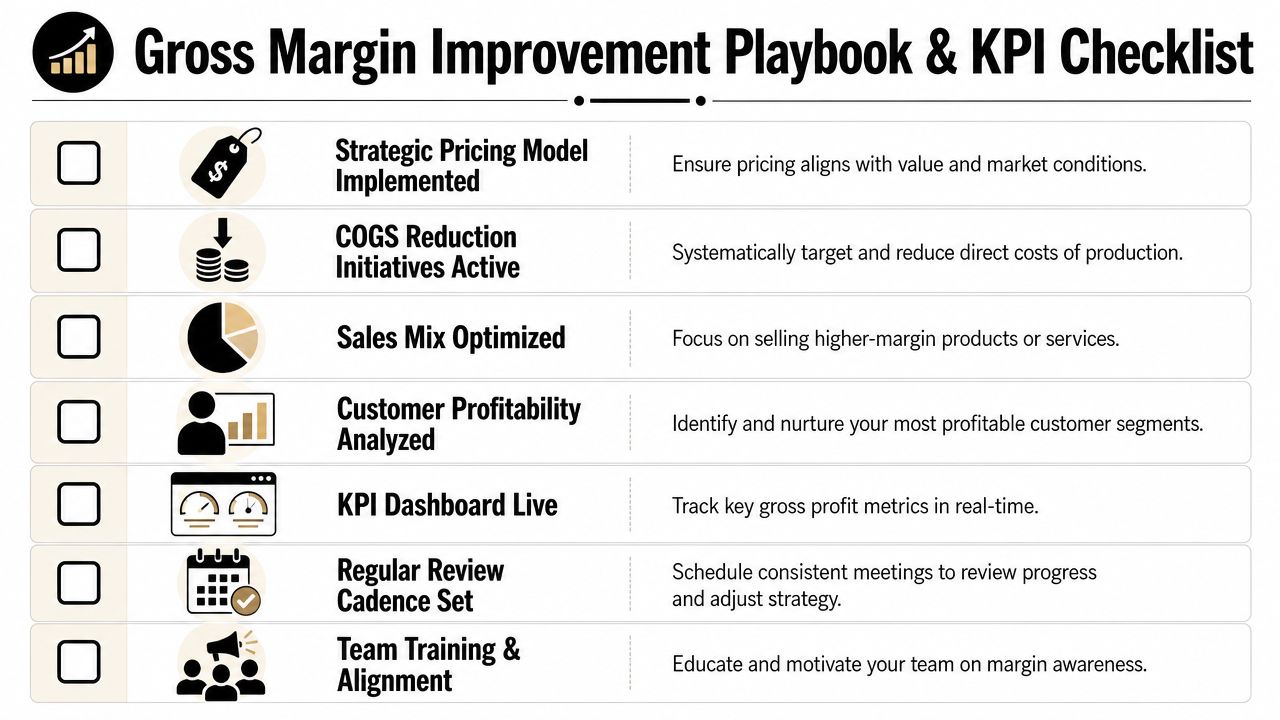
A practical execution checklist
Start with a focused plan. Not twenty initiatives. A handful of changes with owners, dates, and reporting.
- Build job, client, and product-level margin reporting: If direct costs aren't assigned properly, fix the coding and reporting structure first.
- Set target margin ranges by segment: One company-wide target isn't enough. Set expectations by job type, client type, or product category.
- Run a pricing review: Flag top sellers, high-complexity work, legacy accounts, and bundled services.
- Launch COGS initiatives: Prioritize labor efficiency, supplier strategy, freight control, and waste reduction.
- Prune low-margin mix: Reprice, redesign, or exit work that repeatedly underperforms.
- Train sales and ops together: Margin targets fail when sales chases volume and ops inherits the mess.
- Review every month: If margin analysis only happens at quarter-end, you're late.
Chortek reports that a three-phase margin optimization methodology starting with granular COGS attribution, followed by price modeling, and concluding with supplier negotiation yields a 12–18% gross margin improvement in 6–9 months for mid-market firms in construction and distribution, with a 74% success rate when implemented systematically. That outcome comes from process, not inspiration.
The KPI dashboard I'd want on my desk
A dashboard should help you act, not admire charts. If you're serious about how to improve gross profit margin, track the metrics that isolate decisions.
Use a short, brutal dashboard:
| KPI | Why it matters | What it tells you |
|---|---|---|
| Overall gross profit margin % | Summary view | Whether total economics are improving |
| Gross margin by client | Customer quality | Which accounts deserve more or less attention |
| Gross margin by job or project | Execution quality | Whether estimating and delivery are working |
| Gross margin by product or service line | Mix quality | Which offers drive profit |
| COGS as a % of revenue | Cost discipline | Whether direct costs are expanding faster than revenue |
| Price realization | Pricing discipline | Whether sales is holding the line |
| Labor hours vs estimate | Operational control | Whether field or delivery teams are overrunning |
| Freight or direct delivery exceptions | Leakage control | Whether fulfillment choices are eroding margin |
If your finance package still arrives as a static monthly PDF, fix that. Put this dashboard in a tool leaders open and review. Then build your monthly meeting around exceptions, not around reading the statements aloud.
For stronger reporting structure, follow financial reporting best practices. Good decisions depend on report design, timing, and accountability.
The operating cadence that keeps gains from slipping
Organizations don't need more analysis. They need a tighter cadence.
Run margin management at three levels:
Weekly
- Review jobs, orders, or accounts that are already below target
- Approve pricing exceptions
- Flag labor, freight, or scope issues before month-end
Monthly
- Review margin by customer, job, and product category
- Compare actuals to target by segment
- Decide which accounts need repricing, restructuring, or escalation
Quarterly
- Reassess product and customer mix
- Update supplier strategy
- Reset pricing where market conditions or delivery complexity changed
This work also has to be shared across teams. Finance shouldn't own margin alone. Estimating, sales, purchasing, operations, and project leadership all shape gross profit.
Use plain language with your team:
- Sales owns price discipline and customer selection
- Operations owns delivery efficiency
- Purchasing owns cost control and supplier performance
- Finance owns visibility, measurement, and decision support
- Leadership owns trade-offs
Margin improves when the people quoting work, buying inputs, and delivering the job all see the same target.
The founder's role matters too. If you override pricing, approve bad-fit customers, and tolerate scope creep, the team learns that margin is optional. It isn't optional. It's one of the clearest indicators of whether your growth is building value or just creating activity.
If you want one clean starting point, do this in the next two weeks:
- Pull your top clients, jobs, or products by revenue.
- Calculate gross profit margin for each one.
- Rank them from best to worst.
- Identify the bottom group.
- Decide which will be repriced, redesigned, or exited.
- Put monthly margin review on the calendar with the leadership team.
That alone will put you ahead of most companies your size.
If you're ready to stop guessing and build a margin improvement plan that changes decisions, talk with AmbitionCFO. We work with founder-led businesses in construction, distribution, and professional services to build job and client profitability reporting, KPI dashboards, forecasting, and the operating discipline required to improve margins without adding a full-time CFO.