

You're probably not asking, “Can we build another forecast?” You're asking a harder question: if revenue slips, margins tighten, or a major customer changes course, how quickly can the business protect cash and keep moving?
That question matters most in founder-led companies between $10M and $100M in annual revenue, where one delayed project, underpriced contract, or aggressive hiring decision can change the owner's options. A single forecast can make the future look orderly. The operating reality usually isn't.
Scenario planning gives you a practical way to prepare for several plausible futures, connect each one to cash and margin, and decide in advance what action you'll take when conditions change. It isn't a strategy-deck exercise. Used properly, it becomes part of the weekly cash meeting, the hiring decision, the equipment purchase, the bank conversation, and the exit plan.
Table of Contents
- The Moment a Single Forecast Is Not Enough
- What Scenario Planning Actually Means
- How a Credible Scenario Process Actually Works
- Wiring Scenarios Into Cash Flow, Margin, and Forecasting
- Industry Snapshots From Construction, Distribution, and Professional Services
- Pitfalls That Undermine Scenario Planning in Growing Companies
- Your First 90 Days and the Next Step to Take
The Moment a Single Forecast Is Not Enough
A specialty contractor rolls into Q3 with a healthy backlog. The controller prints the budget, the owner approves a new equipment purchase, and the leadership team assumes the next six months will follow the plan.
Then a major general contractor pushes two projects by 90 days.
The work hasn't disappeared. That's what makes the problem easy to underestimate. Revenue has moved to the right, payroll still arrives on schedule, equipment payments remain fixed, and subcontractor commitments may already be in motion. A forecast built around one expected timing assumption can turn from reassuring to dangerous without any dramatic change in the long-term outlook.
The owner doesn't need a more attractive spreadsheet at that point. The owner needs to know whether to delay the purchase, accelerate collections, renegotiate payment timing, slow hiring, draw on the revolver, or change the operating plan.
That's where forecasting accuracy matters, but accuracy alone isn't enough. A forecast can be carefully prepared and still fail to prepare the team for a different operating environment. The better question is whether the leadership team already knows what it will do if the forecast's key assumptions break.
The decision behind the forecast
A founder-led distributor may be deciding whether to add inventory before a major customer rollout. A professional services owner may be considering several senior hires before signed work converts to revenue. A construction company may be weighing equipment financing while retainage collections remain uncertain.
Each decision depends on variables the owner can't fully control. Revenue timing, gross margin, customer concentration, labor availability, collections, freight, material costs, and borrowing capacity can all move independently.
A single forecast hides that range. It gives the team one answer when the business really has several plausible paths.
Practical rule: If a decision would be painful to reverse, test it against more than one future before approving it.
Scenario planning helps the owner act before the cash problem becomes urgent. It turns uncertainty into a set of prepared choices, each tied to a trigger and an owner. The rest of the process is about making those choices concrete enough to use during an ordinary operating week.
What Scenario Planning Actually Means
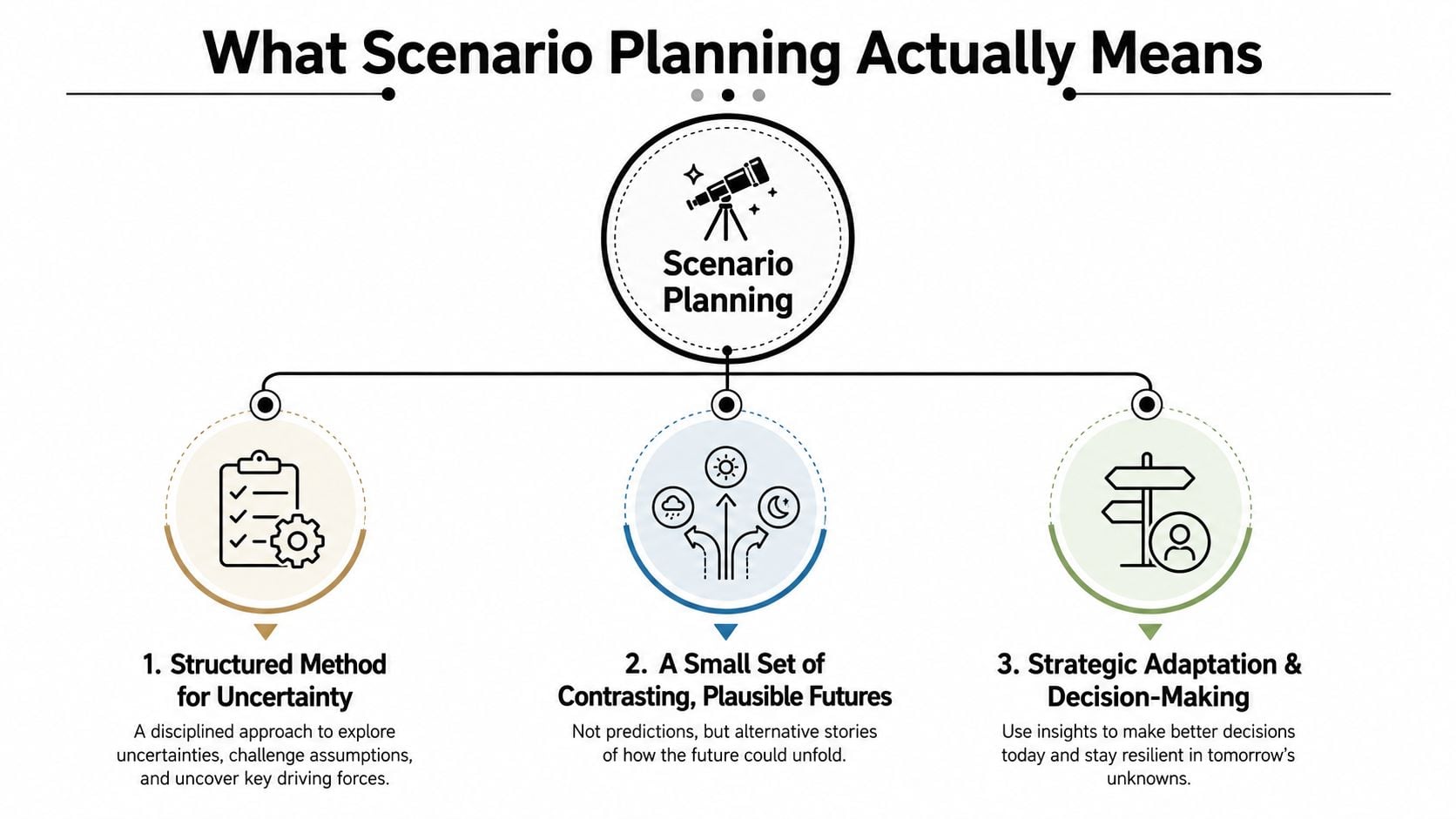
Scenario planning is a structured method for working with uncertainty. Instead of predicting one future, the leadership team develops a small set of contrasting, plausible futures and tests important decisions against each one. The method is described in research on strategic decision-making as a way to build flexible strategies and organizational resilience when the future is uncertain (Oxford research on scenario planning).
A point forecast gives you one expected path. Scenario planning gives you several usable paths, such as a base case, a downside case, and a stretch case. The purpose isn't to label one scenario “correct.” The purpose is to identify what would change the decision and prepare the response before the change arrives.
Forecasting, workshops, and operating decisions
A point forecast resembles a single weather report. Scenario planning resembles checking the radar across several likely storm tracks before deciding whether to hold the outdoor event, delay equipment delivery, or proceed as planned.
The comparison is useful because both methods have a place. A forecast supports routine planning and resource allocation. Scenario planning becomes more valuable when revenue, margin, demand, or capacity can move quickly.
A strategy workshop can produce useful ideas, but it often fails when nobody assigns an owner or defines the number that changes the plan. Scenario planning turns those ideas into operating instructions:
- Driver: What could move the outcome?
- Assumption: What does the current plan assume?
- Trigger: What observable number tells the team conditions have changed?
- Action: What will a named owner do next?
The technical value comes from forcing leaders to expose assumptions and decision points. That helps counter overconfidence and narrow thinking, especially during growth. A founder who feels confident about demand may still need to test what happens if collections slow or gross margin compresses.
For a practical comparison between related financial techniques, review the difference between sensitivity analysis and scenario analysis. Teams that need help turning financial scenarios into operating routines may also benefit from resources designed for COOs.
A concise explanation for your CFO or controller is: “Scenario planning builds several plausible futures, then tests our major decisions against each one. We're not trying to predict the future, we're defining the triggers and actions that keep the business financially safe when conditions change.”
How a Credible Scenario Process Actually Works
A credible process has three phases, preparation, development, and use. That structure appears in scenario-planning research and keeps the exercise tied to a decision rather than allowing it to become an open-ended discussion (three-phase scenario-planning process).
Phase one fixes the decision
Start with a decision that matters now. “What might the market look like?” is too broad. “Can we afford to hire three project managers in Q1?” gives the team something testable.
Write down the current answer and the assumptions behind it. Then identify the forces most likely to change that answer, such as project slippage, subcontractor margin, labor availability, collections, or line-of-credit capacity.
The preparation phase should produce a short decision statement, a list of key drivers, and the financial measures that matter. A company considering expansion may focus on cash minimums and debt capacity. A company considering hiring may focus on signed backlog, utilization, and payroll coverage.
Phase two turns drivers into stories
The development phase creates contrasting narratives rather than disconnected numbers. Each scenario should describe how the future unfolds and what it means for operations.
For example, the downside story might say that project starts move later, labor costs rise, and collections stretch. The base story might assume the current backlog converts broadly as planned. The stretch story might include faster customer demand but also require additional working capital.
Attach numbers to the story, but don't confuse precision with quality. A small set of coherent scenarios is more useful than a large collection of minor variations. Research describes scenario planning as developing a limited set of contrasting, plausible future states and examining their impact on the operating environment (scenario planning for strategic decision-making).
Phase three makes the scenarios operational
The use phase answers the question founders often skip: what changes on Monday morning?
For each scenario, define the financial condition, the operational action, and the person responsible. If the cash forecast falls below the agreed minimum, the owner may pause discretionary capital spending. If a job's projected margin drops below the acceptable range, the operations leader may renegotiate scope or review production assumptions.
Refresh the model when a major driver moves, or at least quarterly in a volatile business. Recent planning coverage describes a shift toward quarterly scenario cycles and greater use of external data and AI-enabled planning workflows (enterprise planning trends). A mid-market company doesn't need an enterprise foresight department. It needs an owner, a current model, and a recurring decision rhythm.
Use a flexible budgeting approach so the operating plan can respond to volume and margin changes instead of treating the original budget as permanent.
Wiring Scenarios Into Cash Flow, Margin, and Forecasting
Scenarios become useful when they live inside the financial tools the team already uses. For a $25M services firm, that usually means connecting three views:
- A 13-week cash flow model for immediate liquidity.
- A job-level or client-level margin view for profitability.
- A rolling 12-month forecast for hiring, capital spending, debt, and exit planning.
The cash model should show base, downside, and stretch cases using the same opening cash balance and the same payment obligations. The differences should come from explicit assumptions, such as collections timing, project starts, payroll, contractor spend, and customer demand.
A margin view adds a second layer. Revenue can hold while gross margin deteriorates because labor, subcontractor, freight, or delivery costs rise. That's why a founder should test the economics of individual jobs, clients, or service lines rather than relying only on company-level revenue.
The weekly operating rhythm
The weekly cash meeting should answer four questions:
- Which scenario best matches current conditions?
- Which trigger moved?
- What action does that trigger require?
- Who owns the action and when will the team review it?
The bank conversation improves when the owner can explain more than one expected outcome. Instead of presenting a single forecast and hoping it holds, the owner can show the base cash position, the downside cash position, the assumptions separating them, and the actions that protect liquidity. A cash flow forecast becomes a management instrument rather than a report assembled after decisions have already been made.
| Financial Tool | Base Scenario | Downside Scenario | Trigger to Switch |
|---|---|---|---|
| 13-week cash flow | Collections and project starts follow the current plan | Collections slow or starts move later | Forecast cash reaches the agreed minimum |
| Job or client margin | Current pricing and delivery assumptions hold | Labor, subcontractor, or delivery costs rise | Projected margin falls below the approved range |
| 12-month forecast | Planned hiring and capital spending proceed | Revenue timing or demand weakens | Signed work or conversion assumptions fall below plan |
| AR aging | Customers pay within expected terms | Past-due balances accumulate | A key account crosses the collection threshold |
The most common conversion failure is building attractive scenarios that never reach an operating decision. If the downside case doesn't tell the owner what to stop, what to renegotiate, and what to accelerate, it's only a presentation.
Industry Snapshots From Construction, Distribution, and Professional Services
The same method looks different across industries because cash gets trapped in different places. Construction owners watch backlog conversion, retainage, labor, and materials. Distributors manage inventory, customer concentration, freight, and revolver capacity. Professional services firms live or die by utilization, revenue mix, and payroll timing.
Construction
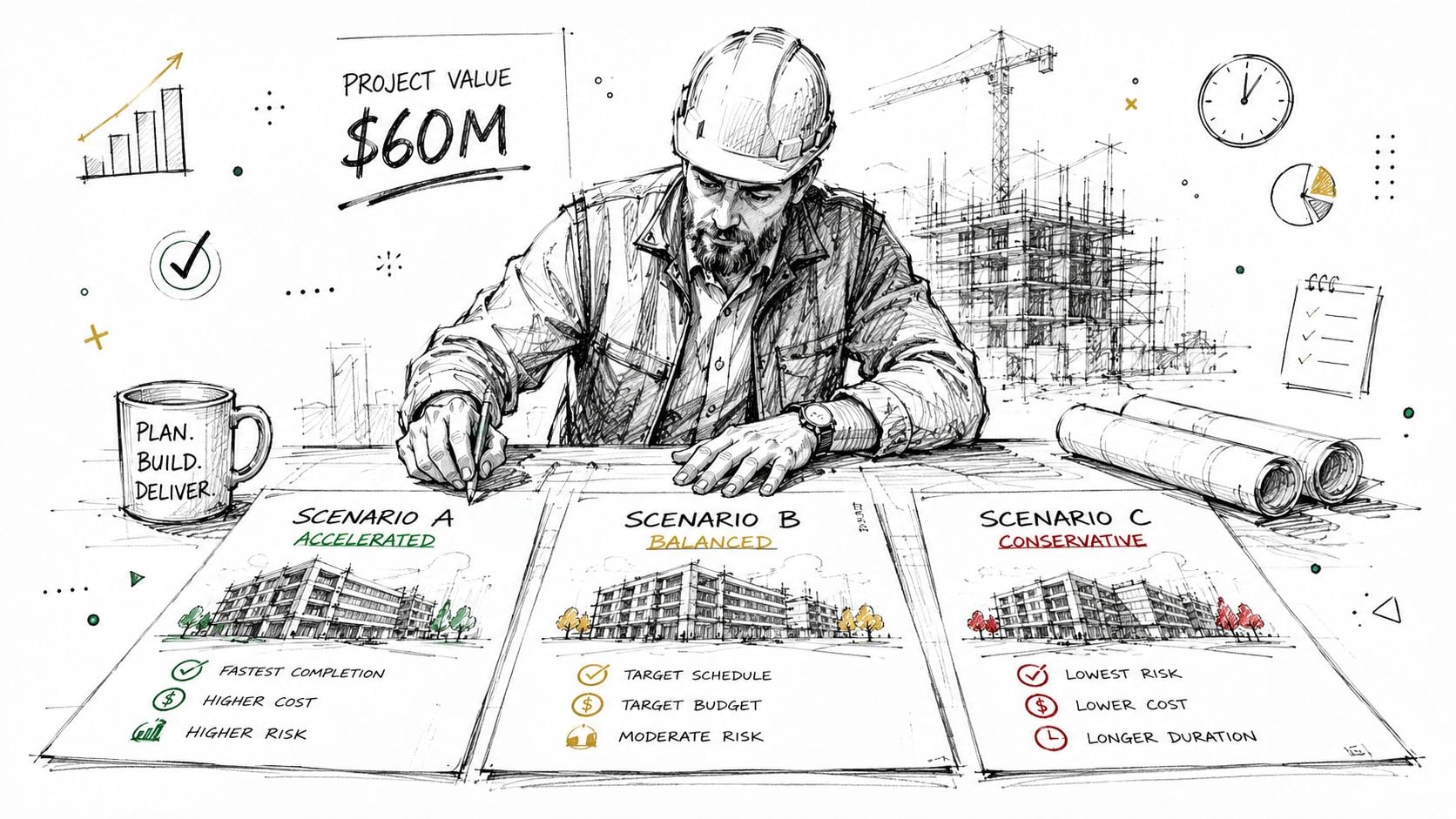
A $60M commercial general contractor tests a downside case in which two GCs push six months of work to the right, material prices rise 8 percent, and retainage collections slow. Those assumptions create a direct cash problem even if the backlog still looks substantial. The work may be profitable eventually, but payroll, equipment, and subcontractor commitments arrive before the delayed receipts.
The trigger is not “the market feels weaker.” It's a measurable change in project start dates, projected cash, or cost-to-complete. The owner can respond by deferring equipment, tightening change-order approvals, prioritizing collection calls, and reviewing subcontractor commitments before the cash gap becomes urgent.
The useful question isn't whether the backlog is large. It's when the backlog converts to cash at an acceptable margin.
Distribution
A $35M industrial distributor models a top customer cutting orders by 30 percent while a freight contract doubles. The immediate concern is working capital. Inventory purchased for the original demand plan may sit longer, while higher freight costs compress margin and increase reliance on the revolver.
The action plan might include reducing replenishment orders, repricing freight-sensitive accounts, moving inventory toward stronger demand, and escalating the customer concentration risk to the owner. The trigger could be a defined order reduction or a revolver balance approaching the company's internal limit.
Professional services
A $22M professional services firm stress-tests the loss of a flagship engagement after two senior hires have already joined. The top-line impact matters, but utilization and revenue mix determine how quickly cash deteriorates. High-cost employees without billable work can create pressure before the owner sees a major change in the annual forecast.
The response may include reallocating senior staff, slowing additional hiring, narrowing subcontractor use, and protecting the most profitable client work. The scenario helps the founder make the staffing decision based on contribution and capacity, not optimism about a replacement engagement.
These examples are compressed operating illustrations, not reported case studies. Their value is the pattern: identify the driver, quantify the financial consequence, define the trigger, and assign the response. For teams that want to see how planning software supports structured comparisons, scenario planning guidance from Adobe offers additional background.
The historical development of the method also explains why it's associated with uncertainty-heavy environments. Scenario planning emerged from Cold War military strategy in the 1950s, when Herman Kahn at RAND used “future-now” thinking to examine multiple plausible futures. By 1961, he had founded the Hudson Institute, and the method moved into business strategy in the early 1970s, when Royal Dutch Shell adopted it under Pierre Wack. Shell's early corporate use became a milestone because it helped the company respond more quickly to the 1973 oil shock than many competitors (history of scenario planning).
Pitfalls That Undermine Scenario Planning in Growing Companies
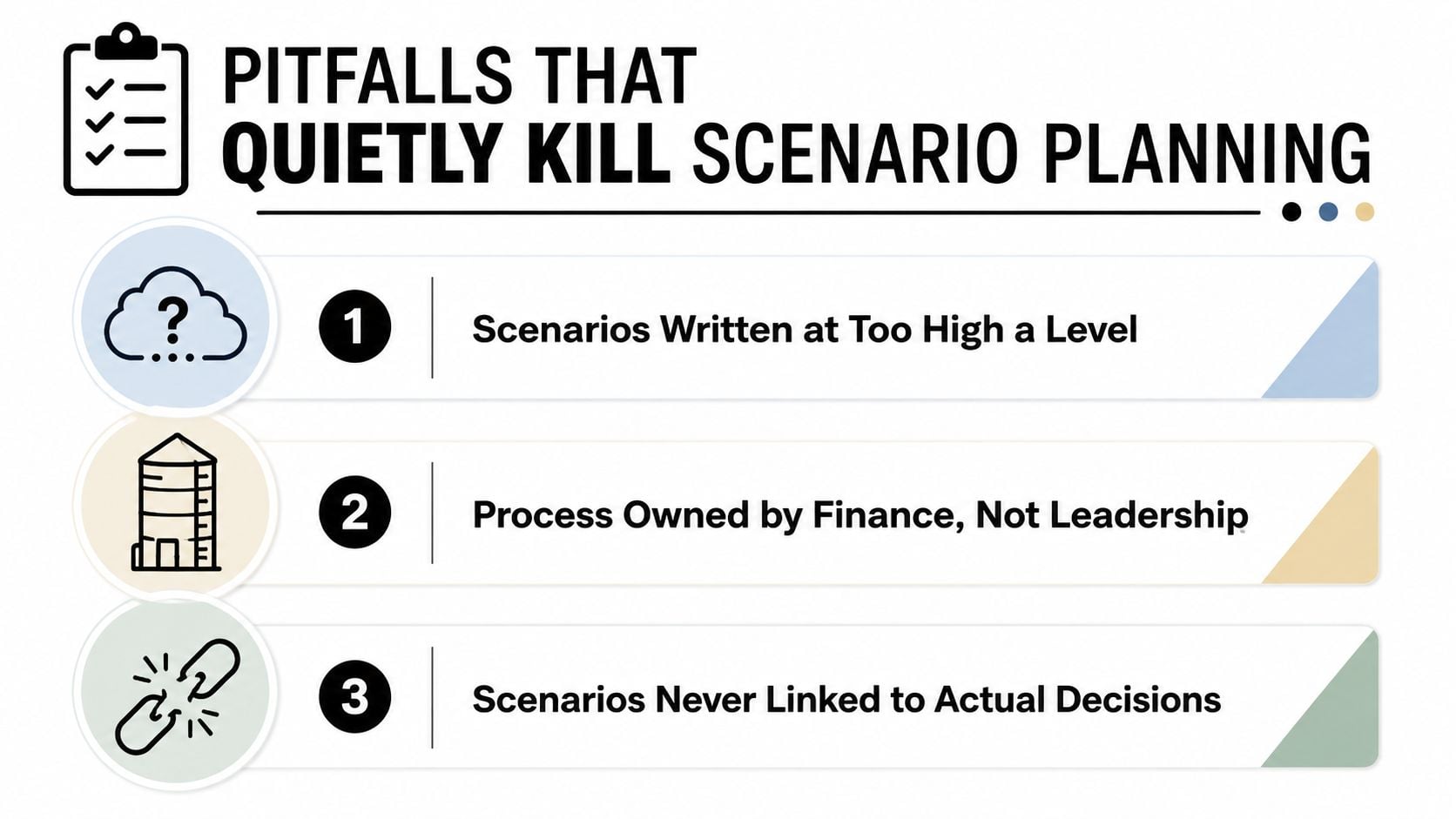
Scenario planning fails when it is disconnected from decisions. A founder may spend weeks discussing uncertainty and still lack a clear answer about cash, margin, hiring, capital spending, or the company's exit readiness.
Vague scenarios produce no operating response
“Strong growth,” “market disruption,” and “economic weakness” sound strategic, but they do not tell anyone what to change. Each scenario should name a business driver, a financial consequence, a trigger, and an owner-controlled response.
For example: “Project starts move later, weekly cash approaches the minimum, and equipment spending pauses unless collections improve.” The wording is less elegant, but it gives the team a decision rule. In construction, that may mean delaying a purchase. In distribution, it may mean reducing a replenishment order. In professional services, it may mean holding a hire until signed work supports the payroll commitment.
Finance builds a model nobody operates
Finance can structure the file, but operations owns many of the assumptions. Project managers understand schedule risk. Sales leaders know whether pipeline is qualified or merely active. Service-line leaders can judge whether utilization supports another hire without cutting margin.
Bring those owners into the assumptions and response plan. Otherwise, the controller carries responsibility for a forecast that department leaders do not use. That disconnect can leave cash exposed even when the spreadsheet is technically sound.
Too many cases bury the decision
A long menu of cases can look thorough while making the trigger harder to see. Keep the analysis focused on the few operating changes that could materially affect cash, gross margin, debt capacity, or the owner's exit timeline.
The purpose is not to predict which result will occur. It is to help leadership recognize a change early and switch the operating response during the quarter. If a case does not alter a decision, a cash requirement, or an assigned action, remove it from the working model.
The model becomes a stored file
A scenario model built once and left in a shared drive will not protect cash. Assign a refresh owner, review the drivers during quarterly planning, and update the model sooner when a material assumption changes.
Historical research found that scenario planning adoption rose sharply after the first oil shock, with another increase from 1976 to 1978 (scenario-planning adoption history). The practical lesson for a founder is direct: the process earns its keep when conditions change and leaders use it to decide what to stop, delay, renegotiate, or fund.
Your First 90 Days and the Next Step to Take
You can build a useful first scenario process without creating a large planning department. The work should start with decisions already competing for cash and leadership attention.
Weeks one and two
Choose two or three decisions that keep resurfacing. Examples include hiring, equipment, a new location, a customer contract, inventory purchases, or a potential acquisition.
Pull apart the current forecast and identify the assumptions hidden inside it. Mark which assumptions affect cash, gross margin, debt capacity, and the owner's exit timeline.
Weeks three through six
Build three scenarios:
- Base: The current operating plan holds broadly.
- Downside: Revenue timing or gross margin weakens enough to require action.
- Stretch: Demand or conversion improves, but growth creates working-capital pressure.
For most founder-led companies, start with two real drivers, revenue timing and gross margin. Drop each scenario into the 13-week cash model and the 12-month forecast. Define the trigger that moves the team from one playbook to another.
Weeks seven through ten
Run the scenarios against the operating plan. Ask department leaders what they would stop, delay, renegotiate, or accelerate under each case.
Assign one owner to each trigger action. A cash trigger without a responsible person is only a warning. A margin trigger without an operating response won't protect profitability.
Weeks eleven and twelve
Set a quarterly refresh rhythm and a faster update rule for major changes. Brief the bank, leadership team, and any exit or M&A advisors on the new view. A company preparing for a transition within 3–10 years should also test how weaker cash generation or margin compression could affect its strategic options.
A fractional CFO can help connect this work to broader planning, including the role described in guidance on a fractional CFO for startups, although the same financial discipline applies to established $10M–$100M companies.
Start this week by writing down one decision, three plausible futures, and the financial trigger that would change your answer. Then build the first version in the cash model your team already reviews.
If the future were certain, you wouldn't need a plan. You'd just need a number.
AmbitionCFO works with founder-led companies on 13-week cash flow modeling, margin analysis, forecasting, scenario modeling, and exit planning. Visit AmbitionCFO to schedule a working session and turn your next major decision into a three-scenario cash model with clear triggers and assigned actions.