

You're probably in one of two situations right now.
Revenue is growing, the team is bigger than it was a year ago, and decisions that used to feel simple now carry real financial risk. You're approving hires, signing leases, extending payment terms, buying inventory, or taking on larger projects, but your visibility into cash, margin, and downside scenarios still lives in spreadsheets that only sort of agree with each other.
Or you're not in chaos on the surface. The books close. Payroll runs. Taxes get filed. But when someone asks, “What does this hiring plan do to cash over the next quarter?” or “Which customers, jobs, or service lines create profit?” the answer gets fuzzy fast.
That's the point where many founders realize they don't need more accounting cleanup. They need senior financial judgment. A fractional CFO for startups fills that gap. Not as an outside commentator who drops in for a slide deck, but as an embedded strategic partner who helps you turn raw financial data into operating decisions.
If rapid growth is stretching your systems and your confidence, this piece on the hidden costs of rapid growth and financial forecasting is a useful companion read.
Table of Contents
- Your Startup Is Scaling Fast Now What
- Five Signs Your Startup Needs a Fractional CFO
- Core Services That Drive Sustainable Growth
- Decoding Fractional CFO Pricing and ROI
- From Chaos to Clarity Real World Case Studies
- Your Playbook for Hiring and Onboarding the Right CFO
- Take Control of Your Financial Future Today
Your Startup Is Scaling Fast Now What
You close a strong month, hire ahead of demand, commit to more inventory, and sign a bigger customer. Revenue is up. Cash is tighter. The team is moving fast, but every important decision now carries more financial risk than it did six months ago.
That is the point where founder instinct starts to break.
Early on, you can keep the business in your head. You know which customers pay late, which hires are worth stretching for, and which expenses can wait. As the company grows, that mental model stops being enough. More volume creates more timing gaps, more fixed costs, and more ways for a good sales month to hide a coming cash problem.
A fractional CFO for startups gives the business senior financial judgment without adding a full-time executive cost too early. The role is not bookkeeping, tax filing, or cleanup after the fact. A CFO turns operating decisions into a financial plan you can use, then pressure-tests that plan against cash, margins, and capacity.
What scaling usually feels like from the founder seat
The warning signs are rarely dramatic at first.
You are still getting paid. Customers are still buying. But decisions start taking longer because no one fully trusts the numbers behind them. Hiring feels reactive. Pricing conversations stay too high level. Cash questions get answered with rough estimates instead of a weekly view of what is coming in, what is going out, and where the strain will hit first.
I see this pattern often in founder-led companies that are not chasing venture capital. They are trying to build a durable business. Their problem is not investor storytelling. Their problem is that growth has outpaced financial structure.
That gap shows up in a few predictable places. Working capital gets absorbed by receivables and inventory. Gross margin looks healthy in aggregate but weak by customer, job, or service line. Annual budgets get approved, then ignored, because they stop matching reality by February. What helps at this stage is not another static spreadsheet. It is a tighter operating cadence built around tools like a rolling forecast and a financial forecasting approach for growing businesses under rapid growth pressure.
Why a fractional CFO fits this stage
A full-time CFO can be too much too soon, especially for a business that needs sharper decisions before it needs another executive salary.
A fractional CFO fills the gap between basic accounting and true financial leadership. The value comes from focus. Build a 13-week cash flow model that gets updated weekly. Tie hiring plans to cash and margin, not optimism. Separate revenue growth from profitable growth. Give the leadership team a reporting rhythm that shows what changed, why it changed, and what needs action now.
That is how the role should be judged.
The point is not to add a finance title to the org chart. The point is to give the company a decision system that can support growth without letting cash, margins, or execution quality slip underneath it.
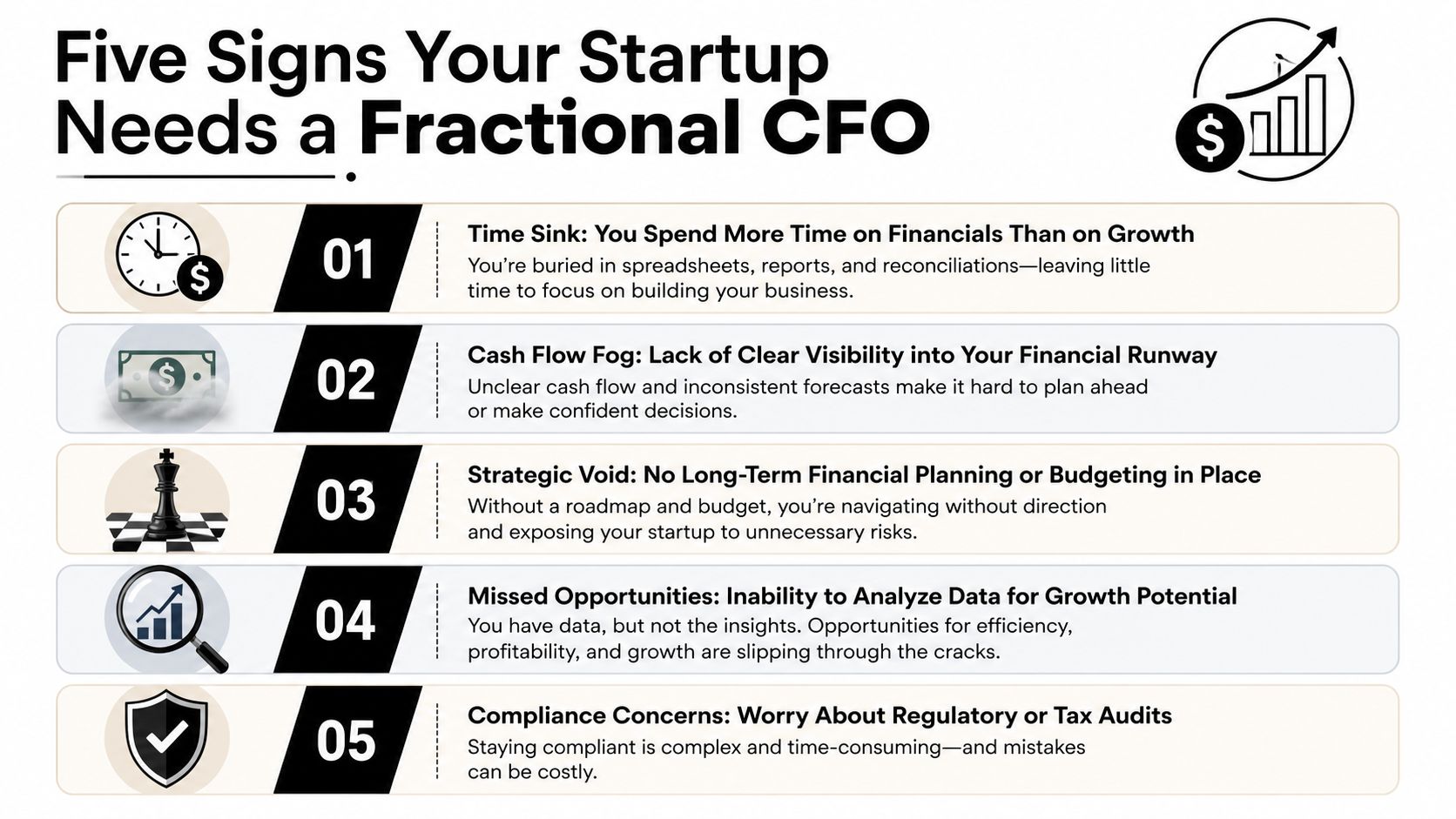
Five Signs Your Startup Needs a Fractional CFO
It usually starts the same way. Sales are up, the team is bigger, and the company looks healthy from the outside. Then a founder gets asked a basic question, such as which customers produce cash, how much room there is to hire, or why profit is trailing revenue, and the answer takes three spreadsheets and a lot of guesswork.
That is the point where growth has outgrown the current finance setup.
If you are trying to judge the timing, this guide on when to hire a fractional CFO adds useful context.
You're becoming the finance department
Early on, that is normal. Later, it becomes expensive.
If you are still the person approving payments, answering payroll questions, explaining the numbers to department heads, and rebuilding forecasts every time something changes, finance is taking time away from selling, hiring, and running the business. More importantly, decisions stall when you are unavailable.
A fractional CFO fixes that by creating a decision process the company can use without routing every question back through the founder. Reporting gets clearer. Ownership improves. The leadership team starts working from the same numbers instead of private spreadsheets and instincts.
Your cash runway answer changes depending on the spreadsheet
A founder should be able to answer a simple question. How much cash is available, what will happen over the next quarter, and what assumptions could break the plan?
If the answer changes based on which spreadsheet is open, there is a control problem. Collections may be lagging. Payroll timing may be distorting the month. Inventory, debt service, taxes, or large vendor payments may be getting missed until they hit the bank account. That is how profitable businesses still end up in a cash squeeze.
A strong fractional CFO brings discipline to cash forecasting and turns runway from a rough estimate into a weekly operating tool.
A short explainer can help make that concrete.
You have a budget but not a decision system
Many startups do have a budget. They just do not run the business from it.
Once the year starts, the file sits in a folder while hiring, pricing, marketing spend, and operating costs drift based on momentum. By the end of the quarter, nobody trusts the original assumptions, but nobody has replaced them with a better planning process either.
That is a sign you need CFO-level judgment, not just bookkeeping and monthly reports. The job is to connect plan to action. Which hires still make sense at the current gross margin? Which sales channels deserve more spend? Which costs should be cut now instead of tolerated for another two quarters?
If the budget never changes a decision, it is only an exercise.
Growth is happening but profit drivers are still hidden
This is one of the most common ceilings I see in founder-led companies.
Revenue is rising, but management cannot clearly explain which products, customers, channels, or service lines create real economic value after fulfillment costs, support load, payment timing, and overhead. On paper, the business is growing. In practice, it may be adding low-quality revenue that strains working capital and suppresses margins.
A fractional CFO goes beneath topline numbers. The work includes contribution margin analysis, customer or product profitability, pricing review, and a hard look at how growth affects cash conversion. That matters as much for agencies, ecommerce brands, manufacturers, and services firms as it does for SaaS. The metrics differ, but the question is the same. Which activity creates profit, and which activity only creates busyness?
Compliance and reporting risk are starting to bother you
This sign is quieter than a cash problem, but it affects value just as much.
At a certain stage, founders start wondering whether revenue is being recognized correctly, whether the balance sheet can be trusted, whether lender reporting will hold up, and whether a buyer or investor would find gaps the team has been papering over. Those concerns usually show up before an event, such as a loan request, quality of earnings review, or sale process. By then, fixing weak reporting gets slower and more expensive.
A fractional CFO helps clean up the finance layer before outside scrutiny forces the issue. That means tighter close procedures, clearer reporting logic, more reliable forecasting, and numbers that stand up in front of lenders, buyers, and a serious board.
If several of these signs are showing up at once, the company does not need more financial noise. It needs senior financial leadership tied to operating decisions, cash discipline, and profitable growth.
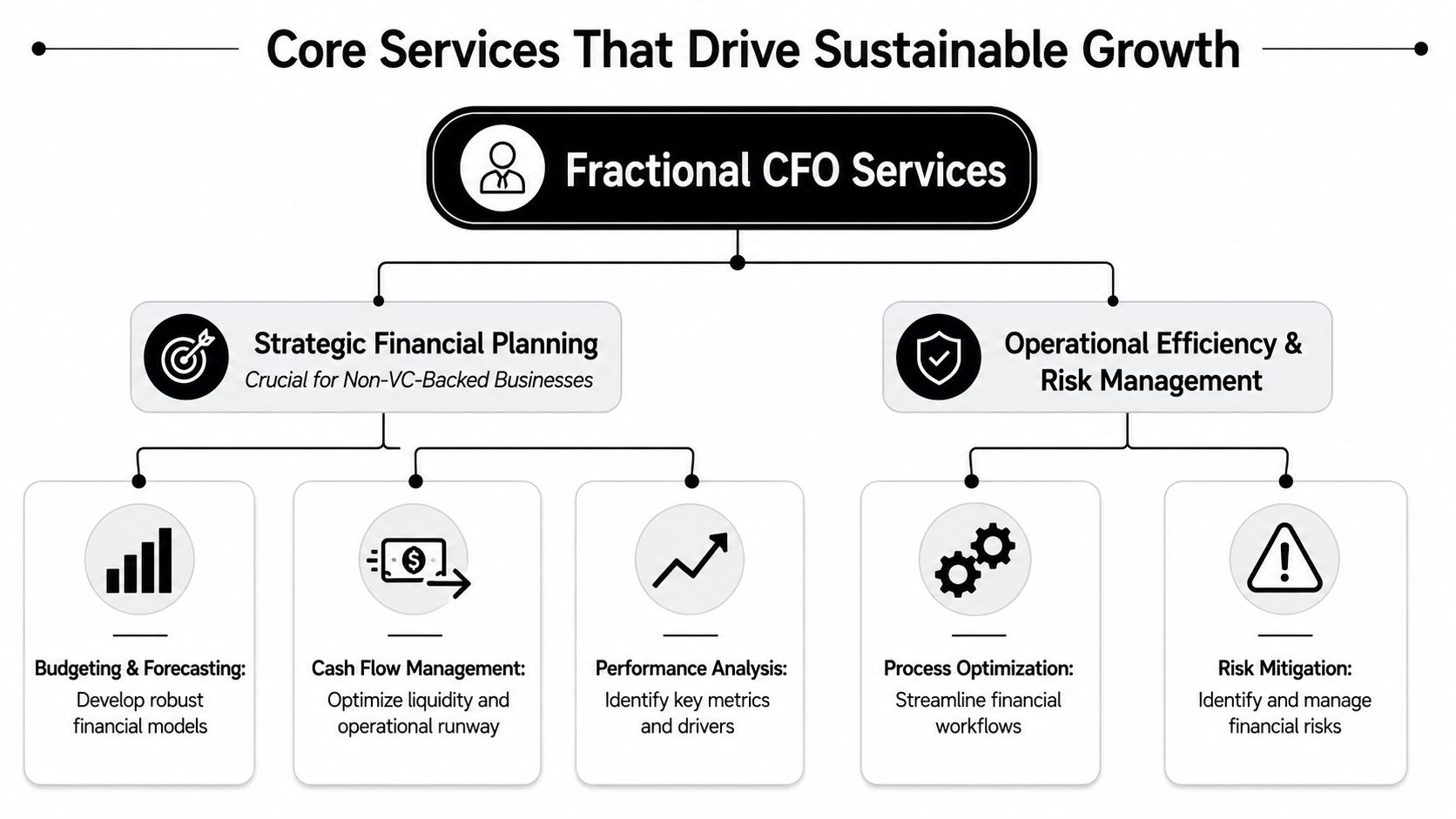
Core Services That Drive Sustainable Growth
A founder hits a ceiling when growth starts creating more cash pressure, more complexity, and less confidence in the numbers.
That is usually the point where a fractional CFO stops being a nice-to-have and starts acting like an operating partner. The job is not to build a fundraising story. It is to put better financial controls around the business so growth produces cash, profit, and enterprise value.
If you want a stronger foundation for this work, this guide to financial forecasting for startups pairs well with the operating tools below.
The 13 week cash flow model comes first
For founder-led companies, I start with a 13-week cash flow forecast more often than anything else.
It gives management a weekly view of expected cash receipts, payroll, vendor payments, taxes, debt service, inventory purchases, and other near-term obligations. That matters because annual budgets rarely capture timing risk well. A business can look profitable on paper and still run into a cash squeeze in three weeks because receivables slipped, inventory landed early, or a large payment batch hit at once.
The value is practical. A rolling 13-week model helps answer operating questions before they become emergencies:
- Can the business support this hire now: Or does collections need to improve first?
- What happens if a key customer pays late: Does the company need to slow discretionary spending or adjust terms?
- Is this the right quarter to buy equipment: Or is liquidity tighter than the P&L suggests?
- Which specific week gets tightest: That is where management attention belongs.
Annual budgets still matter. They set targets. The 13-week model tests whether those targets are financially workable in real time.
A strong fractional CFO updates that model regularly, pressure-tests assumptions, and ties it to actual operating decisions. That is a very different discipline from reviewing a budget once a month and hoping timing works out.
Margin analysis turns growth into profit
Revenue growth can hide weak economics.
I see this often in companies that are busy, winning work, and hiring, but still feeling short on cash. The issue is usually not demand. It is that leadership does not have a clean view of contribution margin after direct labor, materials, fulfillment, discounts, rework, freight, commissions, or servicing costs. Without that view, the company keeps scaling activity that looks productive and underprices the work that drains profit.
The analysis should match the business model.
In construction, that often means job costing by project type and tighter review of change orders, labor overruns, and gross margin drift. In distribution, it may mean customer and SKU profitability after freight, carrying costs, and payment terms. In professional services, it usually means utilization, realization, pricing discipline, and margin by client or project.
A simple review framework helps:
| Question | What to review |
|---|---|
| Which jobs or clients produce the most gross profit dollars | Revenue minus direct costs by account, project, or service line |
| Which ones consume the most cash | Payment timing, change orders, rework, inventory, or labor loading |
| Where do we discount most often | Pricing exceptions by salesperson, client type, or project size |
| Which offerings scale cleanly | Revenue growth compared with labor intensity and delivery complexity |
This work changes decisions. It shows where to raise prices, where to exit low-quality revenue, where to tighten terms, and where capacity should go first.
Forecasting and reporting create management discipline
Once cash visibility and margin visibility improve, the next step is building a planning and reporting cadence the leadership team will use.
That usually includes monthly reporting packets with actuals and variance analysis, scenario modeling for hiring and pricing decisions, a focused KPI dashboard, and clear ownership for budget misses. Good reporting is not a stack of exports. It is a management tool that helps the founder and department leaders act faster and with fewer surprises.
The trade-off is real. Better reporting takes time, cleaner data, and some process discipline from the team. But without it, founders end up making staffing, purchasing, and growth decisions off instinct and lagging financials.
One option in this market is AmbitionCFO, which focuses on 13-week cash flow modeling, margin analysis by job or client, KPI dashboards, forecasting, and exit planning for founder-led companies.
For businesses that are not chasing venture capital, this is often where the role creates the most value. The goal is not investor theater. The goal is a company that can fund its own growth, protect margin, and become more valuable over time.
Decoding Fractional CFO Pricing and ROI
Founders usually wait to ask about price until the business is under pressure.
At that point, the cost of delay is already on the P&L. Cash is tighter than expected. Hiring decisions were made without a forward view. Pricing stayed in place while delivery costs climbed. The critical question is not just what a fractional CFO costs. It is what poor financial decisions are already costing the business each month.
A deeper look at fractional CFO ROI can help frame the decision as an investment tied to better cash control, margin improvement, and stronger operating discipline.
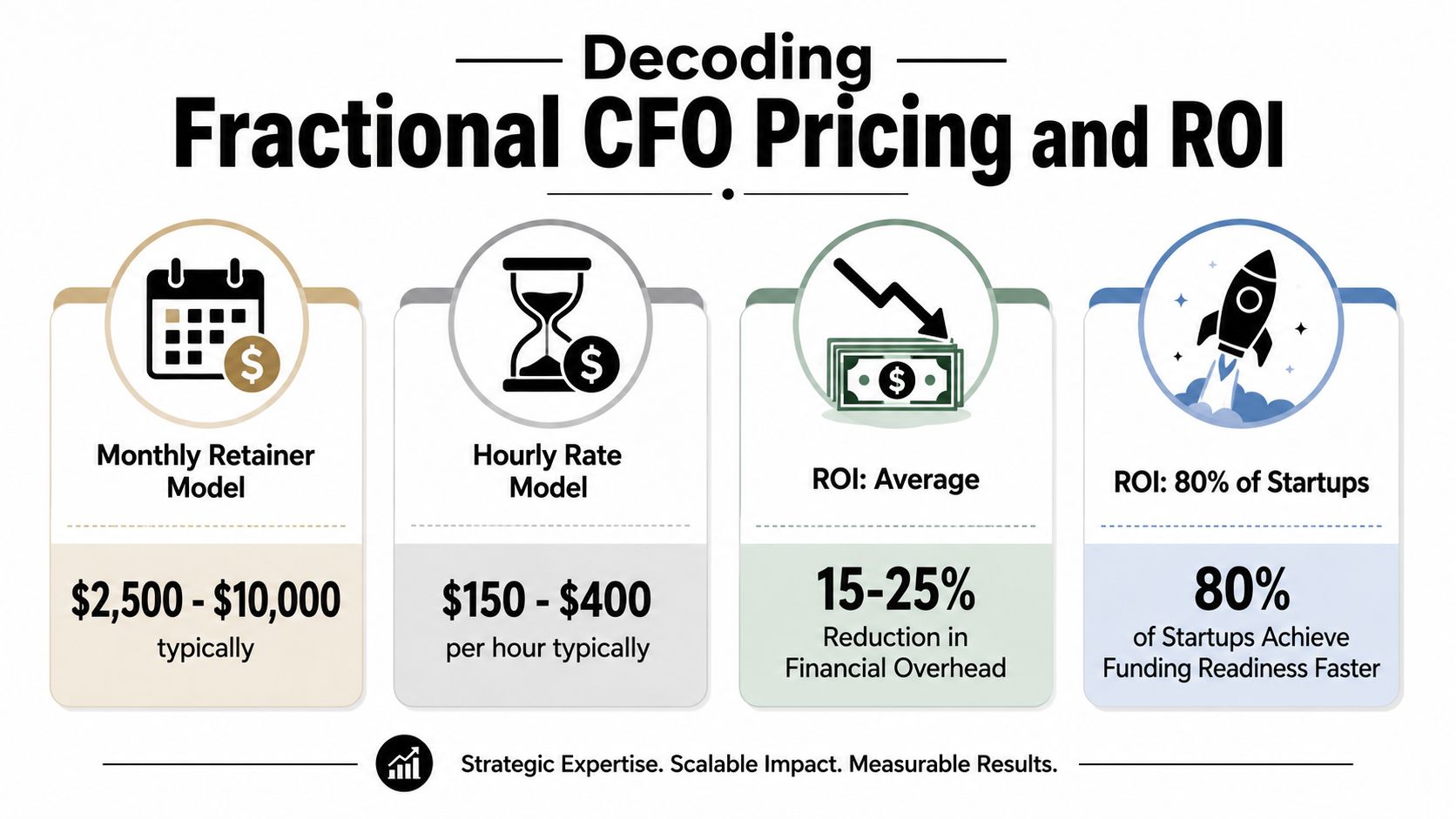
How pricing usually works
Fractional CFO pricing follows scope, cadence, and decision complexity more than company size alone.
| Pricing model | Typical use |
|---|---|
| Hourly | Short-term analysis, cleanup work, or a defined problem |
| Monthly retainer | Ongoing support with recurring forecasting, reporting, and leadership input |
| Project fee | Diligence support, systems implementation, planning work, or a major financial reset |
In practice, many startups and founder-led companies use a monthly retainer once the need becomes recurring. Earlier-stage or narrower engagements often start hourly. Project pricing fits a business that needs one specific outcome, such as rebuilding the forecast model, preparing lender materials, or cleaning up reporting before a sale process.
Published market ranges vary. Some firms position fractional CFO support as a relatively light annual engagement, while others price for deeper involvement that covers forecasting, board materials, strategic planning, and team oversight. A founder should expect the fee to rise when the role includes regular leadership meetings, 13-week cash flow management, pricing analysis, lender support, or cleanup of weak financial systems.
That variation matters. A company buying two strategic calls per month is not buying the same thing as a company asking for weekly cash reviews, scenario planning, department accountability, and active support on banking or investor questions.
What the ROI looks like in practice
ROI shows up first in avoided mistakes.
A good fractional CFO can prevent a bad hire made six months too early. They can show that a revenue line with strong top-line growth is dragging down contribution margin. They can force attention onto receivables before cash gets squeezed. They can replace an annual budget that nobody trusts with a 13-week cash flow model the leadership team uses every week.
That is a core value for many non-VC-backed businesses. The role is less about fundraising prep and more about helping the company fund its own growth without drifting into margin erosion or avoidable cash stress.
Use four tests to judge whether the engagement is paying for itself:
- Decision quality: Major hiring, pricing, and expansion decisions are modeled before money is committed.
- Cash control: Leadership can see short-term cash pressure early enough to adjust collections, expenses, or timing.
- Profit visibility: The business knows which customers, projects, channels, or service lines create margin and which ones absorb it.
- Exit and lender readiness: Financials are clean enough that a buyer, bank, or diligence team can trust the numbers.
I would add one more test from practice. If the founder is still spending late nights trying to reconcile cash, payroll timing, and growth plans in a spreadsheet, the finance function is still too reactive.
A fractional CFO does not create value by producing nicer reports. The value comes from better timing, better trade-offs, and fewer expensive guesses.
From Chaos to Clarity Real World Case Studies
Most writing about fractional CFOs stays inside the fundraising narrative. That leaves out a huge part of the market.
A better lens is operational finance. According to Burkland's discussion of why startups hire fractional CFOs, 70% of $10M to $100M U.S. businesses are not VC-backed and never raise external capital. Those companies still need senior financial leadership. In many cases, they need it more because every decision has to be funded through operations.
For owners thinking beyond growth and into transition planning, this piece on the role of fractional CFOs in business mergers and acquisitions adds a useful layer.
Construction company with margin confusion
A construction founder may know revenue by project and still not know true profitability by job type.
The common problem is inconsistent job costing. Labor burden gets applied unevenly. Change orders are slow to hit the financials. Equipment usage and subcontractor overages don't make it into the weekly management conversation. The company keeps winning work, but the owner can't tell which work is worth chasing.
A fractional CFO usually starts by standardizing cost categories, tightening project reporting, and creating a recurring review with operations and project managers. The breakthrough isn't the spreadsheet itself. It's the discipline of reviewing projected gross margin against actual gross margin early enough to intervene.
What changes in practice:
- Bid decisions improve: The team stops chasing work that strains crews and produces weak margin.
- Project reviews get sharper: Managers can see where labor, materials, or subcontractor assumptions broke down.
- Cash planning becomes more realistic: Large project timing no longer surprises the owner as often.
Distribution business with cash trapped in operations
Distribution businesses often look healthy on the income statement while cash is tight.
That happens when inventory grows faster than sales discipline, receivables stretch, and vendor terms don't line up with customer payment behavior. The founder sees revenue moving, but cash seems to disappear between the warehouse and the bank account.
A fractional CFO approaches this differently from a tax accountant. The focus is working capital mechanics. Which inventory categories move too slowly? Which customers consistently pay late? Where are margin and payment terms misaligned? Which purchasing habits create avoidable cash pressure?
The result is often a more controlled operating system:
| Pressure point | CFO focus |
|---|---|
| Slow collections | Accounts receivable review and escalation rhythm |
| Inventory buildup | Purchasing discipline tied to demand and lead times |
| Vendor term mismatch | Renegotiation priorities and payment timing analysis |
| Low-margin accounts | Customer profitability review |
If cash keeps tightening while sales rise, don't assume growth is the cure. In many businesses, growth is the stress test.
Professional services firm preparing for exit
Professional services firms often reach a point where the founder is still central to pricing, client selection, and delivery oversight. That creates value concentration. Buyers notice it immediately.
A fractional CFO helps by cleaning up financial reporting, clarifying client and service-line profitability, and building a planning process that reduces dependence on founder intuition. When owners plan to transition within the next several years, this work becomes strategic. Cleaner numbers and a more disciplined operating model can strengthen the story a buyer sees.
Typical focus areas include:
- Revenue quality: Is work recurring, project-based, concentrated, or diversified?
- Margin consistency: Which clients and service lines pull the firm forward, and which ones absorb leadership time without enough return?
- Forecast discipline: Can the business demonstrate predictable performance?
- Exit readiness: Are the numbers organized in a way that supports diligence?
These aren't flashy changes. They're the kind that make a business easier to run now and easier to transfer later.
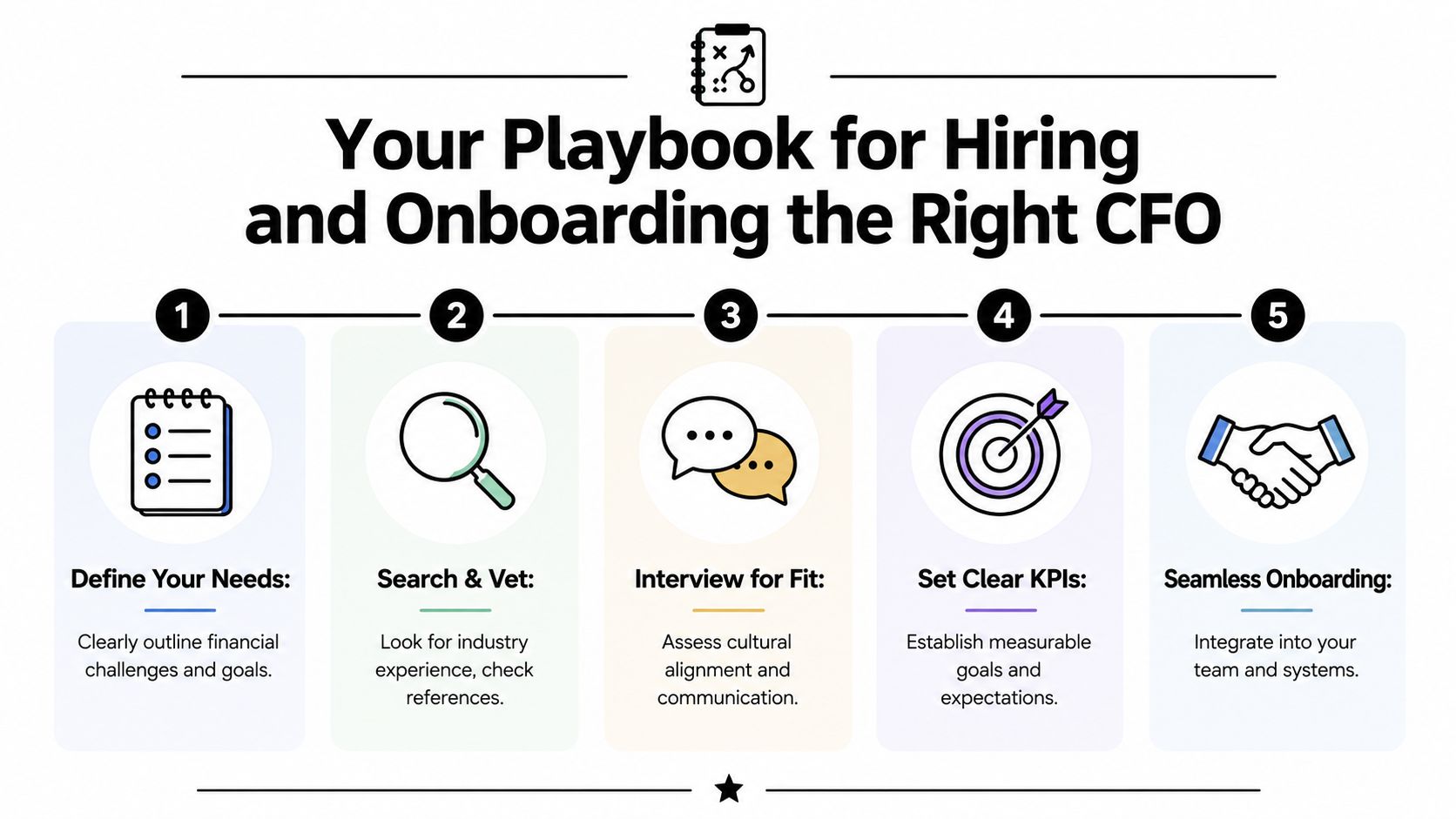
Your Playbook for Hiring and Onboarding the Right CFO
You hire a fractional CFO because growth has started to outrun your financial controls. Sales are up, headcount is rising, and cash still feels tighter than it should. Then three months pass and nothing important changes. Reporting looks cleaner, but pricing decisions, hiring timing, and cash planning are still running on instinct.
That usually means the role was scoped too loosely, or the onboarding process left the CFO reacting instead of leading.
A strong hire gives you decision support fast. In founder-led businesses that are not chasing venture capital, that often starts with tighter weekly cash management, a usable 13-week cash flow model, better visibility into margin by product, client, or channel, and a planning cadence the leadership team will use.
Credentials matter. Fit matters more.
Questions to ask before you hire
Interview for operating judgment, not polish. A candidate may have an impressive background and still be wrong for a company that needs cash discipline, pricing correction, and better planning around profitable growth.
Ask questions that reveal how they work inside an imperfect business:
- How do you build and maintain a cash flow forecast? Look for weekly forecasting discipline, clear assumptions, and a method for updating collections, payables, payroll, and short-term decision points.
- What KPIs would you track in a business like ours? Strong answers connect metrics to actions. For example, gross margin by line, labor efficiency, customer acquisition payback, backlog quality, or cash conversion.
- How do you approach profitability analysis? They should be comfortable getting below the company-wide P&L and into job, customer, service-line, channel, or SKU economics.
- What do you need from our accounting setup to be effective? Good candidates can work with messy systems, but they should also know where weak controls or poor chart-of-accounts structure will distort decisions.
- How do you run monthly reviews with leadership? The right answer sounds like decision-making. It should include variance analysis, forecast updates, risks, and a short list of actions with owners.
- How have you helped companies before a financing event or outside diligence? You want someone who can build discipline before pressure arrives, not someone who only appears once a fundraise or sale process starts.
Ask for examples. Ask what changed in the business because of their work. Ask what they would do in the first 30 days if cash is tight but growth is still coming.
Style is part of the evaluation too. The right fractional CFO should be able to challenge a founder, simplify complex trade-offs for department leaders, and keep discussions grounded in facts rather than finance theater.
A practical 90 day onboarding plan
Founders often lose value here. They bring in senior finance help, then delay access, drip out information, and keep priorities vague. That turns the first month into cleanup instead of progress.
Use the first 90 days to install operating cadence.
| Time frame | What should happen |
|---|---|
| First 30 days | Access to financial systems, chart of accounts review, cash review, reporting assessment, key stakeholder interviews |
| Days 31 to 60 | Initial forecast model, KPI draft, margin analysis priorities, monthly review cadence, decision calendar |
| Days 61 to 90 | Refined dashboard, variance review process, scenario planning, leadership accountability for targets |
That table only works if the founder does their part. Three inputs matter more than anything else.
First, provide full access early. That includes banking, accounting, payroll, debt schedules, major customer and vendor agreements, board or lender reporting, and any prior forecast models. A fractional CFO cannot fix visibility while waiting for basic records.
Second, define the decisions that matter now. Be specific. Hiring pace, pricing changes, inventory buys, customer concentration, capex timing, refinancing, expansion into a new market, or owner transition planning all require different financial analysis.
Third, commit to a cadence. In many companies, a weekly cash meeting and a monthly operating review are enough to create traction. Without that rhythm, even a good CFO gets reduced to ad hoc analysis.
One more point is easy to miss. Success should be measured by better decisions, not better spreadsheets. If the engagement is working, you should be able to answer questions faster and with more confidence: Can we afford this hire? Which customers are profitable? What happens to cash if sales slip for six weeks? Where are we underpricing work? How much working capital will this growth plan consume?
Hire for the financial decisions the business needs to make next, and onboard for speed, access, and accountability.
That is how a fractional CFO becomes a strategic partner instead of an expensive observer.
Take Control of Your Financial Future Today
A founder usually feels the ceiling before the numbers explain it. Sales are up, the team is larger, and cash still feels tight. Pricing decisions get delayed. Hiring feels risky. Growth starts creating pressure instead of confidence.
That is the point where a fractional CFO for startups can change the trajectory of the business.
The value is not in polished board decks or fundraising theater. It is in operating control. A clear 13 week cash flow model. Margin visibility by customer, product, or job. Forecasts tied to decisions you need to make. A finance partner who can pressure test growth plans before they consume working capital and reduce flexibility.
For founder-led companies that are building without venture backing, that matters more than image. Profitable growth usually comes from tighter cash management, better pricing discipline, cleaner reporting, and faster decision-making. Those are the levers that improve resilience and increase enterprise value over time.
If this article felt familiar, treat that as a prompt to act. Write down the financial questions your team still cannot answer with confidence today. Then decide whether your current finance setup can solve them with speed and accuracy.
If the answer is no, bring in senior financial leadership before the next expansion decision becomes a cash problem.
If your business has outgrown basic accounting but is not ready for a full-time CFO, AmbitionCFO can help you build cash visibility, stronger forecasting, better margin insight, and an operating plan your team can use.