
What is cash flow management in business? It is the process of tracking, analyzing, and shaping money moving into and out of a business so you can cover bills, payroll, and growth spending without tying up too much idle cash. That matters because the median U.S. small business holds only about 27 days of cash, and the bottom quarter holds 13 days or fewer.
Cash flow management goes beyond bookkeeping. It is the discipline of managing timing risk, the gap between when cash leaves for suppliers, payroll, debt service, and capital spending, and when it comes back from customers.
Table of Contents
- Why Cash Flow Management Determines Business Survival
- The Five Components of Cash Flow Management
- Building a 13-Week Cash Flow Model and KPI Dashboard
- Cash Flow Challenges by Industry
- Common Cash Flow Mistakes Founders Make
- When to Bring in a Fractional CFO
- Your Next Steps to Take Control of Cash Flow
Why Cash Flow Management Determines Business Survival
The survival statistic is hard to ignore, 82% of small business failures are tied to cash flow problems (U.S. Bank finding summarized here). That doesn't mean every failed business had weak sales. It means plenty of owners ran into a timing problem they couldn't bridge.
Profit and cash are not the same thing. A company can show healthy revenue on paper and still miss payroll if customer collections lag, inventory sits on the shelf, or a large equipment bill lands before cash arrives.

Cash flow is a timing system, not a bookkeeping report
A practical cash flow definition from BookkeepDIY describes it as the movement of money in and out of a business, which is the right mental model for founders who need to pay real obligations on real dates (BookkeepDIY). The important part is movement, not just balance.
That's why a profitable construction job, a growing distribution line, or a packed consulting pipeline can still create a cash crunch. If the cash leaves before it returns, the business feels the strain immediately.
Practical rule: When cash is tight, ask, “What delayed the cash, and what can we move first?” That question is usually more useful than, “How do I sell more?”
Founder-led companies in the $10 million to $100 million range feel this pressure more than smaller firms because growth pulls on every working-capital lever at once. Payroll gets larger, inventory buys get earlier, and customers often expect longer terms.
Why this becomes an operating discipline
Cash flow management has clearly become a core management function, not a back-office task. Independent market research estimates the global cash flow management market will grow from USD 369 million in 2020 to USD 1,170 million by 2025, a 25.9% CAGR (MarketsandMarkets). That growth reflects the demand for forecasting and working-capital visibility.
The lesson for founders is simple. Cash flow management is the system that tells you whether the business can survive normal delays, and whether it can keep growing without tripping over its own receivables, payables, and inventory cycle.
For a broader liquidity lens, the internal guide on liquidity management is a useful companion.
The Five Components of Cash Flow Management
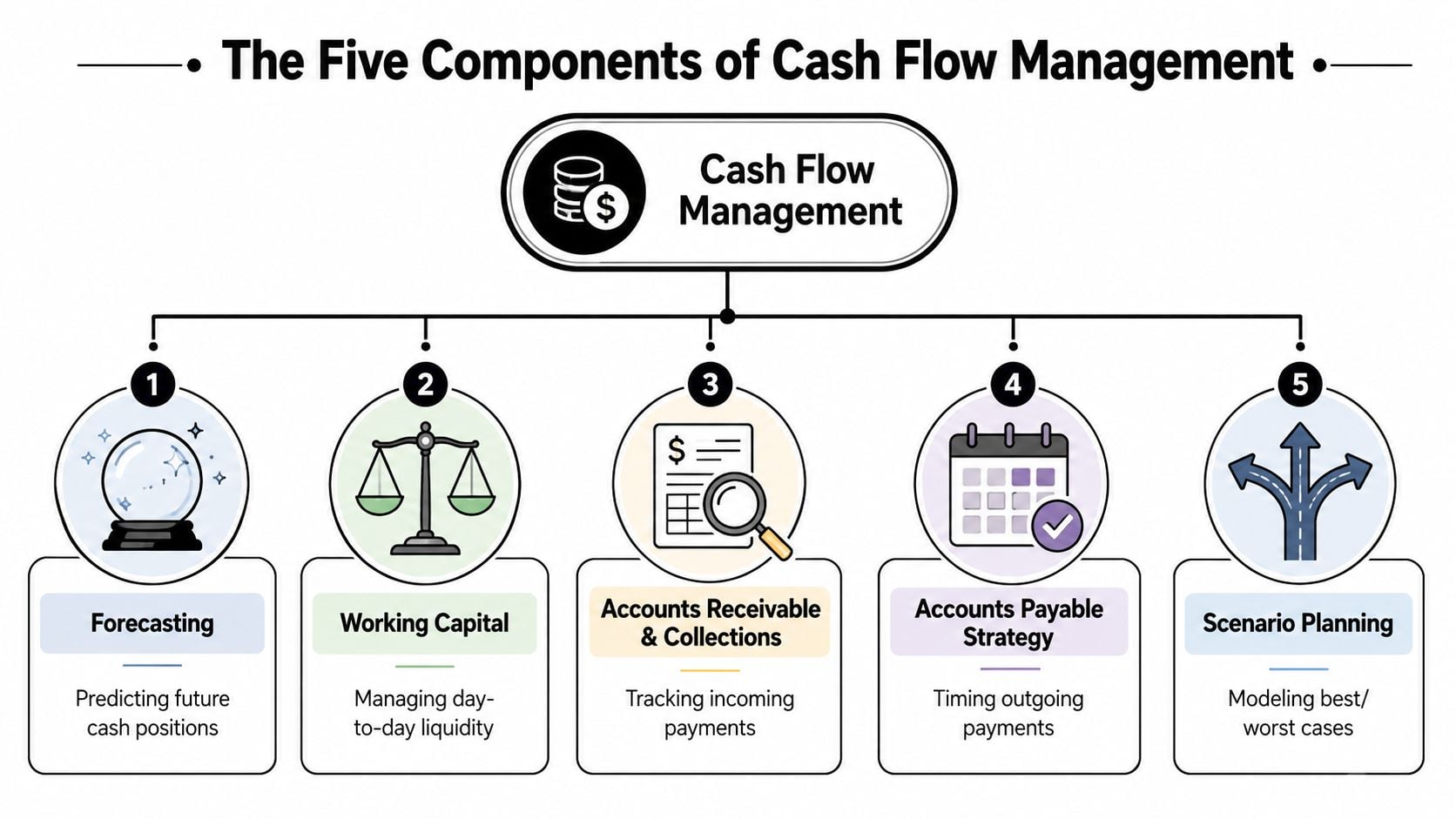
Cash flow management runs as one connected system. If receivables slip, inventory piles up, or payroll lands before collections do, the pressure shows up quickly.
1. Forecasting
A forecast answers a basic question, when will cash be short or flush? The strongest forecasts are not annual spreadsheets that sit untouched until quarter-end. They are living views of inflows, outflows, and timing shifts that change how much room the business really has.
A practical way to use forecasting is to separate revenue from cash. Revenue shows what you have earned. Cash shows what is available. That difference matters when customers stretch payment terms beyond your expense cycle or when a profitable project still leaves the bank account under strain.
2. Working capital management
Working capital is the money tied up in day-to-day operations, mainly receivables, inventory, and payables. It is the fuel in the tank, not the number on the dashboard. A business can show solid profit and still run short on cash if too much money is sitting in stock or waiting to be collected.
The most useful cash metrics in practice include operating cash flow, free cash flow, the cash conversion cycle, and days sales outstanding. Finance teams use them because they show whether revenue is turning into spendable cash quickly enough. If you want a broader set of ratios to track alongside them, the financial metrics every business owner should track is a useful companion.
3. Accounts receivable and collections
Receivables are cash you have earned but have not collected yet. When collections slow down, the business ends up funding the delay whether it planned to or not.
The fix is not always to send invoices faster. In construction, the better move may be tighter billing milestones and clearer sign-off rules. In distribution, it may mean enforcing credit terms and watching over due accounts before they age too far. In professional services, partial upfront payment or milestone billing often protects cash better than waiting until the end of a long engagement.
A company with strong sales and slow collections often looks healthy right up until the week payroll hits.
4. Accounts payable strategy
Payables are a cash tool when they are managed deliberately. The goal is not to avoid vendors. The goal is to align outgoing cash with incoming cash as closely as possible so the business keeps room to operate.
Payment timing matters. Pay too early, and working capital gets drained before it has to leave the business. Pay too late, and supplier trust starts to erode. The right balance depends on how tight the supply chain is, how much influence the business has with each vendor, and how much cash cushion remains after payroll and other fixed commitments.
5. Scenario planning
Scenario planning asks what happens if a large customer pays late, a project starts slipping, or inventory demand shifts. It keeps optimism from turning into a cash problem.
It also forces the right questions before the shortage shows up. If a delayed receivable hits first, collections may be the immediate lever. If cash is tied up in stock, inventory buys may need to slow before anything else. If payroll is the pressure point, the forecast has to show whether a timing bridge is possible or whether spending needs to come down now.
For a deeper operational view, the internal metric guide on the financial metrics every business owner should track is a good companion.
The five components only work together when the owner treats them as one operating system. Tightening collections helps more when inventory is controlled and payables are timed with intent.
Building a 13-Week Cash Flow Model and KPI Dashboard
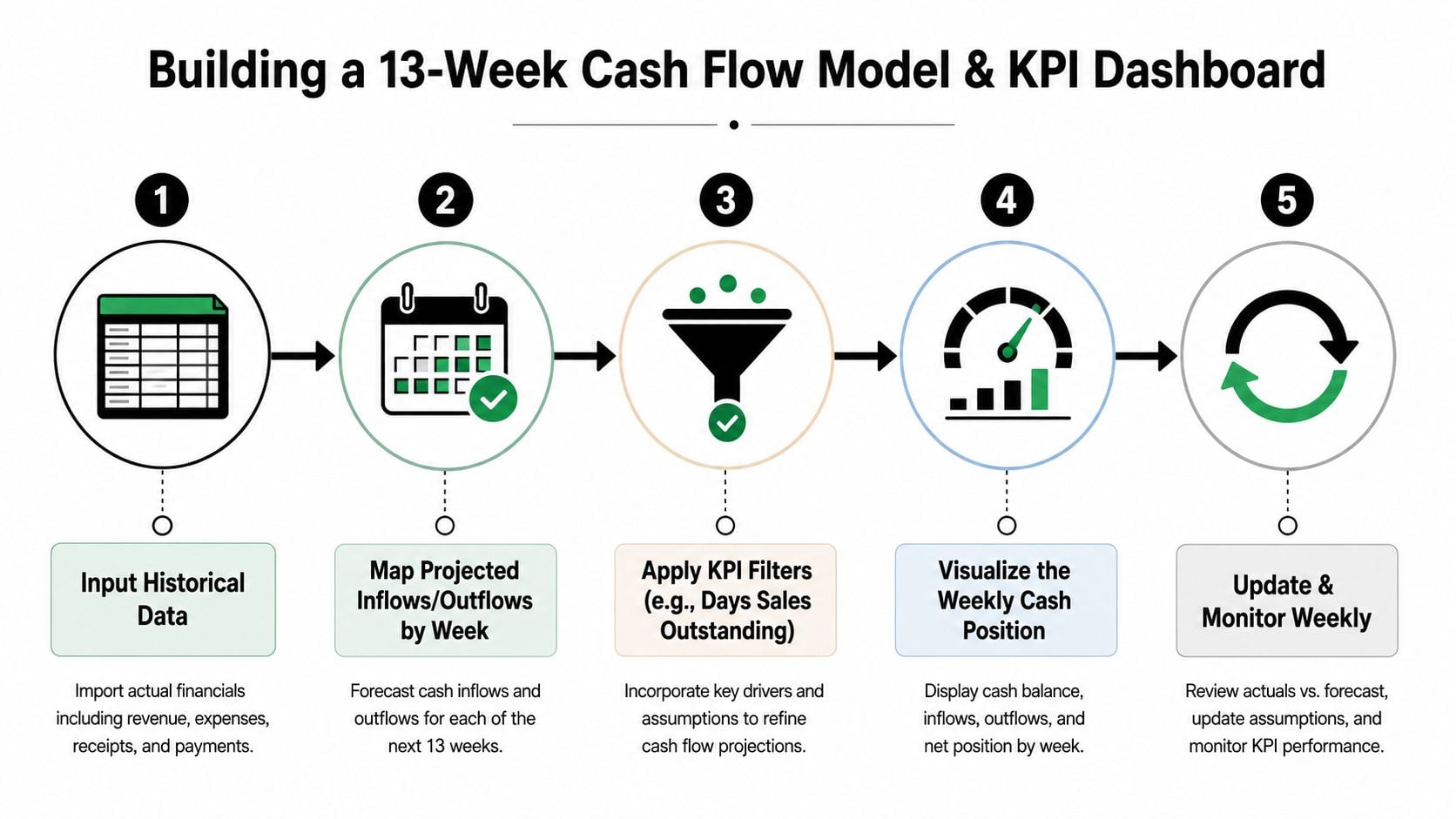
The 13-week cash flow model is the shortest horizon that still gives you room to act. Mid-market treasury guidance recommends daily cash positioning for the immediate 1 to 2 week window, paired with a 13-week model, because that range is long enough to surface collection slippage, payroll gaps, covenant pressure, and capex timing before they become crises (Agicap).
What the model needs each week
Build it with three lines for each week, cash in, cash out, and ending cash balance. Then update it every week with actuals so the forecast does not drift away from reality.
The model becomes far more useful when you tie each line to a named source. Sales forecast, known collections, payroll, vendor payments, tax dates, debt service, and capex commitments all belong in the same view.
The KPI dashboard that sits beside it
The dashboard should focus on working-capital behavior, not vanity metrics. The most actionable measures are DSO, DPO, forecast-versus-actual variance, and total liquidity (Agicap). If DSO is drifting upward, cash is usually getting trapped in receivables. If variance is widening, the forecast itself may need cleanup.
Decision trigger: If your forecast keeps missing by a wide margin, fix the assumptions before you fix the spending. Bad data creates bad decisions faster than a bad month does.
A cash forecast becomes management-grade when it changes decisions. It should affect hiring timing, equipment buys, owner distributions, and whether you take on a new contract.
For cross-border and operational modeling context, the guide on cross-border cash flow with OneSafe is a useful reference point.
A simple weekly cadence
Use the same cadence every Friday. Update collections, payables, payroll, and bank balances, then compare forecast to actual and flag anything that changed the next two weeks.
The internal walkthrough on 13-week cash flow can help if you want a deeper implementation structure. The point is consistency. A forecast that gets touched weekly is worth more than a prettier one that sits untouched.
Cash Flow Challenges by Industry
Generic advice breaks down fast once you look at how cash moves in different businesses. Construction, distribution, and professional services each have their own timing traps.
Construction
Construction often creates cash gaps because progress billing, retainage, and project timing don't line up neatly with labor and material costs. A profitable job can still drain cash if the contractor has already paid subcontractors, bought materials, and mobilized crews before the next billing milestone lands.
The first lever to pull is billing discipline. In construction, the cash problem is often not margin, it's the pace of collecting on work already completed.
For deeper context, the internal guide on construction cash flow management is the right companion piece.
Distribution
Distribution businesses can look strong during peak demand while cash gets trapped in inventory. You buy stock early, hold it through the season, and wait for revenue to catch up later.
The first lever here is inventory planning. If inventory is built too early or too much, cash is sitting on shelves instead of sitting in the bank account.
Professional services
Professional services firms often face a different pattern. Work gets delivered, invoices go out on milestones, and collections arrive after a delay while payroll stays steady every cycle.
The first lever is usually billing structure. If you're doing a lot of work before an invoice goes out, you're funding the client relationship with your own cash.
For industries that rely on delayed billing and large receivables, resources like invoice factoring for oilfield companies show how specialized financing sometimes enters the picture when timing pressure gets severe.
The same cash flow rule applies in every industry, but the weak point changes. In construction it's billing, in distribution it's inventory, and in professional services it's collections.
Common Cash Flow Mistakes Founders Make
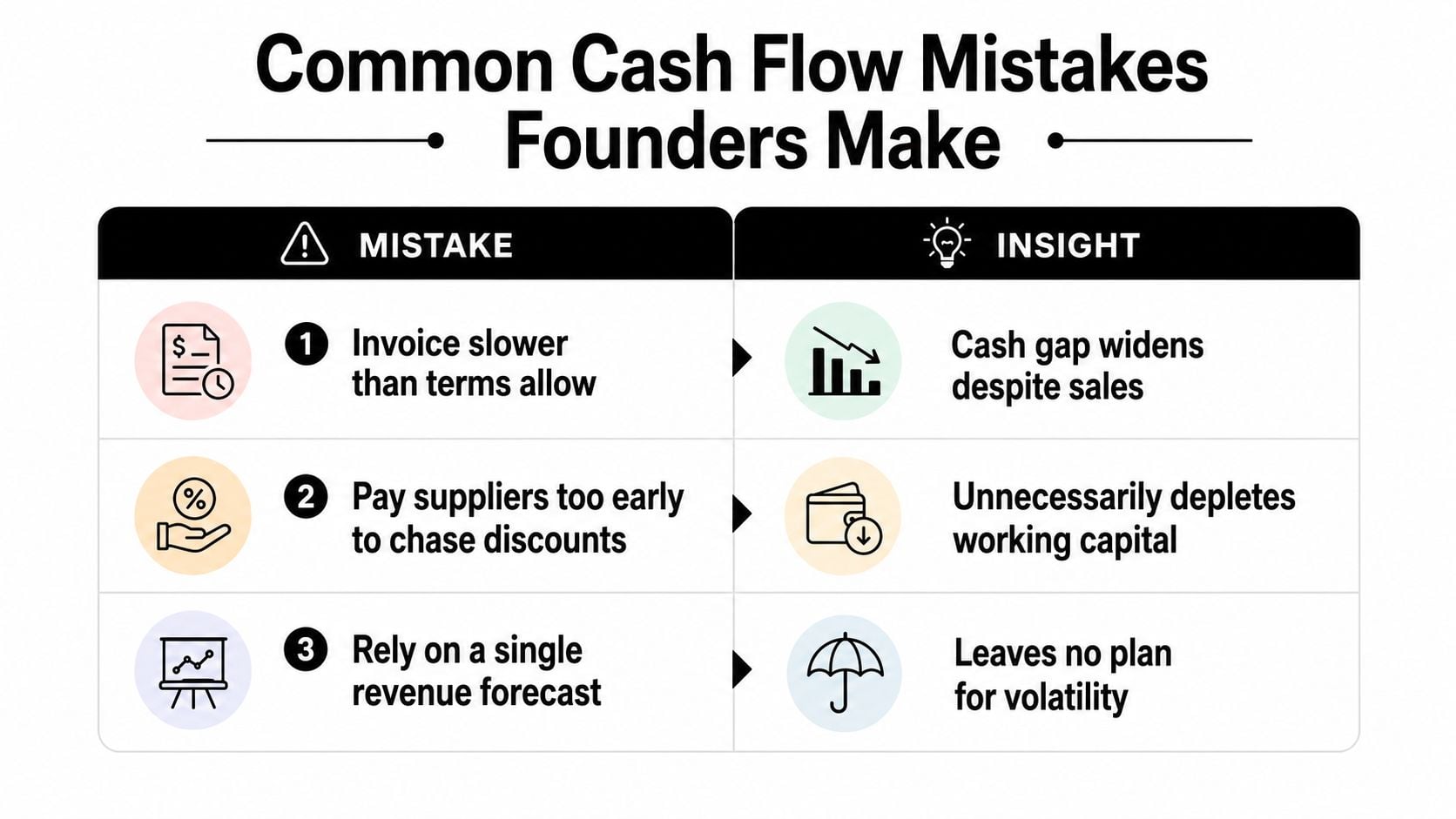
Founders usually don't miss cash because they're careless. They miss it because they confuse a temporary fix with a structural one.
The most common traps
- Confusing profit with cash. A business can be profitable and still miss obligations if cash arrives too late. The fix is to track operating cash flow and the timing of collections, not just the income statement.
- Using debt as the first answer. A line of credit can help bridge a short gap, but relying on it too heavily turns a timing issue into a financing habit.
- Managing only monthly. Monthly review is too slow when payroll, vendor bills, and collections move weekly.
- Taking on a large contract without modeling cash impact. A profitable deal can still strain liquidity if it requires upfront labor, materials, or equipment before customer cash arrives.
What the pattern usually means
If a founder keeps asking for the same emergency fix, the issue is probably not the size of the invoice. It's the structure of the cash cycle. That's the difference between a tactical problem and a system problem.
A useful correction is to start with the biggest timing gap. If receivables are the long pole, tighten billing and collections. If inventory is the drag, slow purchases and improve turnover. If payables are too fast, renegotiate terms before you touch headcount.
For a cash flow review that goes deeper than surface advice, the when to hire a fractional CFO guide is a practical next read. Sometimes the fix is not another reminder to invoice faster. It's a better financial operating system.
When to Bring in a Fractional CFO
A fractional CFO makes sense when the business has outgrown bookkeeping-level reporting but doesn't need a full-time senior finance hire. That usually shows up when the owner is still the only person connecting cash, margin, hiring, and expansion decisions.
AmbitionCFO is one example of that model. It provides fractional CFO support for founder-led businesses, including 13-week cash flow modeling, margin analysis, KPI dashboards, budgeting, forecasting, and certified exit planning, while not handling bookkeeping, tax prep, or audit work.
The value is in decision support, not data entry. A good fractional CFO helps the owner see which lever matters first, whether that's collections, payables, inventory, or capex timing.
When the seat is probably missing
- You have reporting, but not decisions. The books close, yet no one is using them to steer next week's cash.
- You're growing, but cash gets tighter. Growth is creating strain instead of flexibility.
- You're making bigger commitments. Hiring, equipment purchases, and new contracts need a cash model before approval.
- You need senior-level finance thinking without a full-time hire. Many founder-led firms don't need a permanent CFO seat yet, but they do need the discipline.
A fractional CFO does not replace your bookkeeper or CPA. The role is to connect financial reporting to operating choices and help leadership act earlier.
For a deeper look at scope and fit, the internal guide on when to hire a fractional CFO lays out the decision criteria well. If your business is already too complex for reactive cash management, that's usually the signal.
Your Next Steps to Take Control of Cash Flow
Cash flow management becomes clearer once you treat it as a system. Forecasting, working capital, receivables, payables, and scenario planning all feed the same outcome, whether the business is in construction, distribution, or professional services.
Start with four moves this week.
- Measure your cash buffer days. Know how much runway you have.
- Name your biggest timing risk. Receivables, inventory, payables, or payroll.
- Build a basic 13-week model. Keep it simple, then update it weekly.
- Review whether you need senior finance help. If your current setup only records history, it's time to add decision support.
The point isn't to make cash flow perfect. It's to make it visible early enough that you can act before a good business runs into a bad timing problem.
AmbitionCFO helps founder-led businesses turn cash flow into a decision-making system, with fractional CFO support, forecasting, KPI dashboards, and practical working-capital management. If you're dealing with timing pressure, growth strain, or a profitable business that still feels tight on cash, visit AmbitionCFO to explore a cash flow assessment and see what needs to change first.