

You can have a solid backlog, decent margin, and still miss payroll. That's the part nobody wants to say out loud, but it's the reality in construction when labor and materials go out the door before client cash comes back. The question you're really trying to answer is simple, will this work create enough cash at the right time, or will it drain the business?
In construction, that question matters more than profit on paper. A job can look healthy on the WIP report and still trap cash in billing delays, retainage, and slow collections. If you're running the company from the P&L alone, you're steering with the wrong dashboard.
Table of Contents
- Why Construction Cash Flow Breaks Profitable Companies
- Building Your 13-Week Cash Flow Forecast
- Job-Level Margin Controls That Actually Protect Cash
- Using Cash Flow as a Bid-Governance Filter
- Financing Options That Bridge the Gap
- KPIs, Dashboards, and the Weekly Cash Meeting
- Your 30-60-90 Day Implementation Plan
Why Construction Cash Flow Breaks Profitable Companies
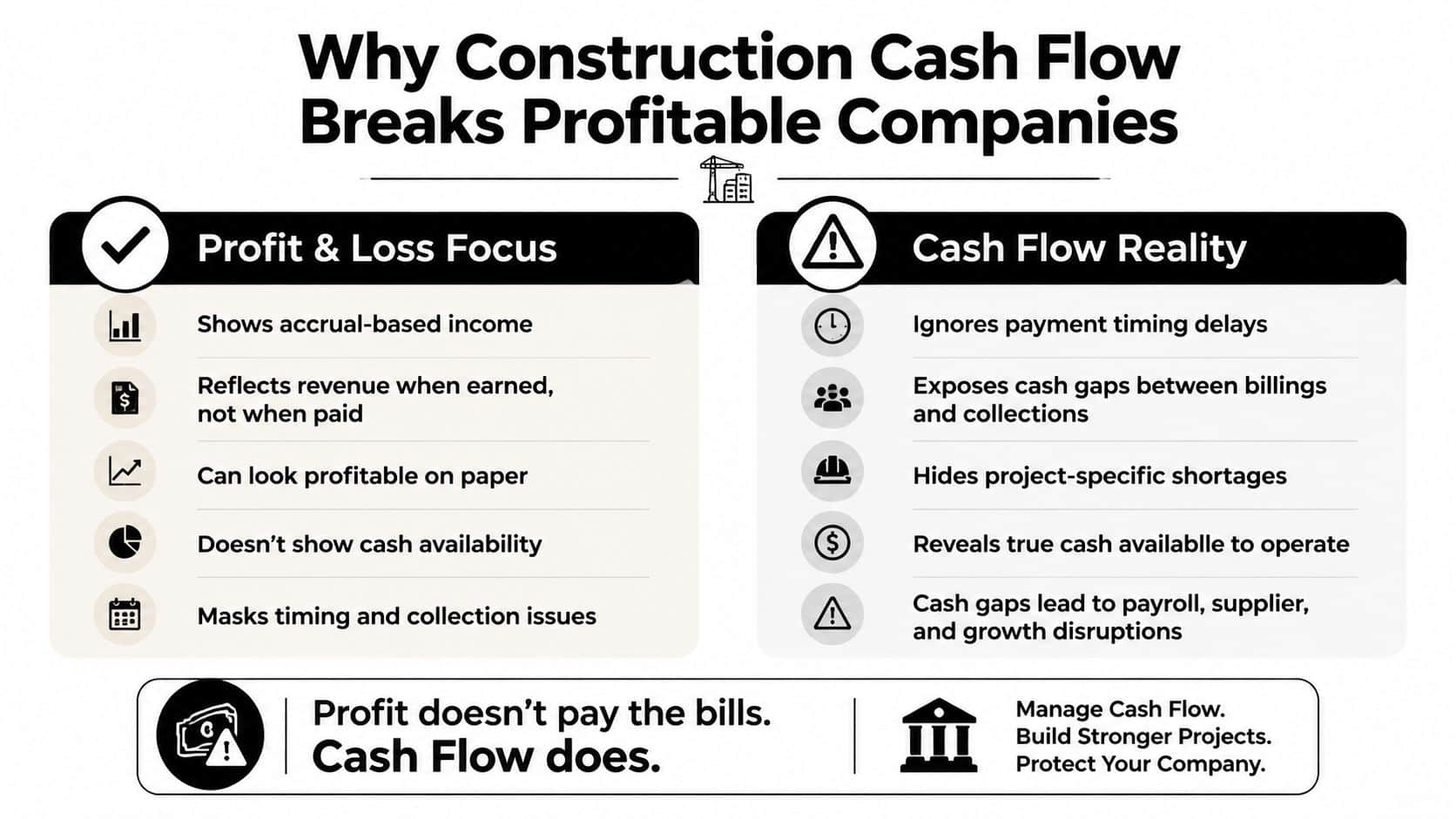
A contractor can look busy, profitable, and even ahead on the job-cost report, then miss payroll because two receivables slip a month. That is the reality in construction when labor and materials go out the door before client cash comes back. I've seen that movie too many times. The problem is not weak demand, it is that construction cash moves on a different clock than construction costs.
The structure is unforgiving. Independent industry sources say the average U.S. construction payment cycle is 90 days, roughly twice the 45-day threshold many financial analysts consider healthy, while the CFMA's 2024 Construction Financial Benchmarker found an average DSO of 56.6 days across 1,290 surveyed companies, and other benchmarks show about 40% of contractor assets sitting in receivables, only 21% held in cash, with receivables taking about 55 days to collect (Corpay). That is why a business can be profitable and still run short on cash.
The terms you need to use correctly
Net Cash Flow means total cash inflows minus total cash outflows, which is the number that tells you whether the account balance is rising or falling (The Access Group). DSO is days sales outstanding, which tells you how long it takes to collect what you billed. Working capital turnover tells you how much revenue each dollar of working capital supports, and current ratio tells you whether current assets are large enough to cover current liabilities.
The trap is simple. Profit is measured on accrual timing, cash is measured on bank timing, and those two numbers do not have to match. A contractor with strong margin can still get squeezed when costs are front-loaded, retainage is trapped, or billing slips behind field progress.
Every dollar you pay for labor, material, subcontractors, and overhead leaves the account now, but the cash that is supposed to replace it may not arrive for weeks. That mismatch is the whole game.
If you want a practical overview that stays grounded in this reality, the guide to construction cash flow lays out the basic mechanics clearly, and the pressure point is the same in every market. For a tighter look at the operating fixes that matter, see our guide to cash flow problems and solutions. The numbers may vary by company, but the timing problem does not.
A regional interior contractor can be profitable on paper and still stall on growth because one slow-paying general contractor ties up enough cash to delay payroll, vendor payments, and the next material order. Nothing about the job volume changed. The billing and collection cycle did.
That is why I do not start with profit in this business. I start with collections timing, cash on hand, and whether the next project will help or hurt working capital. A job that looks good on margin can still be a bad bid if it traps cash for too long.
The right mental model is blunt. Construction cash flow management is a timing problem first, a profitability problem second.
Building Your 13-Week Cash Flow Forecast
A 13-week forecast is the only forecast most contractors will use if it's built right. Anything longer gets fuzzy, anything shorter misses the compounding effect of payroll, billings, and payables. If you're rebuilding it every Monday from scratch, you don't have a forecast, you have a ritual.
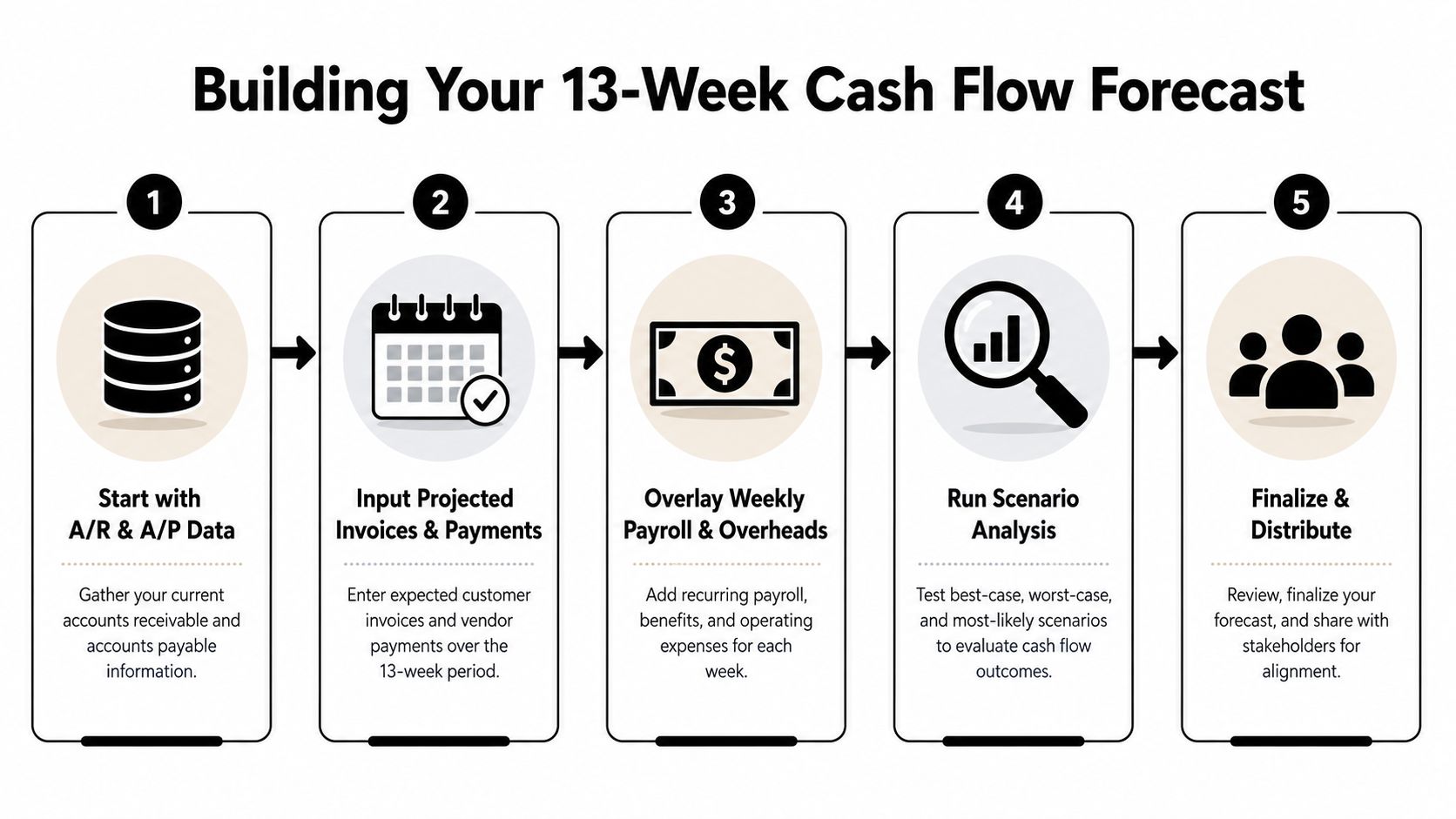
Start with the opening bank balance. Then lay out weekly inflows by project, not by client, because different jobs collect at different speeds and the project-level view is where the truth lives. After that, map weekly outflows by payroll, materials, subcontractors, equipment, and overhead, and end with a closing balance that tells you when action is required.
Practical rule: if the closing balance drops below your floor, the meeting stops being informational and becomes operational.
Build it from the general ledger, not from memory
Pull the data from the GL, open A/R, open A/P, payroll schedules, and the current WIP. Retainage should sit in its own bucket, not buried inside ordinary receivables, because the timing is different and the cash is effectively locked. If you treat retainage like normal cash, you'll overstate liquidity every time.
For a structured walkthrough of the mechanics, the 13-week cash flow guide from Allied Tax Advisors is a useful reference for timing discipline. If you need a separate framework for building the model itself, use our cash flow forecast process as the implementation standard.
Here's the working logic. Week 1 starts with the bank balance, then you add expected billings and collections, subtract payroll and vendor payments, and carry the result forward into Week 2. Every week should roll forward with the same structure so the forecast stays alive instead of becoming a one-time spreadsheet.
What a delay does to the model
A $25M general contractor with three active jobs can feel comfortable on a spreadsheet and still get pinched by one delayed pay app. If one owner pushes a payment five weeks, the comfort cushion can disappear by week nine because payroll and material outflows don't care that the check is late. That's why the model needs a slow-collection stress test, not just a base case.
Use three scenarios. Base case assumes normal collections, downside case assumes one major payment slips, and worst case assumes a billing rejection plus a delayed release. Don't overcomplicate it. The point is to see when the bank balance crosses the line so you can act before it does.
The forecast works when it creates decisions. It should tell you when to slow spending, when to accelerate billing, and when to pull the collections team into the room. If it's not changing behavior, it's not managing cash.
Job-Level Margin Controls That Actually Protect Cash
WIP tells you whether a job is profitable. It doesn't tell you whether that job is funding the business or starving it. That distinction is where a lot of contractors get fooled, because the job can look strong while the cash cycle on that same job is terrible.
The better lens is a cash-conversion overlay. I want you looking at cost-to-complete, days-to-bill, days-to-collect, and days-to-pay on every active job. That gives you a real picture of how much cash each project is consuming before the profit shows up.
Use the weekly job review to catch underbilling early
Hold a weekly job-cost review with the project manager, controller, and owner. Every PM should answer three questions without hand-waving. What did we bill this week? What is underbilled? What is the projected cash collection date?
If a PM can't answer those three questions clearly, the job is not under control. You don't need a more complex dashboard, you need a tighter operating cadence. A project with decent margin but weak billing discipline can become a working-capital sink.
Here's the operational standard I'd use. Push the billing calendar hard, set the submission deadline several business days before the due date, and make the documentation package complete before it leaves the office. That means progress backup, approved change support, field quantities, and anything the owner typically asks for before they stall payment.
The first overdue call should happen the day after terms, not after the invoice is old enough to become a habit.
The collections sequence should move from project manager to controller to owner. The PM starts the conversation because they know the job, the controller keeps the process moving, and the owner escalates when the check is late enough to affect cash. Retainage needs its own aging report and its own release reminders, because it behaves differently from ordinary A/R.
Why billing speed beats margin percentage
A high-margin job can still tie up more cash than a lower-margin job if the terms are worse. That's the part owners miss. A 22% margin hospital renovation with slow pay terms and retainage can strain liquidity more than a 12% design-build project that pays faster and releases cash cleanly.
One concrete subcontractor I worked with, in the rough $60M range, moved from monthly job reviews to weekly reviews and cut average underbilling sharply. The reason wasn't magic, it was visibility and pressure. When the PM has to explain variance every week, billing stops slipping.
Tie the job report to the bank account, not just the P&L. If a job is profitable but the cash collection date keeps drifting, it's not a healthy job, it's a future problem with good accounting. That's why the best operators care about cash conversion more than margin alone.
If you want the deeper mechanics of job-level reporting, our construction job costing overview is the right companion piece. It's the margin side of the house, while this section is the cash side. You need both, but cash gets the veto.
Using Cash Flow as a Bid-Governance Filter
Most owners use a forecast to report what happened. That's too passive. The smarter move is to use cash flow as a gate before you bid, because the best cash decision is often the job you don't take.
The filter is straightforward. First, check the owner's payment timing and whether it matches your billing cycle. Second, identify the retainage percentage and release date so you know how much cash gets trapped. Third, test underbilling risk if the PM falls behind on quantities. Fourth, ask whether the job will force a line-of-credit draw and whether that draw is acceptable.
A go no-go test you can use before the next bid
If the job creates a bad cash squeeze even with decent margin, walk away or redline the contract. That's not timid, that's disciplined. Profit doesn't pay payroll on the right day, cash does.
A $15M specialty contractor once passed on a $4M hospital fit-out because the payment timing would have pushed the revolver to its limit, even though the gross margin looked healthy. That call saved the company from funding a project that would have looked good on paper and bad in the bank account. I'd make that call again without hesitation.
If the job needs your balance sheet more than it needs your expertise, price it harder or decline it.
When the contract is still open for negotiation, push for progress payments, milestone billing, and lower retainage. These are not “nice to have” edits. They are direct cash levers, and they belong in redlines before you sign.
For a simple visual checklist of the decision points, the bid-governance filter graphic works well in an owner meeting. It's the kind of discipline that keeps a contractor from buying revenue at the expense of liquidity.
What to measure before committing
Use the same four questions every time. If the answers are ugly, the job is ugly for cash, no matter how nice the margin looks. Owners who build this habit stop confusing backlog with capacity.
- Payment timing: Does the owner pay on a cycle your company can absorb?
- Retainage exposure: How much cash will sit trapped until release?
- Underbilling risk: Can the PM keep billings ahead of cost?
- Credit usage: Will the job require borrowing just to stay afloat?
That list is the point. A cash capacity test turns bidding into governance instead of wishful thinking.
Financing Options That Bridge the Gap
External financing has a place in construction, but it should bridge timing gaps, not excuse weak billing. A line of credit can make sense when the business is healthy and the timing gap is temporary. Factoring can make sense when collections are the bottleneck and speed matters more than headline cost.
The right choice depends on whether you have a timing problem or an absolute capital problem. If the company is profitable and the issue is the gap between paying out and collecting in, revolving credit is usually the first tool to evaluate. If collections are slow enough that the cost of waiting is higher than the discount you'd give up, receivables financing may be the practical answer.
The four tools owners actually end up using
Revolving credit is the cleanest bridge when the bank trusts the story and the reporting is tight. Construction-to-permanent financing is more project-specific and works when the facility is tied to a defined job. Factoring or receivables purchasing can be faster, but you pay for that speed. Owner capital or investor infusion is the bluntest option and usually the most painful if used to cover recurring operating gaps.
For project-specific financing, the construction to permanent loan options page from New American Funding, LLC. is a useful starting point when a deal is tied to a particular build. It's not a substitute for cash discipline, but it can fit the right project structure.
| Construction Financing Options Compared | Best Use Case | Typical Cost | Speed to Fund |
|---|---|---|---|
| Revolving line of credit | Short timing gaps and seasonal swings | Lower than receivables sale, but depends on facility terms | Moderate |
| Construction-to-permanent loan | Single project with defined lifecycle | Project-specific financing cost | Moderate |
| Factoring or receivables purchasing | Slow collections and urgent liquidity needs | Higher than bank credit because you're buying speed | Fast |
| Owner capital or investor infusion | Emergency recapitalization or growth support | Dilutive or expensive in another way | Fast if the money is ready |
Banks don't just want optimism. They want an aging report, WIP, a 13-week forecast, and three years of financial statements before they underwrite a facility. They also watch covenants closely, especially when growth outpaces control.
If you need help preparing the reporting package or negotiating with lenders, that's the point where a fractional CFO earns their keep. AmbitionCFO provides that kind of cash flow management and forecasting support for founder-led contractors who need structure without hiring a full-time finance executive. The objective is simple, build a facility package the bank can trust and a cash model the owner can act on.
For a broader operating view of liquidity, our liquidity management page connects the financing decision to the larger balance-sheet picture. Funding is useful, but only if the company can use it without creating a worse problem later.
KPIs, Dashboards, and the Weekly Cash Meeting
A forecast nobody reads is a forecast nobody uses. That's why the weekly cash meeting matters more than the spreadsheet itself. It forces the owner, controller, and lead PM to look at the same numbers and make decisions while there's still time to do something about them.
The meeting should be short, consistent, and uncomfortable in the right way. Print one page, keep the room small, and leave slides out of it. The point is action, not theater.
The one-page dashboard that earns its keep
Track the metrics that change behavior. DSO, DPO, current ratio, working capital turnover, underbilling percentage, cash reserves in days, retainage balance, and revolver availability belong on the page. Anything else is probably decorative.
For a deeper KPI set and why it matters, our construction KPIs page covers the broader reporting stack. The weekly meeting is where those numbers become decisions instead of month-end history.
Use the same rhythm every Monday morning. The owner asks what cash is coming in this week. The controller flags what is past due or at risk. The PM commits to the billing and collection actions tied to their jobs.
Meeting rule: every cash meeting ends with three decisions, what we're collecting, what we're paying late, and whether the forecast needs to change.
That third question matters. If the forecast doesn't get updated when reality changes, it becomes a historical artifact. The weekly meeting keeps the 13-week view honest, and that honesty is what protects the bank balance before trouble gets visible in operations.
What good looks like
A healthy dashboard isn't the same as a perfect one. What matters is whether the team can see risk early and react before it becomes a payroll issue. If outside lenders or board members need the same view, roll the same page into the monthly board packet so there's no mismatch between leadership and outsiders.
The weekly cash meeting is where construction cash flow management turns into operating discipline. Without it, even a good forecast becomes shelfware. With it, you catch the problem while there's still a lever to pull.
Your 30-60-90 Day Implementation Plan
The fastest way to improve cash is to stop treating it like a side task. Make it a project with deadlines, owners, and a scorecard. The first 30 days are about visibility, the next 30 are about control, and the final 30 are about governance.
Days 1 to 30
Build the 13-week forecast from the GL and current payables and receivables. Set the cash floor, then launch the weekly cash meeting with a one-page dashboard. Don't wait for the model to be perfect, make it usable.
Days 31 to 60
Add the job-level cash-conversion overlay and tighten the billing calendar. Start the collections cadence on day one past terms, not when the invoice feels old enough to call. The shortfalls usually start to shrink because the team stops giving away days.
Days 61 to 90
Implement the go-no-go cash capacity test before the next round of bids. Negotiate one or two contract redlines that improve payment timing or reduce retainage, then refresh or secure the line of credit with the documentation package the bank expects. If you want the CFO-level view of how liquidity, forecasting, and operating discipline fit together, this is the phase where it starts compounding.
The practical goal is not cosmetic improvement. It's a real change in behavior that shows up in faster collections and less panic. In many firms, the early win is a noticeable DSO improvement within one quarter and a better cash reserve position after that.
Schedule a 45-minute working session with your controller this week and map the current 13-week outlook line by line. Find the single biggest gap, because that's where the next cash problem is hiding.
AmbitionCFO works with founder-led contractors that need tighter visibility into collections, retainage, payroll timing, and project cash demands. If you want a fractional CFO who can help build the forecast, the dashboard, and the bid-governance filter around your real jobs, visit AmbitionCFO and start the conversation.