

You already know the feeling. The job is real, the margin looks good, the owner wants a bid, and then your bond agent slows the whole thing down because the number on your balance sheet doesn't support the work you want to chase. That's the part most contractors hate, because it feels like the surety is blocking growth when the issue is usually a balance sheet that hasn't been built for scale.
Construction bonding capacity is the limit that decides whether you can take the job, not just whether you can win it. If you're trying to understand why one profitable project is greenlit and another gets passed over, you're asking the right question.
Table of Contents
- What Construction Bonding Capacity Actually Means
- How Underwriters Calculate Construction Bonding Capacity
- The Hidden Adjustments Sureties Make to Your Balance Sheet
- Key Factors That Raise or Lower Your Bonding Capacity
- A 90-Day Playbook to Grow Your Construction Bonding Capacity
- A Worked Example for a $20M Construction Firm
- Underwriter and Lender Requirements You Should Have Ready
- How a Fractional CFO Helps You Increase Your Bonding Capacity
What Construction Bonding Capacity Actually Means
The first mistake owners make is treating bonding capacity like a vague approval rating. It is a two-part ceiling the surety sets on your business, and if you do not know both parts, you are flying blind.
The two limits that matter
The first limit is the single-job limit, the largest individual project the surety will bond. The second is the aggregate limit, the total bonded backlog the surety will carry at one time. That split matters because you can be shut out of a new job even when the project itself is profitable if your active bonded backlog has already burned through the aggregate ceiling, a point that comes through clearly in industry guidance on bonding capacity and backlog control. Higginbotham's bonding capacity overview explains the structure well, and Procore's bonding capacity guide lays out the same two-limit framework in practical terms. For bond coverage from Duncan & Associates, see their surety bonds resource.
A contractor can have room for one more job on paper and still get blocked because the surety has already loaded the aggregate with other bonded work. That is why capacity behaves like a credit line for backlog, not a trophy for past performance.
Practical rule: If you do not know your single-job and aggregate limits separately, you do not really know your bonding capacity.
A common example in surety guidance is a contractor with a $5 million single limit and a $20 million aggregate limit. In that setup, the surety may pre-approve projects up to $5 million as long as total bonded work stays inside the $20 million ceiling. That same logic appears in the CFMA example on determining bonding capacity, where a $5 million single / $25 million aggregate structure is tied to backlog at bid time.
Why this becomes a growth gate
Bonding capacity matters because it controls what you can bid, not just what you can build. If your capital structure cannot support the backlog, the surety will not care that the margin is attractive. It sees risk, not potential.
That is why I tell owners to stop talking about bonding capacity as a branding issue. It is a financing constraint. If you want larger work, your job is to make the balance sheet look strong enough that the surety is willing to lend its credit to your backlog. If you already track job-level performance and backlog exposure, use your construction KPI dashboard to keep those limits visible every month. A company that knows its ceiling can bid with discipline. A company that guesses gets surprised at the worst possible time.
How Underwriters Calculate Construction Bonding Capacity
A contractor can show solid revenue and still get a tight bond program. Sureties care first about whether you can fund labor, materials, and overruns long enough to get paid. That is why underwriters anchor capacity to working capital, net worth, and cash flow, not top line alone, as noted in the guidance from Construction Tools on bonding capacity and Conwize's bonding capacity glossary.
The basic math sureties use
Working capital is current assets minus current liabilities. Sureties then apply a multiplier to estimate how much bonded work the contractor can support. A widely cited range is 10 to 20 times working capital, with a contractor at $1 million in working capital often estimated to support roughly $10 million to $20 million in bonding capacity. That estimate depends on reporting quality, backlog, and history, and it shows why two contractors with the same revenue can have very different bond programs. BuySuretyBonds also points to that range.
Here is the clean way to read the number. Stronger liquidity and cleaner reporting push the surety toward the high end of the range. Messy books pull the line down fast.
A surety is not rewarding sales volume. It is pricing risk in your ability to absorb cash strain.
A quick multiplier table
| Working Capital | Single-Job Limit (10x) | Aggregate Limit (17.5x midpoint) |
|---|---|---|
| $500,000 | $5,000,000 | $8,750,000 |
| $1,000,000 | $10,000,000 | $17,500,000 |
| $1,500,000 | $15,000,000 | $26,250,000 |
That table is a model, not a promise. It uses the 10x single-job midpoint and the 17.5x midpoint for aggregate capacity to show how sureties think about scale.
Clean balance sheet versus strained balance sheet
Two contractors can report the same revenue and still get different limits. The one with cleaner current assets, stronger cash conversion, and better project history usually gets the better line. The one with bloated receivables, weak WIP discipline, or short-term debt stuffed into current liabilities gets discounted fast.
If you want a practical support tool for the finance side, accounting automation for finance teams can help reduce the lag between job activity and usable reporting. That matters because the surety cannot underwrite what your team has not measured yet.
Bottom line: bonding capacity is often a multiplier of adjusted working capital, then refined by backlog and track record.
If you want to separate bondability from other forecasting issues, the logic is similar to the distinction between sensitivity analysis and scenario analysis. One number tells you what happens if one input moves. The other shows how the full picture changes when several inputs move together.
The Hidden Adjustments Sureties Make to Your Balance Sheet
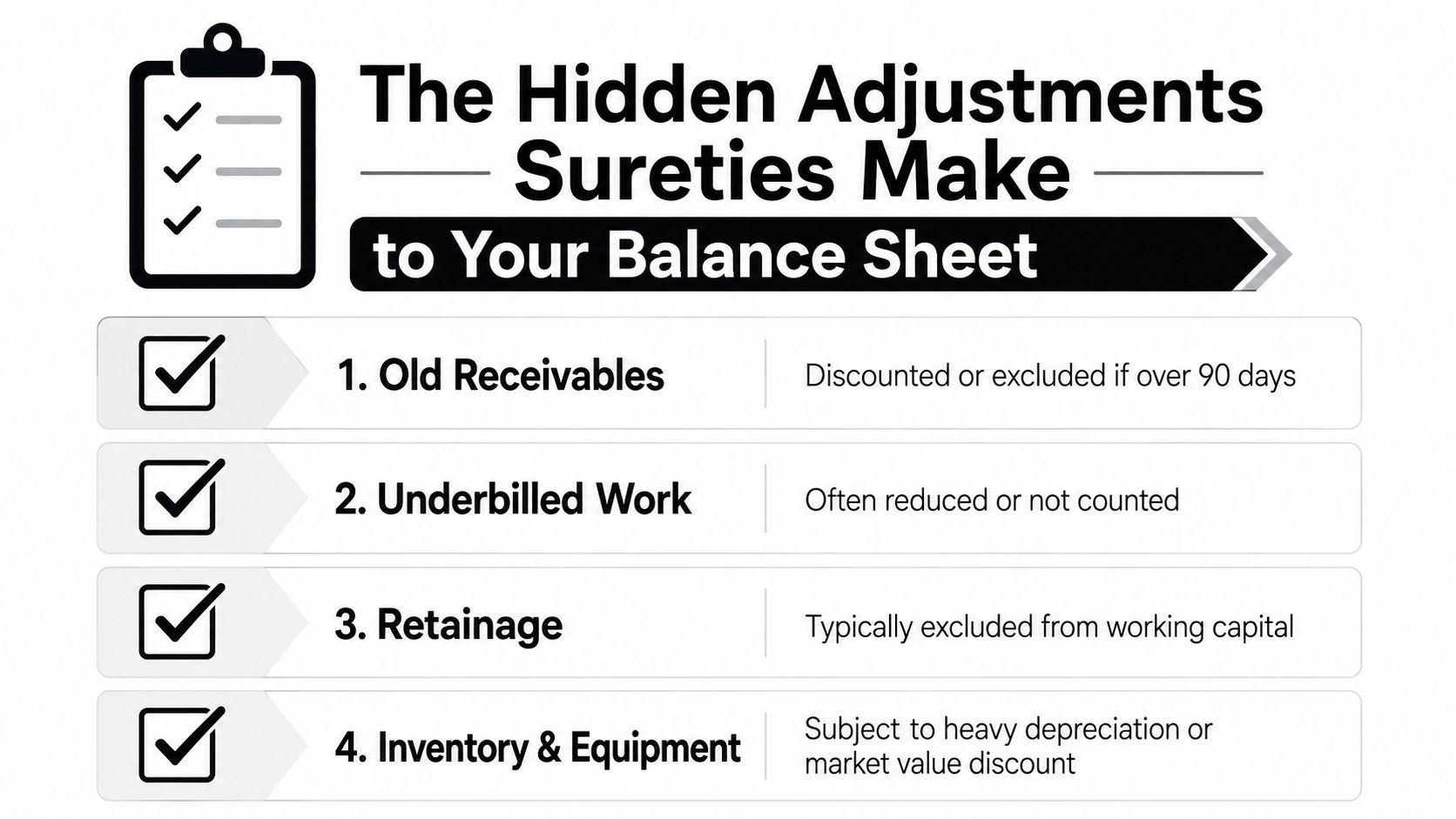
A lot of owners get burned here. Your books can say you're solvent, but the surety is not obligated to count every asset the way your accountant does. It normalizes working capital by cutting out items that don't really fund work in progress.
What gets discounted
The big adjustments are old receivables, underbilled work, overbillings, and certain related-party balances. Independent CPA guidance notes that sureties commonly discount or exclude those items when they calculate effective working capital, which is exactly why a contractor can look healthy on paper and still be treated as tight by the underwriter. DMCPA's guidance on bonding capacity explains that gap clearly.
Here's how I read those items in a review meeting:
- Old receivables: If they're stale, the surety treats them as weak cash, not reliable liquidity.
- Underbilled work: If you've earned revenue you haven't billed cleanly, the surety often trims it back.
- Overbillings: Useful for cash, but not counted as true working capital the way owners hope.
- Related-party balances: Money tied up with owners or affiliates gets treated as unavailable to fund bonded work.
That's the part many owners miss. Bigger revenue does not automatically mean stronger bonding capacity. If the working capital is inflated by items the surety discounts, the underwriting conversation gets smaller fast.
What to review before submission
Before you ask for more capacity, pull these line items and stress-test them:
- Aged receivables over 90 days
- Underbilled jobs on the WIP
- Overbillings that are masking weak liquidity
- Loans to owners or related entities
- Inventory or equipment that is carried too aggressively
If you need a document workflow to clean up the package before submission, accounting document automation blogs can be useful for tightening the reporting process around recurring surety requests. The point is simple, if the surety can't trust the composition of your working capital, it won't give you credit for all of it.
Key Factors That Raise or Lower Your Bonding Capacity
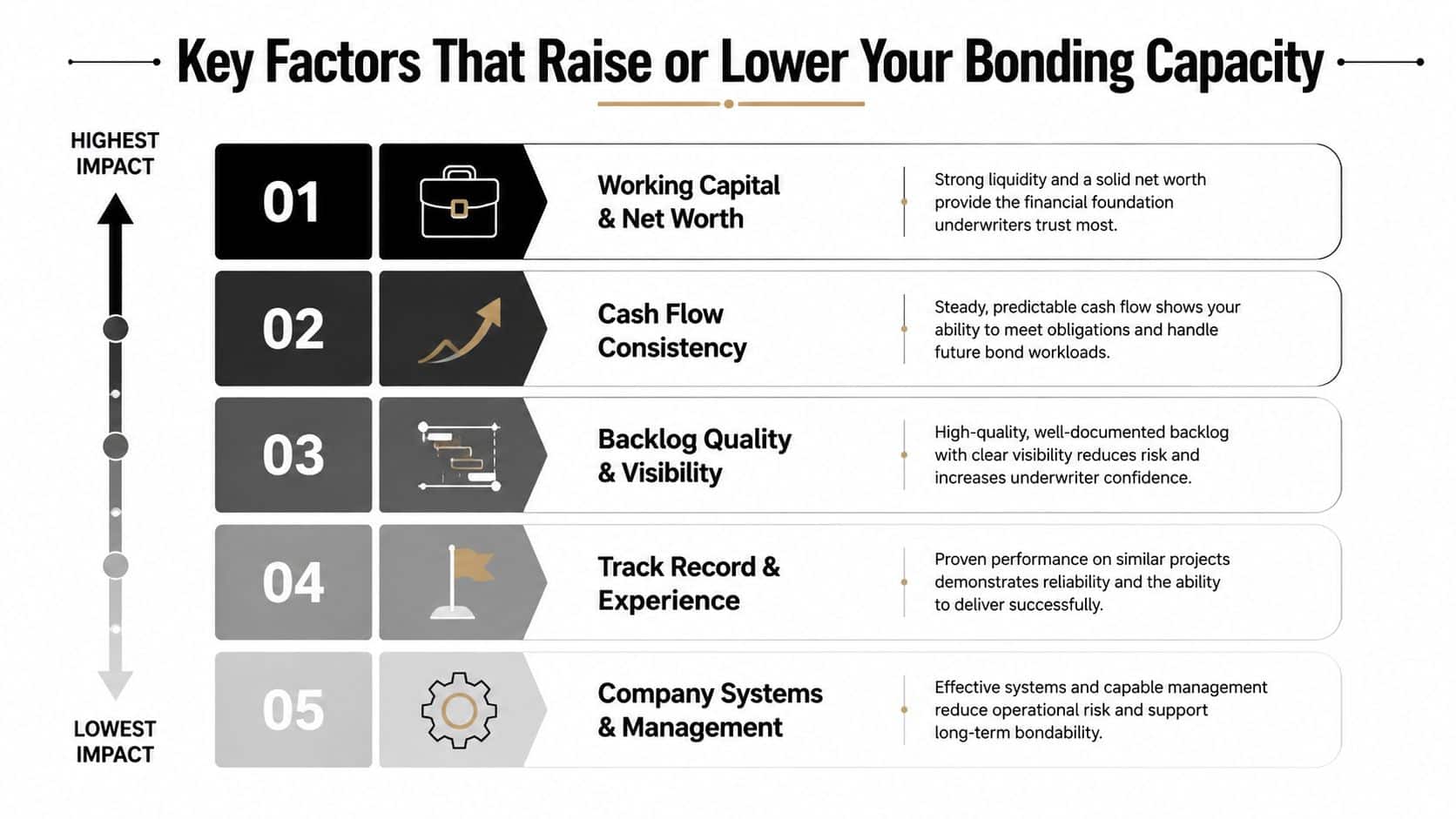
Capacity is a stack of inputs, not a single score. The fastest way to grow it is to focus on the few factors the surety really cares about and ignore the noise.
The factors, ranked by impact
Working capital and net worth
This is the first gate. Strong current assets, low current liabilities, and retained earnings tell the surety you can absorb risk. Weak liquidity lowers the line even if revenue is growing.Cash flow consistency
Sureties want to know you can fund payroll and materials before progress payments arrive. Erratic cash flow means higher perceived risk, which usually means tighter limits.Backlog quality and visibility
A backlog full of low-margin, concentrated, or poorly sequenced work hurts capacity. Clean backlog with visible job progress gives the surety more confidence in both single-job and aggregate exposure.Track record and experience
The surety looks at completion history, similar job size, and whether your team has done this type of work before. Newer firms usually sit at the low end of the multiplier range, while established contractors with a clean track record can justify more.Company systems and management
Reporting discipline, job-cost clarity, and internal controls matter more than owners like to admit. A contractor with weak systems can be profitable and still bond poorly because the surety doesn't trust the numbers.
What moves the needle and what doesn't
Profit alone won't save you. A contractor can show revenue growth and still get capped if current assets aren't strong enough or if the WIP is a mess. The underwriter is looking for a business that can tell a consistent story from bid to closeout.
The pattern I see most often is this. A contractor blames the surety for being conservative, but the core issue is that the balance sheet doesn't support the backlog. If you want larger single-job capacity, you need stronger liquidity and proof that the team can manage bigger jobs. If you want aggregate growth, you need the whole backlog to look clean, visible, and financeable.
If you use a structured cash forecast, tie it to your bond program and your lender covenants. That's where a 13-week cash flow model stops being an accounting exercise and starts shaping bondable growth.
Practical rule: Raise liquidity first, then improve reporting, then ask for more capacity.
A 90-Day Playbook to Grow Your Construction Bonding Capacity
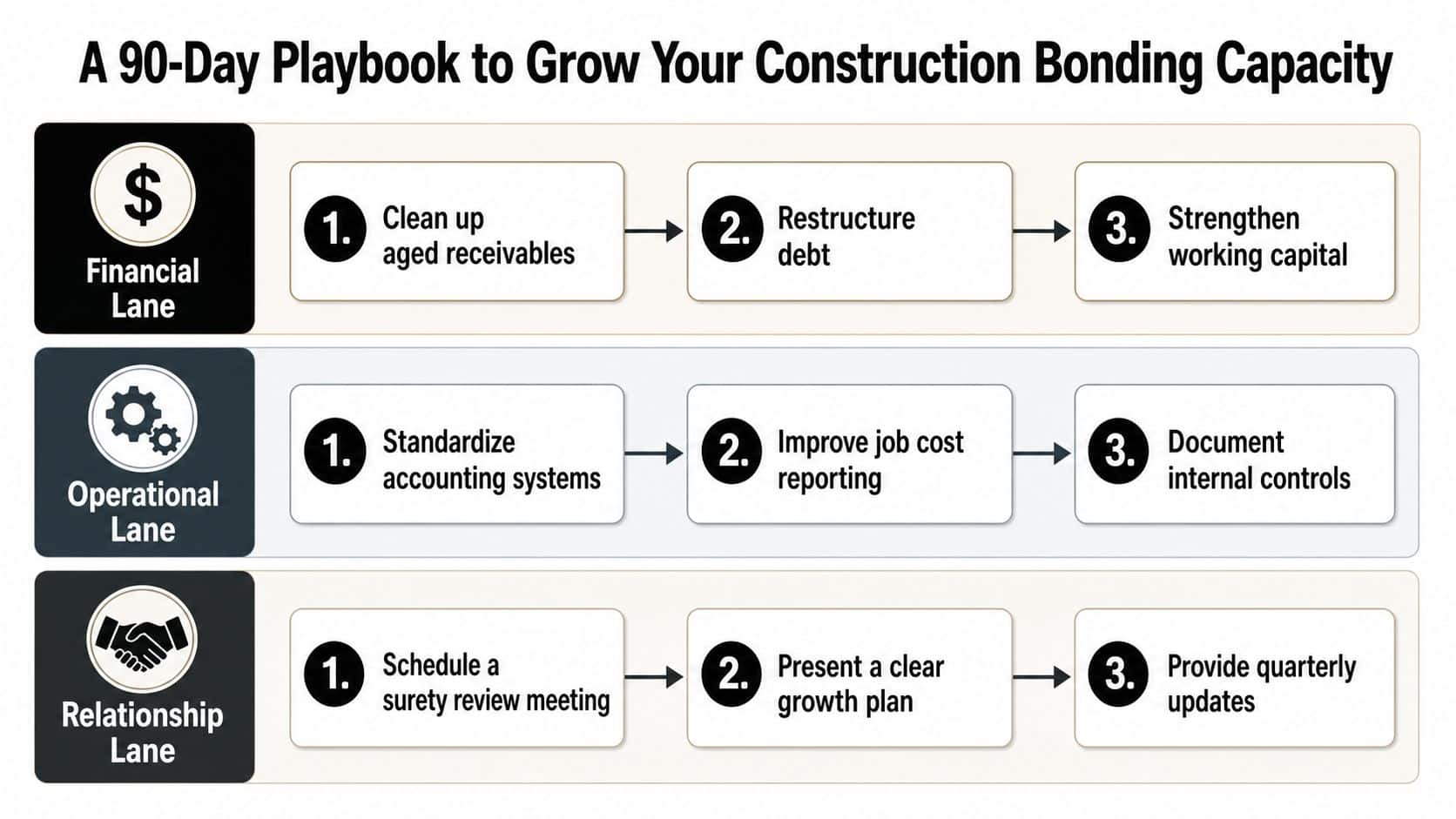
You don't need a miracle. You need a quarter of disciplined cleanup. The fastest gains usually come from fixing the balance sheet, tightening the reporting, and showing the surety a better story.
Financial lane
Start with the obvious stuff. Clean up aged receivables, strip out related-party balances, and refinance short-term debt if it is choking current ratios. That doesn't just improve the look of the balance sheet, it changes the surety's risk-adjusted view of your working capital.
Then look at overbillings and underbillings. If the WIP is distorting reality, the surety will haircut the number anyway. Fixing the accounting now is better than explaining the mess later.
Operational lane
Prune weak backlog. If a job is tying up capital and producing little margin, it's not helping your bond program. Tighten job-cost reporting so every project has a visible margin story, not just a hopeful one.
You also need a sharper backlog narrative. The surety wants to know what work is coming, why it fits your team, and how the schedule lines up with your capital. That's where better job-cost discipline supports both single-job and aggregate limits.
Documentation lane
Prepare a surety-ready package with reviewed or audited financials, a current WIP schedule, and a written backlog narrative. If your company still relies on scattered spreadsheets and delayed close cycles, the underwriter will read that as risk.
A fractional CFO can help organize the package, but the primary goal is simpler. Make the financial story easy to underwrite. The surety is more willing to stretch when the documents are clean, current, and consistent.
The sequence that matters
- Clean the balance sheet first
- Stabilize cash flow second
- Present the package third
- Ask for the limit increase after the story is obvious
That order is fixed. If you ask for capacity before the numbers are cleaned up, you usually just get a polite no.
A Worked Example for a $20M Construction Firm
A commercial contractor doing $20 million in revenue has $1.5 million in working capital, but the backlog story is thin. The surety sees decent scale, but not enough confidence to give the owner every dollar he wants on the first call.
At the outset, a reasonable estimate would put single-job capacity somewhere around $12 million to $18 million and aggregate capacity around $22 million to $30 million, depending on the multiplier used and how clean the supporting reports look. That spread is exactly why the quality of the package matters so much. Same company, same revenue, different result based on how the underwriter reads the balance sheet.
Then the owner runs the 90-day playbook. Receivables get cleaned up, a short-term line is renegotiated, a 4 percent margin project is dropped from the backlog, and monthly job-cost reviews are installed. That combination does two things. It improves the quality of working capital and gives the surety a better answer on cash conversion.
The gain isn't the single move. It's the compounding effect of cleaner current assets, better backlog, and more credible reporting. When the surety sees that the contractor is managing the business instead of reacting to it, the capacity conversation gets easier.
A surety will stretch for a contractor that looks controlled. It will not stretch for one that looks busy but unfocused.
The lesson for owners is blunt. If your financials are messy, your capacity will look smaller than your business. If your reporting is disciplined, your bond line can expand before revenue does.
Underwriter and Lender Requirements You Should Have Ready
Sureties reward preparation. Lenders do too. If you walk in with the right documents, the review is faster and the discussion gets more serious.
The readiness checklist
| Item | What the Surety Wants | What the Lender Wants |
|---|---|---|
| Financial statements | Reviewed or audited statements with clear notes and support | Clean statements that support covenants and borrowing base |
| WIP schedule | Current, accurate job status and cost-to-complete detail | Proof the company can manage cash and margins |
| Backlog schedule | Visible project mix and timing | Evidence of future revenue and credit quality |
| Personal financial statement | Owner support and indemnity strength | Secondary repayment capacity and transparency |
| Bank reference | Proof of stable banking relationship | Confirmation of deposit history and payment discipline |
| Surety application package | Consistent story across documents | Financial consistency and risk control |
| Construction line covenants | Working capital and net-worth awareness | Minimum ratio compliance and monitoring |
| Internal reporting package | Monthly updates and reconciliations | Timely financial management discipline |
Sureties typically want the financials, WIP, backlog, indemnity, and bank support all aligned. Lenders want something similar, but they also care about covenant compliance on the construction line of credit. If your working capital gets thin, both sides notice.
If you want a cleaner standard for what counts as good reporting, what financial reporting means in practice is worth reviewing before your next surety renewal.
What gets missed most often
The most common miss is a stale WIP. The second is a backlog schedule that tells the truth but not the story. The third is an owner package that looks fine individually but conflicts with the business financials.
Don't let that happen. Build one packet, make every number tie, and send it early enough that the surety can ask questions before your bid deadline hits.
How a Fractional CFO Helps You Increase Your Bonding Capacity
A fractional CFO earns his keep here because this is not a bookkeeping problem. It is a capital structure problem, a reporting problem, and a cash timing problem all at once. The right finance lead cleans up the numbers the surety uses and strips out the items that make the file look weaker than it is.
A practical engagement usually starts with a diagnostic, then moves into monthly WIP review, working-capital normalization, lender covenant tracking, and a 13-week cash flow model that keeps the company inside its borrowing limits while it grows. That work is the core of what a fractional CFO does, because the job is to make the balance sheet, cash flow, and reporting package tell the same story.
AmbitionCFO works with founder-led construction businesses that need stronger financial visibility without adding a full-time CFO too early. One of the service areas is Bonding and Banking Support, which is aimed at tightening working capital and financial reporting so the surety can underwrite more confidently.
If you want a higher bond line, stop asking for one before the numbers are ready. Start with the current limits, clean the balance sheet, and make the surety's job easier. That means getting receivables, underbillings, overbillings, debt classification, and owner support into a form the underwriter will trust. If you want a direct view of what is holding your program back, schedule a capacity diagnostic with John Myklusch and the AmbitionCFO team this week.
If you want help turning your financials into more bonding headroom, visit AmbitionCFO and talk with a team that works on cash flow, reporting, and forecasting for growth-stage owners. They can help you clean up the numbers the surety uses, so your next bid is not blocked by noise on the balance sheet.