

You're probably looking at your latest P&L and asking a blunt question: is my EBITDA good, or am I just telling myself a comforting story?
That's the right question, especially if your business does $10M to $100M in revenue and you're in construction, distribution, or professional services. At that size, EBITDA stops being an accounting metric and starts becoming a decision metric. It affects how you hire, how you price, how lenders look at you, and what a buyer will pay if you want out in the next few years.
Most owners don't have an EBITDA problem. They have a clarity problem. They're looking at reported profit, not normalized profit. They're comparing themselves to the wrong peer group. And they're waiting too long to clean up the numbers before an exit.
Table of Contents
- Beyond Profit What Your EBITDA Number Really Means
- Calculating Your True Profitability EBITDA and Add-Backs
- Benchmarking Your EBITDA Margin Against Your Industry
- Is Your EBITDA Healthy A 3-Point Checklist
- 4 Levers to Pull to Immediately Improve Your EBITDA
- How to Maximize Your Business Value for an Exit
Beyond Profit What Your EBITDA Number Really Means
A business owner reviews the income statement and sees a profit number that looks fine. Then the bank asks about debt capacity, a buyer asks for trailing twelve-month EBITDA, and the owner realizes those conversations are using a different language.
That language is EBITDA, which means earnings before interest, taxes, depreciation, and amortization. In plain English, it shows how your core business performs before financing choices, tax structure, and non-cash accounting entries muddy the picture.
That matters because two companies can have similar revenue and very different net income for reasons that have little to do with operating discipline. One may carry more debt. Another may have heavier depreciation. A third may have a tax setup that lowers reported profit. EBITDA strips those out so people can judge the business itself.
Buyers don't pay for accounting noise. They pay for repeatable operating earnings.
For most owners, the practical use of EBITDA is simple. It helps you answer three questions:
- How efficient is the business really? You can see whether your operations are converting revenue into operating profit.
- How do you compare to peers? EBITDA margin is one of the cleanest ways to benchmark against similar firms.
- What's the business likely worth to an outside party? Buyers, lenders, and investors often center the conversation on EBITDA, not net income.
The confusion starts when owners treat EBITDA like a vanity metric. It isn't. It's a decision tool. If your margin is thin, you likely have less room for mistakes, slower cash generation, and weaker negotiating power. If your margin is consistent and credible, you have options.
If you want a broader scorecard beyond EBITDA alone, review the financial metrics every business owner should track. EBITDA is critical, but it works best when you read it alongside cash flow, gross margin, backlog, and working capital.
Calculating Your True Profitability EBITDA and Add-Backs
A lot of owners say they know their EBITDA. Fewer know their adjusted EBITDA. That's the number that matters when someone serious reviews your business.
Start with the standard formula
The standard calculation is straightforward.
EBITDA = Operating Income + Depreciation + Amortization
For margin, use:
EBITDA Margin (%) = (EBITDA ÷ Revenue) × 100
According to this EBITDA margin reference from Assets America, you should use operating income, not net income, then add back depreciation and amortization, and make sure EBITDA and revenue come from the same period, typically TTM. That same source also notes that EBITDA excludes interest, taxes, depreciation, and amortization, which gives you a clearer view of operating profitability independent of capital structure or tax policy.
Here's the visual most owners need before they start cleaning up the number:
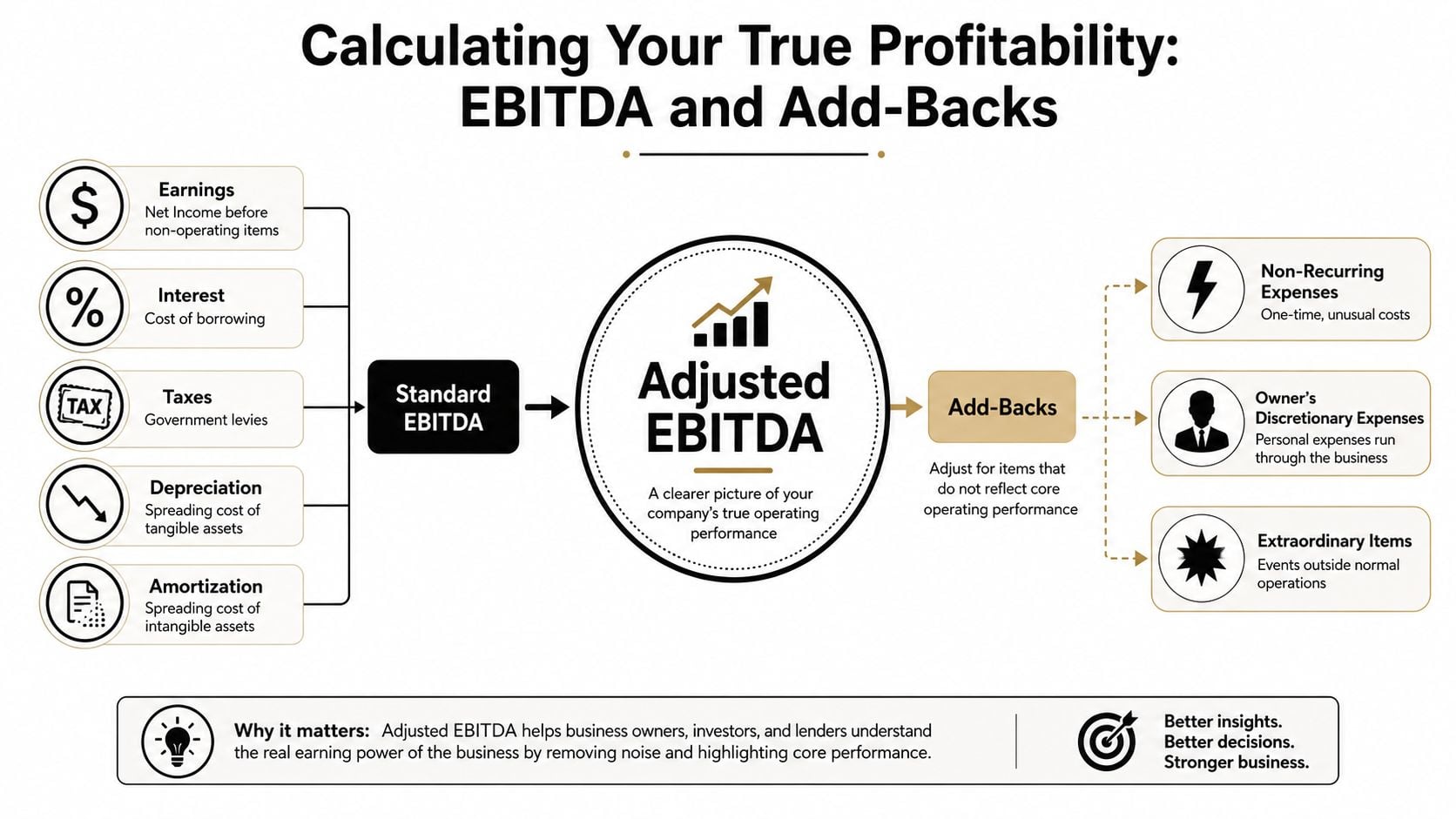
Adjusted EBITDA is what buyers care about
Standard EBITDA is only the starting line. Adjusted EBITDA takes that figure and removes expenses that don't reflect normal ongoing operations.
Think of it this way. Standard EBITDA is your financials as recorded. Adjusted EBITDA is your business as a rational buyer wants to understand it.
Common add-backs usually fall into a few buckets:
- One-time costs like unusual legal expenses, a non-recurring consulting project, or an isolated operational disruption
- Owner-related discretionary spending that runs through the business but won't continue under new ownership
- Extraordinary items that sit outside normal operations
That doesn't mean you can add back anything you dislike. Buyers will challenge weak adjustments fast. If the expense is recurring, loosely documented, or tied to how the business operates, don't assume it survives diligence.
Practical rule: If you can't explain an add-back clearly and support it with records, it's not an add-back. It's a hope.
Strong reporting discipline makes this process much easier. If your monthly close is messy, your chart of accounts is vague, or your P&L mixes personal and business items, start by tightening your process with financial reporting best practices.
A simple worksheet you can use
Use this quick worksheet with your controller, CPA, or CFO:
| Line item | Include in standard EBITDA | Potential add-back | Notes to document |
|---|---|---|---|
| Operating income | Yes | No | Start here |
| Depreciation | Yes | No | Add back |
| Amortization | Yes | No | Add back |
| Interest expense | Excluded | No | Not part of EBITDA |
| Taxes | Excluded | No | Not part of EBITDA |
| One-time unusual expense | No | Maybe | Must be documented |
| Owner discretionary expense | No | Maybe | Must be supportable |
| Extraordinary event cost | No | Maybe | Show why it won't recur |
A clean EBITDA number isn't just more accurate. It changes the conversation. It tells lenders you understand your economics. It tells buyers you're organized. And it tells your leadership team what the business actually has to work with.
Benchmarking Your EBITDA Margin Against Your Industry
If you're asking what is a good EBITDA, the honest answer is simple: it depends on your sector.
A margin that looks weak in one business can be solid in another. That's why generic advice is usually useless for owners in the middle market. You need benchmarks that fit your operating model.
The benchmark table that matters
For AmbitionCFO's core industries, this industry benchmark overview from CTA Acquisitions gives the most practical ranges: distribution runs about 3–8%, retail/construction-adjacent businesses run about 5–15%, and professional services run about 15–25%. That same source notes that below 10% is typical in low-margin sectors like distribution, while 15%+ signals operational efficiency in professional services.
Using that guidance, here's a practical scorecard for mid-market owners.
EBITDA Margin Benchmarks for Mid-Market Businesses
| Industry | Needs Improvement (<) | Healthy Range | Strong Performance (>) |
|---|---|---|---|
| Distribution | 3% | 3–8% | 8% |
| Construction | 5% | 5–15% | 15% |
| Professional Services | 15% | 15–25% | 25% |
This table should change how you read your numbers.
If you own a distribution company at the lower end of the range, you may still be operating within the reality of your sector. If you run a professional services firm with the same margin, that's a warning sign, not a victory.
A “good” margin only means something when you compare it to the right business model.
Why the ranges differ so much
Construction, distribution, and professional services don't earn money the same way.
Distribution often runs on volume, purchasing discipline, freight management, and inventory turns. Margins are naturally tighter. A bad pricing decision or sloppy purchasing process can wipe out a large share of EBITDA quickly.
Construction lives on estimating accuracy, job costing, change order control, labor productivity, and equipment utilization. EBITDA can look decent in one period and then get crushed by job overruns, delayed collections, or a few underbid projects.
Professional services usually have higher margin potential because they sell expertise, utilization, and client relationships rather than physical product. But the margin still disappears if pricing is weak, partner compensation is bloated, or client delivery is inefficient.
There's also a broader market context. According to this EBITDA margin roundup referencing NYU Stern sector data, the average EBITDA margin across the U.S. market is about 15%, rising to about 16% when financial firms are excluded. That same source notes that below 10% usually signals thin profitability, 15–20% is solid in many industries, and 20–30% reflects strong financial management, while sectors vary widely. It also points out the obvious but often ignored truth: software can run at 30–40%+ while grocery operates at 3–5%.
That's why benchmarking is not optional. If you're thinking about value, not just operations, pair your margin analysis with guidance on how to value a small business for sale. Buyers don't judge EBITDA in a vacuum. They judge it against what a similar company should produce.
Is Your EBITDA Healthy A 3-Point Checklist
A single EBITDA number can hide a lot. You need a quick diagnostic, not just a benchmark.
The fastest way to judge whether your EBITDA is healthy is to test it in three directions: trend, plan, and quality.
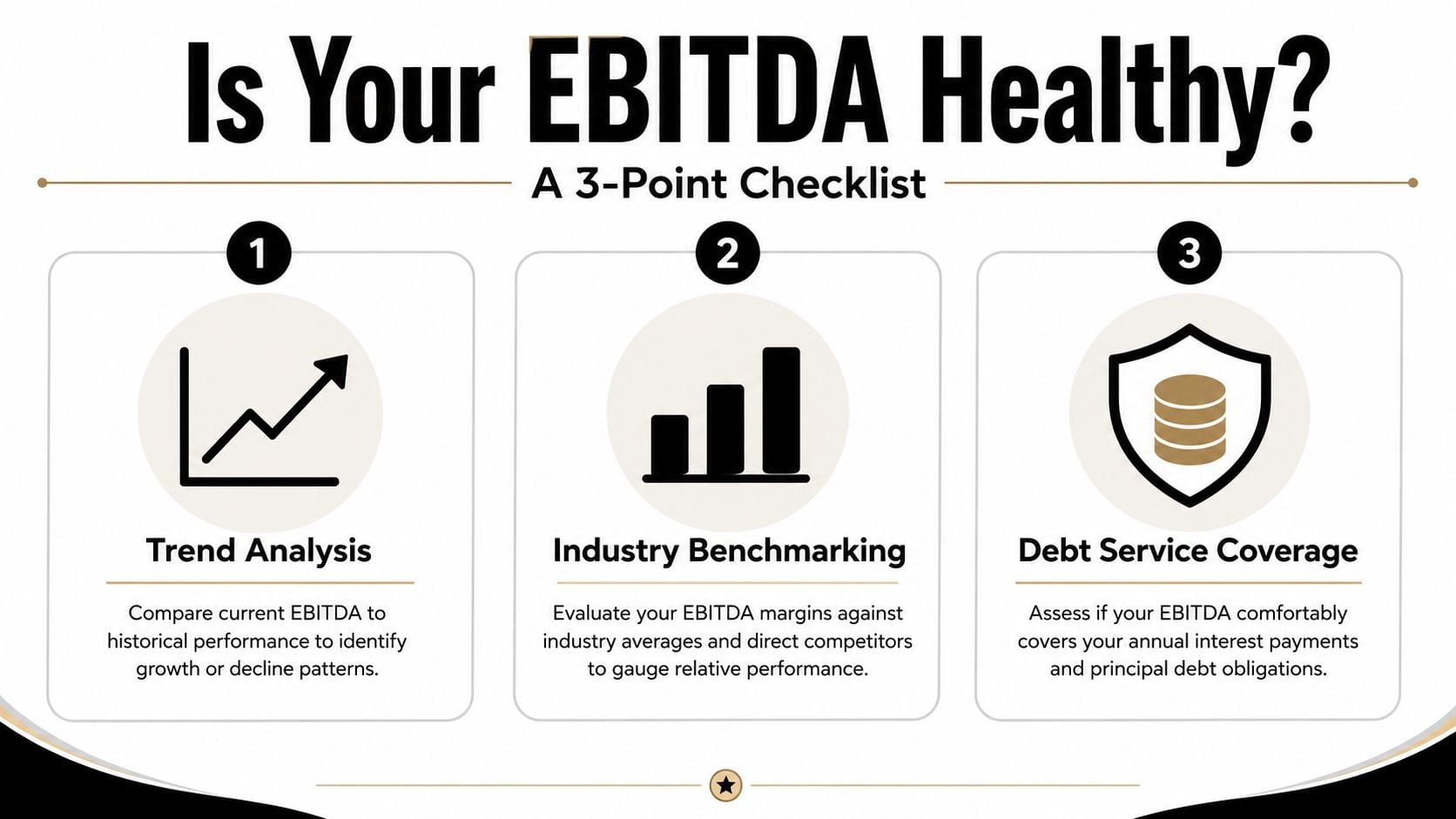
Check the trend
Start with the past few years. Don't ask whether this month was good. Ask whether the business is becoming more efficient over time.
A useful rule of thumb from this EBITDA margin post on LinkedIn is that above 20% indicates a strong, efficient business, 10–20% is average and stable, and below 10% suggests cost pressure or a highly competitive sector. The same source also makes the important point that those ranges need context from business model and growth stage.
If your EBITDA margin is moving up, you're usually seeing one of two things: better pricing discipline or better cost control. If it's moving down, don't overcomplicate it. Your costs are outrunning your revenue, or your pricing is too soft.
Check performance against plan
A healthy EBITDA number should line up with your budget and forecast. If actual results regularly miss plan, your planning process is weak or your execution is weaker.
Use a short monthly review:
- Compare actual to budget: Identify whether misses came from revenue, gross margin, or overhead.
- Compare actual to forecast: Ask whether the forecast adjusted quickly enough when conditions changed.
- Tie it to cash impact: EBITDA can look acceptable while cash gets squeezed. That's why operating review and liquidity review have to work together.
If your team doesn't connect EBITDA to near-term cash needs, fix that with stronger liquidity management practices. Plenty of profitable companies still create stress because they don't turn earnings into cash fast enough.
Check the quality of earnings
This is where owners fool themselves.
Strong EBITDA built on repeat work, disciplined pricing, reliable project delivery, and documented add-backs is healthy. EBITDA boosted by one lucky project, deferred maintenance, owner underinvestment, or aggressive adjustments is fragile.
Use this checklist:
- Repeatability: Did core operations generate the earnings?
- Documentation: Can you support adjustments with invoices, payroll records, and clear explanations?
- Durability: Would a buyer believe these earnings continue after ownership changes?
If your EBITDA needs a long verbal explanation every month, it isn't healthy yet.
4 Levers to Pull to Immediately Improve Your EBITDA
You don't improve EBITDA by staring at reports. You improve it by changing specific operating decisions.
The good news is that the levers are simple. The hard part is having the discipline to pull them consistently.
Here's the high-level picture:
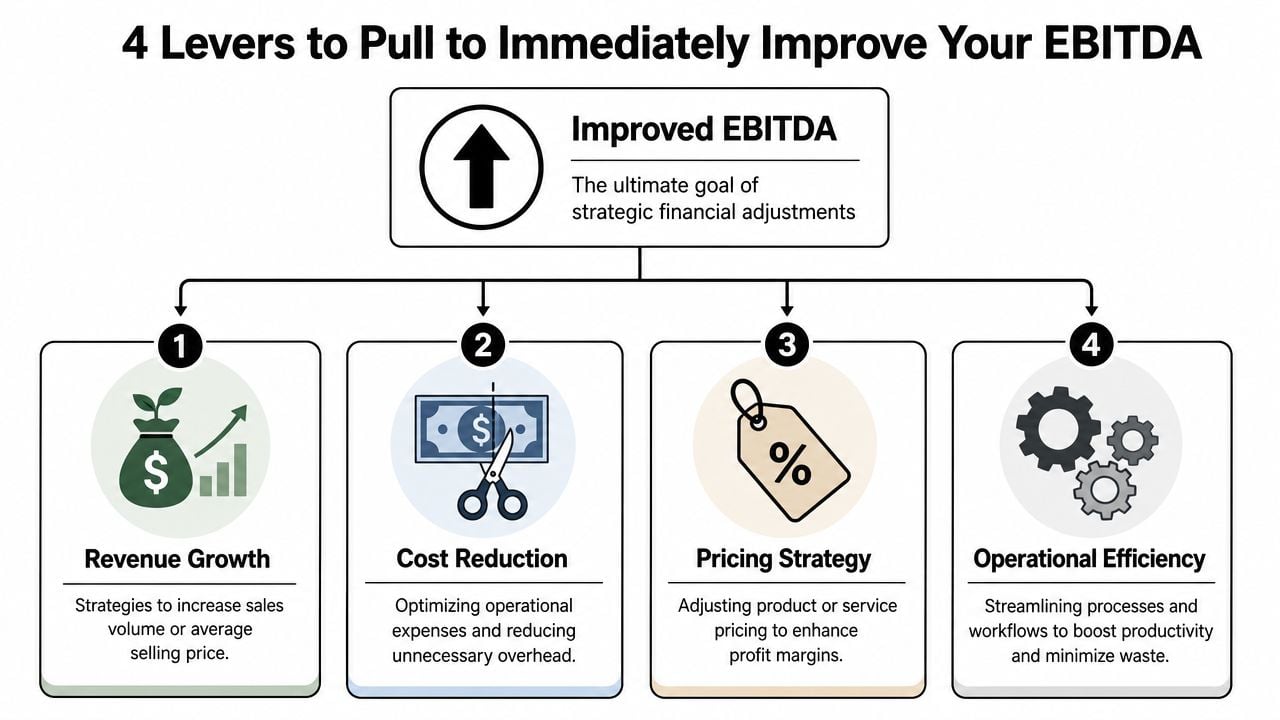
Lever one grows revenue without growing overhead at the same pace
Revenue growth only improves EBITDA if you don't add costs just as fast.
In service businesses, that can mean raising rates on underpriced clients, improving staff utilization, or selling higher-value scopes instead of discount-heavy work. In construction, it may mean selecting better-fit jobs instead of chasing every contract. In distribution, it can mean shifting mix toward accounts or product categories with better margin quality.
A practical move is to separate customers into tiers and review price realization. Many owners think they have a sales problem when their true issue is a pricing discipline problem.
Lever two protects gross margin
This lever usually moves fastest.
According to this EBITDA improvement guide from Craftybase, owners can improve EBITDA margin through four concrete actions: grow revenue without proportional cost increases, reduce material costs, improve operational efficiency, and review capital structure to reduce interest costs. That same source notes that a 5% material saving can meaningfully shift margin.
For your business, that translates into direct actions:
- Construction owners: Rebid key suppliers, tighten estimating assumptions, and track purchase price variance by job.
- Distributors: Renegotiate vendor terms, clean up obsolete inventory, and stop tolerating margin leakage on “strategic” accounts that never improve.
- Professional services firms: Reduce write-offs and scope creep. Every unbilled hour is gross margin you chose to surrender.
Here's a useful operating conversation to have this month. Pull your top cost categories and ask which one is rising faster than revenue. Start there.
A deeper walkthrough on pricing and gross profit strategy is in how to improve gross profit margin.
Here's a short explainer that can help your team think about EBITDA improvement in practical terms:
Lever three cuts waste in operating expenses
Don't go hunting for random cuts. Cut friction, duplication, and low-return spending.
Look for patterns like too many software tools, bloated admin layers, poor fleet utilization, excess office costs, weak purchasing controls, or reports nobody uses. In professional services, partner draws and compensation structures often deserve a hard review. In construction, field inefficiency can show up as overhead when the underlying issue is scheduling or rework.
One practical tool here is a simple spend review with category owners. If nobody can explain why the expense exists and what value it creates, it belongs on the cut list.
Lever four improves execution and capital structure
Operational efficiency is where EBITDA gains become sustainable.
That includes better scheduling, cleaner handoffs, less rework, improved billing speed, tighter collections, and stronger reporting. If manual processes are slowing invoicing or hiding job issues until month-end, you're giving away margin.
It also includes capital structure review. If debt terms are adding unnecessary pressure, fix them. In some cases, owners use a quality-of-earnings model to document normalized EBITDA and support stronger financing or exit prep. AmbitionCFO provides that type of normalization work as part of fractional CFO support for owner-led firms.
Practical rule: Start with one revenue lever, one gross margin lever, one overhead lever, and one process lever. Assign an owner to each. Review them every month until EBITDA changes.
How to Maximize Your Business Value for an Exit
If you plan to sell in the next few years, stop asking only whether your EBITDA is good today. Ask whether it will be credible, growing, and well-documented when a buyer starts diligence.
That's the difference between reported earnings and exit-quality earnings.
According to this exit-planning discussion of good EBITDA, exit valuations depend on adjustable EBITDA, not the reported figure. The same source also notes that even top-performing SaaS firms averaged only 9.3% EBITDA margin in Q3 2025, yet valuations still depend on normalized earnings. That should tell you something important. Buyers care less about the headline number in isolation and more about the quality and adjustability of the earnings stream.
For an owner in construction, distribution, or professional services, the practical lesson is clear:
- Build a clean monthly reporting process now
- Separate personal, unusual, and non-recurring items from core operations
- Document every legitimate add-back before you need it
- Show a stable or improving earnings trend over time, not one heroic year
- Make sure your EBITDA story matches how the business runs
A buyer will test whether your earnings survive ownership change. If your margin depends on underpaying yourself, carrying messy books, or explaining away recurring costs as “one-time,” you'll lose your bargaining power.
The best exit prep starts earlier than most owners want to admit. If you wait until the sale process begins, you're negotiating from cleanup mode instead of strength.
If you want a clearer answer to what is a good EBITDA for your business, and especially how to improve and normalize it before an exit, contact AmbitionCFO. A fractional CFO can help you benchmark your margin, clean up add-backs, build reliable forecasts, and turn your financials into an exit-ready earnings story.