

Your revenue is up, the backlog looks strong, and yet every big decision still feels like a coin flip. You're looking at payroll, vendor bills, inventory, debt, and the next round of hiring, and the question underneath all of it is simple: what should we do next with the numbers we already have?
That's where financial management consulting earns its keep. It's not bookkeeping, and it's not tax prep. It's the discipline of turning accounting data into operating decisions, so an owner can protect cash, improve margins, and commit capital with less guesswork.
Table of Contents
- Why Your Growing Business Feels Financially Stuck
- The Core Services That Drive Growth and Stability
- When a Fractional CFO Becomes Non-Negotiable
- Real-World ROI Industry Specific Examples
- Your Typical Engagement Roadmap From Day One
- How to Evaluate and Choose the Right Partner
- Common Questions About Financial Consulting
Why Your Growing Business Feels Financially Stuck
You can have a healthy top line and still feel trapped by your own numbers. That usually happens when the business has outgrown reactive accounting, but hasn't yet built a decision system for cash, margin, and capital allocation. If that sounds familiar, the problem isn't effort. It's that the finance function is still looking backward while the business needs to look forward.
For founders in construction, distribution, and professional services, the pressure shows up in slightly different ways. A contractor wins a big job and then worries whether the draw schedule will cover labor and materials. A distributor sees sales rise but inventory ties up cash faster than it can be replaced. A services firm adds headcount and then wonders why utilization and profitability don't move together.
That's the point where financial management consulting becomes useful. It gives you a framework for answering questions like, “Can we afford this hire?” and “Will this contract help or hurt cash?” If you want a practical starting point on the operational side, strategies for professional services cash flow is a good reference for seeing how leaders think about timing, visibility, and payment pressure.
Practical rule: if you can't explain how a decision affects cash in the next few months, you're not ready to make it confidently.
The first internal shift is simple. Stop treating finance as a compliance function and start using it as a management tool. If your cash feels tight, it's also worth comparing that experience with cash flow problems and solutions, because the underlying issue is often not lack of sales, but lack of visibility.
The Core Services That Drive Growth and Stability
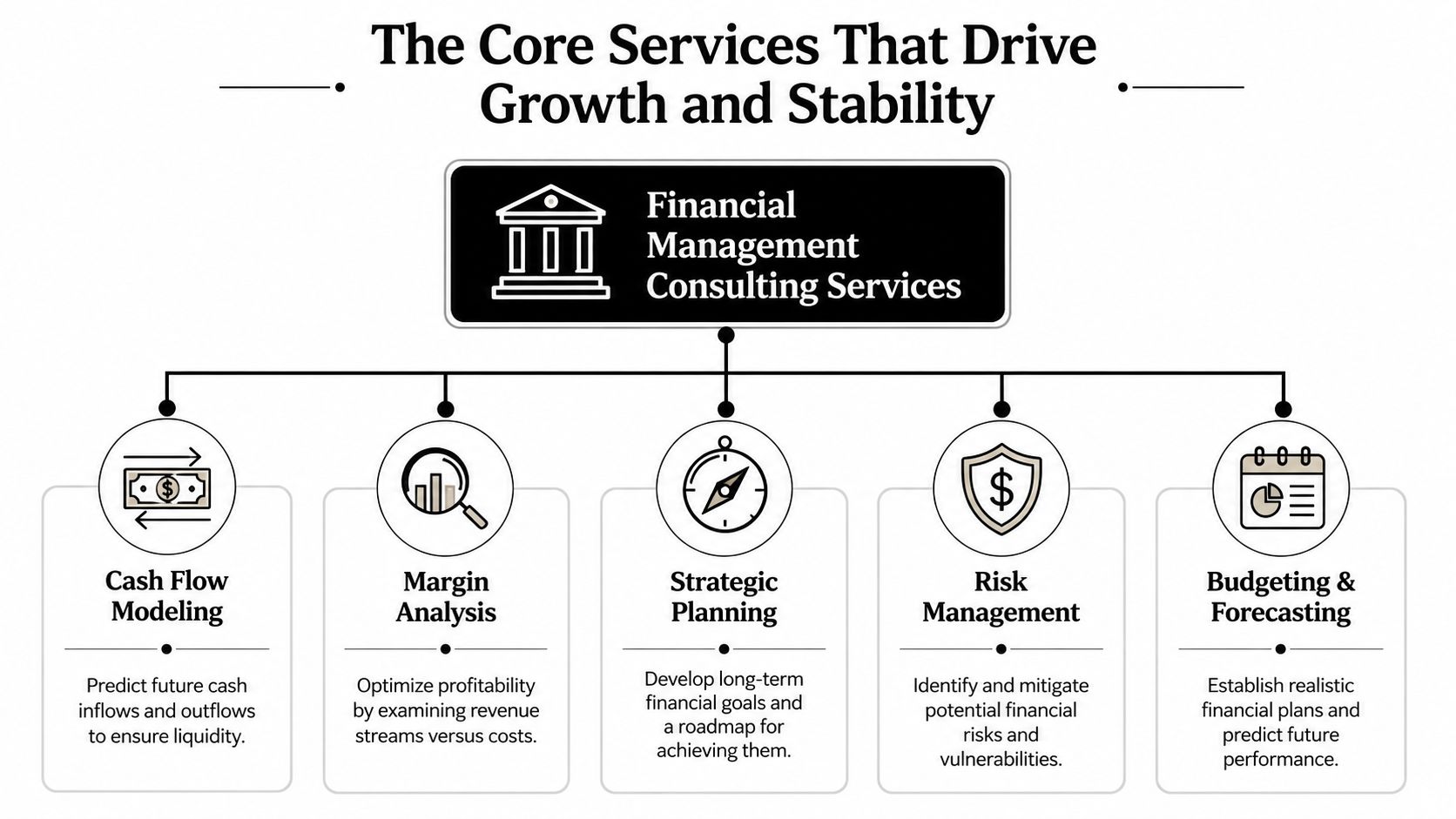
The financial service consulting market is expanding fast, from $418.15 billion in 2025 to $483.16 billion in 2026, a 15.5% year-over-year increase, with a projection of $851.9 billion by 2030 at a 15.2% CAGR according to Research and Markets. That growth matters because it reflects a basic reality. Owners are outsourcing more finance thinking, not because they want more reports, but because the business has become too complex to manage from instinct alone.
Cash flow modeling
Cash flow modeling is your money GPS. It shows what's likely to come in, what's likely to go out, and when the gap might open up. In practice, that helps you decide whether you can place an order, cover payroll, or wait two weeks before making a purchase.
For construction, it's often the difference between winning work and surviving it. For distribution, it helps you see how inventory buys affect liquidity before the shelves are full. For any owner, it changes the question from “Do we have sales?” to “Will the timing of receipts and payments support the next move?”
Margin analysis
Margin analysis tells you which jobs, products, or clients are profitable. Revenue alone can hide weak pricing, bad terms, or too much labor leaking into a project. A contractor may think a big contract is a win until the job-level margin shows the opposite.
That's why this service should feed decisions immediately. If a customer segment is consistently thin, you raise price, change scope, or walk away. If one product line is funding the rest of the business, you protect it and invest there first.
Owner's test: if a sale doesn't improve margin, it may still grow the business, but it can also drain it.
Strategic planning, risk, and budgeting
Strategic planning connects the finance model to the next 12 to 36 months of choices. Risk management looks at what happens if a customer pays late, a supplier changes terms, or a project slips. Budgeting and forecasting keep those plans honest by checking actual performance against the plan.
If you're comparing finance help with transaction-level tax choices, entity choice and capital gains is useful background, because ownership structure and operating strategy often intersect. And if you're trying to separate planning work from accounting work, the distinction between strategy and recordkeeping is laid out clearly in FP&A vs accounting.
When a Fractional CFO Becomes Non-Negotiable
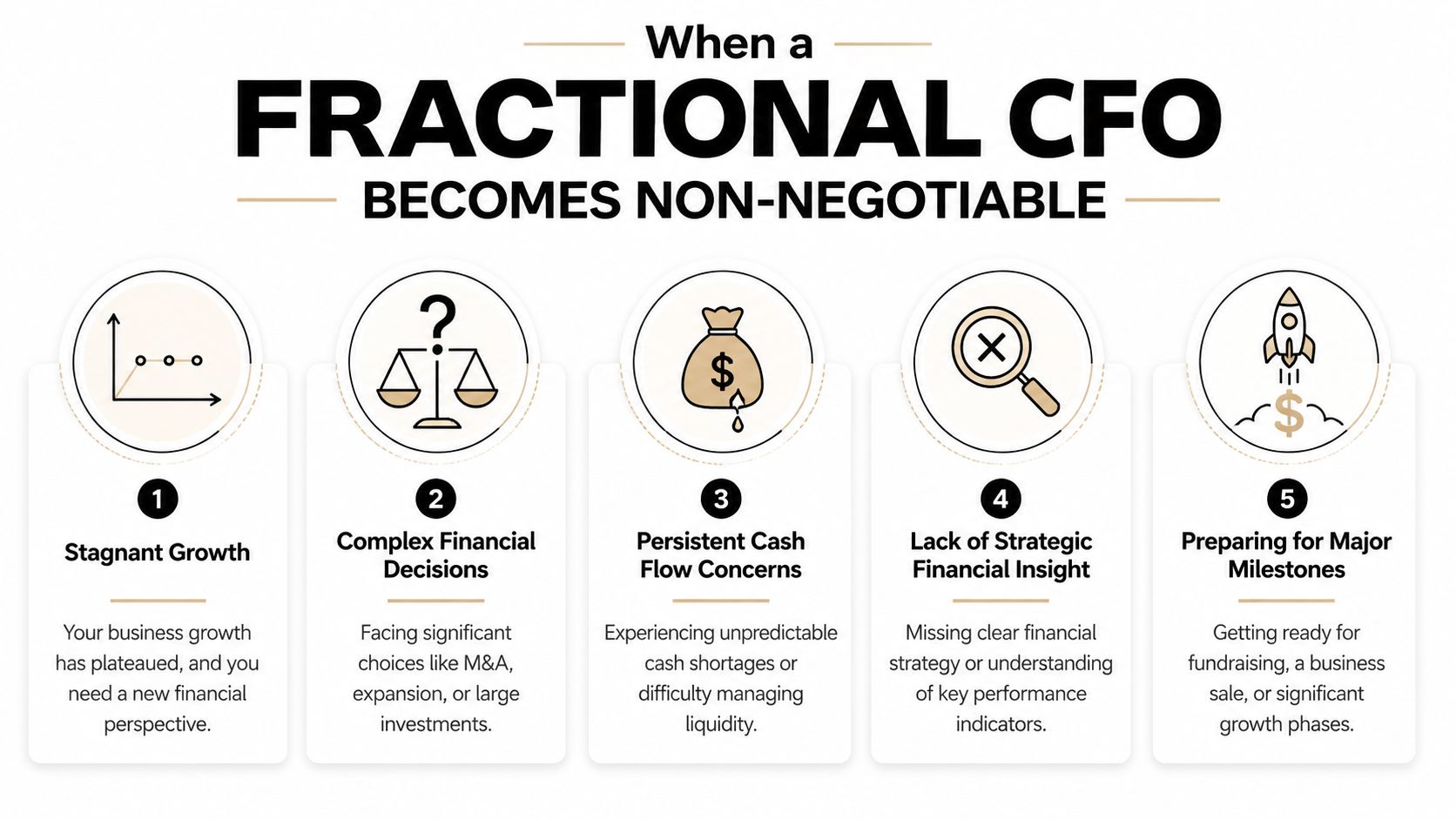
A fractional CFO stops being optional when the business starts making decisions that are too expensive to guess at. That usually happens around major hiring, new debt, equipment purchases, expansion, or owner transition. The reason is straightforward. Historical accounting tells you what already happened, while strategy tells you what should happen next.
The fit range matters too. A useful benchmark is that the sweet spot for fractional CFO services is often businesses with $2 million to $30 million in annual revenue, with a practical lower floor around $750,000, while some providers note that above $30 million a full-time CFO often becomes necessary to handle daily complexity My Business CFO. For owners in that middle band, the question is rarely whether the business is big enough. It's whether the decisions have become expensive enough to justify strategic finance leadership.
The signal isn't always distress. Sometimes the business is healthy, but the owner is about to make a commitment that will change the shape of the balance sheet. That's when a CFO perspective helps because it forces a decision to survive contact with the numbers.
If you're weighing whether the role pays for itself, the economics are worth studying in fractional CFO ROI. A broader market lens shows why demand keeps climbing, too. IBISWorld estimates the U.S. management consulting industry at $411.7 billion in 2026 and the global industry at $1.1 trillion in 2026, which includes financial management consulting services as a covered line IBISWorld.
Real-World ROI Industry Specific Examples

The strongest value in this work comes from translating strategy into a concrete owner decision. That gap is widely missed in generic advice, which is why emoneyadvisor.com's discussion of underserved advisory needs resonates so much with founder-led businesses. Owners usually aren't asking for theory. They're asking whether to hire, buy, expand, or hold.
Construction
A contractor looks profitable on paper, but one major project is absorbing more labor and materials than expected. The problem is job costing. Without it, the owner sees revenue but not the actual margin by project.
The solution is to tie estimated versus actual costs to each job and review the variances before the next bid goes out. That lets the team correct pricing, change subcontractor assumptions, or tighten change-order discipline. The result is better bid discipline and less surprise on completed work.
Distribution
A distributor is growing sales, but cash keeps getting tight because inventory is bought before receivables come in. The fix is a 13-week cash flow model tied to purchase timing, collections, and vendor terms. That model gives the owner a practical view of when inventory is creating value and when it is merely absorbing cash.
The business can then adjust reorder timing, renegotiate terms, or delay nonessential purchases. With these adjustments, cash flow turns from an accounting report into an operating control. A model doesn't eliminate risk, but it makes the risk visible before it becomes a crisis.
Professional services
A services firm adds staff, but utilization falls and profit per client gets fuzzy. The answer is a KPI dashboard that tracks billable time, realization, and project mix in one place. Once the owner sees the pattern, they can rebalance workloads, reprice underperforming work, or stop selling work that looks busy but doesn't earn enough.
This is also where a smart consulting arrangement supports better decision-making, not just better reporting. The payoff is that owners spend less time reacting and more time steering.
Your Typical Engagement Roadmap From Day One
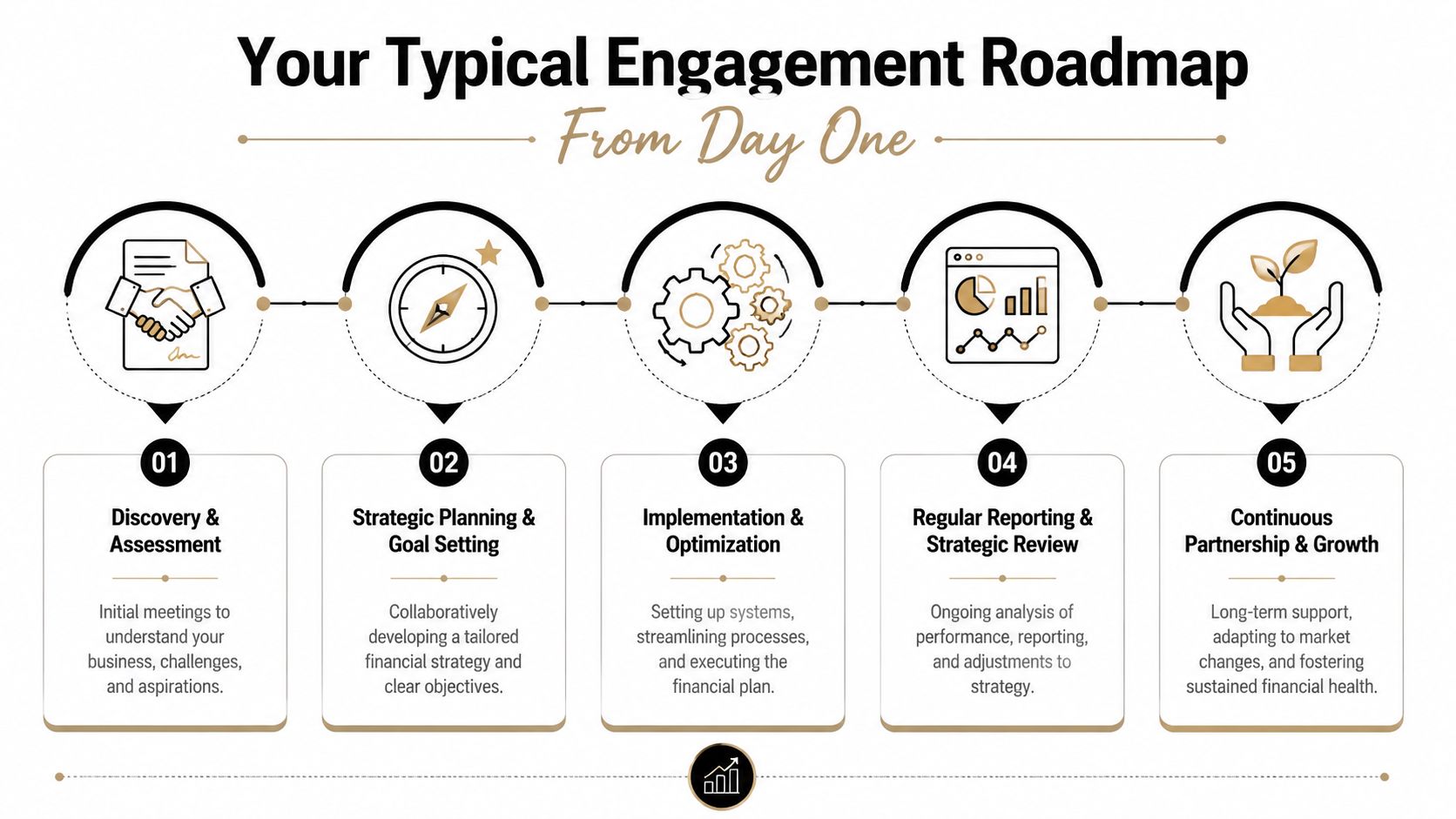
Most owners worry a fractional CFO engagement will feel vague or overly academic. It shouldn't. The best engagements move from diagnosis to action quickly, because the point is to improve decisions, not add another layer of meetings.
Discovery and first deliverables
The first conversations should focus on what's breaking, what's changing, and what the owner needs to decide soon. That usually leads to the first working model, often a 13-week cash flow forecast, which gives a near-term view of liquidity and helps leadership spot pressure before it lands. If you want a closer look at the mechanics, 13-week cash flow is a useful benchmark.
Start with the decisions, then build the model around them.
Weekly rhythm and monthly review
After the setup, the cadence usually settles into weekly check-ins and monthly reviews. Weekly work catches collections issues, vendor timing changes, and operating surprises. Monthly work checks whether the plan still fits the business.
That rhythm matters because finance doesn't help much when it arrives late. The best process is light enough to use, but structured enough to trigger action when the numbers move.
Tools, reporting, and implementation
Implementation should produce a short list of usable tools, not a pile of spreadsheets. For some owners, that means a dashboard. For others, it's a budget, a forecast, a margin review, or a capital allocation memo.
AmbitionCFO is one example of a firm that provides this kind of embedded support for founder-led businesses, especially where cash flow, profitability, and exit planning need to be managed together. The key is not the logo. It's whether the partner can turn the finance function into a decision engine.
How to Evaluate and Choose the Right Partner
Fractional CFO services typically cost between $3,000 and $15,000 per month, or $150 to $400 per hour, and businesses can save up to 30% to 40% versus a full-time CFO by avoiding salary, benefits, bonuses, and payroll taxes Eagle Rock CFO. That makes buyer discipline important. You're not buying generic advice. You're buying judgment, speed, and fit.
What to ask before you sign
Ask whether the consultant has worked in your industry, and whether they've handled the specific decisions you're facing now. Construction owners should ask about job costing and WIP complexity. Distribution owners should ask about inventory, vendor terms, and cash timing. Professional services owners should ask about utilization, realization, and pricing discipline.
Credentials matter too, but they're not enough by themselves. CPA experience helps with financial rigor. CEPA experience matters if exit planning is part of the picture. The better question is whether the person can connect those skills to decisions you must make.
Compare the models before you compare the price
| Attribute | Fractional CFO | Full-Time CFO |
|---|---|---|
| Cost structure | Monthly retainer or hourly support | Salary, benefits, bonuses, payroll taxes |
| Best fit | Strategic needs without full-time complexity | Continuous daily finance leadership |
| Speed to value | Usually faster on focused projects | Strong for deep internal ownership |
| Flexibility | Scales with project demand | Fixed capacity and fixed cost |
| Typical use case | Owner needs guidance on cash, margin, forecast, or capital decisions | Finance is central to daily operations and constant executive coordination |
If you want a practical benchmark on engagement economics, outsourced CFO services cost can help frame the conversation. The right choice is the one that matches the intensity of your decisions, not just the size of your company.
Common Questions About Financial Consulting
A few objections come up again and again, and they're fair ones.
Is this only for businesses in trouble? No. Many owners bring in help when the business is growing quickly, not when it's failing. The main trigger is usually complexity, not distress.
How is this different from my CPA or bookkeeper? A bookkeeper records transactions, and a CPA handles tax and compliance work. A fractional CFO focuses on what the numbers mean for tomorrow's choices, including hiring, pricing, debt, and expansion.
How much time will it take from me? Early on, expect enough time for context, decision priorities, and review. After that, the work should get lighter for you, not heavier, because the system should do more of the reporting.
What if we're not ready for a full-time finance executive? That's exactly the gap financial management consulting fills. It gives you senior-level financial thinking without committing to a permanent hire too early.
If you're at the point where the business is making bigger calls and the numbers aren't giving you enough confidence, talk to a partner who works this way every day. Review your cash flow, the next three decisions on your plate, and whether the current finance setup can support them. Then schedule a discovery conversation with AmbitionCFO and bring the questions that matter most to your business.
A CTA for AmbitionCFO.