

Only 23% of private business owners report having a succession plan that's both fully documented and implemented. 46% have a plan in progress, while 30% have none, according to the 2025 Private Business Owner Survey. That gap explains why many founders feel prepared until a buyer asks for operating procedures, management continuity, customer data, clean financials, and a credible post-close transition plan.
The question you're really trying to answer is simple: How do I turn the company I built into an asset someone else can confidently own?
Business exit planning strategies aren't just about choosing between a strategic buyer, a family transfer, or an employee ownership plan. They're about building a business that produces dependable cash flow, operates without constant founder intervention, survives due diligence, and gives you more than one acceptable path forward.
Table of Contents
- Why Exit Planning Is Now a Strategic Imperative
- Comparing the Major Business Exit Planning Strategies
- How Buyers Value Your Business and What Moves the Multiple
- The Execution Gap That Derails Most Exits
- Tax and Estate Considerations That Change Your Net Proceeds
- Your Phased Exit Planning Action Plan
- Take Your First Step Toward a Successful Exit
Why Exit Planning Is Now a Strategic Imperative
In the United States, 2.9 million businesses are owned by people aged 55 or older. Those companies support 32.1 million employees, generate $1.3 trillion in payroll, and produce $6.5 trillion in revenue, according to business owner statistics from Project Equity.
That scale makes exit planning an operating priority, not a retirement topic. Your decisions affect employees, customers, lenders, suppliers, and your family's wealth long before a buyer submits an offer.
Industry surveys cited by the same source found that 73% of privately held U.S. companies planned to transition ownership within 10 years, representing a $14 trillion opportunity, while 49% of owners expected to exit within five years. Owners who wait until a transaction is urgent lose time to improve earnings, document processes, strengthen management, and correct financial weaknesses.

Exit planning means building transferability
An exit plan is a management discipline that answers practical questions, rather than a note that says, “Sell to a strategic buyer.”
- Value creation: What makes the business worth buying, and what evidence supports that value?
- Operational continuity: Can the company serve customers if you stop making daily decisions?
- Leadership succession: Who can lead the company, and have they operated without your intervention?
- Financial clarity: Can a buyer reconcile revenue, margins, cash flow, working capital, and adjustments?
- Personal readiness: What should your money, time, identity, and relationships look like after ownership changes?
A construction company may need to transfer estimating relationships and project knowledge. A distributor may need stronger purchasing controls and customer diversification. A professional services firm may need to move client trust from the founder to a broader delivery team.
Practical rule: If your company's most important customer, employee, process, or decision depends on you, you haven't finished exit planning.
Transferability is proven through execution. Managers must make decisions without you, procedures must exist outside your memory, and financial reports must withstand buyer scrutiny. A plan on paper has little value if leadership turnover or post-close integration exposes the company's dependence on its founder.
Owners who start early gain options. They can improve earnings, replace undocumented knowledge with systems, develop managers, test internal successors, and assess whether a sale, staged transition, or employee ownership structure fits their goals. Owners who delay often negotiate from fatigue and necessity.
For a practical overview, review The Owner's Shortlist's exit guide. Then use scenario planning for business decisions to test buyer types, timing assumptions, tax outcomes, and transition structures.
Comparing the Major Business Exit Planning Strategies
The best exit strategy is the one your company can execute, not the one that sounds most attractive on paper. Choose based on your liquidity target, family and employee objectives, transferability, timeline, and willingness to remain involved after closing. A plan fails when the buyer, successor, or employees cannot operate the business without you.
Third-party sale
A strategic or financial buyer usually provides the clearest liquidity event. Strategic buyers may pay for customer access, geographic reach, capabilities, or operating synergies. Financial buyers focus on durable cash flow, management depth, scalability, and a credible growth plan.
Choose this path if you want a market-based transaction and accept potential changes to culture, leadership, or operating priorities. Prepare for scrutiny. Buyer diligence will test customer concentration, founder dependence, reporting quality, margins, contracts, and management continuity. Weaknesses can reduce the offer, increase contingent consideration, or extend the transition period.
Execution matters as much as marketing the company. Buyers need evidence that managers can make decisions, procedures exist outside the founder's memory, and financial reports reconcile cleanly to the general ledger.
Family or management succession
An internal transfer can preserve culture, customer relationships, and institutional knowledge. It also gives a successor time to build leadership credibility and financial capacity before taking full control.
Liquidity is the trade-off. Family members or managers may not have the resources to match an outside buyer's price, leaving the seller dependent on installments, retained ownership, distributions, or another staged arrangement. Personal relationships can distort decisions. Select a successor for competence and operating discipline, not proximity.
Set written expectations for authority, compensation, performance, financing, and the transfer schedule. A successor who has never run the company independently is not yet ready, regardless of family ties or tenure.
Employee Stock Ownership Plan
An Employee Stock Ownership Plan, or ESOP, is a qualified retirement plan that owns company stock for eligible employees. The process generally starts with a preliminary valuation study and an analysis of how the structure affects the sponsor company.
An ESOP fits owners who want to preserve employee ownership and company culture while creating a structured ownership transition. One source states that a company may deduct ESOP contributions up to 25% of payroll, and that selling to an ESOP can eliminate ongoing taxes on profits for S-corporation owners, subject to applicable rules and professional review, as outlined in ESOPs for exit planning.
The structure requires reliable cash flow, disciplined governance, accurate valuation work, and leaders who can run the company after the transaction. An ESOP does not solve weak management or undocumented operating knowledge.
Staged transition or partial recapitalization
A staged transition lets the owner sell part of the company, retain a minority interest, or transfer control over time. It suits a founder who wants liquidity but is not ready for a complete separation, or a next-generation leader who needs time to prove performance.
Document authority, economics, performance expectations, distributions, exit rights, and future purchase terms before closing. Ambiguity over control or compensation turns flexibility into conflict.
| Exit Strategy | Typical Timeline | Ideal For | Key Advantage | Primary Risk |
|---|---|---|---|---|
| Third-party sale | Planned over several years, with a focused transaction period | Owners seeking liquidity and a market-based outcome | Broadest buyer pool and potential for a clean transfer | Diligence findings can reduce price or increase deal conditions |
| Family succession | Gradual handoff | Owners prioritizing legacy and continuity | Preserves family ownership and relationships | Family conflict, successor capability, and limited liquidity |
| Management succession | Gradual transfer | Companies with capable internal leaders | Retains operating knowledge and culture | Financing and leadership readiness may be insufficient |
| ESOP | Structured, multi-stage process | Profitable companies with employee continuity goals | Employee ownership and potential tax benefits | Complex administration, valuation, and cash-flow requirements |
| Partial recapitalization | Staged transaction | Owners wanting liquidity and continued participation | Balances liquidity with future upside | Unclear control rights or misaligned partners |
Choose only after separating your personal objectives from the company's preferred outcome. An owner seeking immediate liquidity should not select an internal transfer without accepting its financing consequences and longer timetable. For state-specific ownership issues, review this resource on planning your Texas business sale with legal counsel.
How Buyers Value Your Business and What Moves the Multiple
Owners often value a company through years of effort, customer goodwill, equipment, and future potential. Buyers focus on a narrower question: how likely future cash flow is to continue after the founder leaves. That transferability determines how much risk they must accept and how confidently they can underwrite the deal.
Smaller companies are commonly assessed using Seller's Discretionary Earnings, or SDE. SDE generally represents the cash benefit available to one owner-operator after appropriate adjustments. Businesses above roughly $250K to $2M of EBITDA are more commonly evaluated using EBITDA, or earnings before interest, taxes, depreciation, and amortization, according to business valuation guidance from Valutico.
A higher multiple reflects lower transition risk, not busyness or effort.
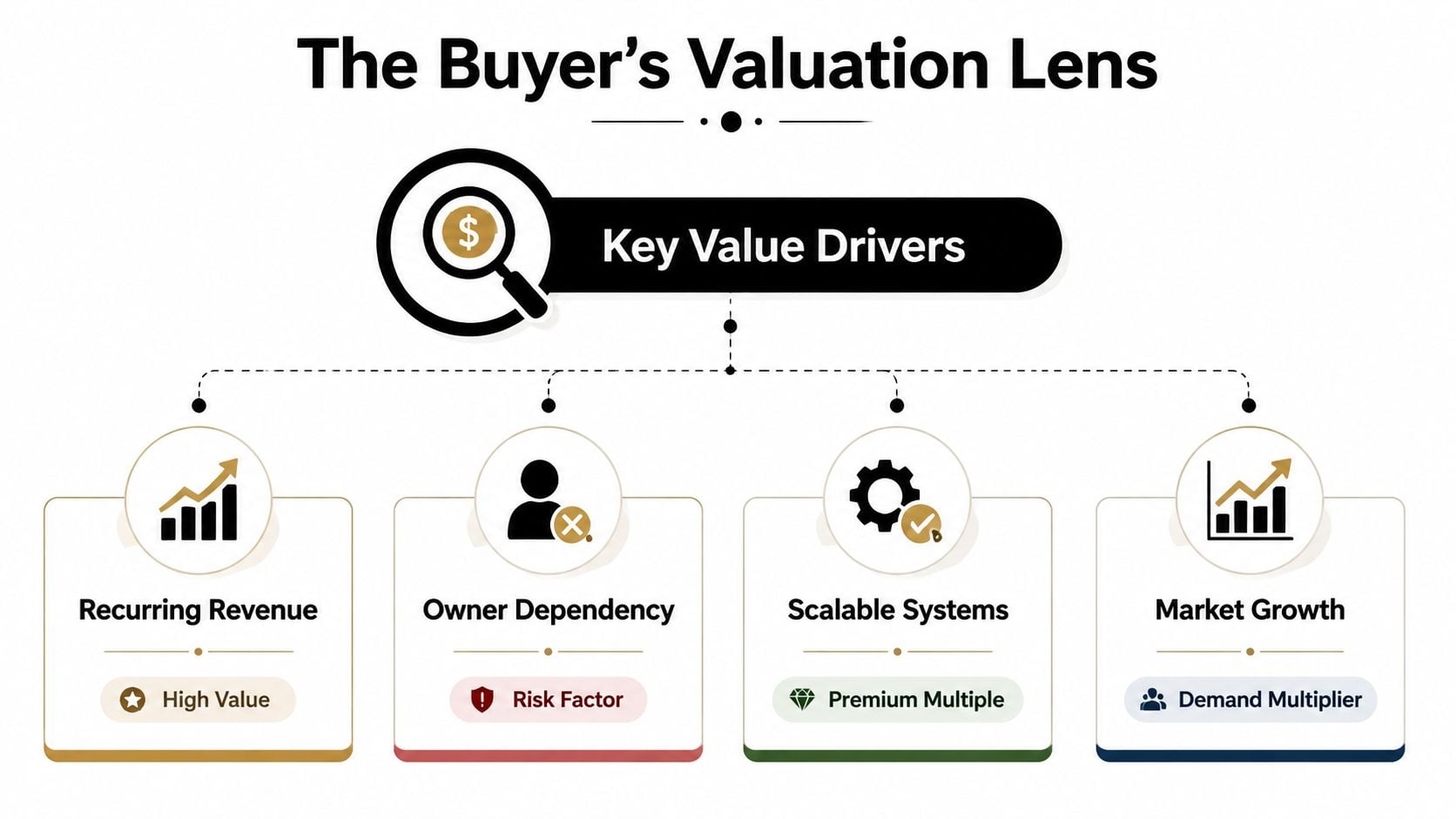
Four operating levers buyers examine
Normalized earnings establish the starting point. Remove non-recurring items, separate personal expenses from operating costs, document legitimate add-backs, and reconcile management reporting to the general ledger. Buyers need a defensible view of earnings that should repeat after closing.
Margin visibility shows how reliably the company converts revenue into profit. Standardize gross-margin analysis by job, project, customer, service line, or location. If management cannot explain margin changes, buyers may price that uncertainty into the deal.
Customer diversification lowers revenue concentration risk. A company built around a few founder-held relationships is harder to transfer than one with broad relationships, contractual continuity, and a team responsible for account management.
Management depth supports a credible transition. Buyers look for evidence that other people can approve spending, manage delivery, retain employees, solve customer problems, and make decisions without waiting for the founder.
Systems become valuable when managers use them consistently. Document quoting rules, purchasing approvals, project reviews, customer onboarding, hiring decisions, collections, and monthly close procedures. Then step out of selected decisions and test whether the team produces the same result.
Buyers do not pay extra for impressive processes in a binder. They pay for evidence that those processes produce consistent results without you.
Professional services often trade at lower multiples than software because transferability and staff retention create different buyer risks. Manufacturing and recurring-revenue businesses may command stronger ranges when customer diversification, contract stability, and operating scalability reduce uncertainty, as discussed in private company value.
Track five lines each month: normalized EBITDA, cash conversion, largest customer exposure, owner-held decisions, and management-owned revenue. A private company valuation framework can help organize the analysis, but the dashboard should expose execution gaps, not decorate management reports. The objective is a company that remains understandable, operable, and financeable through due diligence and after the founder exits.
The Execution Gap That Derails Most Exits
A plan on paper will not survive buyer diligence. Buyers test whether the company can operate when the founder's authority, relationships, and institutional memory are removed. Transferability is the standard, and it must be demonstrated before the process begins.
The survey evidence identifies the human barriers that delay execution. Family dynamics affected 46% of respondents, while 41% cited the lack of a clear successor, 28% cited emotional reluctance to exit, and 13% cited tax implications, according to the 2025 Private Business Owner Survey. These issues require decisions, accountability, and rehearsal.
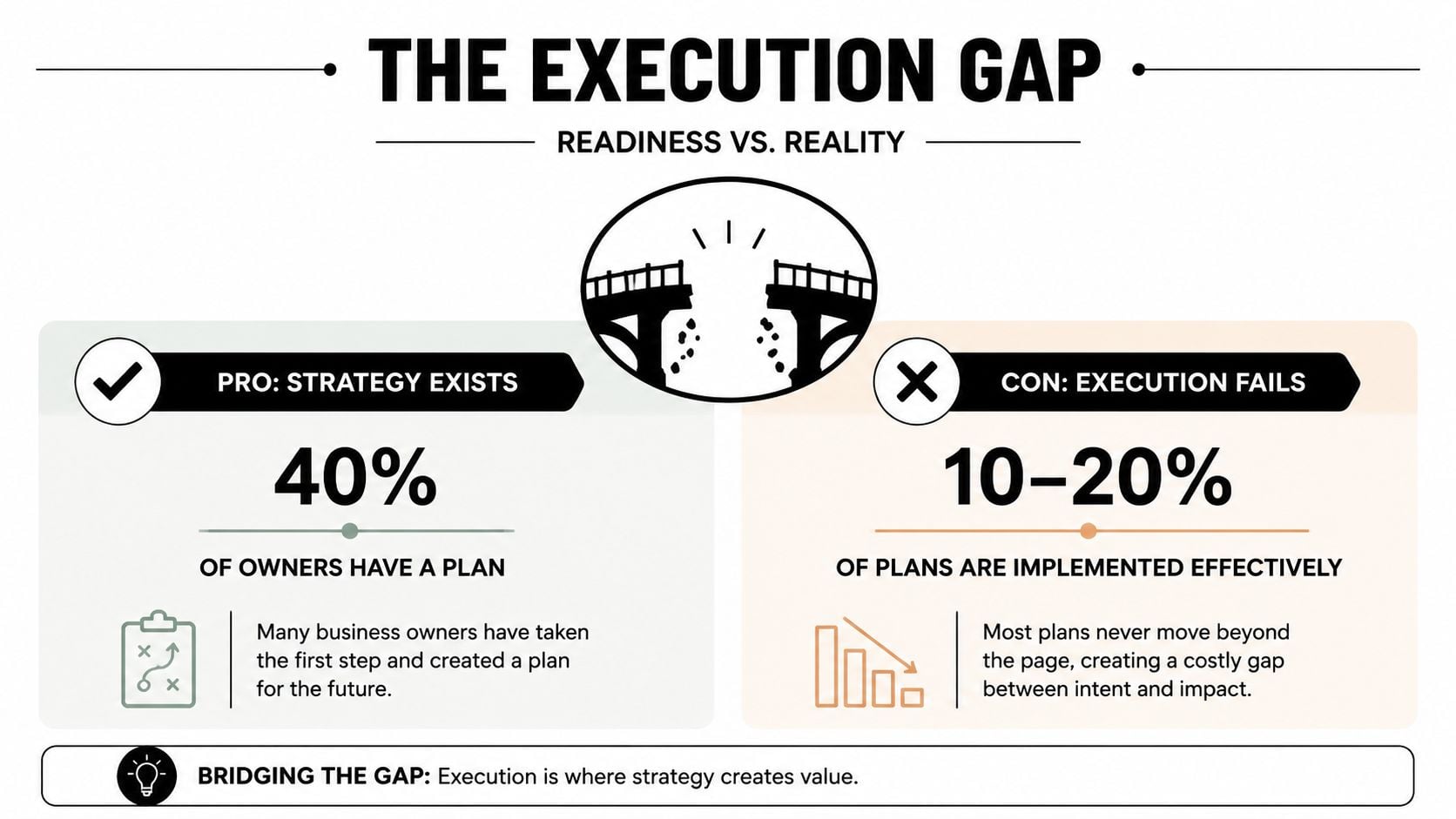
Build readiness as an operating system
Start with a responsibility map. List the decisions you make each week, then assign a named owner, backup, documented procedure, and performance metric to each one. Include pricing exceptions, major hiring, customer escalations, vendor approvals, project risk, borrowing, and cash disbursements.
Then test the map. Take a planned absence from selected decisions. Let the management team run the weekly operating meeting, approve routine exceptions, and communicate with key customers. Record every failure, ambiguity, and delay, then fix the underlying system.
The market creates another risk. Independent research summarized in 2025 found that 70% of companies put on the market do not sell, 50% of exits are involuntary, and 78% of owners lack a formal transition team, while 60% have no formal personal plan for life after exit, according to the Boomer Business Succession Wave Report.
Your exit plan needs a fallback. Define the response if a third-party sale fails, an internal successor cannot finance the purchase, or the business no longer supports an attractive transaction. Options include a staged transfer, partial recapitalization, employee ownership, an orderly wind-down, or continued ownership under a professional manager.
Use a business performance improvement framework to connect operating improvements to exit readiness. Each project should identify the risk it reduces, the cash flow it protects, and the person who will own the result after the founder steps back. A transferable company survives diligence, leadership turnover, and post-close integration because its operating knowledge lives in the business, not in one person.
Tax and Estate Considerations That Change Your Net Proceeds
Gross purchase price is not the number you retire on. Your structure, tax basis, taxable income, transaction timing, and estate objectives determine what remains after closing.
In the United States, long-term capital gains tax rates for business-sale proceeds are 0%, 15%, or 20%. A current source states that the 20% bracket begins at $545,500 of taxable income for single filers and $613,700 for married couples filing jointly, making seller income and transaction timing important planning variables, as explained in business exit tax planning.
Start with the tax architecture
Ask your tax advisor to model the expected net proceeds before you sign a letter of intent. The model should distinguish asset sales from equity sales, identify the tax treatment of different consideration types, account for debt and working-capital adjustments, and show how installment payments or earnouts affect timing.
Don't wait until a buyer appears. Entity structure, basis, compensation, charitable planning, estate transfers, and ownership changes may require lead time. A transaction model should show at least a gross price, transaction expenses, debt repayment, taxes, contingent consideration, and estimated personal liquidity.
Qualified Small Business Stock, or QSBS, under IRC Section 1202 can materially change the outcome for eligible stock. For stock issued after July 4, 2025, a 2026 advisory source states that the exclusion phases in at 50% after three years, 75% after four years, and 100% after five years. The same source states that the gain-exclusion cap rises to $15 million and the gross-assets ceiling increases to $75 million, as outlined in the Section 1202 QSBS advisory guide.
Eligibility is technical. Confirm the issuance date, entity requirements, active-business tests, holding period, shareholder status, and exclusion limits with qualified tax counsel. Treat QSBS as a planning question, not an assumed benefit.
Account for international exposure
UK owners face a separate timing issue. Qualifying disposals receiving Business Asset Disposal Relief, or BADR, are taxed at 14% in the 2025-26 tax year, with the rate rising to 18% from April 6, 2026. The lifetime gains limit remains £1 million, according to UK business-sale tax guidance.
Your estate plan also needs updating. A sale converts concentrated business equity into liquid wealth, which changes beneficiary designations, insurance needs, investment policy, charitable plans, and family governance. Use small-business succession planning guidance to coordinate the business transition with your personal plan, then have your attorney and tax advisor document the legal implementation.
Your Phased Exit Planning Action Plan
A strong exit plan runs through the business like a quarterly operating cadence. Each phase has a financial purpose, an operational purpose, and a personal decision attached to it.
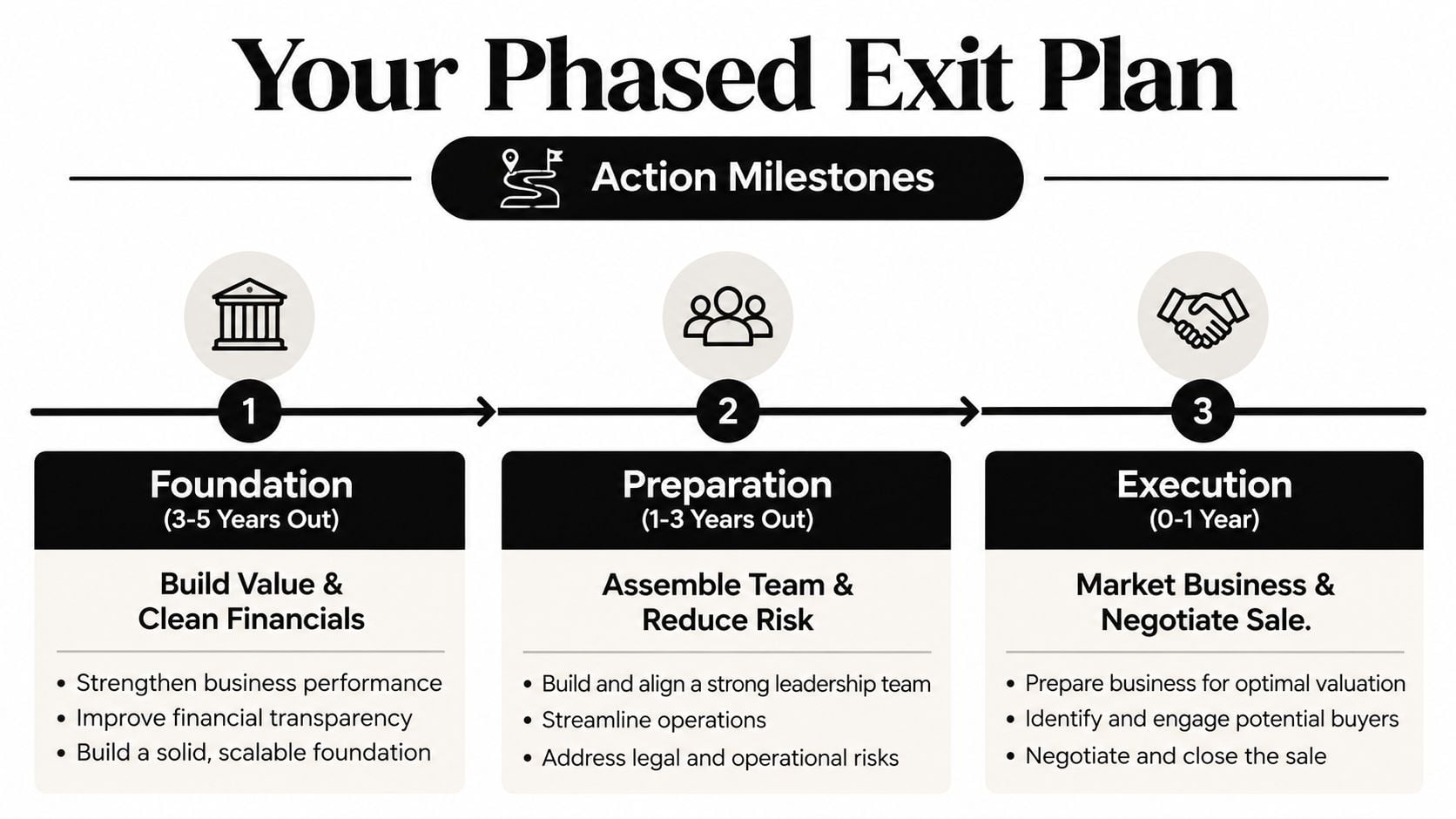
Foundation three to five years out
You create transferable value.
Start with a baseline. Build a normalized income statement, a cash flow forecast, a working-capital analysis, and margin reporting by job or client. For project-based companies, connect estimating assumptions to actual project results. For distributors, track gross margin by customer and product category. For professional services firms, separate founder-originated revenue from team-managed revenue.
Then document the company. Create standard operating procedures for the functions that affect customer delivery, cash conversion, quality, compliance, and employee retention. Assign an owner and backup for each critical process.
Your quarterly scorecard should include:
- Financial reporting: Close the books consistently and explain material variances.
- Cash visibility: Maintain a rolling 13-week cash flow model that identifies funding pressure early.
- Margin control: Review job or client profitability with the managers responsible for results.
- Leadership depth: Transfer decisions from the founder to capable operators.
- Personal planning: Define your desired liquidity, involvement, successor, and post-exit life.
Preparation one to three years out
Now turn improvement into evidence. Build a buyer-ready data room structure with financial statements, tax records, contracts, customer information, employee data, insurance, legal documents, policies, and operating metrics.
Reduce avoidable risk. Renegotiate weak customer terms, resolve old receivables, close documentation gaps, formalize management incentives, and eliminate unexplained owner expenses. Start management meetings that run without you, and review whether the company can maintain service quality during your absence.
This is also the point to evaluate exit routes. Compare a third-party sale with management succession, an ESOP, or a staged transaction. A fractional CFO can model each structure, while a Certified Exit Planning Advisor, or CEPA, can help connect business, personal, and transaction decisions. AmbitionCFO's CEPA exit planning service is one example of support focused on financial readiness and transition planning.
Execution within the final 12 months
The final phase is not the time to discover that your records are inconsistent or your successor lacks authority.
Confirm the transaction team, including legal counsel, tax advisors, valuation professionals, and the appropriate intermediary or buyer representatives. Prepare the normalized earnings schedule, quality-of-earnings support, management presentation, customer-retention plan, and transition calendar.
Keep operating the business. Don't sacrifice customer service or margin discipline because a transaction is underway. Buyers notice deterioration, and employees notice uncertainty.
Use a weekly transaction dashboard covering diligence requests, open issues, cash performance, customer and employee retention, negotiation points, and decisions requiring owner approval. At closing, the transition plan should specify who communicates with employees, customers, vendors, lenders, and managers, and when.
Exit planning improves the business even if you never sell. Cleaner reporting supports better pricing decisions. A deeper leadership team reduces operating bottlenecks. A reliable cash model improves capital allocation. The transaction is only one possible payoff.
Take Your First Step Toward a Successful Exit
You do not need to choose a buyer this week. You do need to identify what would stop the company if you disappeared tomorrow.
Open a spreadsheet with five columns: critical decision, current owner, successor, documented process, evidence of independent execution. List decisions that could disrupt revenue, customers, cash flow, or delivery. Rank the rows by financial and customer risk, then select the top three.
For each decision, assign a manager, document the process, define a measurable outcome, and review progress at the next quarterly meeting. This converts succession planning into a test of whether the business can operate without founder intervention.
Your next readiness review should examine normalized earnings, customer concentration, owner-held relationships, management depth, reporting quality, tax structure, and your definition of a successful transition. Choose an exit path only after you understand the company you are transferring and the evidence a buyer will test.
When you have identified those three high-risk decisions, a fractional CFO can model whether your current trajectory supports the target exit timeline. AmbitionCFO works with founder-led companies on cash flow modeling, margin analysis by job or client, forecasting, KPI dashboards, due diligence preparation, deal-structure scenarios, and CEPA-led exit planning. Use that conversation to turn the spreadsheet into a measurable operating roadmap.
The execution gap becomes visible when diligence begins. Documented systems, rehearsed leadership coverage, and independently produced reporting are what help a company withstand diligence, leadership turnover, and post-close integration.