

Job costing assigns direct materials, direct labor, and overhead to a specific job or project, so you can see the true profitability of each job instead of relying on company-wide averages. In percentage-of-completion reporting, Percent Complete = Actual Costs ÷ Projected Costs, and one documented example calculates 151,400 ÷ 836,400 = 18.1061693%.
You probably know the situation. A project closes, the customer has paid, the revenue looks respectable, and your company-wide profit and loss statement still shows a healthy result. Then your controller finishes the job analysis and finds that the project barely broke even, or lost money entirely. The cash is gone, the crew has moved on, and the opportunity to correct the problem disappeared weeks earlier.
That's why job costing isn't merely an accounting report. Used properly, it's an operating system for protecting margins while work is still underway. It tells you which labor, material, equipment, subcontractor, and overhead costs belong to each job, then compares those costs with the original estimate and the latest forecast.
A company-wide P&L tells you how the business performed. Job costing tells you which jobs created that result and which ones damaged it. That distinction matters when you're bidding new work, deciding whether to approve a change order, reallocating crews, or preparing the business for a future sale.
Table of Contents
- What Job Costing Actually Means for Your Business
- Job-Order Costing vs Process Costing
- How Overhead Allocation Changes Your True Margin
- Implementing Job Costing Step by Step
- Using Variance Analysis to Catch Margin Leaks Early
- Job Costing Applications Across Industries
- Common Pitfalls and Your Next Steps
What Job Costing Actually Means for Your Business
A founder often asks, “What is job costing, and why should I care if my income statement already shows total labor and materials?” The answer is simple. Job costing is a cost-accounting method that assigns materials, labor, and overhead to a specific job or project. Construction businesses began using it widely in the 1950s and 1960s as project complexity increased, while the unit cost method developed by John Woollett in the 1920s helped break work into measurable units for more precise tracking. BuildBook's overview of construction job costing provides that historical context.
The practical difference is between tracking spending by company category and tracking spending by project. Your general ledger may tell you that the business spent heavily on payroll. Job costing tells you whether that payroll supported the hospital renovation, the warehouse buildout, or the service division.
The three cost buckets
Direct materials are inputs you can trace to one job, such as concrete, steel, lumber, fixtures, or purchased components. If the supplier invoice names the project, the cost usually belongs directly to that project.
Direct labor is the compensation for employees who work on the job. Their time needs to be recorded against the correct project and cost code. For a construction company, that may mean separating framing, electrical, concrete, or finishing labor.
Overhead includes costs that support multiple jobs but can't be traced cleanly to one project. Rent, utilities, administrative salaries, equipment depreciation, insurance, and maintenance belong in this category and must be allocated through a logical driver. Deltek's explanation of construction overhead allocation outlines how companies classify and distribute these indirect costs.
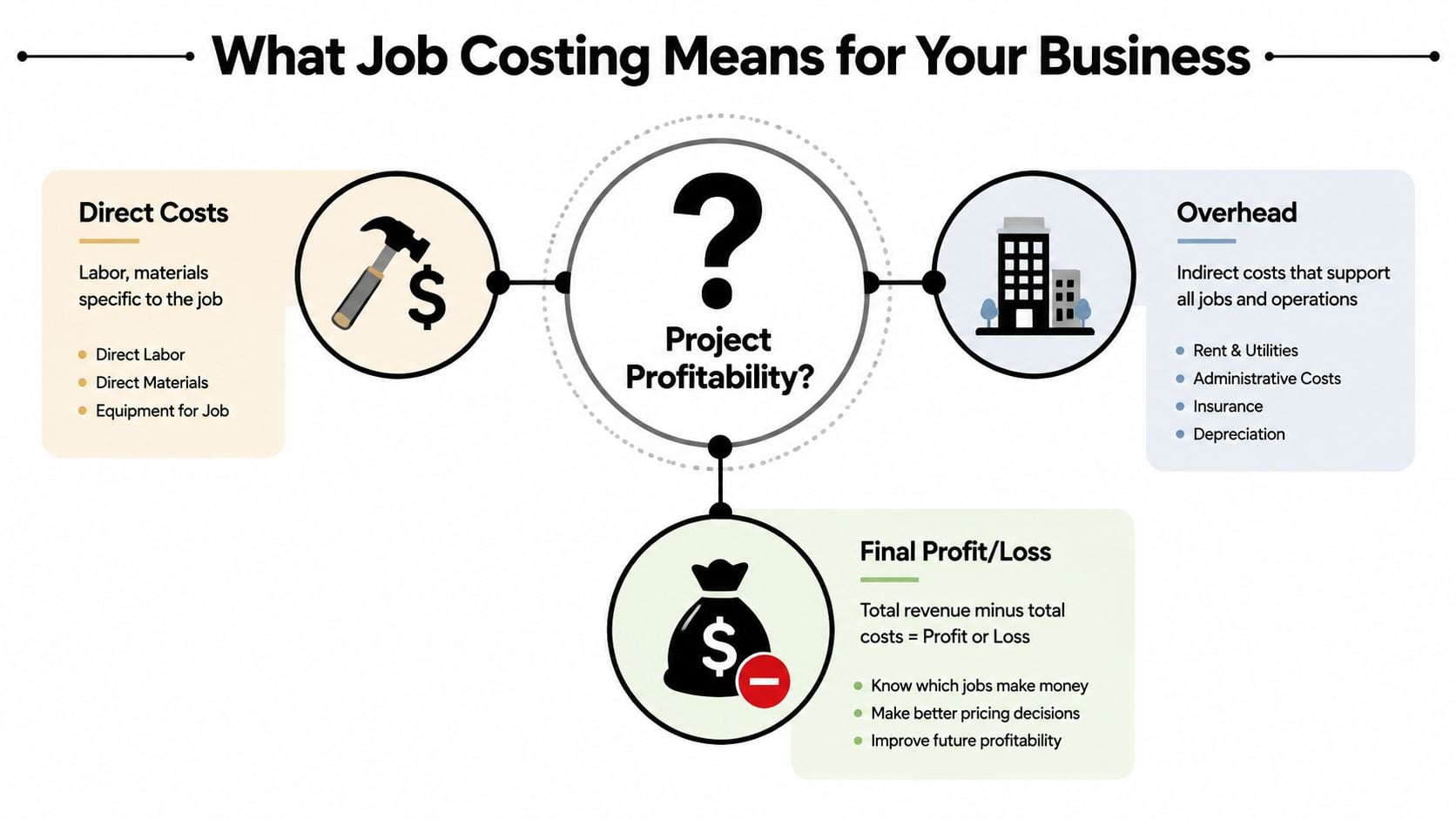
Think of a restaurant. If the owner only tracks total food purchases, the business may look profitable overall. A dish with expensive ingredients and excessive preparation time can still lose money while another dish carries the margin. Job costing is the restaurant's recipe-level view applied to projects.
Owner's rule: If you can't explain the margin on each major job, your company-wide profit is only a partial answer.
Job-level reporting lets you price from actual experience, identify unprofitable scopes, and intervene before closeout. For a broader framework on evaluating profitability across customers and engagements, see customer profitability analysis.
Job-Order Costing vs Process Costing
The correct costing method depends on how your business produces revenue. Job-order costing follows the individual project, contract, client engagement, or batch. Process costing averages costs across repeated, substantially identical units.
A commercial contractor needs to know the labor, materials, equipment, subcontractors, and overhead consumed by a particular building project. A plant producing identical goods may care more about the average cost of each production stage. Neither method is universally better. The wrong method answers the wrong question.
| Characteristic | Job-Order Costing | Process Costing |
|---|---|---|
| Primary focus | Costs assigned to a distinct job, project, client, or batch | Costs averaged across a continuous or repetitive process |
| Best fit | Construction, custom manufacturing, agencies, consultancies | High-volume production of substantially identical goods |
| Cost visibility | Specific revenue-generating job or engagement | Department, production stage, or process |
| Typical question | “Did this contract earn its expected margin?” | “What did each unit cost through production?” |
| Useful inputs | Timesheets, purchase invoices, equipment usage, subcontractor bills | Production volumes, process costs, equivalent units |
| Main pricing benefit | Improves estimates for unique work | Supports pricing based on consistent average production cost |
Use the job method when the work is unique
Construction is the clearest example. A project has its own scope, schedule, crew mix, procurement decisions, and subcontractor commitments. Custom manufacturers and engineering firms face the same issue. Each order can consume resources differently, so averaging costs across all work hides the commercial result.
Service businesses can use job costing, too. An agency can assign designers' and strategists' hours, outside vendors, and allocated overhead to a client engagement. A consultancy can compare the margin on a fixed-fee project with the senior time that project consumed.
Use process costing when repetition dominates
Process costing fits environments where output moves through repeatable stages and individual units don't require separate financial tracking. The business needs an average cost for the process, not a bespoke margin analysis for every unit.
Some companies need both. A manufacturer may use process costing for standard production and job-order costing for custom engineering, tooling, or special customer orders. The decision matrix is straightforward: unique scope requires job-order visibility, while repetitive output supports process averaging.
For a deeper look at tracking costs by individual contract or project, review job-order costing.
How Overhead Allocation Changes Your True Margin
Overhead is where many job costing systems become unreliable. Owners assign direct costs carefully, then spread rent, supervision, insurance, depreciation, and administrative salaries using a convenient rate that has little connection to how projects consume those resources.
The accounting mechanics are clear. First classify indirect costs into an overhead pool. Then allocate that pool using a driver such as direct labor hours, direct labor cost, machine hours, or total direct costs. The driver should reflect the cause of overhead consumption. If machine-heavy projects consume the equipment department's resources, direct labor hours may be the wrong base. Deltek's construction overhead guidance makes this connection explicit.
The allocation choice changes the story
Assume a project has $100,000 in revenue, $60,000 in direct costs, and a company overhead pool of $40,000, as shown in the required visualization. If the project consumes 15% of the company's direct-cost base, a proportional method would typically assign about 15% of allocated overhead to it. The resulting project margin depends on whether that allocation reflects actual resource use.
A project with modest labor but intensive equipment usage may appear attractive under a labor-hour allocation. The same project can look materially worse under a machine-hour allocation because machine usage better explains the overhead it consumed. The issue isn't that one calculation is mathematically wrong. The issue is whether the selected base tells the economic truth.
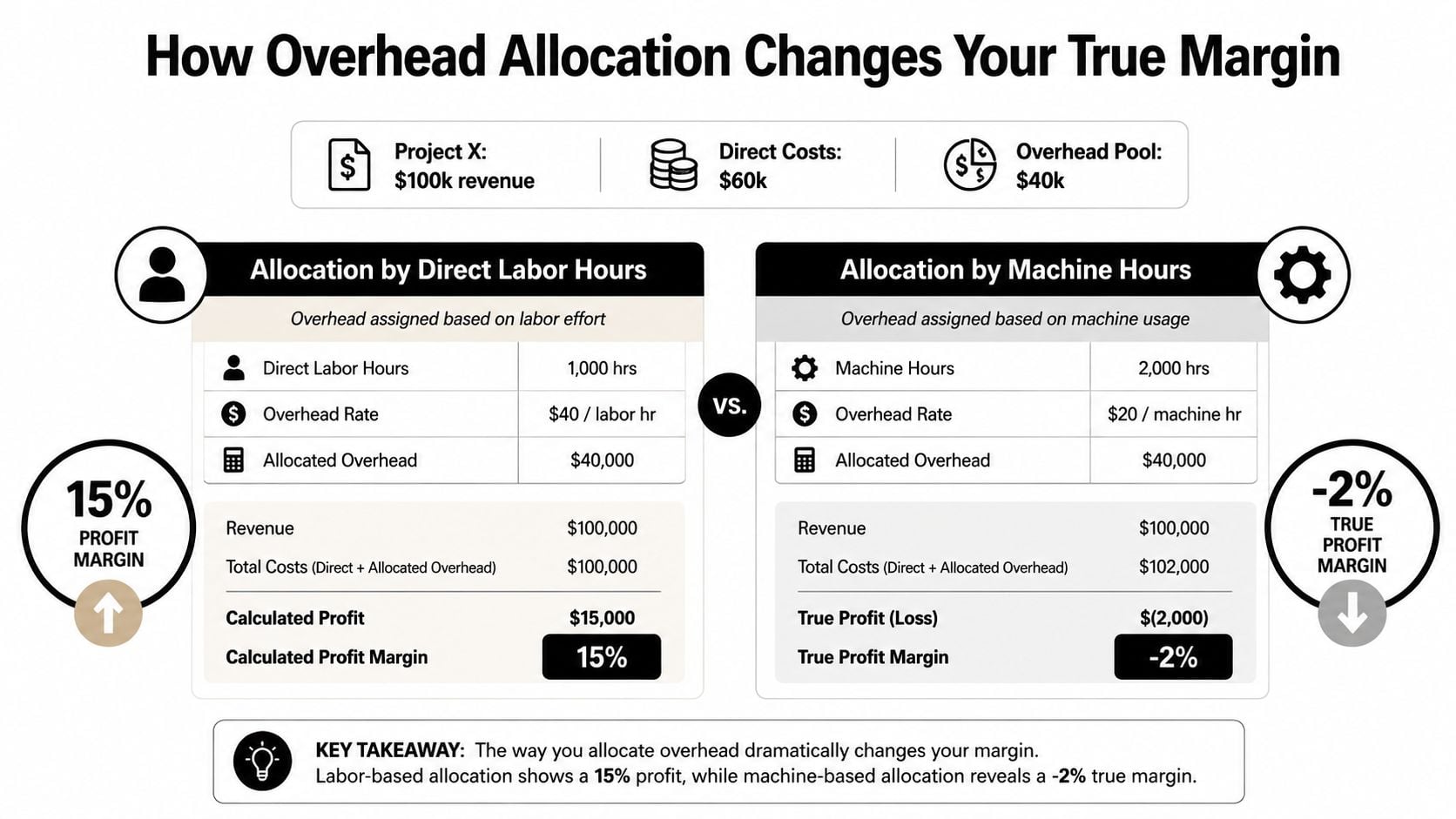
That's why a reported 15% profit margin under direct labor hours and a negative 2% true profit margin under machine hours can describe the same project in the visualization. Treat those figures as an illustration of allocation distortion, not as a universal benchmark.
Select a driver that follows consumption
Use these questions before locking an allocation base:
- Labor-intensive work: Direct labor hours or direct labor cost may be appropriate when supervision and administrative effort follow staffing.
- Equipment-intensive work: Machine hours can provide a more credible link when owned or rented equipment drives support costs.
- Mixed projects: Total direct costs may be practical, but test whether the result unfairly penalizes low-overhead work.
- Multiple divisions: Separate pools and drivers are often more useful than one company-wide rate.
Practical rule: A simple allocation that reflects consumption beats a sophisticated allocation that merely spreads expense evenly.
Your bids depend on this logic. Underallocated overhead makes prices look competitive while reducing recovery of fixed costs. Overallocated overhead can make good work appear unattractive. Owners in landscaping and field services may also benefit from this practical resource on how to boost profit margins in landscaping. For construction-specific benchmarking considerations, see construction overhead percentage.
Implementing Job Costing Step by Step
A job costing system succeeds when field activity, project management, and accounting use the same language. Start with the cost structure, then build the reporting rhythm around reliable inputs.
Step one sets the cost-code foundation
Create a chart of accounts and project cost codes that match how managers make decisions. Separate labor, materials, equipment, subcontractors, and overhead, then add useful subcategories by trade, phase, or scope.
Don't create codes nobody will use. A short, consistent list that captures meaningful differences is better than an elaborate structure that produces incomplete timesheets and misclassified invoices.
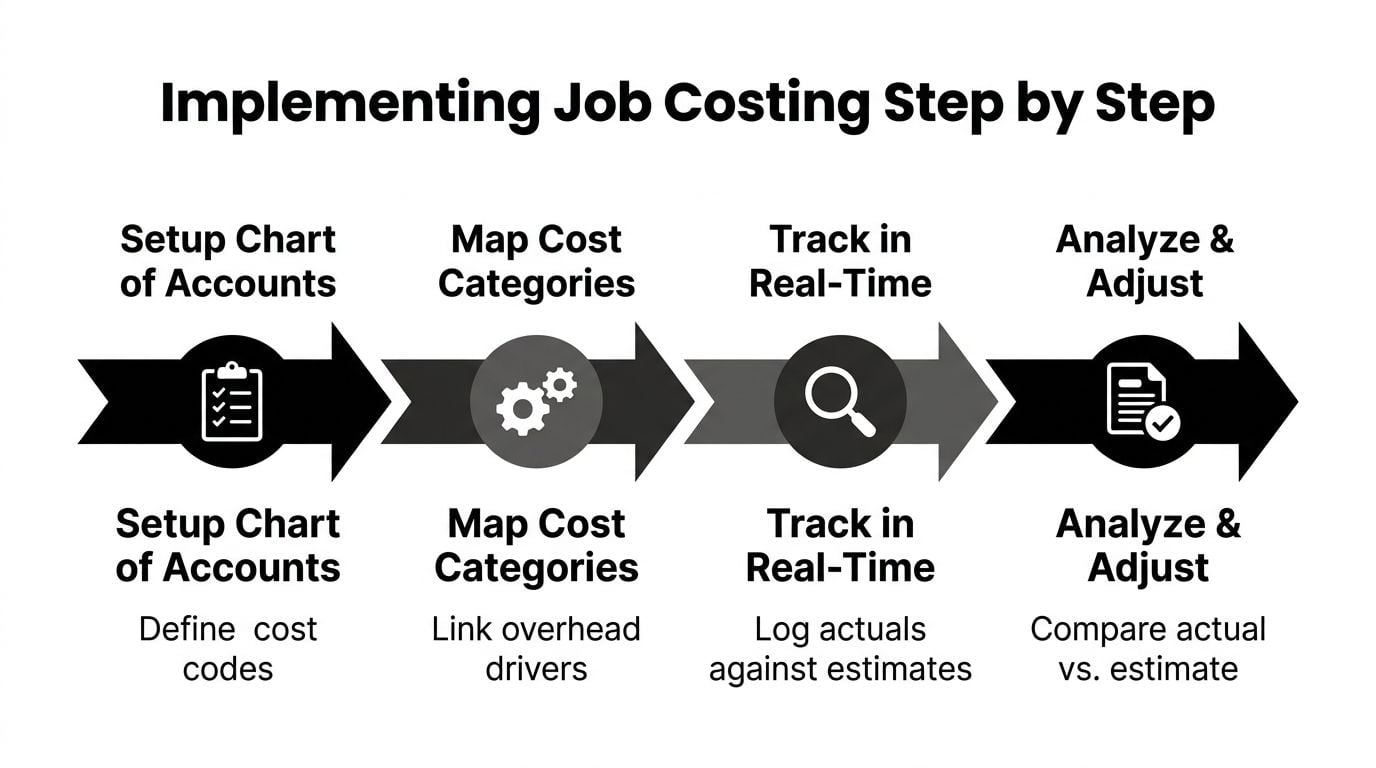
Step two connects transactions to jobs
Require employees to record hours against a job and cost code. Code material purchases, freight, equipment usage, subcontractor invoices, and approved change orders the same way. Someone should own the review of exceptions before costs reach the monthly close.
The system needs a clean flow:
- Field teams: Submit time, equipment, material usage, and receipts against the correct job.
- Project managers: Review actual spending, commitments, progress, and remaining scope.
- Accounting: Validate invoices, payroll allocations, accruals, and overhead postings.
- Owner or CFO: Review margin, forecast cost to complete, cash implications, and corrective actions.
Software can support this process, but it can't fix missing source data. Evaluate construction job costing software based on mobile entry, cost-code support, accounting integration, change-order controls, and cost-to-complete forecasting.
Step three establishes WIP reporting
A contractor's work-in-progress schedule typically requires contract price, total estimated construction cost, costs incurred to date, and progress billings. Wegner CPAs explains these WIP inputs and calculations.
Use the formula:
Percent Complete = Actual Costs ÷ Projected Costs
The documented example is:
151,400 ÷ 836,400 = 18.1061693%
Revenue earned to date equals percent complete multiplied by total contract price. Keep the forecast current. If projected costs rise but the schedule still uses the original estimate, the WIP report gives management a false sense of security.
Step four sets the review cadence
For active projects, review job costs at least weekly when field data changes quickly, and use a formal weekly or biweekly variance meeting with project managers. Review WIP monthly at minimum for financial reporting, with an immediate deep dive when labor, materials, equipment, subcontractors, billings, or forecast cost to complete move materially away from plan.
Using Variance Analysis to Catch Margin Leaks Early
Job costing tells you what has been spent. Variance analysis tells you whether the spending is damaging the expected result and why. This is the point where accounting data becomes an operating control.
At each cost-code level, compare budgeted costs with actual costs for labor, materials, equipment, and subcontractors. The basic formula is:
Cost Variance = Budgeted Cost − Actual Cost
A positive result is favorable because actual cost is below budget. A negative result is unfavorable because actual cost exceeds budget. Datateer's guidance on job cost variances recommends taking this analysis down to the cost-code level and separating quantity variance from rate variance.
Separate quantity from rate
Suppose the labor cost code is unfavorable. That answer is not enough for a project manager.
- Quantity variance: The crew used more hours or more units than the estimate assumed. Investigate productivity, rework, scope creep, scheduling, and waste.
- Rate variance: The business paid more per hour or per unit than planned. Investigate wage changes, overtime, subcontractor pricing, supplier increases, or incorrect estimate assumptions.
The same logic applies to materials and equipment. More material consumed points toward quantity, waste, or design changes. A higher purchase price points toward rate, procurement timing, or supplier terms.
Forecast the finish, not just the past
Every review should answer three questions:
- What has changed? Identify unfavorable cost codes since the prior review.
- Why did it change? Separate quantity, rate, timing, and scope explanations.
- What will the job cost at completion? Update the cost-to-complete forecast using current field conditions.
Treat labor as a direct cost whenever employees perform work that can be traced to a specific job. Include the relevant labor burden consistently, rather than comparing a wage-only estimate with a fully burdened actual. Compensation costs in the United States were rising 3.4% year over year in Q2 2026, which makes labor burden and estimate drift more consequential for contractors and other project-based businesses. The Kaizen-ju reference document provides that figure.
CFO standard: A variance without an owner, explanation, and corrective action is just a colored cell on a report.
Run the review weekly or biweekly while projects are active. Escalate immediately when a cost code threatens the remaining margin, when a change order isn't reflected in the budget, or when the cost-to-complete forecast rises without a corresponding pricing adjustment. For a broader framework, use budget versus actual variance analysis.
Job Costing Applications Across Industries
The same discipline applies across industries, but the cost codes and decision points change. A construction founder needs production-phase visibility. A distributor needs order-level landed cost. A professional-services owner needs to know which clients consume senior capacity.
Construction
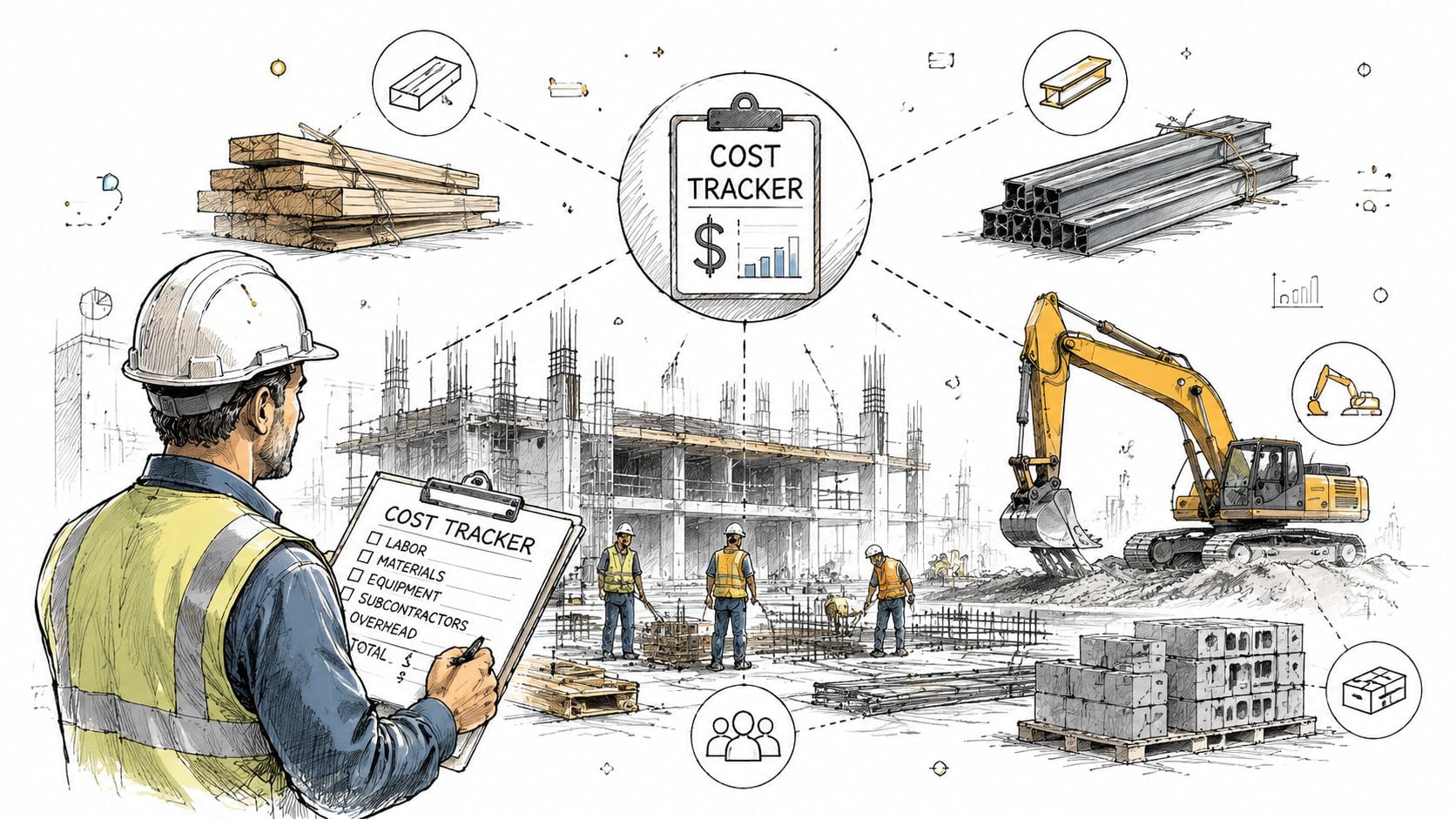
A contractor might track labor by trade, materials by scope, equipment by project usage, subcontractors by contract package, and overhead through separate allocation pools. The project manager uses those codes to manage production, while the owner uses them to update margin and cost-to-complete forecasts.
WIP reporting adds the revenue context. The required inputs are contract price, total estimated construction cost, costs incurred to date, and progress billings. Government contractors face an additional requirement. FAR-compliant job cost reporting must segregate direct costs, indirect costs, and unallowable costs, while tracking monthly revenue, actual spending versus budget, and how labor and materials are charged to each contract. CohnReznick's FAR-compliant reporting discussion explains why this is a compliance and audit-readiness issue, not just an internal management preference.
A construction leader who wants more practical budgeting guidance can also review this resource on managing construction budgets effectively.
Distribution
Distribution businesses often think in terms of products and customers, but a shipment or customer order can function as the job. Assign purchase cost, inbound freight, handling, storage, delivery, returns, and special service costs to the order or account where the data supports it.
That view can expose customers who generate attractive sales but consume disproportionate operational effort. It also gives the sales team a better basis for minimum order policies, delivery charges, and account-specific pricing.
Professional services
For agencies, consultancies, and other project-based firms, labor is usually the central cost. Track billable and nonbillable time by client, engagement, role, and phase. Add outside specialists and a rational share of administrative and technology overhead.
A fixed-fee engagement can look successful based on invoicing alone. Job costing reveals whether senior staff spent too much time rescuing the work, whether revisions exceeded the assumed scope, or whether the delivery model needs to change.
The video below adds a practical construction perspective to the operating discipline behind project cost control.
Common Pitfalls and Your Next Steps
Most job costing failures aren't caused by complicated accounting. They come from inconsistent execution.
Inaccurate time tracking makes direct labor unreliable. Require employees to enter time against a job and cost code, then have managers review exceptions promptly.
Stale cost-to-complete estimates make WIP reports misleading. Update remaining labor, materials, equipment, subcontractors, and overhead when scope, schedule, or productivity changes.
One company-wide overhead rate can misstate project economics. Use separate pools or drivers when different types of work consume support resources differently.
Closeout-only review guarantees late discovery. Review active job costs weekly or biweekly, and make the project manager explain unfavorable variances before the next reporting cycle.
Poor handoffs create the classic garbage-in, garbage-out problem. Field teams need clear entry rules, project managers need accountability for review, and accounting needs controls for invoices, payroll, accruals, and change orders.
Run a practical audit now:
- Review your codes: Remove categories that don't support decisions and add codes for recurring margin leaks.
- Trace transactions: Select active jobs and follow labor, materials, equipment, subcontractors, and overhead from source document to report.
- Identify three risks: Name the three cost codes most likely to erode margin before closeout.
- Set the cadence: Put weekly or biweekly variance reviews on the calendar.
- Update the forecast: Recalculate cost to complete using current production facts, not the original estimate.
Job costing should help you make decisions while you can still change the outcome. If your reports only explain last quarter, they aren't protecting today's margin.
AmbitionCFO provides fractional CFO support for founder-led construction, distribution, and professional-services businesses, including margin analysis by job or client, budgeting, forecasting, KPI dashboards, and cash-flow planning. Visit AmbitionCFO to discuss an audit of your current job costing process and build reporting that supports stronger margins and your long-term growth or exit plans.