

Which costs can you cut without slowing growth? That's the question most founders are really asking when profit pressure rises. They don't want a cash crisis caused by poor timing, weaker delivery, lost capacity, or cuts that damage revenue-producing work.
Effective cost cutting strategies start by separating four different levers. Cash timing changes when money enters or leaves the bank account. True cost reduction lowers the expense required to operate. Margin improvement changes the economics of a job, client, product, or service. Working-capital release converts receivables, inventory, or payment terms into usable cash without necessarily reducing reported expenses.
For growth-stage, founder-led businesses above $10M in revenue, the safest sequence is visibility first, protection of profitable work second, low-risk savings third, and structural changes only after the facts are clear. A rolling cash forecast, margin analysis, vendor review, and focused spending audit give owners a better basis for decisions than a broad expense freeze. A fractional CFO can model short-term liquidity and longer-term operating effects before execution.
This approach is consistent with reducing operational costs through data-driven tactics, where the central decision is not what can be removed, but what can be improved without weakening the business.
Table of Contents
- 1. 13-Week Cash Flow Forecasting and Optimization
- 2. Job or Client-Level Margin Analysis and Underperforming Account Elimination
- 3. Renegotiation of Supplier and Vendor Contracts to Extend Payment Terms and Reduce Rates
- 4. Outsourcing Non-Core Functions to Reduce Fixed Labor Costs and Improve Flexibility
- 5. Inventory Optimization
- 6. Work-in-Process Management and Progress Billing
- 7. Elimination of Non-Essential Spending and Administrative Overhead
- 8. Right-Sizing Facility and Real Estate Footprint to Match Current and Projected Needs
- 9. Implementation and ROI Reference
- 9-Point Comparison of Cost-Cutting Strategies
- Turn the Savings List Into a 90-Day Cash Plan
1. 13-Week Cash Flow Forecasting and Optimization
A construction company with $25M in revenue discovered project payment delays that created an $800K cash gap. That scenario shows why weekly liquidity deserves attention before broad cost cuts. A 13-week forecast lays out expected collections, payroll, taxes, supplier payments, debt service, project costs, and other cash movements, giving the owner time to act before a timing problem becomes an emergency.
Profit and cash follow different schedules. Customers may pay late, inventory may arrive early, or project spending may come before billing. A forecast helps management identify collections that need follow-up, payments that can be scheduled, and supplier terms that may need renegotiation. It also gives operations a cash constraint to use when approving purchases, hiring, and project timing.
In the documented case study, changing invoice timing and negotiating milestone payments reduced borrowing by $600K annually and saved $45K in interest. A distribution business reduced inventory days from 45 to 38, freeing $300K for working capital. A professional services firm adjusted payroll timing and client invoicing, reducing its operating line of credit by $250K and saving $15K per year in interest and fees.
Use these cash flow forecasting best practices to structure the model, then make the forecast part of the weekly operating routine.
Make the forecast a weekly management tool
Begin with your three largest customers and suppliers. Record actual payment behavior rather than relying only on contractual terms. Every Friday, update the bank balance, completed collections, revised payment dates, and new commitments.
- Set collection targets: Tie weekly collection activity to the cash gaps shown in the forecast.
- Run what-if scenarios: Test delayed customer payments, accelerated project spending, and unexpected supplier demands.
- Share the operating view: Give operations a simplified version so purchasing, hiring, and scheduling reflect cash consequences.
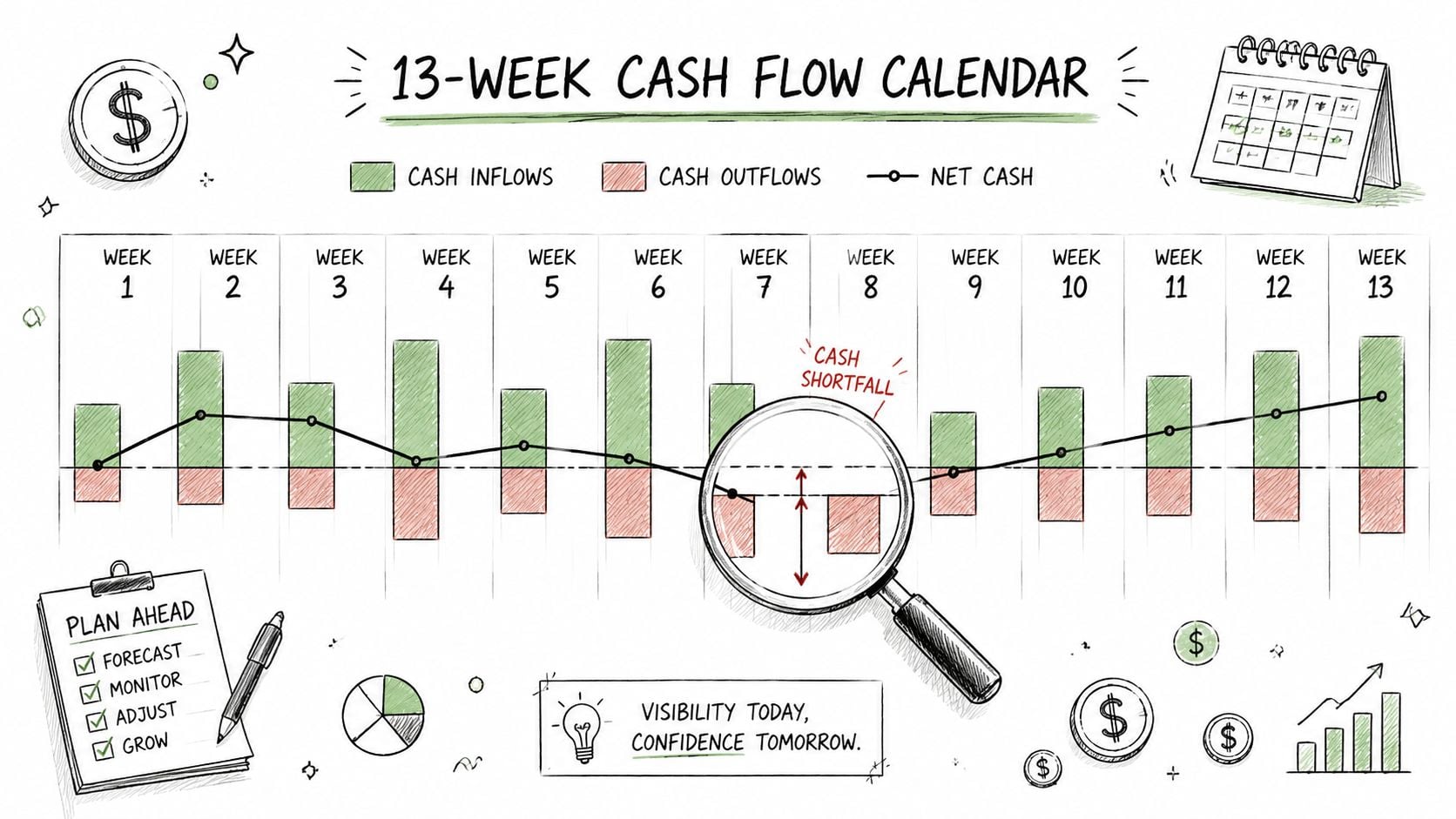
Cash visibility should precede aggressive cost action. It prevents an owner from cutting a useful expense while overlooking a larger receivables, inventory, or payment-timing issue.
2. Job or Client-Level Margin Analysis and Underperforming Account Elimination
Revenue can hide weak economics. A large customer or busy project may consume disproportionate labor, rework, service time, freight, management attention, or working capital while contributing little profit.
Job or client-level margin analysis assigns direct costs and a reasonable share of overhead to each project, account, or service line. For professional services, that means comparing billing rates with actual billable hours and burdened labor rates. For construction, it means reviewing estimated versus actual labor, materials, subcontractors, change orders, and project overhead. For distribution, it means analyzing order size, delivery cost, returns, discounts, and service requirements.
A construction company with $45M in revenue found 12 clients losing money and four clients driving 35% of margin. After eliminating unprofitable relationships and repricing selected accounts, net profit increased by $800K, equal to 12% of EBITDA, with no revenue decline. An $18M professional services firm changed a major contract to hybrid pricing, improving margin from 12% to 28% and adding $270K in annual profit. A $32M distribution company introduced minimum order values, eliminated 180 unprofitable customers, and reduced operational overhead by $120K annually while retaining 95% of revenue.
Use customer profitability analysis to build a scorecard that separates attractive revenue from expensive activity.
Price, redesign, or exit
Start with your 10 largest and 10 smallest customers. The comparison often reveals whether the problem comes from pricing, service intensity, order behavior, payment terms, or an account type that should be redesigned.
Define profitability after direct costs and allocated overhead. Then test three choices:
- Reprice: Increase rates, remove discounts, add minimums, or charge for custom service.
- Redesign: Change delivery frequency, scope, staffing, or contract structure.
- Exit: End work that remains unprofitable after a fair commercial discussion.
Practical rule: Never eliminate a low-margin account from revenue data alone. Model the cash effect, avoidable costs, stranded labor, and capacity that can be redeployed first.
3. Renegotiation of Supplier and Vendor Contracts to Extend Payment Terms and Reduce Rates
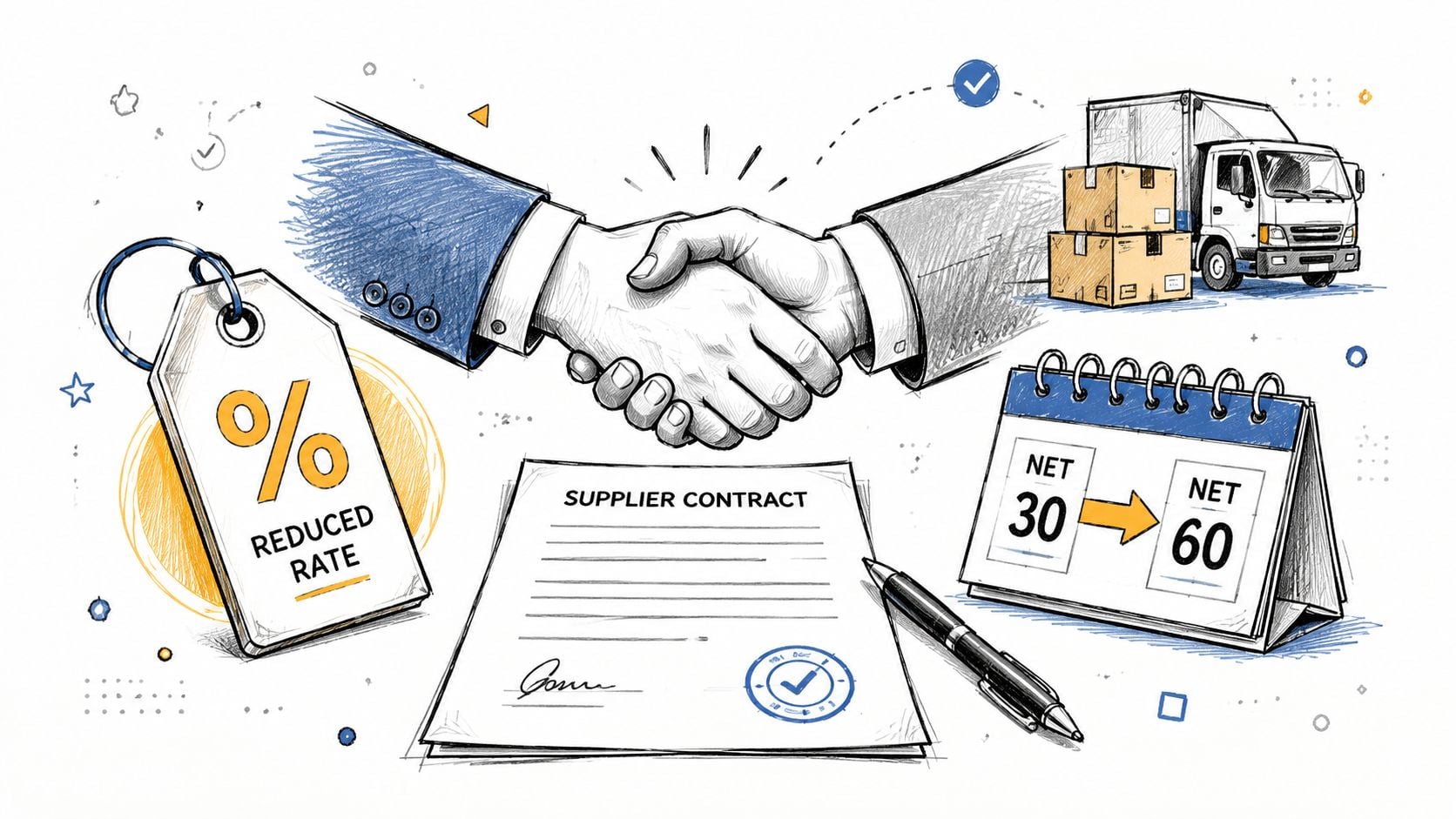
Supplier negotiations that focus only on unit rates often miss liquidity gains hidden in payment terms. A cheaper input can still weaken weekly cash flow if lead times lengthen, quality falls, minimum-order commitments rise, or payment is due before customers pay.
Separate materials, freight, subcontractors, insurance, rent, utilities, software, and professional services. Bring purchasing history, contract terms, renewal dates, volume patterns, and supplier performance into one review. The goal is a negotiation backed by facts, with each concession tested against job margins, service levels, and working capital.
A construction company with $28M in revenue reduced lumber and concrete costs by 8%, equal to $240K, while extending terms to net 45, freeing $120K in working capital. A distribution company consolidated shipments with one carrier, cutting freight costs by 11%, or $180K per year, and extending terms to net 60. A professional services firm renegotiated several contracts at renewal and saved $80K annually after benchmarking competing quotes.
Trade price for value carefully
Start with the top 20 vendors representing 80% of spend, based on the supplied operating example. Obtain three competitive quotes for major categories before negotiating. Switching is optional. Credible alternatives create bargaining power, while a supplier that already understands your quality and delivery requirements may offer the safer result.
- Offer something in return: Consider longer commitments, consolidated volume, forecast visibility, or faster payment when weekly liquidity allows.
- Separate price from terms: Negotiate the rate and payment schedule independently. A lower price should not conceal a weaker cash position.
- Protect service requirements: Set quality standards, delivery expectations, response times, and escalation procedures in writing.
- Track renewal dates: Calendar deadlines well before renewal, when the business still has time to compare options.
Maverick spend, unauthorized or off-contract purchasing, is another direct target. Procurement guidance from Sievo's procurement cost-savings framework recommends eliminating this leakage so teams use negotiated supplier terms instead of bypassing them.
4. Outsourcing Non-Core Functions to Reduce Fixed Labor Costs and Improve Flexibility
Outsource a function when it consumes steady labor but does not differentiate the company. Bookkeeping, payroll administration, HR administration, IT support, data entry, and routine customer service may fit. The immediate benefit is flexibility: a variable vendor cost can replace fixed payroll, benefits, recruiting, training, and management time.
Cash-flow safety depends on the transition plan. Compare the provider's invoice with the full internal cost, including software, supervision, backup coverage, review time, and the owner's attention. Also price the downside of errors, slower decisions, security exposure, and weaker customer service. A lower monthly bill is not a saving if rework or service failures reduce job or client margins.
Three operating examples show the range. A construction company with $32M in revenue outsourced bookkeeping for $1,000 per month, saving $55K annually against its prior in-house cost. An $18M professional services firm paid $800 per month for managed IT, replaced an internal IT manager, and saved $65K per year while improving service quality. A distribution company with $45M in revenue outsourced HR administration at $50 per employee per month, saving $22K per year versus an internal administrative role.
Choose work with limited dependency
Start with a defined process that does not rely heavily on institutional knowledge. Request references, relevant certifications, security documentation, and a service-level agreement. Set response times, deliverables, escalation paths, reporting, and remedies for missed performance.
Run the decision through four checks:
- Calculate total cost: Include internal review time and transition costs.
- Assign one owner: Review results weekly and resolve exceptions quickly.
- Retain critical knowledge: Keep approvals, decisions, and process documentation inside the company.
- Test before expanding: Move a defined scope first, then assess quality, cash impact, and management burden.
Benefit administration also requires structure selection. Owners can compare PEO, ASO, and TPA models before choosing an external arrangement. The best option is the one that reduces fixed workload without weakening control over employee service, data, or cash commitments.
5. Inventory Optimization
The tension in inventory management is between avoiding shortages and freeing trapped cash. Excess stock adds storage, damage, obsolescence, and carrying costs. Shortages can cause missed sales, production delays, expedited freight, and strained customer relationships. The decision is to reduce inventory where service risk is manageable, then monitor the cash result weekly.
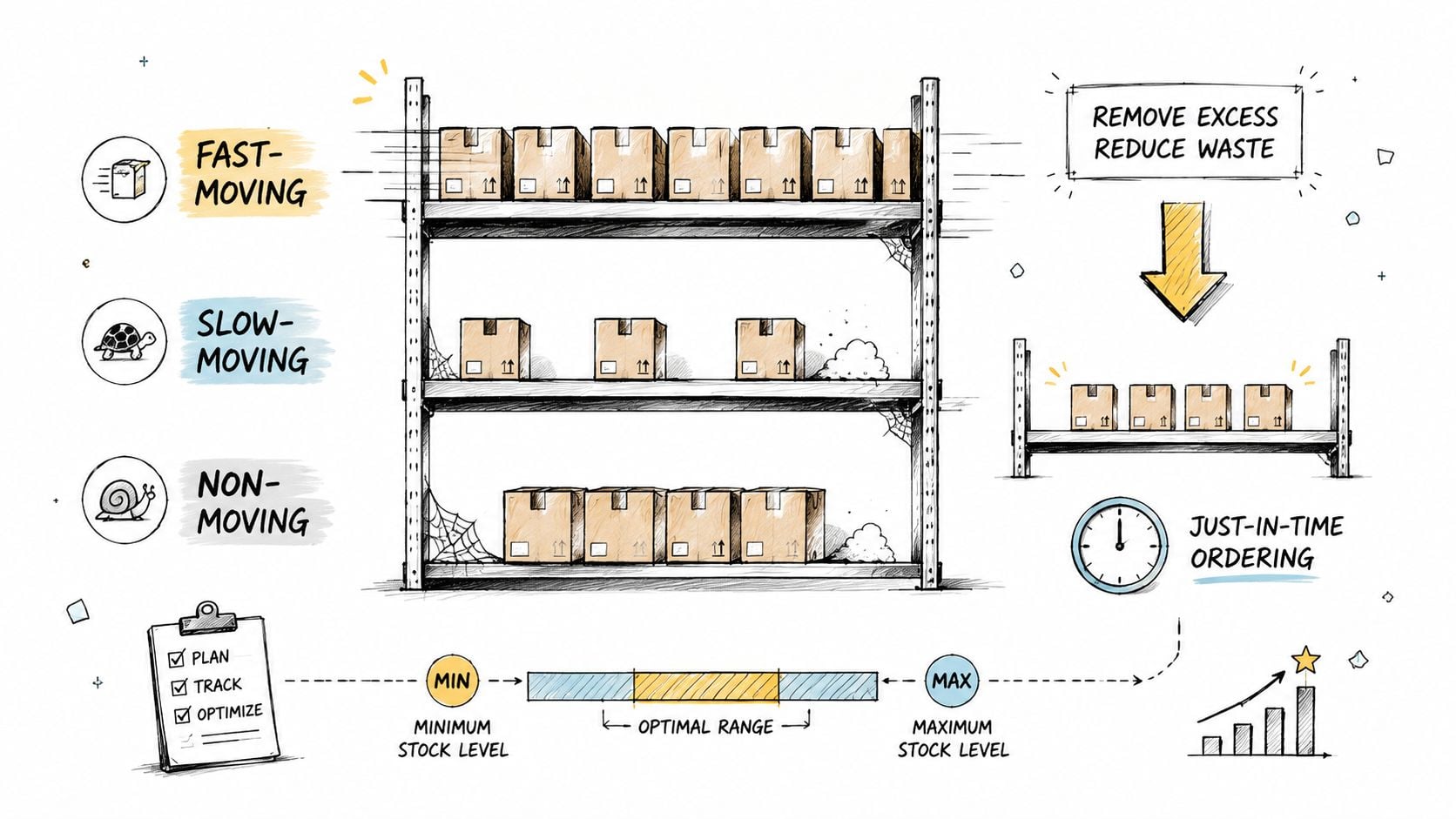
Start with a SKU-level audit. Record annual sales, purchase cost, current units, usage rate, lead time, stockouts, returns, and aging. Separate fast-moving items from slow-moving and obsolete stock. Cost of goods sold divided by average inventory provides a basic turnover measure, but management must connect it to service levels and supplier lead times.
A distribution company with $32M in revenue discontinued its bottom SKUs and introduced min-max ordering, reducing inventory from 45 days to 35 days and freeing $600K in cash. A manufacturer with $15M in revenue implemented just-in-time ordering with key suppliers, reducing inventory days from 38 to 28 and freeing $350K. These examples show the trade-off: purchasing discipline can release cash, while supplier reliability determines whether lower stock creates operating disruption.
Reduce stock without creating shortages
Set minimum and maximum levels from actual usage and lead time. Work with suppliers to shorten lead times before lowering safety stock. If a supplier is unreliable, a lower inventory target may shift the cost into emergency purchasing, expedited freight, or lost production.
- Identify dead stock: Create a disposition plan for obsolete, excess, and slow-moving items.
- Prioritize major cash pools: Focus first on categories with high value and weak velocity.
- Review reorder logic: Use a defined reorder point formula rather than informal judgment.
- Monitor exceptions: Review stockouts, rush orders, and excess purchases every week.
Keep inventory decisions tied to receivables and payables. The Middle Market Center working-capital tool presents those accounts together, helping owners assess how much cash operations currently require.
6. Work-in-Process Management and Progress Billing
Work-in-process, or WIP, is unfinished work whose costs have been incurred but whose revenue may not yet have been billed. It becomes a cash problem when teams complete substantial work, delay invoicing until the end, or fail to identify under-billed jobs.
Progress billing changes the collection rhythm. Instead of waiting for project completion, the company invoices monthly or when contractual milestones are achieved. The method can improve cash flow, but only when project managers update completion estimates accurately and contracts define how progress is measured.
A construction company with $28M in revenue switched to monthly progress billing and accelerated average cash collection by 45 days, freeing $1.5M from a $12M backlog. Project-level WIP tracking also identified under-billed work, allowing timely invoices and reducing unbilled receivables.
Connect project data to collections
Contracts should specify milestones, percentage-complete methods, retainage, approval requirements, and documentation. Project managers need a regular process for reporting costs incurred, work completed, approved changes, and expected final cost.
- Bill progress, not hope: Invoice when the contract allows and the work supports the claim.
- Review under-billing: Compare earned revenue with invoiced revenue by project.
- Escalate disputes early: A disputed invoice becomes harder to resolve after the project team has moved on.
- Link WIP to the forecast: Put expected billing and collection dates into the weekly cash model.
Job-order costing provides a useful foundation for connecting job costs, billing, and project profitability. The owner should also distinguish cash released from WIP from a permanent cost reduction. Progress billing improves liquidity, but it won't automatically lower labor or material expense.
7. Elimination of Non-Essential Spending and Administrative Overhead
Which expenses still earn their place in the current operating model? A bottoms-up review should cover software, subscriptions, memberships, travel, meals, supplies, contractors, facilities, and external services. Recurring charges deserve review even when the company has paid them for years.
Start with the profit-and-loss statement. For each significant line, ask: If we were starting from scratch, would we approve this expense today? Tie the answer to usage, business purpose, owner, contract term, renewal date, and cancellation requirements. The goal is to release weekly cash without weakening delivery, sales, compliance, or customer retention.
The savings can be concrete. A professional services firm with $22M in revenue found $42K per year in waste across unused software, memberships, and excess travel. A construction company with $35M in revenue switched to a lower-cost project management tool and saved $14K per year, then found another $8K through related cuts. A distribution company with $18M in revenue introduced travel policies and saved $12K per year without harming customer relationships.
Remove duplication before reducing capability
Prioritize expenses that provide little current value, duplicate another tool, or support unused capacity. Keep spending that protects revenue and execution, then test every cut against its effect on job margins, service levels, and working capital.
- Review the largest categories first: Examine facilities, labor, contractors, software, and travel before pursuing minor line items.
- Assign every subscription: Record the owner, purpose, renewal date, active users, and cancellation requirements.
- Consolidate overlapping tools: Select one system when several products perform similar work.
- Protect growth investments: Model the revenue consequence before reducing marketing or customer development.
Expense management software benchmarks show annual savings of 15% to 20%, while adoption has remained between 39% and 47% since 2021, per expense management software industry statistics. For an owner, that points to a practical test: automate receipt capture, approval routing, and policy enforcement where manual handling consumes time or causes missed controls. Record the recurring savings in the cash forecast, and separate them from one-time cancellation credits or avoided renewals.
8. Right-Sizing Facility and Real Estate Footprint to Match Current and Projected Needs
Is the company still paying for space built around past headcount, inventory, or operating habits? Review office utilization, warehouse capacity, parking, storage, utilities, maintenance, and lease obligations as one cash-flow decision. A smaller footprint can reduce recurring costs, while relocation can disrupt employees, customers, and operations.
Standard commercial real estate planning uses a three-to-five-year headcount projection. Base that projection on realistic hiring and inventory assumptions. Do not commit to space based on optimistic growth that lacks support from bookings, capacity plans, or available cash.
The examples show the trade-off. A professional services firm with $24M in revenue reduced space from 18,000 to 12,000 square feet, saving $180K per year and netting $155K in the first year after relocation costs. A distribution company with $32M in revenue cut its warehouse from 45,000 to 35,000 square feet after inventory optimization, saving $45K per year plus $30K in utilities. A construction company with $18M in revenue negotiated a reduction from 8,000 to 6,000 square feet, saving $30K annually.
Compare the full decision, not just rent
Calculate rent per employee, storage cost per inventory unit, utilities, common-area charges, moving costs, downtime, and lease termination obligations. Review lease terms six to 12 months before expiration to preserve negotiating room and time to assess alternatives.
Use actual operating evidence:
- Measure utilization: Track space use by day and function.
- Test subleasing: Recover part of the cost from unused space when relocation is impractical.
- Assess hybrid work: Recalculate office needs when employees work remotely.
- Calculate payback: Compare moving costs with recurring annual savings.
The decision may be renegotiation, consolidation, subleasing, or no change. Set the option against weekly liquidity, job or client margins, and working-capital needs before signing. A facility reduction that causes delivery delays, congestion, or lost capacity transfers cost into operations rather than reducing it.
9. Implementation and ROI Reference
Not every attractive idea deserves immediate execution. A strategy with recurring savings can still be a poor first move if it requires heavy implementation effort, creates operational risk, or delays cash relief. Prioritize actions by cash-flow safety, decision value, implementation effort, recurring savings, freed cash, margin impact, and growth risk.
The practical sequence is to complete visibility work first, then pursue changes that are reversible and low-risk. Forecasting, expense reviews, margin analysis, and vendor-term discussions often create information or liquidity without changing customer-facing capacity. Inventory, WIP, outsourcing, facility changes, and account exits require stronger operational analysis.
A consolidated ROI reference should record the expected implementation cost and annual benefit for every candidate. The supplied examples show why owners need both dimensions. A vendor change may produce a recurring rate reduction and better terms. An inventory initiative may release cash without changing annual profit. A facility move may create meaningful annual savings but require a one-time relocation cost.
Use a decision scorecard
For each strategy, record the baseline spend or cash tied up, expected annual savings, one-time implementation cost, timing of cash impact, accountable owner, operational risk, and review date. Calculate payback using the relationship between implementation cost and recurring benefit, then test the result against the company's liquidity position. A discounted payback period formula can help when timing and the value of future cash flows matter.
Don't treat ROI as a substitute for judgment. A modest saving that protects delivery may be more valuable than a larger saving that weakens capacity. The 2020 MIT Sloan Management Review benchmark examined 626 publicly traded B2B companies and 4,105 customers and found that the combination of cost cutting and customer value strongly affected profitability. Companies with high cost cutting and low customer satisfaction had the worst gross margins, while companies with high cost cutting and high customer value had the highest margins. The practical lesson is clear, targeted reductions are safer than indiscriminate cuts that damage customer experience. MIT Sloan Management Review's cost-cutting benchmark supports protecting the value customers experience.
9-Point Comparison of Cost-Cutting Strategies
| Strategy | Implementation complexity | Resource requirements | Expected outcomes | Ideal use cases | Key advantages |
|---|---|---|---|---|---|
| 13-Week Cash Flow Forecasting and Optimization | Low–Moderate, build model and update weekly | Finance time 2–4 hrs/week or advisory $500–$1.5K/mo; $0–$2K setup | Short-term cash visibility, fewer surprise shortfalls, DSO and borrowing reduction | Founder-led businesses, seasonal cash cycles, short liquidity horizons | Early shortfall detection; optimizes timing of receivables/payables |
| Job or Client-Level Margin Analysis & Underperforming Account Elimination | Moderate–High, detailed job costing and overhead allocations | Cost-tracking systems, analyst time; $2K–$8K initial, $500–$2K/mo | Identify unprofitable clients/projects, enable repricing or elimination, higher margins | Project-based firms, professional services, construction, distribution | Increases profit without revenue loss; data-driven pricing decisions |
| Renegotiation of Supplier & Vendor Contracts | Moderate, spend analysis and negotiation cycles | Procurement effort or consultant $0–$5K per category | Direct cost reductions (5–15%), extended payment terms, improved cash flow | Companies with concentrated vendor spend or large purchase categories | Immediate cost savings; better payment terms and vendor consolidation |
| Outsourcing Non-Core Functions | Moderate, vendor selection and transition management | Transition $2K–$5K; monthly vendor fees $500–$2.5K+ depending on scope | Convert fixed payroll to variable costs, reduce overhead, ROI in 6–12 months | Firms with high back-office costs or limited internal expertise | Reduces fixed labor costs 30–50%; access to specialized skills and compliance relief |
| Inventory Optimization | Moderate, SKU analysis, min-max and supplier coordination | Analysis/software $1K–$5K; $200–$500/mo for tools | Lower carrying costs, freed cash, improved turnover and cash conversion cycle | Distribution and manufacturing with significant inventory | Frees large amounts of cash; reduces obsolescence and storage costs |
| WIP Management and Progress Billing | Low–Moderate, process and billing changes, % complete tracking | $1K–$5K setup; project management discipline and system updates | Accelerated cash collection (examples 30–60 days), reduced unbilled receivables | Construction, professional services, long-duration projects | Speeds cash inflows; improves project profitability visibility |
| Elimination of Non-Essential Spending & Administrative Overhead | Low, bottoms-up expense audit or zero-based review | Minimal $0–$2K internal; $2K–$5K with consultant | Quick annual savings ($20K–$100K+), improved margins with low impact | Any organization seeking rapid margin improvement | Fast wins with little operational disruption when done carefully |
| Right-Sizing Facility & Real Estate Footprint | Moderate–High, utilization analysis and possible relocation | Analysis $2K–$10K; relocation $15K–$50K if moving | Recurring lease and facility cost savings ($20K–$150K+), improved space efficiency | Organizations with underused space or changing headcount | Significant ongoing rent savings; better alignment of space to needs |
| Implementation & ROI Reference (Consolidated) | Low, informational mapping and prioritization tool | Minimal setup to compile ranges and decision criteria | Prioritized initiatives by cost vs ROI to guide investments | Finance teams and executives evaluating multiple strategies | Quick comparison of implementation cost and expected ROI to aid prioritization |
Turn the Savings List Into a 90-Day Cash Plan
A list of cost cutting strategies doesn't improve cash flow by itself. Owners need an execution sequence that distinguishes immediate liquidity from recurring savings, margin improvement from expense removal, and reversible decisions from commitments that reshape the operating model.
Start by ranking every opportunity against six criteria:
- Cash-flow safety: Will the action protect or weaken delivery, service, quality, or sales capacity?
- Implementation effort: How much leadership time, data cleanup, system work, or transition effort is required?
- Recurring savings: Does the action permanently reduce the cost base?
- Freed cash: Does it release receivables, inventory, or working capital?
- Margin impact: Does it improve the economics of jobs, clients, products, or services?
- Growth risk: Could it reduce future revenue, expertise, responsiveness, or strategic flexibility?
The first 30 days should focus on visibility. Build a 13-week cash forecast and update it every Friday. Complete a focused expense audit. Analyze margins for major jobs, clients, and service lines. Review the largest vendor commitments and identify upcoming renewal dates. Don't begin with layoffs or broad freezes when the business hasn't established where cash is going.
Days 31 through 60 should capture safer savings. Negotiate vendor rates and terms, eliminate unauthorized or duplicate spend, correct billing delays, reduce avoidable WIP, and address clearly excess inventory. In the McKinsey global cost-cutting survey cited by CFO, just over half of respondents used a targeted approach focused on a geography or function, while 44% used across-the-board reductions. The distinction matters because targeted action can reduce specific cost pools without weakening the entire operating model. CFO's coverage of targeted cost reduction also connects cost reduction with operating model choices such as process simplification, automation, and mix changes.
Days 61 through 90 are for structural decisions. Evaluate outsourcing, facility changes, account exits, software consolidation, project delays, and recurring commitments. ETR's Spring 2026 survey, identified as a projection-oriented current survey in the supplied research, found staffing cuts were named the primary IT cost-cutting method by 20% of respondents, the lowest share across five quarterly surveys. Vendor consolidation was 16%, project delays 15%, and SaaS licensing optimization 9%, illustrating the shift toward recurring-spend and portfolio choices rather than relying only on headcount reductions. ETR's Spring 2026 technology cost-cutting survey provides that comparison. These figures apply to the cited IT survey, not every operating business.
Use a worksheet like this for each initiative:
- Strategy and baseline: What expense, cash pool, job, client, or commitment is being changed?
- Accountable owner: Who will negotiate, implement, approve, and report the result?
- Expected annual savings: What recurring benefit is reasonably supported by current data?
- One-time cost: What will transition, relocation, consulting, cancellation, or system work cost?
- Cash timing: When will cash be released or payments reduced?
- Operational risk: What could happen to delivery, quality, customers, employees, or compliance?
- Review date: When will management compare actual results with the approved case?
A fractional CFO becomes valuable when the owner needs scenario modeling, job or client profitability analysis, forecasting, KPI reporting, vendor-term execution, or coordinated implementation without hiring a full-time CFO. AmbitionCFO serves founder-led businesses with $10M to $100M in revenue and supports construction, distribution, and professional services companies with 13-week cash flow modeling, margin analysis by job or client, financial reporting, budgeting, forecasting, KPI dashboards, and leadership support.
The firm can help separate cash timing from true cost reduction, model the impact of operational choices, and coordinate decisions across liquidity, margins, working capital, and longer-term commitments. Use the prioritization worksheet this week, identify the three safest actions, and contact AmbitionCFO when you need the financial model and execution plan behind them.
AmbitionCFO provides 13-week cash flow modeling, margin analysis by job or client, forecasting, KPI reporting, and leadership support for founder-led businesses with $10M to $100M in revenue. Visit AmbitionCFO to discuss how to model and execute cost cutting strategies that improve liquidity without weakening growth capacity.