
Are you profitable on paper but still staring at the bank balance before you approve payroll? That tension is exactly why cash flow forecasting best practices matter. A profit and loss statement tells you what happened. A cash forecast tells you whether you can keep the business moving without guessing.
For owners of growing construction, distribution, and professional services firms, the issue usually isn't a lack of sales. It's timing. Invoices go out, customers pay late, vendors want their money now, and payroll never waits. That's why a practical forecast has to track real cash movement, not just accounting profit, and why the right model is built around a rolling view that updates as new information comes in. For a simple breakdown of the difference between accounting methods, start with this guide to cash and accrual accounting.
The fastest way to get control is to stop thinking of forecasting as a finance report and start treating it like an operating tool. A good forecast helps you decide when to hire, when to delay equipment, when to push collections, and when to preserve borrowing power. That's the lens I use as a fractional CFO with owners who've outgrown their bookkeeper but don't want to make expensive decisions blind.
Table of Contents
- 1. Implement 13-Week Rolling Cash Flow Forecasts
- 2. Reconcile Cash Flow Forecast to Accounting Records Monthly
- 3. Integrate Unbilled Accrued Revenue Into Cash Flow Forecasts
- 4. Model Sensitivity to Key Drivers Scenario Planning
- 5. Link Cash Flow Forecasts to KPI Dashboards and Operating Metrics
- 6. Manage Customer and Vendor Concentration Risk in Cash Flow Models
- 7. Establish and Enforce Cash Minimum Thresholds and Contingency Actions
- 8. Implementation Checklist and Quick Reference
- 8-Point Cash Flow Forecasting Comparison
- Your Next Move Build a Predictable Cash Engine
1. Implement 13-Week Rolling Cash Flow Forecasts
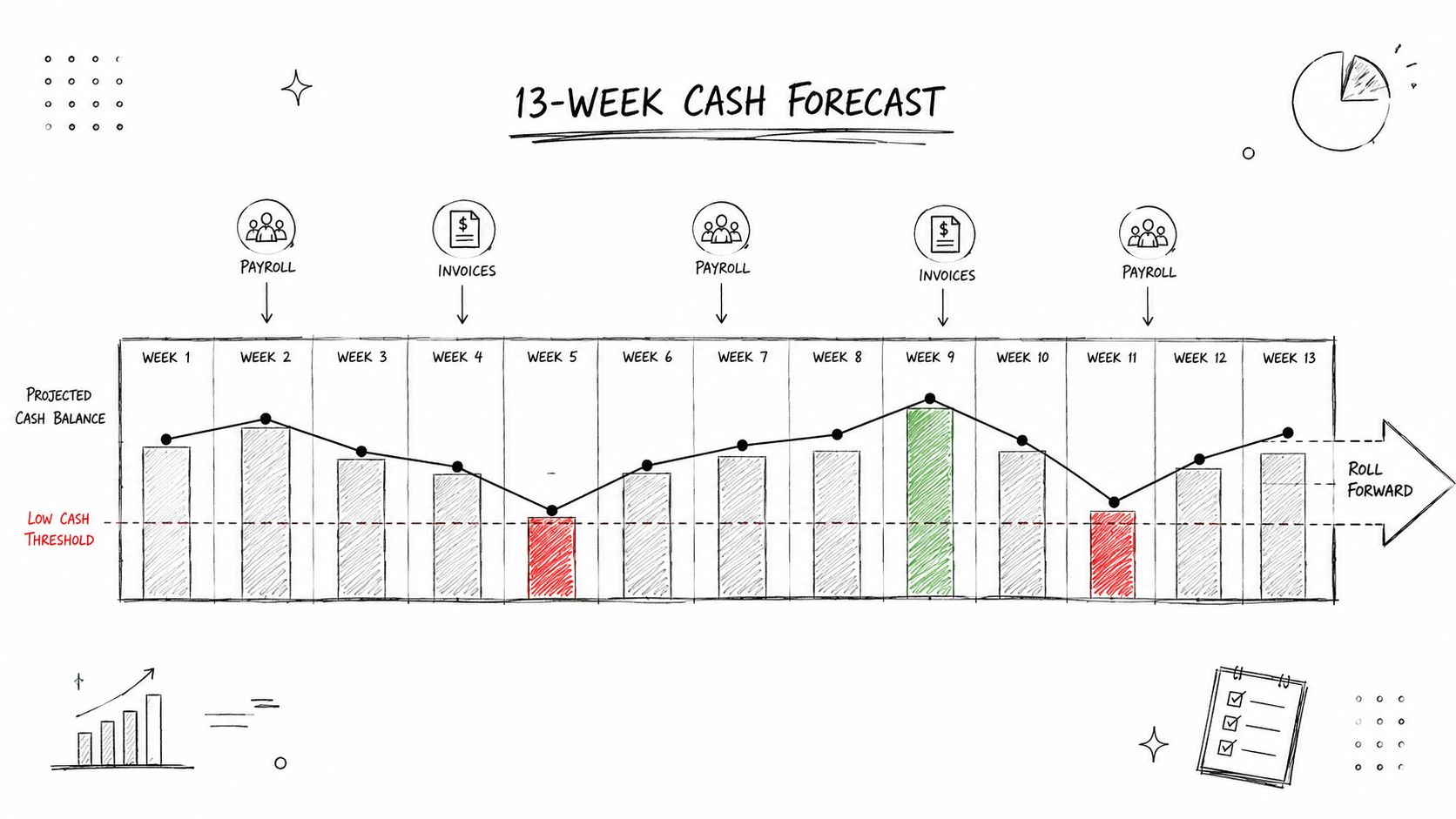
A rolling 13-week forecast is the closest thing most businesses have to a cash GPS. JPMorgan's middle-market guidance recommends rolling forecasts, scenario analysis, driver-based forecasting, and frequent variance review, and Ripple Treasury also identifies the 13-week model as a core enterprise treasury practice, because the horizon is long enough to catch liquidity pressure but short enough to act on it. JPMorgan's cash forecasting guide makes the point clearly, and the practical value shows up fast in businesses where collections, payroll, and vendor timing all move within a single quarter.
Build the forecast around real cash dates
Start with the accounts receivable aging report, then convert invoice dates into realistic payment dates based on how customers typically behave. JPMorgan and Ripple Treasury both emphasize that the forecast needs frequent updates and actual-vs.-forecast review, not wishful thinking. JPMorgan's forecasting tips also recommend using historical cash flow patterns as the baseline, which is exactly where many owners get this wrong, they assume contract terms are the same as cash timing.
Build fixed costs first, payroll, rent, and loan payments. Then layer in variable items like materials, freight, subcontractors, or travel. In construction, that often means aligning cash with job milestones and retention timing. In distribution, it means mapping when goods arrive, when they ship, and when the invoice goes out. In professional services, it means separating work performed from work billed.
Practical rule: if a payment date hasn't been seen in the bank account before, don't treat it like cash.
A simple weekly cadence works better than a fancy model nobody touches. Review it every Monday with leadership, even if it's only ten minutes. Flag the red weeks in advance, define a minimum cash threshold, and use the forecast to decide which vendor invoices get paid on which dates.
AmbitionCFO's internal forecasting accuracy guide fits neatly here, because a rolling forecast only works when the team treats it as a living model, not a one-time spreadsheet.
2. Reconcile Cash Flow Forecast to Accounting Records Monthly
A forecast without reconciliation drifts fast. The model may look tidy, but if the general ledger, AR aging, AP aging, and bank statements don't line up with what's in the forecast, leadership ends up making decisions on fiction. The fix is a monthly reconciliation discipline that turns the forecast into something you can trust.
Compare the forecast to the books, not just the bank balance
The basic structure is simple, forecast ending cash versus GL cash, then adjust for uncleared checks and in-transit deposits. Fathom identifies the forecast's core components as opening cash balance, inflows, outflows, and closing cash balance, and PwC's mechanics show the same running logic, list income and outgoings, then subtract outflows from inflows to get cash movement. Fathom's forecast structure overview is useful because it reminds owners that cash forecasting is built from timing, not just totals.
A monthly reconciliation meeting should happen two to three days after close. That's late enough for the books to settle and early enough to still change the forecast. I like a simple bridge document that explains every meaningful variance, whether it came from timing, data quality, or a broken assumption.
Operational credibility gets built here. A professional services firm may think unbilled work is all billable, but if the controller reconciles work-in-progress to the GL and finds only part of it is complete, the forecast gets better immediately. A distributor may assume a vendor still pays on prior terms, then discover the payable cycle changed and borrow too late if the forecast wasn't reconciled. A construction company may assume collections are holding when the aging says otherwise, and that assumption can wreck a quarter.
Reconciliation is where optimism meets evidence.
Train your bookkeeper or controller to own the timing issues, not just the numbers. When they know the model and the bank activity, they can spot a collection problem or a vendor shift before it turns into a liquidity surprise. AmbitionCFO's financial reporting best practices align with this approach, because clean reporting and good forecasting are inseparable.
For a practical step-by-step process on the banking side, this bank reconciliation guide can help your team tighten the monthly close.
3. Integrate Unbilled Accrued Revenue Into Cash Flow Forecasts
Many growth companies look profitable because the work is done, but the cash hasn't arrived yet. That's the gap unbilled revenue, or work-in-progress, is meant to expose. If you leave it out of the forecast, you end up telling yourself a comforting story about revenue while payroll and vendor payments keep asking for actual cash.
Model the lag between work and money
Professional services firms feel this first. A team can complete client work in one month, invoice in the next, and collect in the one after that. Construction firms live with retainage and milestone billing, which means even approved work can sit before it converts to cash. In both cases, the income statement says one thing, and the bank account says something else.
The simplest way to model this is to build a weekly WIP schedule. Start with hours or progress completed, apply the billable rate or contract value, then separate what's earned from what's invoiced and what's collected. If your project accounting system can export WIP weekly, pull it into the forecast every week instead of waiting for month-end.
Here's the discipline that matters. Segment clients by payment behavior, not just by contract size. A small group of slow-paying customers can create a bigger funding need than a larger group of reliable ones. Also, enforce invoicing rules tightly. If you bill late, the forecast should show the cash delay, not hide it.
Use the forecast to set operating limits
When unbilled revenue is included, the business can make better choices about hiring, bonuses, equipment, and growth pacing. That matters in a consulting firm adding staff, because growth can create a working-capital drain long before the new work turns into collections. It also matters in a construction business where retainage release timing can push cash into a different month than the revenue line suggests.
The question isn't whether revenue is growing. The question is when that revenue becomes spendable cash.
I also recommend reviewing unbilled revenue with project leads every week. Aging WIP is a leading indicator of future cash stress, especially when a project slips, a client disputes scope, or billing gets delayed because someone is waiting on approvals. If you want a deeper model for how to make the forecast operational, AmbitionCFO's cash flow forecast guide is a useful companion.
4. Model Sensitivity to Key Drivers Scenario Planning
A single forecast number is rarely the number you'll live with. That's why scenario planning is one of the most valuable cash flow forecasting best practices. It forces you to ask which assumptions matter most, then ties those assumptions to actual decisions instead of leaving them buried in a spreadsheet.
Build three to five scenarios, not one fantasy line
Start with base, upside, and downside. Then identify the three to five drivers that move cash, payment timing, backlog, utilization, order volume, project milestones, or customer concentration. JPMorgan's cash forecasting guidance recommends testing multiple scenarios, such as best case, worst case, and most likely outcomes, because the point is to understand the range of cash positions, not pretend precision exists where it doesn't. Ripple Treasury's best practices also emphasizes scenario analysis as part of effective forecasting.
A distribution owner can use this to decide whether a new customer is worth the risk. A construction owner can test what happens if a large project slips. A professional services firm can model hiring earlier or later depending on downside cash exposure. The value isn't the spreadsheet, it's the decision clarity.
When I build scenarios with clients, I like to assign probabilities, but only if the assumptions are grounded in actual business history. Then I use the model to identify trigger points. If the downside starts to look real, the company knows which actions get pulled first, delay capex, slow hiring, tighten collections, or negotiate milestones.
Link scenarios to capital choices
A lot of forecasts fall apart here. Owners build scenarios, nod at the downside, then never connect them to borrowing needs or spending decisions. The better move is to define what each scenario means for the credit line, vendor terms, or project timing. That makes the forecast actionable.
A waterfall view works well here, because it shows which assumption changes drive the largest cash swing. So does a simple trigger dashboard. If one customer pays late, or a major project slips, the leadership team should know what gets done that day.
If a scenario doesn't change behavior, it's just analysis.
5. Link Cash Flow Forecasts to KPI Dashboards and Operating Metrics
Cash doesn't move in isolation. It follows backlog, pipeline, utilization, order volume, project stage, and inventory decisions. If the forecast sits in finance while the operating team works from separate metrics, you end up with two versions of reality. The fix is to connect the operational dashboard to the cash model.
A construction company can use backlog and scheduled billings to predict cash several weeks out. A distributor can watch daily order trends and weekly inventory turnover. A professional services firm can track utilization and pipeline stage, then connect the drop in one metric to delayed collections in the forecast. AmbitionCFO's metrics guide for business owners supports this idea, because finance only gets predictive when it listens to the operating signals.
Translate operational movement into cash timing
The key is lead time. Define the path from order to invoice to cash for each revenue stream. In construction, a change in backlog doesn't hit the bank immediately, but it tells you what billings will look like later. In distribution, inventory purchases can pressure cash before revenue appears. In professional services, utilization changes often show up in cash later, after the billing cycle catches up.
Keep the dashboard tight. Three to five core metrics are usually enough. More than that, and nobody uses it consistently. I'd rather see a leadership team review a short dashboard every week than scan a longer one once a month and miss the key signal.
Embed finance in operations meetings. That doesn't mean turning every meeting into a budget review. It means translating the metric into cash language. If pipeline weakens, what happens to billings? If backlog drops, what happens to cash in six weeks? If inventory rises, what gets trapped in working capital?
I've found that simple visual dashboards work better than dense reports. Put the leading metrics beside forecasted ending cash and a trigger flag. People react faster when they can see the connection immediately.
A quick video walkthrough can also help teams understand how the metrics connect to liquidity, especially when leaders aren't finance-trained.
6. Manage Customer and Vendor Concentration Risk in Cash Flow Models
Concentration risk is one of the fastest ways a healthy-looking forecast can turn into a liquidity emergency. A business may have strong revenue, but if too much of it depends on a few customers, or too much of its supply chain depends on one vendor, cash timing becomes fragile. The forecast needs to show that fragility before the business feels it.
Quantify the exposure before you need the answer
Start by ranking customers and vendors. Sum the top three, top five, and top ten customers, then layer in payment terms and lateness risk. Do the same for vendors, especially if one supplier controls a critical material or a contract term change would squeeze the business. Ripple Treasury's guidance on forecasting from the ground up emphasizes that cash forecasting should tell you where you're cash-rich, where you're cash-constrained, and how different outcomes change your liquidity picture. Ripple Treasury's comprehensive guide fits this concentration work well.
The practical question is simple. What happens if your largest customer pays late? What happens if your biggest vendor shortens terms? Those are not theoretical questions in construction, distribution, or professional services. They're operating risks that show up in the forecast before they show up in the bank.
Build mitigation into the model. That can mean diversifying accounts, renegotiating terms, securing credit, or changing billing structure. It can also mean flagging strategic customers and vendors three to six months before renewals or contract changes so the leadership team can act before the pressure hits.
Use the model to make better commercial decisions
The forecast becomes strategic. A distributor may decide not to chase risky volume if the top customers already create enough working-capital strain. A construction firm may push milestone billing and reduce reliance on one client. A professional services firm may move part of its volume to a second vendor when a single supplier threatens terms.
AmbitionCFO's financial risk management strategies are relevant here because cash forecasting is not just about prediction, it's about reducing avoidable shocks. Once the concentration is visible, the business can decide whether to absorb it, hedge it, or redesign around it.
A forecast is only strong if it reveals the weak points in the business model.
7. Establish and Enforce Cash Minimum Thresholds and Contingency Actions
A cash minimum is not a guess, it's an operating rule. If the forecast shows the business will break below that line, everyone should already know what happens next. The point is to remove panic from liquidity decisions and replace it with a playbook.
Define the trigger points before stress arrives
The best thresholds are tied to real obligations, payroll, debt service, critical vendor payments, and the timing of collections. Then set tiered actions. At one level, reduce discretionary spending. At the next, defer non-critical capex and extend payables where possible. At the next, activate borrowing or other contingency actions. JPMorgan's guidance emphasizes variance review and driver-based forecasting, and that logic is what makes threshold planning work in practice. JPMorgan's middle-market cash forecasting ebook supports the weekly discipline behind this.
The reason this matters is simple. Decisions made in calm times are cheaper than decisions made under pressure. A company that waits until the bank balance is already tight loses negotiating power with lenders and vendors. A company that sees the breach four weeks away can act early and preserve options.
I like writing thresholds directly into the forecast. If the model shows a likely breach, the action is assigned to a named owner. That could be the controller, the COO, or the owner. Without an owner, the threshold is just a number on a screen.
Treat the forecast as a decision system
Many businesses do the math but skip the management step. They know cash is getting tighter, but they haven't rehearsed what happens when the alert turns red. So they freeze, call a last-minute meeting, and make expensive choices from a weak position.
A better practice is to rehearse the actions in calm periods. Run the downside once. Decide which vendor invoices get delayed, which spending is paused, and which line of credit gets tapped. Then document it so the team doesn't improvise under stress.
A clear minimum cash policy also helps with leadership discipline. It stops one-off spending requests from sneaking in at the wrong time and gives the owner a hard line to enforce.
8. Implementation Checklist and Quick Reference
The fastest way to improve forecasting is to start small and make the process repeatable. Most businesses do not need a massive system on day one. They need a clean weekly cadence, a model that reflects reality, and a few leading indicators tied to actual decisions. That's why the 13-week model comes first, and everything else layers on top of it.
Keep the model simple enough to use every week
Begin with opening cash, inflows, outflows, and ending cash. Then layer in WIP, AR behavior, AP timing, scenarios, operating metrics, concentration risk, and threshold triggers. That order matters because if you try to build everything at once, the forecast turns into a project instead of a tool.
Automate data pulls wherever possible. Pull bank data, AR, AP, and project data from the source systems rather than retyping them. Standardize one reconciliation template, one weekly review cadence, and one monthly deep dive. The more consistent the process, the less time you spend fixing preventable errors.
A few simple practices make a real difference:
- Adopt the 13-week rolling model first. It gives you near-term visibility without overcomplicating the process.
- Add WIP and billing timing next. That closes the gap between work performed and cash collected.
- Layer in 3 to 5 KPIs. Keep them focused on what moves cash, not what just looks interesting.
- Document trigger levels and owners. Every contingency action should have a name beside it.
- Review assumptions quarterly. Update them faster if the business changes materially.
Use the model as a management habit
The forecast only works when the leadership team uses it to make decisions. That means the controller, the bookkeeper, the operations lead, and the owner all need to understand their role in the process. It also means the forecast should be reviewed when conditions change, not just when someone remembers to ask finance for an update.
If your current process lives in a spreadsheet with no cadence, no variance review, and no operational tie-in, start by rebuilding the weekly rhythm. Then bring in the rest. AmbitionCFO's step-by-step cash flow forecast guide is a practical reference if you want a cleaner starting point for that rollout.
8-Point Cash Flow Forecasting Comparison
| Practice | Implementation complexity | Resource requirements | Expected outcomes | Ideal use cases | Key advantages |
|---|---|---|---|---|---|
| Implement 13-Week Rolling Cash Flow Forecasts | Medium–High, weekly cadence and disciplined updates | Weekly finance time, AR/AP data, spreadsheet or forecasting tool | Near-term cash visibility; early shortfall detection; fewer emergency borrows | Seasonal, project-based, or mid-market firms with variable receipts | High accuracy in the 13-week window; prevents surprise cash crises |
| Reconcile Cash Flow Forecast to Accounting Records Monthly | Medium, aligns with month‑end close and GL review | Accounting staff time, GL/bank access, reconciliation template | Improved forecast credibility and month‑over‑month accuracy | Firms needing auditability and tighter finance/ops alignment | Ties forecast to auditable records; reveals systemic variances |
| Integrate Unbilled/Accrued Revenue Into Cash Flow Forecasts | High, requires disciplined project accounting and WIP tracking | Project accounting system or regular WIP reports, project leads input | Prevents “profitable but broke”; better working‑capital planning | Professional services, construction, labor‑intensive businesses | Exposes revenue‑to‑cash gap; supports faster invoicing and collection actions |
| Model Sensitivity to Key Drivers (Scenario Planning) | Medium–High, scenario builds and probability weighting | FP&A time, modeling tools, historical volatility data | Risk‑aware decisions; reduced reactive borrowing; better capital allocation | Companies facing volatility or major strategic choices | Quantifies upside/downside; enables contingency plans and trigger points |
| Link Cash Flow Forecasts to KPI Dashboards and Operating Metrics | Medium, data integration and cross‑functional coordination | BI/dashboard tools, operational data feeds, weekly ops finance meetings | Earlier detection of cash trends; aligned operational and financial actions | Firms with measurable leading metrics (backlog, utilization, orders) | Predicts cash from leading indicators; drives operational ownership |
| Manage Customer and Vendor Concentration Risk in Cash Flow Models | Low–Medium, analysis and periodic scenario runs | Customer/vendor data, periodic reviews, stakeholder alignment | Quantified dependency risk; mitigation plans; lower single‑event exposure | Businesses with high revenue or supplier concentration | Reveals concentration risks; informs diversification and negotiation strategy |
| Establish and Enforce Cash Minimum Thresholds and Contingency Actions | Low–Medium, policy setting, governance and triggers | Leadership alignment, documented actions, monitoring cadence | Faster, consistent response to breaches; reduced panic borrowing | Any organization seeking disciplined contingency responses | Clear trigger‑action playbook; preserves optionality during stress |
| Implementation Checklist and Quick Reference | Low, consolidation of practices into a playbook | Time to standardize processes, templates, and basic automation | Faster operationalization; consistent cadence and ownership | Organizations adopting multiple cash practices or scaling finance teams | Practical roadmap for phased adoption; reduces implementation friction |
Your Next Move Build a Predictable Cash Engine
The value of these cash flow forecasting best practices is not prettier reports. It's better decisions. When you can see cash coming in and going out with enough clarity, you can hire with confidence, buy equipment at the right time, push back on risky terms, and stop treating every deposit like a surprise.
For a founder-led business, that shift changes everything. Cash stops being a constant source of stress and becomes a management tool. A rolling forecast tells you when you can grow, when you need to protect liquidity, and when a decision that looks smart on the P&L could strain the bank account. That's especially true in construction, distribution, and professional services, where timing differences often matter more than the headline revenue number.
The businesses that win with forecasting don't rely on a perfect spreadsheet. They build a disciplined process, update it often, and force every assumption to face reality. JPMorgan's emphasis on rolling forecasts, variance review, and driver-based planning lines up with what works in the field, and so does the 13-week model that many treasury teams treat as the operating standard for short-term liquidity. Ripple Treasury's guide and Sage's cash flow overview both reinforce the same idea, different horizons serve different decisions, and the 13-week view is the one that gives owners immediate control.
AmbitionCFO works with founder-led businesses that have outgrown reactive cash management. If you want a forecast that connects cash, operations, and decision-making without building a full finance department, the next step is simple. Use the model, review it weekly, and make sure your team knows which actions kick in when the forecast turns red.
If you're ready to turn cash forecasting into a repeatable operating system, visit AmbitionCFO and start a conversation about a 13-week cash flow model built around your business. AmbitionCFO helps owners of $10M to $100M companies turn collections, payroll, billing, and spending into a clear weekly plan, so you can make decisions with confidence instead of waiting for the bank balance to tell you what to do.