

Your revenue can look healthy while the bank balance heads toward trouble. A construction company may have profitable jobs but cash trapped in retainage. A distributor may have strong orders but too much money tied up in inventory and supplier deposits. A professional services firm may invoice reliably while clients pay after payroll and contractors are due.
The question is simple: which 13 week cash flow template will show your cash gap early enough to make a decision? A useful forecast tracks cleared beginning cash, expected receipts, payroll, vendors, debt service, taxes, capital spending, and ending cash across the next 13 weeks. It turns uncertain timing into a weekly operating schedule, not an annual budget.
The right tool depends on your largest cash driver. This comparison moves from simple starter grids to lender-grade models, then ends with a customization checklist. Each option has a practical fit, a limitation, and a weekly routine you can use immediately. If you're still managing revenue shares in disconnected spreadsheets, using Creem for revenue shares can also reduce one source of manual reconciliation before it reaches your forecast.
Table of Contents
- 1. CashPulse
- 2. Flocuity
- 3. Insight Accounting Solutions
- 4. Eagle Rock CFO
- 5. Skyline Nexus
- 6. Covirage.ai
- 7. Holdings
- 8. The DTC Playbook
- 9. Julian R. Sterling
- 10. Wall Street Prep
- 13-Week Cash Flow Template, Top 10 Comparison
- Build Your Forecast Before the Next Payroll Run
1. CashPulse
CashPulse's 13-week cash flow template is a sensible starting point when your company has no consistent weekly cash routine. The editable Excel file keeps the structure light. You get weekly columns, totals, ending cash, and room to record assumptions or follow-ups.
That simplicity matters for an owner who needs a working file today, not a finance project. A construction manager can enter expected progress-billing receipts and subcontractor payments. A services founder can list payroll, contractor invoices, and customer collections without learning a complicated model first.
Best fit and weekly discipline
CashPulse works best for rapid what-if timing tests. Move a customer receipt later, shift a vendor payment, or remove a discretionary purchase. Then look at the effect on ending cash. The file is also easy to hand off across a small leadership team.
Its limitation is equally clear. This is a basic template, not a lender reporting system. It doesn't provide the depth of a model with solid variance analysis, covenant testing, or detailed borrowing-base mechanics. The template is free, while additional software functionality is offered separately.
Use it if your first decision is, “Will I have enough cash after the next payroll and supplier cycle?” Before you add complexity, follow a consistent guide to creating a cash flow forecast and make sure every week begins with cleared bank cash, not an accounting balance.
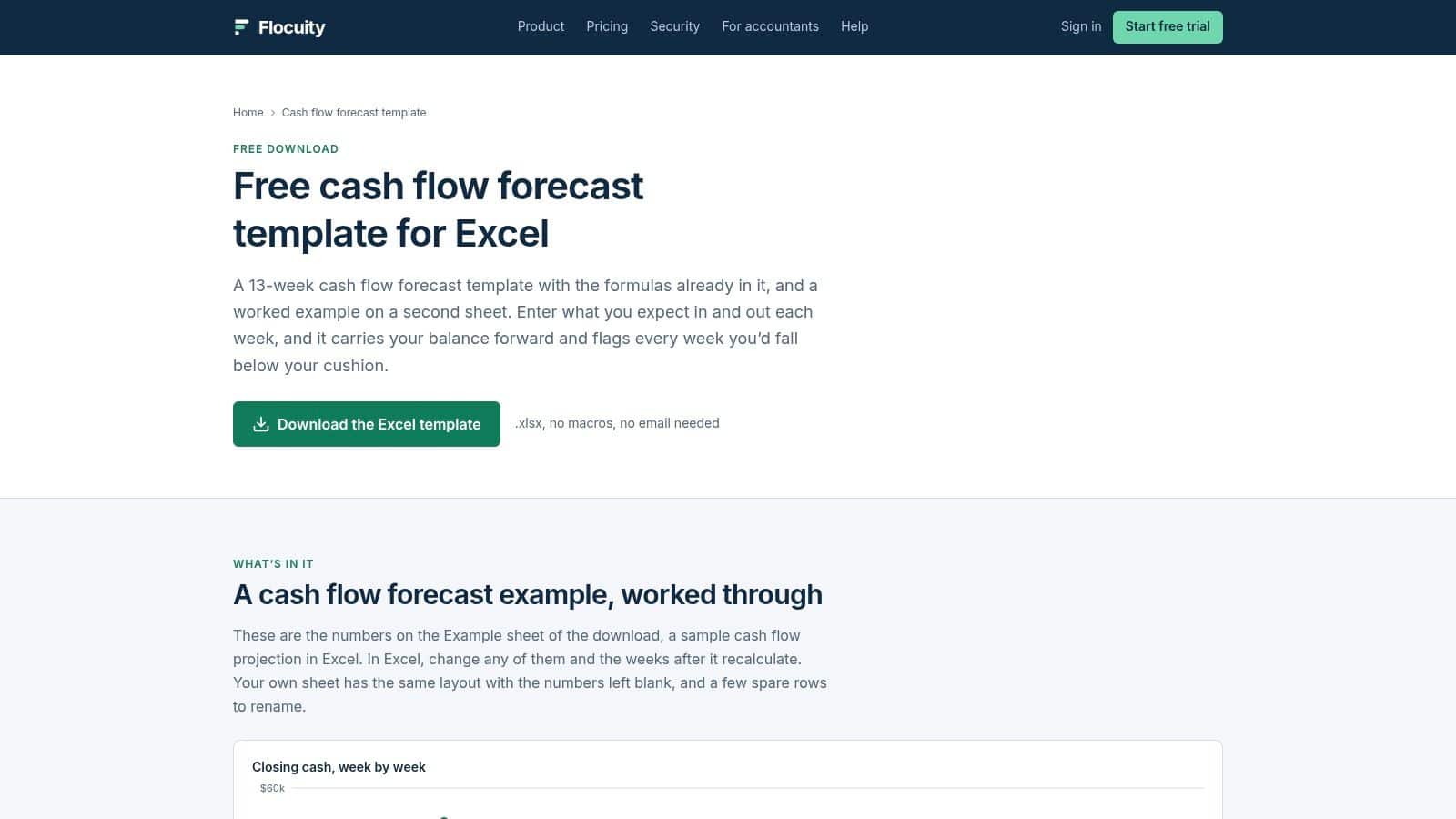
2. Flocuity
Flocuity's free 13-week cash flow forecast is built for fast adoption by owners who don't live in spreadsheets. The worked example gives a new user a reference point, while automatic carry-forward keeps each week connected to the next.
The most useful feature is the cushion threshold. Set a minimum cash level, and the template flags weeks that fall below it. That changes the conversation from “Are we profitable?” to “Which week needs an action plan?”
Where it earns its place
For a professional services firm, the example tab can help an owner organize payroll, contractor payments, rent, and expected client receipts without waiting for a finance team. For a distributor, it can highlight the week when a supplier payment collides with a slower customer collection.
The trade-off is depth. Flocuity may be too lightweight for complex credit facilities, multiple entities, or formal lender reporting. It won't replace a model that needs covenant calculations or detailed financing schedules.
Start by setting the cushion from your actual obligations. Include payroll, taxes, debt service, and core operating costs. Then add customer-level collections rather than one optimistic revenue line. The Federal Reserve's 2025 Consumer and Community Context publication reported that 37% of small employer firms applied for a loan, line of credit, or merchant cash advance during the prior 12 months in 2023, so your forecast should show precisely when a financing need might arise.
3. Insight Accounting Solutions
Insight Accounting Solutions' cash flow forecast template gives contractors and service businesses a straightforward rolling model. The start-here tab reduces setup friction. Inflow and outflow sections use familiar categories, and the closing balance carries into the next opening balance.
That roll-forward is the part owners must protect. A 13-week forecast only stays useful when the completed week is replaced with actual bank activity, the remaining weeks move forward, and a new thirteenth week is added. A static quarterly schedule becomes stale as soon as a customer pays late or a project cost changes.
A practical contractor setup
Use separate rows for progress billings, retainage releases, payroll, subcontractors, materials, insurance, taxes, and equipment spending. Contractual due dates provide a baseline, but expected payment dates should reflect customer behavior. An invoice dated March 1 with 30-day terms belongs in the week the cash is realistically expected to clear, not automatically in the issue week.
Insight Accounting Solutions also flags weeks below a user-set minimum. That makes it accessible to non-finance users, but it doesn't include advanced borrowing-base or covenant tests. If your owner needs a clearer division between accounting records and forward-looking operating decisions, FP&A versus accounting explains why both functions matter.
Use this option when the immediate decision is whether a service business or contractor can fund committed work without confusing profit with cash.
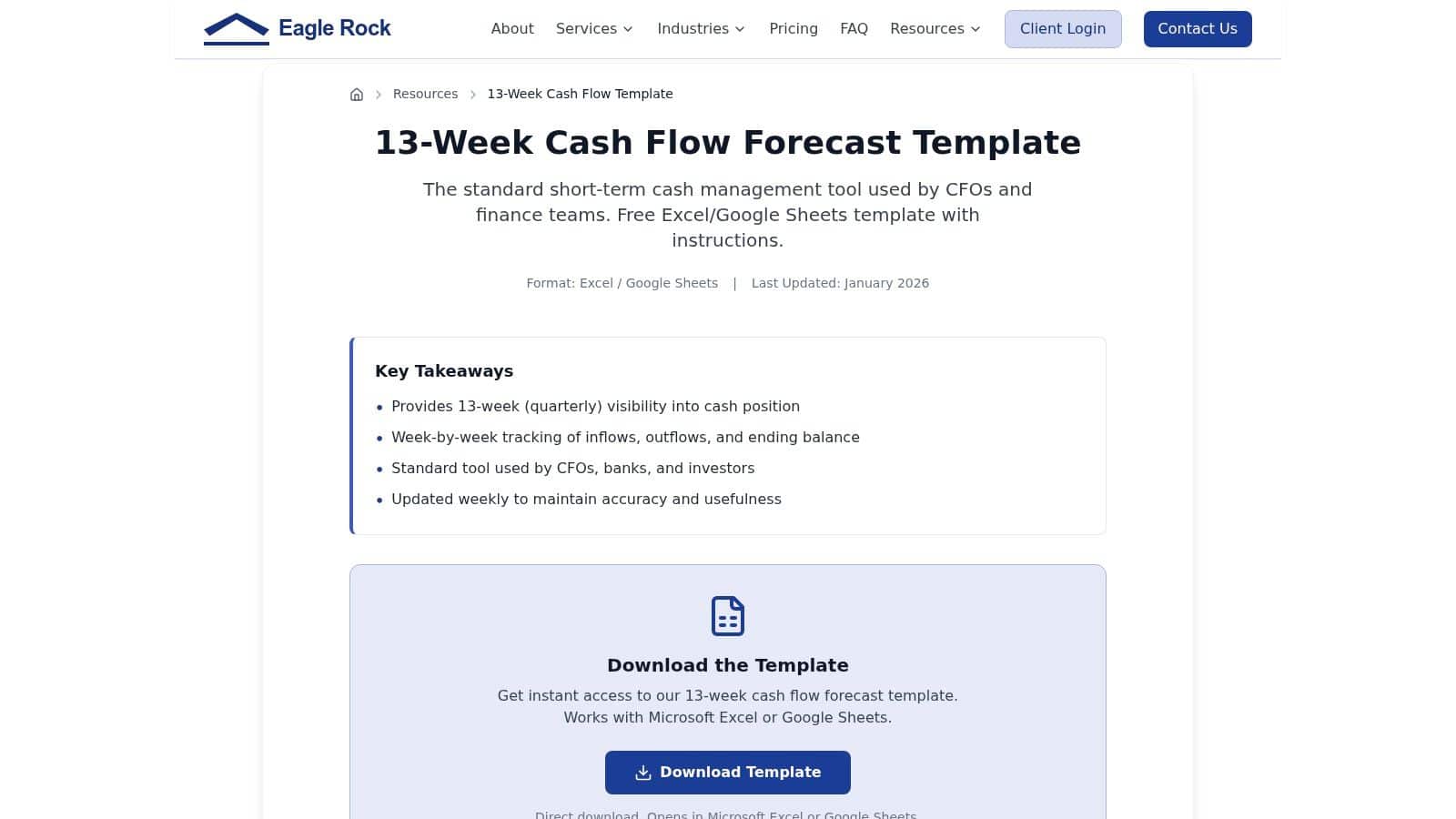
4. Eagle Rock CFO
Eagle Rock CFO's 13-week cash flow template is a clean on-ramp for a small or midsize finance team. It works directly with Google Sheets, which helps when the owner, controller, project manager, and operations lead need to review one live file.
The model includes weekly inflows, outflows, ending cash, an actuals column, and variance tracking. That actuals column is important. A forecast isn't improving unless someone compares what happened with what was expected and records why the difference occurred.
Good for visibility, lighter on financing mechanics
Construction teams can use the file to compare forecast and actual subcontractor payments. Distributors can track supplier timing and inventory-related cash outflows. Professional services firms can watch collections against payroll and contractor commitments.
The template also alerts users when cash falls below a minimum. That supports turnaround discussions and bank reporting, but the structure has less emphasis on borrowing bases, revolver mechanics, and covenant calculations. Those omissions aren't a flaw for a straightforward operating forecast. They become a problem when lenders require a formal liquidity package.
Set one owner for the weekly close. That person should confirm cleared balances, replace the prior week with actuals, explain material variances, and assign the next action. If the owner is spending too much time maintaining the file instead of making decisions, when to hire a CFO offers a useful point for evaluating the next level of support.
5. Skyline Nexus
Skyline Nexus, also known as AlsSkyline, offers a 13-week cash flow guide and template that puts unusual emphasis on the process around the spreadsheet. The downloadable .xlsx file has no macros or passwords, and the accompanying material explains common forecasting mistakes.
That educational layer helps when the file will be used by someone who understands the business but isn't a trained treasury professional. The receipts and payments layout is familiar. Minimum-cash alerts make the risk visible. The forecast accuracy block encourages a weekly comparison between actual and expected cash.
The template is only as good as the review
A one-page model can work for a professional services company with predictable payroll and a manageable receivables list. It can also help a contractor begin separating committed payments from assumptions. It may be outgrown when jobs, entities, credit facilities, or detailed customer schedules multiply.
Use the accuracy block to classify forecast errors as timing, amount, omitted transaction, or assumption failure. That classification tells you what to fix. If receipts are late, improve collection assumptions. If vendor payments are larger than expected, review purchase commitments. If transactions are missing, change the weekly input process.
The model's educational content is a strength. The separate ERP promotion is a reminder that the downloadable template remains basic. Adopt it when your biggest weakness is process discipline, not model complexity.
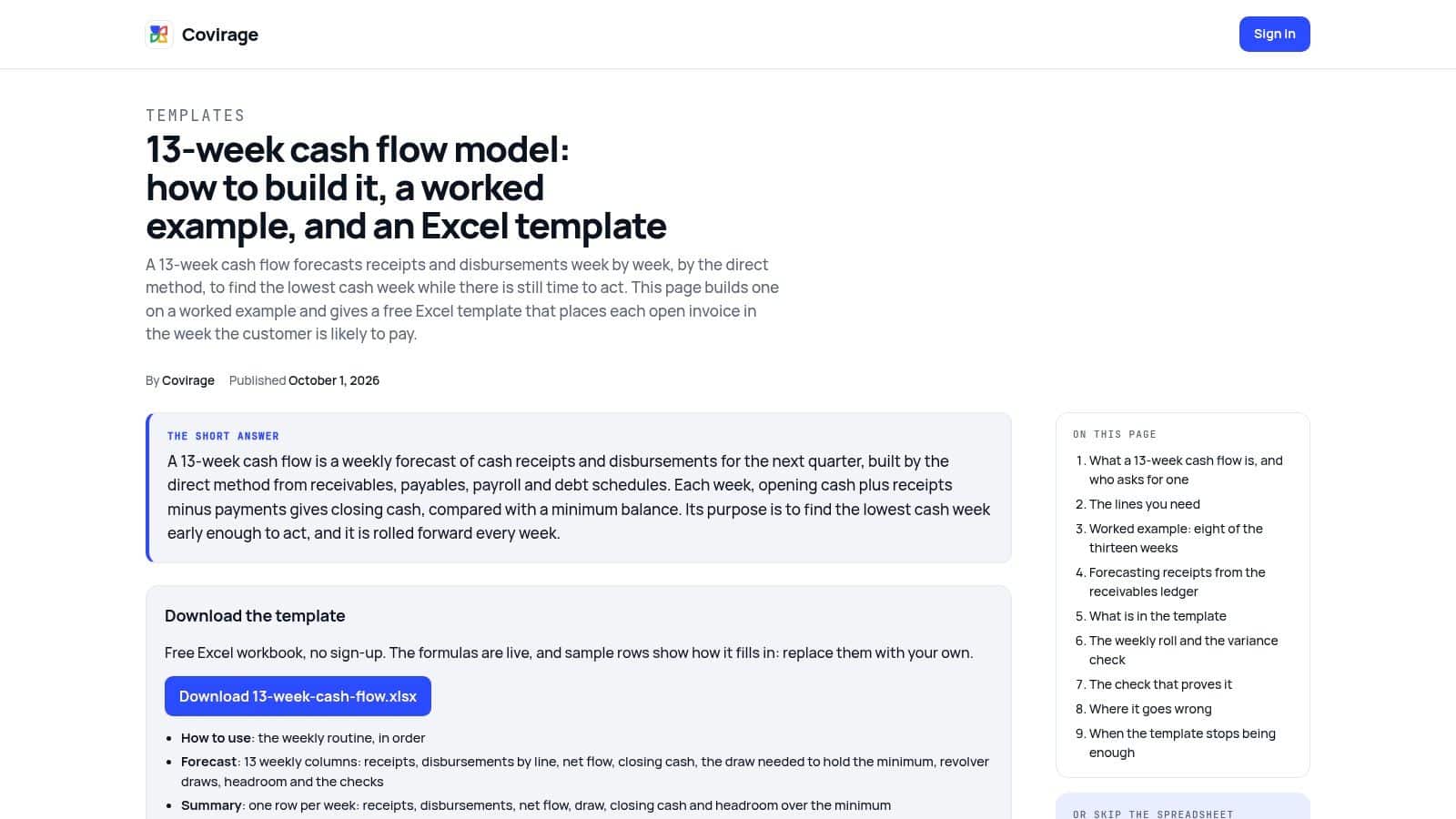
6. Covirage.ai
Covirage.ai's 13-week cash flow template is built for a weekly question owners ask under pressure: which invoices will turn into cash before payroll, rent, and supplier drafts hit. Its AR and AP tabs push invoices and bills into expected weeks based on average payment behavior, not just due dates. For a distributor managing uneven vendor terms, or a professional services firm waiting on slow clients, that makes the forecast more usable.
The workbook includes Inputs, Forecast, Variance, and Summary tabs. You also get minimum-cash headroom, optional revolver draw lines, lowest-cash-week callouts, and weekly accuracy tracking.
Stronger timing logic, more upkeep
The fit is strongest when timing is the core problem. A services firm can split normal receivables from disputed invoices or milestone billing. A contractor can track retainage separately instead of pretending it will clear on schedule. That distinction matters, and a disciplined weekly review improves the assumptions over time. Our guide to forecasting accuracy explains how to tighten that process.
The trade-off is maintenance. Someone has to refresh customer and vendor detail every week. If that slips, the model starts to look precise while getting less trustworthy.
Practical rule: Start with contractual due dates. Then adjust for actual customer payment patterns, supplier behavior, and one downside case.
The pressure behind that work is real. QuickBooks reported that 56% of surveyed small businesses had outstanding invoices, while 47% said some were more than 30 days past due in its 2025 late payments report. Use Covirage when receivables timing is creating the cash squeeze. Skip it if your bigger issue is weak weekly update discipline.
7. Holdings
Holdings' 13-week cash flow PDF template is designed less as a live calculation engine and more as a governance and meeting tool. The fillable grid covers common receipts and disbursements. Base, best, and worst scenarios sit alongside a KPI summary, action plan, thresholds, and a weekly update checklist.
That format works well when leadership needs one page to review together. A construction owner can bring the file to a weekly job and liquidity meeting. A professional services partner can use it to agree on collection actions, spending holds, and escalation points.
Treat it as the control sheet, not the system
The PDF is printer-friendly and useful for setting governance. It isn't the right choice if you need immediate formula-driven forecasting. Port the layout into Excel or Sheets if you need automatic roll-forward, variance calculations, or customer-level receipt timing.
Its scenario design is the strongest feature. Don't use “best case” as a hopeful sales plan. Use it to show what happens if a customer pays early or a project milestone lands on time. Use the downside case to delay collections, accelerate supplier payments, or include a cost overrun.
This template earns its place when your team already has numbers but lacks a repeatable meeting routine. It gives the meeting a structure. Your live spreadsheet or accounting system still needs to hold the calculations.
8. The DTC Playbook
The DTC Playbook's 13-week cash flow template is the clearest fit for inventory-heavy consumer businesses. It organizes receipts and payments by category, adds negative-cash warnings and runway flags, and gives founders practical notes about inventory and purchase-order timing.
That focus transfers well to distribution, even though the template isn't designed for multi-entity consolidation. A distributor should use separate lines for inventory purchases, supplier deposits, freight, customer receipts, and planned purchase orders. The key question is whether the next buying decision creates a cash trough before the related inventory converts into collections.
Helpful for founders, limited for complex groups
The rolling workflow guidance is written for founders and operations leaders. That makes it practical for a weekly review where one person updates the file and another approves purchasing or spending decisions.
The download requires a free account, which adds a small adoption hurdle. The bigger limitation is structure. It isn't built for multi-entity consolidations or a complex lending package.
Use the template before approving a major inventory purchase. Enter the expected supplier payment week, freight cost, payroll impact, and realistic customer payout date. If ending cash falls below your minimum, the decision is not automatically “don't buy.” It may be “negotiate supplier timing,” “reduce the order,” or “secure a facility before committing.”
9. Julian R. Sterling
A weekly cash meeting gets harder once debt terms start driving operating decisions. Julian R. Sterling's 13-week cash flow workbook fits that moment well. The Excel file includes seven sheets, with a direct-method forecast, Liquidity and Levers tabs, a worked case, a Checks sheet, and a covenant test.
Its best feature is the separation between liquidity and usable liquidity. Cash in the bank does not always mean cash you can spend. Borrowing limits, restricted funds, and covenant pressure can block what looks available on the bank balance. That matters for a distributor managing supplier terms, a contractor dealing with retainage and job-cost timing, or a professional services firm carrying payroll while receivables lag.
Choose it when the lender conversation matters
If you already report to a bank or expect a tough financing conversation, this model gives management a clearer weekly routine. The Liquidity and Levers tabs connect a projected shortfall to actions you can take this week, such as speeding up collections, pushing a payment, drawing on a revolver, or cutting discretionary spend. The variance process also helps explain why the forecast changed, which lenders and boards usually want to see.
The trade-off is time. A very small company that just needs payroll, rent, vendors, and customer receipts may find the workbook too involved.
For construction and other debt-heavy businesses, the added structure can be worth it. Before sharing the file externally, run the Checks sheet. Make sure opening cash ties to the bank, ending cash rolls forward, financing lines are classified correctly, and minimum cash is easy to spot. A fractional CFO advisor can review the model before you send it to a lender.
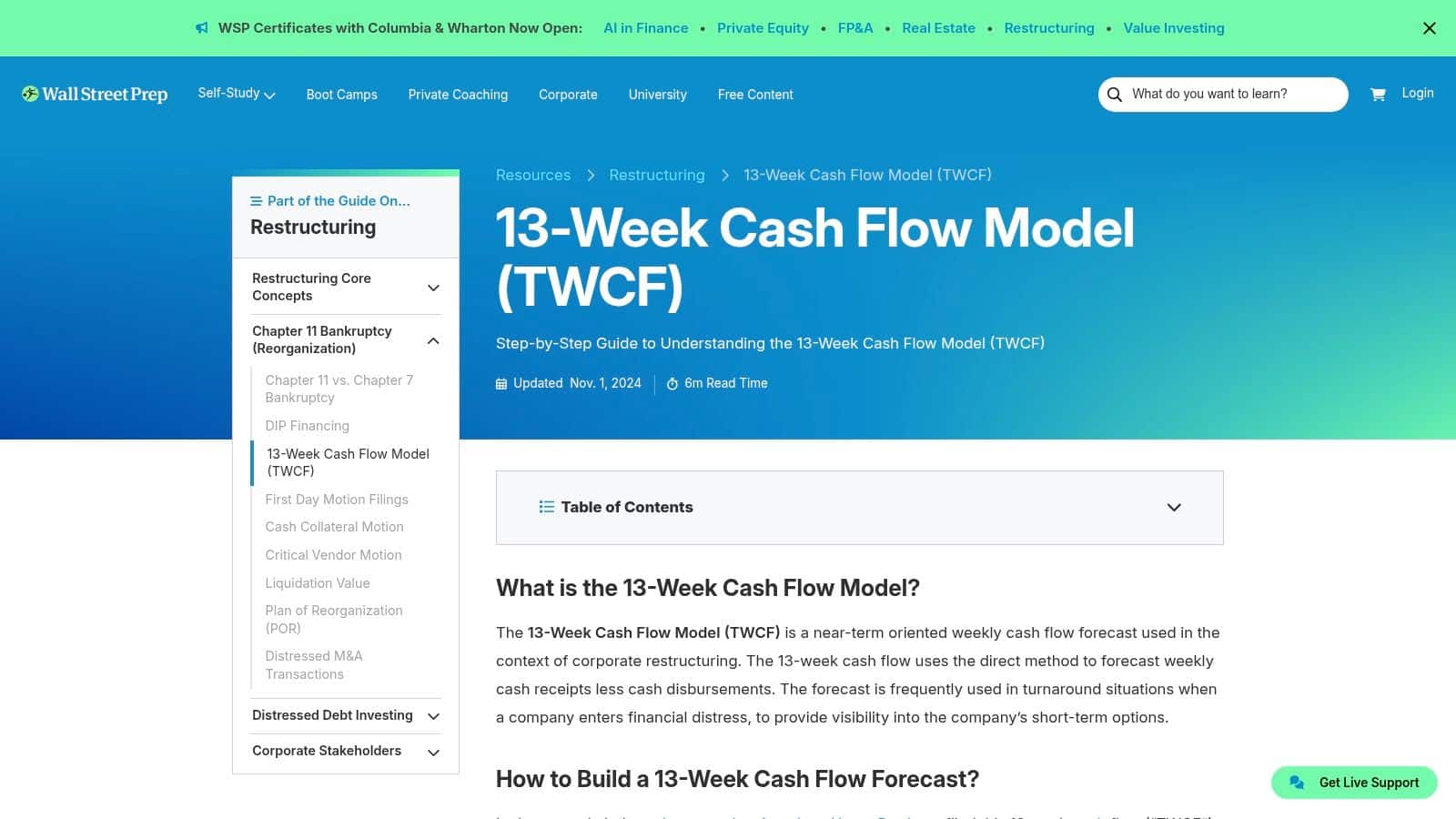
10. Wall Street Prep
A Friday lender call changes what “good enough” looks like. If your weekly cash forecast needs to stand up in a bank meeting, a workout process, or formal reporting, Wall Street Prep's 13-week cash flow methodology is built for that standard. The free article explains the direct cash receipts and disbursements approach. The paid self-study course adds a reusable Excel model, video training, certification, and CPE eligibility.
This model covers more than a starter grid. It includes borrowing-base logic, revolver or DIP activity, EBITDA-to-cash reconciliation, and a variance process you can use week after week. That makes it a better fit for a distributor managing inventory swings and lender reporting, a contractor dealing with retainage and uneven job-cost timing, or a professional services firm carrying payroll while collections slip.
Rigor has a cost
The trade-off is setup time and operator skill. The learning curve is steeper because the model covers financing mechanics, reconciliations, and variance analysis in detail. Since the full Excel file comes with the paid course, it is not the quickest choice for an owner who just wants a simple view of receipts, payables, payroll, and ending cash before the next payroll run.
Use it when the financing decision is material.
Before you adopt it, assign clear ownership for every input. AR should own collections timing. AP or operations should own vendor disbursements. Payroll should own payroll dates and taxes. The CFO or lender contact should own debt activity and covenant-sensitive items. Then apply financial modeling best practices so the file stays readable, auditable, and usable after the original builder is gone.
13-Week Cash Flow Template, Top 10 Comparison
| Tool | Target / Best for | Core features | Value / Strengths | Limitations | Price |
|---|---|---|---|---|---|
| CashPulse | Teams starting from zero; weekly routines | Editable 13-week Excel; timing assumptions; quick what-if | Minimal friction; fast adoption | Feature-light vs covenant models; software sold separately | Free template (software extra) |
| Flocuity | Non-finance owners; fast implementers | 13-week Excel; auto carry-forward; cushion flags; example tab | Fast to implement; helpful visual flags | Limited for complex credit facilities or multi-entity | Free |
| Insight Accounting Solutions | Service businesses & contractors | Start-here tab; categorized inflows/outflows; rolling horizon; flags | Straightforward; embedded rolling process guidance | Lacks borrowing base/covenant modeling | Free |
| Eagle Rock CFO | SMB finance/CFO teams | Week-by-week inflows/outflows; actuals & variance; alerts; Google Sheets | Clean on-ramp; clear instructions for bank/turnaround use cases | Less emphasis on covenant mechanics | Free |
| Skyline Nexus (AlsSkyline) | Teams wanting education + accuracy tracking | Receipts/payments layout; forecast accuracy block; guide; .xlsx download | Strong educational content; accuracy tracking | One-page/simple; may be outgrown; ERP upsell | Free |
| Covirage.ai | Operators wanting AR/AP-driven timing realism | AR/AP tabs mapped by avg days late; forecast/variance/summary; headroom & revolver lines | Improves receipts realism; no signup required | Requires manual AR/AP upkeep without tooling | Free |
| Holdings | Leadership meetings; governance & playbooks | Printable fillable PDF; base/best/worst scenarios; action plan & checklist | Great for meeting one-pagers and governance routines | PDF must be ported to Excel/Sheets for live formulas | Free PDF |
| The DTC Playbook | Consumer / DTC brands with inventory | Receipts/payments by category; inventory/PO timing notes; rolling workflow | Practical for inventory-heavy, seasonal builds; founder-friendly | Gated by account; not for multi-entity consolidations | Free (account required) |
| Julian R. Sterling | SMBs with credit facilities and covenant needs | Direct-method weekly; Liquidity & Levers; covenant tests; worked case | Transparent; lender- and covenant-ready | May be overkill for very small firms | Free |
| Wall Street Prep | Bankers, restructuring, teams needing training | TWCF methodology; borrowing base & revolver mechanics; EBITDA→cash reconciliation; course | Industry-standard rigor; step-by-step video training & certification | Steeper learning curve; full model bundled in paid course | Free article; paid course & model |
Build Your Forecast Before the Next Payroll Run
The best 13 week cash flow template isn't the most complex file. It's the one your team can update every week with real cash dates, clear ownership, and a decision attached to each warning.
Choose based on your dominant cash driver:
- Construction: Prioritize job-level timing. Track mobilization, payroll, materials, subcontractors, billing milestones, retainage, change orders, and expected collections.
- Distribution: Prioritize inventory and supplier terms. Add purchase orders, deposits, freight, payment dates, and the week customer cash is likely to arrive.
- Professional services: Prioritize receivables and payroll. Separate client collections from recurring payroll, contractor costs, taxes, and owner distributions.
A rolling model should start with cleared balances across every active bank account. It should show expected receipts, committed payments, financing activity, capital spending, and ending cash. Each weekly close should replace the prior forecast with actuals, classify the variance, remove the completed week, add a new thirteenth week, and refresh assumptions.
Forecast confidence should also change across the horizon. Use high-confidence invoice-level receipts and committed disbursements for the first four weeks. Use documented operating assumptions for weeks five through eight. Use scenario ranges for weeks nine through thirteen. Benchmark data reports spreadsheet or manual forecast error at approximately 8% to 15% at a 30-day horizon and 18% to 30% at 90 days, while reported AI and machine-learning approaches show roughly 2% to 4% and 5% to 9%, respectively. These figures aren't a guaranteed small-business benchmark, but they support a practical rule about uncertainty and horizon length. Read the reported forecast accuracy benchmarks as a control principle, not a promise.
Your selection checklist is short:
- Does the template show cleared opening cash?
- Can you enter customer-level receipts by expected clearing week?
- Can you separate committed payments from assumptions?
- Is minimum cash visible?
- Can you compare actuals with forecast?
- Can you model delayed collections and accelerated payments?
- Does it support your financing structure?
- Can the team update it without the original builder?
- Does it match your largest cash driver?
- Does it produce a decision this week?
The Federal Reserve's Small Business Credit Survey is conducted annually by all 12 Federal Reserve Banks and covers U.S. employer firms with 1 to 499 employees. Its 2024 survey cycle included 6,131 responses from all 50 states and the District of Columbia, offering a broad view of small-firm financing conditions in the Chicago Fed's survey summary. Your model doesn't need to imitate a survey. It does need to help you see whether the next shortfall comes from slow collections, weak margins, excessive payment terms, or a major commitment.
Load last week's actuals now. Set the minimum cash line before the next payroll or supplier run. If the file still feels fragile, AmbitionCFO at AmbitionCFO builds and maintains 13-week cash flow models for construction, distribution, and professional services firms, then connects them to forecasting and KPI dashboards. The firm serves founder-led businesses with $10M to $100M in annual revenue, providing fractional CFO support without the cost of a full-time CFO.
Use the model to test the next major decision, not just to monitor the bank balance. A profitable contract can still damage liquidity during its first 13 weeks. Construction evidence reports that 51% of construction professionals cited high upfront costs and 38% cited waiting for payments as major challenges, while 56% had turned down projects because of cash-flow or payment risk, according to Equipment Finance News. The question before accepting work is whether the incremental project cash profile leaves enough headroom under base, delayed-payment, and cost-overrun cases.
AmbitionCFO builds and maintains rolling 13-week cash flow models for construction, distribution, and professional services businesses, with job, client, receivables, payroll, and financing detail tied to weekly decisions. Visit AmbitionCFO to discuss a model that gives your leadership team clearer cash visibility before the next payroll, supplier commitment, or major contract decision.