

Fractional CFO rates for $10M–$100M founder-led businesses typically fall between $175 and $450 per hour, with monthly retainers most commonly landing between $3,000 and $10,000. The right number depends on deliverables and cadence, not the rate alone.
That range is useful only as a starting point. A low hourly rate can buy too little access to manage weekly cash risk, while a higher rate can be rational when the CFO owns margin analysis, lender diligence, acquisition modeling, or exit preparation. The question I'd want every owner to ask is simple: What decisions will this engagement help me make, and how often will that support arrive?
Table of Contents
- What Fractional CFO Rates Look Like in 2026
- The Three Pricing Models Explained
- Benchmark Rate Tiers for Founder-Led Companies
- What Drives the Rate Up or Down
- Fractional Cost vs Full-Time CFO Compensation
- How Real Engagements Get Scoped and Priced
- A Five-Step Method to Score Any Proposal
- Recalibrating the Engagement After 60 to 90 Days
What Fractional CFO Rates Look Like in 2026
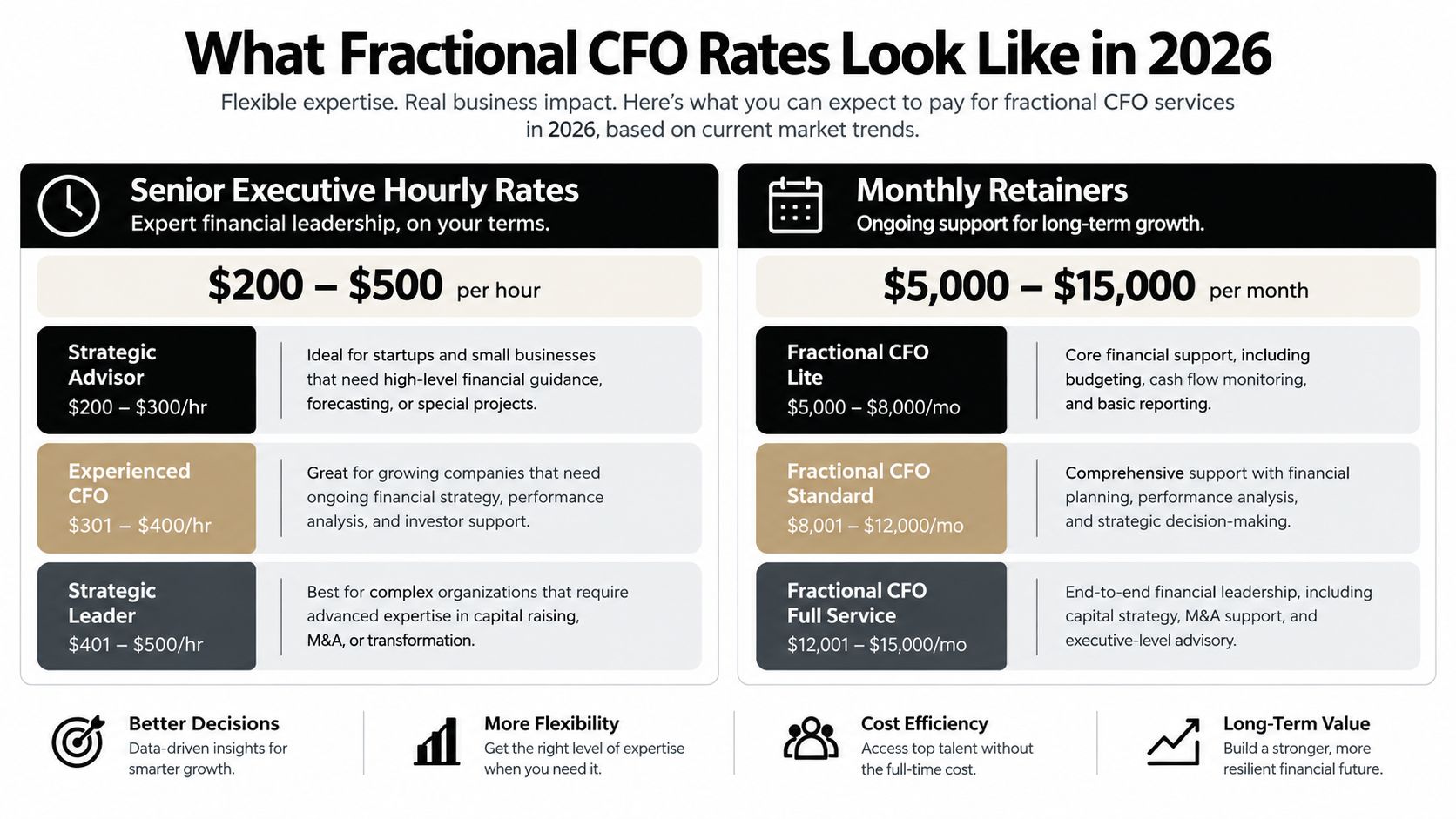
Published benchmarks put experienced finance executives at $150–$225 per hour with 10–15 years of experience, $225–$325 per hour for 15–20 years or specialist expertise, and $325–$500 per hour for executives with 20 or more years and multiple CFO engagements, according to this fractional CFO cost benchmark. Another dataset reports a $229 mean hourly rate from 546 self-reported rates, but that figure is not a representative independent survey.
Published retainer structures show how capacity changes the price. Strategic advisory covers 10–15 hours monthly at $2,500–$5,250. Operational support covers 20–30 hours at $4,000–$9,000, while full-service support covers 40–60 hours at $7,000–$15,000, according to this fractional CFO budgeting analysis. Across engagements, monthly retainers commonly range from $3,000 to $10,000 for roughly 10–30 hours of support.
Why the average misleads
A $10M construction company may need a weekly 13-week cash-flow model, job-level gross-margin analysis, and project reviews. A $40M professional-services firm may need monthly reporting, utilization analysis, and an exit-readiness plan. A $100M distributor may require working-capital oversight, inventory decisions, lender communication, and acquisition modeling.
The rate should reflect the decisions the CFO must support, the frequency of that support, and who owns implementation. A low-cost advisor may deliver reports without helping management act on them. A higher rate can make sense when the CFO leads lender discussions, acquisition modeling, margin improvement, or exit planning.
For a company between $10M and $100M in revenue, price should follow decision complexity, cadence, data ownership, and implementation responsibility. Separate hourly work, recurring retainers, and fixed projects, then test each quote against the capacity and deliverables leadership requires.
The Three Pricing Models Explained
Fractional CFO work usually fits one of three commercial structures. Each can be appropriate, but the wrong structure creates friction or hides an underscoped engagement.
Hourly pricing
Hourly billing works best when the work has a defined endpoint. Examples include a financial diagnostic, a model review, a reporting-control assessment, or limited transaction-readiness work.
The math is transparent. Twenty hours per month at $250–$325 per hour equals $5,000–$6,500 monthly, before project-specific work, based on the published benchmark for experienced finance executives. The risk is that the owner starts rationing access precisely when timely advice matters most.
Monthly retainers
A retainer fits recurring decision support. The CFO agrees to a defined capacity and cadence, such as weekly cash forecasting, monthly management reporting, margin analysis, leadership meetings, and forecast updates.
Retainers work because they reserve access. The owner knows when the CFO will be available, what the CFO owns, and which deliverables arrive each month. For most stable operating businesses, this is the cleanest structure.
Project pricing
A project fee suits a one-time build or event. A 13-week cash-flow model, financial planning model, transaction-readiness review, or exit-planning sprint can be scoped around a fixed output rather than a recurring number of hours.
Ask for assumptions in writing. A fixed fee should identify the data you must provide, the meetings included, the revisions allowed, and what happens if the scope changes.
Owners evaluating broader executive hiring options may also benefit from this guide to picking the right executive search firm, particularly when deciding whether a temporary fractional solution or a permanent executive search better fits the business.
For a practical overview of how outsourced finance leadership can be structured, review outsourced CFO services. The important distinction is this: use a retainer for recurring cadence, hourly billing for contained analysis, and project pricing for a defined transformation or transaction.
Benchmark Rate Tiers for Founder-Led Companies
Published benchmarks become useful only when tied to capacity and deliverables. The figures below show what different levels of access can buy for founder-led companies from $10M to $100M. Monthly amounts are examples calculated from the stated hours and rates, not universal package prices.
| Experience Tier | Hourly Rate | Typical Monthly Hours | Monthly Retainer | Best-Fit Company Size |
|---|---|---|---|---|
| Experienced finance executive | $150–$225 | 10–15 | $1,500–$3,375 | $10M business with defined reporting needs |
| Senior or specialist CFO | $225–$325 | 20–30 | $4,500–$9,750 | $10M–$40M business with recurring operating decisions |
| Highly experienced CFO | $325–$500 | 10–20 | $3,250–$10,000 | $40M–$100M business or specialized project |
| Full-scope CFO support | $175–$250 | 40–60 | $7,000–$15,000 | Complex operating business, transaction, or turnaround |
The hourly bands and retainer structures reflect the benchmarks cited in the previous section.
What the tiers actually buy
At $150–$225 per hour, you are buying experienced review and direction. The right deliverable is usually a monthly management pack, a forecast review, and a focused leadership meeting. This tier suits a $10M company with clean accounting records, a capable controller, and clear reporting requirements. It will not replace day-to-day finance ownership.
The $225–$325 tier buys recurring decision support. The CFO can maintain a rolling forecast, run monthly KPI and margin reviews, revise the operating plan, and prepare leadership decisions. Ask for a defined monthly close timetable and a written action log. Without those outputs, the business is paying for conversations rather than a finance operating rhythm.
The $325–$500 tier must produce senior judgment that changes outcomes. Expect transaction modeling, lender or buyer communication, scenario analysis, and direct preparation for an acquisition or exit. For an owner planning a sale, that may include an exit-planning workstream and a clear list of issues that could weaken buyer confidence.
Capacity matters more than the headline hourly rate. A $250-per-hour CFO working 20 hours monthly costs $5,000. A $400-per-hour CFO working 10 hours costs $4,000, based on the published pricing examples in this CFO services pricing breakdown. The second engagement costs less, but it may lack the time to build a 13-week cash-flow model, analyze client or job margins, and support an acquisition.
For a $40M or $100M business, revenue alone does not determine the tier. Entity structure, transaction volume, data quality, industry economics, and leadership cadence matter more than the top-line number.
What Drives the Rate Up or Down
A proposal should explain its price through the work required. Use this checklist to test whether the quote reflects your business or merely reflects the provider's preferred package.
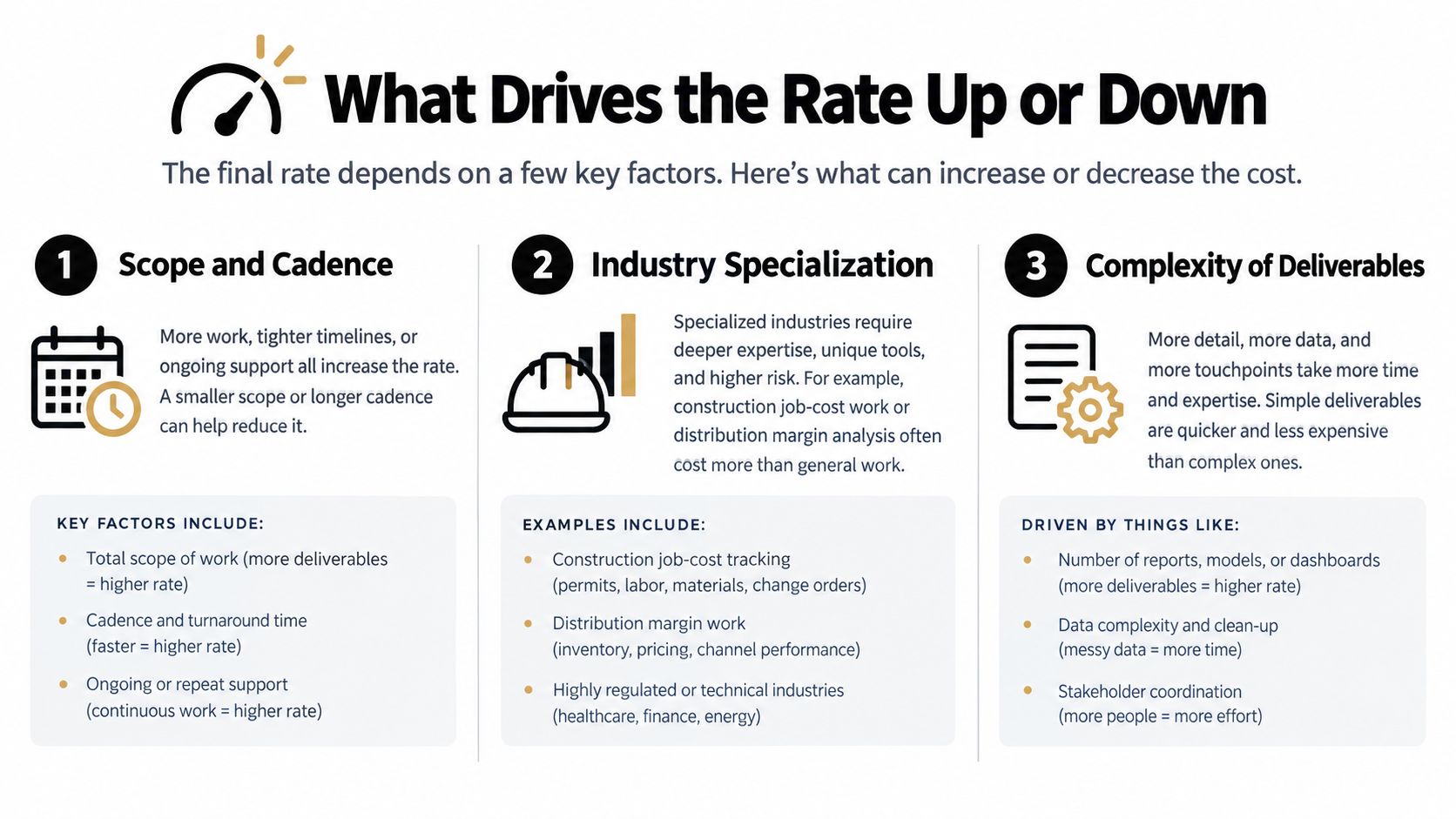
- Scope and cadence: Monthly review is lighter than weekly cash management. More frequent decisions require more reserved capacity.
- Industry specialization: Construction job-cost analysis, distribution margin work, and professional-services utilization reporting require different operating knowledge. Expect the price to rise when the CFO must make industry-specific decisions.
- Transaction involvement: Acquisitions, lender diligence, buyer diligence, and exit planning justify senior expertise because errors affect a major corporate event.
- Data and systems complexity: Multiple entities, inconsistent reporting, disconnected operational data, and weak controls increase the work before analysis can begin.
- Deliverable ownership: A CFO who only comments on reports costs less than one who builds the model, implements the reporting process, trains the team, and owns the monthly package.
- Response time: Same-day access during a financing, expansion, or cash squeeze requires reserved availability. A scheduled monthly call doesn't provide that.
- Leadership participation: Board reporting, executive meetings, and pricing or hiring decisions move the engagement from back-office analysis into embedded advisory.
- Geographic market: Published pricing can vary by market, but geography should matter only when it brings relevant executive networks, industry knowledge, or on-site requirements.
A higher rate is justified when the CFO removes work from your leadership team and owns the financial output. A lower rate is attractive only if the scope still solves the actual problem.
Ask every provider: Who builds the model? Who updates it? Who reconciles the operational data? How often do we meet? What response time is included? Which decisions will you attend?
For a deeper review of the variables behind an outsourced engagement, see factors affecting CFO cost.
Fractional Cost vs Full-Time CFO Compensation
The strongest economic case for a fractional CFO is not that the hourly rate looks low. It's that the company buys the senior capacity it needs without paying for unused full-time capacity.
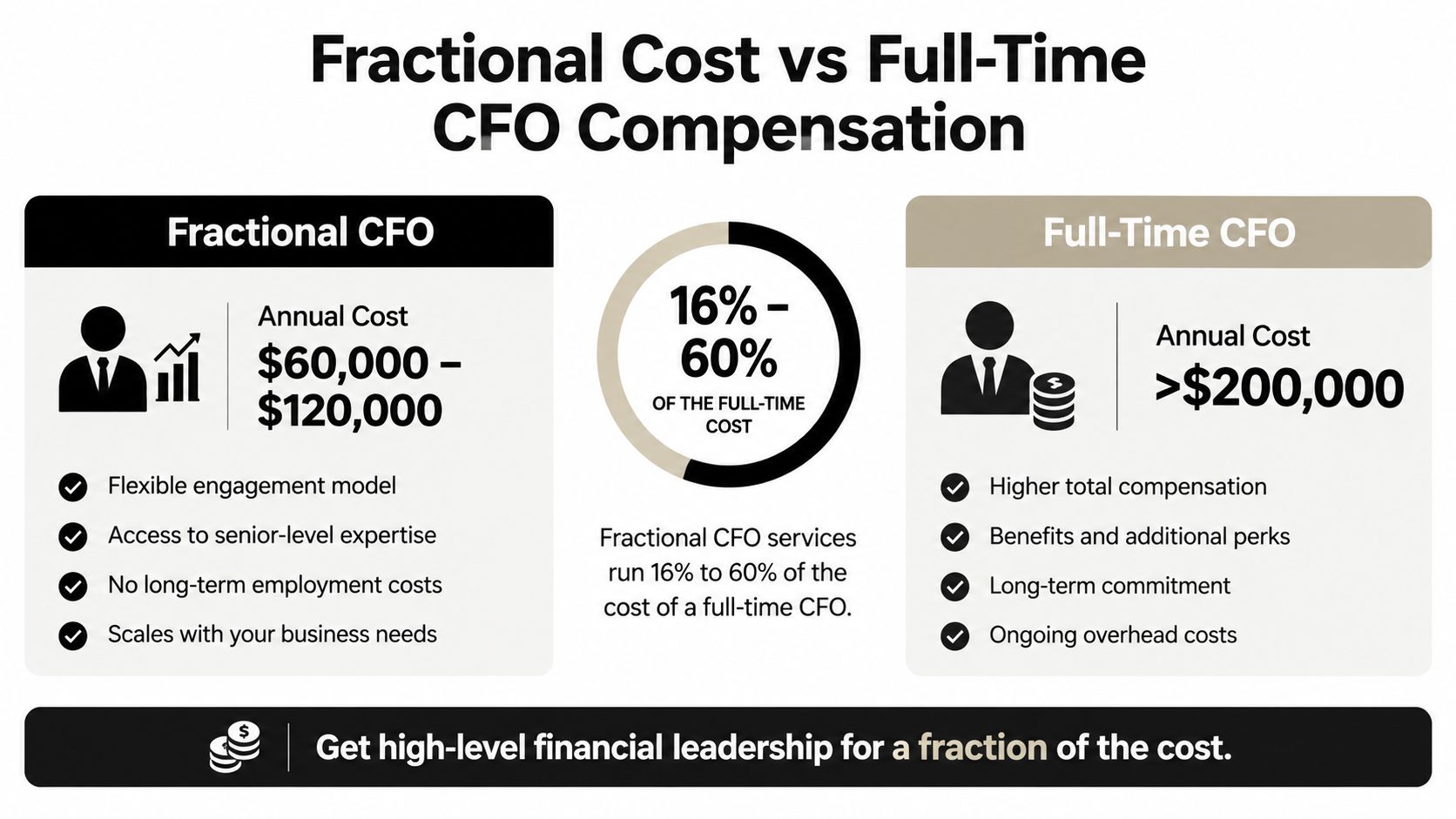
Published private-company compensation benchmarks place small-company CFO total compensation around $200,000–$350,000 and mid-sized private-company CFO total compensation around $240,000–$375,000, as summarized in this private-company CFO compensation benchmark. A separate 2025 compensation survey places U.S. CFO total cash compensation in PE-backed companies at an average of $604,000.
A fractional engagement priced at $5,000–$10,000 monthly costs $60,000–$120,000 annually. That equals roughly 16%–60% of a $200,000–$375,000 full-time compensation package, before benefits and employment overhead.
When the comparison is valid
The comparison only works if the fractional scope produces measurable financial outputs. Look for:
- Cash-conversion visibility: You can see collections, disbursements, and upcoming cash pressure clearly.
- Margin controls: You identify unprofitable jobs, clients, contracts, or service lines earlier.
- Forecast accuracy: Leadership can test hiring, equipment, pricing, and expansion decisions against a maintained model.
- Debt-capacity analysis: You understand borrowing capacity and repayment pressure before making a financing decision.
- Exit readiness: Financial reporting, operational metrics, and management processes support a credible transition plan.
A low hourly rate without reliable data, implementation ownership, or executive access can create less value than a higher rate tied to defined outcomes.
If you're weighing a permanent search, this financial executive recruiters guide can help clarify the difference between sourcing a full-time leader and buying interim capacity. For a closer look at engagement economics, see outsourced CFO services cost.
Fractional wins when you need senior modeling and decision support, but not a CFO working 40 hours per week. Full-time wins when the business needs a constant internal operator, dedicated team leadership, daily cross-functional coordination, and continuous ownership of the finance department.
How Real Engagements Get Scoped and Priced
The best way to understand fractional CFO rates is to start with the decision, not the invoice. These examples show how I'd think about scope for three founder-led companies.
A construction company losing money on jobs
A construction company with $25M in revenue discovers that several jobs are producing weak or negative margins. The need isn't a generic monthly close review. The CFO must connect estimating, labor, change orders, committed costs, billing, collections, and job-level profitability.
The recurring scope would include a 13-week cash-flow model, job-margin reporting, backlog analysis, monthly leadership meetings, and a review of project forecasts. A reasonable starting structure is 20–30 hours monthly at the senior or specialist tier, producing a retainer of $4,000–$9,000, based on the published operational-support range. The first phase may also require a separate project to rebuild the job-cost model if the source data isn't dependable.
For owners wanting a plain-language introduction to assigning shared costs, this resource on activity based costing for small businesses provides useful background.
A distributor expanding into a new region
A distribution company at $60M in revenue is adding a region and needs to decide how much inventory, warehouse capacity, working capital, and management support the expansion will consume. The CFO's value comes from connecting operational choices to cash and margin outcomes.
The scope might include weekly cash forecasting during the expansion, regional gross-margin analysis, inventory and receivables reporting, scenario modeling, lender communication, and leadership meetings. This is likely a 20–30 hour monthly retainer initially, with temporary project capacity if the company needs acquisition or financing support.
A professional-services firm preparing for an exit
A professional-services company at $15M in revenue has an owner targeting a transition within five years. The CFO should focus on client-level profitability, recurring revenue quality, delivery capacity, management depth, forecasting, and the reporting discipline a buyer will expect.
The engagement may start with a diagnostic and model build, then move into a monthly retainer covering management reporting, margin analysis, forecast updates, KPI dashboards, and exit-readiness work. Owners can use this guide on when to hire a fractional CFO to pressure-test timing and scope.
In each example, price follows the decisions supported. That's the template to use before taking a sales call.
A Five-Step Method to Score Any Proposal
Use this worksheet structure to compare proposals from any firm, including AmbitionCFO. Don't compare monthly totals until both providers are answering the same operating question.
- Define the decisions. Write down the decisions the CFO must support. Prompt: “What decision becomes safer or faster with this engagement?”
- List the deliverables. Name the actual outputs, such as a 13-week cash-flow model, management reporting, margin analysis, or an exit plan. Prompt: “What arrives, in what format, and who owns updates?”
- Set cadence and access. Specify weekly or monthly meetings, leadership participation, and response time. Prompt: “What happens when an urgent question arrives outside the scheduled meeting?”
- Convert scope into hours. Estimate the capacity required for recurring work and separate one-time projects. Prompt: “Does the proposed capacity fit the deliverables, or is the provider relying on vague access?”
- Compare outcomes and cost. Calculate effective hourly cost, annual cost, and the financial outcomes promised. Prompt: “What evidence will show that the engagement is working?”
A useful ROI framework should connect fees to decisions, not vague aspirations. This fractional CFO ROI framework offers another way to structure that evaluation.
Recalibrating the Engagement After 60 to 90 Days
Don't leave the original scope untouched after the business reveals what it needs. Recalibrate the engagement after 60–90 days using five checks:
- Actual hours used
- Deliverables completed
- Forecast accuracy
- Decisions supported
- Cash, margin, or reporting outcomes
If the CFO is spending time cleaning data instead of advising leadership, the scope needs to acknowledge implementation work. If the owner rarely uses the reserved capacity, reduce the retainer. If expansion, diligence, or cash volatility has increased the decision load, add hours or create a separate project.
The review protects both sides. You get a service aligned with current needs, and the CFO gets a clear mandate instead of an expanding list of informal requests.
Start this week by writing down the three financial decisions your team is currently making with the least confidence, then turn those decisions into a one-page scope worksheet. If the answers point to recurring cash, margin, forecasting, or exit support, book a 30-minute scoping call and test the proposed cadence before committing to a long-term package.
AmbitionCFO provides embedded fractional CFO advisory for founder-led businesses, including 13-week cash-flow modeling, profitability analysis, forecasting, KPI reporting, and exit planning. Visit AmbitionCFO to define the capacity, deliverables, and decision support your business needs.