

A pro forma budget is a decision-testing model that links operating assumptions to projected revenue, cash flow, and balance sheet position, not a static annual target. For a $10M to $100M company, the useful version connects job volume, pricing, headcount, collections, capital spending, and financing to the week your cash balance reaches its minimum.
You know the situation. Last year's budget showed a healthy profit, but a payroll scare arrived anyway because receivables grew, equipment was purchased, and customer payments landed later than expected. The income statement looked fine. The bank balance told the truth.
That gap is why a pro forma budget must do more than project sales and expenses. It must show what changes, when the cash changes, and which operating lever gives management time to respond.
Table of Contents
- What a Pro Forma Budget Actually Is
- How a Pro Forma Budget Differs From Ordinary Budgets and Forecasts
- Building the Linked Three-Statement Model
- Adapting the Model to Construction, Distribution, and Professional Services
- Walking Through an Acquisition Pro Forma Step by Step
- Governing the Model When Assumptions Change
- A 90-Day Rollout That Connects to Cash and Exit Planning
What a Pro Forma Budget Actually Is
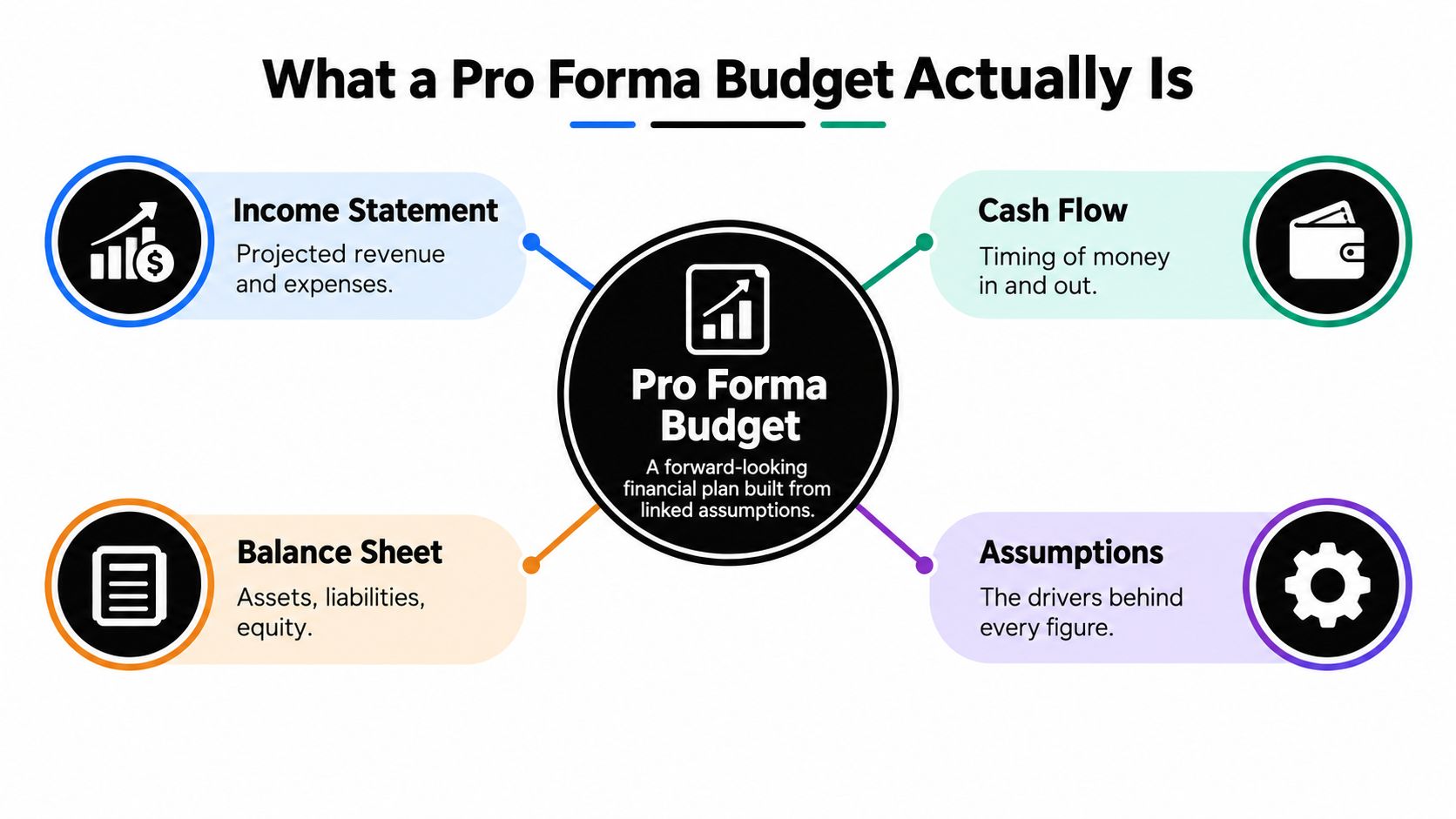
A pro forma budget is a forward-looking financial plan that models expected revenue, expenses, cash flow, resulting profit, planned capital expenditures, related depreciation, and the projected effect of those decisions on the balance sheet, as described by NetSuite's explanation of pro forma financial statements.
That definition matters because an ordinary annual budget often becomes a fixed target. Management approves revenue, payroll, overhead, and profit goals, then compares actual results with those targets after the fact. A pro forma model starts with a specific decision and asks whether the business can support it before committing capital.
The decision might be a major contract, a new project manager, a warehouse purchase, an acquisition, an expansion, or a change in customer terms. The model translates that event into monthly revenue recognition, direct costs, collections, payroll, debt service, capital spending, and ending cash.
The four components that must connect
A decision-grade model has four connected parts:
- Income statement: Projected revenue, direct costs, operating expenses, interest, taxes, and profit.
- Cash flow: The timing of customer receipts, payroll, supplier payments, taxes, capital purchases, debt activity, and distributions.
- Balance sheet: Projected cash, receivables, inventory, equipment, debt, payables, and equity.
- Assumptions: The operational drivers behind every figure, including volume, pricing, margin, hiring dates, collection timing, and payment terms.
For a founder-led business, this structure creates a common language for the owner, controller, operations leader, lender, and board. It also clarifies the difference between a budget and a forecast. The practical distinctions are laid out in this guide to budget versus forecast.
An annual budget answers, “What are we committing to?” A forecast answers, “What do we now expect?” A pro forma budget answers, “What happens financially if we make this decision under these assumptions?” That is the version that should sit in front of management before the signature, hire, purchase, or acquisition.
How a Pro Forma Budget Differs From Ordinary Budgets and Forecasts
The words budget, forecast, and pro forma often get used as if they mean the same thing. They don't.
A standard operating budget is management's planned financial target for a period. It supports accountability. A rolling forecast is the latest estimate of what the business expects to happen as actual results and market conditions change. A pro forma model isolates the effect of a defined event or assumption.
That distinction is important because planning discipline is uneven. A 2023 survey of 160 post-revenue small-business owners found that 49% maintained a regular budget, 60% had a sales-and-expense forecast, confidence in those plans was 48%, and 34% reported difficulty forecasting future cash position, profits, and revenue goals.
Those figures point to a practical problem. A business can have a spreadsheet labeled “budget” and still lack a usable decision system. The solution isn't another tab. It's assigning each planning tool a specific job.
| Tool | Purpose | Time horizon | Update cadence | Best for | Key risk if misused |
|---|---|---|---|---|---|
| Pro Forma Budget | Isolate the financial effect of a decision or event | Decision-specific, often 12 to 36 months | When assumptions or deal terms change | Hiring, equipment, contracts, acquisitions, expansion | Management accepts optimistic assumptions as fact |
| Standard Budget | Set annual operating targets and accountability | Annual, expressed by month | Usually annual, with formal revisions | Department plans, spending control, profit targets | It becomes obsolete when conditions change |
| Rolling Forecast | Update the expected outcome using actual performance | Near term through the operating outlook | Monthly or on an agreed close cycle | Liquidity, staffing, pricing, cash planning | It reports movement without explaining the decision causing it |
A company needs all three. The annual budget establishes the operating promise. The rolling forecast keeps management aware of current liquidity. The pro forma budget tests the specific move that could change the business.
Practical rule: Never approve a major hire, contract, equipment purchase, or acquisition from the annual budget alone. Run the decision through a separate pro forma scenario.
Building the Linked Three-Statement Model
An earnings-only budget can make profitable growth look safe when it isn't. A project may produce accounting profit while receivables accumulate, payroll runs weekly, materials must be purchased immediately, and customer receipts arrive later. Equipment purchases create the same problem when the cash leaves before the asset contributes to revenue.
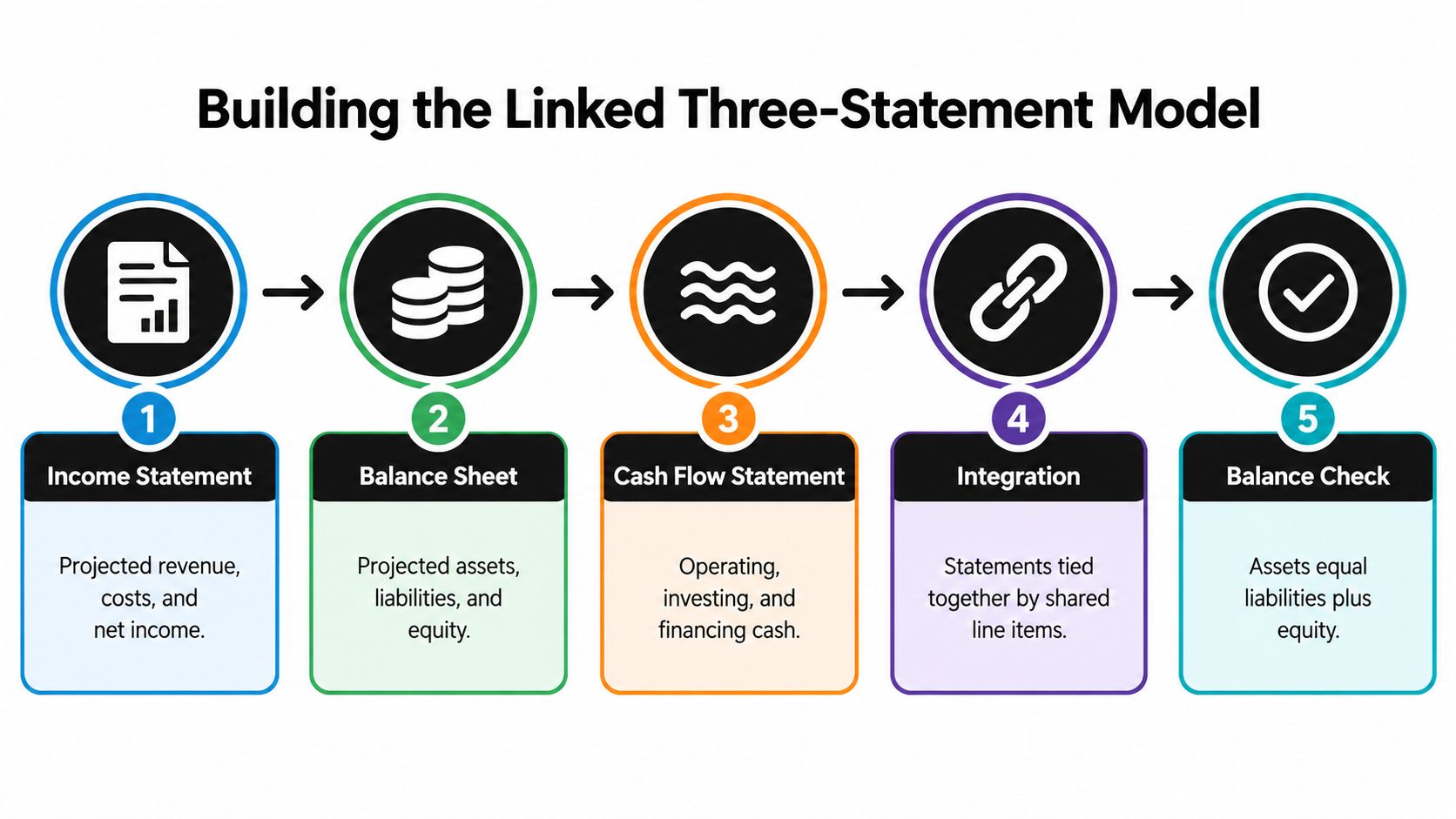
A technically sound model therefore connects revenue, direct costs, operating expenses, working capital, capital expenditures, debt activity, and financing sources across the projected income statement, balance sheet, and cash-flow statement. The FDIC guidance on pro forma cash flow statements supports this integrated approach, including the accounting links between net income, retained earnings, and reconciled cash.
Start with operating reality
Don't begin with a growth percentage. Begin with the mechanics of the business.
A construction model needs job starts, backlog conversion, billings, retainage, labor timing, subcontractor payments, change orders, and customer collections. A distributor needs purchase orders, inventory receipts, supplier terms, receivables aging, and borrowing capacity. A professional-services firm needs utilization, staffing starts, realization, billing timing, and collection speed.
Those drivers feed the statements:
- Build the income statement. Project volume, price, direct cost, gross margin, payroll, overhead, interest, taxes, and net income by month.
- Build working capital. Convert payment terms, collection days, inventory purchases, retainage, and supplier terms into projected receivables, inventory, payables, and cash timing.
- Build capital and financing schedules. Add equipment purchases, depreciation, new debt, principal repayments, interest, owner distributions, and equity contributions.
- Link the statements. Net income affects retained earnings. Capital spending affects equipment and investing cash flow. Debt activity affects liabilities and financing cash flow. Ending cash reconciles through operating, investing, and financing activity.
- Check the balance sheet. Assets must equal liabilities plus equity in every projected period.
A spreadsheet can support this work if it remains controlled and auditable. For teams building models in Excel, these Excel formulas and shortcuts from Cloudvara can help reduce repetitive work, but shortcuts don't replace documented assumptions or review controls.
Connect strategic and near-term views
Use the pro forma budget for a 12 to 36-month strategic view. Pair it with a 13-week cash forecast that shows the immediate payment capacity of the business. The long-range model answers whether the decision works economically. The short-range forecast shows whether the company can fund the next payroll, supplier cycle, tax payment, or debt installment.
The model should expose the minimum cash week, not just ending cash for the year. That is the number management acts on.
For a practical build sequence and model architecture, use this resource on how to build financial models. A lender, board member, or future buyer should be able to trace each material result back to an operating assumption.
Adapting the Model to Construction, Distribution, and Professional Services
The three-statement structure stays consistent across industries. The drivers don't.
A contractor can show a strong backlog and still face a liquidity squeeze if billing milestones move, retainage accumulates, labor overruns rise, or one large project dominates the forecast. A distributor can report growing sales while cash is trapped in inventory and receivables. A professional-services firm can add revenue while margins weaken because utilization falls or new employees start before demand arrives.
| Construction | Distribution | Professional services | Primary cash risk | What to stress-test |
|---|---|---|---|---|
| Backlog conversion, billings, retainage, change orders, subcontractors | Inventory buys, supplier terms, receivables aging, borrowing line | Utilization, realization, staffing starts, project mix | Growth consumes cash before collections arrive | Delayed receipts, margin compression, and capacity commitments |
| Project concentration, labor schedule, payment milestones | Stock levels, purchasing cadence, customer concentration | Collection speed, senior staff mix, unbilled work | One operating assumption moves the minimum cash week | Downside demand, slower collections, and higher direct costs |
Construction
Translate the backlog into monthly billings and cash receipts, not just future revenue. Isolate retainage, change-order approval timing, subcontractor payment dates, labor overruns, and the cash effect of project concentration. A $40M contractor should know which project delay moves the minimum cash week and whether the business has financing capacity before that delay occurs.
If the decision involves project financing or a renovation-related capital commitment, management should also understand the process and documentation expected by lenders. A practical overview of the Quicklending LLC loan process can provide useful context, but the pro forma must still test the company's own repayment capacity.
Distribution
Model inventory as cash, not as a sales-supporting footnote. The schedule should show purchase timing, supplier payment terms, receivables aging, safety stock decisions, and the borrowing line required to carry the inventory. A sales increase may improve profit while worsening cash if customers pay slowly and suppliers require payment sooner.
The cost structure should reconcile cleanly with a monthly schedule for cost of goods sold. Isolate the first driver that creates volatility, usually inventory turns, customer collections, or purchasing cadence.
Professional services
Start with capacity. Connect billable utilization, realization, staffing starts, compensation, project mix, unbilled work, and collections. Hiring ahead of demand can be the right strategic move, but the model should show the cash cost before the additional team produces billable work.
Your first worksheet should identify the two or three drivers that move cash most aggressively. For contractors, start with backlog conversion. For distributors, start with inventory turns. For services firms, start with utilization and collection speed.
Walking Through an Acquisition Pro Forma Step by Step
Consider a $40M distributor evaluating the purchase of a $10M competitor. The first mistake would be to add the target's revenue to the buyer's revenue and call the result a pro forma budget.
A defensible acquisition model separates historical results, proposed adjustments, and pro forma results. This presentation makes the mechanics auditable, a discipline also reflected in SEC reporting guidance summarized by Deloitte.

Start with the buyer's actual financial statements and the target's historical statements. Then isolate only the changes caused by the transaction.
| Illustrative acquisition item | Historical results | Proposed adjustment | Pro forma result |
|---|---|---|---|
| Buyer revenue | $40M | Target revenue added | Combined revenue |
| Target revenue | $10M | Included in transaction scenario | Included in combined outlook |
| Duplicate operating costs | Included in historical results | $300,000 cost synergies | Reduced combined costs |
| New financing costs | Not included | $400,000 | Added interest and financing burden |
| Receivables and inventory | Separate balances | Combined working-capital needs | Revised cash requirement |
| Debt service | Existing obligations | New acquisition debt | Total repayment requirement |
The adjustment column forces management to answer difficult questions. Which costs disappear? When do the savings begin? How much inventory must the combined business carry? Do receivable terms change? Does the combined company need a larger working-capital borrowing line? Can it service the new debt and still fund normal purchasing?
A revenue-only model hides those questions. A linked pro forma puts them in the same decision.
Review the supporting assumptions through a structured financial due diligence process. The model should distinguish verified historical results from management estimates, purchase accounting effects, financing terms, integration costs, and expected synergies.
The lender conversation also requires timing. The Small Business Administration planning convention calls for a one-year projected cash-flow statement and three years of projected income statements, with a rationale supporting the projections, as described in this SBA business-plan outline. Build the cash flow monthly so the lender can see when receipts arrive, when inventory must be purchased, and when debt service begins.
Here is a short visual explanation of how the model supports that conversation:
The acquisition should proceed only if the combined business can fund operations through the weakest cash period, not merely produce an attractive annual profit.
Governing the Model When Assumptions Change
Most pro forma failures are governance failures. The spreadsheet isn't the problem. Undocumented assumptions, optimistic revenue bias, and a static annual review are the problem.
A 2025 KeyBank flash poll found that 50% of surveyed small-business owners identified inflation and rising costs as their top concern, while 69% expected revenue to increase over the following year. During the same period, cash-flow comfort declined from 72% to 66%, and 33% valued advisory support for financial planning and forecasting, according to the KeyBank flash poll.
The lesson is direct. Revenue optimism cannot substitute for cash evidence.
Use an operating control system
Assign one owner to every material assumption. Record the source, date, rationale, and next review date. Then compare actual results with the assumption that produced the forecast, not only with last year's budget.
| Assumption reviewed | Owner | Variance threshold | Management action if breached | Review cadence |
|---|---|---|---|---|
| Revenue volume and price | Sales leader | Agreed variance against forecast | Reprice work, revise pipeline, or pause commitments | Monthly |
| Gross margin | Operations or delivery leader | Agreed margin variance | Review labor mix, purchasing, and scope control | Monthly |
| Collections | Controller | Agreed cash forecast error | Escalate receivables, revise terms, or draw approved credit | Weekly and monthly |
| Headcount timing | CEO and department leader | Hiring plan no longer supported by demand | Defer hiring or approve only critical roles | Monthly |
| Capital spending | Owner and CFO | Cash floor or return case no longer holds | Defer purchase or revise financing | Before commitment |
Run a base case, downside case, and capacity-constrained upside case. The downside should test slower collections, weaker margins, delayed hiring benefits, higher supplier costs, and postponed project starts.
Use a monthly meeting agenda:
- Review actual revenue, gross margin, and cash against the forecast.
- Identify which assumption changed and who owns it.
- Update the base case and preserve the prior version.
- Confirm the minimum cash week under downside conditions.
- Decide whether to pause hiring, reprice work, renegotiate terms, draw credit, or defer equipment.
- Record the decision and its trigger.
You can trust the model enough to act when its assumptions are visible, its historical bias is measured, its statements reconcile, and management has agreed in advance what action follows a breach.
A 90-Day Rollout That Connects to Cash and Exit Planning
Start on Monday with three linked views:
- A 12 to 36-month pro forma budget for strategic decisions.
- A 13-week cash forecast for immediate liquidity, using this 13-week cash flow framework.
- An assumption register that assigns ownership, review dates, variance thresholds, and management actions.
During the first 30 days, clean the historical financials, capture operating assumptions, map collections and payment terms, and identify the drivers that move minimum cash. During days 31 through 60, build the integrated statements, add base and downside scenarios, and test hiring, equipment, pricing, contract, and financing decisions. During days 61 through 90, establish the monthly governance meeting, publish the KPI dashboard, and prepare lender or board materials.
Use the pro forma to protect weekly cash during a growth year and to create a documented financial picture for an owner planning an exit in three to ten years. If expansion involves property or development commitments, the developer finance overview from ABS Insurance Brokers can help frame financing considerations, but your own linked model must determine affordability.
Don't wait for the next annual planning cycle. Book a working session with a fractional CFO who can build the first three statements, identify the minimum cash week, and run the first governance meeting agenda within 30 days.
AmbitionCFO builds integrated budgets, rolling forecasts, 13-week cash-flow models, margin analyses, KPI dashboards, and exit-planning models for founder-led companies in construction, distribution, and professional services. Visit AmbitionCFO to start a working conversation about turning your pro forma budget into a decision system.