

Net working capital is current assets minus current liabilities. A positive balance can still hide a timing problem, so it doesn't guarantee your business can pay next Friday.
That's the situation many owners face. The balance sheet looks comfortable, receivables and inventory outweigh payables, yet the bank balance is tight and payroll is due. Profit is on the income statement, but cash is trapped in unpaid invoices, work in progress, or stock that hasn't moved.
The practical question isn't only, “What is net working capital?” It's how much cash can the business access before its next major obligations fall due. A useful answer connects the balance sheet to a rolling 13-week cash forecast and the cash conversion cycle, not to a single month-end number.
Table of Contents
- Why a Healthy Balance Sheet Can Still Leave You Broke
- The Net Working Capital Formula and How to Calculate Yours
- Reading the Number Without Getting Misled
- Connecting Net Working Capital to Cash Flow and KPIs
- What NWC Looks Like in Construction, Distribution, and Services
- Short-Term Tactics and Strategic Moves That Improve NWC
- How a Fractional CFO Models and Improves Net Working Capital
Why a Healthy Balance Sheet Can Still Leave You Broke
A growing contractor can review a healthy balance sheet and still struggle to fund Friday's payroll. Current assets exceed current liabilities, yet cash remains thin because the asset balance sits in unbilled work and receivables awaiting milestone approvals.
Profit does not settle invoices. Signed contracts do not pay employees. Cash arrives only when customers approve and pay the work, while payroll, suppliers, and tax obligations follow their own deadlines.
Treat net working capital as a short-term operating resilience measure, not proof of liquidity. A positive figure helps only when its assets convert to usable cash before obligations fall due. A negative figure means short-term liabilities exceed current assets and can signal pressure in collections, inventory, refinancing, or payment timing. The definition and formula are explained in OpenStax's explanation of working capital.
Practical rule: A balance-sheet asset supports an obligation only after it becomes usable cash before that obligation is due.
Run the balance-sheet view against a rolling 13-week cash forecast and the cash conversion cycle. The forecast shows when cash is available. The cycle shows how long money remains tied up between paying suppliers and collecting customers. If receivables take 60 days to collect and suppliers require payment in 30 days, reducing collection time by 10 days can release roughly 10 days of sales from working capital. The exact cash released depends on daily sales, but the decision is clear: shorten the cycle before adding debt.
Accrual accounting can hide the timing gap. Revenue may be recorded before collection, and expenses may be recognized before payment. Use this guide to converting accrual to cash to reconcile reported earnings with bank activity, then test the result against upcoming payroll and supplier payments.
Run the worksheet in the next section. Within fifteen minutes, you can see whether positive NWC represents collectible cash or a timing gap.
The Net Working Capital Formula and How to Calculate Yours
Start with the balance-sheet calculation:
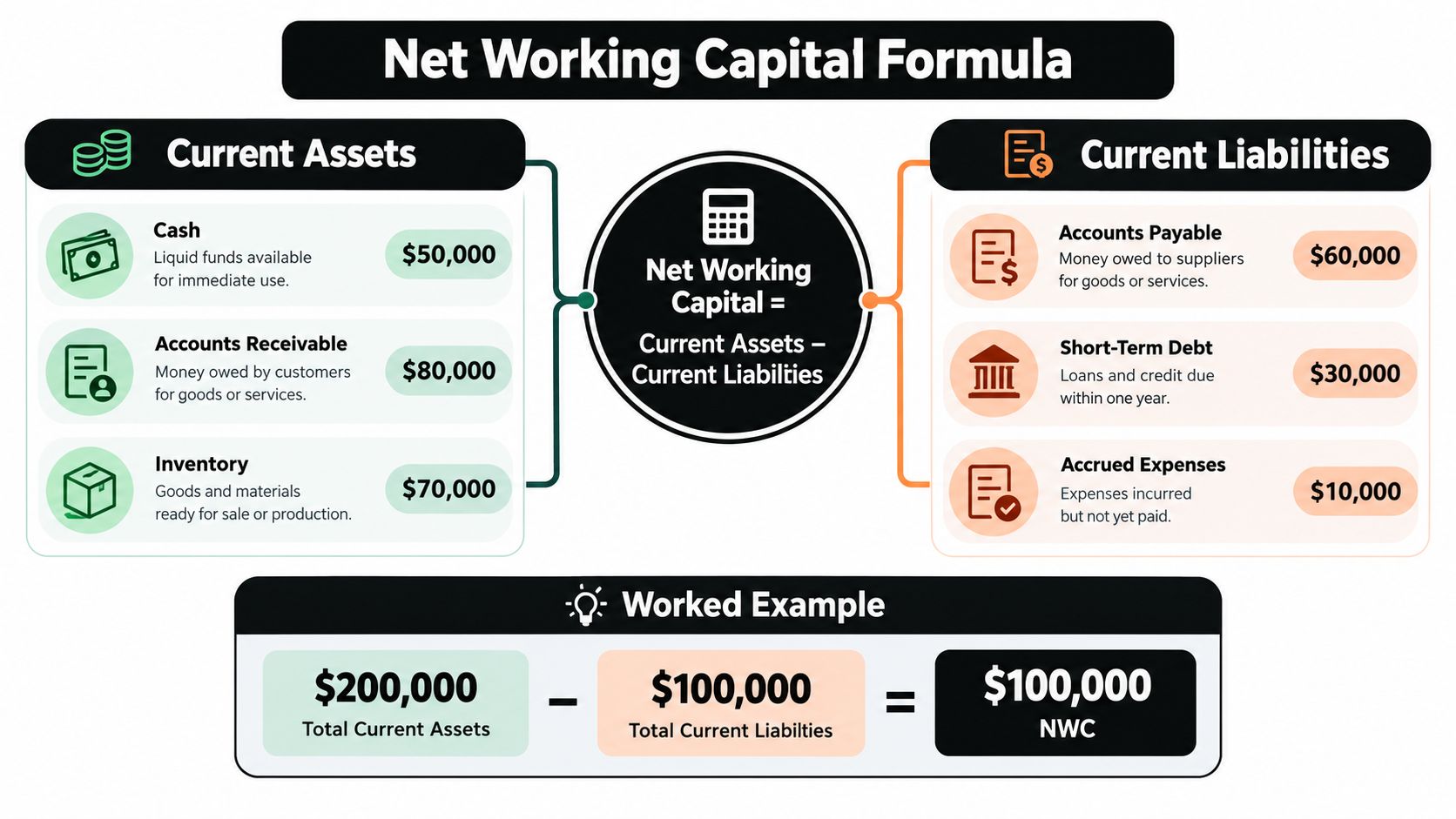
Net working capital = Current assets − Current liabilities
Current assets generally include cash, accounts receivable, inventory, marketable securities, and other resources expected to convert into cash within one year. Current liabilities generally include accounts payable, accrued expenses, short-term debt, deferred revenue, and other obligations due within one year.
A business with $1,000,000 of current assets and $750,000 of current liabilities has $250,000 of net working capital. Before calculating, check classification. Owners often place restricted cash, disputed receivables, retainage, or debt due soon in the wrong bucket, which can distort the result.
The operating version owners should use
For operating decisions, calculate operating NWC separately. Add trade receivables, inventory, and other operating current assets, then subtract accounts payable and accrued operating liabilities. Exclude excess cash, debt, and other financing items, which belong in financing and liquidity analysis. A technical reference on operating working capital explains this distinction.
Consider a distributor with:
- Receivables: $1.8 million
- Inventory: $2.2 million
- Cash: $400,000
- Current liabilities: $2.7 million
Its standard NWC is $1.7 million. The operating view isolates the capital tied up in receivables and inventory after operating obligations are considered. For practical checks on the calculation, use these working capital tips from MyOfficeOps.
A fifteen-minute worksheet
Pull the latest balance sheet and record:
- Total current assets.
- Total current liabilities.
- Current assets minus current liabilities.
- Trade receivables, inventory, and other operating current assets.
- Accounts payable and accrued operating liabilities.
- Operating assets minus operating liabilities.
- The largest month-over-month movement in each category.
Calculate this monthly, then explain each material movement through sales growth, purchases, collections, payroll, taxes, or supplier timing. Add the result to the rolling 13-week cash forecast. Then use the working capital cycle guide to connect the balance-sheet movement to the cash conversion cycle. A reduction of one cycle day releases roughly one day of sales from working capital, so the forecast shows how many days the business must remove to fund near-term cash needs.
Reading the Number Without Getting Misled
Positive NWC isn't automatically good, and negative NWC isn't automatically bad. The quality of the balance depends on how quickly each component becomes cash and when each liability must be paid.
A receivable due promptly is more useful than an invoice under dispute. Inventory that sells regularly is more useful than obsolete stock. Retainage, unbilled work, and contract assets may qualify as current assets while remaining unavailable for payroll or suppliers. On the liability side, accounts payable, accrued compensation, taxes, deferred revenue, and current debt maturities can have very different payment dates and consequences.
A contractor could report $900,000 of current assets against $600,000 of current liabilities, producing $300,000 of positive NWC, yet still face a cash shortfall if $700,000 of those assets consists of unbilled work in progress or receivables due after payroll and subcontractor payments. The arithmetic is correct. The cash conclusion is wrong.
Watch the trend, not just the snapshot
Growth often increases the amount of capital committed to operations. A Federal Reserve Bank of Chicago working paper found that median firm working capital grew at an average real annual rate of 11.3%, compared with 10.2% annualized real growth in median fixed capital over its sample period, as reported in the Federal Reserve Bank of Chicago working paper.
That history matters because an owner can increase sales and reported profit while cash becomes tighter. More sales can create more receivables, more inventory purchases, more payroll commitments, and more work in progress before the customer pays.
Use three tests every month:
- Receivables: What proportion can you realistically collect within the next 13 weeks?
- Inventory: Which items will convert into sales, and which items are merely occupying cash?
- Liabilities: Which obligations mature before those collections and sales occur?
A positive answer on the balance sheet is not enough. Your business needs assets that convert before the bills arrive.
Connecting Net Working Capital to Cash Flow and KPIs
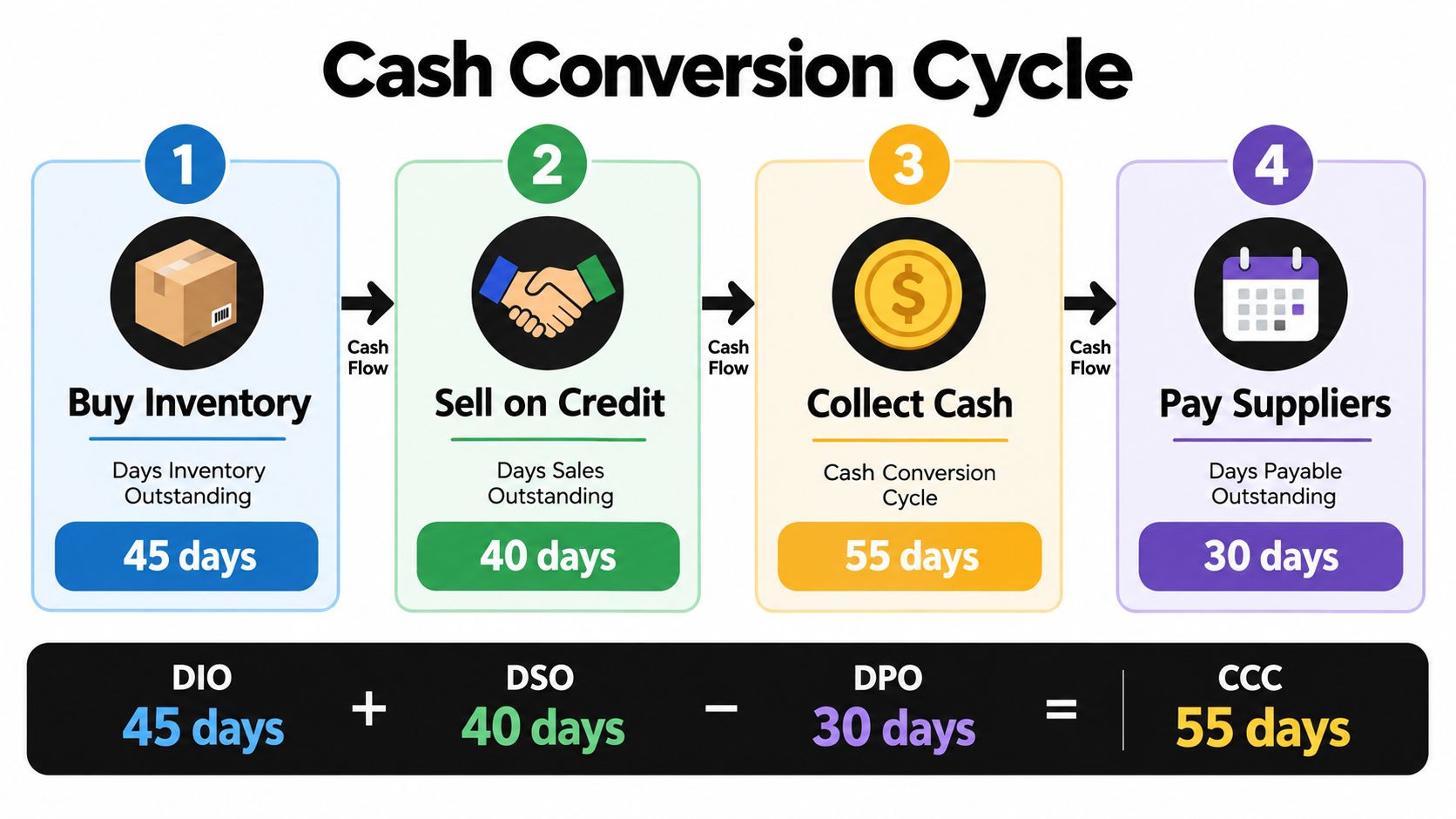
A balance sheet shows the amount tied up in operations. Your rolling 13-week cash forecast shows when that money will arrive or leave. Connect both views through the cash conversion cycle, or CCC:
CCC = DIO + DSO − DPO
DIO, or days inventory outstanding, measures how long stock remains tied up. DSO, or days sales outstanding, measures how long customers take to pay. DPO, or days payables outstanding, measures how long the company takes to pay suppliers.
CCC becomes useful when each component has an owner and a cash target. Reduce DSO to collect sooner, lower DIO to release cash from stock, and manage DPO around agreed supplier terms. Stretching payments beyond those terms can disrupt supply or weaken credit standing, so the objective is controlled timing, not delayed payment at any cost.
On $20 million of annual credit sales, cutting DSO by 10 days releases roughly $548,000, calculated as 20,000,000 divided by 365 and multiplied by 10, before tax and financing effects. Set a day-reduction target with the team, then multiply the days removed by daily credit sales to price the collection effort.
Build the dashboard around decisions
Track these measures together:
- NWC as a percentage of trailing revenue: Shows whether sales growth requires more short-term capital.
- DSO by customer or job: Exposes slow-paying accounts hidden by the company average.
- DIO by product category: Separates productive stock from slow-moving inventory.
- DPO by supplier group: Shows whether payment timing follows agreed terms.
- CCC by segment: Identifies customers, contracts, or product lines that consume cash.
A 2024 meta-study covering 43 papers, almost 62,000 enterprises, and 35 countries found a common negative relationship between profitability and the cash-conversion cycle, including significant negative relationships involving collection, payable, and inventory-cycle measures, as reported in the cash-conversion-cycle research. Slow collections and excess inventory can therefore create financing pressure while reported profit remains positive.
Feed segment-level operating measures into the same 13-week forecast. A construction job, distribution category, and professional-services client can have different billing, inventory, and supplier patterns. Your supply chain KPI framework should help organize those measures.
Every week, ask:
- Which receipts moved out of the forecast?
- Which payments moved forward?
- Which DSO, DIO, or DPO assumption changed?
- What cash action will correct the variance?
That cadence turns NWC from a static balance-sheet figure into a management system tied to real cash decisions.
What NWC Looks Like in Construction, Distribution, and Services
The same formula behaves differently across industries. Owners get into trouble when they compare the dollar balance without comparing the operating cycle that created it.
| Industry | Primary NWC Drivers | Common Trap | Benchmark to Watch |
|---|---|---|---|
| Construction | Receivables, retainage, unbilled work, change orders, milestone billing | Counting approved or expected billings as near-term cash | NWC relative to revenue, DSO by job, and forecasted collections |
| Distribution | Inventory, receivables, supplier terms, stock availability | Buying excess stock to avoid shortages while cash remains tied up | DIO by category, DSO by customer, and DPO by supplier |
| Professional services | Unbilled work, retainers, milestone billing, payroll timing | Recording profitable work before invoices are issued or collected | WIP conversion, DSO by client, and NWC relative to revenue |
Construction
A contractor may fund labor, materials, subcontractors, and equipment before a customer approves a payment application. Retainage and change orders can increase reported current assets while delaying cash. The owner should review each job's billed amount, unbilled work, approval status, expected collection date, and upcoming payroll or subcontractor commitments.
The key test is whether NWC is growing faster or slower than revenue. If revenue rises while unbilled work and receivables expand more quickly, the contract may be profitable but cash-negative.
Distribution
A distributor needs enough stock to serve customers, but every purchase ties up cash until the product sells and the receivable is collected. Supplier financing can reduce the gap, while slow-moving inventory can make a positive NWC balance look stronger than it is.
Review inventory by category, not only in total. Separate items that turn into sales from items that have become expensive storage. The right decision may be a purchasing change, a clearance plan, or a customer-specific stocking policy.
Professional services
A services firm can record work before billing it, particularly when invoices depend on milestones, approvals, or timesheet completion. Retainers may improve cash timing, while large projects with delayed billing can absorb cash through payroll before the client pays.
Payment terms make the problem larger. 60% of U.S. small businesses with longer payment terms reported cash-flow problems, compared with 40% of businesses requiring immediate payment, while average U.S. B2B payment terms were reported near 45 days from invoicing, according to the small-business late-payments report.
Before accepting a new contract, ask:
How much additional revenue can we safely accept before receivables, inventory, payroll, and vendor timing consume our cash?
A profitable contract with extended payment terms may require deposits, milestone billing, a retainer, or financing support before you accept it.
Short-Term Tactics and Strategic Moves That Improve NWC
Improving NWC means releasing trapped cash without damaging delivery, supplier relationships, or customer economics. Start with the levers that can move inside the next month, then address contract and financing decisions that shape the next quarter.
Tactics that can move quickly
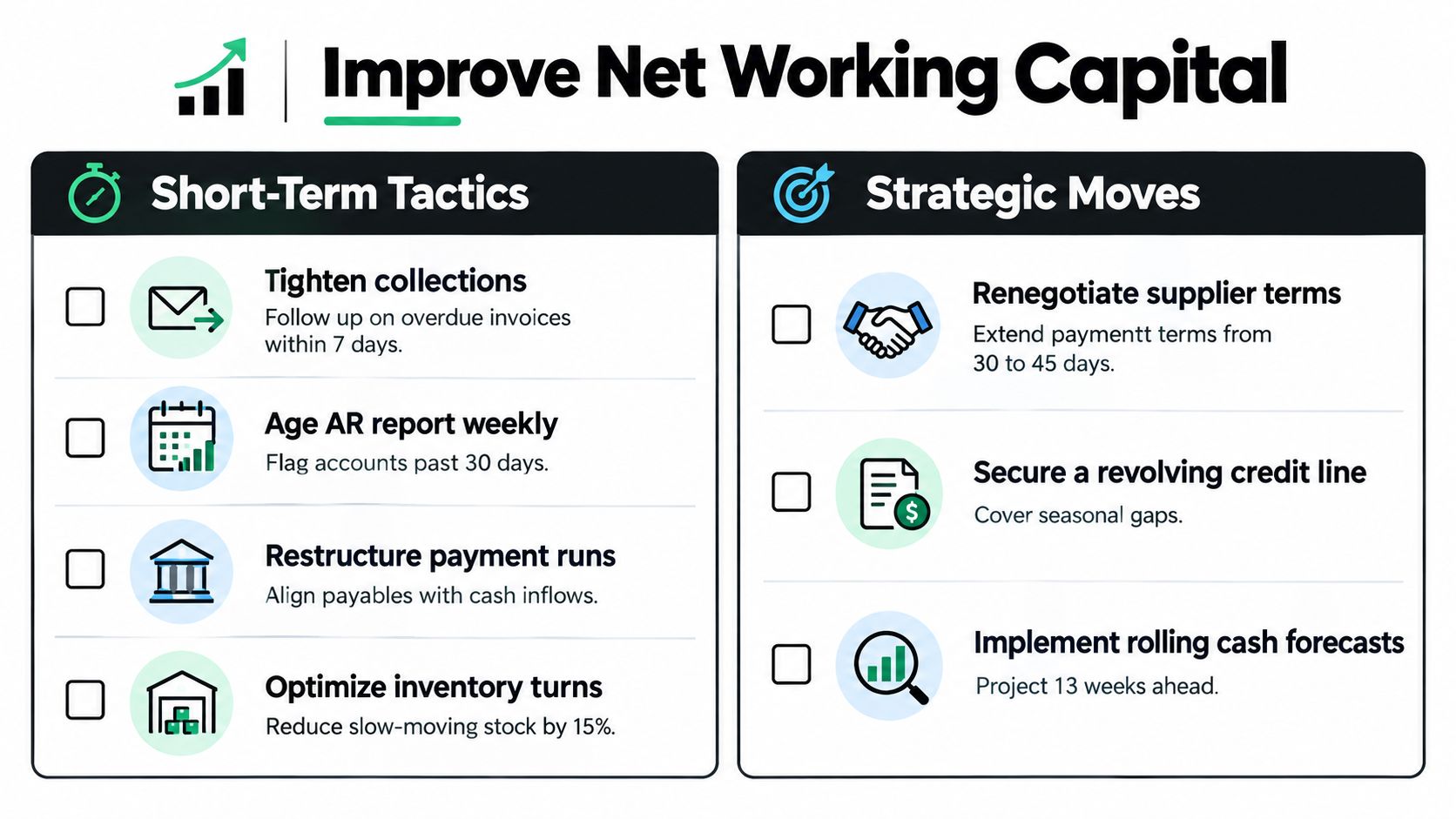
Collections: Age the receivables report weekly. Assign a person to every overdue account, confirm the dispute or approval blocker, and set the next contact date. Faster collection lowers DSO and increases cash without requiring new sales.
Invoicing: Issue invoices immediately after the contractual billing event. For project businesses, connect invoice release to milestone completion, signed change orders, and approved timesheets.
Payment runs: Align supplier payments with actual terms and the forecasted cash inflow. Don't pay early by habit, but don't miss agreed dates and create avoidable friction.
Inventory: Identify slow-moving stock and stop replenishing it until demand justifies another purchase. The goal isn't the lowest inventory balance. It's enough inventory to serve customers without funding idle goods.
For procurement decisions, a practical procurement savings guide from BoloSign can help your team examine purchasing controls and supplier economics.
Strategic moves that change the operating model
Require deposits, retainers, or milestone billing when the company must fund labor or materials before delivery. Reprice contracts when payment timing creates financing costs. Renegotiate supplier terms where volume, reliability, or contract length supports a better schedule.
A distributor might ask a supplier to extend terms while keeping the same order discipline. A professional-services firm might replace one large final invoice with milestone billing. A contractor might require mobilization funding before committing crews and materials.
Use the working capital optimization framework to connect each action to NWC, DSO, DIO, DPO, and forecasted cash.
Pick two or three levers, assign each to a named person, and review them in the same weekly meeting as the 13-week forecast. Avoid a long improvement list with no owner. A smaller set of completed actions will beat a larger set of intentions.
How a Fractional CFO Models and Improves Net Working Capital
A fractional CFO turns the formula into a decision process. The work starts with clean current-asset and current-liability data, then separates operating NWC from financing items, maps DSO, DIO, and DPO by segment, and builds a rolling 13-week cash forecast.
The leadership team can then test decisions before committing cash. What happens if hiring accelerates? Can the company fund equipment? Which contract terms create a cash gap? How much borrowing capacity is needed during a seasonal peak? The same model can support expansion, acquisition preparation, or exit planning.
AmbitionCFO provides this type of working-capital analysis, cash-flow modeling, KPI reporting, and financial forecasting for founder-led businesses. This is senior-level financial strategy, not bookkeeping, tax preparation, or audit work. Owners who want to understand the broader role can review what a fractional CFO does, while NAS Ledger CFO solutions offers another reference point for virtual CFO support.
Book a working-capital diagnostic this week. Bring your latest balance sheet, receivables aging, inventory report, payables aging, and near-term payment schedule so the review produces specific actions rather than another abstract ratio.
AmbitionCFO helps founder-led businesses connect net working capital, the cash conversion cycle, and a rolling 13-week forecast to decisions about hiring, contracts, equipment, and growth. Visit AmbitionCFO to discuss a working-capital diagnostic and identify the two or three cash levers your team should pull first.