

You've received a letter of intent, the headline price looks attractive, and you're already thinking about what the deal will fund. Then the buyer's accountants open the data room. They question revenue recognition, owner expenses, customer concentration, inventory, tax filings, and the amount of cash the business needs to operate. Suddenly, the purchase price feels negotiable.
That outcome isn't inevitable. Financial due diligence gives you a way to find those issues before the buyer does, decide which problems require action, and convert financial findings into better decisions about hiring, capital spending, pricing, and exit timing. For a founder-led company, the right objective isn't just to survive a buyer's review. It's to make the business easier to understand, harder to discount, and more valuable whether or not a transaction closes.
Table of Contents
- What Financial Due Diligence Actually Means for Your Business
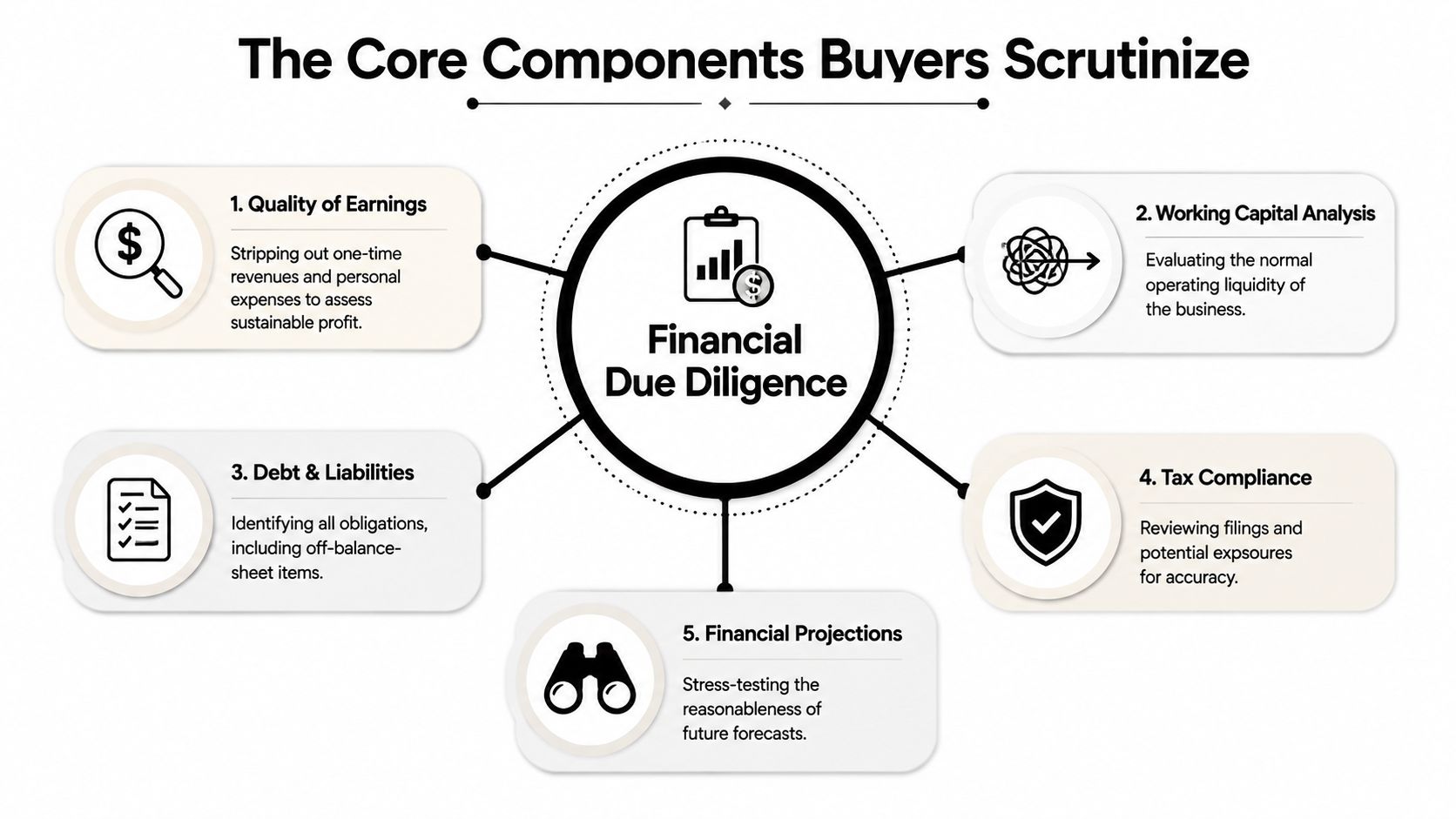
- The Core Components Buyers Scrutinize
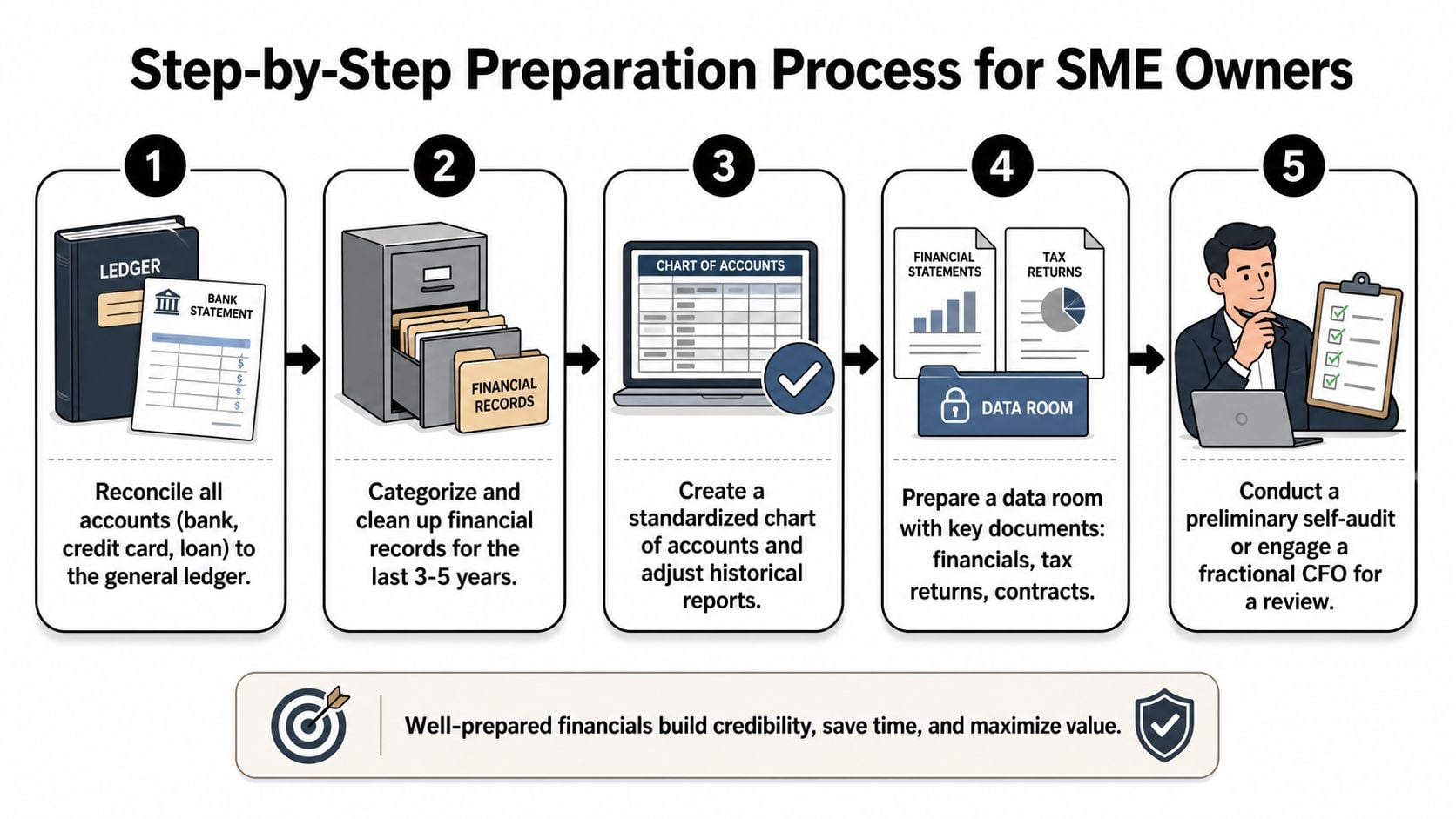
- Step-by-Step Preparation Process for SME Owners
- Key Metrics and Red Flags That Make or Break Deals
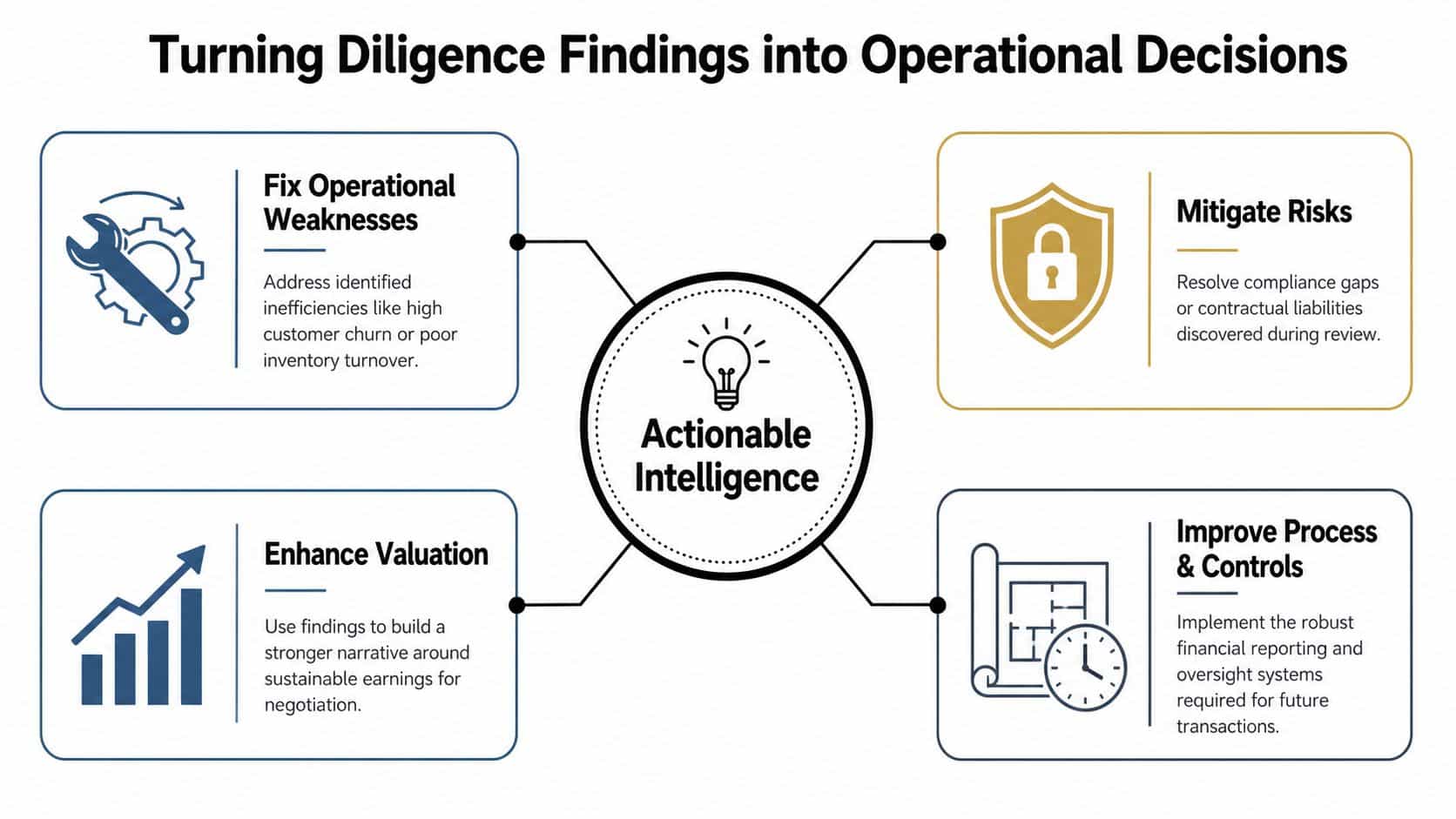
- Turning Diligence Findings into Operational Decisions
- How a Fractional CFO Accelerates Your Preparation
- Your 90-Day Financial Due Diligence Checklist
What Financial Due Diligence Actually Means for Your Business
A founder of a growing services company had spent months negotiating with a strategic buyer. The letter of intent was signed, employees had been told that a transaction was possible, and the owner had started planning a partial exit.
The buyer's review changed the tone. The company had recorded several large projects when milestones were reached, but the supporting schedules didn't clearly reconcile invoices, cash collections, and deferred revenue. The owner had also run personal travel and vehicle costs through the business. None of these items automatically killed the deal. The problem was that the buyer had to reconstruct the financial story instead of trusting it.
That reconstruction is financial due diligence, a buyer-driven examination of historical financial performance, financial health, cash generation, liabilities, and forecasts between the letter of intent and closing. It isn't an audit. An audit focuses on whether financial statements are presented according to an applicable reporting framework. Due diligence asks a different commercial question: What earnings, cash flow, working capital, obligations, and risks will transfer to the buyer?
Practical rule: If you can't explain a material financial movement with a schedule and supporting documents, expect the buyer to treat it as a risk.
The buyer's question
The buyer wants to validate the assumptions behind the offer. That means testing whether reported EBITDA reflects sustainable operating earnings, whether revenue will repeat, whether the business needs more working capital than the purchase agreement assumes, and whether debt-like obligations sit outside the obvious debt schedule.
A quality-of-earnings review typically produces a normalized EBITDA calculation, a net working capital analysis, and a working capital peg for the purchase agreement, as described in this quality-of-earnings overview. Normalized EBITDA removes unusual or non-operating items so both sides can discuss the earnings base that a new owner can reasonably expect.
The seller's opportunity
Sellers often treat diligence as an administrative burden. That's a mistake. A prepared seller can explain unusual results, document legitimate adjustments, demonstrate control over cash flow, and challenge unsupported purchase price reductions.
Financial due diligence became a standard control process in major M&A markets rather than a niche exercise reserved for very large transactions. A German-market study cited in a University of St. Gallen paper found financial due diligence in 94% of investigated M&A transactions, while a later study found financial, including tax, diligence in 94.7% of transactions and legal diligence in 89.8%. The same source reports that, in the transactions examined as far back as 1999, financial diligence appeared in 94%, tax diligence in 82%, and legal diligence in 78% of transactions, according to the University of St. Gallen paper.
The message for an SME owner is straightforward. Buyers expect evidence. Your financial reporting needs to answer questions before they become a point of negotiation. A strong reporting foundation, explained further in this guide to financial reporting, gives you that foundation.
The Core Components Buyers Scrutinize
Buyers don't review every line with equal intensity. They focus on the areas most likely to change sustainable earnings, cash requirements, liabilities, or the probability that projected performance will arrive.
Quality of earnings
Quality of earnings, or QoE, tests whether reported EBITDA converts into repeatable cash earnings. Buyers examine revenue recognition, customer prepayments, deferred revenue, warranties, unpaid payroll taxes, and other balance-sheet items that can behave like debt.
Suppose an owner has charged a personal vehicle expense of $200,000 to SG&A. The buyer won't automatically accept the full amount as an add-back. The owner must show that the expense is personal, non-recurring, and not required by the business after closing. A properly supported adjustment can increase normalized EBITDA. A weak adjustment creates distrust and may be rejected.
The financial due diligence technical guide describes adjustment schedules that remove items such as litigation settlements, gains on asset sales, restructuring charges, and above-market owner compensation from reported EBITDA.
Working capital analysis
The working-capital peg sets the amount of normal operating liquidity the seller must deliver at closing. It's commonly based on a trailing-twelve-month average of normalized net working capital, adjusted for seasonality and unusual swings. Operating working capital generally uses items such as receivables and inventory, less payables and accrued expenses, while excluding cash, debt, and debt-like items.
A construction company that closes with unusually low receivables may appear efficient, but the buyer could inherit a cash shortfall when normal billing cycles return. A distributor with slow-moving inventory may deliver a balance sheet that meets the peg while still requiring a post-close cleanup.
The value of a private company depends on more than an EBITDA multiple. The cash needed to operate the company directly affects the economics of the transaction.
Customer dependency
Customer concentration matters because one contract can carry a large portion of future earnings. If one client represents 30% of revenue, the buyer may require a contract review, retention evidence, pricing analysis, or a purchase price adjustment. The concern isn't merely the historical percentage. It's whether the relationship belongs to the company, the founder, or one salesperson, and whether the contract can be terminated or repriced.
For a broader diligence process around the identity and operating reality of counterparties, a business verification guide can help owners think beyond the general ledger.
Debt and liabilities
Buyers look past bank loans. They search for equipment leases, seller obligations, unpaid taxes, legal claims, customer credits, purchase commitments, guarantees, related-party balances, and obligations that haven't appeared clearly on the balance sheet.
A professional services firm might show minimal debt while carrying a lease commitment, a disputed customer refund, and a significant obligation to compensate departing employees. Each item can affect net debt, indemnities, or the buyer's view of risk.
Tax compliance and forecasts
Sales tax nexus, payroll tax gaps, unfiled returns, and inconsistent tax positions can create post-closing indemnification claims. Buyers also stress-test forecasts. A forecast that assumes stronger margins without showing pricing changes, labor productivity, or contract evidence won't carry much weight.
Financial diligence isn't only a review of what happened. It tests whether the forecast has a credible bridge from historical results to future performance.
Step-by-Step Preparation Process for SME Owners
Start before a buyer asks. The owner who prepares early controls the explanation, identifies missing evidence, and has time to fix the underlying issue instead of defending it under transaction pressure.
Step one, reconcile the financial records
Reconcile every bank account, credit card, and loan statement to the general ledger for the trailing 36 months. Create an exception list for unreconciled items, old suspense balances, unexplained transfers, and intercompany differences.
Don't ask your bookkeeper to just “clean things up.” Require a written explanation for every material correction. Buyers notice when historical balances move without an audit trail.
Step two, recast the income statement
Build an adjustment schedule for every proposed EBITDA add-back. Include above-market owner compensation, personal expenses, one-time professional fees, litigation costs, restructuring charges, and unusual gains or losses.
Each adjustment needs three fields: the amount, the reason it's non-recurring or non-operational, and the supporting documentation. Separate defensible adjustments from expenses that a buyer may need to continue after closing.
Step three, map revenue to cash
Create a revenue recognition schedule that ties invoices to cash receipts. Explain milestone billing, deferred revenue, customer prepayments, credits, refunds, and revenue recorded before collection.
This step is especially important in construction and project-based services. A large month can reflect billing progress rather than durable demand. Your schedule should show what has been earned, what has been billed, and what remains to be delivered.
Step four, build the working-capital schedule
Prepare monthly schedules for accounts receivable, accounts payable, and inventory over the past 24 months. Track aging, write-offs, disputed balances, slow-moving stock, supplier terms, and seasonality.
A practical methodology uses trailing-twelve-month average operating working capital and tracks DSO, DPO, and DIO over a 36-month rolling period to identify trend breaks, according to this financial due diligence methodology.
Step five, organize the data room
Create a virtual data room with a numbered index. Include financial statements, tax returns, bank reconciliations, debt schedules, customer contracts, vendor agreements, leases, insurance, payroll information, and material correspondence.
Use consistent file names. Don't upload five versions of the same contract without explaining which one is active. For contract collection, organization, and document follow-up, a virtual legal assistant can support administrative work, while your finance team remains responsible for the financial conclusions.
Step six, write the management explanation
Prepare a concise management discussion document covering unusual results. Explain a revenue dip during a product transition, an unusual bad-debt write-off, a margin decline caused by a specific contract, or a temporary hiring spike.
A buyer's question is easier to answer when you've already written the answer and attached the evidence. This preparation also supports broader transaction advisory services when the transaction requires coordinated financial and operational work.
The process is document-heavy, and modern diligence takes longer than many owners expect. SS&C Intralinks reported that the average pre-announcement diligence period rose from 124 days for deals between 2008 and 2012 to 203 days for deals between 2013 and 2022, then to 247 days for transactions conducted between 2020 and 2022. The same report described an average process involving 152 virtual data room users and more than 34,000 pages disclosed to bidders in the SS&C Intralinks due diligence report.
Use this video as a practical prompt for organizing your preparation workflow.
Key Metrics and Red Flags That Make or Break Deals
A buyer rarely rejects a company because one number looks imperfect. Deals become difficult when metrics conflict with management's story, historical reports use inconsistent methods, or an owner can't explain why results changed.
The comparison below uses screening thresholds commonly discussed in transaction analysis. They aren't universal acceptance rules. Industry structure, contract terms, seasonality, and the quality of supporting evidence still matter.
| Metric | Healthy Benchmark | Red Flag |
|---|---|---|
| Customer concentration | Below 15% of revenue for any single customer | One customer contributes 30% of revenue without a durable contract or retention evidence |
| Gross margin | Consistent within a 3% band across comparable periods | Margin compression has no documented pricing, labor, or mix explanation |
| Cash conversion cycle | Below 30 days is generally efficient in screening analyses | Above 60 days often warrants investigation, especially when growth consumes cash |
| Accounts receivable aging | Collections follow stated payment terms and disputed balances are documented | Receivables remain outstanding beyond 90 days or aging worsens without a reserve policy |
| EBITDA add-backs | Adjustments are specific, supported, and clearly non-recurring | Owner add-backs exceed 20% of EBITDA or include costs the buyer must continue |
| Inventory valuation | One consistent method with documented reserves and counts | Methods change between periods or slow-moving inventory lacks a reserve |
| Related-party activity | Agreements are documented and priced on understandable terms | Balances, leases, or services are undisclosed or unsupported |
Cash conversion cycle, or CCC, measures how long cash remains tied up between paying suppliers and collecting from customers. The formula is CCC = DSO + DIO – DPO. In a working-capital-heavy company, growth can reduce free cash flow when receivables and inventory rise faster than payables.
A distribution company may report rising sales and EBITDA while its CCC expands beyond 60 days. That growth isn't automatically valuable. The owner may need a permanent working-capital investment, which lowers the cash available to a buyer and can reduce acquisition value unless the forecast funds it.
Use the financial metrics every business owner should track to build a recurring self-audit rather than waiting for a buyer's request list.
Small inconsistencies often carry disproportionate weight. If inventory counts use one valuation method in one period and another method later, the buyer may question all inventory balances. If a related-party transaction appears for the first time in diligence, the buyer may assume other obligations remain undisclosed.
Buyer's likely reaction: An unexplained discrepancy is rarely treated as an isolated bookkeeping issue. It becomes evidence that the financial controls need deeper testing.
Turning Diligence Findings into Operational Decisions
Financial due diligence should change how you run the company before a transaction begins. A finding has value only when it leads to a decision, an owner, a deadline, and a measurable financial effect.
Hiring gates
If revenue depends on one salesperson's relationships, don't hire another salesperson and hope diversification follows. First, require customer ownership in the CRM, documented renewal dates, standardized proposals, and a handoff process.
The hiring gate is simple: add headcount only when the company can show that demand, onboarding capacity, gross margin, and cash funding support the role. If the owner remains the only person who can close major contracts, hire for sales process and account coverage, not just more selling capacity.
Capital expenditure gates
Underinvestment can depress margins and create operational risk. Overinvestment can consume cash before demand is proven.
Require a short investment case for each major equipment or technology purchase. Include expected utilization, maintenance savings, customer commitments, implementation capacity, financing terms, and the effect on working capital. If the company's cash conversion cycle is already under pressure, a capital purchase shouldn't move forward without a funding plan.
Pricing gates
Margin compression usually calls for a pricing decision, not a vague goal to “improve profitability.” Review margin by job, customer, service line, and contract type. Separate price leakage from labor overruns, scope changes, procurement costs, and poor scheduling.
A professional services firm can use this analysis to stop accepting low-margin work, add change-order discipline, or reprice renewals. A contractor can identify which job types create attractive revenue but consume disproportionate supervision and cash.
Exit-readiness gates
Owner dependency, customer concentration, incomplete reporting, and weak controls each create an exit-readiness gate. Don't go to market because the owner feels ready. Go when the business can produce reliable monthly reporting, explain normalized earnings, transfer customer relationships, and support a buyer's operating model.
The market is also moving beyond a backward-looking QoE exercise. An European due diligence report for 2026 reports that 93% of respondents viewed value creation as a key focus, about 60% said downside risk protection was equally important, and nearly 70% identified geopolitical exposure as the top risk. For an SME, the practical lesson is to connect cash flow with operations, technology, leadership capacity, customer concentration, and supply-chain resilience.
| Finding | Decision gate |
|---|---|
| One customer drives a large share of revenue | Diversify accounts before marketing the business |
| Inventory turns slowly | Renegotiate supplier terms, reduce purchasing, or liquidate excess stock |
| Owner approves every major decision | Delegate authority and document controls |
| Margins decline by customer or job | Reprice, change scope discipline, or exit poor-fit work |
| Capex is overdue | Prioritize assets that protect capacity or margin |
| Reporting is late or inconsistent | Install a monthly close calendar and management dashboard |
The result is better than a cleaner data room. You get a business that can make decisions without relying on the founder's intuition alone.
How a Fractional CFO Accelerates Your Preparation
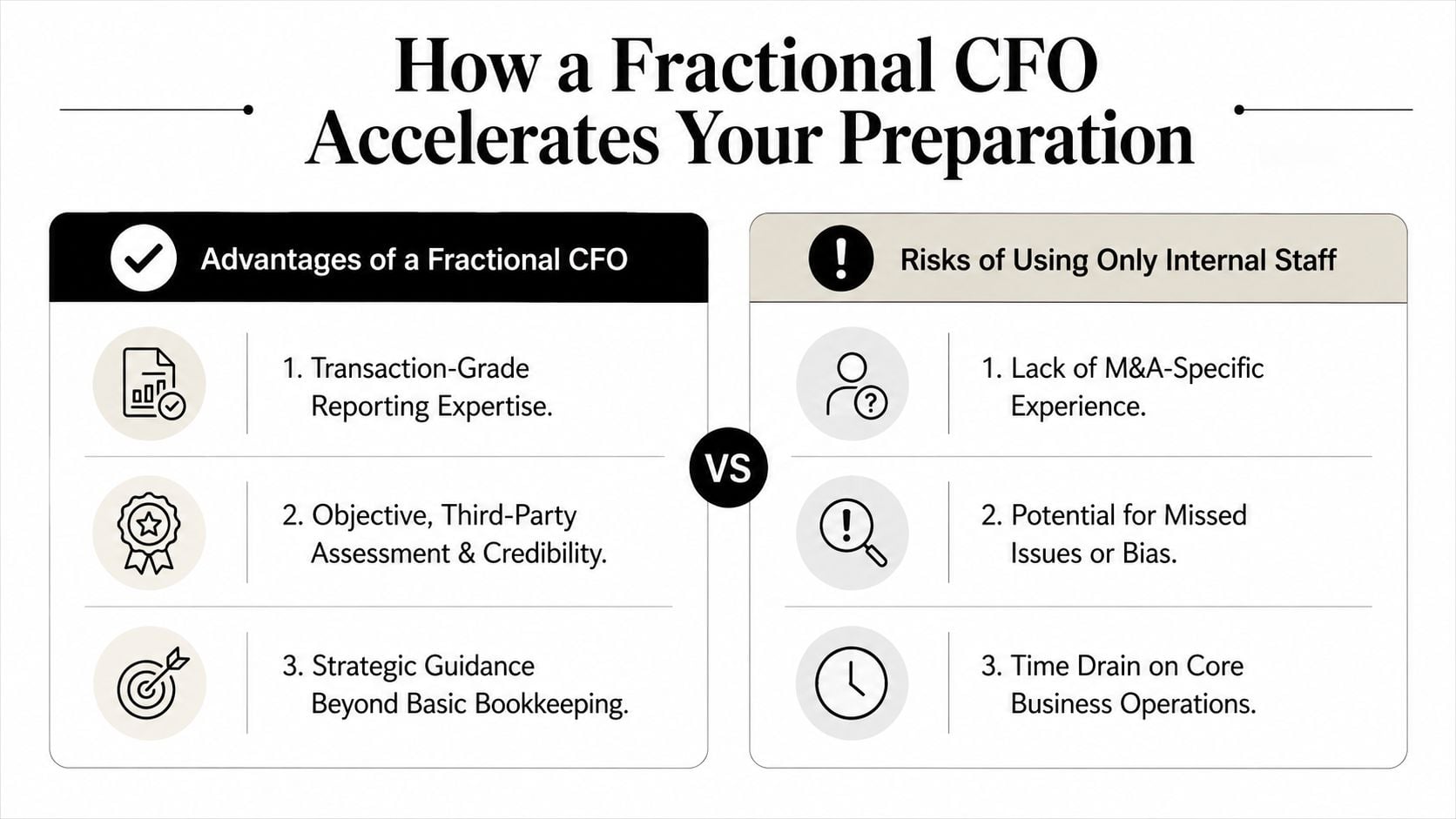
A buyer asks for a normalized EBITDA bridge, a working-capital peg, and pro forma adjustments. Your bookkeeper has kept the ledger accurate, and your controller has closed the books, but neither role necessarily prepares reporting that can withstand transaction scrutiny. That gap can delay decisions and weaken your negotiating position.
A fractional CFO prepares the numbers for buyer review and connects them to operating choices. The work may include restructuring the chart of accounts for clear reporting, documenting defensible add-backs, reconciling operating results to cash, testing seasonality, and preparing management to answer diligence questions with evidence.
The CFO should also turn findings into decision gates. If hiring depends on recurring cash flow, model the role before approving it. If capex is overdue, separate capacity-protecting investment from equipment that only improves appearance. If margins vary by customer or job, use the analysis to reprice, tighten scope, or decline poor-fit work. Exit readiness depends on making these decisions consistently, not assembling a polished data room at the end.
A fractional CFO can identify whether an adjustment is defensible before it reaches the buyer, distinguish an operational problem from a reporting problem, and show how each issue affects cash generation and deal readiness.
What to look for
Choose someone who has worked with founder-led businesses in your industry and understands the difference between bookkeeping cleanup and transaction preparation. Ask for examples of QoE bridges, working-capital analyses, data-room management, and management presentations.
Confirm the engagement boundaries. A fractional CFO may coordinate with your CPA, attorney, tax advisers, and investment banker, but that does not mean the CFO provides tax preparation, audit services, business valuation, or legal advice.
Selection test: Ask the candidate to review one month of financial statements and name the first questions a buyer would ask. The quality of those questions tells you more than a polished service list.
Start early enough to establish reliable reporting trends, resolve old balances, and change operating behavior. A last-minute review can identify problems. It cannot create a history of disciplined management overnight.
Your 90-Day Financial Due Diligence Checklist
Use the next 90 days to create evidence, not just folders. Assign one person to own each deliverable, record open questions, and review progress weekly with the owner.
Days 1 through 30, clean the financial foundation
- Reconcile accounts: Tie bank, credit card, and loan statements to the general ledger for the trailing 36 months.
- Resolve old balances: Clear suspense accounts, stale checks, intercompany differences, and unexplained transfers.
- Normalize the chart: Map inconsistent account names and separate personal, related-party, non-operating, and recurring expenses.
- Recast the P&L: Produce a trailing-twelve-month income statement and a documented EBITDA add-back schedule.
- True up the balance sheet: Review receivables, inventory, payables, accruals, debt, leases, and tax balances.
Pending audits and unresolved accounting issues belong on an issue log. Don't hide them. State the status, responsible owner, expected resolution, and likely financial effect.
Days 31 through 60, assemble the evidence
- Build the contract index: List customer agreements, vendor terms, leases, insurance policies, employment arrangements, and material commitments.
- Prepare tax support: Gather filed returns, sales tax records, payroll tax information, notices, and correspondence.
- Document debt: Include loan agreements, repayment schedules, guarantees, equipment financing, and related-party balances.
- Complete the revenue schedule: Tie invoices, collections, deferred revenue, credits, milestones, and renewals together.
- Resolve governance gaps: Locate board minutes, ownership records, approvals, and amendments. Mark missing documents for follow-up.
Set access permissions before sharing the data room. Buyers should receive the documents relevant to their diligence team, while sensitive employee and customer data should remain controlled.
Days 61 through 90, test the story
- Review quality of earnings: Challenge each adjustment and remove unsupported add-backs.
- Normalize working capital: Calculate operating working capital, analyze seasonality, and prepare a proposed peg.
- Stress-test the forecast: Model lower volume, margin pressure, slower collections, hiring delays, and capex requirements.
- Prepare management answers: Write explanations for revenue dips, margin changes, unusual expenses, customer concentration, and owner dependency.
- Run a mock request list: Ask an outside adviser to identify gaps before a buyer does.
A 13-week cash flow model, such as the approach described in this 13-week cash flow guide, can help you monitor near-term liquidity while the longer-term diligence schedules are being prepared. Keep the data room organized by workstream, use a clear naming convention, maintain a request log, and record when documents are uploaded or replaced.
The next step is practical. Review your last twelve months of financial statements, list every unexplained balance and proposed add-back, then schedule a transaction-readiness discussion with a qualified adviser before signing a letter of intent.
AmbitionCFO helps founder-led companies prepare transaction-grade reporting, normalize EBITDA, analyze working capital, build cash-flow visibility, and connect diligence findings to operational decisions. Visit AmbitionCFO to discuss your financial due diligence preparation and determine which schedules, controls, and decision gates your business should build first.