

LinkedIn profiles promoting fractional C-suite services increased from about 2,000 to approximately 114,000, according to Global Finance's report on freelance CFOs. Flexible executive leadership is no longer an obscure option. The question for an owner is whether you need a temporary finance leader to solve a defined problem, an ongoing strategic partner, or a permanent executive.
Don't start by buying a job title. Start with the decisions you can't confidently make today: approving equipment, funding payroll through a slow collection period, changing prices, or preparing to step away from the business.
Table of Contents
- Why Growing Companies Hire Interim CFO Services
- Interim Fractional and Full-Time Side by Side
- Deliverables That Change Weekly Decisions
- Forecast Accuracy Across Thirteen Weeks
- Construction, Distribution, and Professional Services
- Construction Distribution and Professional Services
- Exit Readiness Three to Five Years Out
- Book a Strategy Session Before You Hire
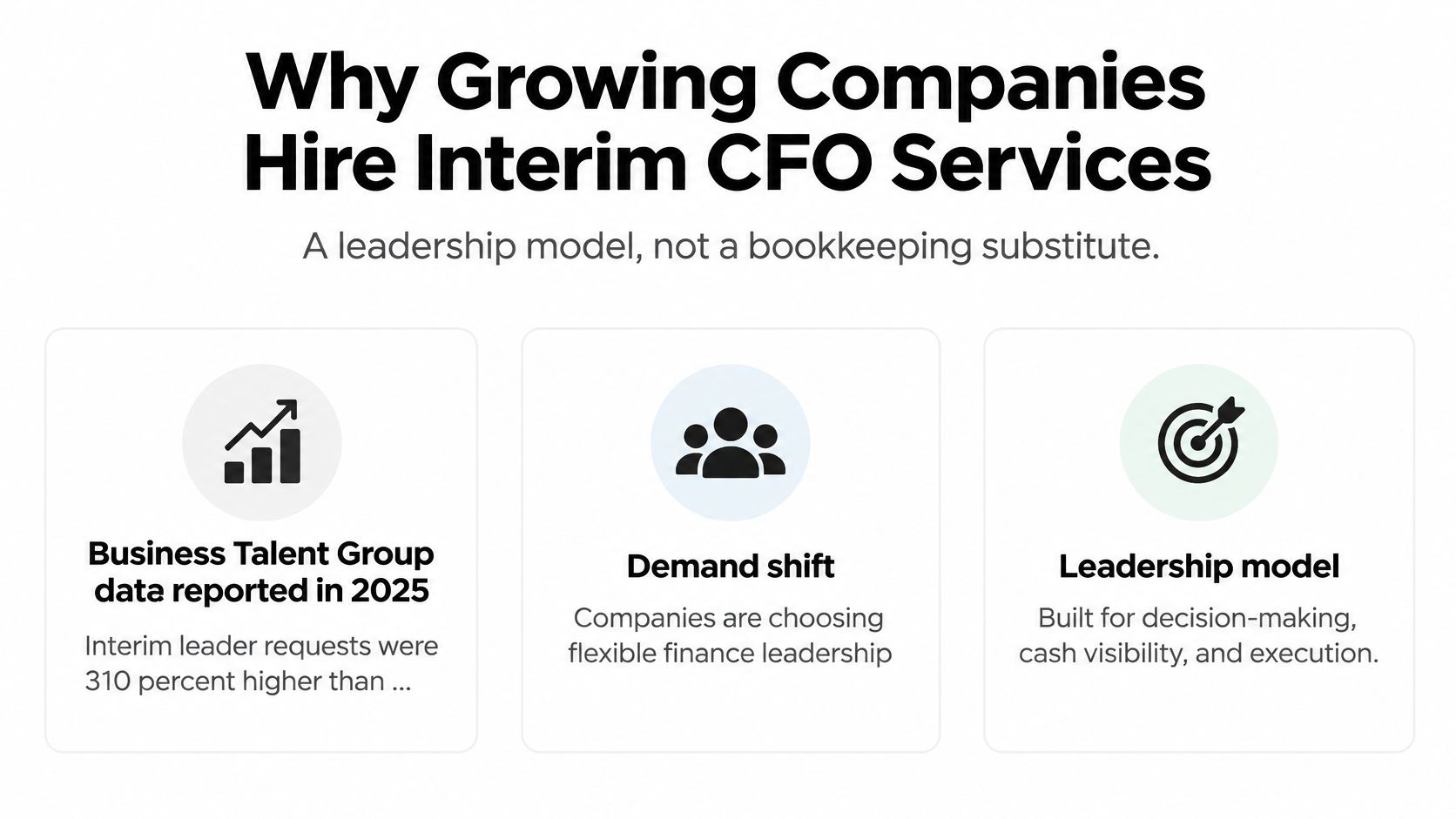
Why Growing Companies Hire Interim CFO Services
Demand for interim finance leadership has grown as companies seek experienced guidance without committing to a permanent executive hire. For owners, the practical question is what decisions need better financial leadership now.
Interim CFO services provide a finance executive for a defined period and mandate. Companies may use interim support to cover a vacant role, rebuild forecasting, investigate margin deterioration, support a transaction, or bridge the business to a permanent hire.
Buy leadership for a named problem
A permanent CFO owns the finance function over time. An interim CFO takes on a defined assignment, such as stabilizing cash flow planning or leading a handoff, while the business continues operating.
Neither role should be confused with reconciling accounts, filing tax returns, or performing an audit. AmbitionCFO's advisory work sits above the bookkeeper and CPA, helping owners turn financial information into decisions.
- Name the decision gap. Identify where leadership lacks a clear view of cash, margins, or commitments.
- Define the endpoint. Set a specific outcome, such as a completed forecast, a stabilized team, or an executive handoff.
- Match authority to responsibility. Give the finance leader access to the people making the decisions that affect results.
Our guide to when a company should hire a CFO can help clarify whether the gap is strategic leadership or accounting capacity. Owners looking to build stronger financial management habits can also use virtual CFO support to bring more discipline to financial decisions.
Choose the model and cost structure after you have defined the problem and how long it needs to be addressed.
Interim Fractional and Full-Time Side by Side
Interim, fractional, and full-time CFO fit
| Model | Mandate | Time shape | Cost shape | Best fit |
|---|---|---|---|---|
| Interim CFO | Named project or vacant seat | Heavy hours for weeks or months, then ends | Project fee or short-term retainer tied to scope | Departure, transaction, or turnaround |
| Fractional CFO | Ongoing strategy without a full-time seat | Weekly or biweekly leadership cadence | Part-time advisory fees rather than a full executive salary | $10M–$100M firms past the bookkeeper stage |
| Full-time CFO | Permanent executive ownership | Full working week, with benefits and bonus | $300K+ salary, before benefits and bonus | Daily multi-entity or treasury complexity |
| Controller or CPA only | Books, tax, and compliance | Ongoing accounting support | Professional fees without executive strategy | Clean records, no strategy gap |
The table describes cost shape, not a quote. Our fractional advisory provides executive-level financial thinking without the $300K+ salary of a full-time CFO. An interim engagement requires a separate scope because concentrated execution and ongoing advice aren't interchangeable.
Choose capacity, not the cheapest label
A vacant CFO seat during a refinancing needs someone who can take ownership immediately. A scheduled advisory meeting won't substitute for daily leadership when employees, lenders, and directors need decisions.
Conversely, don't purchase full-time coverage to answer recurring questions about hiring, pricing, and cash allocation. Fractional support fits businesses that have outgrown basic accounting but don't need a permanent executive in the seat.
A controller maintains accounting integrity and reporting discipline. An outside CPA addresses the agreed accounting and tax scope. Neither arrangement automatically gives someone responsibility for evaluating whether a new branch, major hire, or customer contract makes financial sense.
Selection rule: Buy enough executive availability to make the decisions your business actually faces, not enough to complete an idealized organization chart.
The same distinction applies outside finance. Owners considering part-time executive support can examine fractional counsel services from Kons Law as an example of obtaining specialized leadership without creating a permanent full-time position.
Be honest about fit
Our fractional advisory is built for founder-led businesses around $10M–$100M in annual revenue. We're probably not the right fit below approximately $10M, for bookkeeping or tax-only needs, or for owners who only want someone to prepare reports.
Before committing, write down the decisions, required availability, reporting ownership, and handoff conditions. Also distinguish advisory work from execution: who will update records, chase missing inputs, and implement approved changes?
Mark the row that matches your next 12 months. Choose interim for a defined disruption, fractional for recurring strategic leadership, full-time for sustained daily complexity, and accounting support when there's no executive decision gap.
Deliverables That Change Weekly Decisions
Start with cash, not a presentation deck. A 13-week cash-flow forecast is a liquidity-control model using weekly, invoice-level assumptions for receipts and payments, and Alvarez & Marsal's guidance distinguishes that short-horizon operating view from longer-term financial planning.
The useful structure connects expected cash movements to decisions.
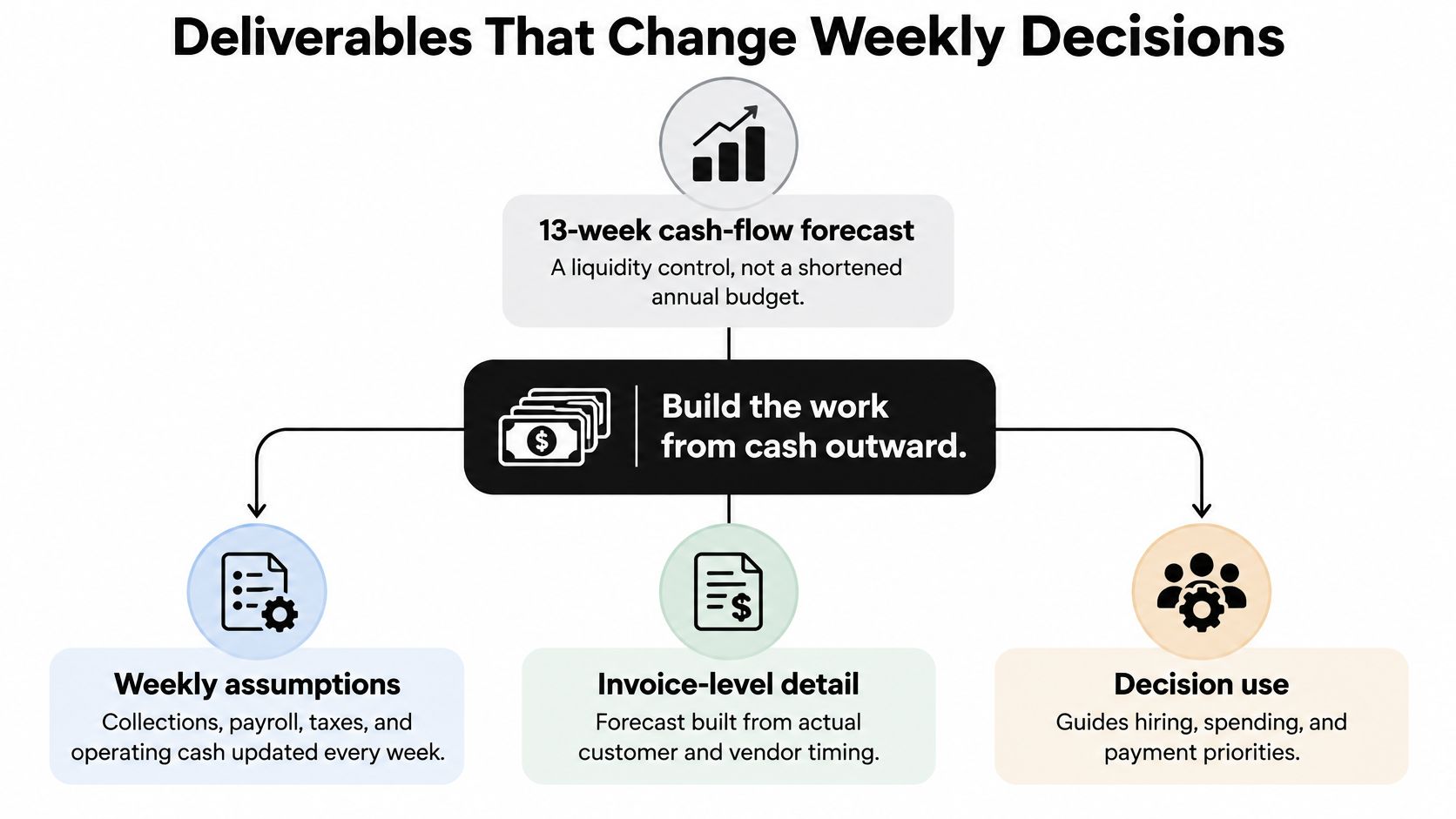
Connect the bank balance to operating drivers
Build collections from customer invoices and credible payment dates. Schedule payroll, taxes, supplier payments, capital expenditure, debt service, and other commitments explicitly rather than spreading annual totals evenly.
Days sales outstanding, or DSO, measures how long customers take to pay. When collections slow, cash receipts move later, potentially forcing borrowing or delayed investment even while EBITDA, earnings before interest, taxes, depreciation, and amortization, remains positive.
Inventory days, supplier terms, backlog conversion, and hiring dates belong in the same discussion. A profitable equipment purchase can still be badly timed if its deposit lands before a major customer payment.
Require outputs that change an approval
The supporting deliverables should answer different management questions.
- Margin analysis by job, client, or product. Identify whether pricing, purchasing, labor, or sales mix needs correction.
- Consistent reports and KPI definitions. Give leadership one version of revenue, gross margin, backlog, and cash.
- Budgets and operating forecasts. Model hiring, expansion, and major commitments before approving them.
- Strategic financial guidance. Translate the analysis into pricing, financing, and capital-allocation choices.
Our listed services are Fractional CFO Advisory, Certified Exit Planning, Profit Architecture, and 13-Week Cash Forecasting. The forecasting work provides a rolling view designed to improve planning and reduce financial surprises, while advisory connects cash visibility to profitability and growth decisions.
A concise operating summary helps leaders use the detail without reading every schedule. Our explanation of what a flash report should show provides a useful reporting companion.
Use this video as a discussion prompt for the leadership team.
Run a one-week test: can leadership name next month's lowest expected cash balance and the three jobs or clients expected to fund it? If not, prioritize those answers over adding another dashboard.
Forecast Accuracy Across Thirteen Weeks
A distant forecast balance isn't as reliable as next week's payroll schedule. Practitioner guidance from Float on forecast accuracy suggests the following bands for a 13-week forecast; they're practitioner targets, not results from an independent study.
13-week forecast accuracy by horizon
| Weeks | What it is based on | Accuracy target | How to use it |
|---|---|---|---|
| 1–4 | Issued invoices, payroll, approved payables, debt service | 90–95% | Lock near-term cash commitments |
| 5–8 | Mix of commitments and operating assumptions | 85–90% | Adjust collections and purchasing |
| 9–13 | Timing, collections, and discretionary spend | 70–85% | Early warning, not a promised balance |
Agree on how you'll measure error before assigning a score. Compare receipts and disbursements separately, because offsetting mistakes can produce an apparently accurate closing balance.
If week 10 indicates a shortage, start collection conversations, reconsider discretionary purchases, and negotiate payment timing while you still have options. Don't wait until the forecast becomes precise enough to confirm a crisis.
A polished spreadsheet can still be wrong
Nearly nine in 10 CFOs surveyed said they make monthly decisions using inaccurate or incomplete data, while one in four rely on gut instinct alone, according to the survey findings discussed by Old National. The same discussion cites a 2026 finance survey in which only 11% of respondents used cash-flow forecasting and 48% of middle-market teams took six or more business days to close.
Stale receivables, missing job costs, unapproved change orders, retainage, and outdated vendor terms all undermine the model. Industry-specific timing matters too; agentcentral's explanation of forecasting cash flow for Amazon sellers offers a useful comparison for businesses balancing inventory commitments and sales receipts.
Make the review an operating meeting
- Operations owns timing assumptions. Confirm job progress, customer acceptance, collection expectations, and purchasing dates.
- Finance owns reconciliation. Tie opening cash to the bank and explain actual-versus-forecast differences by driver.
- Leadership owns responses. Maintain base, downside, and upside cases with explicit actions for each.
After the full forecast horizon, review which assumptions repeatedly failed and rebuild them. Our 13-week cash-flow guide provides additional context for implementing the discipline.
Treat later weeks as permission to act early, not permission to promise cash you haven't collected.
Construction, Distribution, and Professional Services
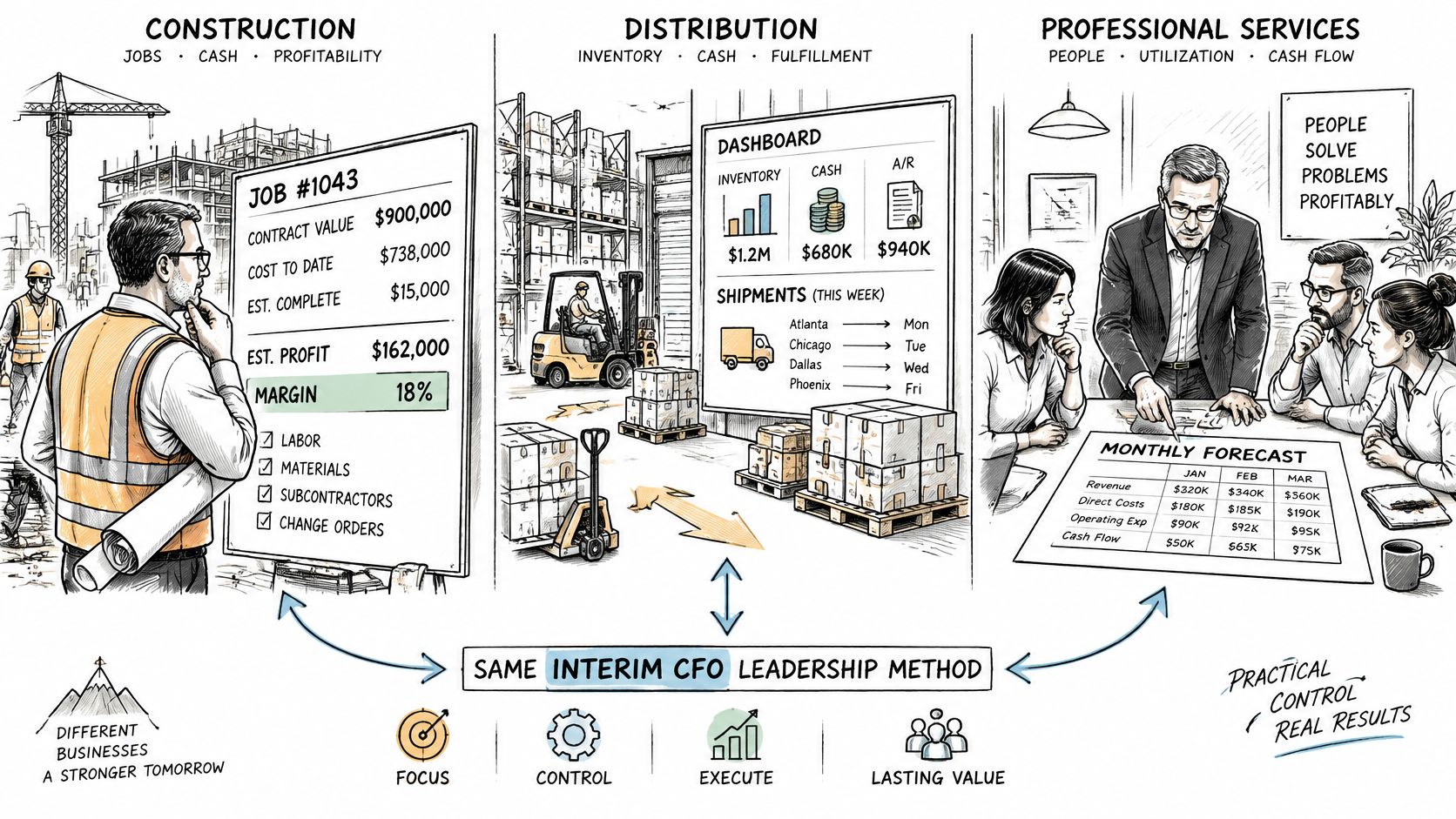
The same financial leadership method produces different decisions in different businesses. The following hypothetical operating scenarios illustrate the mechanics, not industry benchmarks or client results.
Compare where each company earns profit with when it receives cash.
A profitable construction job needs funding
Say a $900,000 job shows an 18% margin under percentage-of-completion reporting, which recognizes performance as work progresses. The customer holds 10% retainage, or $90,000, until closeout, while labor runs approximately six weeks ahead of billing.
In this scenario, the contractor remains cash-negative for six weeks despite reporting profit. The finance leader connects job-level receipts and payments to the cash forecast and ensures approved change orders enter billing promptly rather than waiting for project completion.
Our construction work examines project profitability, labor productivity, overhead structure, pricing, estimating accuracy, and cash performance. The recommendation might be a different billing schedule, not a cheaper crew.
A distributor's margin conceals trapped capital
Suppose gross margin holds at 32%, but $400,000 of inventory has aged beyond 120 days. Meanwhile, GMROI, gross margin return on inventory investment, falls from 2.6 to 1.8.
The distributor hasn't necessarily lost pricing power. It may have purchased the wrong stock or committed too much capital to slow-moving products.
The CFO redirects purchasing toward faster-moving lines and reports GMROI by product line before the next buying cycle. Our distribution advisory includes inventory turns, cash conversion, margins, working capital, and financing capacity so purchasing decisions reflect more than headline sales.
A services firm works harder without earning enough
Consider utilization rising from 68% to 74%, while realization falls from 92% to 84%. Utilization measures how much available capacity goes into chargeable work; realization measures how much standard billable value the firm earns after discounts and write-downs.
Extra hours don't automatically support larger partner draws. In this example, leadership sets a 90% realization floor before increasing distributions, then addresses discount approvals and scope overruns.
Our professional-services work connects client profitability, pricing, capacity planning, cash forecasting, partner compensation, and succession. For a deeper examination of payment capacity rather than accounting profit, use our guide to liquidity analysis.
Pick the three metrics missing from your Monday meeting and compare them with the industry scorecard below.
Construction Distribution and Professional Services
Industry scorecard and cash trap
| Industry | Core metrics | Typical cash trap | Metric to add |
|---|---|---|---|
| Construction and specialty trades | Job margin, labor productivity, overhead absorption, estimate accuracy, bonding capacity, retainage | Retainage and unapproved change orders | Cash position by job |
| Wholesale distribution | Inventory turns, cash conversion cycle, gross margin, GMROI, current ratio, debt service coverage, AR aging | Capital trapped in slow SKUs and aged receivables | GMROI by product line |
| Professional services | Client and project margin, utilization, realization, capacity forecast, partner compensation | Utilization gains lost to discounting | Realization rate by partner |
A scorecard becomes useful when a named manager owns the response. Don't add every metric to the Monday agenda. Select the exceptions that require a decision and retain supporting detail for investigation.
Turn construction exceptions into job decisions
A contractor can report a positive percentage-complete margin while lacking the cash needed to finish the work. In a hypothetical comparison, two equally profitable jobs deserve different funding plans if one customer pays progress invoices promptly and the other withholds cash until closeout.
Ask the project manager to identify the next billable milestone, unresolved change orders, and labor commitments. Ask finance to show the resulting funding requirement before approving another mobilization.
Our work also supports working-capital planning, financial reporting, and bonding capacity. Growth is only sustainable when the contractor can finance the work it wins.
Give distributors a purchasing rule
A buyer may favor a product because its gross margin looks attractive. The owner needs to know whether that product generates enough gross profit relative to the inventory investment and collection delay.
Our standing distribution measures also include operating margin, working capital, EBITDA, and the cash conversion cycle. The current ratio compares current assets with current liabilities; debt service coverage evaluates the ability to meet debt payments.
Use those measures together. An apparently healthy asset balance is less reassuring when inventory won't sell and receivables aren't collectible on schedule.
Protect professional-services capacity
Consulting firms, agencies, IT and managed service providers, engineering practices, architecture firms, accounting firms, law firms, and advisory businesses all sell constrained professional capacity. A busy calendar isn't sufficient evidence that the work deserves more staffing.
Compare client margin with staffing commitments before increasing compensation or partner distributions. A hypothetical firm can post more chargeable hours yet generate less distributable cash when partners discount fees or teams absorb unpriced scope.
- Assign ownership. Put a project leader, purchasing manager, or practice partner beside each exception.
- Set a response. Specify the billing correction, buying restriction, pricing change, or staffing decision.
- Close the loop. Record whether the action improved cash conversion or protected margin.
Choose three missing Monday metrics, name their owners, and require a decision alongside each number.
Exit Readiness Three to Five Years Out
A 2024 survey of RBC Wealth Management business-owner clients found two-thirds lacked a documented sale or transition plan, and 41% had completed no valuation analysis, according to RBC's exit-planning findings. That identifies a preparation gap, not proof that planning causes a higher sale price.
Start with a worksheet that makes preparation observable.
Quarterly exit readiness worksheet
| Item | Metric to track | Review |
|---|---|---|
| Transition window | Target year for sale or succession | Annually |
| Owner and one-time expenses | Dollars added back, with support | Quarterly |
| Earnings quality | Recurring versus nonrecurring EBITDA | Quarterly |
| Customer concentration | Share of revenue from largest customers | Quarterly |
| Working capital | Cash conversion cycle and working-capital need | Quarterly |
| Owner dependence | Critical decisions still requiring the owner | Monthly during 30-day test |
| Management depth | Named backups for critical processes | Quarterly |
Build evidence and transferable decisions
PwC's exit-readiness guidance recommends recurring monthly or quarterly management reports, a defensible forecast often covering three years, and evidence of sustainable earnings and cash flow. Buyers use monthly packages, tax records, and other financial information to assess quality of earnings, meaning how reliably reported profit reflects ongoing operations.
Inconsistent account mapping, unsupported add-backs, weak client margins, and unreconciled working capital make that assessment harder. An add-back is an adjustment proposed to remove an owner-specific or nonrecurring expense; document why it won't recur rather than labeling it exceptional.
Reporting isn't enough if the owner still makes every consequential decision. Gallup's survey conducted in fall 2024 found about one-third of business owners had no long-term plan or were unsure what would happen after they stepped away.
Transferability test: Can another leader make the decision correctly, with documented authority, without calling the founder?
List recurring owner approvals, name backups, establish approval limits, and run a 30-day delegation test. In a hypothetical business where 8 of 20 critical decisions still require the owner, dependency is 40%; track the exceptions and remove their causes.
Use our guide to choosing an exit-planning advisor to connect that operating work with your intended transition. Begin while you still have time to develop managers, correct reporting, and prove repeatable performance.
Book a Strategy Session Before You Hire
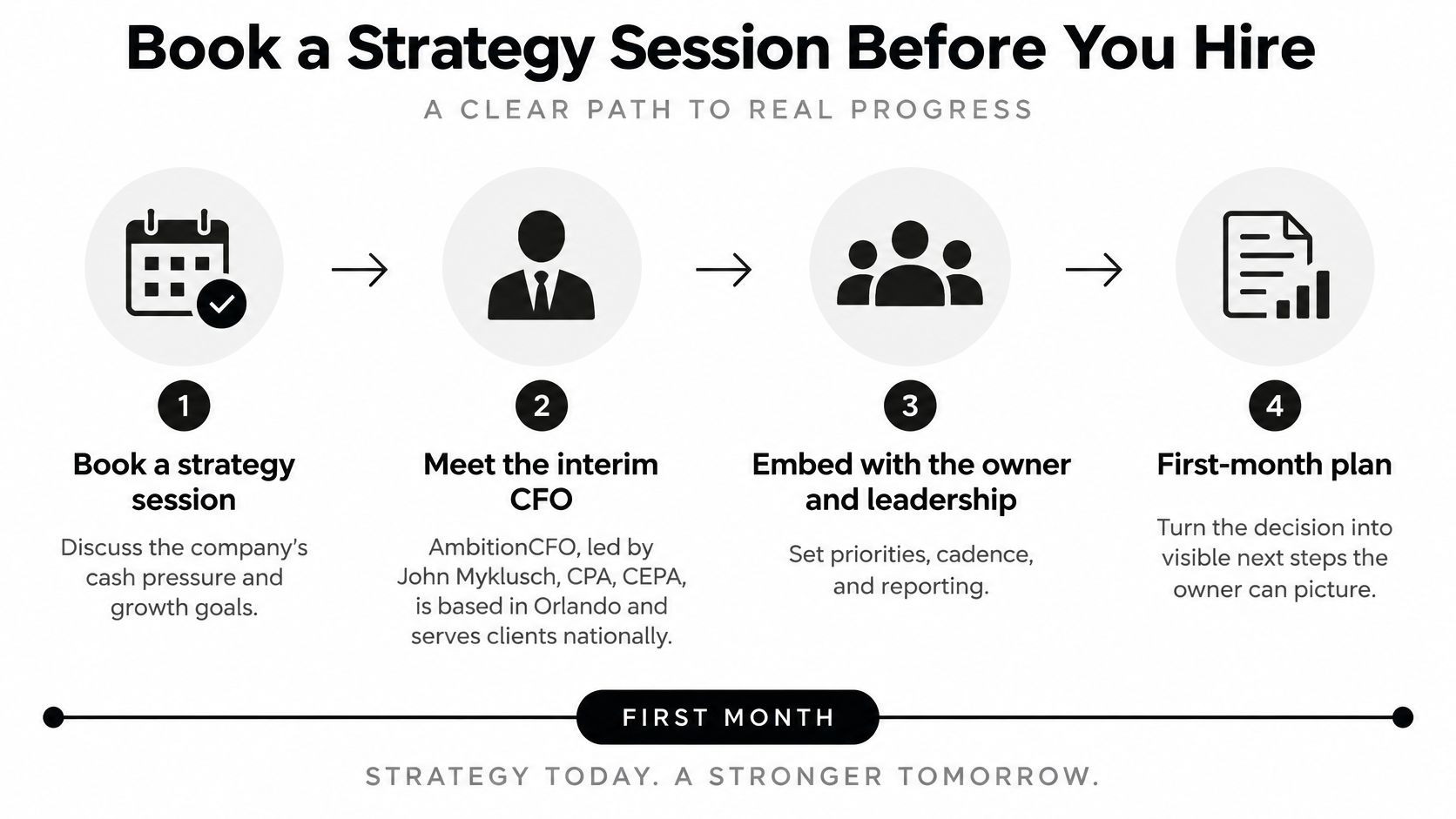
AmbitionCFO is led by John Myklusch, CPA, CEPA, based in Orlando, and serves clients nationally. We embed with the owner and leadership team while working alongside the existing bookkeeper and CPA, not replacing them.
The first-month sequence should make the work tangible.
Establish the financial starting point
- Connect existing systems. We connect to accounting platforms such as QuickBooks and Xero.
- Review financial history. We examine 12–24 months of historical financials to identify patterns and reporting gaps.
- Coordinate the accounting team. We meet your CPA and bookkeeper to agree on data flows and responsibilities.
- Deliver the diagnostic. We provide an initial assessment of cash, profitability, and financial visibility.
Maintain a decision-making cadence
Ongoing partnership includes weekly or biweekly CFO meetings, monthly financial reviews, and quarterly strategic planning. Those meetings connect immediate choices with longer-term priorities rather than becoming reporting presentations.
We focus on fewer cash surprises, decisions made before financial pressure removes options, more profit without chasing revenue for its own sake, one version of the truth, and a company a buyer can understand.
The next step is a 60-minute CFO Strategy Session covering cash flow, profitability, financial systems, and growth. It's a working session, not a sales presentation, and you leave with practical recommendations even if we're not the right fit.
AmbitionCFO offers fractional financial leadership, cash forecasting, profitability analysis, and exit planning to help owners turn financial uncertainty into specific decisions. Visit AmbitionCFO to request your strategy session, and bring your latest receivables aging, a job or client margin report, and the decision you're reluctant to make without a financial model.