

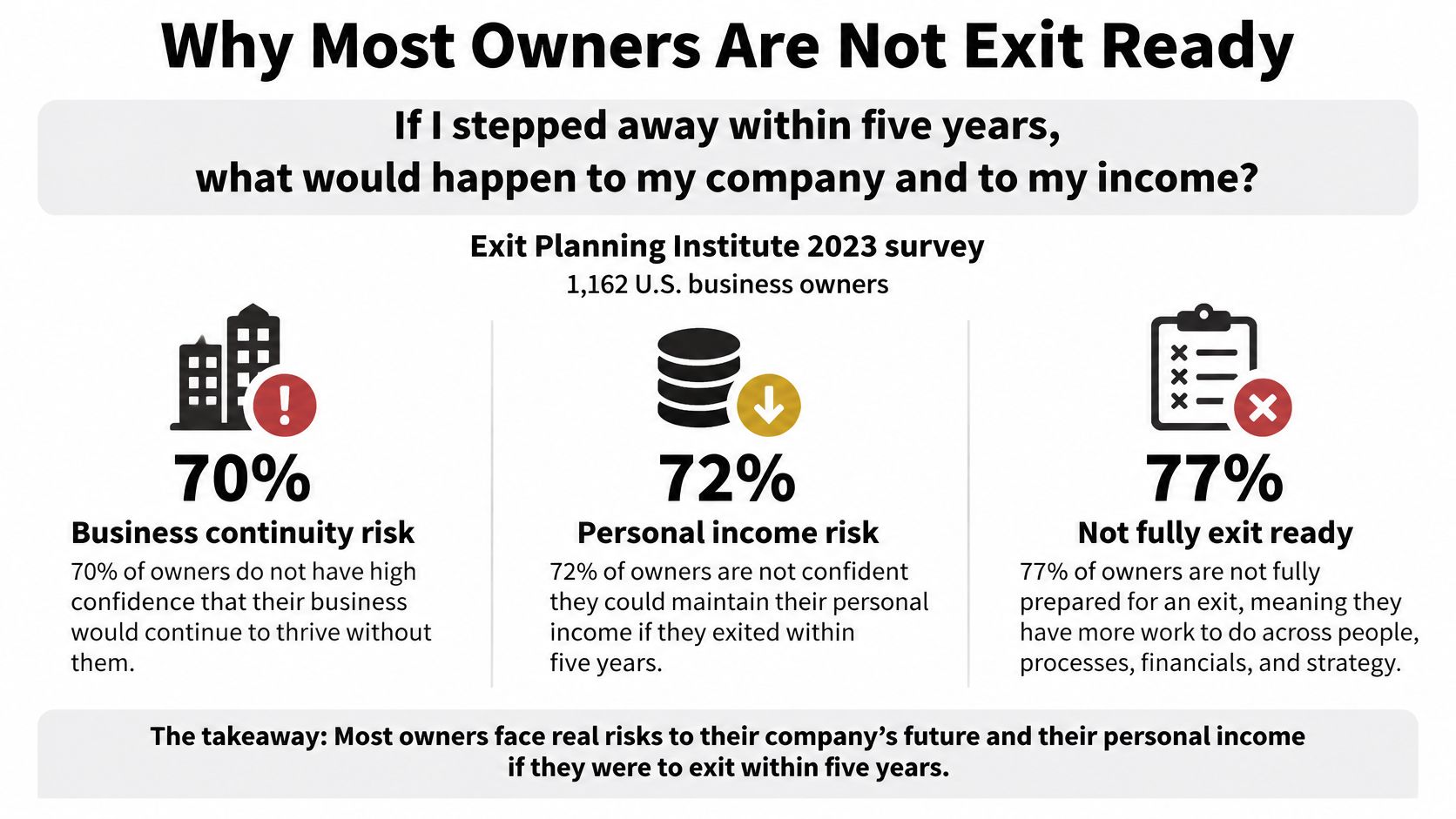
If you had to step away within five years, what would happen to the company, and what would happen to the income you live on? The Exit Planning Institute's 2023 National State of Owner Readiness Report surveyed 1,162 U.S. business owners and found that 75% wanted to exit within 10 years, while 49% expected to exit within five years. On the report's estimate, about 4.5 million privately held businesses could change hands over the following decade, nearly $14 trillion of business wealth, yet only 42% had a formal written business-transition plan. 70% depended on business income for their lifestyle, and 54% said continued profitability was critical to leaving.
An exit planning advisor treats that gap as an operating problem with quarterly targets, not a buyer hunt that starts when you feel ready.
Table of Contents
- Why Most Owners Are Not Exit Ready
- Exit Readiness Scorecard for This Quarter
- What a CEPA Coordinates and What Stays With Specialists
- The Client Journey From First Call to Sale Readiness
- Building a Three to Ten Year Exit Roadmap
- How Value Drivers Change the Sale Multiple
- Deal Terms That Shift Tax Timing
- Schedule a Discovery Call With a Clear Question
Why Most Owners Are Not Exit Ready
Say you run a $28 million distribution company. You still approve every large order, you hold the bank relationship, and your biggest customer calls you, not the team. You tell yourself the exit is five years out. The company looks profitable on the tax return. Your personal spending still comes out of that profit. If you were gone next quarter, both the company and your household would feel it in the same month.
That is the job of an exit planning advisor. The advisor coordinates business continuity, personal wealth, and operating performance years before a sale, a family transfer, or a recapitalization. A broker hired at the end finds a buyer for the company you already have. The advisor's work is to make that company transferable while you still control the calendar.
A one-page worksheet you can finish today
Before any theory, write one page with four fields and review it every quarter.
- Target exit date: Pick a month, even if you later move it.
- Preferred path: Third-party sale, family transfer, management buyout, or recapitalization.
- Likely successor or buyer: A name, or the words "not identified."
- Three functions only you perform: The work that stops if you stop.
Name those three dependencies today. In the distribution example they might be credit approval, the top customer's pricing, and the lender conversation. Each one becomes a project with a backup person, not a personality trait you plan to keep until closing.
Practical rule: If a function has no named backup, it is still your job, and a buyer will price it that way.
Walk the page with your leadership team the way you would walk a board through a decision. A short recorded walkthrough, using the same discipline founders use when they learn how founders present decks with video, keeps the story consistent when you are not in the room. Pair that page with an internal controls assessment so the backups are real authorities, not titles on an org chart.
Exit Readiness Scorecard for This Quarter
A scorecard is a dashboard of risks a buyer prices. It is not a legal file in a drawer. Put a number on each row this month, then pick the two worst rows, name one accountable person for each, and review both inside the monthly financial pack.
| Metric | What a buyer is testing | Action this quarter |
|---|---|---|
| Owner dependence | Whether revenue and decisions survive the founder | List the three functions only the owner performs and name a backup |
| Customer concentration | Whether one account can collapse earnings | Calculate the top five customers as a percent of revenue |
| Gross margin by job or client | Whether reported profit is repeatable | Track margin monthly and flag jobs below the company average |
| Cash conversion and runway | Whether profit turns into cash | Build a 13-week cash view and record weeks of runway |
| Management depth | Whether leadership exists beyond the founder | Assign an accountable leader to each owner-only function |
| Forecast accuracy | Whether the numbers can be trusted in diligence | Compare last quarter's forecast with actual revenue and cash |
| Recurring gross profit | Whether margin will continue after closing | Split recurring margin from project or one-time work |
How to choose the two worst rows
Read the rows in the order a buyer would. Owner-generated revenue and the three owner-only functions measure key-person risk. Customer concentration starts with the top five accounts as a share of revenue. If those five are most of the book, one lost relationship can break a deal even when the income statement looks fine.
Gross margin by job or client shows whether earnings repeat. A single fat project can flatter a year. Cash conversion and weeks of runway show whether profit becomes cash you can plan on. Management depth asks a blunt question: can someone other than you approve estimates, pricing, or a major contract? Forecast accuracy compares last quarter's plan with actual revenue and cash. Recurring gross profit splits repeatable margin from one-off work.
A University of Minnesota Extension study of nearly 300 small-business owners and leaders found that 80.9% rated a written succession or transition plan important or somewhat important, yet only 19.2% had created or updated one within the prior three years. 60.8% spent less than one hour a week on succession planning. Written-plan maintenance, a formal valuation, family discussions, and successor training each lined up with higher business-readiness scores.
Caring about a plan and spending an hour a week on it are different habits. The scorecard forces the hour into the monthly pack.
Pick the two rows with the ugliest numbers, not the two that feel easiest. Assign a person who already sits in the work. If customer concentration is 62% in five accounts, that owner builds a concentration plan. If margin by job swings wildly, that owner flags every job under the company average before the next close. Tie both rows to earnings quality so the monthly pack shows durable profit, not a cleaned-up year-end story.
What a CEPA Coordinates and What Stays With Specialists
CEPA means Certified Exit Planning Advisor. The credential is for coordinating an owner's business goals and personal exit goals. Think of the advisor as a general contractor. The contractor sequences the work. Licensed trades still do their own jobs.
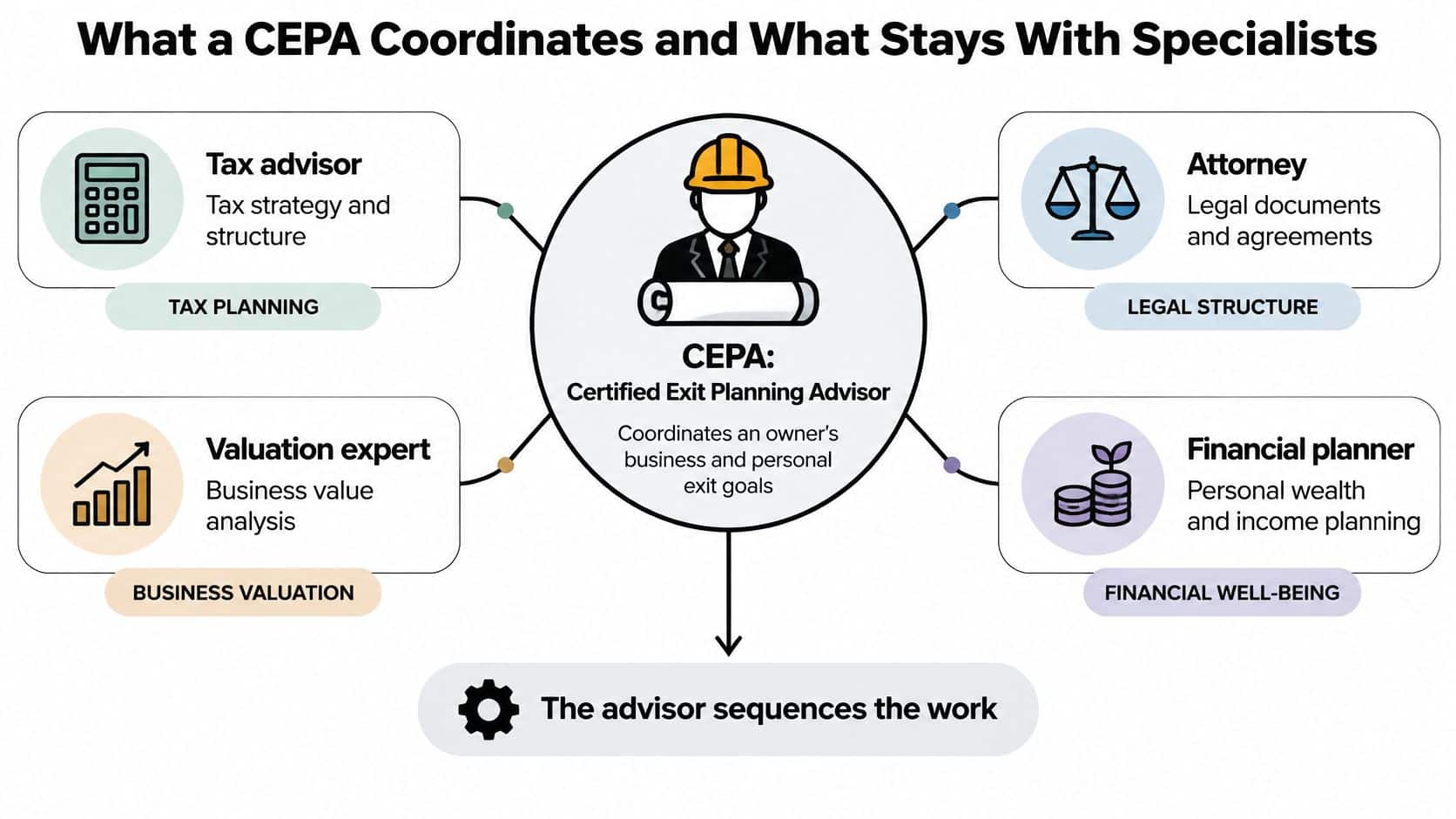
AmbitionCFO was founded by John Myklusch, CPA and Certified Exit Planning Advisor (CEPA). Our lane is value drivers, cash visibility, management depth, reporting that can survive diligence, and a written sequence of decisions. We do not replace the specialists who sign opinions, appraisals, or purchase documents.
The work outside that lane sits with four seats, plus a wealth test:
- A CPA or tax attorney owns tax opinions and returns.
- A valuation specialist owns a formal appraisal. We do not issue one.
- An attorney owns buy-sell documents and the purchase agreement.
- A broker or investment banker runs the sale process when you choose to go to market.
A wealth advisor then tests whether after-tax proceeds fund the life you want. We also do not provide bookkeeping, tax preparation, audit, or fundraising. The hiring test is simple. Will this advisor work beside your CPA, attorney, and wealth advisor, or try to replace them?
Watch a short walkthrough of how that coordination sounds in practice before you staff the empty seats.
Write the name of each specialist already on your team. Mark the seat that is empty. That empty seat is the first call, not a slide for later.
The Client Journey From First Call to Sale Readiness
Each phase ends with a document you keep, whether or not you hire anyone for the next phase.
Discovery call. You bring the one-page worksheet, the two weakest scorecard rows, and the horizon you care about. The advisor names the financial and operating issues holding enterprise value back.
Baseline. Build the quarterly scorecard from the books you already have. Calculate top-five customer concentration, gross margin by job or client, and weeks of cash runway. Draft a normalized EBITDA bridge that a specialist can later test.
Priority setting. Rank the weak rows by enterprise-value impact. A durable lift in earnings usually beats a cosmetic cleanup. Assign one accountable owner per row.
Roadmap and cadence. Lock the horizon, set quarterly milestones, and review the scorecard inside the monthly financial pack. The roadmap stays yours.
Specialist handoff. Before any letter of intent, send the deal-term schedule to your CPA or tax attorney, the valuation question to a formal appraiser, and the buy-sell documents to counsel. Use a financial due diligence checklist so reporting is ready before a buyer asks.
The result is a company you can sell, transfer, or keep without restarting the work.
Building a Three to Ten Year Exit Roadmap
The ideal planning window is often 3 to 5 years before the target date. A full redesign of systems and leadership can take up to 10 years. Build the roadmap from the far horizon inward, and keep a strategic roadmap as a prioritized financial plan you hold onto even if an advisory relationship ends.
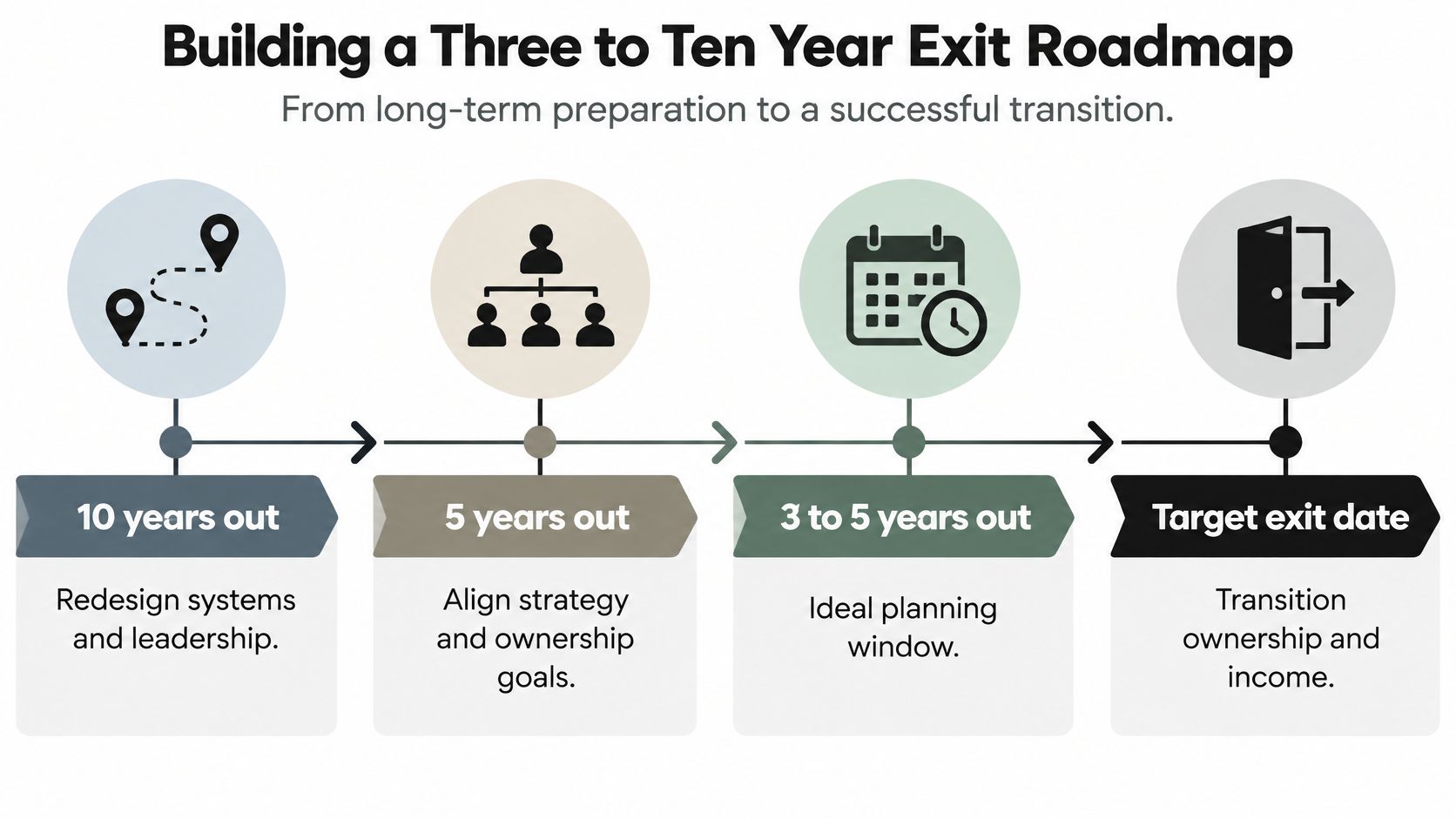
| Horizon | Main job | Proof it is done |
|---|---|---|
| 8 to 10 years out | Align personal wealth needs with a preferred path | Written personal financial plan and a named exit path |
| 5 to 7 years out | Reduce founder dependence | Decision rights documented and a successor identified |
| 3 to 5 years out | Raise earnings quality | Scorecard trending and a normalized earnings bridge started |
| Final 24 months | Become diligence-ready | Clean reporting and a quarter run without the founder |
| Any year, if the successor declines | Keep a sale path alive | Fallback buyer profile and funding gap written down |
A successor who has not agreed is an open risk
A 2026 Revenued survey found that 59% of potential successors believed a succession plan probably or definitely existed, while only 35% of owners reported having any plan. Owners who had operated for more than a decade were the least likely to have identified a successor, at 29%. Longevity does not produce a transition.
Ask a harder question than "who will take over?" Can that person run the company and finance the transfer under realistic terms? Tell them the timeline in a confidential conversation. Set competency milestones. Test seller financing and buy-sell funding before you announce anything. If they decline, the fallback row is already written.
In construction, distribution, and professional services, check four transfers in writing: estimating authority, customer relationships, vendor terms, and project decisions. If those live in your head, cash flow is one resignation away from a surprise. The final 24 months should prove the company can post a clean quarter without you in the approval chain. For timing judgment beyond the roadmap itself, read when to sell a business.
Put one date on the calendar for the phase you are in. If you are inside five years, that date is the first scorecard review, not a vague "someday" retreat.
How Value Drivers Change the Sale Multiple
Buyers in the middle market talk about enterprise value as earnings times a multiple, usually EV/EBITDA. Capstone Partners reported that the average middle-market M&A valuation in Q4 2024 was 8.7x EV/EBITDA. Upper-middle-market companies averaged 12.1x. The 2024 average was 9.1x, below 9.5x in 2023, and the lowest annual level since 2009. A generic industry multiple hides that spread.
| Case | EBITDA | Multiple | Enterprise value |
|---|---|---|---|
| Middle-market base | $3.0M | 8.7x | $26.1M |
| Sustainable EBITDA up $500,000 | $3.5M | 8.7x | $30.45M |
| One extra turn of multiple | $3.0M | 9.7x | $29.1M |
| 2024 middle-market average | Company-specific | 9.1x | Below the 2023 average of 9.5x |
| Upper-middle-market reference | Company-specific | 12.1x | Premium tied to scale and quality |
Dollars first, quality second
Start with the base case. $3 million of EBITDA at 8.7x is about $26.1 million of enterprise value. A durable $500,000 increase, same multiple, adds about $4.35 million. One extra turn on the original $3 million adds $3 million. Earnings quality and the multiple both move the check. Neither is a slogan.
Build a normalized EBITDA bridge before you talk price. Separate recurring margin from temporary cost cuts, owner add-backs, unusual projects, and working-capital swings. A one-time insurance refund is not a run rate. Your above-market salary might be an add-back. A project that will not repeat is not.
What supports a higher multiple
Score each quality test from its scorecard row rather than inventing a new list in the data room. Concentration, job or client gross margin, backlog, pricing discipline, management depth, and cash conversion are the tests buyers use to decide whether earnings last.
Picture a distributor with the same EBITDA as a peer but faster inventory turns and a shorter cash cycle. The bridge shows more of that EBITDA turning into cash, and the multiple conversation has a reason behind it. Scale still matters. The gap between 8.7x and 12.1x is not something a memo creates.
A polished valuation write-up cannot offset unstable cash or a company that only works when the founder is in the building. Compute one base case and one improved-EBITDA case before you name a price. Then read how value drivers show up in the monthly numbers you already track.
Deal Terms That Shift Tax Timing
Ask two questions before you celebrate a headline price. When is the gain recognized, and what risk do you still hold after closing? Then send both answers to a tax professional. Do not self-diagnose.
The IRS Publication 537 defines an installment sale as a sale in which at least one payment is received after the tax year of the sale. If the sale qualifies and produces a gain, the installment method may let you report part of that gain as payments arrive, instead of all of it in the sale year. You can elect to report all of the gain in the year of sale. The installment method cannot be used to report a loss.
| Structure | When cash arrives | Timing point to review |
|---|---|---|
| All cash at closing | 100 percent in the sale year | Gain is generally recognized in the year of sale |
| 40 percent at close and 60 percent over three years | Payments after the sale year | Installment method may spread eligible gain as payments arrive |
| Elect out of installment treatment | Cash schedule unchanged | Seller can choose to report all gain in the sale year |
| Sale at a loss | Cash timing follows the contract | Installment method cannot be used to report a loss |
Same price, different year
Two sellers can sign the same headline number and live in different tax years. One receives 100% at closing. The other receives 40% at closing and 60% over three years. The second seller may spread eligible gain as payments come in. The first generally recognizes the gain in the sale year. Electing out keeps the cash schedule and pulls eligible gain forward. A loss does not get installment treatment at all.
Your worksheet should separate five cash items, then show expected taxable gain by year.
- Cash at closing: What hits the account on day one.
- Scheduled principal: The note, by year.
- Interest: Income, not sale price.
- Contingent payments: Earnouts and holdbacks.
- Retained liabilities: What you still owe if the buyer struggles.
Depreciation recapture, asset type, related-party rules, and buyer default are reasons to stop. An exit planning advisor lays the cash schedule next to your lifestyle need and the company's working-capital story. The tax advisor owns the opinion. Book that review before anyone signs a letter of intent.
Schedule a Discovery Call With a Clear Question
Bring one question to a 60-minute discovery call: which two scorecard rows would change enterprise value most in the next four quarters? That question keeps the hour on operating value, not on a rushed listing.
On the call we identify the financial and operating issues holding the company back. You leave with a clearer view of the biggest opportunities and risks even if we never work together. The fit is a founder-led business with about $10 million to $100 million of revenue, especially in construction, distribution, or professional services, that has outgrown a bookkeeper and does not want a full-time CFO.
Our work sits in four offers: Fractional CFO Advisory, Certified Exit Planning, Profit Architecture, and 13-Week Cash Forecasting. We do not do bookkeeping, tax preparation, audit, formal valuation, or fundraising.
Bring the one-page worksheet, the two weakest scorecard rows, and the horizon from your roadmap. The win is a prioritized financial plan aimed at a transferable company.
AmbitionCFO gives founder-led companies senior financial leadership for cash, margins, and a transferable exit, years before a buyer shows up. We coordinate the operating plan and sit beside your CPA, attorney, and wealth advisor rather than replacing them. Visit AmbitionCFO to schedule a 60-minute discovery call and bring the two scorecard rows that would move enterprise value in the next four quarters.