

You're probably asking a deceptively simple question: when should I sell my business? The answer isn't “when you're burned out,” “when the economy looks strong,” or “when a buyer calls.” The right time is when your company is still producing credible growth, your operations can function without you, and you have enough time to negotiate from strength.
Most owners discover the timing problem too late. They set a personal deadline, then learn that financial cleanup, buyer outreach, diligence, financing, and closing take far longer than expected. By then, a plateau in earnings or a rushed process can easily reduce the value they hoped to protect.
Table of Contents
- Understanding the Full Timeline for Selling
- Financial Signals That Indicate It Is Time
- Evaluating External Market Conditions
- Using Multiple Valuation Lenses Early
- Building a Business Transferable Without You
- Choosing Your Buyer Path Strategically
- Creating Your Three-Year Exit Roadmap
Understanding the Full Timeline for Selling
Selling a business is a project with several phases. The closing date comes last, after preparation, buyer outreach, negotiation, diligence, financing, and final documentation.
In the U.S. small-business transaction market, the median time to close was 170 days in 2025, nearly six months from accepted terms to completion, according to BizBuySell's 2025 market review. Industry matters. Manufacturing transactions took 247 days to close, a 17% year-over-year increase, in the reported market.
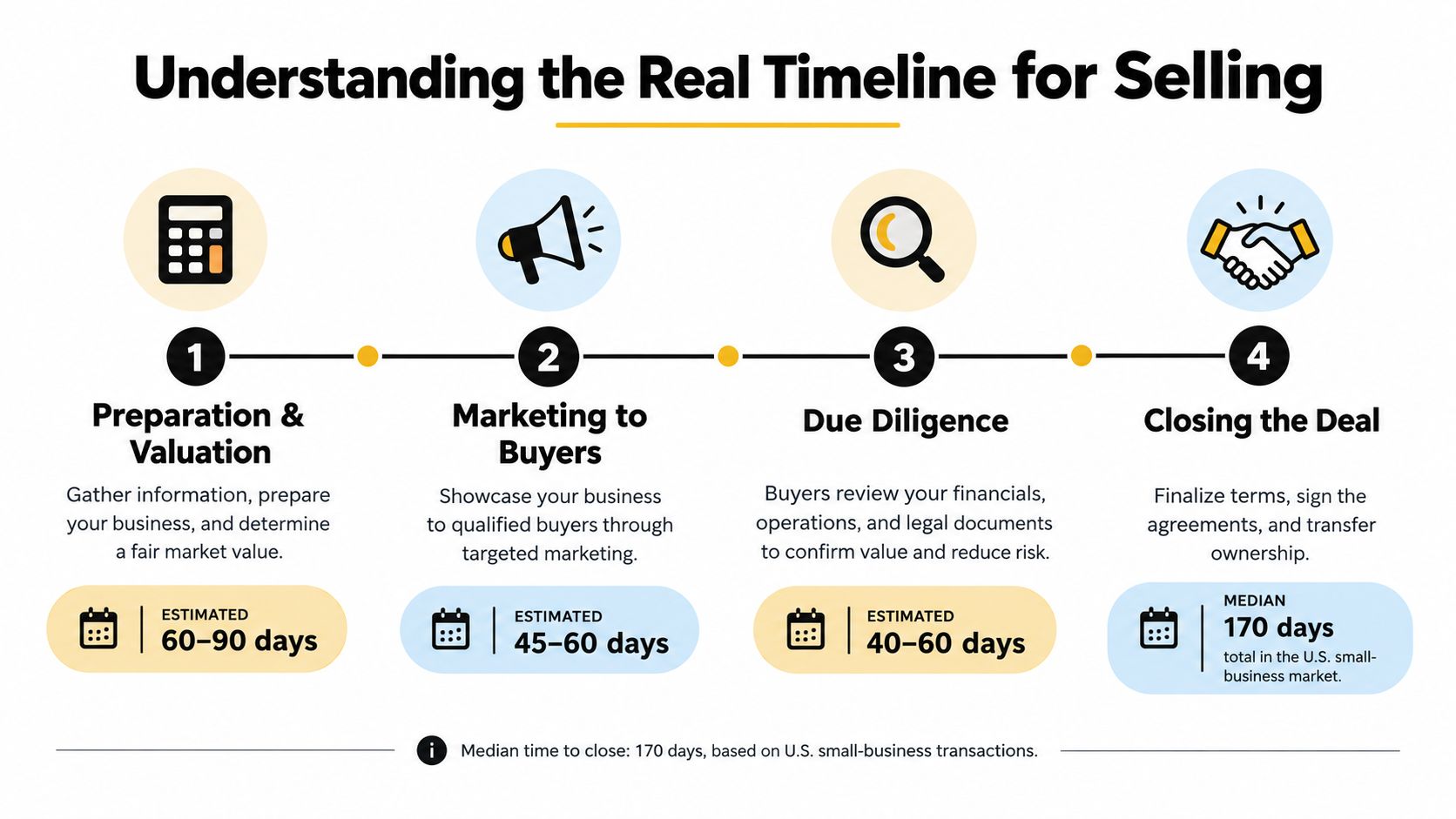
That 170-day clock starts after you have found a buyer and agreed on terms. It excludes the time needed to make the company attractive, transferable, and defensible during diligence. Owners who wait until retirement is imminent often force preparation, marketing, negotiation, and closing into one personal deadline.
Why a rushed process costs you value
Buyers do not need you to announce that you are in a hurry. They see it in the numbers, operating details, and unresolved risks.
Common warning signs include:
- Incomplete financial reporting: Monthly results arrive late, classifications change, or management cannot explain differences between revenue and cash.
- Founder dependence: Customers, employees, vendors, and major decisions still route through the owner.
- Customer concentration: One relationship accounts for too much revenue or gross profit.
- Weak working-capital controls: Receivables, inventory, retainage, payables, or project billing consume cash unpredictably.
- Unresolved operational issues: Legal matters, margin problems, undocumented processes, or contracts that do not transfer cleanly remain open.
A buyer who finds these weaknesses may demand a lower price, more seller financing, an earnout, or stronger representations and warranties. The transaction can still close, but the seller has fewer acceptable options.
Practical rule: Treat a business sale as a multi-year preparation project followed by a transaction process that can take six months or longer.
Owners of companies with $10M to $100M in annual revenue should establish reliable reporting, normalize profitability, document forecasts, and reduce founder dependence well before going to market. A three-to-five-year preparation horizon creates time to improve margins and cash flow, demonstrate repeatable performance, and withstand a lengthy process without accepting unfavorable terms.
Use exit planning guidance for business owners to turn a vague intention into a work plan. Choose a target exit window, then work backward through reporting, management, customer, contract, and cash-flow milestones.
Financial Signals That Indicate It Is Time
The best time to sell is usually when the business still has a credible forward story. Buyers pay for future earnings potential, not just the income statement you hand them on the day of listing.
That means you shouldn't wait for revenue, EBITDA, or customer demand to plateau. A declining earnings trajectory can reduce both the earnings base and the valuation multiple applied to it. The damage can arrive from two directions at once.
Consider the practical example from DealFlow's analysis of when to sell. A company producing $2 million of EBITDA at a 6x multiple is worth approximately $12 million. If performance deterioration reduces the multiple to 4x, implied value falls to $8 million, a $4 million difference before taxes, debt, or transaction costs.
Track the evidence buyers will test
Don't rely on an annual income statement and a hopeful forecast. Build a monthly view covering the prior 24 to 36 months and make the trend easy to explain.
Track:
- Revenue: Separate recurring, contracted, project-based, and one-time revenue so buyers can understand durability.
- Gross margin: Analyze margin by job, client, product line, or location. A strong top line can hide unprofitable work.
- EBITDA: Normalize owner compensation, personal expenses, unusual costs, and nonrecurring items without overstating adjustments.
- Backlog or contracted recurring revenue: Show what has already been sold and how reliably it converts into recognized revenue.
- Customer concentration: Identify whether a single account, channel, or referral source controls too much of the business.
- Cash conversion: Compare accounting profitability with the cash generated after receivables, inventory, retainage, and payables.
A business is often ready for market when these indicators support a credible forecast and management can explain the drivers behind the results. It isn't ready when the forecast depends on a turnaround that hasn't started.
Run a value sensitivity test
Obtain a preliminary valuation two to three years before the intended exit, then model what happens if growth slows, margins compress, or a major customer leaves. This isn't about predicting the future perfectly. It's about identifying which operating weaknesses could create the largest value loss.
For example, if job-level margin reporting shows that a major contract produces weak returns, you have time to reprice, renegotiate, or stop accepting similar work. If cash conversion deteriorates while EBITDA rises, you can investigate billing terms and collection discipline before a buyer interprets the pattern as a structural problem.
Owners who need a refresher on how deal terms, obligations, and pricing interact can review this resource on valuation and contracts explained. For a broader operating dashboard, use the financial metrics every business owner should track.
Evaluating External Market Conditions
A strong company can sell in a slower market. A weak company can struggle in a strong one. Don't let headline economic sentiment make the decision for you.
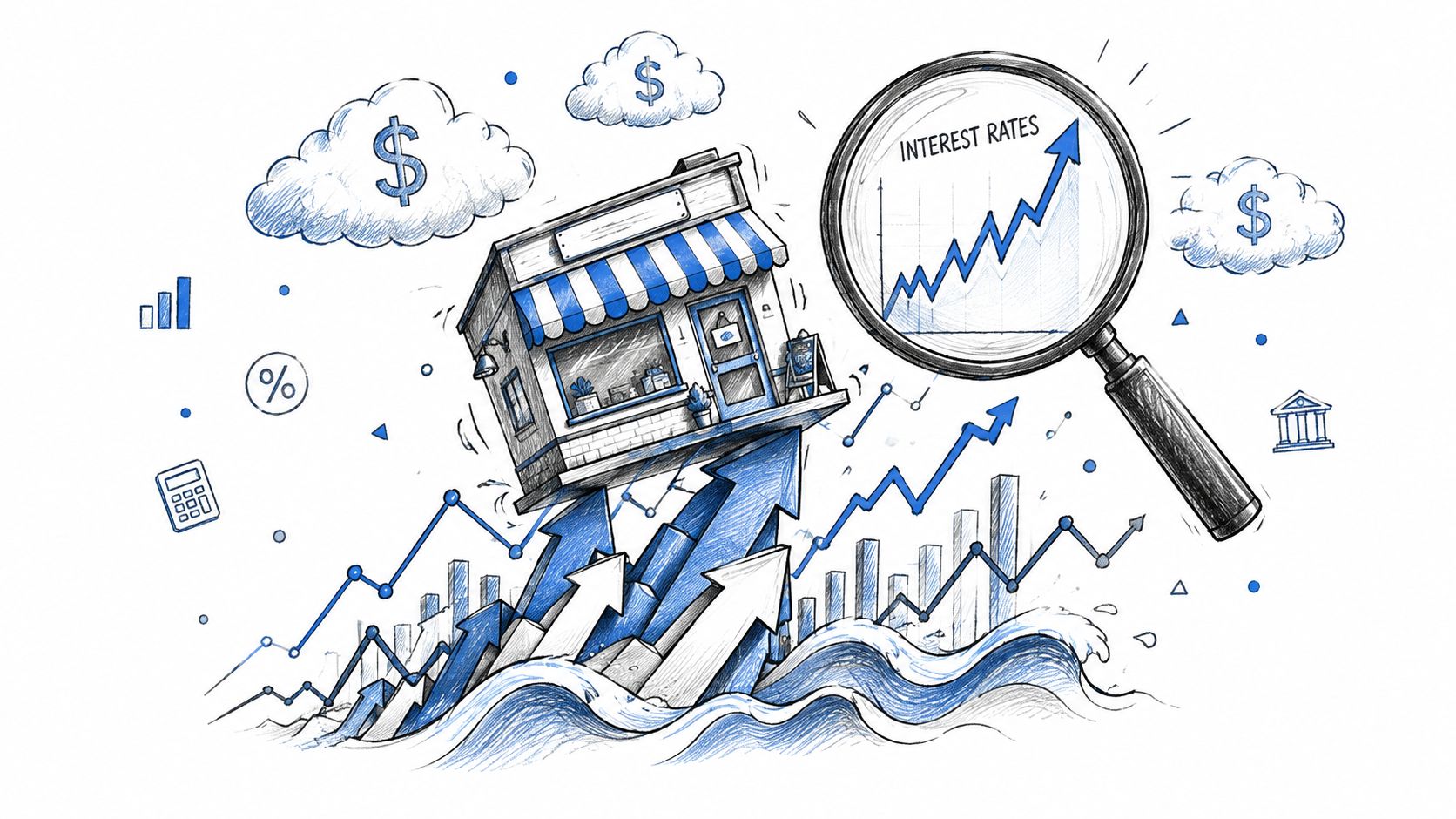
Interest rates affect acquisition financing in direct ways. Rising rates can reduce buyers' debt capacity, increase their weighted cost of capital, and compress EBITDA multiples. Reduced credit availability can shrink the qualified buyer pool or shift more consideration toward earnouts and seller financing.
At the same time, a slower market doesn't automatically mean you should wait. In 2025, U.S. transactions below $500 million in enterprise value fell 6.5% year over year, from 2,327 to 2,176 deals, while survey respondents reported that cash at closing and valuation multiples were broadly flat, according to the 2025 U.S. Middle Market Monitor.
Compare selling now with waiting
The useful comparison isn't “good market versus bad market.” It's value available today versus value you might create by waiting, adjusted for risk.
Build a grid using:
- EBITDA scenarios: Model growth of 10%, 0%, and negative 10%.
- Multiple scenarios: Apply 4x, 5x, and 6x valuation multiples.
- Transaction deductions: Subtract net debt, working-capital adjustments, taxes, and contingent consideration.
- Operating risks: Include customer loss, margin compression, founder dependence, and delayed management succession.
- Personal requirements: Test whether each outcome supports your liquidity, retirement, and post-sale income needs.
The purpose isn't to create false precision. It's to expose the opportunity cost of waiting. A company with improving margins, reliable recurring revenue, and transferable management may command stronger terms today than it could later if growth stalls. Conversely, a company with weak reporting may benefit from waiting, but only if the owner has a defined plan to fix the underlying problems.
Monitor sector-specific transaction volume, lender appetite, comparable-company multiples, and strategic-buyer activity. Then begin buyer-readiness work 12 to 24 months before marketing, including financial reporting, forecasting, customer contracts, succession, and quality-of-earnings evidence.
The right question isn't “Will the market improve?” It's “What must improve inside my company to justify waiting, and what could deteriorate while I wait?”
Use an M&A checklist for business owners to organize the commercial, financial, operational, and legal work before outreach begins.
Using Multiple Valuation Lenses Early
Owners often anchor on one valuation number. That's a mistake. Before marketing the company, calculate value through multiple lenses and investigate the differences.
The U.S. Small Business Administration identifies three common approaches:
- Income approach: Uses projected revenue or cash flow and adjusts for risk.
- Market approach: Compares similar businesses that recently sold.
- Assets approach: Subtracts liabilities from the value of business assets.
Each method answers a different question. The income approach asks what future earnings are worth. The market approach tests how buyers have priced comparable companies. The assets approach establishes what remains if the business is valued primarily through its tangible resources.
Build three internal estimates
Prepare a short valuation worksheet with three outputs:
- Normalized cash-flow value: Start with sustainable earnings, then remove unusual costs and normalize owner compensation. Be disciplined. Buyers won't accept every personal expense as a legitimate adjustment.
- Comparable-sale value: Gather relevant transactions by industry, size, geography, customer model, and margin profile. A generic industry multiple isn't enough.
- Net-asset value: List business assets, subtract liabilities, and assess whether equipment, inventory, receivables, intellectual property, and other assets are recorded at realistic values.
Suppose the income approach produces $8 million, comparable transactions indicate $7 million, and net assets total $5 million. That spread isn't a calculation error to hide. It tells you where diligence will focus.
The buyer may ask whether projected earnings are dependable, whether customer relationships are transferable, and whether intangible value is documented. If the income value depends on a forecast while the asset value remains low, you'll need evidence that the forecast reflects repeatable performance rather than owner optimism.
For a practical primer on pricing a business before listing, focus on the assumptions behind each method, not just the final figure. You can also use this guide to valuing a small business for sale to structure the analysis before a broker or buyer reviews it.
Building a Business Transferable Without You
A valuation is theoretical until the company performs without its founder. Buyers aren't just acquiring revenue and equipment. They're acquiring a system that must continue producing cash after ownership changes.
Start with a founder-dependence audit. For two weeks, record every decision, relationship, approval, and task that requires you personally. Include sales calls, pricing exceptions, hiring decisions, vendor negotiations, collections, project troubleshooting, and employee escalations.
Then classify each item:
| Category | What to document | What readiness looks like |
|---|---|---|
| Customer relationships | Account history, renewal terms, decision-makers, service expectations | A manager can maintain the relationship |
| Core processes | Sales, delivery, purchasing, billing, collections | A documented process exists and someone else owns it |
| Financial controls | Forecasting, approvals, cash reporting, working capital | Leadership can explain cash movement without the owner |
| Management decisions | Hiring, pricing, scheduling, capital spending | Authority is assigned and exercised consistently |
Customer concentration deserves direct attention. If one customer drives a disproportionate share of revenue, build a diversification plan and document the relationship's contractual and operational stability. If your company earns accounting profit but repeatedly needs owner cash to fund operations, fix billing, collections, inventory, or project controls before you discuss price.
Make cash visibility dependable
A 13-week cash-flow forecast is a practical operating tool, not a presentation exercise. Update it regularly with expected receipts, payroll, vendor payments, taxes, debt service, capital spending, and unusual cash demands. Use it to identify shortfalls early and to demonstrate that management understands the company's liquidity.
Seller financing can make a transaction possible when bank debt is constrained, but it increases your exposure after closing. Under IRS rules, an installment sale generally exists when the seller receives at least one payment after the tax year of the sale. The seller allocates the selling price among asset classes and reports eligible gain as principal payments arrive. Depreciation recapture generally must be reported in the year of sale, and installment reporting can't defer every category of business-sale income, as explained in IRS Publication 537.
That means seller financing requires more than a tax discussion. Model cash receipts, debt service, default risk, interest income, and tax payments before accepting a note. For broader transition planning, use succession planning best practices to connect management depth with financial readiness.
Choosing Your Buyer Path Strategically
The right buyer isn't always the one offering the highest headline price. You need to decide what matters most: liquidity at closing, certainty, employee continuity, legacy protection, or continued involvement.
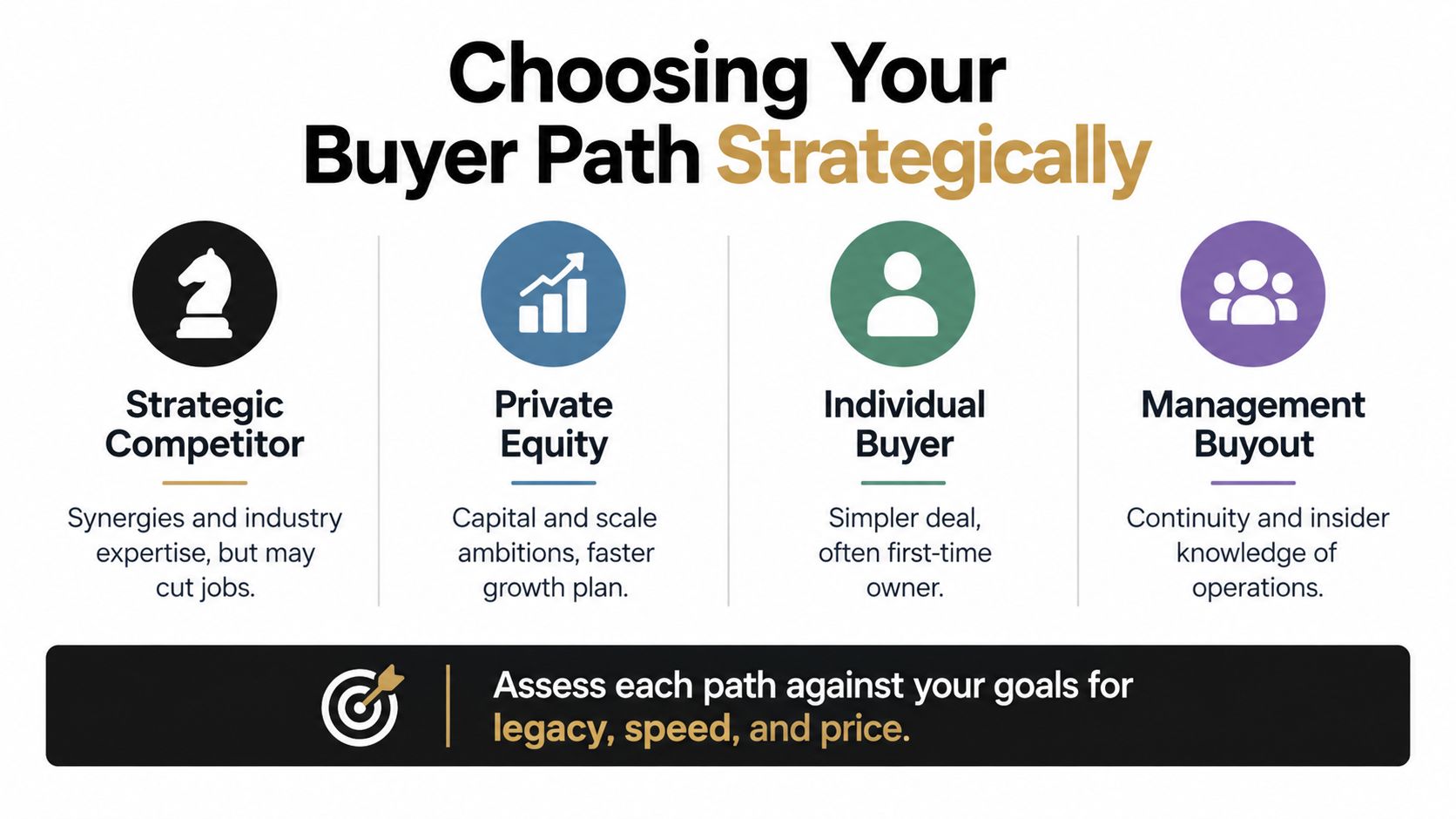
Many owners assume their only options are a strategic competitor or private equity. That leaves valuable paths unexplored, particularly for founder-led construction, distribution, and professional-services companies where relationships and culture influence value.
Match the buyer to the owner's objective
| Buyer path | Potential fit | Primary concern |
|---|---|---|
| Strategic competitor | The company has clear synergies, market access, or operating overlap | The buyer may consolidate functions or cut jobs |
| Private equity | Management can support a scale plan and the owner is open to a structured transition | The deal may involve rollover equity, targets, or continued involvement |
| Individual buyer | The business has understandable operations and a buyer values direct ownership | Financing and experience may require careful diligence |
| Management buyout | Existing leaders know the customers, employees, and operating model | The team may need outside financing or seller support |
| Family succession | A capable family member wants responsibility and the owner prioritizes continuity | Family readiness and financial fairness may not align |
A 2025 Bank of America survey found that 40% of small and midsized business owners had not prepared for the future, while only 38% of owners with a succession plan expected to sell the business, according to Bank of America's survey release. The same source reports that individual buyers accounted for 44% of lower-middle-market acquisitions in 2025.
That matters because an individual buyer may offer a credible path when family succession isn't realistic and private equity isn't aligned with the owner's priorities. Individual buyers can also bring a direct-ownership mindset that suits a stable company with documented processes and a capable operating team.
Watch the deal structure, not just the buyer label. A strategic buyer may offer a higher price but require major integration. A management buyout may protect employees but depend heavily on seller financing. A family transition may preserve the name but create unresolved governance and compensation issues.
Before choosing a path, prepare the financial records a buyer will inspect. A structured HireAccountants due diligence guide can help organize supporting schedules, reconciliations, contracts, and evidence behind reported earnings.
Your business becomes easier to sell when it can operate independently of any specific buyer type. That means management depth, documented processes, customer diversification, normalized owner compensation, and dependable cash-flow visibility should come before the buyer search.
Creating Your Three-Year Exit Roadmap
Start exit planning at least 3 to 5 years before the intended sale. Regions recommends this lead time because owners need to establish clean financial statements, strengthen management, and document profitability before approaching buyers.
Use a quarterly readiness schedule:
- Year one: Clean up monthly reporting, normalize owner compensation, map customer concentration, and establish a dependable 13-week cash-flow forecast.
- Year two: Transfer key responsibilities, document operating processes, improve weak margins, formalize contracts, and test management's ability to run the company without daily founder intervention.
- Year three: Obtain a preliminary valuation, assemble quality-of-earnings support, confirm the preferred buyer path, and prepare the company for marketing.
Obtain that preliminary valuation two to three years before the intended exit. If the result falls short of your personal objective, you still have time to improve pricing, cash conversion, management depth, and customer diversification.
Don't wait for the perfect market. Set your target window, measure the value of waiting against the risk of decline, and make the company transferable before you need to sell it.
AmbitionCFO helps founder-led companies build exit readiness through financial reporting, forecasting, cash-flow modeling, margin analysis, KPI dashboards, and multi-year transition planning. Visit AmbitionCFO to discuss your target exit window and turn it into a practical readiness roadmap.