

82% of family businesses have some form of succession plan, but only approximately half have a thorough, well-developed one. Business exit planning services close that gap by turning a stated intention into measurable financial, operational, and leadership readiness.
That distinction matters because a plan can be little more than a name on a document. A usable strategy shows how the company will perform without its founder, how the buyer will verify earnings, how the owner will receive proceeds, and who will make decisions during the transition. Exit planning is not a legal event that begins when a purchase agreement arrives. It's a long-term operating discipline that protects both enterprise value and the owner's peace of mind.
Table of Contents
- The Hidden Gap in Business Exit Planning
- Core Components of Effective Exit Planning Services
- How Fractional CFOs and CEPAs Embed with Leadership
- Industry-Specific Considerations for Construction and Distribution
- Measuring ROI and Cost and Value Outcomes of Exit Planning
- Evaluating and Selecting an Exit Planning Provider
- Your Next Steps Toward a Successful Exit
The Hidden Gap in Business Exit Planning
Deloitte's 2025 global research surveyed 1,587 family businesses across multiple countries. Each company reported at least US$100 million in revenue and family ownership of at least 51%. The research found that 40% were already experiencing, or expected to experience, a CEO change within the next 10 years, while 82% reported some form of succession plan. Only approximately half had a thorough, well-developed plan. Deloitte's family business succession research
That gap is where exits become fragile. A founder may have identified a child, executive, or buyer as the likely successor, yet still lack documented processes, reliable financial reporting, management depth, or a funding plan. The business has a succession intention, not a transition-ready company.
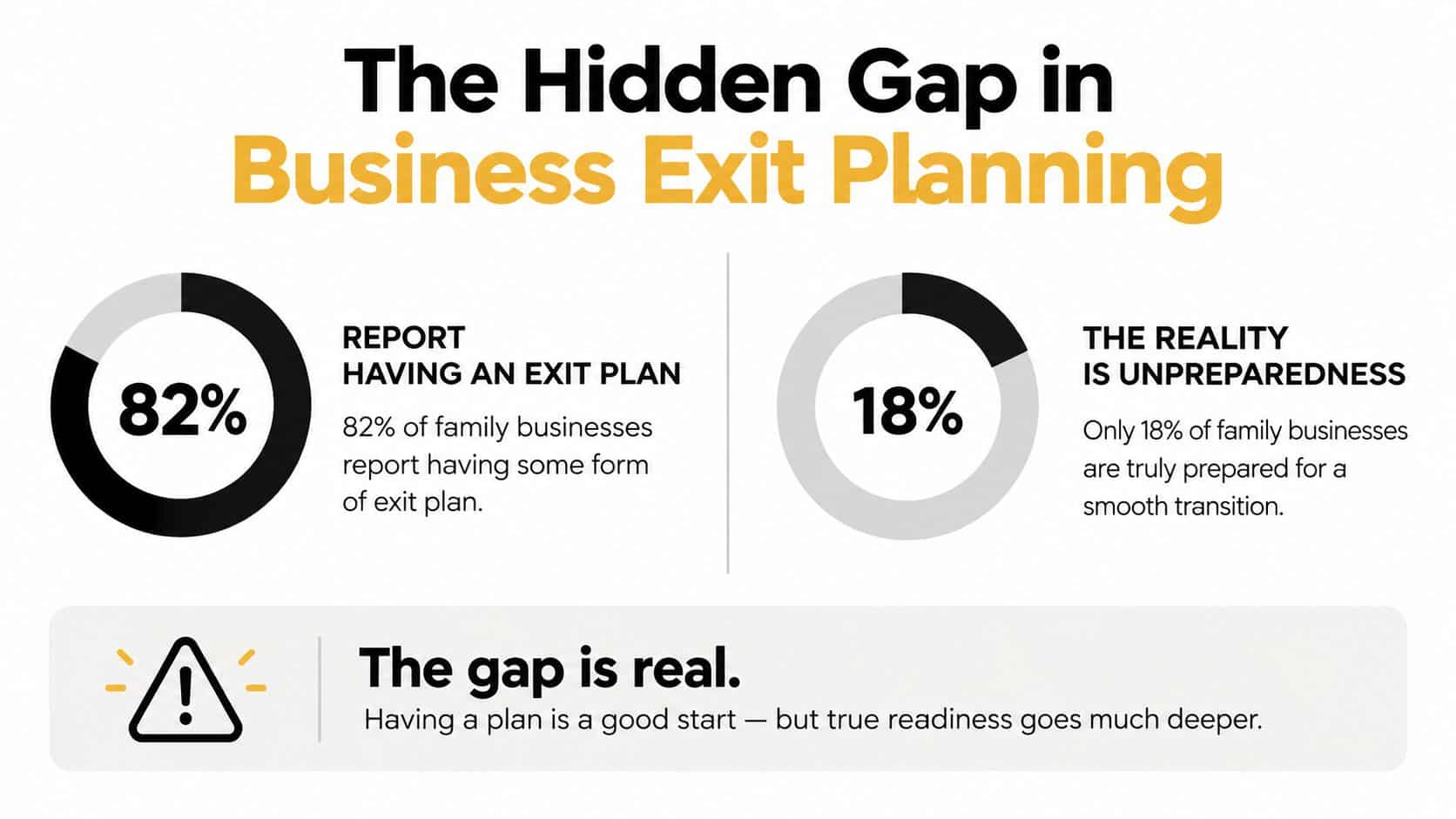
A name on a list isn't a strategy
A nominal succession plan answers one question: who might take over? A strong exit strategy answers harder questions:
- Leadership continuity: Who can run sales, operations, finance, and customer relationships without the founder?
- Financial credibility: Can the company produce normalized earnings that a buyer, lender, or successor can understand?
- Decision rights: Who approves spending, hiring, pricing, and contracts during the transition?
- Owner economics: Will the transaction provide enough after-tax proceeds to support the owner's next stage?
- Transfer mechanics: Will the exit be a sale, family transfer, management buyout, or another structure?
Historical evidence shows this planning gap has persisted. The 2007 American Family Business Survey found that 40% of owners expected to retire within 10 years, yet only 45% of owners expecting to retire within five years had selected a successor. Among owners expecting to retire in six to 11 years, only 29% had done so. The succession planning history summarized by Morgan Stanley
A useful exit plan therefore behaves like an operating roadmap. It assigns owners to specific improvements, establishes reporting rhythms, and tracks whether the company is becoming less dependent on one person. Owners who want a legal perspective on ownership transfer can also use this California succession planning guide as a reference point, but legal documents alone won't make a business transferable.
Practical rule: If the founder still approves every major quote, resolves every customer dispute, and carries the most important relationships, the company isn't ready simply because a successor has been named.
Core Components of Effective Exit Planning Services
Effective business exit planning services connect financial strategy, legal coordination, and operational readiness. If one pillar is missing, the owner may receive a valuation that the business can't support, a deal structure that creates unnecessary tax pressure, or a transition plan that fails when the founder steps away.
Start with the earnings that a buyer can trust. A normalized EBITDA schedule removes owner-specific expenses, one-time costs, nonrecurring gains, and unusual compensation. The schedule should reconcile to tax returns and monthly financial statements, then test whether margins repeat by customer, contract, job, or service line. EBITDA means earnings before interest, taxes, depreciation, and amortization. “Normalized” means adjusted to represent the sustainable economics of the business after a buyer replaces the owner's role and removes unusual items.
Build the financial foundation
Financial readiness should include:
- Normalized EBITDA: Document every adjustment and retain support for it. Unsupported add-backs weaken credibility during diligence.
- Working capital analysis: Track receivables, inventory, work in process, payables, and the cash required to operate after closing.
- Concentration reporting: Show the revenue and gross margin contribution of major customers, contracts, suppliers, and service lines.
- Cash-flow forecasting: Model base, downside, and stress cases, including debt service, capital expenditures, collections, and owner replacement costs.
The transaction structure changes the cash outcome. In the IBBA/M&A Source Q4 2024 survey, sellers of businesses valued at $5 million to $50 million received an average of 6.0× EBITDA. Approximately 84% of total consideration was paid in cash at closing, while seller financing generally represented 15% or less of deals. The Q4 2024 Market Pulse survey
Tax advisers and attorneys should coordinate with the financial plan, not arrive after the headline offer. An asset sale may produce different tax results from an equity sale, and payment timing affects the owner's cash flow. Under the IRS installment method, a business owner who sells assets and receives at least one payment after the tax year of sale may generally report eligible gain as payments are received. The method doesn't apply to losses, and the buyer and seller generally allocate the purchase price among asset classes and report that allocation on Form 8594. IRS Publication 537
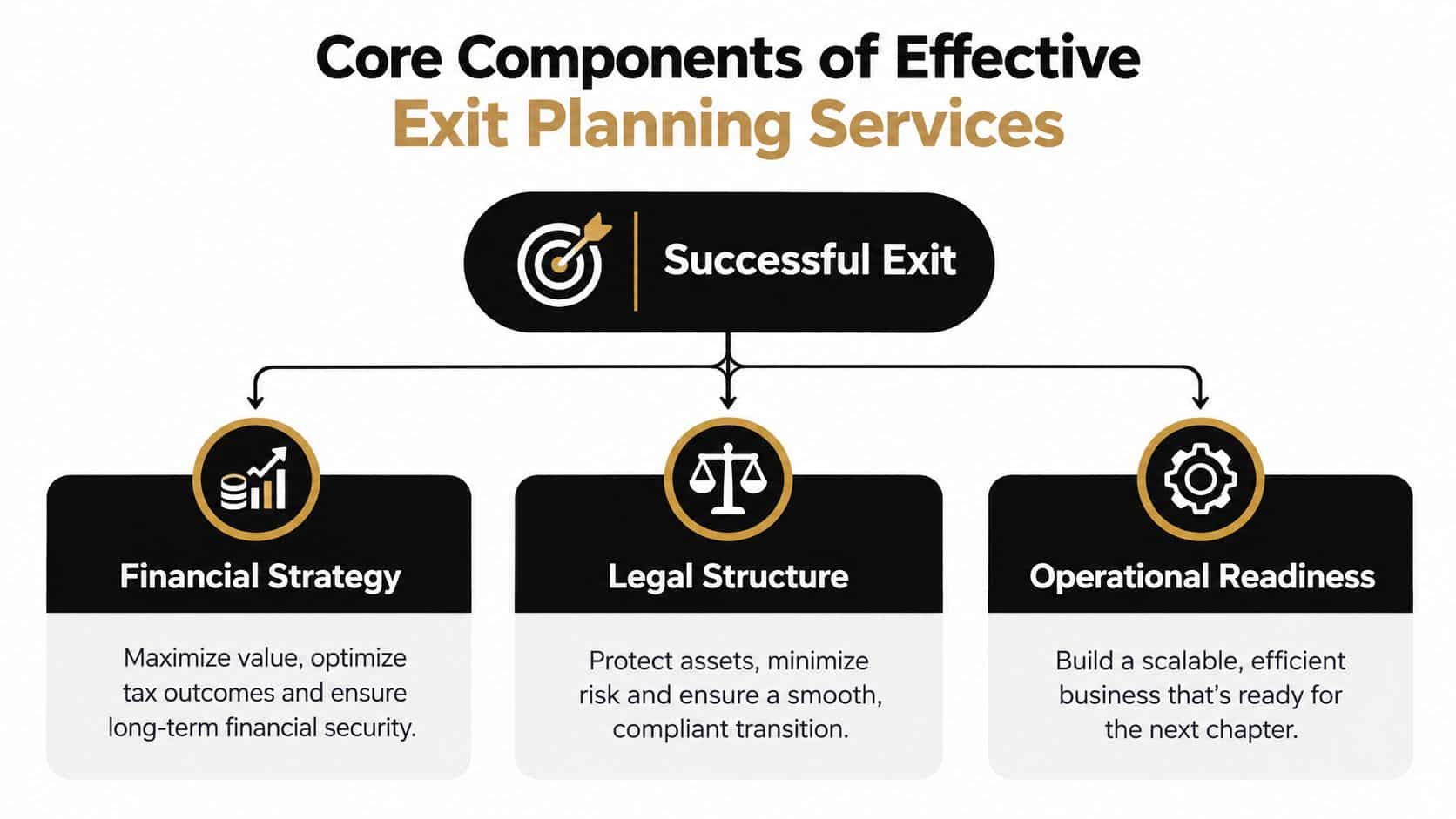
Prepare people and deal terms together
Leadership development is more than selecting a successor. Give future leaders authority over defined functions, document recurring decisions, and measure whether the company can operate when the founder is unavailable. Owners of agencies and other relationship businesses may find the discussion in this resource on planning your agency succession useful because client continuity and leadership transfer must be addressed together.
Deal preparation also requires a negotiation worksheet. Track the working-capital target, earnout metric and measurement period, escrow amount and release date, and permitted buyer actions. Locked-box pricing, completion accounts, earnouts, and escrow allocate financial risk between buyer and seller. PwC's overview of M&A transaction mechanisms explains why a seemingly attractive price can produce less or later cash after closing adjustments and contingencies.
For a practical explanation of the operating factors that influence value, review this guide to value drivers. The objective isn't to chase a theoretical multiple. It's to create a company whose earnings, management, customers, and systems remain credible after ownership changes.
How Fractional CFOs and CEPAs Embed with Leadership
A bookkeeper records what happened. A tax preparer reports required information. A traditional CPA may provide valuable compliance and accounting guidance. Exit readiness needs another layer, a senior financial operator who helps leadership decide what to do next and measures whether those decisions improve transferability.
A fractional CFO or Certified Exit Planning Advisor, known as a CEPA, works inside the leadership rhythm without requiring a full-time executive hire. The role may include a 13-week cash-flow model, monthly forecasting, margin analysis by job or client, KPI dashboards, and scenario planning for hiring, equipment, pricing, debt, or a potential transaction.

The engagement should change decisions
The right provider doesn't just deliver a dashboard. They use the dashboard to force management decisions.
- Every week: Review cash receipts, upcoming disbursements, payroll, debt obligations, and collection risks.
- Every month: Compare actual revenue, gross margin, operating expenses, and EBITDA with the forecast.
- Every quarter: Review customer concentration, management capacity, owner dependence, capital needs, and progress against the exit roadmap.
- Before a major commitment: Model the impact of a new contract, equipment purchase, executive hire, or expansion before signing.
A 13-week cash-flow model is particularly useful because it makes near-term liquidity visible. It can expose a profitable company that still cannot fund payroll, inventory, or project costs on schedule. The model should also show whether a buyer could service acquisition debt while maintaining the working capital required for normal operations.
Choose strategic integration over occasional advice
An embedded adviser joins leadership meetings, challenges unsupported assumptions, and translates operational changes into financial outcomes. That differs from waiting for year-end statements or asking for a valuation shortly before a sale. Owners can explore the role of a CEPA in exit planning when they need a structured process that combines personal objectives with business preparation.
For example, an owner may believe a new sales manager will reduce founder dependence. A fractional CFO should test that belief by tracking revenue ownership, sales-cycle progression, customer handoffs, gross margin, and the manager's authority over pricing and staffing. The result is a measurable operating change, not a hopeful statement in a presentation.
Owner test: Ask your adviser which three operating metrics will prove that the company can perform without you. If the answer is vague, you have compliance support, not exit leadership.
Industry-Specific Considerations for Construction and Distribution
Buyers don't evaluate every company through the same lens. A construction company creates confidence through job-level economics and backlog quality. A distributor depends on inventory discipline, supplier resilience, and customer breadth. A professional-services firm must prove that clients and revenue belong to the business, not only to the founder or a few rainmakers.
| Industry | Buyer focus | Readiness evidence |
|---|---|---|
| Construction | Project margins, backlog, job costing, and change-order discipline | Reliable job-level gross margins, current backlog quality, and documented project controls |
| Distribution | Customer concentration, inventory, suppliers, and working capital | Inventory reporting, purchasing discipline, customer retention, and supplier diversification |
| Professional services | Key-person risk, client retention, and delivery capacity | Documented client ownership, repeatable delivery, leadership depth, and service-line margins |
Construction
Construction owners should separate estimated profit from realized profit. Track labor, materials, subcontractors, change orders, retainage, and project completion by job. A backlog full of low-margin or poorly documented work can reduce buyer confidence even when the revenue outlook appears strong. This construction job-costing resource shows why project-level reporting belongs in the exit roadmap, not only in the accounting department.
Owners who want to assess their bookkeeping infrastructure can also review construction bookkeeping services from Allied Tax Advisors. The exit adviser's job remains broader, connecting job data to normalized earnings, cash conversion, management capacity, and buyer diligence.
Distribution and professional services
Distributors need to know which customers generate durable gross margin, how much cash inventory consumes, and whether supplier relationships transfer with ownership. A customer concentration problem doesn't disappear because total revenue is growing. Management should document reorder patterns, aging inventory, purchasing approvals, and the effect of losing a major account.
Professional-services firms face a different dependency risk. If the owner controls the client relationship, pricing, delivery standard, and renewal conversation, the buyer may view revenue as personally attached. Transfer key relationships to a broader leadership team, document delivery procedures, and report profitability by client or service line. These changes create evidence that the firm can retain customers and deliver work after the founder exits.
Measuring ROI and Cost and Value Outcomes of Exit Planning
Exit planning earns its keep when it improves the company before a transaction. Better reporting, lower earnings volatility, stronger cash conversion, and reduced founder dependence can make the business easier to finance and easier to transfer. The owner benefits even if the planned sale date changes.
For lower-middle-market companies valued between $5 million and $50 million, the IBBA/M&A Source Q4 2022 Market Pulse survey reported an average valuation of 4.1× EBITDA and identified poor financials as a leading cause of failed transactions in smaller deals. The Q4 2022 Market Pulse executive summary
Consider the supplied example. A company producing $1.5 million of normalized EBITDA at a 4.1× multiple implies approximately $6.15 million of enterprise value. A 0.5× improvement in the applicable multiple would imply approximately $750,000 of additional enterprise value before debt and working capital. That outcome doesn't come from asking for a higher price. It comes from proving that earnings are durable, transferable, and supported by reliable operations.
Measure the improvements buyers can underwrite
Build a monthly readiness scorecard around metrics such as:
- Normalized EBITDA: Reconcile adjustments to financial statements and tax returns.
- Margin consistency: Track gross margin by customer, job, contract, or service line.
- Cash conversion: Compare EBITDA with collections, working-capital investment, capital expenditures, and debt service.
- Customer exposure: Monitor concentration and retention rather than relying on total revenue.
- Management independence: Record decisions that no longer require founder approval.
- Reporting quality: Close accounts consistently and explain significant variances.
The scorecard should show trend and accountability. Assign each improvement to a leader, set a review cadence, and retain the underlying documentation. A buyer pays for evidence, not the owner's memory.
Connect value to the owner's life
The company can be valuable while the owner remains personally unprepared. One 2025 survey summary reported that 58% of owners planned to exit within five years, while only 13% had a formal personal plan and 22% had completed a value-enhancement project. The owner-readiness findings summarized by Capitaliz
Calculate the after-tax proceeds required for the owner's next stage, then compare that amount with a realistic transaction outcome. If there's a gap, improve recurring profit, reduce owner dependence, diversify customers, strengthen management, or reconsider the deal structure. A practical discussion of the ROI of a fractional CFO can help owners evaluate the financial leadership required to manage these improvements.
Evaluating and Selecting an Exit Planning Provider
Don't hire a provider because they promise a valuation. Hire the person who can show how the company will become more valuable, more understandable, and less dependent on the founder.
Start with credentials and role clarity. A CEPA can bring a formal exit-planning framework. A fractional CFO should demonstrate competence in forecasting, cash management, profitability analysis, and transaction preparation. Attorneys and tax advisers should handle legal and tax opinions within their specialties. No single provider should pretend to replace every adviser.
Ask questions that expose execution ability
Use this interview checklist:
- “What will you measure every month?” Look for normalized EBITDA, margin, cash flow, working capital, customer concentration, and management depth.
- “How will you test founder dependence?” The provider should identify decisions, relationships, and processes currently controlled by the owner.
- “What will the first operating review produce?” Expect a baseline, a prioritized risk register, and assigned actions, not a generic presentation.
- “How do you coordinate with legal and tax advisers?” The answer should include shared assumptions for asset allocation, payment timing, transaction structure, and personal objectives.
- “How will you model downside?” The provider should stress collections, margins, backlog, inventory, capital expenditures, debt service, and owner replacement costs.
- “What happens if I delay the sale?” A strong plan remains useful as a performance-improvement program.
Red flags are easy to recognize. Avoid providers who focus on a headline valuation while ignoring financial reporting, working capital, leadership depth, or customer transferability. Be cautious when the provider can't explain its assumptions, won't define deliverables, or treats the owner's personal financial target as unrelated to the business plan.
You can also review how transaction advisory services fit alongside operational preparation. The engagement should specify who owns each workstream and how progress will be reported to leadership.
Your Next Steps Toward a Successful Exit
A founder often waits for emotional certainty before starting. That's backwards. You don't need a fixed sale date to improve reporting, delegate decisions, understand cash needs, or calculate the proceeds required for your future.
The readiness gap is especially serious among owners approaching transition. In the 2025 generational owner-readiness findings, more than half of surveyed Baby Boomer owners expected to exit within five years, but only 27% had completed a formal business valuation, 9% had an estate plan, and just 5% had a dedicated exit-planning team. The owner-readiness findings from the Exit Planning Institute summary
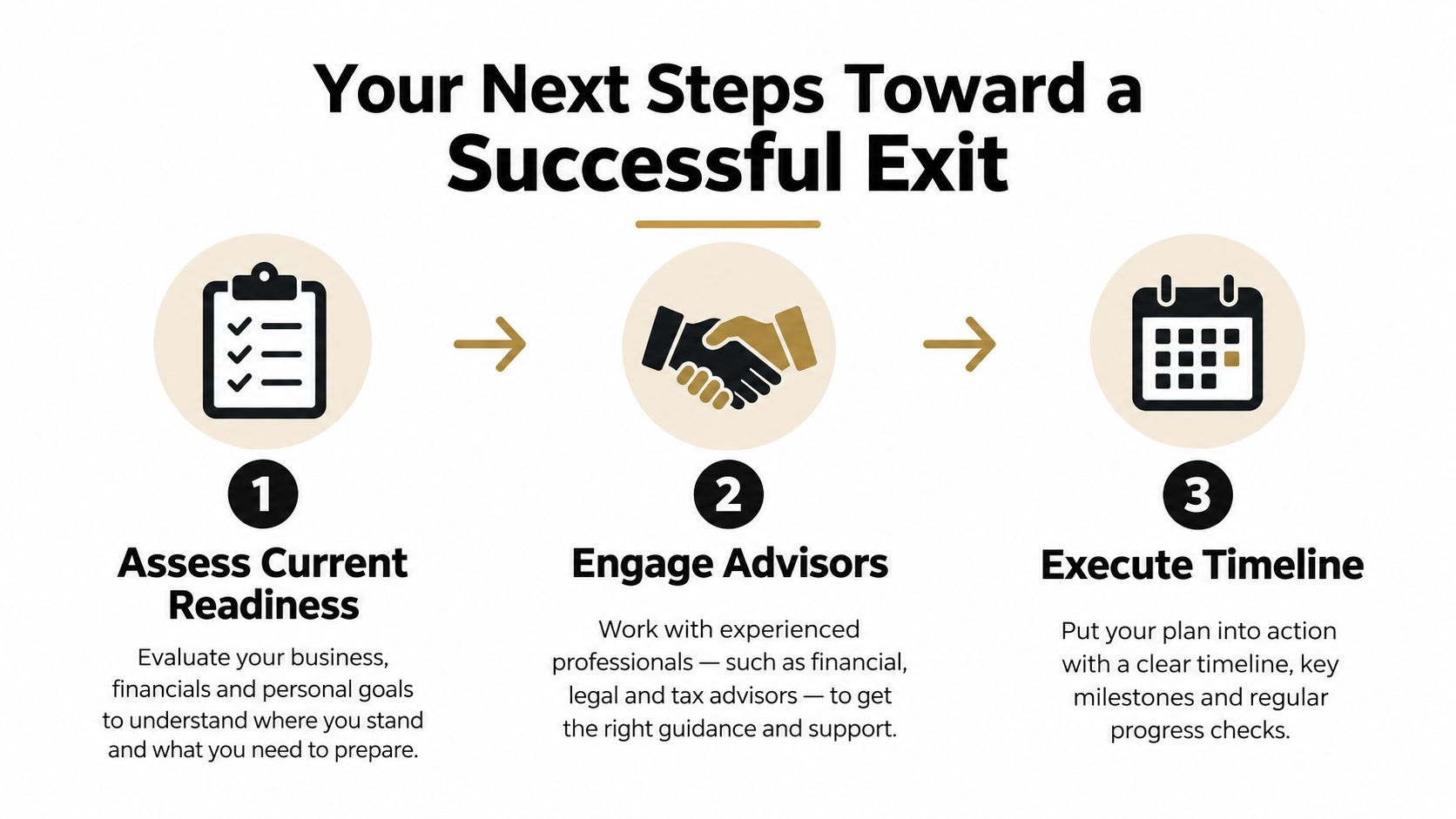
Use this immediate checklist:
- Assess current readiness: Gather monthly financial statements, tax returns, customer data, backlog, contracts, debt schedules, and owner-specific expenses. Identify the decisions and relationships that still depend on you.
- Engage advisers: Assemble financial, legal, tax, and operational support. Define the personal proceeds you need and the transition paths you're willing to consider.
- Execute the timeline: Create a quarterly roadmap with accountable owners, measurable targets, and a recurring leadership review. Update it as the business changes.
The best exit strategy gives you options. It can support a third-party sale, family transfer, management succession, or even a stronger company that produces more cash and fewer personal emergencies.
AmbitionCFO provides fractional CFO and CEPA-led support for founder-led businesses, including cash-flow modeling, profitability improvement, KPI reporting, due-diligence preparation, and exit planning. Visit AmbitionCFO to discuss your current readiness, define the financial outcomes you need, and build an operating roadmap for the transition ahead.