

You're profitable, bookings look strong, and yet you're checking the bank balance before approving the next hire, equipment purchase, or supplier payment. That tension is familiar to founders in construction, distribution, and professional services. The business may be earning money on paper while cash is trapped in unpaid invoices, work in progress, inventory, or commitments that arrive before customer receipts.
The question you're really trying to answer is simple: can this business fund its obligations, growth plans, and eventual exit without a cash surprise? A useful liquidity analysis answers that question by combining accounting ratios with operational forecasting. The current ratio matters, but it's only the starting point.
Table of Contents
- Rethinking Liquidity Beyond Static Ratios
- Releasing Trapped Working Capital
- Building a 13-Week Cash Flow Model
- Navigating Industry-Specific Cash Traps
- Aligning Liquidity with Growth and Exit Goals
- Upgrading Your Financial Leadership
Rethinking Liquidity Beyond Static Ratios
A profitable contractor can recognize revenue on completed work while waiting for progress billing approval. A distributor can report sales while cash sits on warehouse shelves. A consulting firm can show strong margins while unbilled work and slow client approvals delay collection. In each case, the income statement may look healthy while the bank account tightens.
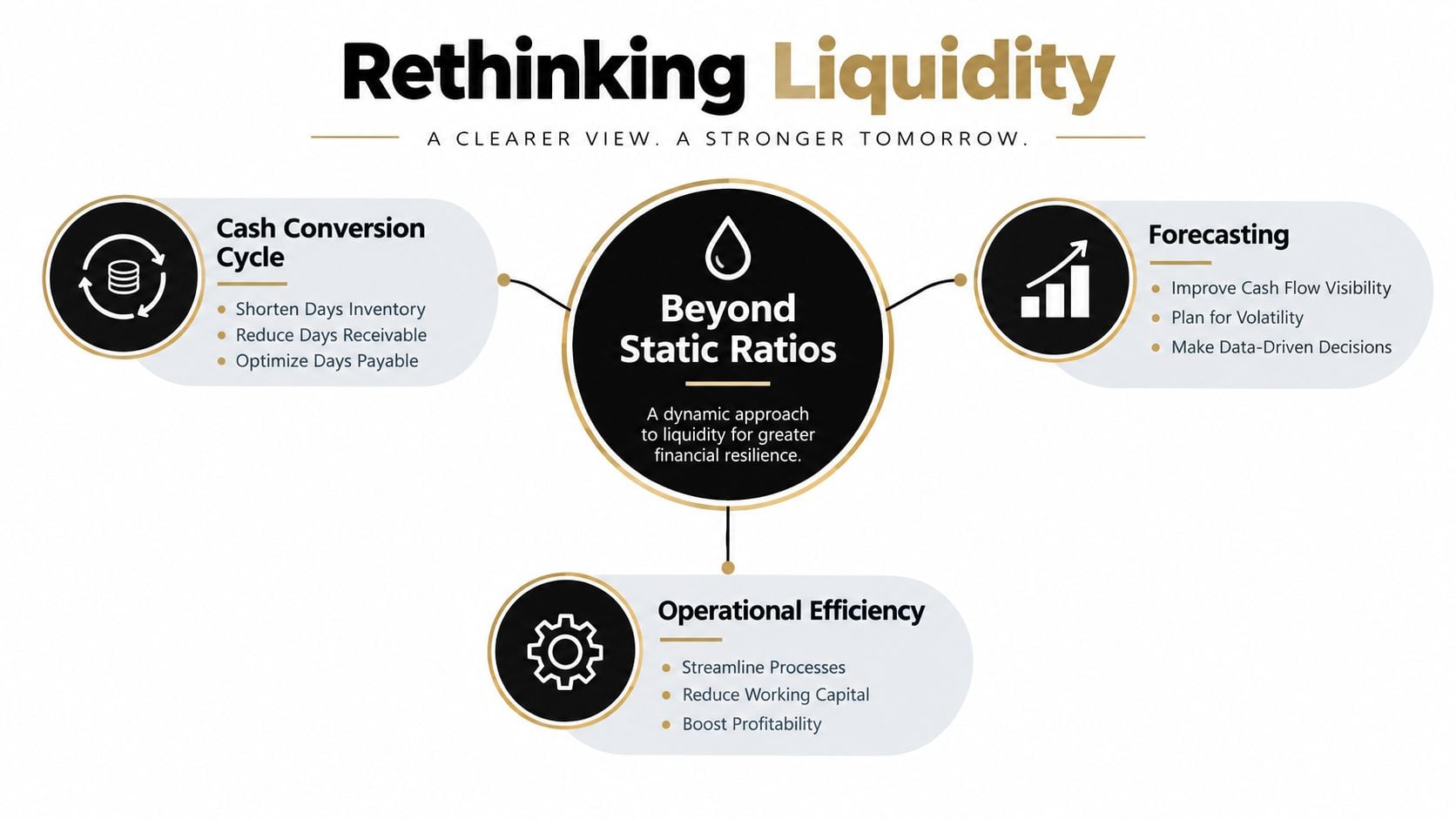
That's why a static balance-sheet snapshot is an incomplete management tool. The current ratio compares current assets with current liabilities. Current assets commonly include cash, accounts receivable, and inventory, while current liabilities are obligations due within one year. The formula is:
Current Ratio = Current Assets ÷ Current Liabilities
Investopedia's explanation of liquidity ratios provides the standard definition and formula. The metric is useful for spotting broad short-term coverage, but it doesn't tell you when receivables will arrive, whether inventory can be sold promptly, or which obligations are unavoidable next week.
Practical rule: A balance sheet tells you what exists at a date. A cash forecast tells you whether the business can survive the dates ahead.
Replace the snapshot with sources and uses
A more useful framework separates liquidity sources from liquidity uses. Major rating methodologies for non-financial companies identify sources such as forecasted funds from operations, working-capital inflows, dependable asset-sale proceeds, and the undrawn available portion of committed credit facilities. Uses include near-term debt maturities, peak working-capital needs, capital expenditure, and investment requirements. See S&P Global Ratings' liquidity methodology for the source-versus-use approach.
Build this schedule before making a major decision:
- Operating sources: expected customer receipts and forecasted funds from operations.
- Financing sources: committed, undrawn credit that's genuinely available, not informal promises.
- Operating uses: payroll, suppliers, taxes, subcontractors, rent, and other critical obligations.
- Strategic uses: equipment, hiring, facility expansion, and owner distributions.
Then add timing. A source that arrives after payroll isn't available for payroll. A credit facility with conditions you haven't tested isn't a reliable contingency plan. Here, many founders discover that their real problem isn't a lack of profitability. It's a mismatch between cash timing and obligation timing.
Use ratios as warning lights, not steering wheels
The quick ratio removes inventory from the near-cash coverage question, which makes it useful when inventory might take time to convert. Corporate Finance Institute's comparison of the current and quick ratios explains this distinction.
Historical practice made the current ratio especially prominent. Liquidity analysis became more formal in modern finance during the late 19th century, when banks began requesting borrower balance sheets and comparing current assets with current liabilities. Alexander Wall later popularized a 2:1 current ratio as adequate liquidity for many manufacturing firms, while the Great Depression helped drive development of the quick ratio after analysts recognized that inventory could become illiquid quickly, as described in this overview of liquidity ratios.
That history is useful, but it shouldn't dictate your operating decisions. A 2024 empirical study reviewing work from Beaver, Altman, and Shumway found that the current ratio was significantly negatively related to failure only at low levels. The implication is important: liquidity analysis becomes most informative when short-term coverage is tight, not when a company sits comfortably above 1.0. The study is available through Wiley.
Your management dashboard should therefore pair ratios with the lowest projected cash balance, receipts at risk, required disbursements, and committed funding. That combination gives you time to act instead of forcing you to explain a cash crisis after it appears.
Releasing Trapped Working Capital
A founder can report a healthy current ratio while payroll, suppliers, and project costs consume the bank balance. Liquidity analysis must therefore track how operating activity converts into usable cash, not merely compare current assets with current liabilities.
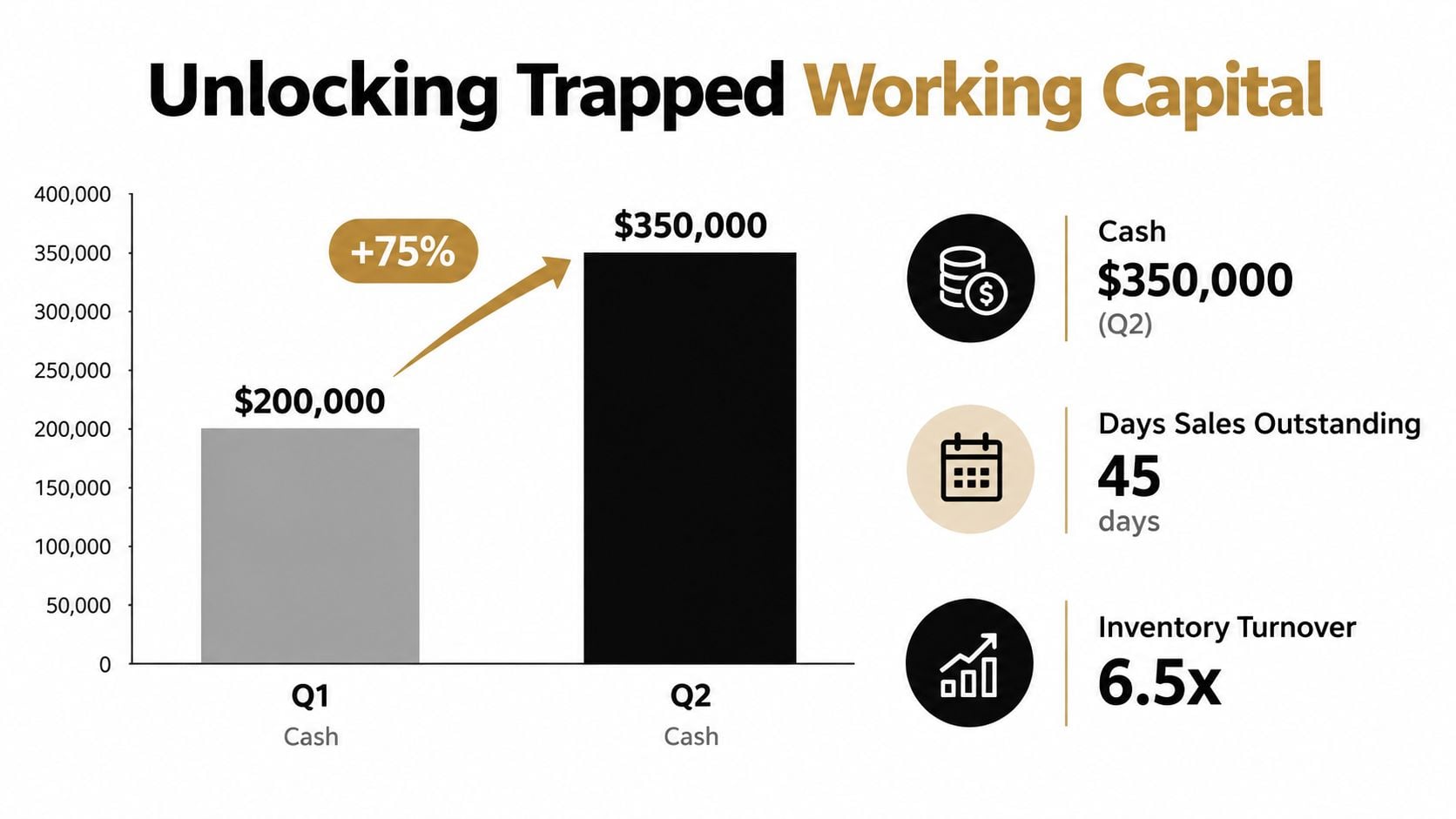
Working capital equals current assets minus current liabilities. The working capital ratio, also called the current ratio, expresses those inputs as a ratio, as explained by OpenStax's finance text. The cash conversion cycle adds an operating view by measuring how long cash remains tied up between paying for inputs and collecting from customers.
Review three movements:
- Receivables: How quickly does the firm invoice, obtain approval, and collect?
- Inventory or work in progress: How long does cash remain in stock, materials, or unfinished jobs?
- Payables: Do supplier payments match the value and timing of customer receipts?
A current ratio can conceal the process creating the pressure. A distribution company may hold adequate total assets while slow-moving stock absorbs cash. A construction company may show a strong backlog while approvals and progress billings lag. A professional services firm may produce excellent margins while unbilled time accumulates.
Turn the cash conversion cycle into decisions
Start with a customer-by-customer receivables review. Sort invoices by age, dispute status, approval stage, and promised payment date. Assign an owner to every material overdue balance. “Accounts receivable” is not a collection plan. Each balance needs a named person, a next action, and a date.
Review inventory and work in progress by velocity and economic usefulness. Identify stock that no longer matches demand, materials purchased before confirmed work, and projects where costs are ahead of billings. Protecting reported margin while cash sits in items that cannot be converted promptly is poor financial management.
Payables require control, not indiscriminate delay. Preserve supplier trust while negotiating terms that fit the billing cycle, purchasing volume, and customer payment behavior. A stronger liquidity position often comes from better process design rather than a larger idle cash balance. Use this guide to working capital optimization to structure that review.
For smaller operators, an efficient invoicing workflow can remove avoidable collection friction. If you are comparing lightweight tools, this guide to the best invoice app for solo businesses can help assess options for faster invoice creation and follow-up.
Use a working-capital worksheet that turns findings into assigned actions:
| Area | Question | Immediate action |
|---|---|---|
| Receivables | Which invoices need approval, clarification, or escalation? | Contact the decision-maker and record a committed payment date |
| Inventory | Which items are slow-moving or disconnected from confirmed demand? | Freeze replenishment and create a disposition plan |
| Work in progress | Which jobs consume cash before billing milestones? | Reprice, rebill, or renegotiate milestone timing |
| Payables | Which suppliers could support terms that better match collections? | Start a structured terms conversation |
Standard Chartered's 2026 outlook estimates about USD 2.6 trillion tied up across payables and receivables and describes working capital as an underused board-level funding lever. Read the outlook. Hackett's 2025 U.S. survey found USD 1.7 trillion trapped in excess working capital and reported a 37-day cash conversion cycle, with improvement attributed largely to better payables management rather than broad balance-sheet strength, as reported in the Hackett Group survey.
These figures support an operating review, not a policy of hoarding cash. Examine approval delays, collection ownership, purchasing decisions, billing milestones, and supplier terms. Founders preparing for growth or an exit should show that working capital is managed through repeatable controls, tested funding, and committed, undrawn credit that is available under tested conditions.
Building a 13-Week Cash Flow Model
A 13-week cash flow model converts liquidity analysis from a monthly reporting exercise into a weekly operating system. It's long enough to include recurring payroll, supplier cycles, debt service, project milestones, and customer collection patterns. It's short enough to force honest assumptions.
Build it in a spreadsheet or finance platform, but don't overcomplicate the first version. Precision comes from disciplined inputs and weekly accountability, not from decorative formulas.
Step 1 collect the cash inputs
Create a weekly column for the next 13 weeks. Start with the opening bank balance, then list gross inflows and gross outflows separately.
Gather these source files:
- Receivables aging: Include invoice amount, customer, due date, dispute status, expected receipt date, and confidence level.
- Contract and project schedules: Add progress billings, retainage releases, deposits, milestone invoices, and expected change-order collections.
- Payables aging: Separate ordinary supplier payments from critical obligations and disputed invoices.
- Payroll schedule: Include wages, payroll taxes, commissions, bonuses, and contractor payments.
- Debt calendar: Add principal, interest, lease payments, and any covenant-related requirements.
- Tax and statutory calendar: Include every known payment date.
- Capital plan: Add equipment, software, facility, and other approved purchases.
Use actual expected dates, not accounting-period assumptions. If a customer usually pays late, forecast the late date until behavior changes. If management hasn't approved a purchase, don't treat it as a committed outflow, but show it in a separate decision layer.
Step 2 calculate the weekly net position
For each week, calculate:
Opening cash + gross inflows − gross outflows = closing cash
Then identify the lowest projected cash balance across the horizon. Track committed liquidity separately from potential liquidity. An undrawn committed facility may be a source. A hoped-for loan, owner contribution, or accelerated sale isn't a source until it's dependable.
The IMF's framework describes a liquidity workflow using narrative design, shock generation, and Monte Carlo simulation of each agent's net liquidity position. It also warns against treating liquidity as a static ratio exercise, emphasizing forward-looking cash-flow projection, critical obligations, and contingency planning. Read the IMF working paper.
Step 3 add scenarios and triggers
Your base case should reflect the most realistic collection and payment timing. Add stress cases for delayed customer receipts, weaker demand, tariff or input-cost pressure, project overruns, and reduced financing availability. Don't bury these scenarios in an annual budget. Put them directly into the weekly model.
Set trigger points before the model shows a crisis:
- Collection trigger: Escalate invoices when promised receipts move beyond the forecast date.
- Spending trigger: Pause discretionary purchases when the projected minimum balance falls below your approved operating threshold.
- Funding trigger: Begin lender or owner discussions before the forecast shows a gap.
- Growth trigger: Delay hiring or expansion when recurring cash sources don't cover the added fixed commitment.
Review the model weekly with the person responsible for collections, purchasing, payroll, and operations. Replace forecasted receipts with actual receipts, explain variances, and roll the horizon forward. For a practical model structure, see this guide to building a 13-week cash flow forecast.
If you want a packaged cash-flow resource to compare against your internal process, review the Calm Cashflow product details from Accountant She Ltd. The tool matters less than the cadence. A model that nobody updates is an expensive document, not a control system.
Navigating Industry-Specific Cash Traps
Liquidity risk doesn't look the same in every business. The right analysis follows the operating model, not a generic benchmark.
| Industry | Primary Cash Trap | Key Metric to Monitor |
|---|---|---|
| Construction | Progress billing delays, retainage, and work in progress | Cost-to-complete against billed and collected cash |
| Distribution | Inventory purchased before demand and supplier terms that don't match collections | Inventory velocity and customer collection timing |
| Professional services | Unbilled revenue, low utilization, and client concentration | Billable utilization, unbilled work, and receipts by client |
Construction
Construction founders often confuse backlog with liquidity. A signed contract can support future revenue while the project consumes cash through labor, materials, subcontractors, and equipment before the next billing milestone.
Track cost-to-complete weekly by job. Compare incurred costs, approved billings, collected cash, pending change orders, and retainage. Treat unapproved change orders as potential upside, not as a funding source. Build scenarios for delayed payment approvals, material-cost pressure, and projects that consume more labor than estimated.
The operating decision may be a billing redesign rather than a financing request. A deposit, more frequent progress billing, clearer change-order approvals, or supplier terms aligned with project milestones can reduce the gap between spending and collection. Use this resource on construction cash flow management to structure the review.
Distribution
Distribution businesses can look liquid because inventory appears as a current asset. That assumption fails when stock turns slowly, demand changes, or tariffs and supply disruptions make replenishment decisions less predictable.
Segment inventory by movement, margin, and customer commitment. Freeze purchases that don't support confirmed demand, negotiate replenishment flexibility, and make supplier terms part of the sales and purchasing conversation. Model seasonal demand shocks and delayed customer payments in the 13-week forecast. A warehouse full of products isn't a substitute for cash that can fund payroll and suppliers.
Professional services
Professional services firms face a different trap. Their assets may be light, but cash disappears when teams perform work before invoicing, clients delay acceptance, or a large account represents too much of the monthly collection base.
Track utilization, unbilled work, invoice approval time, and receipts by client. Require project managers to review unbilled balances rather than leaving that responsibility entirely with accounting. Add a concentration scenario to the forecast, where one major client pays later than expected or reduces its scope.
Each industry needs its own escalation logic. Construction should escalate cost-to-cash gaps. Distribution should escalate inventory and supplier exposure. Professional services should escalate unbilled work and client concentration. The model becomes useful when it tells the operator what to do next.
Aligning Liquidity with Growth and Exit Goals
Liquidity analysis supports more than survival. It tells you whether growth is self-funded, whether a new commitment is affordable, and whether the business will be easier for someone else to own.
Founders often approve a hire, vehicle, equipment purchase, or facility expansion because projected revenue looks strong. That's incomplete. The decision should pass three tests:
- Cash timing: When will the outflow occur, and when will the related inflow arrive?
- Downside capacity: What happens if collections slow or the project takes longer?
- Operating resilience: Can the company keep meeting critical obligations if the investment underperforms?
A disciplined 13-week model answers the first two. A KPI dashboard and margin analysis answer the third. For construction, analyze margin by job. For distribution, review margin by product and customer. For professional services, examine margin by client, service line, and delivery team.
Make the business transferable
Buyers care about cash-flow predictability, working-capital requirements, and the quality of earnings. They'll examine whether reported profit converts into cash, whether working capital is normalized, and whether the owner's relationships or daily intervention are carrying the operation.
That makes liquidity discipline part of exit readiness. Clean billing procedures, consistent collection records, documented approval workflows, reliable forecasts, and clear responsibility for cash decisions reduce uncertainty during diligence. They also help a buyer understand the working-capital peg, meaning the level of operating working capital expected to transfer with the business at closing.
Use this guide to exit planning to connect near-term financial controls with a longer transition strategy. Owners planning an exit within 3–10 years should start building evidence of predictable performance well before a transaction process begins.
Buyers don't just buy your profit. They buy their confidence that the profit will continue without you.
A stronger liquidity system can also improve growth quality. Instead of expanding because sales are available, you can choose work that supports cash conversion, protects margins, and fits your funding capacity. That's how liquidity becomes a strategic filter rather than a monthly report.
Upgrading Your Financial Leadership
A bookkeeper records what happened. A tax adviser helps you comply. Neither role automatically gives you the forward-looking operating control a growth-stage company needs.
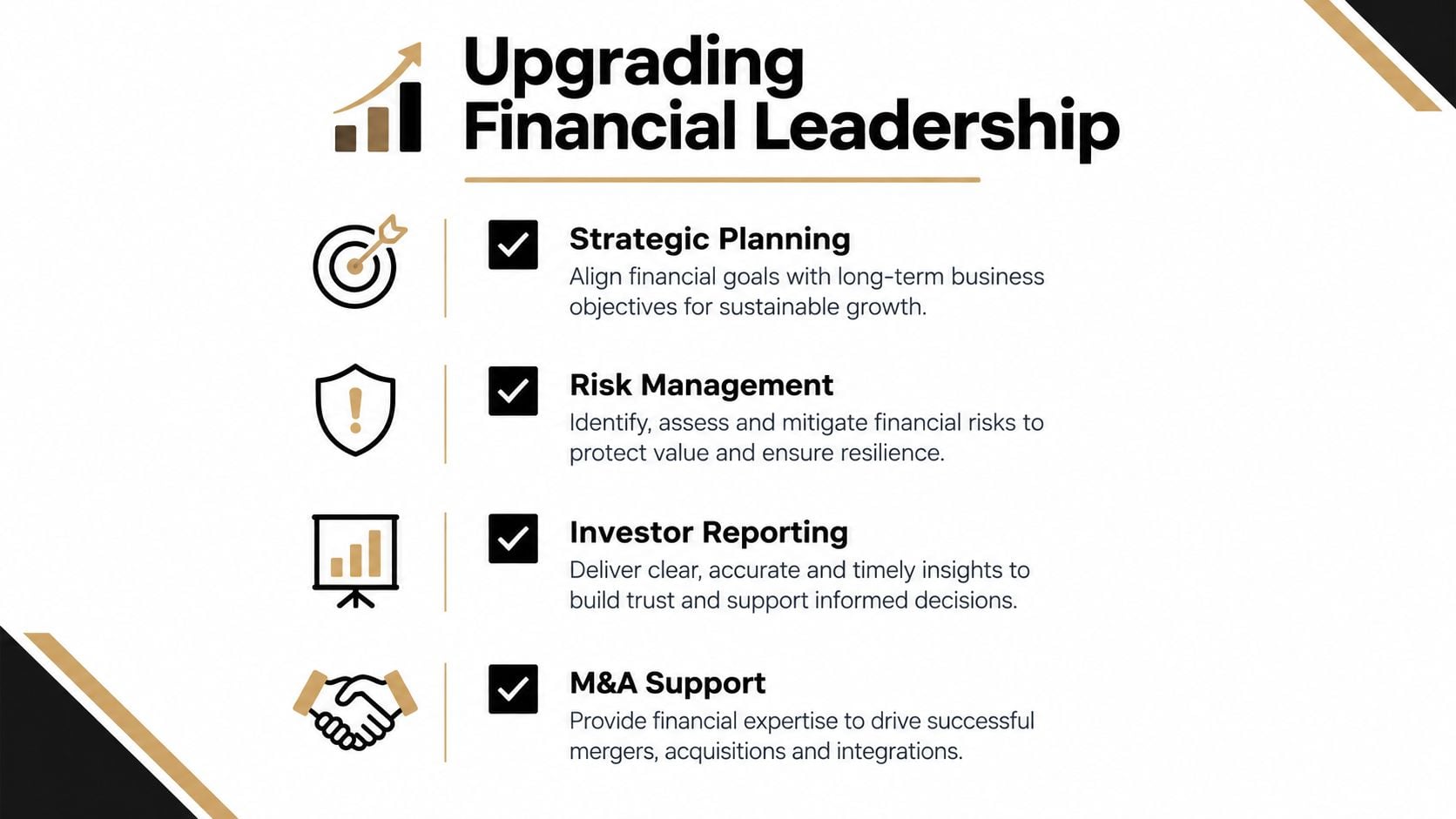
You may be ready for a financial leadership upgrade if:
- Forecasts arrive late: You learn about cash pressure after the bank balance changes.
- Reporting lacks decisions: Statements show totals but not job, client, product, or location-level performance.
- Collections have no owner: Overdue invoices remain visible but unresolved.
- Growth decisions lack scenarios: Hiring, equipment, and expansion decisions rely on optimism.
- Exit preparation is informal: Key processes and financial assumptions live in the founder's head.
A full-time CFO isn't the only answer. Many founder-led companies need senior judgment, but not a permanent executive salary. A fractional CFO can build the 13-week model, establish reporting rhythms, test scenarios, improve margin visibility, and connect liquidity decisions to exit planning while working alongside the existing bookkeeper and CPA.
AmbitionCFO provides rolling 13-week cash-flow models, forecasting, KPI dashboards, margin analysis, and exit-planning guidance for founder-led businesses. The firm serves construction, distribution, and professional services companies and works with owners nationally. Learn more about the role of an outsourced CFO before deciding whether your current finance structure matches your next stage.
Operational efficiency matters here too. Reducing administrative delays can support faster execution, whether that means tightening invoice follow-up or organizing communication. For field-service owners comparing tools, an AI email assistant for HVAC plumbers may help organize customer and supplier correspondence, but automation should support, not replace, clear financial ownership.
Start with a diagnostic, not a software purchase. Pull your current ratio, quick ratio, receivables aging, payables aging, open commitments, and the lowest projected cash balance. Then ask whether someone reviews those figures weekly and turns them into decisions.
AmbitionCFO helps founder-led businesses build rolling 13-week cash-flow models, improve cash conversion, strengthen reporting, and prepare for a confident exit. Visit AmbitionCFO to schedule a financial diagnostic and identify the cash traps limiting your next growth decision.