

The usual advice about selling a small company starts in the wrong place: get a valuation, find a broker, and look for buyers. Your real question is how to turn the business you've built into spendable, after-tax proceeds without leaving your financial future dependent on promises. Start with transferable earnings and deal terms, not a flattering multiple.
A buyer can negotiate a price. They can't easily fix a company whose customer relationships, operating knowledge, and financial explanations all live in the owner's head. Build something another owner can operate confidently, then negotiate how you'll get paid.
Table of Contents
- Why Most Small Companies Don't Sell
- The 3-to-5-Year Exit Readiness Window
- Cleaning Up the Financial Package Buyers Will Scrutinize
- Improving EBITDA and Margins in the 24 Months Before a Sale
- Deal Structure Decisions That Change Your Actual Cash
- Running the Deal Process From Teaser to Closing
- Your Readiness Scorecard and First Three Steps
Why Most Small Companies Don't Sell
Selling isn't the natural ending of business ownership. It's an outcome you have to prepare for, and the distinction matters when your retirement depends on it.
A Washington University in St. Louis analysis published in 2022 reported that approximately 92% of small-business exits occurred through closure, 5% through sale, and 3% through transfers; it also cited McKinsey's estimate that more than 1 million of roughly 6 million businesses expected to face ownership exits during the following decade could be transferable, representing an estimated $5.1 trillion in enterprise value.
Those figures describe ownership exits, not the success rate of businesses actively marketed for sale. Don't confuse the two populations.
Separate a valuable livelihood from a transferable company
An owner can earn a good living from a business that would be difficult to sell. If the founder wins every important contract, resolves every delivery problem, and personally approves every purchase, a buyer is acquiring a transition problem alongside the earnings.
My recommendation is to assess transferability before valuation:
- Customer continuity: Can someone besides you maintain the relationships that support revenue?
- Operating continuity: Can managers deliver work, hire people, and resolve exceptions without your intervention?
- Financial credibility: Can another finance professional reproduce your reported results?
- Succession readiness: Is there a practical plan for replacing your responsibilities?
The visual below highlights the preparation gap, but its sale-attempt percentage shouldn't be treated as a verified benchmark.
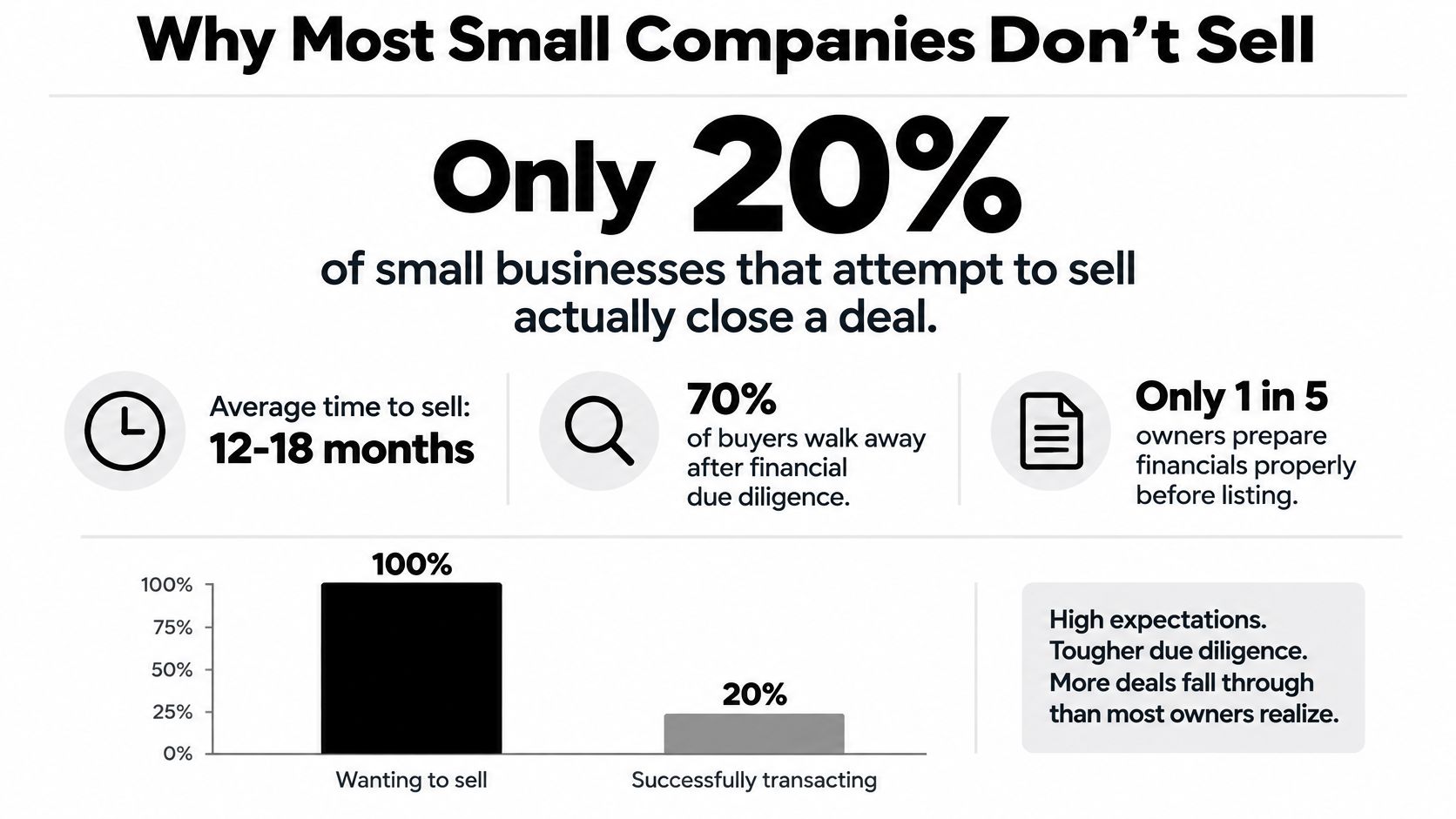
Prepare before you need leverage
Treat the readiness questions as operating assignments, not presentation problems. Give each weakness an accountable manager, supporting evidence, and a review date.
Practical rule: Don't ask whether someone would buy your company until you can explain how they would run it without you.
You don't need to build a perfect company. You need to remove the avoidable reasons a qualified buyer would hesitate, reduce their offer, or require you to stay longer than you want.
The 3-to-5-Year Exit Readiness Window
Use the 3-to-5-year window as a planning framework, not a promise about how long a transaction takes. Start with the owner's destination, then work backward into financial and operational milestones.
The preparation gap is real: Cornerstone's owner research reported that 92% of surveyed founders or inheritors had never sold a business, fewer than four in ten had completed a reputable market analysis, and 19% had no written exit plan.
Before changing the business, decide what you want your life to look like after the sale.

Run a four-quarter readiness cycle
The opening quarter is for decision clarity. Write down your preferred exit date, required personal liquidity, acceptable post-sale role, and willingness to retain investment risk. A Certified Exit Planning Advisor, or CEPA, can help coordinate owner, business, and financial readiness with legal, tax, and wealth advisers.
Next, reconcile ownership. Ask counsel to review the capitalization table, the record of who owns what, alongside shareholder agreements, options, approval rights, and unresolved ownership promises.
Use the following quarter to assign operating authority. Document who controls pricing, hiring, purchasing, collections, and delivery. Have managers exercise that authority while you're available to coach, rather than discovering gaps during buyer meetings.
During the next operating cycle, investigate concentration and contract continuity:
- Construction: Distinguish executable backlog from work exposed to cancellation, disputed changes, or uncertain collection.
- Distribution: Examine supplier alternatives, inventory quality, and whether customer relationships extend beyond the founder.
- Professional services: Separate recurring engagements from projects that happen to repeat.
Close the cycle by testing the evidence. Can the team explain performance, produce supporting reports, and resolve exceptions without routing everything through you?
Use evidence-based gates
Farther from a sale, prioritize leadership development, contract quality, and reliable reporting. Closer to marketing, prioritize reproducible financial schedules, organized agreements, and an achievable transition plan.
| Readiness area | Evidence to require |
|---|---|
| Owner objectives | Written liquidity and transition requirements |
| Ownership | Reconciled records and documented approval rights |
| Leadership | Managers making consequential decisions |
| Commercial resilience | Concentration analysis and contract review |
| Financial readiness | Repeatable reporting and supported forecasts |
Use this guidance on when to sell a business to challenge your timing assumptions. Choose the date deliberately, then make the company ready to support it.
Cleaning Up the Financial Package Buyers Will Scrutinize
A buyer won't pay for earnings your finance team can't substantiate. Clean financials mean reproducible numbers, not attractive spreadsheets.
Start with a consistent income statement, balance sheet, and cash-flow statement. Reconcile them to the general ledger, bank activity, tax reporting, and supporting schedules. Add monthly profitability by job, client, or product line so the buyer can distinguish healthy revenue from expensive activity.
Use this checklist to organize the package before granting data-room access.
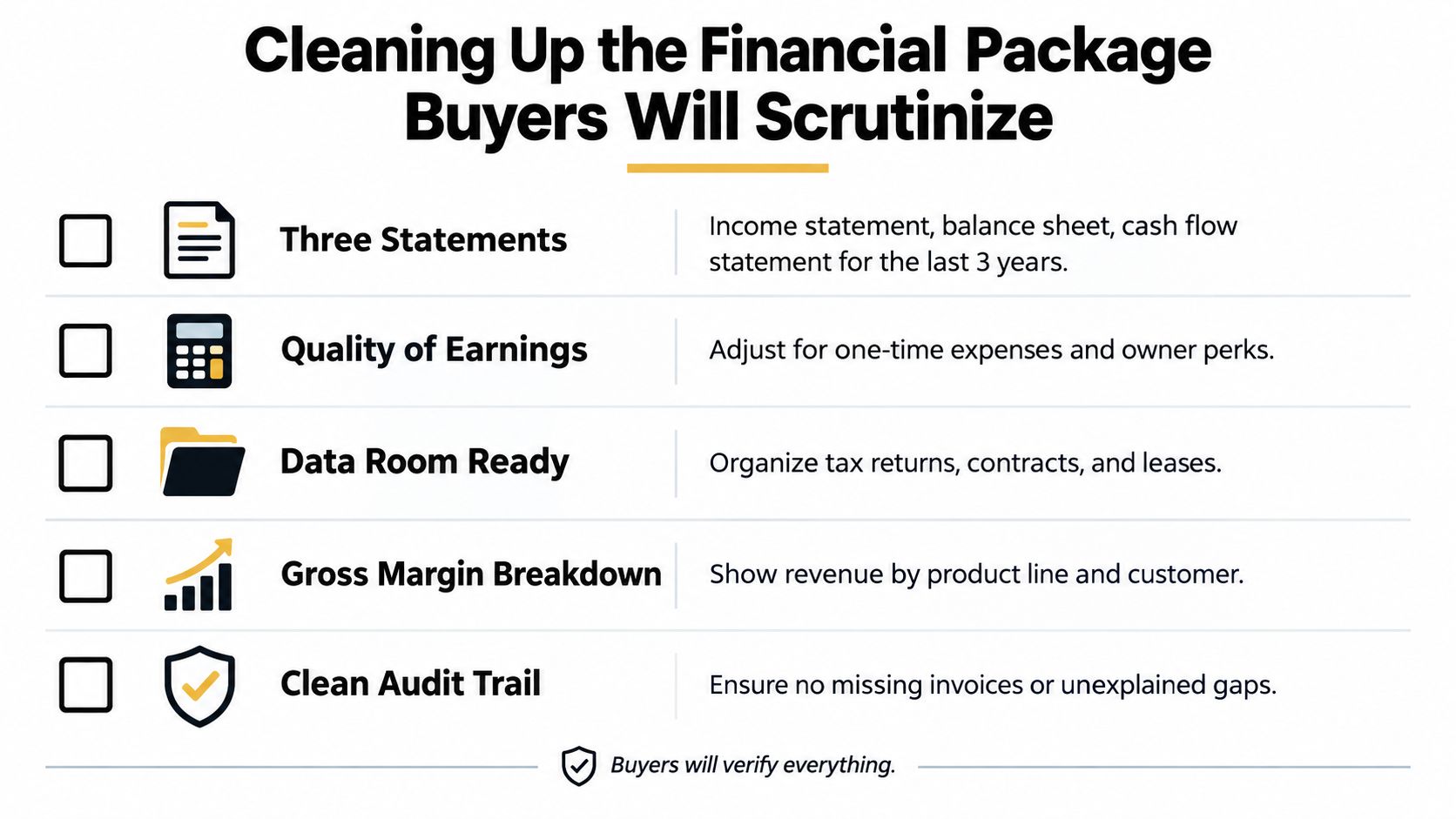
Build an earnings bridge that survives review
Quality of earnings, often shortened to QoE, examines whether reported earnings reflect sustainable business performance. An add-back is an expense adjustment proposed to show earnings without a cost the buyer supposedly won't incur.
Don't confuse a cost you dislike with a legitimate adjustment.
| Proposed adjustment | Evidence and judgment required |
|---|---|
| Owner's personal vehicle | Separate personal use from necessary business transportation |
| Related-party rent | Document the lease and support a market-based replacement cost |
| Discretionary travel | Identify trips precisely and establish whether revenue depends on them |
| Legal settlement | Retain the agreement and assess whether the underlying problem could recur |
Build the bridge from reported earnings to proposed normalized earnings. For every adjustment, show the ledger account, source document, business explanation, and expected treatment after acquisition.
A buyer also needs the costs you've left out. If your replacement requires additional compensation, include it. If a family member performs necessary work below market pay, pretending that arrangement will continue won't improve credibility.
Make verification easy
For a broader systems perspective, SIX ERP's discussion of why clean finance data matters is a useful companion resource. For transaction preparation, use this financial due-diligence guide to organize the questions your team needs to answer.
Before sharing the package, check:
- Reconciliations: Receivables, payables, inventory, debt, and cash agree with supporting records.
- Revenue support: Contracts, invoices, delivery evidence, and recognition policies align.
- Adjustment support: Every proposed add-back has documentation.
- Forecast integrity: Assumptions connect to staffing, capacity, contracts, and collections.
Use the following video as a discussion prompt with the person responsible for your financial package.
Improving EBITDA and Margins in the 24 Months Before a Sale
“Boost EBITDA” isn't an operating plan. Your managers need decisions they can execute without weakening the business a buyer will inherit.
EBITDA means earnings before interest, taxes, depreciation, and amortization. Use it to analyze operating earnings, but don't mistake it for cash available to distribute. Inventory purchases, equipment needs, collections, and debt obligations still matter.
As a market reference, BizBuySell's 2025 year-end report covered 9,586 closed transactions, with a $350,000 median sale price, $158,950 median seller-reported cash flow, and an average sale price of approximately 94% of asking price. These are smaller-business marketplace benchmarks, not a valuation formula for a larger founder-led company.
Improve the work, not just the presentation
For a distribution business, start with customer and product contribution. A high-revenue account may produce poor returns after freight, special handling, rebates, returns, and slow collections.
For construction, compare estimated and actual job margins. For professional services, connect engagement pricing to staffing mix, rework, scope changes, and collection performance.
Margin Improvement Levers and Realistic EBITDA Impact
| Operating Lever | Realistic Margin Lift | Time to Realize | Durability |
|---|---|---|---|
| Pricing discipline | Model from actual discounts and cost-to-serve | Repricing and renewal cycles | Stronger when customers accept repeatable terms |
| Customer and product mix | Calculate contribution after service costs | As the sales mix changes | Depends on replacement demand |
| Labor productivity | Measure reduced rework and better utilization | After workflow changes take hold | Stronger with documented methods |
| Procurement | Verify savings net of freight and quality costs | Purchasing and supplier cycles | Depends on supply reliability |
| Overhead absorption | Model capacity against incremental volume | As profitable volume develops | Weak if growth requires unmodeled spending |
There's no defensible universal margin lift for these levers. Build the estimate from your transactions rather than borrowing an adviser's generic percentage.
Model improvement without inventing a multiple
Use this worksheet:
Incremental operating earnings = retained price improvements + purchasing savings + productivity gains + contribution from mix changes − implementation costs − required ongoing spending.
Then test whether each improvement persists after ownership changes. Recurring contracts, disciplined estimating, and consistent procurement processes are more persuasive than a temporary spending freeze.
Cutting maintenance or starving customer service can improve the latest income statement while making the business less attractive to own.
Use this practical guide to improving profit margins to turn the analysis into management assignments. Track realized results separately from proposed savings, and let your transaction adviser assess valuation implications using relevant market evidence.
Deal Structure Decisions That Change Your Actual Cash
An attractive headline price can conceal a disappointing closing wire. Compare offers by cash certainty, payment timing, retained risk, and after-tax proceeds.
Consider an owner reviewing competing proposals for the same company. One buyer offers payment at closing; another proposes the same headline consideration but retains portions through deferred and contingent arrangements. Those offers aren't economically equivalent.
Use the visual as a conceptual comparison, not as evidence that structured offers necessarily command a premium.
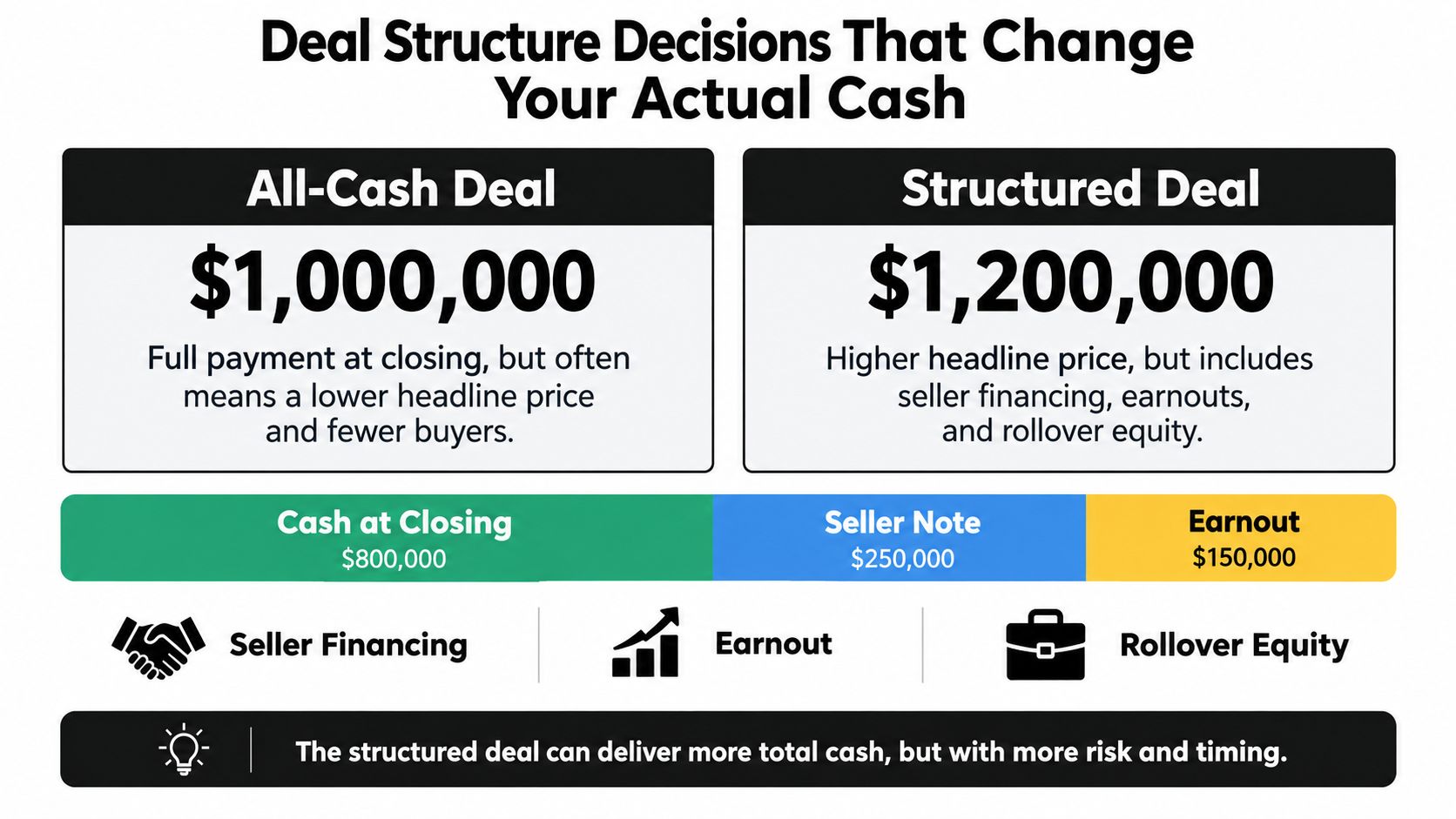
Build a proceeds waterfall
A seller note makes you a lender to the buyer. An earnout makes payment contingent on defined future results. Rollover equity leaves part of your wealth invested in the acquired business, while escrow holds proceeds against specified obligations.
Calder Capital's market update reported seller financing averaging about 15% in the $1 million–$5 million transaction range and 11%–13% in the $5 million–$10 million range. Deferred payment deserves explicit modeling, not a footnote.
| Proceeds worksheet | Closing-payment proposal | Structured proposal |
|---|---|---|
| Headline consideration | Enter agreed value | Enter agreed value |
| Deferred consideration | Identify any amount withheld | Separate note, earnout, and equity |
| Closing deductions | Debt, expenses, adjustments | Debt, expenses, adjustments |
| Immediately available cash | Calculate closing distribution | Calculate closing distribution |
| Downside exposure | Review indemnities | Add collection and performance risks |
Stress-test an earnout against customer losses, delayed collections, integration changes, and spending decisions controlled by the buyer. Have counsel negotiate measurement rules, reporting access, dispute procedures, and restrictions on actions that could undermine payment.
Negotiate working capital and taxes early
Normalized working capital is the agreed operating capital delivered with the business. Establish the target using a trailing 12–24-month monthly analysis, and maintain transaction discipline even when activity rises: BizBuySell's Q3 2025 report recorded 2,599 closings, up 8% year over year, while median price declined to $320,044.
Tax allocation also changes economics. The IRS instructions for Form 8594 explain qualifying asset-sale reporting and the residual allocation method, which determines the buyer's basis and seller's gain or loss by asset.
For partner-owned companies, bring the Law Office of Bryan Fagan, PLLC's guide to buy-sell agreements for partners to your counsel discussion. Coordinate ownership restrictions and offer modeling with your broader exit-planning strategies.
Running the Deal Process From Teaser to Closing
Run the sale as a controlled project with a separate operating cadence. The owner shouldn't become so consumed by buyer requests that customers and managers lose attention.
Assign responsibility for information requests, maintain a decision log, and establish approval rights for disclosure. Your operating team still needs to deliver the forecast while advisers manage transaction work.
Release information through defined gates
- Teaser and buyer screening: Circulate an anonymized summary and assess strategic fit, funding capacity, decision authority, and acquisition intent.
- NDA and information memorandum: Execute a confidentiality agreement before providing the confidential information memorandum, or CIM, which describes the company and investment rationale.
- Management meetings and bids: Let leaders explain their functions. Seek initial indications of interest, then more developed proposals from qualified buyers.
- Letter of intent: Negotiate price, structure, working-capital principles, transition expectations, and process terms before granting exclusivity.
- Diligence and definitive agreements: Coordinate financial, legal, commercial, and financing work through to the purchase agreement and closing conditions.
Don't treat the letter of intent, or LOI, as either a completed deal or a harmless expression of interest. Ask counsel which provisions bind the parties and what commercial terms remain unresolved.
The Coto & Waddington, Attorneys at Law legal guide for founders facing acquisition offers can support that discussion. Keep the execution team aligned with a mergers-and-acquisitions checklist.
Prepare managers without scripting a performance
Give managers practice explaining results, missed targets, corrective actions, and resource needs. Buyers should hear consistent facts, not rehearsed optimism.
Meeting discipline: Let the accountable manager answer first. An owner who interrupts every response undermines the case for an independent leadership team.
Don't assign a closing schedule from company size alone. A smaller company with unresolved records can be harder to transact than a larger one with organized reporting and clear authority.
Require advisers to build a milestone calendar around actual dependencies: reporting completion, consent requirements, lender approval, diligence responses, and purchase-agreement negotiations. Update that calendar as facts change, and don't announce victory until funds move and closing obligations are satisfied.
Your Readiness Scorecard and First Three Steps
Score readiness by evidence, not confidence. Use red for undocumented or owner-dependent work, amber for partially implemented improvements, and green for processes the team can demonstrate consistently.
| Dimension | Evidence for a green assessment |
|---|---|
| Decision clarity | Written exit objectives and acceptable trade-offs |
| Management depth | Leaders operating within clear authority |
| Concentration | Documented exposures and credible mitigation |
| Financial package | Reconciled reporting and supported adjustments |
| Operating discipline | Forecast reviews followed by corrective action |
Turn the assessment into assignments
Start with your exit decision. Write your preferred transition date, personal liquidity needs, and acceptable continuing role. Select a CEPA-credentialed adviser to coordinate readiness, alongside independent legal, tax, and personal financial advice.
Next, establish the financial baseline. Ask for an earnings-normalization assessment and current working-capital analysis. Where independent assurance is needed, engage an appropriate external provider rather than confusing internal preparation with independent verification.
Then, assign the operating gaps. Give each red item an owner, a deliverable, and a review date. Prioritize the issues that threaten sustainable earnings or make the company difficult to transfer.
Your action this week is straightforward: hold a readiness meeting with the owner, finance lead, and operating leader, then agree on the most consequential unresolved issue. At the next review, require evidence of progress rather than a verbal update.
A sale-ready company gives you options. You can pursue a transaction, delay it deliberately, or keep owning a business that runs with less dependence on you.
AmbitionCFO offers fractional CFO support for exit readiness, including 13-week cash-flow modeling, job or client margin analysis, KPI dashboards, and exit-planning coordination. Visit AmbitionCFO to discuss a readiness assessment and identify the financial and operating work to complete before approaching buyers.