

You're growing, customers are buying, and your income statement says you're profitable. Then payroll lands before your biggest customer pays. That's when owners learn Why Is Working Capital Important in practical terms. It's not about a ratio looking healthy. It's about how much cash is trapped in receivables, inventory, and work in progress, and whether you have enough left to act.
Table of Contents
- When Strong Sales Still Create a Cash Crunch
- Understanding Working Capital Fundamentals
- Why Working Capital Protects Operations and Growth
- Working Capital as a Cash Flow and Valuation Decision
- How Business Models Trap or Release Cash
- Finding the Right Working Capital Level
- A Practical Working Capital Improvement Plan
- Turn Working Capital Into a Strategic Advantage
When Strong Sales Still Create a Cash Crunch
A distributor wins a larger order. The team buys inventory, ships the product, and sends the invoice. Revenue is recorded, the sales team celebrates, and the owner still has to fund wages, freight, rent, and the supplier bill weeks before the customer pays.
That's the operating reality behind Why Is Working Capital Important. Profit and cash move at different speeds. You can read more about converting accrual results into cash reality to see why reported earnings don't tell you what's available on Friday.

The Question You're Actually Trying to Answer
Don't start with your current ratio. Start with this question. Can you convert sales into usable cash in time to meet obligations and take the next opportunity?
The scale of the pressure is broad. The Federal Reserve's 2024 Report on Employer Firms found that 93% of U.S. employer firms experienced at least one financial challenge during 2023, while 91% experienced at least one operational challenge, and more than half reported difficulty paying operating expenses or managing uneven cash flow.
Even payment timing at checkout matters for smaller firms, which is why it's worth understanding resources like 2026 card settlement timelines for SMEs as one piece of a larger collections picture. The lesson is simple and motivating. Growth is good, but growth also widens the distance between spending and collecting. Measure that distance this week before you commit to more of it.
Understanding Working Capital Fundamentals
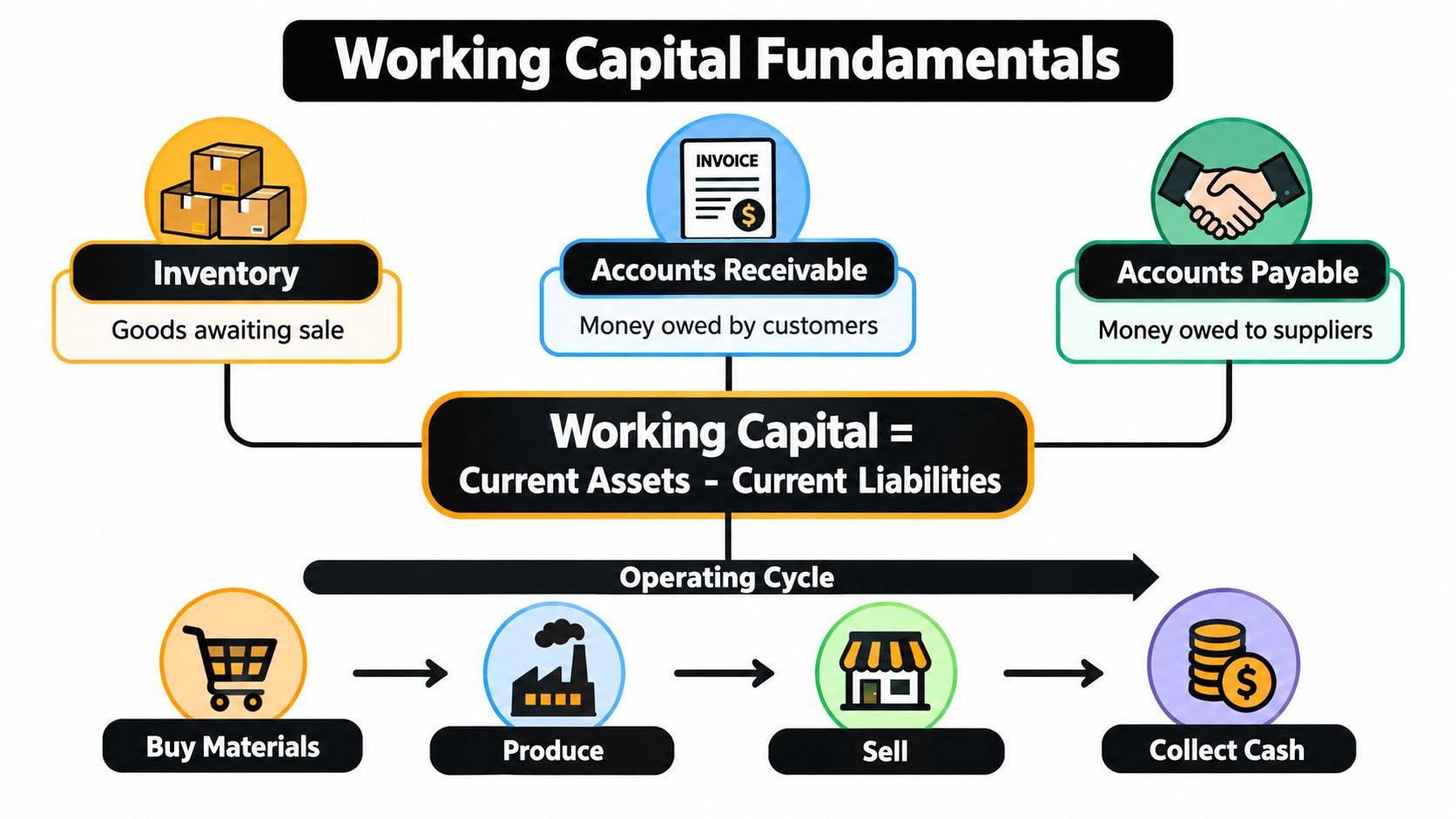
Working capital is current assets minus current liabilities. Current assets are resources you expect to turn into cash or use within a year, including cash, receivables, and inventory. Current liabilities are obligations due within a year, including accounts payable, accrued payroll, and short-term debt.
That formula is only the starting point. A positive balance doesn't mean cash is sitting in the bank. Most of the balance may be invoices customers haven't paid or inventory that hasn't sold.
Read It Through the Operating Cycle
Follow one dollar through your business:
- Buy: You purchase materials or staff a project and cash goes out, or a payable is created.
- Deliver: Inventory becomes a finished job or shipped order, and value is created but not yet collected.
- Bill: The sale becomes a receivable, which looks like an asset but can't pay wages.
- Collect: Cash finally arrives and can fund the next cycle.
The current ratio, current assets divided by current liabilities, gives you a quick reference point. It doesn't tell you the quality of those assets. A receivable from a reliable customer due this week is not the same as a disputed invoice or slow-moving stock.
Owner's test: List what's tied up, when it converts to cash, and what must be paid before it does. That timing gap is your real working capital story.
Use that test monthly. You'll spot whether liquidity is available or only looks available on the balance sheet, and you'll know which asset needs attention first.
Why Working Capital Protects Operations and Growth
Working capital pays for the work before the customer pays you. It funds materials, subcontractors, project staff, and order fulfillment. Without it, profitable work stalls because you can't mobilize.
The diagram below maps how liquidity supports day to day execution.
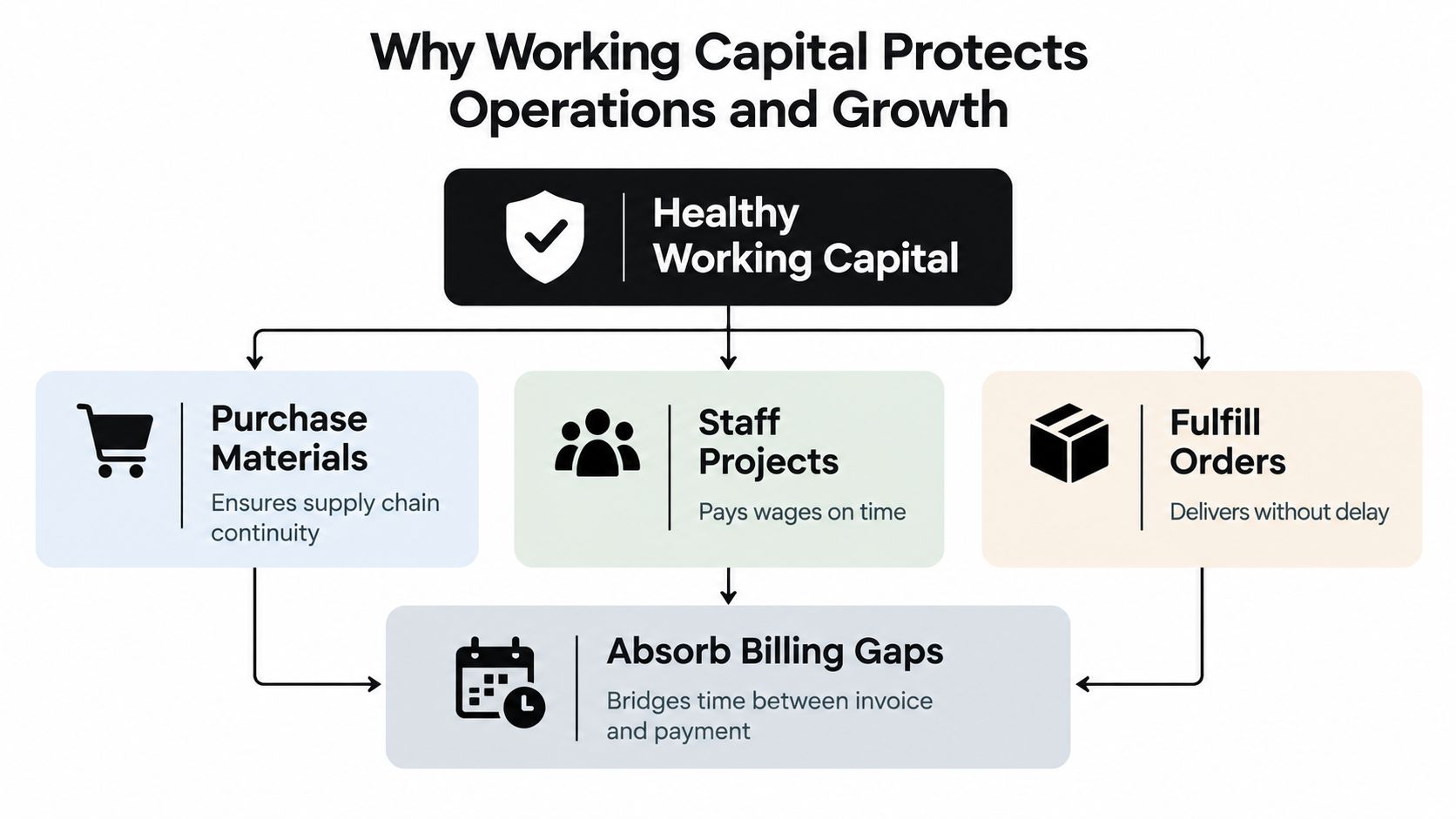
Strong liquidity also gives you choices. You can accept a contract that requires upfront labor, buy equipment without draining the operating account, or negotiate from strength instead of urgency. Weak liquidity reverses that. You delay suppliers, turn down good work, or borrow under pressure.
Borrowing Is Not a Cash Plan
Financing has a role, but it isn't a substitute for conversion discipline. The Federal Reserve's national Small Business Credit Survey reported that 59% of employer firms sought new financing during the 12 months preceding the 2024 survey, with 56% of financing applicants citing meeting operating expenses and 46% seeking funds for expansion or another new opportunity. When operating expenses drive borrowing, you're financing timing gaps instead of funding growth.
Build visibility before you need a lender. Our guidance on why a cash flow forecast matters for owners shows how forward visibility changes the conversation.
The short video below reinforces how forecasting turns liquidity from a surprise into a managed decision.
Protect the buffer that keeps delivery reliable. That buffer is what lets growth create momentum instead of anxiety.
Working Capital as a Cash Flow and Valuation Decision
Earnings quality depends on cash conversion. A buyer, lender, or partner won't just ask what you earned. They'll ask how reliably earnings became cash, and how much additional cash each new dollar of growth consumes.
Measure the Cash Conversion Cycle
The cash conversion cycle (CCC) is days sales outstanding plus days inventory outstanding minus days payables outstanding. In plain terms, it's how long your cash stays tied up between paying suppliers and collecting from customers. Shorten collections or inventory days, and cash returns sooner. Extend supplier days carefully, and you keep cash longer.
The evidence supports paying attention. A global meta-analysis covering 43 studies, nearly 62,000 enterprises, and 35 countries found a statistically significant negative relationship between the cash conversion cycle and profitability, and for a $20 million company, reducing the cycle by 10 days could theoretically release approximately $548,000, subject to actual cost and payment patterns.
Treat that figure as an illustration, not a promise. Your result depends on margins, purchase timing, and customer terms. Still, the math shows why small timing gains matter at scale. A few days saved across many invoices can fund a hire or reduce line usage without selling anything extra.
What Better Conversion Does for Value
Reliable conversion lowers dependence on emergency borrowing and makes earnings more credible in diligence. It also clarifies which customers and jobs create value after financing their payment delays. That connects directly to understanding what value drivers actually move enterprise value before a sale or succession.
Don't chase the lowest CCC at any cost. Stretching suppliers until they deprioritize you, or cutting inventory until you miss orders, destroys the value you're trying to build. Optimize the cycle. Don't starve it.
Cash trapped in the cycle is financing you're providing to customers and stockrooms. Price that financing into your decisions, or you'll keep giving it away free.
How Business Models Trap or Release Cash
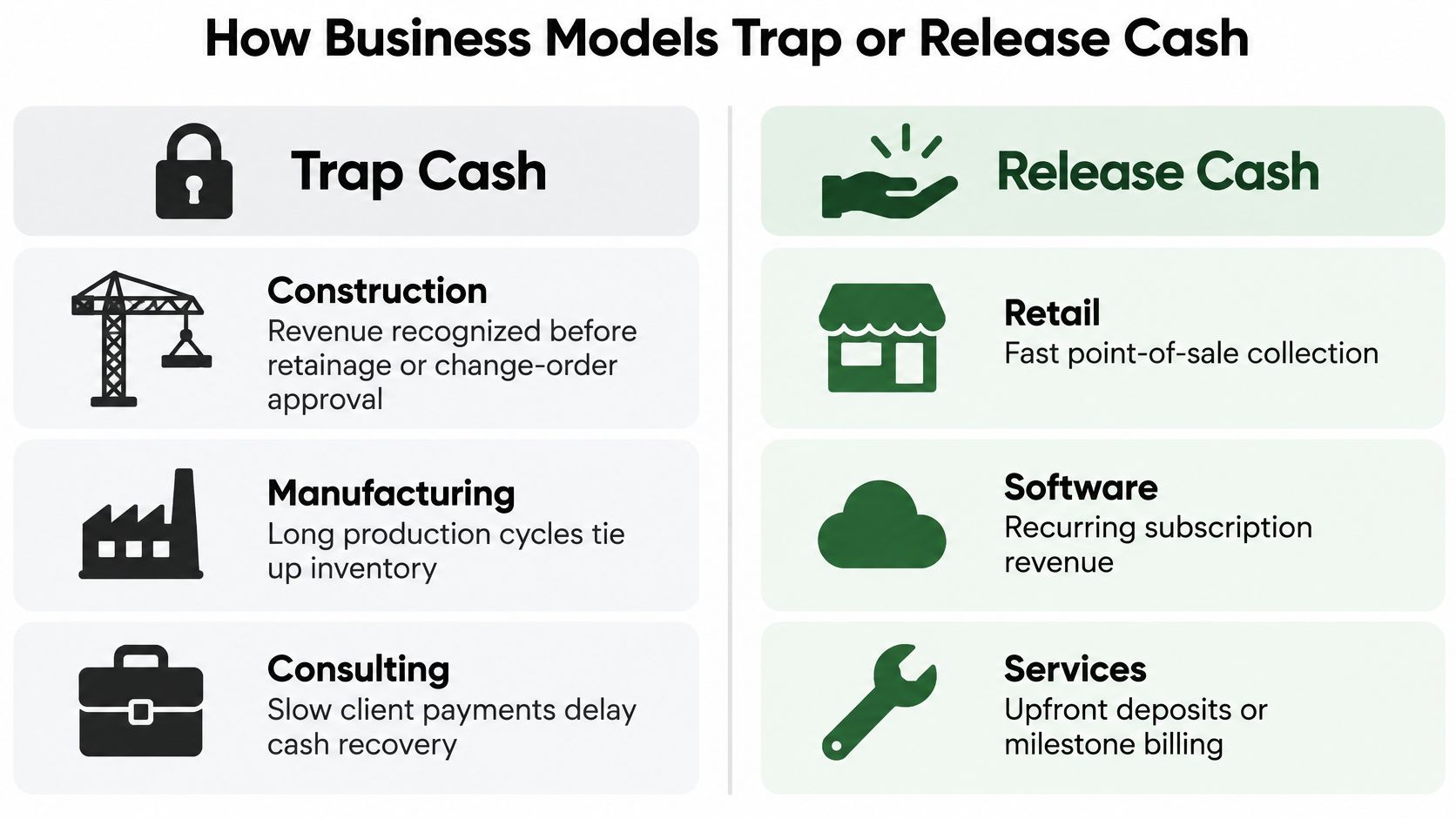
Different models trap cash in different places, so a single company-wide number misleads you. Look at three illustrative scenarios common in founder-led firms.
Construction. A contractor recognizes revenue as work progresses, but retainage is held back and change orders wait for approval. Crews and subcontractors are paid now. The owner should ask which contracts consume cash before billing milestones catch up.
Distribution. A distributor buys inventory ahead of demand, then offers customer terms. Cash sits on shelves, then sits again in receivables. The owner should ask which categories earn their shelf space. Reviewing product mix strategies that improve margin and turnover helps connect assortment choices to cash.
Professional services. A firm pays specialists weekly but invoices at project milestones. Work in progress grows between bills. The owner should ask how much unbilled time is aging and why.
Receivables pressure is widespread. Recent U.S. survey data found that 56% of small businesses had outstanding invoices, with affected businesses owed an average of $17,500, and 47% reported that at least some invoices were more than 30 days overdue.
Businesses that release cash faster share habits. They collect deposits, bill at clear milestones, keep inventory purposeful, and align supplier terms with their cycle. Identify your specific trap, its owner, and its duration. That's where improvement starts.
Finding the Right Working Capital Level
The lowest possible working capital is not the goal. Too little liquidity interrupts payroll, procurement, and project execution. Too much leaves cash parked in slow receivables, excess inventory, and unbilled work earning nothing.
Research supports a middle path. An empirical study of 719 Polish listed companies from 2007 to 2016 found an inverted-U relationship between working-capital levels and profitability, where profitability improved up to an optimal point and then declined as additional working capital accumulated.
Compare Three Positions
| Position | What It Looks Like | Main Risk |
|---|---|---|
| Dangerously lean | Minimal cash, stretched suppliers, thin inventory | Stockouts, missed projects, supplier distrust |
| Balanced | Cash floor protected, terms aligned to cycle | Requires active weekly management |
| Excess liquidity | Large receivables and inventory balances | Idle capital, weaker returns, hidden waste |
Set your threshold from your model, not a generic benchmark. Factor in committed payroll, subcontractor obligations, customer collection patterns, mobilization costs, and supplier credit you can rely on. Include gross margin too. Thin margins leave less room to absorb a late payment.
Ask one direct question for each major commitment. What cash does this decision consume before it returns cash, and can we fund that gap without weakening delivery? If you can't answer, you're not ready to approve it.
Resilient beats lean. A balanced position protects service levels and supplier access while keeping idle capital in check, and that's the position that supports durable growth.
A Practical Working Capital Improvement Plan
Start this week with visibility, then act on what you find. You don't need new software to begin. You need a cadence and clear ownership.
Build Your 13-Week View
- Forecast weekly: Build a rolling 13-week cash forecast using expected collections by customer, payroll, supplier payments, taxes, debt service, and planned purchases.
- Segment receivables: Sort balances by customer, project, age, dispute status, and expected collectability. Separate temporary timing gaps from balances that may never collect.
- Track leading metrics: Monitor DSO, inventory or work-in-process days, DPO, backlog-to-cash timing, and forecast-versus-actual collections every week.
Sector context matters when you judge payment behavior. European evidence reported that overdue invoices affected an average 57% of B2B credit sales while inventory build-up tied up capital and increased operating costs, and payment behavior differs by sector, with wholesale trade averaging 10.3 days late and transportation and utilities averaging 11.6 days late.
Turn Findings Into Actions
Clarify billing milestones in contracts before work starts. Resolve disputes within days, not at month end. Prioritize collections by amount and age, and tighten credit for repeat late payers. For service businesses that bill after delivery, reviewing RCM tactics to boost revenue can spark ideas on cleaner claims, faster follow-up, and fewer preventable delays.
Review slow-moving inventory and stop reordering what isn't turning. Negotiate supplier terms openly rather than paying late unnoticed. Then run scenarios before hiring, buying equipment, or signing a large contract, so you see the cash dip before the income statement shows strain.
Close the loop weekly. Compare forecasted collections with actual receipts, name the variance owner, and update the next 13 weeks. Cash released is the scoreboard.
Turn Working Capital Into a Strategic Advantage
Working capital determines whether revenue becomes usable cash, whether operations survive timing gaps, and whether growth creates value or just creates obligations. Owners who manage it well don't guess. They know their cash floor, their largest trapped balances, and the cash cost of the next big decision.
Do three things now. Schedule a review of your 13-week forecast this week. Identify your largest receivable, inventory, or work-in-progress exposure and assign an owner to it. Set a minimum cash threshold that must hold before you approve hiring, equipment, or expansion.
Financing choices sit downstream of that clarity, which is why understanding equity versus debt for growth decisions matters once you know your true funding gap. AmbitionCFO works with founder-led firms on 13-week cash flow modeling, KPI dashboards, and forecasting as one option for owners who want senior finance support without a full-time hire.
You've already built the sales engine. Now build the cash engine behind it, and growth becomes something you can fund with confidence instead of hope.
If your forecast can't show you the next cash gap, it's time for a working-capital and cash-visibility review fitted to your growth plans. Visit AmbitionCFO to request a working-capital worksheet or start a conversation about building a rolling 13-week forecast for your business.