

Your accountant says the business is profitable, but you're still checking the bank balance before approving a hire or replacing equipment. Sales look healthy. The bottom line looks respectable. So why doesn't running the business feel more financially secure?
When you ask what is a good net profit margin, you're really asking whether your business earns enough to support its obligations, your plans, and the return you expect as an owner. A useful answer needs more than an industry average.
Table of Contents
- Why Your Net Profit Margin May Be Misleading You
- What Net Profit Margin Actually Measures
- Industry Benchmarks for Net Profit Margin
- Why a Good Margin Depends on Your Business Model
- How to Spot Hidden Cash Risks Behind a Healthy Margin
- Practical Steps to Improve Your Net Profit Margin
- Using Your Margin to Make Better Business Decisions
- Your Next Step Toward Stronger Profitability
Why Your Net Profit Margin May Be Misleading You
Consider a familiar situation: your team finishes a demanding project, records the revenue, and reports a profit. You approve the next purchase order, then discover that the customer hasn't paid and your suppliers won't wait.
Nothing about that situation requires the profit calculation to be wrong. The problem is that you're trying to answer a cash question with an earnings measure.
A similar disconnect appears when growth looks impressive but the work requires more supervision, administration, or financing than expected. You can celebrate winning customers while questioning whether those customers make the business stronger.
Separate sales success from financial success
Start by distinguishing the questions behind your reports:
- Revenue quality: Which customers, services, and channels generate business worth keeping?
- Profit quality: Does the reported result reflect the full cost of delivering that business?
- Financial capacity: Can you meet commitments without repeatedly postponing necessary decisions?
For the sales-side analysis, SourceLoop's explanation of revenue attribution key metrics is a useful companion resource. Use attribution to investigate where revenue originates, then connect that revenue to delivery costs and profitability. Don't treat a successful acquisition channel as proof of a profitable customer relationship.
Practical rule: A margin is useful only when you understand what produced it and what the business still needs to fund.
The wrong response is to abandon profit measurement because it doesn't explain everything. The better response is to give each report a specific job.
Your income statement helps evaluate earnings. Your cash planning helps determine what you can afford. Your operating reports explain what management can change.
A meaningful margin assessment connects those views. It should help you decide whether to hire, accept more work, replace equipment, or retain cash, rather than merely tell you whether last month looked good.
What Net Profit Margin Actually Measures
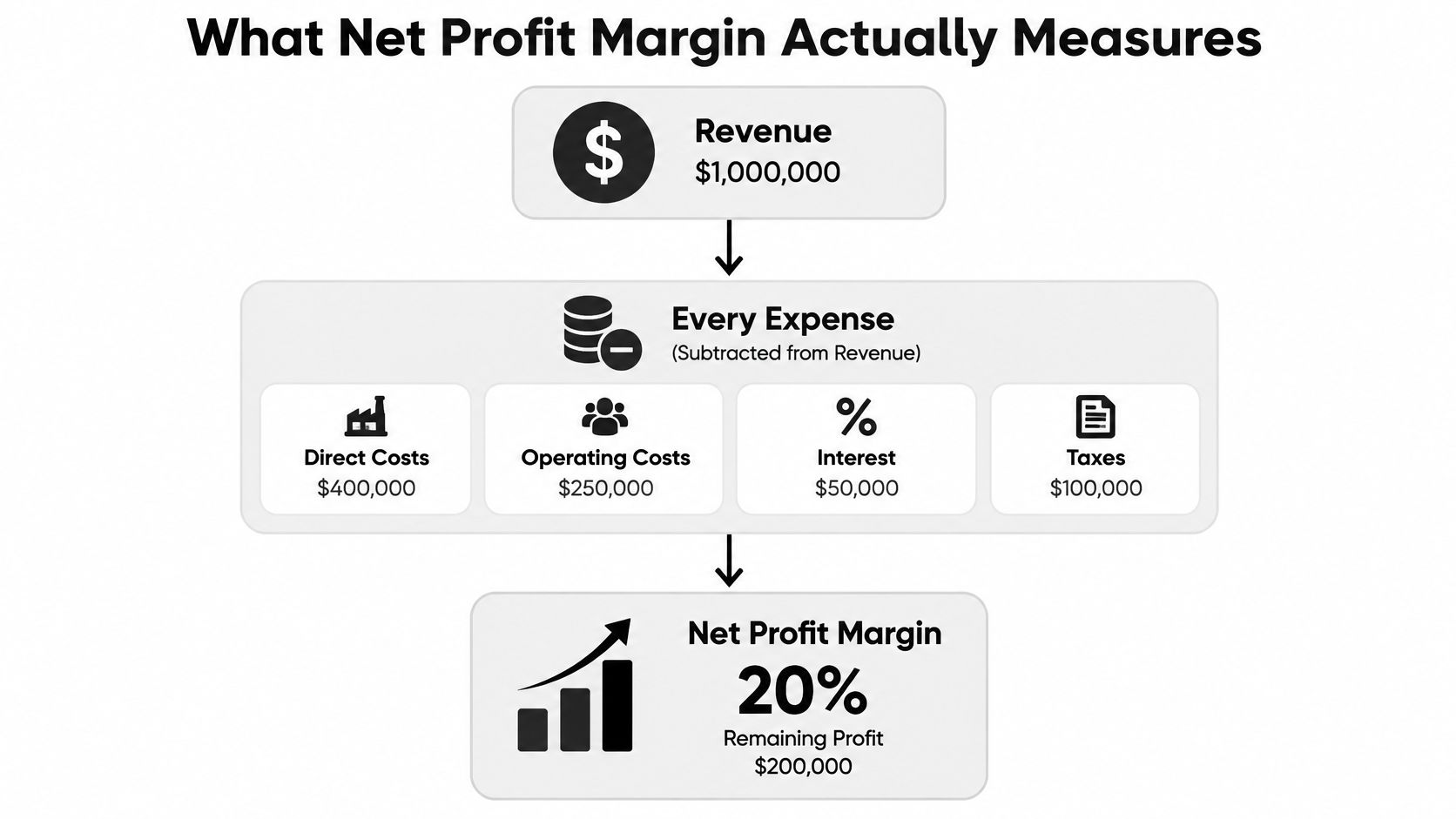
Net profit margin is the percentage of revenue remaining after all expenses, including direct costs, operating overhead, interest, and taxes. The calculation is net income ÷ revenue × 100, as outlined in Homebase's explanation of profit-margin calculations.
For example, a company with $12 million in revenue and $720,000 in net income has a 6% net margin, meaning it retains six cents per revenue dollar using that calculation.
The diagram shows the path from revenue to the final result.
Calculate it from a consistent income statement
Use a simple worksheet rather than relying on a percentage displayed by your accounting software.
| Worksheet line | What to include |
|---|---|
| Revenue | Sales recognized for the selected period |
| Direct costs | Materials, inventory, subcontractors, and direct labor |
| Operating expenses | Administrative payroll, occupancy, insurance, selling costs, and depreciation |
| Financing and taxes | Interest and applicable tax expense |
| Net income | The remaining earnings after expenses |
| Net profit margin | Net income divided by revenue, expressed as a percentage |
Compare matching periods using the same accounting basis. A seasonal month shouldn't be judged against a full-year benchmark without context, and switching between cash and accrual reports can make operational changes difficult to distinguish from timing differences.
Don't confuse gross margin with net margin
Gross margin measures what remains after direct delivery costs. Net margin measures the final result after the rest of the income statement.
That distinction changes the corrective action. If direct labor or materials consume too much revenue, investigate estimating, purchasing, pricing, and execution. If gross profitability is sound but little reaches the bottom line, examine overhead, financing, and other expenses.
Keep classifications consistent, too. Moving a supervisor's salary between direct labor and overhead changes the appearance of gross margin without necessarily improving the business. Your worksheet should help identify an economic problem, not manufacture a more attractive presentation.
Industry Benchmarks for Net Profit Margin
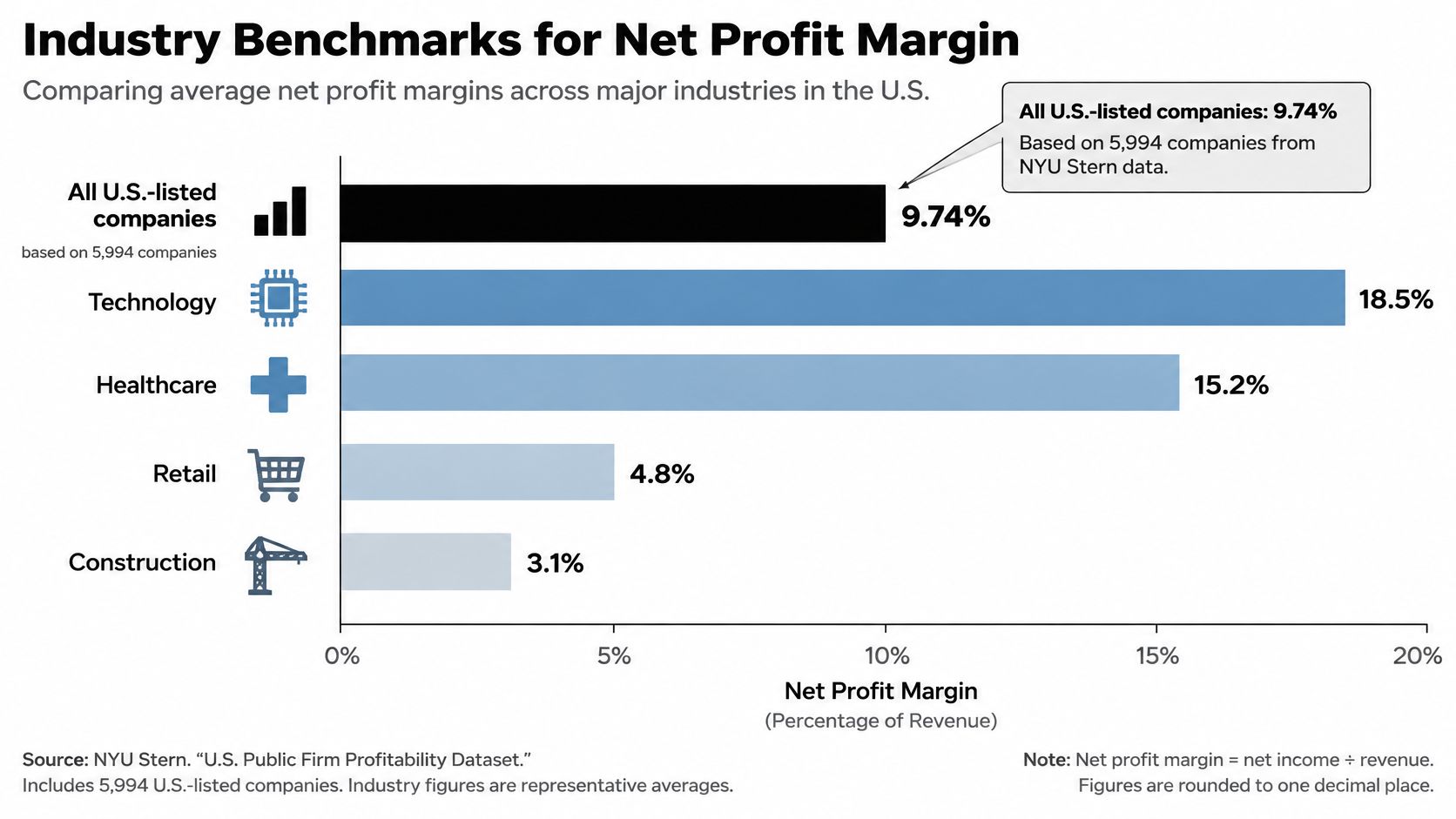
A useful broad reference is the 9.74% aggregate net margin across approximately 5,994 U.S.-listed companies in NYU Stern's industry margin dataset. The same dataset shows substantial differences between industries.
| Industry | Net profit margin |
|---|---|
| Restaurants | 9.37% |
| Building materials | 7.42% |
| Apparel | 3.85% |
| Air transport | 2.51% |
| Auto parts | 0.72% |
These are reference points, not pass-or-fail standards for a privately owned company. An aggregate across public companies doesn't account for your particular ownership structure, financing arrangements, or operating scale.
The visual reinforces the importance of industry context. Use the sourced figures in the table for numerical comparisons rather than treating every illustrative category in the graphic as a directly comparable benchmark.
Build a relevant comparison
Additional sector figures put engineering and construction near 2.95%, food wholesalers near 1.34%, and general retail near 4.60%, according to the sector benchmarks discussed by Keka. That source reports restaurant margins of 10.62%, illustrating why figures from different benchmark sets shouldn't be blended into a single supposedly definitive average.
Before using any benchmark, check the industry definition, reporting period, and calculation method. A distributor with substantial inventory requirements isn't an appropriate comparison for an advisory firm because their annual revenue is similar.
For contractors, examining construction overhead percentage can help distinguish a delivery-cost problem from an overhead problem before setting a target.
Use this video as additional context for evaluating profitability.
A 5% margin may be respectable in a low-margin sector but weak for a scalable software business or specialized professional-services firm, given the industry differences above. The practical question isn't whether you beat the overall average. It's whether your result is competitive against businesses with similar economics and sufficient for your own commitments.
Why a Good Margin Depends on Your Business Model
A business can match its industry benchmark and still leave its owner exposed. Peer performance tells you what's common. It doesn't establish what's adequate.
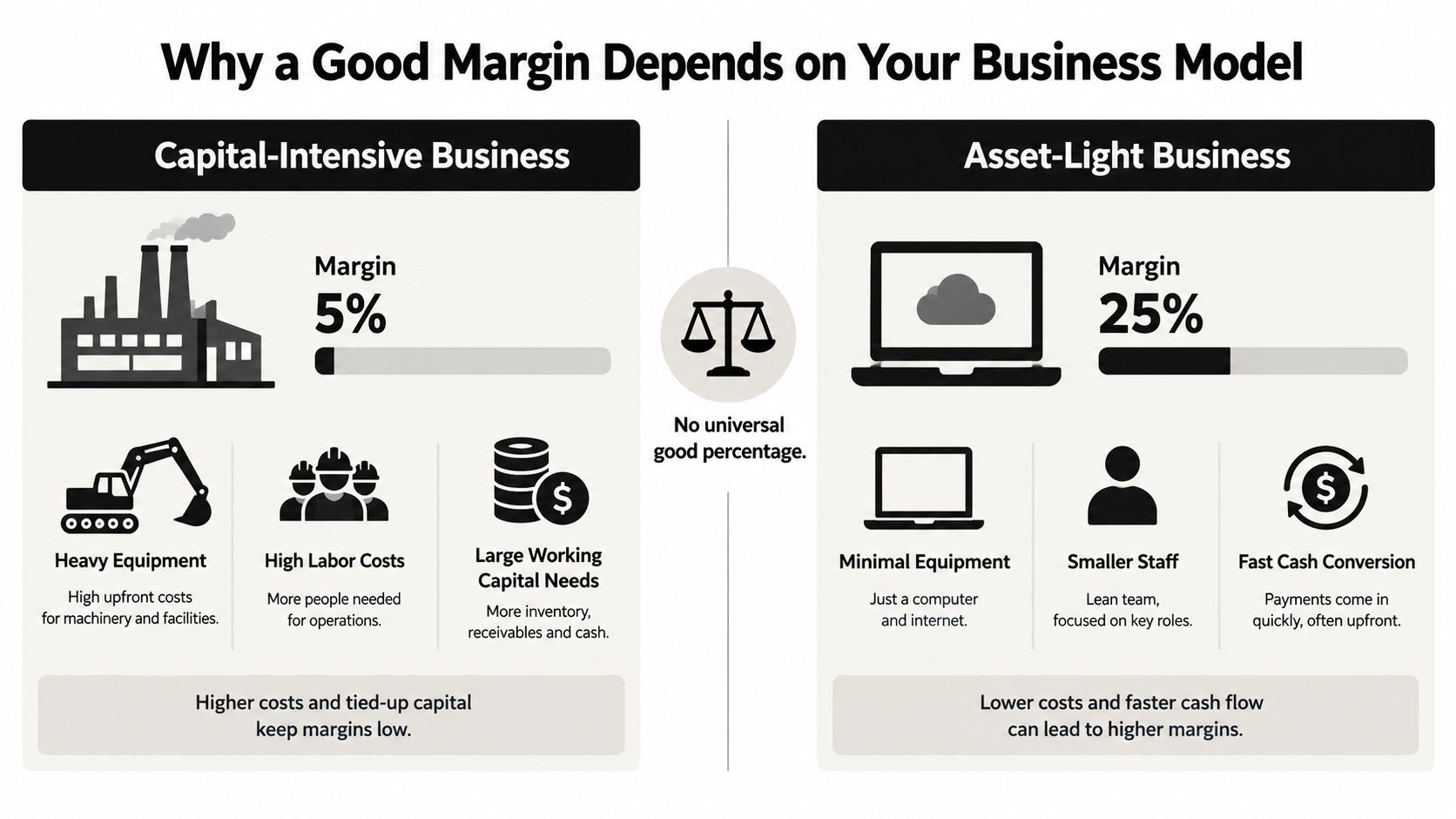
The construction benchmarks above show how little room some operators have for mistakes. A disputed change order, labor overrun, or delayed payment can make an apparently acceptable result uncomfortable. An asset-light advisory firm faces a different test: whether its expertise and pricing power justify a stronger return.
The comparison below illustrates the structural difference. Treat its margin labels as examples, not recommended targets.
Test what the business must support
Assess your margin against the demands of your model:
- Capital intensity: What equipment, facilities, or technology must you maintain and replace?
- Labor structure: Are you paying sustainable compensation for the people required to deliver?
- Commercial risk: How dependent are you on a major customer, contract renewal, or specialized employee?
- Pricing power: Can you charge for expertise, urgency, complexity, and customer value?
Machine Marketing's pricing advice for B2B companies provides a useful starting point for thinking about market acceptance. Pair that commercial judgment with an examination of the factors affecting cost before deciding what your business can sustainably charge.
A high margin can also deserve scrutiny
An unusually strong result isn't automatically evidence of excellent management. You might be postponing maintenance, doing unpaid management work yourself, or avoiding investments the business will eventually need.
Don't congratulate yourself for a margin that depends on obligations you've postponed rather than costs you've genuinely eliminated.
The useful standard is a margin that supports the business at a sustainable operating level. That includes fair compensation for necessary work and enough economic return to justify the risks you retain.
Replace the search for a universal percentage with a tougher question: does this business earn enough to support its operating model without relying on owner sacrifice or deferred spending?
How to Spot Hidden Cash Risks Behind a Healthy Margin
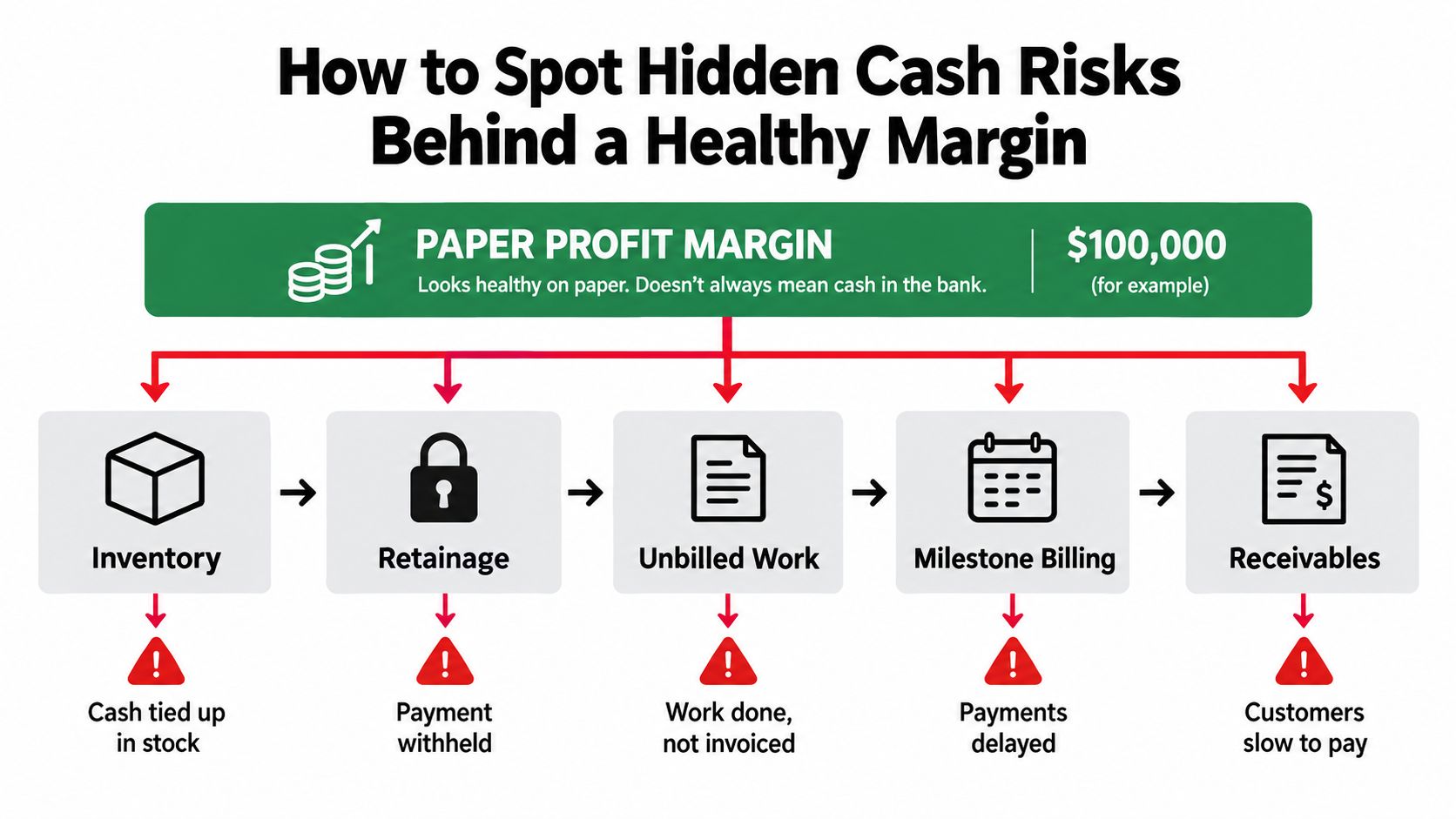
A profitable income statement can still leave you short at the bank. Follow the money from completed work to collected cash. In construction, distribution, and project-based services, that journey runs through inventory, unbilled work, contractual payment milestones, and retainage, the portion a customer withholds until specified conditions are satisfied.
The narrow industry buffers discussed earlier make these timing gaps dangerous. As SmartBiz explains in its discussion of small-business profit margins, material costs, overtime, financing expense, and collection delays can drain cash even while the income statement stays profitable. Profit you cannot collect on schedule will not cover estimated taxes, service the credit line, or rebuild reserves.
This diagram shows where to look.
Build a cash-risk dashboard
Track a compact set of measures, each tied to a management question.
| Measure | Question to investigate |
|---|---|
| Gross margin by job or client | Which work produces the expected delivery profit? |
| Contribution margin | What remains after costs that vary with the work? |
| Backlog quality | Is contracted future work profitable and executable? |
| Utilization | Are available labor hours becoming productive work? |
| Accounts-receivable days | How quickly are customers paying? |
| Inventory turns | How efficiently are you moving stock? |
| Operating cash flow | Are operations generating cash, not just earnings? |
Read them together. High utilization means little if crews are busy fixing mistakes, and a fat backlog offers thin comfort when the contracts were priced too low to begin with.
Forecast collection dates, not hopes
Build a rolling 13-week cash forecast, an approach SmartBiz also covers in the article cited above. Use expected receipts and actual payment commitments, then update assumptions as customers and project managers supply better information.
Assign one person to resolve disputed invoices, approve billing milestones, and challenge slow-moving purchases. Pair the forecast with liquidity analysis and practical routines to manage your business cash flow from EndureGo Tax.
The question to bring to your next leadership meeting: how much of our profit is real, repeatable, and collectible? If the honest answer leaves no room for taxes, reinvestment, debt service, and your own required return, the margin is thinner than it looks.
Practical Steps to Improve Your Net Profit Margin
Improving profitability doesn't always require more sales. On $10 million of revenue, moving from a 3.85% net margin to 5% increases annual net income from $385,000 to $500,000, an improvement of $115,000 without additional sales, as illustrated in Shopify's profit-margin discussion.
That's a financial illustration, not a promise that every business can achieve the same change. The management task is to identify which decisions could produce a durable improvement in your company.
Build a margin bridge
A margin bridge explains the movement from your starting profit to your ending profit. Separate operational changes from timing effects so management can see what worked.
| Driver | A practical test |
|---|---|
| Price | Review underpriced renewals and exceptions |
| Volume | Check whether added work covers its incremental support needs |
| Sales mix | Compare profitable work with work that consumes scarce capacity |
| Labor efficiency | Investigate rework, overtime, scheduling gaps, and poor handoffs |
| Overhead absorption | Evaluate whether your revenue base supports fixed operating costs |
| Purchasing | Compare supplier pricing, reliability, quality, and payment terms |
Keep working capital and cash conversion alongside this bridge rather than pretending they're income-statement expenses. Their role is to show whether the earnings improvement becomes usable cash.
Run targeted experiments
Choose a specific change, assign an owner, and document the expected operational effect. A pricing test should track customer acceptance and retained profitability, not just whether invoices increased.
Supplier negotiations should consider more than unit price. Buying additional stock for a discount may weaken liquidity, while a cheaper input that causes rework can undermine the apparent saving.
Use pricing and cost analysis to connect these choices before making broad cuts.
Management discipline: Remove waste before removing the capacity required to deliver, sell, and manage the business well.
Across-the-board overhead reductions can improve the reported margin temporarily while weakening quality, delivery, sales, or succession readiness. Require each proposed saving to identify both the expense removed and the work that will stop, move, or become more efficient.
Using Your Margin to Make Better Business Decisions
Before using margin to support borrowing, expansion, or an ownership transition, normalize the earnings. That means adjusting your interpretation for unusual expenses, one-time gains or losses, and owner compensation that doesn't reflect the work the business requires.
Keep reported results and adjustments visible side by side. A prospective lender or buyer should be able to distinguish documented exceptions from optimistic explanations.
Use the right measure for the decision
Different measures answer different questions. Don't substitute whichever produces the most attractive presentation.
| Measure | What it helps you assess |
|---|---|
| Net margin | Profit after the full expense structure |
| Operating margin | Profitability of operations before financing and taxes |
| EBITDA margin | Earnings before interest, taxes, depreciation, and amortization relative to revenue |
| Cash conversion | How effectively earnings become cash |
| Return on invested capital | Operating returns relative to the capital committed |
EBITDA isn't a substitute for cash available to distribute. Equipment replacement, financing commitments, and the cash requirements identified earlier still matter.
For decisions involving different services or customer groups, use a segment margin formula to avoid letting profitable work hide weaker activities.
Put decisions through a practical test
A new contract should clear more than a revenue hurdle. Ask whether its pricing covers delivery risk, whether the team has capacity, and whether payment terms fit your funding position.
A hiring decision requires an explicit assumption about workload and productivity. An equipment purchase involves comparing expected operating benefits with the cash commitment, not merely confirming that last year was profitable.
Build your peer set around revenue mix, customer concentration, labor intensity, and asset requirements. Those characteristics make comparisons more useful than company size alone.
Before signing a major commitment, put its expected receipts, payments, and operating effects into your existing forecast. If the decision works only when customers pay early or execution goes perfectly, revise the terms or preserve more financial flexibility.
Your Next Step Toward Stronger Profitability
A good margin isn't a badge. It's evidence that the business can support the obligations and choices that matter to you.
The central question is whether your earnings can fund taxes, reinvestment, debt obligations, reserves, and your required return without repeatedly forcing uncomfortable trade-offs. Remember that some of those needs are already reflected in net income, while others require a separate cash allocation. Don't count the same requirement twice.
Prepare a working profitability worksheet
Use your latest reliable financial statements and the operating detail behind them. Keep the worksheet practical enough that your leadership team will update it.
- Establish the baseline: Record revenue, direct costs, overhead, financing costs, taxes, and net income using consistent classifications.
- Explain the result: Identify the customers, jobs, pricing decisions, and expenses responsible for the outcome.
- Document adjustments: Separate unusual items and unsustainable operating assumptions from repeatable performance.
- Identify the constraint: Decide whether the immediate problem is pricing, execution, overhead, collections, or required investment.
- Assign action: Give each improvement an accountable person and a clear measure of completion.
Turn the worksheet into a management routine
Review the margin bridge monthly alongside your rolling cash forecast. Discuss differences between expected and actual results, then update decisions rather than merely explaining history.
Start with the issue you can investigate most directly. That might mean reviewing an unprofitable customer, resolving unbilled work, or reassessing a purchasing commitment before approving another one.
You can run this process with your controller and leadership team, supported where necessary by a fractional financial advisor. The important distinction is between producing reports and using them to make decisions.
You don't need a perfect benchmark to act. You need reliable numbers, an honest assessment of business requirements, and a routine that exposes problems while you still have options.
AmbitionCFO provides fractional CFO support for founder-led construction, distribution, and professional-services businesses, including margin analysis, cash forecasting, and profitability planning without hiring a full-time CFO. Visit AmbitionCFO to discuss building a margin bridge and cash forecast that show whether your profitability supports your next major decision.