

Your company's P&L shows a profit, but cash still feels tight. You know revenue is growing, yet you can't tell whether a major construction job, a large distribution account, or a service line is earning its place in the business. Company-wide profit hides those differences.
The segment margin formula gives you a sharper view. It treats each job, client, product line, branch, or division as a small business inside your company, then measures what remains after that segment pays its own costs. Once you see that number consistently, you can price work more intelligently, allocate resources with confidence, and stop allowing weak segments to consume the profits generated by strong ones.
Table of Contents
- Introduction What Is Your Business Really Earning
- The Segment Margin Formula Explained
- How to Calculate Segment Margin Step by Step
- Segment Margin in Action A Real World Example
- Using Segment Margin to Drive Smarter Decisions
- Avoid These Common Segment Margin Mistakes
- Conclusion Turn Profit Insight Into Profitable Action
Introduction What Is Your Business Really Earning
Net income answers one broad question: did the company make money after all expenses? It doesn't answer the operational questions owners face every day. Which jobs deserve more attention? Which clients create cash pressure? Which product line should receive additional inventory or sales support?
Segment margin isolates the profit generated by a specific segment after subtracting the costs directly connected to it. Those segments might be a division, product line, geographic location, construction project, customer, or professional service. The measure excludes common corporate overhead, such as headquarters rent or the CEO's salary, when those costs don't disappear if the segment closes.
That makes segment margin different from contribution margin and net income:
- Contribution margin subtracts variable costs from revenue but leaves out traceable fixed costs.
- Segment margin subtracts both variable costs and fixed costs that belong specifically to the segment.
- Net income includes the entire company's expenses, including shared costs and corporate overhead.
Practical rule: If a cost would disappear when you discontinue the segment, investigate whether it belongs in segment margin. If it would remain, don't force it into the segment's economics.
Start by reviewing your financial reporting structure alongside the broader financial metrics every business owner should track. Then identify the segments that drive management decisions, not just the legal entities shown in your accounting system.
The Segment Margin Formula Explained
The formula is straightforward:
Segment Margin = Segment Revenue − Segment Variable Costs − Traceable Fixed Costs
You can also express the first step as:
Segment Revenue − Segment Variable Costs = Contribution Margin
Then:
Contribution Margin − Traceable Fixed Costs = Segment Margin
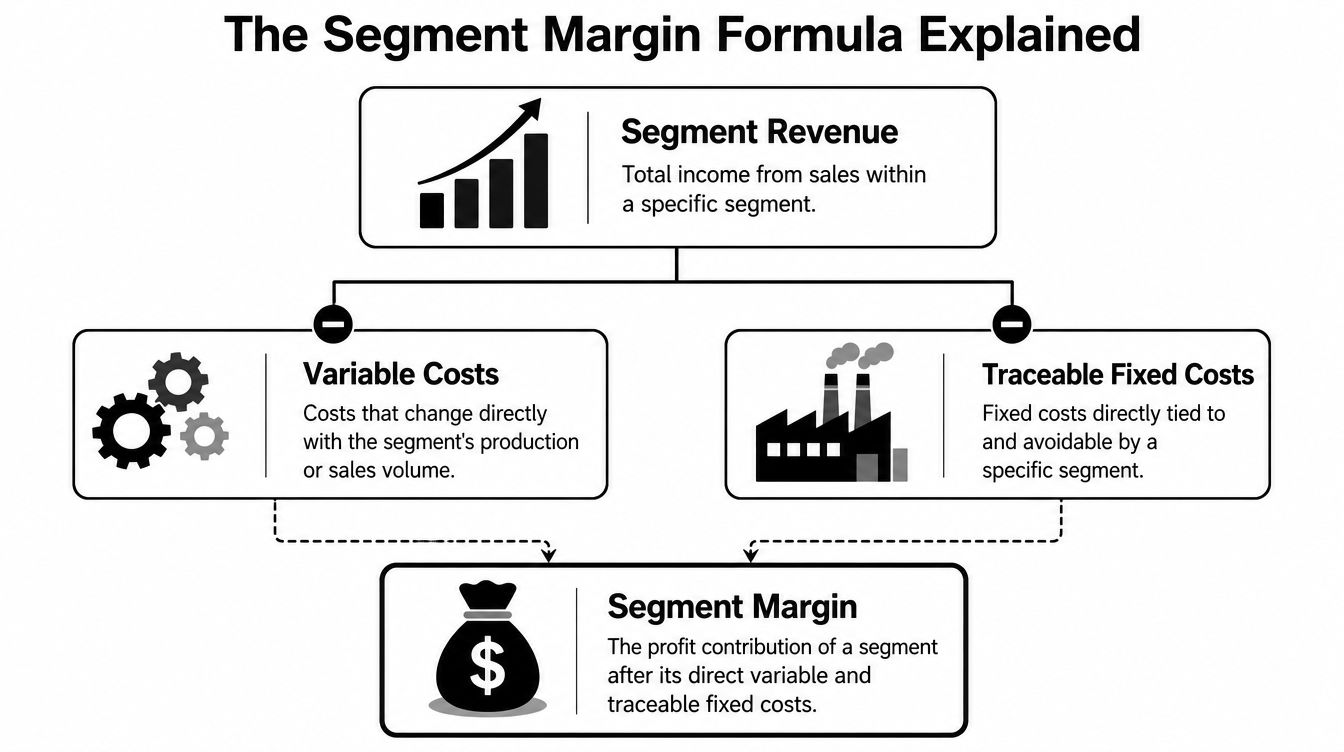
Think of a segment as a mini-business. It sells something, incurs costs to deliver that offering, and may require dedicated resources to operate. Segment margin shows what that mini-business contributes before the company absorbs costs shared across the entire organization. This is why the formula sits at the center of responsibility accounting, as explained in this explanation of segment margin and reporting.
Start with revenue
Segment revenue includes sales generated by the specific segment. For a construction company, that may mean contract revenue by job or project type. For a distributor, it may mean sales from a product family or customer channel. For a professional services firm, it could mean billings by client, practice area, or engagement.
The scope must be consistent. If you include all revenue from a client, you also need to capture the direct costs required to serve that client.
Subtract variable costs
Variable costs change with the segment's sales or activity. Typical examples include:
- Materials and supplies: Costs that rise as a construction project consumes more inputs.
- Product costs: Purchases tied directly to units sold by a distributor.
- Shipping and fulfillment: Delivery costs that move with order volume.
- Sales commissions: Compensation tied directly to segment sales.
- Direct labor: Labor that increases with project hours or client work.
These costs usually belong in the segment because they're economically connected to producing the revenue.
Subtract traceable fixed costs
Most owners should give this aspect careful consideration. Traceable fixed costs don't fluctuate directly with volume, but they exist because the segment exists and can be tied specifically to it.
Examples include a dedicated sales manager for a product division, a lease for a branch serving one geographic market, or a manager employed solely for a particular service line. If discontinuing the segment would eliminate that cost, the cost is a strong candidate for inclusion.
Common corporate overhead stays out. Corporate headquarters rent, a company-wide accounting team, and executive compensation may support every segment, but allocating those costs across divisions can make a viable segment look unprofitable.
How to Calculate Segment Margin Step by Step
A distribution company can apply the formula without building a complicated financial model. The work depends more on disciplined cost classification than on advanced accounting software.
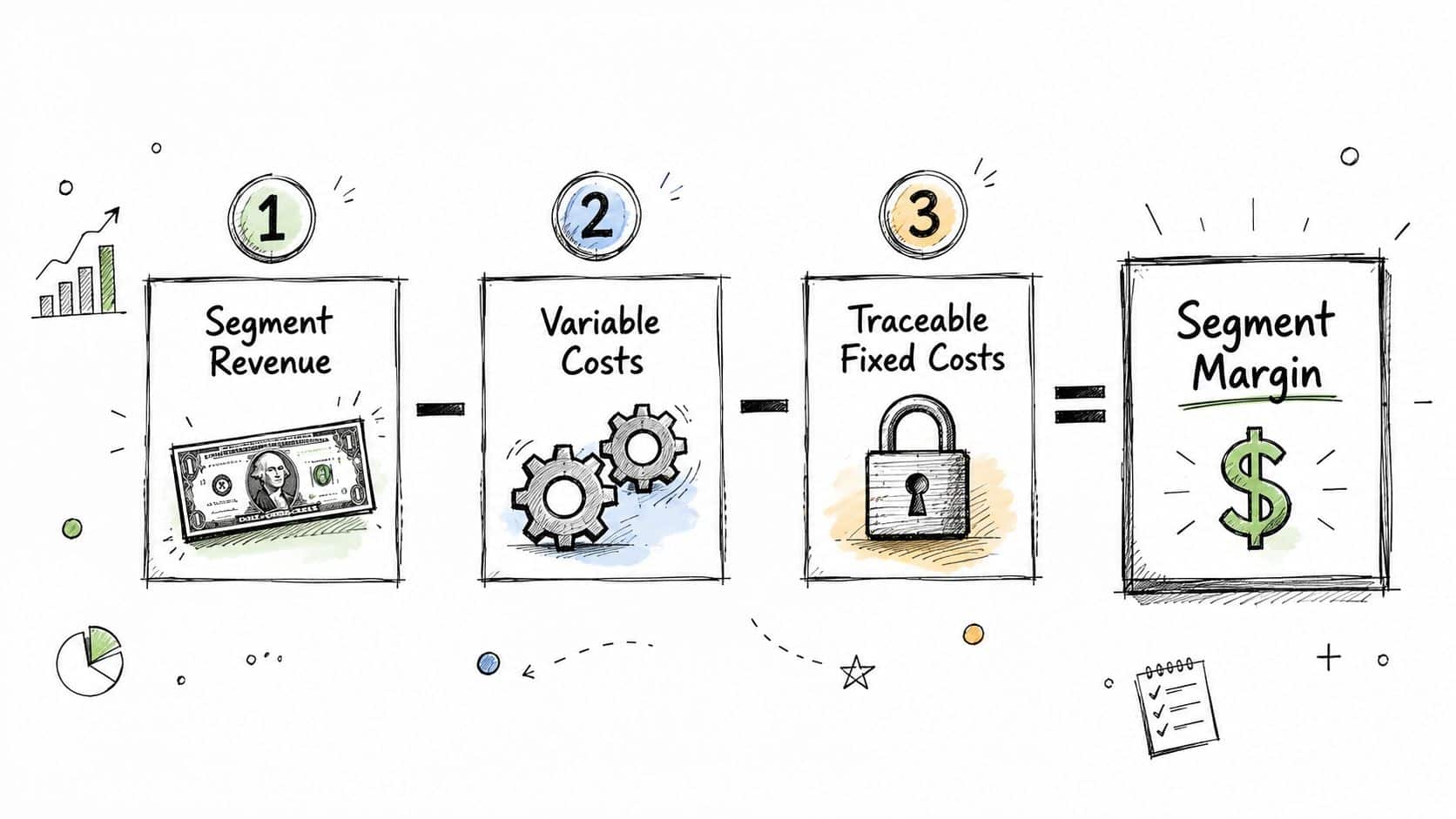
1. Define the segment
Choose a segment that supports a real decision. A product line, branch, job type, client group, or service offering usually works better than an arbitrary reporting category.
A distribution company might separate commercial equipment from residential replacement parts. A construction company might separate public contracts from private commercial work. A professional services firm might compare recurring advisory engagements with one-time implementation projects.
Your segment definition should remain stable enough to support comparisons over time.
2. Capture segment revenue
Pull sales from invoices, contracts, orders, or project billing records. Exclude revenue that belongs to another segment, even if the same customer buys from both.
For job-based businesses, job costing becomes essential. Without reliable job-level revenue and cost records, the segment margin calculation will only look precise while resting on weak inputs.
3. Identify variable costs
List every cost that moves with the segment's activity. Include direct purchases, freight, subcontractors, hourly production labor, commissions, and other costs that rise as the segment produces or sells more.
Don't limit the review to the general ledger label. Ask the operational owner what the segment must purchase or consume to deliver its work. That conversation often surfaces delivery, rework, overtime, or subcontracting costs that a broad P&L classification conceals.
4. Identify traceable fixed costs
Next, isolate fixed costs that belong only to the segment. A dedicated manager's salary belongs here if that manager wouldn't be needed after the segment closes. A facility lease belongs here if the company rents it solely for that segment.
Common fixed costs don't belong in the formula. The Investopedia explanation of segment margin emphasizes that excluding common fixed costs supports long-run profitability decisions because allocated overhead can distort whether a segment is economically viable.
5. Run the calculation and review the result
Subtract variable costs and traceable fixed costs from segment revenue. Then review the result with the person responsible for the segment.
For example, suppose two product lines produce the following internal results:
| Product line | Revenue | Variable costs | Traceable fixed costs | Segment margin |
|---|---|---|---|---|
| Commercial equipment | $200,000 | $150,000 | $20,000 | $30,000 |
| Residential parts | $200,000 | $120,000 | $40,000 | $40,000 |
The commercial line has the same revenue as the residential line, but the residential line contributes more after its own costs. That difference may change inventory, pricing, hiring, or marketing priorities.
For owners who want to validate the broader return logic behind an investment decision, this resource on avoiding common ROI calculation mistakes provides useful complementary guidance.
Segment Margin in Action A Real World Example
Consider an HVAC distributor with two product divisions, Commercial HVAC Units and Residential HVAC Parts. Revenue alone doesn't settle the question of which division deserves more working capital. Commercial units may generate large invoices, while residential parts may produce stronger economics after delivery and dedicated support costs.
The owner builds the analysis using revenue, cost of goods sold, shipping, and fixed costs that belong specifically to each division.
| Metric | Commercial Units | Residential Parts | Company Total |
|---|---|---|---|
| Segment revenue | $200,000 | $200,000 | $400,000 |
| Variable costs | $150,000 | $120,000 | $270,000 |
| Traceable fixed costs | $20,000 | $40,000 | $60,000 |
| Segment margin | $30,000 | $40,000 | $70,000 |
Commercial Units produces a $30,000 segment margin. Residential Parts produces $40,000. The commercial division may still be strategically important, but its higher sales volume doesn't make it the stronger economic contributor in this example.
The company total of $70,000 reflects the combined segment margins before common corporate overhead. The analysis excludes costs such as corporate headquarters rent, the CEO's salary, company-wide accounting, and other expenses that would continue even if one division stopped operating.
Compare segment margin percentages
Segment margin percentage puts the results on a comparable basis:
Segment Margin Percentage = Segment Margin ÷ Segment Revenue × 100
Commercial Units has a segment margin percentage of 15%, calculated as $30,000 divided by $200,000. Residential Parts has a segment margin percentage of 20%, calculated as $40,000 divided by $200,000.
A separate educational example shows the same percentage logic with $200,000 in revenue and $150,000 in segment costs. The resulting $50,000 segment margin equals a 25% segment margin percentage, as demonstrated by this segment margin calculator example.
Turn the result into a decision
The owner shouldn't automatically discontinue Commercial Units. Instead, the result raises specific questions:
- Can the division improve pricing?
- Are shipping arrangements eroding the economics?
- Is the dedicated sales manager producing enough incremental contribution?
- Does the division require too much working capital relative to its margin?
- Would selected commercial accounts be attractive after client-level costs are reviewed?
For a deeper client-by-client view, pair the analysis with customer profitability analysis. The segment margin formula gives you the operating result. Customer profitability analysis helps explain which accounts create or consume that result.
Using Segment Margin to Drive Smarter Decisions
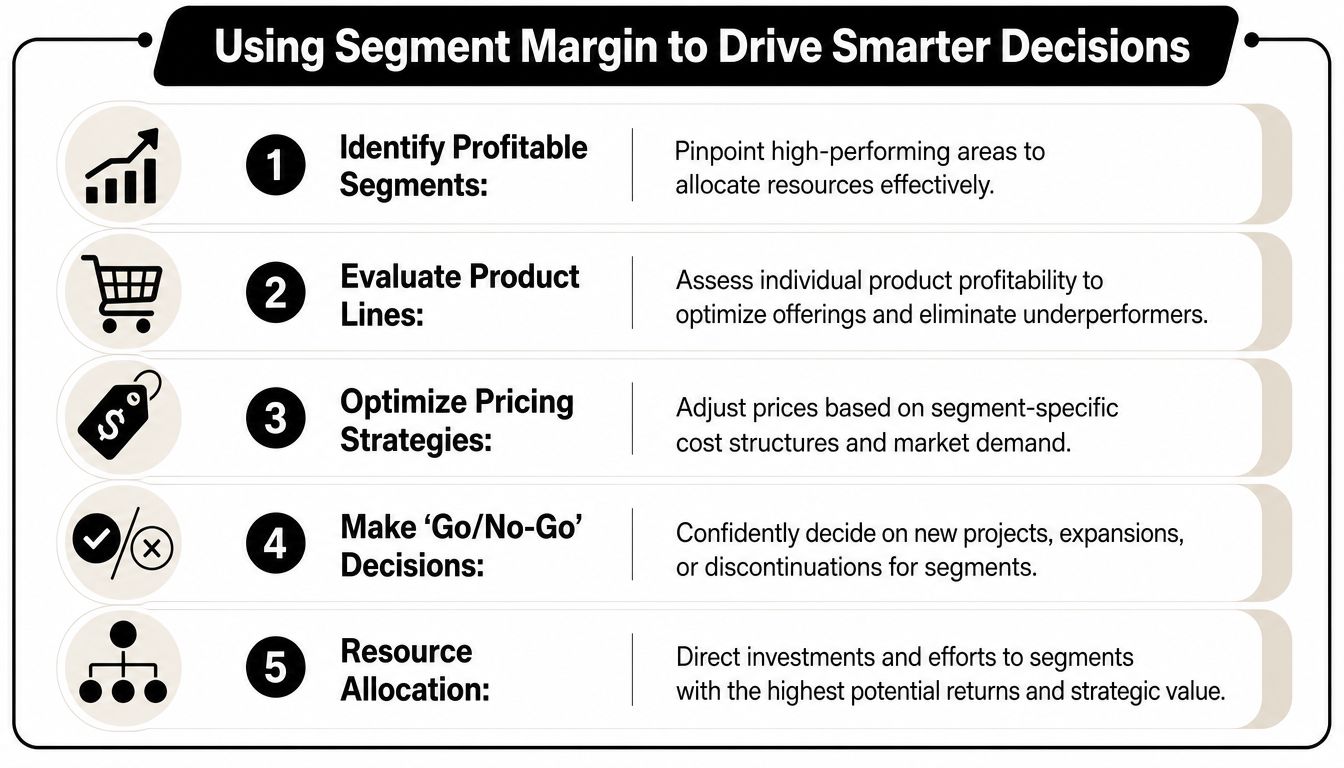
Segment margin is useful because it changes the conversation from “Which segment has the most revenue?” to “Which segment creates the strongest economic contribution after its own costs?”
That distinction matters in construction, distribution, and professional services. A large contract can consume management attention, working capital, specialized labor, and rework capacity while producing a weaker margin than a smaller engagement. A major customer can appear valuable until dedicated service demands are included. A branch can look successful until its location-specific costs are measured properly.
Choose where to invest
Use segment margin to rank opportunities for additional sales effort, equipment, inventory, hiring, or marketing. A segment with a strong margin may justify more capacity. A weak segment may need a price increase, tighter scope control, or a redesigned delivery process before receiving more resources.
Don't reward revenue growth by default. Reward growth that improves the company's economic contribution.
Evaluate jobs and clients
Treat a major job or client as a segment when it consumes identifiable resources. Include direct labor, materials, subcontractors, freight, commissions, dedicated account support, and other traceable costs.
Construction owners should review project margin after change orders, labor overruns, and subcontractor costs. Professional services firms should include delivery hours, project management, travel, and dedicated support. Distributors should examine freight, returns, discounts, and account-specific service requirements.
Decide whether to expand or exit
The segment margin measure is designed for long-term decisions about whether to expand, discontinue, or invest in a division because it focuses on avoidable and traceable costs rather than allocated common costs. That makes it more informative than gross profit alone for multi-segment businesses, as outlined by the Corporate Finance Institute's segment margin guidance.
A negative result requires investigation, not an automatic shutdown. Determine whether the segment is temporarily underperforming, priced incorrectly, burdened by avoidable inefficiency, or structurally unable to cover the costs required to operate it.
Avoid the interpretation errors
Owners commonly make four mistakes:
- Confusing revenue with value: High sales can hide weak cost recovery.
- Ignoring mix: A segment may look stable while customers or products shift toward less profitable work.
- Treating one period as a verdict: Review the result across comparable periods and investigate operational causes.
- Using allocated overhead as a decision rule: Shared costs can make a segment look worse without changing the cash savings from discontinuing it.
A reliable reporting system should put segment revenue, costs, margin, and operational drivers in one view. A well-designed KPI dashboard can help leadership monitor those measures without rebuilding the analysis manually every month.
For businesses managing financial data across multiple users or locations, hosted accounting environments such as QuickBooks Enterprise cloud hosting can also support more accessible reporting workflows. The technology won't fix poor cost definitions, but it can make consistent review easier.
Avoid These Common Segment Margin Mistakes
The most damaging error is allocating common corporate costs to every segment and then treating the result as operational truth. Dividing headquarters rent by revenue, spreading the CEO's salary across product lines, or assigning corporate accounting costs by headcount may produce a fully allocated profit figure. It doesn't necessarily tell you whether the segment itself creates value.
If the segment closes, ask which costs disappear. Those costs belong in the segment's avoidable economics. Costs that remain should stay visible at the corporate level rather than being used to punish a segment manager for expenses they can't control.
Separate traceable from common fixed costs
A fixed cost is not automatically common or traceable. Classification depends on the relationship between the cost and the segment.
| Cost | Likely treatment |
|---|---|
| Dedicated branch lease | Traceable fixed cost |
| Product-line manager | Traceable fixed cost |
| Corporate headquarters rent | Common fixed cost |
| Company-wide finance team | Common fixed cost |
| Segment-specific marketing program | Traceable fixed cost |
| CEO compensation | Common fixed cost |
The test is practical. If the segment disappears, does the cost disappear with it? If the answer is yes, include it after confirming the operational connection. If the answer is no, keep it outside segment margin and show it separately in the company-level bridge.
Don't confuse internal and external reporting
Segment margin is primarily an internal management measure. External segment reporting under FASB ASC Topic 280 requires public companies to provide quantitative and qualitative disclosures for reportable segments, but it doesn't prescribe one universal managerial formula. Internal segment margin can therefore differ materially from the profit shown in external disclosures, as explained in BDO's ASC 280 segment reporting guidance.
That distinction matters during an acquisition or exit. Buyers care about the economics management uses to run the business, but they also need a clear reconciliation to reported results. Build a bridge from contribution margin to segment margin, then to broader profitability measures used in your financial reporting.
Exit preparation requires consistency: Keep definitions, cost classifications, and period-to-period reconciliations documented before a buyer asks for them.
Finally, don't use segment margin as a substitute for action. Review pricing, scope, labor utilization, purchasing, customer mix, and resource allocation. Owners looking for a practical framework to improve those levers can use this guide to improve profit margins.
Conclusion Turn Profit Insight Into Profitable Action
You can't manage the profitability you can't see. A company-wide P&L may tell you that the business is profitable, but the segment margin formula tells you which jobs, clients, product lines, branches, and divisions are producing that result.
Use the formula consistently:
Segment Margin = Revenue − Variable Costs − Traceable Fixed Costs
Then calculate the percentage, compare segments on the same basis, and investigate the operational reasons behind the differences. Keep common corporate overhead outside the segment calculation unless the cost would disappear when the segment closes.
For a construction company, that means reviewing profitability by job and contract type. For a distributor, it means testing product lines and customer channels. For a professional services firm, it means measuring client and engagement economics after delivery effort and dedicated support are included.
The right result won't always be “invest more in the highest-margin segment.” A lower-margin segment may support strategic relationships or provide useful capacity. But you should know the economic tradeoff before committing more cash, people, or equipment.
Start with your last completed reporting period. Choose three meaningful segments, classify each cost as variable, traceable fixed, or common, and calculate the margin. Then schedule a management review focused on one decision per segment, invest, reprice, restructure, or exit.
AmbitionCFO helps founder-led businesses build margin analysis by job, client, product, geography, or channel, then connect the findings to cash flow models, forecasting, and operating decisions. Visit AmbitionCFO to discuss a practical segment profitability model for your construction, distribution, or professional services business.