

Growth is up. Cash feels tight. Your controller candidate says the books need discipline. Your operations lead says pricing is off. Your banker wants a forecast you trust. You're asking the wrong question if all you're asking is CFO vs Controller.
Founders usually ask that question after the pain has already arrived. A big customer ramps. Payroll expands. Inventory builds. Jobs start faster than collections come in. The P&L says you're making money, but the bank balance says something else. That's when owners start shopping for a title.
The title is not the decision. The missing capability is the decision.
In a founder-led business between $10M and $100M, that difference matters. You may not need a full-time CFO yet. You may also be well past the point where a bookkeeper, outside CPA, or reactive accounting manager can carry the load. If your close is late, your job margins are fuzzy, or your hiring and equipment decisions aren't tied to a cash model, you need to design the finance stack around what the business is missing right now. A good starting point is this guide on when to hire a CFO.
The practical question is simpler than most articles make it:
- If the numbers aren't reliable, you need controller capability.
- If the numbers are reliable but not helping you decide, you need CFO capability.
- If both are true, a controller plus fractional CFO is often the right answer.
That's especially true in construction, distribution, and professional services. Those businesses don't fail because someone picked the wrong title. They get squeezed because no one connected close discipline, margin analysis, and short-term cash forecasting soon enough.
Table of Contents
- Introduction Why Founders Ask CFO vs Controller at the Wrong Time
- What Each Role Actually Owns in a Growing Business
- CFO vs Controller Side by Side Comparison That Drives Decisions
- Cost ROI and the Fractional CFO Alternative for Mid Market Companies
- Real World Scenarios When to Hire Each Role
- How to Sequence Your Finance Stack Without Overhiring
- Choosing the Right Path for Your Business and Next Steps
Introduction Why Founders Ask CFO vs Controller at the Wrong Time
A founder in construction wins more work than expected. Revenue looks healthy. Yet every week turns into a cash scramble because billing lags, change orders are messy, and equipment decisions are being made from instinct instead of a real cash forecast.
A distributor hits growth, but inventory keeps absorbing cash faster than receivables come in. The owner wants to add salespeople, but no one can clearly show what that does to working capital, debt capacity, or margin by customer.
A professional services firm sees strong top-line demand, but utilization, project pricing, and hiring don't line up. The owner asks whether it's time for a CFO or controller. Usually, the issue is that the business has outgrown basic accounting, but it hasn't built the forward-looking finance layer either.
The title question hides the real problem
Most founders ask CFO vs Controller as if they're picking the higher-ranking person. That's the wrong frame.
The issue is this: what finance capability is missing today?
If your books close late, reconciliations are weak, and audit support is painful, a controller solves the immediate operational problem. If your books are mostly clean but you still can't answer what happens to cash if backlog slips, labor rises, or a new location opens, that's a CFO problem.
Practical rule: Don't hire the most senior title you can afford. Hire the role that fixes the bottleneck that's hurting decisions right now.
Why this matters for the middle market
In the $10M to $100M range, most businesses need more than bookkeeping and less than a full in-house C-suite finance department. That's where owners make expensive mistakes. They either overhire a strategic executive before the accounting engine is ready, or they keep stretching a controller into CFO work that no one has time or training to do well.
This guide is built to help you decide what to do next. You'll see the difference in ownership, how the roles compare, what the market says about cost, and how to sequence controller and CFO capabilities without overhiring.
What Each Role Actually Owns in a Growing Business
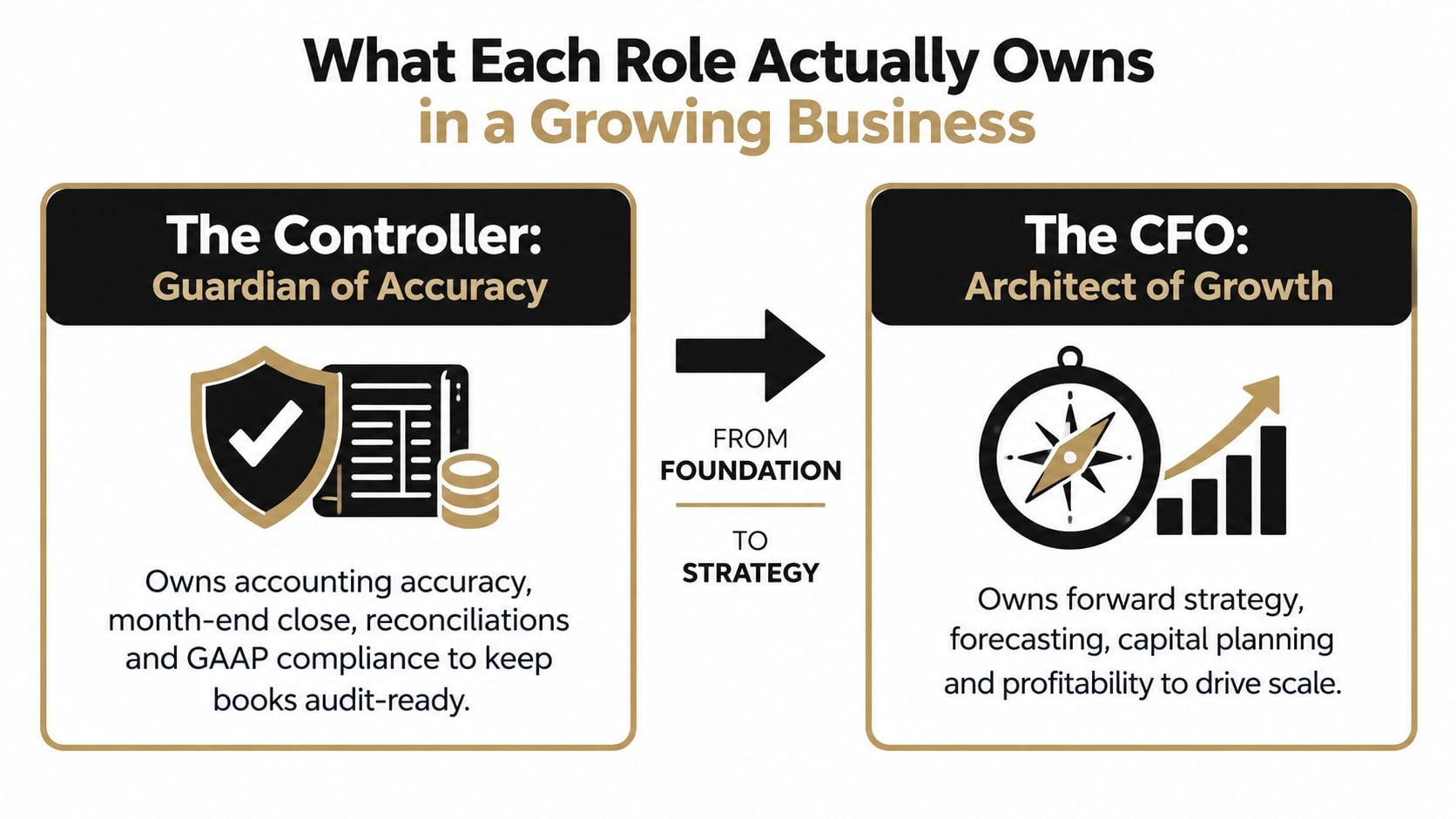
The cleanest way to think about this is simple. The controller owns financial accuracy. The CFO owns financial direction.
That's not theory. In practical operating terms, the controller is usually accountable for the general ledger, journal entries, reconciliations, audit coordination, and GAAP-compliant statements, while the CFO uses those outputs to drive FP&A, scenario planning, investor communication, and strategic decision support, as outlined in Spendesk's breakdown of controller vs CFO responsibilities.
What the controller actually owns
A controller runs the accounting backbone of the business. If this role is weak, every later finance conversation gets distorted.
Core controller ownership usually includes:
- Close discipline: Month-end close, account reconciliations, journal entry review, and balance sheet integrity.
- Financial reporting: Accurate income statement, balance sheet, and cash flow statement production.
- Compliance and controls: Internal controls, audit support, and policy consistency.
- Accounting operations: Making sure the accounting team can produce reliable outputs on time.
In construction, that shows up as cleaner WIP reporting, better job-cost integrity, and fewer surprises around overbilling or underbilling. In distribution, it means inventory and payable data that leadership can trust. In professional services, it means project financials that hold up under scrutiny.
What the CFO actually owns
A CFO sits above that operating foundation and turns data into decisions. Independent guidance from WhippleWood describes controllers as leaders of reporting, forecasts, accounting, audit, and budget functions, while CFOs sit above them with responsibility for strategy, capital allocation, and enterprise decision-making in its discussion of when growth demands a fractional CFO.
That translates into work like:
- Cash planning: Modeling liquidity and testing downside cases.
- Profitability analysis: Margin by job, customer, service line, or crew.
- Capital decisions: Equipment purchases, debt structure, and working capital strategy.
- Executive support: Giving the owner a financial lens for pricing, hiring, expansion, and exit timing.
If your sales team needs a compliance process before revenue can scale safely, a resource like this B2B revenue team compliance checklist can help connect finance discipline to commercial execution.
Why the handoff matters
The controller and CFO shouldn't duplicate each other. They should hand off cleanly.
The controller says, “These numbers are right.”
The CFO says, “Here's what these numbers mean, and here's what we should do next.”
That distinction is also the heart of the difference between FP&A and accounting. Accounting records reality. FP&A and CFO work use that reality to guide the business.
A strong CFO can't work around bad accounting for long. A strong controller can't answer strategic questions the business never modeled.
CFO vs Controller Side by Side Comparison That Drives Decisions
Here's the side-by-side view founders need. Not title hierarchy. Decision impact.
| Criteria | Controller | CFO |
|---|---|---|
| Primary mission | Keep financial records accurate, timely, and controlled | Turn financial information into operating and strategic decisions |
| Time horizon | Past and present | Future-focused |
| Core deliverables | Close, reconciliations, statements, audit support, controls | Forecasts, scenarios, KPI design, capital planning, decision support |
| Main audience | Accounting team, auditors, internal operators | CEO, owners, board, lenders, leadership team |
| Biggest risk if weak | Bad numbers, messy close, reporting errors, weak controls | Poor pricing, bad capital decisions, missed cash problems, reactive growth |
| Typical questions answered | Are the books right? Are we compliant? | What happens next? Can we afford this? Which move creates value? |
| Operational impact | Reporting reliability | Better hiring, pricing, expansion, and cash deployment decisions |
CFO vs Controller Responsibility and Deliverable Comparison
A controller's work shows up in the quality of the reporting package. A CFO's work shows up in the quality of decisions made from that package.
If your month-end reports are late, incomplete, or packed with unexplained swings, the controller gap is obvious. If reports arrive on time but don't help you choose whether to add a branch, bid a lower-margin contract, or hire ahead of demand, that's the CFO gap.
Where founders misread the comparison
Founders often assume a controller can “grow into” all CFO work. Sometimes that happens. Often it doesn't.
The jobs require different instincts. A controller is built to protect accuracy, process, and consistency. A CFO is built to weigh tradeoffs under uncertainty. That means pricing choices, debt capacity, labor ramp timing, and whether a new contract improves revenue while damaging cash.
Key distinction: The controller owns whether the numbers are dependable. The CFO owns whether leadership is using those numbers to make better bets.
Use this test before you hire
Ask your team these questions:
- Can we close cleanly and trust the balance sheet? If no, fix controller capability first.
- Can we see cash by week, not just by month? If no, add CFO capability.
- Can we explain margin by job, customer, or service line? If no, you need more than accounting.
- Can management model a hiring, capex, or pricing decision before acting? If no, CFO work is missing.
If you need a clearer baseline on the accounting side, this overview of what financial reporting includes is worth reviewing with your team.
The important point is that CFO vs Controller is rarely a winner-take-all choice in a scaling company. It's a question of which capability comes first and which one has to follow quickly behind it.
Cost ROI and the Fractional CFO Alternative for Mid Market Companies
The market pays more for CFO scope because the job reaches further. It affects strategy, capital, and leadership decisions that can help or hurt the whole company.
Historically, controller work is often grouped inside the broader financial manager category in official labor data rather than tracked as a standalone occupation. The U.S. Bureau of Labor Statistics Occupational Employment and Wage Statistics program reported a median annual wage of $166,570 for financial managers in May 2025, with the bottom 10% below $94,310 and the top 10% above $323,270, according to this controller vs comptroller vs CFO analysis.
What salary benchmarks tell you
Private market salary guides make the split clearer. Robert Half's 2026 finance and accounting salary guide lists a median range of $152,000 to $213,250 for corporate controllers and $195,500 to $321,750 for CFOs, showing a clear premium for broader strategic responsibility, as summarized in Tipalti's review of controller vs CFO compensation and scope.
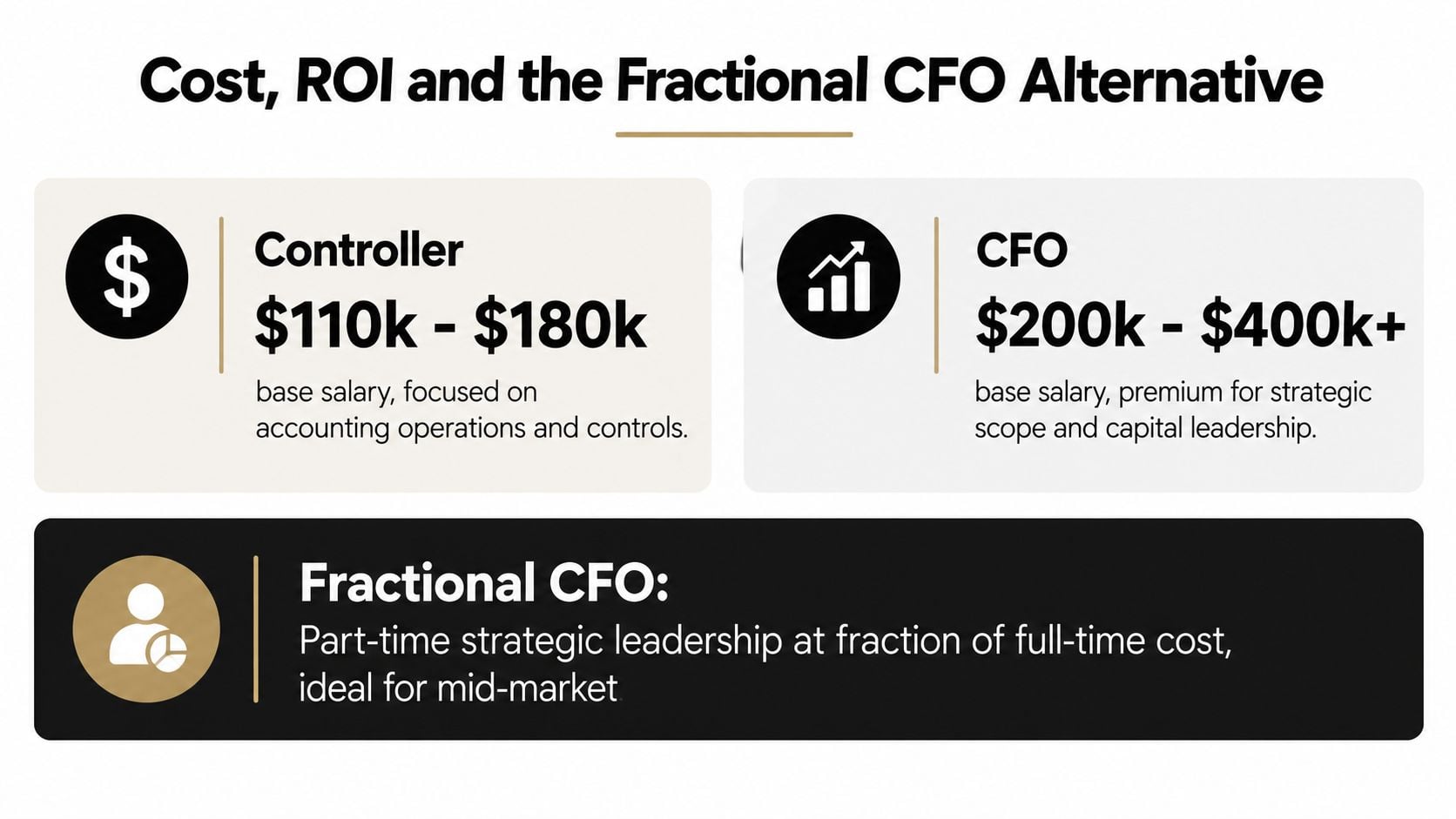
Another benchmark cited by Bill reports average U.S. base salary of about $419,000 for CFOs versus about $239,000 for controllers, with controller salaries also commonly cited between $110,000 and $180,000, and some reaching $250,000, in its guide to controller vs CFO hiring decisions.
Those numbers matter because they explain why many founder-led firms shouldn't jump straight to a full-time CFO.
When fractional CFO economics make sense
If your business needs:
- 13-week cash visibility
- Margin analysis by job, customer, or service line
- Budgeting and forecast discipline
- Decision support for hiring, pricing, and expansion
You may need CFO capability without needing a full-time CFO seat.
That's where a fractional model often makes more sense than a rushed executive hire. Ramp's summary of the market notes a meaningful compensation gap and points to the rise of fractional and hybrid finance leadership models, especially for owner-led companies that need controller-level accuracy plus selective CFO-level strategy.
How to think about ROI
Don't evaluate CFO support like overhead. Evaluate it against avoided mistakes and faster decisions.
A strong finance leader should help you:
- Catch cash pressure earlier so you adjust receivables, payables, inventory, or billing before the bank balance forces the issue.
- Improve margin visibility so low-quality revenue doesn't hide inside headline growth.
- Pressure-test capital moves so equipment, hiring, and location bets are funded intentionally.
For companies that need this layer without a full-time executive, fractional CFO ROI usually comes from better cash discipline and sharper operating choices, not from adding another senior salary line and hoping strategy appears.
Real World Scenarios When to Hire Each Role
The fastest way to decide is to ignore titles and diagnose symptoms.

Scenario one with messy close and audit pain
If your close drags, reconciliations are inconsistent, and your outside CPA keeps asking for cleanup, hire controller capability first.
In the first stretch of work, expect tighter account ownership, cleaner balance sheet support, and reporting that stops changing after the fact. Construction firms feel this when WIP schedules don't tie. Distribution companies feel it when inventory and AP don't reconcile. Professional services firms feel it when revenue recognition and project accruals move around too much.
Scenario two with growth but weak cash visibility
If revenue is growing and cash still feels unpredictable, add CFO capability. This is common when the business is profitable on paper but short on liquidity because billing timing, inventory, payroll, or contract economics aren't being modeled in advance.
A practical tool here is a 13-week cash flow forecast. Accordion explains that a 13-week forecast is a short-term liquidity model built on actual weekly cash movements, not accounting profit, and that the direct method forecasts receipts and disbursements by category and week in its 13-week cash flow forecasting guide.
Here's a short walkthrough that shows what that looks like in practice:
Scenario three with margin pressure and pricing confusion
If jobs, customers, or service lines produce different results and no one can explain why, you need CFO work layered onto decent accounting.
Many owners underreact. They think the issue is “reporting.” It usually isn't. The issue is decision-grade analysis. In construction, that may mean margin by project manager or crew mix. In distribution, margin by customer after freight and carrying cost. In professional services, realization and utilization by team or engagement type.
If your team can tell you last month's revenue but can't model next quarter's cash or margin, accounting isn't the bottleneck anymore.
Scenario four with exit planning or expansion
If you're planning a transition within the next several years, opening a location, or making bigger capital commitments, don't force one person to be both immaculate controller and strategic CFO unless they've already proven they can do both.
In those moments, a hybrid model often wins. The controller keeps the engine clean. The CFO translates that into cash planning, KPI design, and strategic decision support.
How to Sequence Your Finance Stack Without Overhiring
The right finance stack starts with order. Not titles.
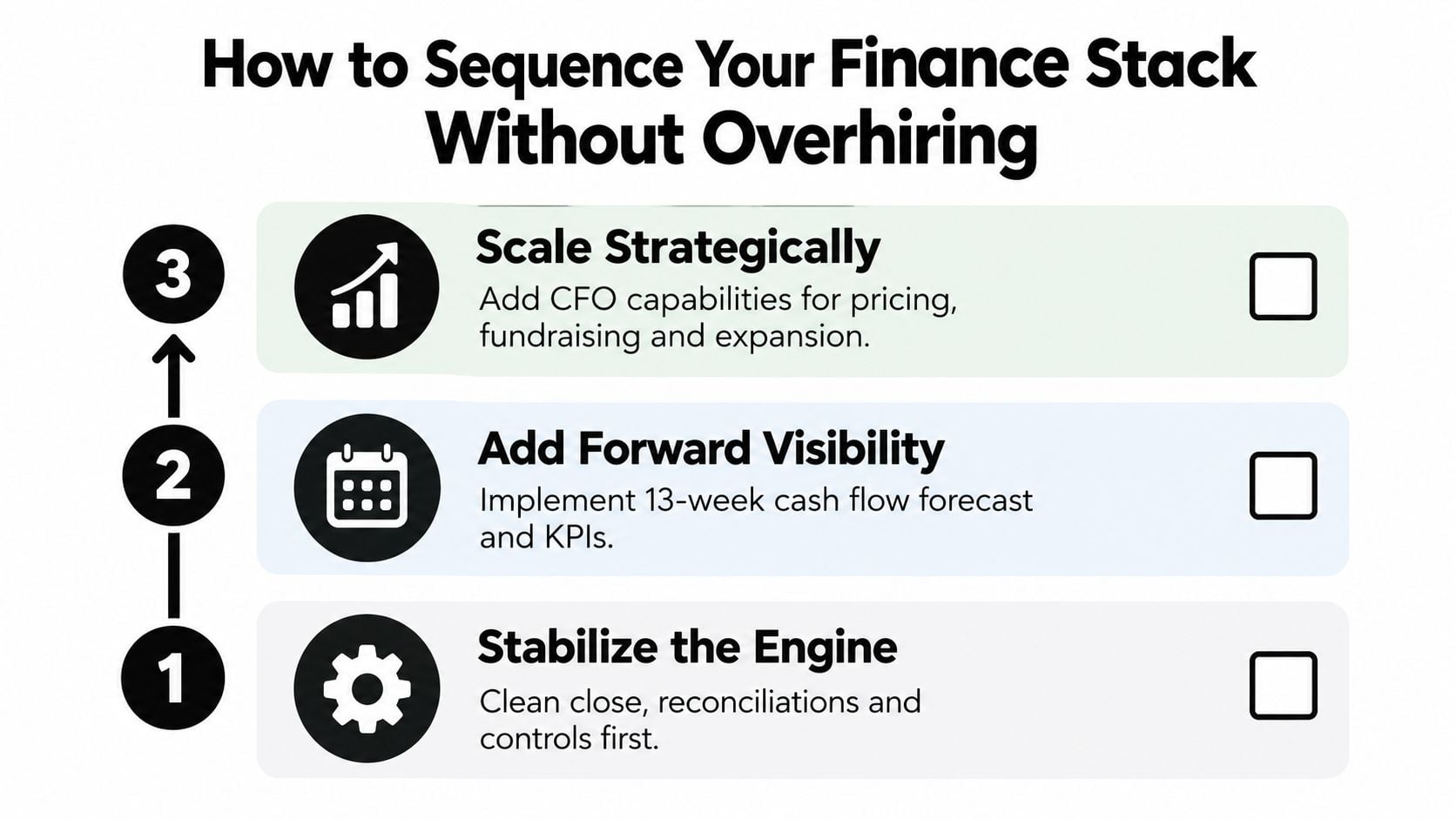
Most founder-led companies should build in sequence. First stabilize the accounting engine. Then add forward visibility. Then scale strategic finance.
Step one stabilize the accounting engine
If the books are unreliable, everything downstream gets weaker. Start here:
- Clean the close process: Define who owns reconciliations, accruals, cutoff, and review.
- Tighten balance sheet support: Every significant account should tie to detail.
- Standardize reporting: The management team should see the same package, on the same cadence.
If cleanup is still underway, practical resources like this autobankstatement clean-up guide can help you think through what has to be fixed before strategic modeling becomes useful.
Step two add forward visibility
Once the accounting engine is stable enough, build a short-term cash model. Finamodel's guidance on a 13-week cash flow forecast recommends starting from reconciled cash, defining the entities and bank accounts in scope, using actual due dates for payroll, rent, debt service, taxes, and capex, and setting a minimum cash floor.
That matters because a proper 13-week model isn't a budget cut into smaller pieces. It's a weekly operating tool.
Use this sequence:
- Start with reconciled opening cash.
- List expected receipts by actual week.
- List disbursements by actual due date.
- Calculate weekly net cash flow.
- Roll ending cash into the next week.
- Test a minimum-cash floor and downside cases.
This is also where systems start to matter. If reporting lives in spreadsheets patched together by one person, you'll eventually need upgrading a system to support cleaner reporting and repeatable analysis.
Step three layer the right leadership
Here's the quick worksheet I'd use with any founder:
- Hire or strengthen a controller first if books are late, reconciliations are weak, or audit support is chaotic.
- Add a fractional CFO first if accounting is basically functional but cash planning, pricing, margin, and forecasting are still reactive.
- Use both together if the business is scaling, cash swings are sharp, and owners are making hiring or capital decisions without a model.
One option in that middle-market lane is AmbitionCFO, which focuses on fractional CFO work like 13-week cash modeling, profitability analysis, forecasting, KPI dashboards, and exit planning for founder-led companies in construction, distribution, and professional services.
Choosing the Right Path for Your Business and Next Steps
Here's the blunt recommendation.
If your financial statements aren't reliable, don't hire strategy first. Fix the accounting engine with controller capability.
If your statements are reliable but you still can't see cash coming, price work confidently, or model a growth bet before making it, add CFO capability. If both conditions exist at once, stop trying to force an either-or answer. Put controller discipline and fractional CFO leadership together.
A simple decision matrix
Use this:
Messy close, weak reconciliations, audit stress
Hire a controller.Tight cash despite growth, no weekly forecast, unclear margin
Add a fractional CFO.Rapid growth, operational complexity, hiring and capex decisions stacking up
Use both.Owner planning a transition in the next several years
Add CFO capability even if accounting is decent, because exit planning depends on visibility, discipline, and repeatable performance.
What I'd tell most $10M to $100M founders
Don't wait for a crisis to sort this out. By the time cash gets uncomfortable, you've usually needed better finance design for a while.
The best sequence for many middle-market companies is straightforward. Build controller-grade accuracy first. Add CFO-grade forecasting and decision support next. Keep both focused on business outcomes, not job descriptions.
The smartest hire isn't the more senior title. It's the role that removes the next constraint on cash, margin, and decision quality.
If you're unsure where the gap is, diagnose capabilities in plain terms. Can you trust the close? Can you see weekly cash? Can you explain margin by job, customer, or service line? Can leadership model a decision before making it?
If the answer to even one of those is no, you already know what to fix.
If you need help sorting out whether your business needs controller discipline, CFO guidance, or both, AmbitionCFO works with founder-led companies to build cash visibility, forecasting discipline, and sharper operating decisions. Start with a finance capability review, identify the missing layer, and fix the bottleneck before the next growth move forces the issue.