

Working capital management is managing short-term assets and liabilities, especially cash, receivables, inventory, and payables, to keep the business liquid and operating smoothly. It matters because even small timing shifts can free meaningful cash, and a 2024 global study found about €1.56 trillion of excess working capital could still be released worldwide while DSO had increased 6.6% over the previous five years.
You know the feeling. Sales are up, the P&L looks decent, and yet your bank balance says something very different. Payroll is coming. A supplier wants to be paid. A big customer still hasn't cleared an invoice. You're profitable on paper and tight on cash in real life.
That gap is where founders get frustrated. You didn't start a business to stare at aging reports or argue with vendors about payment timing. But if cash keeps arriving late and leaving early, growth starts to feel like punishment.
For most founder-led businesses, question isn't just what is working capital management. The better question is: where is cash trapped right now, and how do I get it moving without breaking operations?
That's the useful frame. Working capital isn't an accounting definition you memorize and forget. It's the operating system for day-to-day liquidity. It shows whether your business turns activity into usable cash fast enough to fund payroll, inventory, jobs in progress, and the next round of growth.
If you're trying to make sense of why a growing company can still feel cash-poor, this is the place to start. I'll keep it practical, use plain language, and stay close to the decisions founders make. You'll see where cash hides, which metrics matter, and what to do this week to improve the situation.
If accrual profit and real cash keep telling you two different stories, this guide on converting accrual results to cash reality is a useful companion.
Table of Contents
- Introduction Why Cash Feels Tight Even When Sales Grow
- Understanding What Working Capital Management Really Means
- Key Metrics That Show How Cash Moves Through Your Business
- Proven Strategies to Free Up Cash Without Hurting Operations
- How Working Capital Challenges Differ by Industry
- Building a Simple System to Manage Working Capital Every Week
- Take Control of Your Cash Starting This Week
Introduction Why Cash Feels Tight Even When Sales Grow
A founder lands a strong quarter. Revenue climbs. The team is busy. Customers are happy. Then Friday shows up, and the company is juggling payroll, vendor payments, and a tax deposit while waiting on customer cash that should have arrived already.
That's not unusual. It's what happens when the business grows faster than its cash habits.
Profit doesn't pay bills on schedule
Profit measures whether the company created value. Cash answers a different question: did the money arrive in time to cover what's due now?
A simple example makes this clear. You finish a project this month, send the invoice next week, and the customer pays later. On the income statement, you may already look successful. In the bank account, you're still waiting.
Cash stress usually isn't caused by one dramatic mistake. It's caused by timing friction across dozens of ordinary decisions.
Founders often assume the answer is a bigger line of credit. Sometimes that helps. But credit is usually the backup plan, not the first fix. The first fix is to find trapped cash inside the operating cycle.
The trapped-cash hunt founders actually need
Cash often hides in three places:
- Receivables: You earned the revenue, but the customer hasn't paid.
- Inventory or work in process: You bought or built something before it turned into collected cash.
- Payables timing: You paid faster than you needed to, or you never negotiated terms that fit your cycle.
That's why working capital management matters. It helps you control the gap between doing the work and having the cash.
In practice, this is less about accounting and more about operating discipline. How fast do invoices go out? How often does someone follow up? Which stock moves? Which suppliers can support better timing?
Those are management questions. They affect whether growth creates flexibility or stress.
Understanding What Working Capital Management Really Means
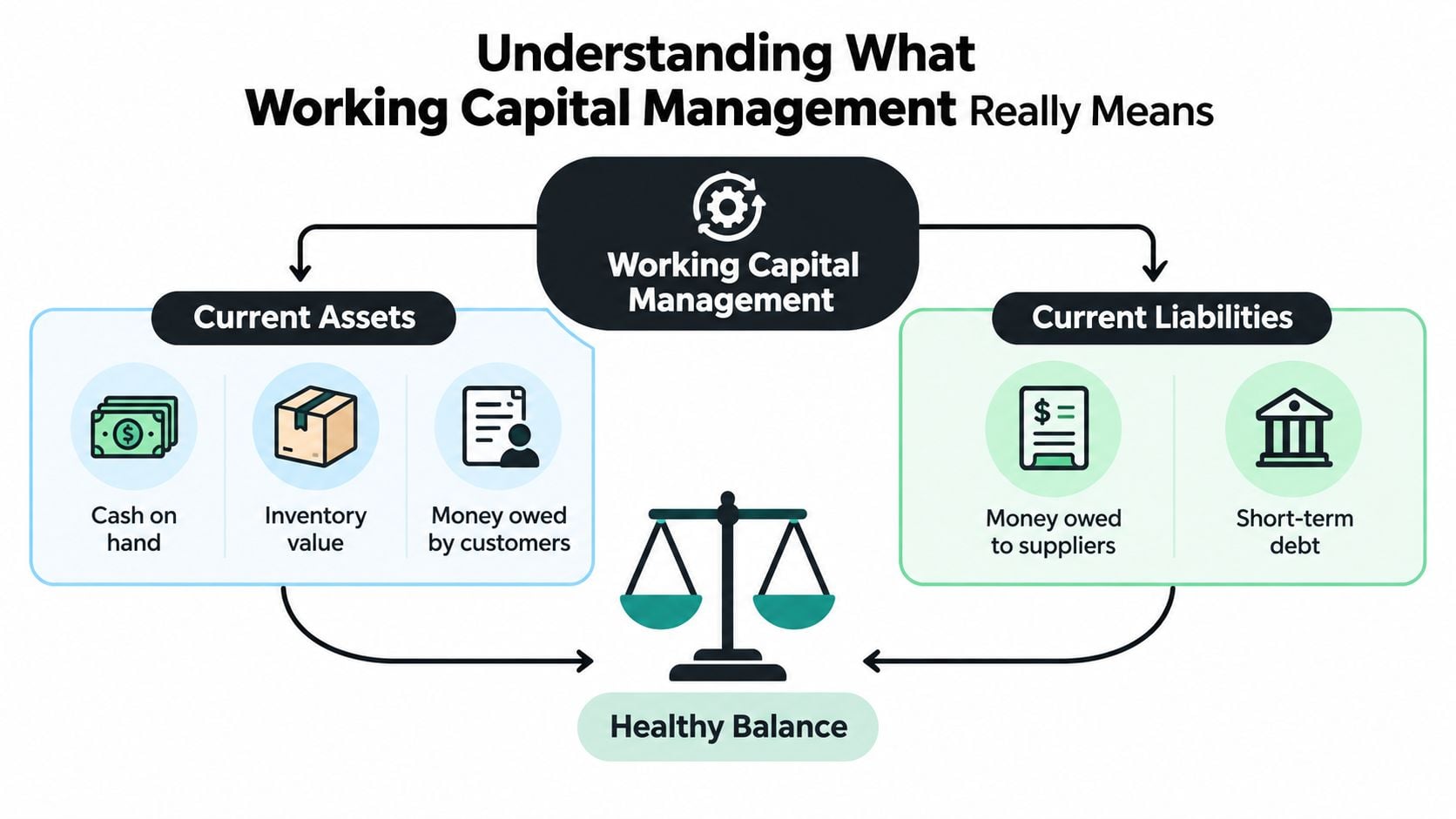
At its simplest, working capital is Current Assets minus Current Liabilities. Another common liquidity check is the current ratio, which is Current Assets ÷ Current Liabilities. Both are standard ways to see whether a business can cover short-term obligations with short-term resources, as explained in Investopedia's overview of working capital management.
The plain-English definition
Here's the version I'd give a founder in a meeting:
Working capital management is how you control short-term assets and liabilities so the business has enough liquidity to keep operating without unnecessary cash strain.
The truck may be valuable. The jobs may be profitable. But if there isn't enough fuel in the tank at the right time, the day falls apart.
Working capital management is that fuel discipline for the business.
What sits inside working capital
Four pieces matter most:
- Cash: Money already available to spend.
- Accounts receivable: Money customers owe you for work already completed or goods already delivered.
- Inventory: Cash that has been converted into stock, materials, or products waiting to sell.
- Accounts payable: Money you owe suppliers and vendors.
These pieces interact constantly. If receivables slow down, cash tightens. If inventory piles up, cash gets parked on shelves. If you pay vendors too early, you shrink your own cushion.
What it is not
Working capital management is not bookkeeping cleanup. It's not just reconciling accounts after the fact. It's not long-term capital planning, fundraising, or deciding whether to buy another company.
It's the daily and weekly discipline of managing timing.
A helpful way to think about it is through the working capital cycle, which connects purchasing, selling, billing, collecting, and paying into one cash story. If you want that full flow mapped out, this guide to the working capital cycle breaks it down cleanly.
Why timing matters more than profit alone
A business can be profitable and still run into cash trouble. That usually surprises founders the first time they hit a growth spurt.
Historically, this field evolved far beyond a basic liquidity idea. A major review describes several stages in the development of working capital thinking, from operations around 1900 to accounting around 1930, economics around 1960, capital markets around 1990, and an information approach emerging by 2020. Another bibliometric review indexed 913 working-capital-management articles in Scopus from 1981 to 2025, showing how substantial the field has become, and PwC's 2019/20 report found net working capital rose by €360 billion in 2018, up 9.4% from 2017. Those milestones are discussed in this review of working capital management literature.
The practical takeaway is simple. This isn't finance trivia. It's a refined management discipline built around one problem: how to turn operating activity into cash fast enough to stay healthy.
Key Metrics That Show How Cash Moves Through Your Business
If working capital is the fuel, the cash conversion cycle tells you how long that fuel is tied up before it comes back.
ACCA uses a practical formula for the cash conversion cycle: CCC = Inventory days + Receivables days − Payables days. A shorter cycle improves liquidity because less cash is stuck between paying suppliers and collecting from customers, as ACCA explains in its working capital management guide.
Working capital metrics at a glance
| Metric | Formula | What It Tells You |
|---|---|---|
| Cash Conversion Cycle (CCC) | DIO + DSO − DPO | How many days cash stays tied up in operations |
| Days Inventory Outstanding (DIO) | Inventory-related days measure | How long inventory sits before sale |
| Days Sales Outstanding (DSO) | Receivables-related days measure | How long customers take to pay |
| Days Payables Outstanding (DPO) | Payables-related days measure | How long you take to pay suppliers |
| Current Ratio | Current Assets ÷ Current Liabilities | Whether short-term assets cover short-term obligations |
| Net Working Capital | Current Assets − Current Liabilities | The size of your short-term liquidity cushion |
The three operating drivers
Wall Street Prep breaks the cash conversion cycle into three components: DIO, DSO, and DPO, with the common formula CCC = DIO + DSO − DPO. It defines DIO as how long inventory sits before sale, DSO as how long customers take to pay, and DPO as how long the company takes to pay suppliers in this cash conversion cycle reference.
Here's how to read them in plain language:
- Lower DIO is usually better: Inventory moves faster, so less cash sits on shelves.
- Lower DSO is usually better: Customers pay sooner, so you don't finance their business.
- Higher DPO can help: You hold cash longer before paying suppliers, but only if you don't damage relationships or incur penalties.
A metric matters only if it changes a decision. If DSO is high, the question isn't “why is the ratio ugly?” It's “who owns follow-up and what happens by Friday?”
How founders should use these numbers
Let's say your business feels tight on cash. These metrics tell you where to look first.
If DSO is the main issue, billing and collections are likely the bottleneck. In some sectors, better front-end payment processes can make a meaningful difference. For example, healthcare operators looking for ideas on reducing collection delays may find these healthcare revenue cycle best practices useful because they show how payment capture decisions affect DSO.
If DIO is too high, purchasing or production may be overbuilding. If DPO is unusually low, your team may be paying invoices as soon as they arrive instead of according to terms.
For project-based firms, another common distortion comes from billing timing. If revenue is recognized but billing lags, your reported performance can look stronger than your cash position. That's why understanding costs in excess of billing matters in construction and long-cycle work.
One health check beyond the cycle
A research definition from Virginia Tech describes the CCC as the number of days a company's cash resources remain committed to working capital before they are converted back into cash in this working capital cycle study.
That's why owners should care. A shorter cycle means you can redeploy cash faster and rely less on outside financing.
Proven Strategies to Free Up Cash Without Hurting Operations
The biggest mistake I see is treating working capital like a generic “optimize cash” project. That framing is too vague to be useful. The better move is to hunt for trapped liquidity.
A 2026 corporate survey found 72% of global corporates said releasing trapped liquidity was their top strategic priority for the next 12 months, 64% said identifying how much liquidity is trapped in supply chains was a key driver of working-capital strategy, up from 55% earlier in the year, and 59% said interest rates influenced their working-capital decisions. Those findings are in Citi's report, The World Rewired. For founder-led companies, that same question applies right now: where is your cash stuck?
Tighten collections discipline
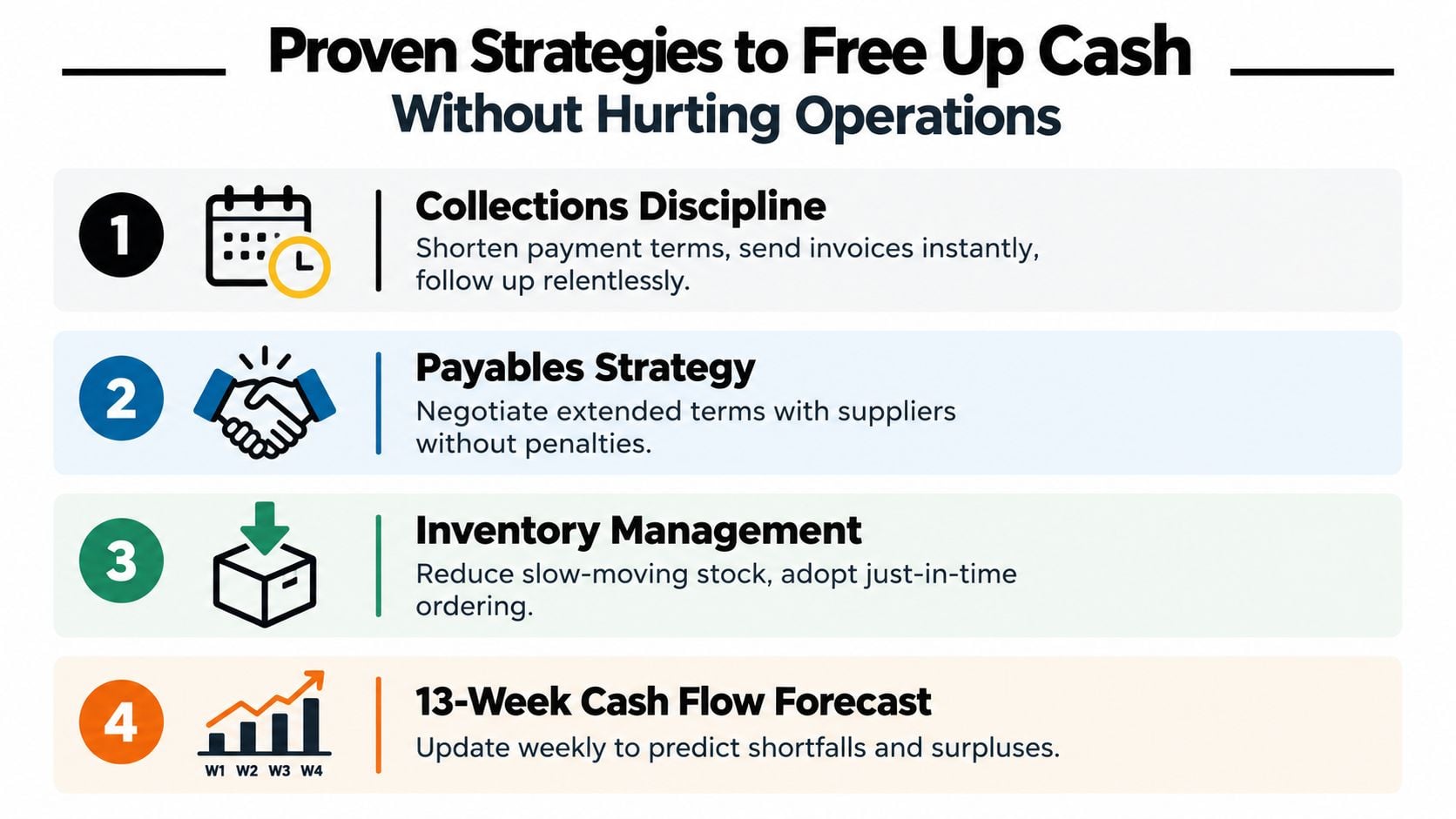
Most receivables problems start earlier than the collections call. They start when terms are vague, invoices go out late, or backup documentation is missing.
A stronger routine looks like this:
- Set terms upfront: Put payment expectations into the quote, contract, and customer record.
- Invoice immediately: Don't wait for month-end if the work is done.
- Follow a cadence: Send reminders before due dates, not just after they're missed.
- Escalate consistently: Decide when sales, operations, or the owner steps in.
The trap here is passivity. Teams often wait because they don't want to irritate a customer. But clear, professional follow-up usually protects the relationship better than silence and frustration.
Use payables as a strategy, not an afterthought
Payables discipline isn't about paying late for the sake of it. It's about paying according to terms, on purpose.
Reviewing your invoice approval process can help because sloppy approvals often cause premature payments or missed visibility. This breakdown of an invoice approval process is a practical reference if your team still routes invoices informally by email or spreadsheet.
A few useful habits:
- Match invoices to terms before approval.
- Batch payment runs on a schedule.
- Segment suppliers by importance.
- Renegotiate timing where the relationship can support it.
Get inventory and WIP under control
Inventory is cash wearing a costume. In construction, that may show up as materials bought too early. In distribution, it shows up as slow-moving stock. In services, it often appears as work completed but not billed.
Look for categories that always seem to linger. The point isn't to starve the business of stock. The point is to stop funding things that aren't moving.
Useful inventory management starts with one question: what do we keep buying or building before demand is truly ready?
Run a weekly cash forecast
A lot of companies know their P&L monthly and still can't see a cash shortfall coming. That's a forecasting problem.
One recent working-capital survey reported that only 4% of organizations had fully automated, real-time cash forecasting, nearly 50% cited inefficient processes as their top challenge, 31% still relied on spreadsheets, and 94.2% planned to adopt at least one working-capital solution in 2026, including 45.6% considering flexible on-demand tools such as commercial and virtual cards. The same benchmark noted U.S. working-capital performance improved only modestly in 2025, with CCC shortening by about 0.9 days, while $1.7 trillion remained trapped in excess working capital. Those figures are summarized in this working capital survey roundup.
That tells you something important. Technology helps, but process still wins.
Here's the section's most practical tool. A weekly cash review should answer:
- What cash is expected in over the next 13 weeks?
- Which invoices are most likely to slip?
- What vendor payments are flexible and which are not?
- Where is inventory or WIP building faster than collections?
If you need a structured starting point, working capital optimization can be tackled through a repeatable cadence that connects collections, payables, inventory, and forecasting. AmbitionCFO is one option founder-led companies use for that kind of 13-week cash flow modeling and operating review.
A short video can help make the discipline concrete:
How Working Capital Challenges Differ by Industry
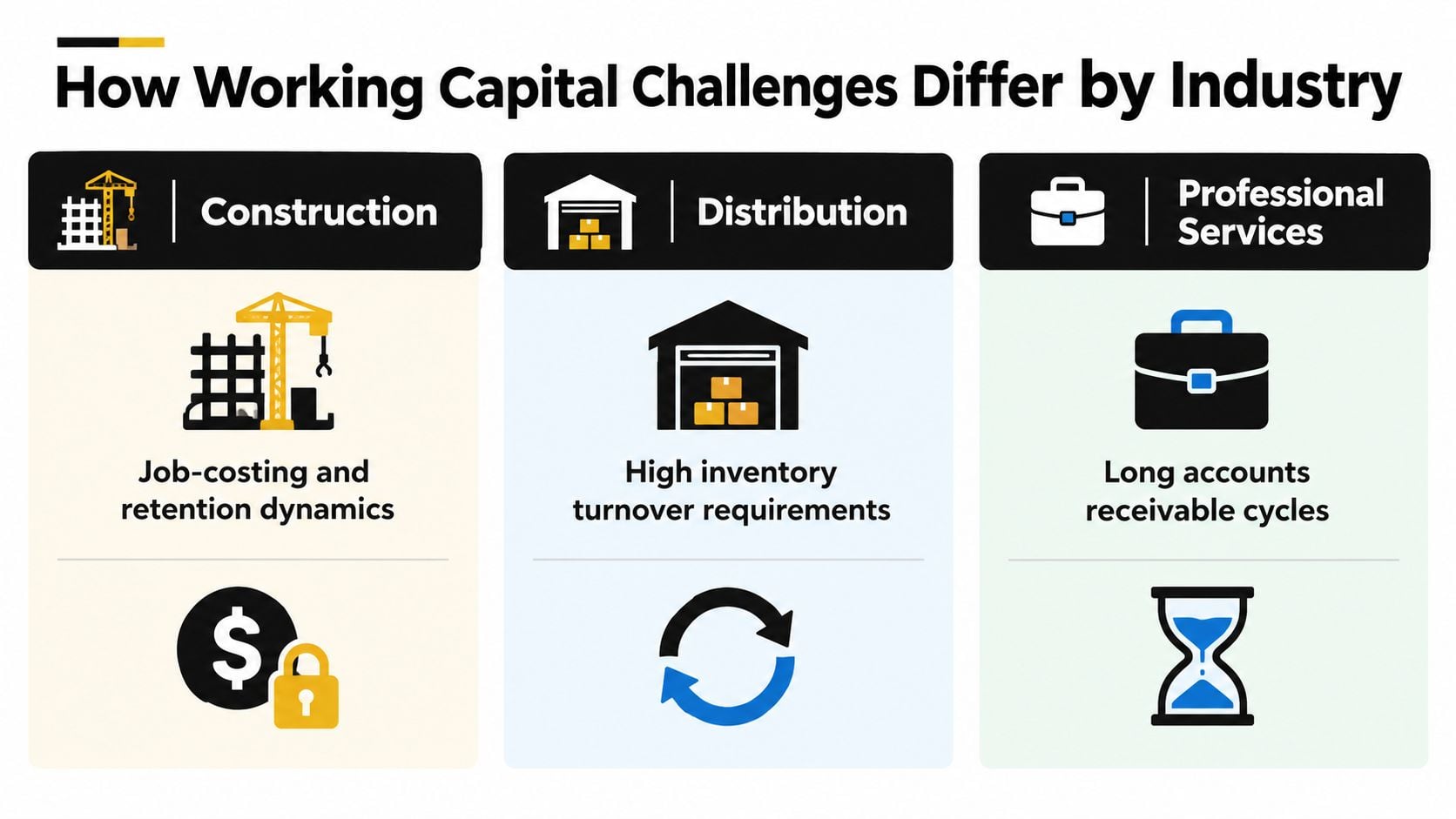
General advice on working capital often falls apart because different industries trap cash in different places. The metric may be the same. The operational reality isn't.
Construction
Construction companies often carry cash pressure through mobilization, change orders, retention, and work in process. The job may be moving, but billing can lag the field.
A common pattern looks like this: materials are purchased early, subcontractors need payment, and the owner or GC pays later after approvals. In that setup, the founder should watch billing speed, unapproved change orders, and the gap between job progress and collected cash.
Distribution
Distributors usually feel the squeeze through inventory and supplier terms. Shelves full of slow-moving product can make a business look busy while draining liquidity.
The founder's first diagnostic question is often simple: which SKUs convert to cash quickly, and which ones sit because “we've always stocked them”? Supplier relationships matter here too, because term structure can either support or strain the cycle.
Professional services
Professional services firms don't usually have heavy inventory, but they can still carry a long cash cycle. The problem often sits in utilization, delayed invoicing, weak scope control, or clients that approve bills slowly.
A firm can be fully staffed, billable, and profitable while still running tight because completed work hasn't been invoiced or collected. For these businesses, discipline around time capture, invoice timing, and collections usually matters more than inventory analysis.
The first priority depends on where your cash gets stuck. Construction often starts with WIP and billing. Distribution often starts with stock. Services often start with invoicing and collection speed.
Building a Simple System to Manage Working Capital Every Week
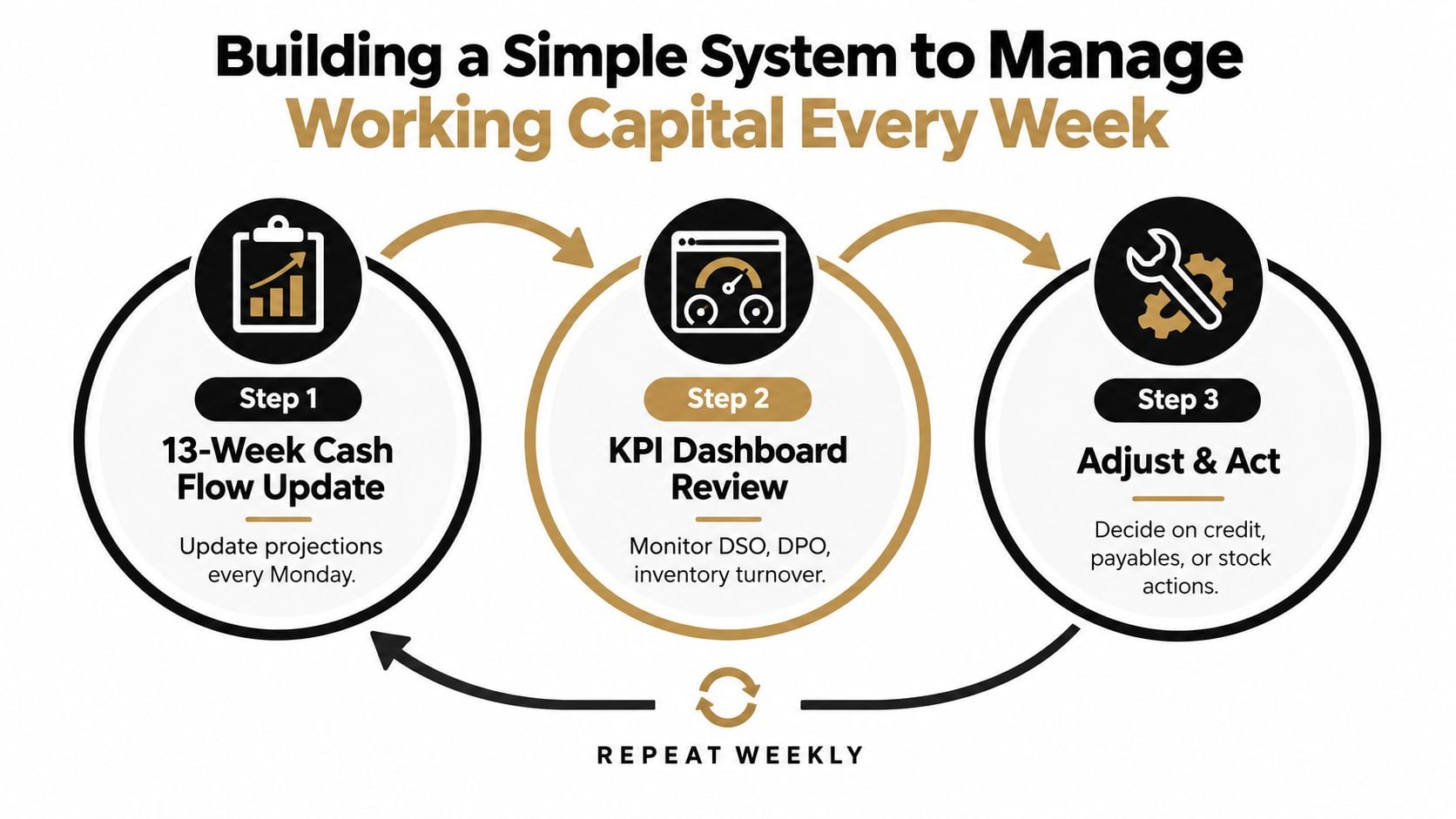
The companies that improve working capital consistently usually don't rely on heroic month-end catch-up. They run a simple weekly system.
A weekly rhythm that works
Here's a practical cadence for a founder-led team:
Update the 13-week cash forecast every Monday.
Replace guesses with expected receipts, scheduled disbursements, payroll, debt service, and known surprises.Review a tight KPI dashboard.
Focus on a handful of measures, such as collections status, payables due by week, inventory pressure points, and major billing delays.Hold a short action meeting.
Finance, operations, and the owner decide what changes this week. That might mean escalating a customer account, pausing a purchase, or changing the timing of a vendor payment.
Who should own what
Working capital improves faster when ownership is explicit.
- Owner or CEO: Break ties and make tradeoff decisions.
- Controller or finance lead: Maintain the forecast and report variances.
- Operations leader: Flag delays in delivery, billing readiness, or stock movement.
- Sales or account lead: Help push collections when a customer relationship matters.
Without clear owners, the same old invoices age and the same purchasing habits continue.
A simple worksheet you can use
Use this checklist in your next weekly review:
- Cash in: Which expected receipts this week are firm, and which are shaky?
- Cash out: Which payments must go out, and which can follow normal terms?
- Receivables: Which invoices need a call, not just an email?
- Inventory or WIP: What's building without a near-term path to cash?
- Margin signal: Are certain jobs, clients, or product lines consuming cash faster than they earn it?
- Decision log: What will change before the next meeting?
That last item matters. A meeting without decisions is just reporting.
If you want a model to start from, a cash flow forecasting model can make the 13-week process much easier to run consistently.
Take Control of Your Cash Starting This Week
Working capital management comes down to timing. Not just profit, not just growth, and not just whether the business looks good on paper.
If cash feels tight, don't start with abstract finance theory. Start by asking where cash is trapped. Is it sitting in late receivables, excess inventory, unbilled work, or vendor payments going out too early? That question leads to action.
A founder doesn't need a giant finance department to do this well. You need a few metrics you trust, a weekly operating cadence, and people who own the follow-up. When those pieces are in place, cash gets more visible, decisions get cleaner, and growth gets easier to fund.
A good first move this week is straightforward:
- Pull your current receivables aging and identify the accounts that need action
- Review payment timing against supplier terms
- List inventory, WIP, or backlog items that tie up cash without a clear collection date
- Build or refresh a 13-week cash forecast
If you do only that, you'll already be managing working capital more effectively than many companies that rely on backward-looking financial statements alone.
For more practical next steps, it also helps to review related resources on cash flow visibility, forecasting discipline, and operating metrics before making hiring, purchasing, or expansion decisions.
If you want senior-level help turning receivables, payables, inventory, and forecasting into a practical cash system, AmbitionCFO works with founder-led businesses on 13-week cash flow modeling, KPI dashboards, and profitability analysis by job or client. If your company has outgrown basic bookkeeping but doesn't need a full-time CFO, it's a sensible next step to get clearer visibility and better control over working capital.