

What must be ready before you step away?
Most owners frame succession too narrowly. They ask who will take over. The better question is whether the company can keep performing, protect key relationships, and still support your financial goals after you stop being the center of every major decision.
That's why succession planning best practices need a 3 to 10 year lens. Succession planning is about leadership, authority, ownership, and continuity. Exit planning is the broader path around it. It covers your timeline, personal financial readiness, tax posture, and whether you're moving toward a family transfer, management handoff, or sale. If you've heard the term CEPA, it means Certified Exit Planning. A CEPA advisor helps owners connect business readiness to personal readiness so the transition works on both sides.
Start with a written baseline. Document where the business still depends on you, how deep the leadership bench really is, how visible cash flow and margins are, where customer concentration sits, and what transition path you want.
A founder-led construction company is a familiar example. The owner still approves major bids, solves job issues with the top superintendent, knows which customer will pay late, and personally calms the largest client when a schedule slips. On paper, there's a successor. In practice, there's a bottleneck.
A real transition isn't a single handoff. It's a tested operating system that keeps working when the owner steps back.
If you want the business to transfer cleanly, sell cleanly, or survive an unexpected event, get the mechanics in place early.
Table of Contents
- 1. Develop a Formal Succession Plan with a Written Timeline
- 2. Identify and Assess High-Potential Internal Candidates Early
- 3. Create a Structured Knowledge Transfer and Cross-Training Program
- 4. Implement Formal Leadership Development and Coaching for Successors
- 5. Gradually Shift Decision-Making Authority and P&L Responsibility to the Successor
- 6. Establish an Advisory Board or Board of Directors for Objective Perspective
- 7. Build Financial Literacy and Strategic Decision-Making Capability in the Successor
- 8. Document Your Exit Strategy and Align Succession Planning with Business Valuation Goals
- 9. Manage Key Customer and Vendor Relationships During Transition to Build Stakeholder Confidence
- 10. Create Contingency Plans for Unexpected Events
- 10-Point Succession Planning Comparison
- Turn the Plan Into Your Next 90 Days
1. Develop a Formal Succession Plan with a Written Timeline
A verbal plan usually means this: everyone thinks they agree until a real decision has to be made. Then the owner, successor, family, and managers realize they were picturing different timelines, different roles, and different outcomes.
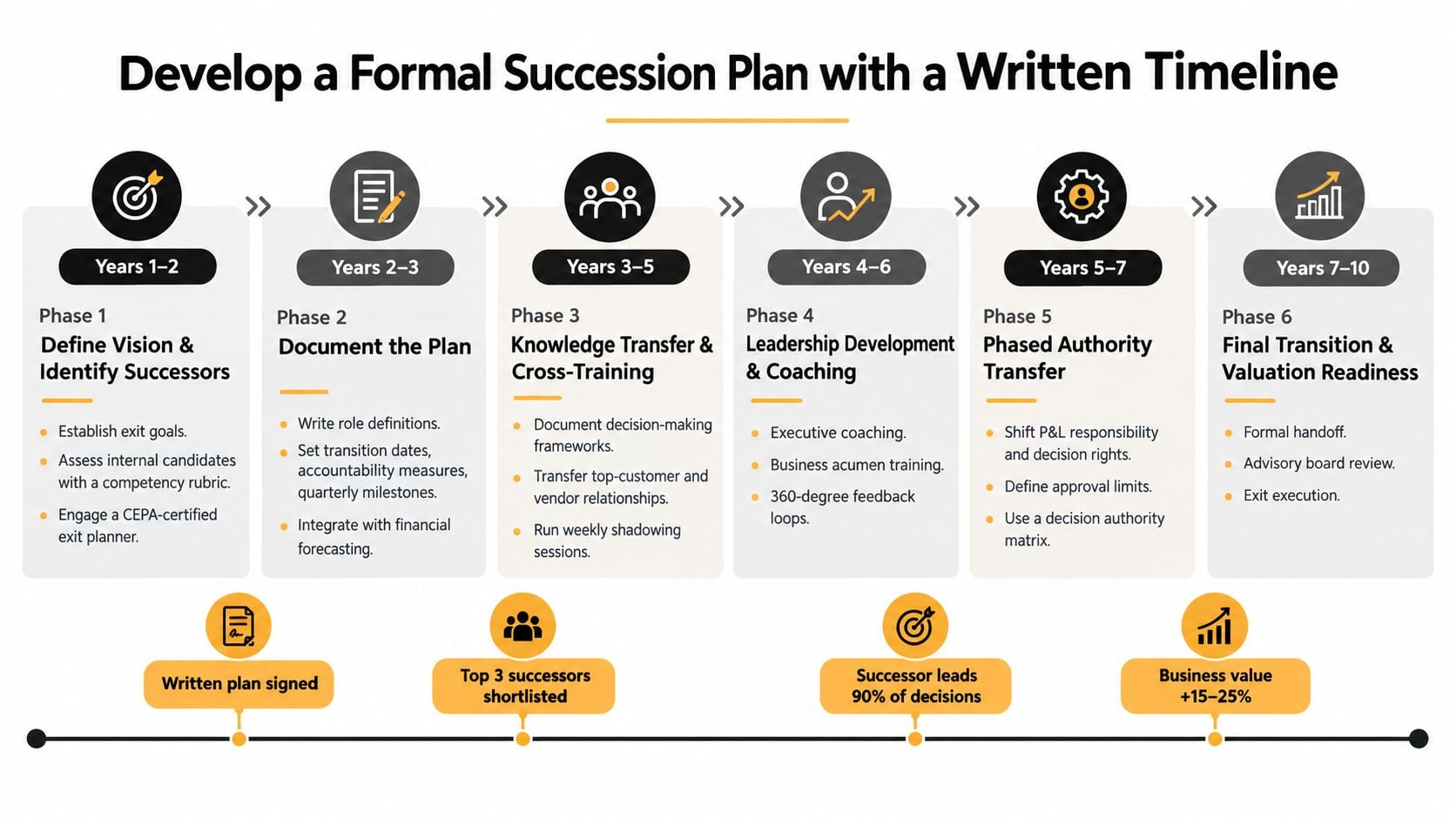
That's why the first of all succession planning best practices is simple. Put it in writing. A formal plan should name the likely transition window, the intended successor path, the owner's future role, the authority transfer sequence, and the business risks that must be reduced before the handoff.
The timing issue is bigger than many owners think. A 2026 Deloitte Private survey of 300 family business executives found that 78% expect a CEO transition within the next decade, and 42% expect it within three to five years. In the same survey, 85% said strategic CEO succession planning is critical to long-term success, but only 57% had established a plan, 23% were actively implementing one, and 30% said their planning was behind schedule.
What the written plan should include
- Target window: Pick a realistic transition range, not a vague someday date.
- Named milestones: Set review points for successor development, authority transfer, and owner step-back.
- Role clarity: Define what the owner still approves, what the successor owns, and what the board or advisors review.
- Critical process list: Identify the top three processes the successor must master before the handoff.
A distribution owner might document a three-year relationship transfer for top accounts with quarterly reviews. A construction owner might map an 18-month progression from shadowing bid reviews to leading them.
Practical rule: If it won't survive a hard conversation in writing, it won't survive a real transition.
Review the plan every year. A formal timeline improves operating discipline today and signals maturity if the business eventually goes to market.
2. Identify and Assess High-Potential Internal Candidates Early
A successor title doesn't prove successor capability. In owner-dependent firms, the question is whether a candidate can absorb pressure, make calls with incomplete information, and protect cash when conditions tighten.
The strongest internal candidates usually show up before they look polished. They take ownership, ask sharper financial questions, and handle uncomfortable conversations without freezing. What they need is time and structured assessment.

A professional services firm might identify three partner-level candidates and give each one a different stretch role. One leads pricing discussions. One runs hiring and team utilization. One takes over a weak service line. After enough exposure, one person usually starts separating from the group.
What to assess beyond performance
Use a written rubric and don't rely on gut feel alone. A good rubric should cover:
- Financial command: Can this person read a P&L, understand cash pressure, and explain margin drivers?
- Decision quality: Do they make timely calls, or do they escalate every hard issue upward?
- Relationship transferability: Will key clients, vendors, and managers trust them in the top seat?
- Strategic range: Can they think beyond today's fire drill?
For a practical structure, a talent review for succession can help owners compare current performance against future leadership potential.
This part needs honesty. In many companies, the presumed heir is strong at execution but weak at financial judgment. That isn't a reason to give up on them. It's a reason to know the gap early enough to close it.
3. Create a Structured Knowledge Transfer and Cross-Training Program
What breaks first when an owner steps back. The title, or the day-to-day judgment that keeps jobs on track, customers calm, and cash coming in?
For owner-dependent firms, risk is rarely a missing org chart. It is missing operating judgment. The owner knows which customer complaint needs a same-day call, which bid should be passed over even if revenue looks tempting, which PM can recover a troubled job, and which vendor promise should be verified before production starts. If that knowledge stays informal, authority cannot transfer cleanly, and a sale or internal handoff will look weaker under scrutiny.

Start by mapping knowledge into three buckets: decisions, relationships, and exceptions. Decisions cover pricing, hiring, collections, capital spending, and margin trade-offs. Relationships cover the customers, vendors, lenders, and field leaders who call the owner first. Exceptions cover the unusual situations that never make it into a standard SOP but still affect profit and continuity.
A construction company might capture how the owner reviews estimates, spots risky contract language, and decides when to approve a change order fight instead of conceding margin. A distributor might document how rush inventory gets allocated during shortages, who gets payment terms extended, and when to push a price increase through despite expected pushback. A professional services firm often needs to transfer proposal strategy, client rescue conversations, write-off judgment, and partner staffing calls.
Do not try to document everything at once. Prioritize the work that protects valuation and continuity if the owner is unavailable for 30 days.
Here is a practical sequence that works better than shadowing alone:
- List the owner-only decisions made in the last 90 days. If only one person can explain why those calls were made, start there.
- Record the logic, not just the steps. A checklist helps, but the successor also needs to hear why one customer gets special handling and another does not.
- Assign cross-training by risk area. The successor should run at least part of estimating, forecasting, client communication, hiring, and problem resolution with observation and review.
- Test transfer with live decisions. Let the successor make the next call inside defined limits, then review the outcome.
- Track what still routes back to the owner. That list shows where authority has not really moved.
This is also where financial readiness becomes visible. If a successor cannot connect an operating decision to margin, cash flow, backlog quality, or working capital pressure, the transfer is incomplete. The link between daily execution and enterprise performance needs to be taught directly, and business performance improvement is a useful frame for that work.
Documentation matters, but so does format. Long manuals often get ignored. Short decision logs, recorded walkthroughs, account briefs, and role-based playbooks get used. For documented handoffs, these handover templates and tools can help teams standardize what gets captured instead of relying on memory.
One caution. Cross-training is not the same as making everyone partially responsible for everything. Breadth helps continuity. Too much breadth can blur accountability. The successor needs enough exposure to run the business without the owner, while department leaders still keep clear ownership of their lanes.
Use recurring transfer sessions on the calendar, but make them operational. Review one estimate. Sit in on one vendor dispute. Let the successor lead one client meeting. Debrief one weekly forecast. That rhythm builds capability, exposes weak spots early, and gives buyers, lenders, or family shareholders more confidence that the company can perform without founder intervention.
4. Implement Formal Leadership Development and Coaching for Successors
Successors often need development in two areas at once. They need sharper business judgment, and they need the presence to lead people who used to report through the founder's shadow.
That's why coaching matters. Not because the candidate is weak, but because the top role asks for a different mix of skills than operations leadership, sales leadership, or technical leadership. A great superintendent, rainmaker, or senior partner can still struggle when every issue now routes through them.
A distribution business provides a useful example. The likely successor may know inventory, customer service, and operations cold, but still hesitate when facing pricing disputes, a weak quarter, or a senior employee conflict. Structured coaching gives that person a place to practice decisions before every mistake becomes public.
What formal development should target
- Decision-making under pressure: The top role requires timely calls, not endless consensus-building.
- Financial fluency: Successors need to understand margin, cash flow, and trade-offs clearly enough to lead reviews themselves.
- Stakeholder communication: They must reassure employees, lenders, customers, and family members without overpromising.
- Strategic thinking: They need to move from department logic to enterprise logic.
In some firms, a retired CEO or board advisor is the best coach. In others, an external executive coach works better because the founder's voice is already too loud in the system. Either way, development should tie to actual business situations, not generic leadership theory.
Good coaching also surfaces an uncomfortable truth early. Sometimes the designated successor can grow into the role. Sometimes they can become a strong second-in-command but not the top operator. It's better to learn that before the owner is trying to leave.
5. Gradually Shift Decision-Making Authority and P&L Responsibility to the Successor
A successor isn't ready when they know what you do. They're ready when they can do it, own the result, and live with the consequence.
That shift should happen in phases. Start with contained decisions, then move to business-unit authority, then broader company-level calls. The owner's role changes from decider to reviewer, then from reviewer to backstop.

A construction firm might let the successor control staffing and subcontractor selection first. If that goes well, the next phase could include pricing smaller jobs and handling customer negotiations. A distributor might assign one product line with full accountability for gross margin, inventory, and service levels before expanding the scope.
Give authority in writing
Most owners accidentally sabotage succession here. They tell the team the successor is in charge, then override decisions in side conversations. That destroys confidence fast.
Write down approval thresholds, escalation paths, and ownership by decision type. The difference between reporting and planning becomes clear here. If you want the successor to own performance, they need more than historical books. They need forward-looking decision support, which is why understanding FP&A vs accounting matters during a handoff.
Don't test successor readiness in theory. Test it in monthly results, customer reactions, and cash movement.
Keep a decision log. Note what was delegated, what happened, and what the owner had to step back into. Over time, this becomes hard evidence of readiness for internal governance and outside diligence.
6. Establish an Advisory Board or Board of Directors for Objective Perspective
Founder-led firms often have one core succession problem. Nobody regularly tells the owner the truth with enough independence to matter.
An advisory board solves that better than informal coffee meetings. A small group with outside perspective can challenge timelines, question assumptions about the successor, and push the owner to separate identity from operating necessity.
A professional services firm might build an advisory group with a retired industry operator, a finance leader from a larger peer, and a people leader who understands partner development. A construction company might bring in an operations-heavy advisor, a lender-experienced finance voice, and an owner who has already completed a transition.
Use the board to measure readiness, not just discuss it
Good boards don't ask whether a plan exists. They ask whether it works. That distinction matters because many organizations have paper plans but weak execution. A Deloitte study on effective leadership succession planning found that 86% of organizations have some form of succession plan, yet only 14% say they do leadership succession planning effectively, and only 21% report a strong bench of ready successors for critical roles.
That should change how owners run reviews. Use the board to look at successor scorecards, decision logs, customer-transition progress, and leadership gaps. If you want a succession process tied to enterprise value, shareholder value maximization is the right frame. Buyers and minority owners both care whether the company can perform without founder dependency.
Compensated advisory roles can also help with accountability. When people know they're expected to read the materials, ask hard questions, and mentor the successor directly, the meetings get better fast.
7. Build Financial Literacy and Strategic Decision-Making Capability in the Successor
Many succession plans break at the same point. The successor can run operations, sell work, or lead teams, but can't reliably translate those activities into cash, margin, and capital decisions.
That gap is dangerous because top leadership is really an economic decision role. The CEO decides where the business takes risk, how it prices that risk, and when to protect cash instead of chasing volume.
A construction successor needs to understand job profitability, cash timing, backlog quality, and how one bad contract can distort the quarter. A professional services successor needs to understand utilization, realization, staffing ratios, and client mix. A distribution successor needs to know where margin gets diluted across products, customers, and freight realities.
Make financial readiness visible
Use a structured curriculum, not random exposure. Monthly forecasting, weekly cash review, variance analysis, and scenario planning are the core reps. The best successors learn by working inside the company's own numbers, not by sitting through generic finance lectures.
That's especially important because the field is shifting toward proof, not naming names. Recent expert coverage describes succession as moving “from identifying who might succeed to proving who will perform,” and notes that one-third of leaders have no specific KPIs for the process in Pinsight's 2026 succession planning trends coverage.
Build monthly scorecards around business outcomes. Have the successor lead forecasting discussions. Ask them to explain the downside case, not just the base case. If they need stronger modeling skills, how to build financial models is a practical place to strengthen that discipline.
8. Document Your Exit Strategy and Align Succession Planning with Business Valuation Goals
Succession without exit clarity creates conflicting decisions. An owner says they want a family or management transition, but still runs the business as if a third-party sale is imminent. Or they say they may sell, but never reduce founder dependency enough to make the company transferable.
You need one clear answer to start. What path are you building toward: sale, family transfer, internal management handoff, or some blend over time? Each path changes how you invest in leadership, governance, compensation, and risk reduction.
A CEPA process helps because it connects the owner's goals to the company's mechanics. In plain terms, Certified Exit Planning means making sure your personal timeline, after-tax expectations, and business readiness are aligned instead of left to chance.
Paper plan versus developed plan
The quality gap here is real. According to a 2026 Deloitte global report on succession preparedness, 89% of families and 82% of family businesses report having some form of succession plan, but only 50% of families and 46% of businesses describe those plans as broad and well-developed.
That's the difference between “my daughter may take over someday” and “we've defined ownership transfer mechanics, leadership readiness milestones, governance, and the owner's post-transition role.”
If you're planning around enterprise value, document the risks that would weaken a transfer. In owner-led firms, those usually include customer concentration, undocumented processes, inconsistent margins, and a leadership bench that hasn't been tested.
For owners sorting through transition paths, what is exit planning is a useful starting point. It helps separate the personal side of the move from the operational side, while keeping both connected.
9. Manage Key Customer and Vendor Relationships During Transition to Build Stakeholder Confidence
Who will your top customers, suppliers, and referral partners call when something goes wrong six months into the transition?
That question exposes a real transfer risk. A buyer, lender, or incoming owner does not just want proof that relationships exist. They want evidence that those relationships will hold after the founder is less involved. If the owner still absorbs every service issue, pricing exception, and late-payment conversation, the business remains owner-dependent no matter how polished the succession plan looks on paper.
Use a stakeholder retention schedule, not just a relationship list.
For each top customer and strategic vendor, set a 12 to 18 month handoff path with named checkpoints. The goal is not more joint meetings. The goal is measurable confidence transfer. In practice, that means the successor becomes the first call, response times stay stable, and renewals or purchase volume do not dip during the change.
A simple schedule works:
- Tier 1 stakeholders: Highest revenue impact, delivery dependence, or reputation risk. Assign a formal transition window, usually 6 to 12 months, with quarterly review points.
- Tier 2 stakeholders: Important but less concentrated accounts. Move them after Tier 1 patterns are working.
- Tier 3 stakeholders: Broader base relationships that can shift through normal operating cadence.
Track three indicators that show whether authority is transferring:
- Primary-contact conversion: The percentage of key accounts that contact the successor or assigned leader first instead of the owner.
- Retention through transition: Revenue retained, contract renewals, or purchase continuity across the handoff period.
- Decision independence: The number of customer or vendor issues resolved without owner involvement.
This is different from the knowledge-transfer work in section 3. The issue here is outside confidence. Customers want to know who owns the account. Vendors want to know who can commit, approve, and solve problems. A surety provider on a construction firm, a major line supplier in distribution, or a long-term client in professional services will notice hesitation fast.
Use a short communication brief for each high-value relationship. Include five items: current commitments, economic importance, open risks, decision boundaries for the successor, and the owner's planned visibility level over the next two quarters. That document gives the management team, and any future buyer, a clearer view of continuity risk than post-meeting notes alone.
One caution. Do not disappear too early. Founders often wait too long to transfer authority, then try to force a fast exit. Both approaches create avoidable churn. The handoff should be visible enough to build trust, but controlled enough that the successor earns credibility through real decisions, not an announcement.
10. Create Contingency Plans for Unexpected Events
What happens to the business if the owner cannot show up tomorrow?
That question exposes a different risk than planned succession. A sale process can pause. Payroll, project decisions, lender communication, and client commitments usually cannot. For owner-dependent firms, contingency planning is the short-horizon test of whether authority, information, and financial control have moved beyond one person.
A good emergency plan should answer three practical questions fast. Who is in charge by day two. What that person can approve without creating legal or financial mistakes. How the company will protect cash, customers, and employees during the first 30 days.
The answer looks different by industry. In construction, the pressure points are often jobsite commitments, surety relationships, payroll, subcontractor payments, and change-order approvals. In distribution, the immediate risk is purchasing authority, inventory priorities, borrowing-base reporting, and top-account continuity. In professional services, the weak spots are engagement ownership, partner sign-off, collections, and client communication if the founder disappears mid-project.
Do not bury this in a binder.
Set up a decision-ready emergency package that a controller, second-in-command, or outside advisor can use under stress. Include access instructions for banking, debt agreements, insurance contacts, legal documents, entity records, and critical systems. Add a simple authority matrix with dollar limits for spending, pricing exceptions, hiring, payroll changes, customer concessions, and contract execution. Name an interim leader, a backup to that leader, and one outside support option such as legal counsel, CPA, or fractional executive support.
Then test the plan in the order a real event would hit the company:
- First 24 hours: confirm who communicates internally, who speaks to the bank, and who can release payroll and vendor payments.
- First 7 days: review open bids, active projects, expiring contracts, borrowing needs, and any owner approvals that would otherwise stall revenue.
- First 30 days: decide whether the interim structure can hold, whether the successor is ready for a larger role, and whether a sale, recapitalization, or leadership search timeline needs to change.
Contingency planning connects back to exit readiness. If the company cannot function for 30 days without the founder, buyers will discount value, lenders will tighten scrutiny, and internal successors will inherit chaos instead of a business. A contingency plan does not replace the succession roadmap. It pressure-tests it.
Run one tabletop exercise each year with the people who would carry the load. If they hesitate on approvals, cannot find the right documents, or keep routing decisions back to the absent owner, the firm has not transferred enough authority yet.
10-Point Succession Planning Comparison
| Initiative | Implementation complexity | Resource requirements | Expected outcomes | Ideal use cases | Key advantages |
|---|---|---|---|---|---|
| Develop a Formal Succession Plan with a Written Timeline | High, 6–12 months to create; ongoing updates | CEPA planner or advisor, templates, time from owner and leadership | Clear transition milestones, reduced uncertainty, valuation uplift (≈15–25%) | $10M–$100M owner-led firms planning exit in 3–10 years | Accountability, aligned stakeholders, tested timeline |
| Identify and Assess High-Potential Internal Candidates Early | Medium, systematic assessments over 3–5 years | Assessment tools, 360-feedback, HR or external assessor, coaching budget | Multiple vetted successors, lower external hire costs, fewer failed transitions | Firms preferring internal succession; talent-rich organizations | Preserves institutional knowledge, cost-effective, faster ramp |
| Create a Structured Knowledge Transfer and Cross-Training Program | Medium–High, 12–36 months of disciplined activity | Time from owner, documentation tools, checklists, recording tools | Higher customer/vendor retention, fewer operational errors, documented processes | Owner-dependent businesses (construction, professional services, distribution) | Preserves institutional knowledge, reduces operational risk |
| Implement Formal Leadership Development and Coaching for Successors | Medium, 12–24 months to show impact | Executive coaches, training programs, advisory mentors ($5K–$50K/yr) | Accelerated readiness (12–18 months faster), greater stakeholder confidence | Successors with capability gaps or limited executive experience | Objective feedback, targeted skill closure, faster readiness |
| Gradually Shift Decision-Making Authority and P&L Responsibility to the Successor | High, phased over 18–36 months | Decision authority matrix, monitoring, owner coaching time | Demonstrable decision track record, stakeholder buy-in, reduced transition risk | Firms that can allocate units/P&L to successor for testing | Real-world readiness testing, builds credibility, documents performance |
| Establish an Advisory Board or Board of Directors for Objective Perspective | Medium, setup and onboarding then ongoing meetings | 3–5 advisors, meeting prep, charter, modest compensation | Faster, more accountable transitions; governance signal to buyers | Founder-led firms needing external oversight and credibility | Objective oversight, mentorship, accountability for owner |
| Build Financial Literacy and Strategic Decision-Making Capability in the Successor | Medium, 6–12 months intensive curriculum | Fractional CFO time, curriculum, hands-on monthly reviews | Better financial decisions, improved profitability (10–20%), buyer confidence | Successors lacking finance skills in $10M–$100M firms | Reduces key-person risk, strengthens credibility with lenders/buyers |
| Document Your Exit Strategy and Align Succession with Valuation Goals | High, requires external planning and alignment | CEPA exit planner, valuation assessment, tax advisor ($5K–$25K) | Valuation uplift (≈20–30%), aligned timeline and tax strategy | Owners targeting sale, family succession, or structured exit | Aligns succession with financial goals, reduces tax/value risk |
| Manage Key Customer and Vendor Relationships During Transition | Medium, starts 12–24 months before transition | Owner time for joint visits, communication plans, relationship logs | Higher customer/vendor retention (85–95%), preserved revenue | Businesses with owner-driven client/vendor relationships | Preserves revenue, builds stakeholder confidence in successor |
| Create Contingency Plans for Unexpected Events (illness, sudden departure) | Medium, planning + annual reviews | Contingency templates, interim leader arrangements, documented access | Faster recovery from leadership shocks, continuity preserved | All $10M–$100M firms that cannot tolerate leadership gaps | Minimizes downtime, preserves stakeholder confidence |
| (Combined approach) Use integrated succession practices (planning, training, governance) | Very High, coordinated across initiatives | Advisors, CEPA planner, coaches, fractional CFO, advisory board | Smoother transitions, maximized valuation, lower disruption | Businesses seeking sale or stable long-term transfer | Holistic risk mitigation, compounded benefits across initiatives |
Turn the Plan Into Your Next 90 Days
A good succession plan becomes real when it turns into owners, dates, and recurring measures. If you want traction in the next quarter, don't start with a giant binder. Start with a sequence.
First, choose the transition window. Decide whether you're aiming for a handoff in three, five, or ten years. Second, document the desired path. That means family transfer, internal leadership succession, sale, or a staged combination. Third, map owner dependency in plain language. List the decisions, relationships, approvals, and financial judgments that still route through you. Fourth, assess two or three successor candidates, even if you think the answer is obvious. Fifth, establish a financial-readiness baseline so the successor can start learning the numbers behind the business. Sixth, schedule the first advisory session or CEPA planning meeting and put it on the calendar now.
A compact worksheet should track a few practical fields:
- Workstream owner: Who owns the action, such as the founder, successor, CFO, or advisor
- Target date: When the milestone should be completed
- Quarterly measure: What proves progress, such as successor-led financial review, customer handoff completed, or documented authority matrix approved
- Current risk: What could block the step, such as weak bench depth, customer concentration, or lack of cash visibility
For small business owners generally, documented specificity is still a major gap. In a 2025 survey, only 50% reported having a specific, detailed succession plan, while 23% had a plan in mind but not the details and 27% had not decided on a plan in the ideas42 small-business succession planning report. That's a useful reminder that awareness isn't the same as readiness.
For founder-led firms in the $10M to $100M range, the financial workstreams often determine whether the plan will hold. That includes 13-week cash flow modeling, margin analysis by job or client, forecasting, KPI dashboards, and scenario testing around leadership transfer. Those tools tell you whether the successor is ready to run the economics of the business, not just the org chart.
AmbitionCFO can support that kind of work for construction, distribution, and professional services owners who are planning a transition over the next several years. The focus is practical: clearer cash visibility, better operating metrics, stronger forecasting discipline, and CEPA-based exit planning tied to the transition path. That support fits owners who've outgrown basic accounting visibility but don't need a full-time CFO.
The next step is straightforward. Complete a succession planning worksheet, assign names and dates to the first wave of actions, and then talk through the plan with a financial advisor who can connect leadership readiness to business performance. If you want help translating the handoff into measurable workstreams, contact AmbitionCFO through AmbitionCFO.
AmbitionCFO works with founder-led businesses on the financial side of succession planning, including 13-week cash flow modeling, forecasting, margin analysis, KPI dashboards, and CEPA exit planning. If you're preparing a leadership handoff in construction, distribution, or professional services, visit AmbitionCFO to discuss the next planning step.