

Most advice about shareholder value maximization is written for public-company executives, activist investors, and Wall Street analysts. That framing misses the owner who runs a construction company, distributor, or professional-services firm and plans to sell, transition, or recapitalize the business in the next 3–10 years.
The practical question is simpler: Which decisions increase the sustainable cash your company can produce, reduce the risks a buyer sees, and raise the amount you can realize when control changes hands? For an owner-operated business, shareholder value maximization is an operating system, not a slogan. You use it to decide whether the next dollar belongs in hiring, equipment, inventory, debt reduction, distributions, or retained earnings.
This guide gives you four strategic levers, a monthly KPI dashboard, industry-specific applications, and an exit-focused action plan. The objective isn't academic elegance. It's making better decisions before the deal room forces you to explain every dollar.
Table of Contents
- Why Shareholder Value Maximization Is Not Just a Wall Street Slogan
- What Shareholder Value Maximization Actually Means for a Founder
- The Four Strategic Levers That Move the Number
- The KPI Dashboard That Tracks Real Value Creation
- How the Framework Plays Out in Construction, Distribution, and Professional Services
- Connecting Every Lever to Your Exit Three to Ten Years Out
- Three Misconceptions That Quietly Shrink Your Exit Check
- Your 30-Day Shareholder Value Action Plan
Why Shareholder Value Maximization Is Not Just a Wall Street Slogan
The popular advice says owners should maximize profit, grow revenue, and keep shareholders happy. That's incomplete. Revenue can rise while cash gets trapped in receivables, margins deteriorate, and the owner becomes more indispensable. A business can look busy and still become less valuable.
For a founder-led company, shareholder value maximization means building the highest sustainable economic benefit for the owner over time and at exit, adjusted for the risk of receiving it. You create that benefit through better cash generation, durable margins, profitable growth, and disciplined capital allocation. The exit isn't a separate event at the end. It's the point where years of operating choices become a negotiated price.
Why the phrase deserves a practical translation
The doctrine has a real corporate and financial history. Shareholder value maximization became a dominant corporate-governance idea in the 1970s, with Milton Friedman's 1970 essay as a major intellectual milestone and Jensen and Meckling's 1976 agency-theory work providing a later quantitative rationale. By the early 1970s, the idea that a firm's surplus belonged to shareholders and should be managed to maximize shareholder utility had become an axiomatic assumption in many Western, English-speaking countries, as described in this history of shareholder-centered finance models.
The phrase spread into corporate practice later. A historical usage study found the first database occurrence of “shareholder value” in 1965, while intentional, repeated use by corporate managers didn't begin until the early 1980s. Usage rose sharply from 1983 to 1987, remained at about 30% of corporations through 1993, and reached at least 40% of corporations from 1993 to 2000, according to the London School of Economics historical usage study.
Practical rule: If a decision can't improve future cash, reduce operating risk, strengthen growth quality, or improve your exit position, challenge it before approving it.
The owner-operator version
You don't need a public-company stock price to apply the framework. You need:
- A cash flow forecast that exposes funding pressure before it arrives.
- Margin reporting by job, product line, customer, or service.
- A growth plan that distinguishes profitable demand from expensive volume.
- A capital allocation process that tests the return on every major investment.
- An exit file that proves the business can perform without daily founder intervention.
The concept still attracts skepticism, and some of that skepticism is justified. Recent literature continues to debate whether shareholder value is a long-term operating strategy or a short-term governance slogan. A 2025 review found that research remains concentrated in developed economies, with ESG, digital transformation, and sustainability still underexplored, as discussed in this review of shareholder value research. That gap matters to private owners because abstract doctrine doesn't tell you whether to buy another truck, extend customer terms, add a salesperson, or distribute cash.
The operating system does. It forces every major decision back to the number a buyer, successor, or future owner will eventually evaluate.
What Shareholder Value Maximization Actually Means for a Founder
Start with a definition you can use in a leadership meeting:
Shareholder value maximization is the pursuit of the highest sustainable cash return to the owner across the life of the business and at exit, adjusted for timing and risk.
The word sustainable does the heavy lifting. A one-time profit from underinvesting in maintenance isn't value creation. Neither is a revenue spike created by discounting work below its true cost. Buyers pay for cash flow they believe will continue after the transaction.
Translate the shorthand into your P&L
Think about four questions:
- Cash flow quality: Does reported profit turn into cash, or does working capital consume it?
- Margin structure: Which jobs, customers, products, or services earn money after direct and indirect costs?
- Growth runway: Can the company grow without requiring disproportionate capital, management attention, or risk?
- Capital allocation discipline: Does each retained dollar produce a better return inside the company than it could elsewhere?
A construction owner sees cash flow quality in progress billing, retainage, change-order control, and equipment utilization. A distributor sees it in inventory velocity, supplier terms, and obsolete stock. A professional-services founder sees it in utilization, realization, pricing, and the productivity of managers who can deliver work without the founder.
The financial statements show the result, but operating mechanics create it.
The buyer's mechanical question
A buyer isn't only asking whether your company made money last year. The buyer is asking whether the earnings are repeatable, whether the cash conversion is dependable, and whether future growth can be funded without creating a liquidity problem.
Retained earnings aren't automatically valuable. Keeping cash in the business makes sense when management can deploy it at attractive risk-adjusted returns. If the money sits idle, funds low-margin growth, or covers avoidable inefficiency, the owner has delayed a distribution without creating a stronger asset.
Use the financial metrics every business owner should track to connect operating activity to financial outcomes. Then add a decision note to every major investment: expected cash benefit, timing, downside risk, owner required, and alternative use of the funds.
The founder's test: Would an informed buyer want this decision repeated after closing?
A company with clean books but weak operating economics won't command a strong outcome. A company with strong economics but poor reporting may fail to prove its value. Shareholder value maximization joins those two requirements. You build the cash engine, then document why it works.
The Four Strategic Levers That Move the Number
Enterprise value responds to the quality and durability of operating earnings, cash generation, growth, and risk. The four levers below work together, but they don't carry equal weight in every business.
Cash flow turns accounting profit into owner value
Profit on the income statement doesn't pay suppliers. Cash does. Collections, billing cadence, customer deposits, supplier terms, inventory control, and maintenance spending determine whether earnings become distributable cash or finance someone else's balance sheet.
A founder should review overdue receivables by customer, not just total accounts receivable. Ask why invoices remain unpaid, whether contract terms create avoidable delays, and whether the team bills immediately when a milestone is complete. The same discipline applies to payables and inventory. Extending supplier terms responsibly can preserve liquidity, while excess stock can consume cash without supporting profitable sales.
Use this working-capital optimization guide to map the cash conversion cycle and identify the largest trapped-cash account.
Margins reveal pricing power and operating control
Revenue growth with weak margins is expensive activity. Improve margins through pricing, customer and product mix, labor productivity, procurement, scheduling, and the elimination of work that consumes capacity without producing an acceptable return.
A 100-basis-point margin improvement means a one-percentage-point increase in operating margin. Applied to the same revenue base, that change creates additional operating earnings without requiring equivalent top-line growth. The resulting value impact depends on the buyer's valuation method and multiple, so calculate it using your actual earnings base rather than a generic market assumption.
Growth matters when it compounds profitably
The right growth expands future cash generation without forcing the owner to inject cash every month. Recurring revenue, contracted backlog, repeat customers, referral channels, and scalable delivery systems can create a stronger growth runway. Discounting, excessive customization, and customer concentration can create the opposite.
Ask whether the next growth initiative improves contribution margin and whether the company can deliver it with existing management capacity. If growth requires more working capital than the business can fund, the initiative may increase revenue while reducing shareholder value.
Capital allocation is the opportunity-cost decision
Every dollar has a competing use. You can reinvest it, reduce debt, retain liquidity, buy equipment, hire talent, or distribute it. Compare the expected risk-adjusted return of each use, then include the cash timing and operational dependency.
A new machine may improve throughput, but only if demand, utilization, maintenance, and staffing support the investment. A senior hire may expand capacity, but only if the role produces measurable gross profit without creating a permanent fixed-cost burden. Debt can accelerate growth, but a clean debt structure gives a buyer more confidence and gives the owner more flexibility during a downturn.
| Lever | What It Changes | Typical Founder Action |
|---|---|---|
| Cash flow | How quickly earnings become usable cash | Tighten collections, revise billing milestones, control inventory, and prioritize essential capex |
| Margins | Profit earned from each dollar of revenue | Reprice weak accounts, improve mix, and measure job or customer contribution |
| Growth | Future earnings capacity and strategic appeal | Favor repeatable, profitable demand over volume that consumes cash |
| Capital allocation | Return and risk associated with retained cash | Rank investments against debt reduction, liquidity, and distributions |
The practical sequence is clear. Protect cash first, improve the economics of what you sell, fund growth that compounds, and challenge every use of retained capital.
The KPI Dashboard That Tracks Real Value Creation
A founder's dashboard should fit into a 30-minute monthly review. It shouldn't reproduce every page in the accounting system. It should answer four questions: Are we generating cash, protecting margins, growing with quality, and earning an acceptable return on capital?
Track trends by month and compare current performance with your own budget, prior periods, and customer or project cohorts. Don't use invented universal benchmarks as a substitute for business-specific analysis. A threshold is a management signal, not a magic industry number.
Cash flow metrics
Track days sales outstanding, days payable outstanding, free cash flow conversion, and the cash conversion cycle. A rising DSO asks whether customers are paying more slowly or whether billing discipline has weakened. A falling DPO may show that the company is paying faster without receiving a commercial benefit. Weak free cash flow conversion means reported earnings aren't reaching the bank account.
Margin and growth metrics
Review gross margin by product, job, client, or service line. Track EBITDA margin and contribution margin, because consolidated averages can hide a deteriorating account or profitable niche.
For growth, use the metric that fits your model. A software or recurring-services company may track ARR growth and net revenue retention. A contractor may use backlog growth and gross margin by project. Every business should monitor customer concentration, because growth tied to one major account carries more risk than diversified repeat demand.
For sales leaders who need a clearer connection between activity, territory design, and profitable production, this SPM guide for sales leaders provides useful context on sales performance management.
Capital allocation metrics
Track return on invested capital, debt-to-EBITDA, and capex-to-revenue. ROIC asks whether invested capital is producing an attractive operating return. Debt-to-EBITDA highlights balance-sheet pressure. Capex-to-revenue shows whether the asset base is expanding faster than the economics justify.
| Lever | KPI 1 and Threshold | KPI 2 and Threshold | Question It Answers |
|---|---|---|---|
| Cash flow | DSO, rising trend signals collection drift | Free cash flow conversion, falling trend signals earnings quality risk | Is growth silently financing customers? |
| Margins | Gross margin by line, declining line requires investigation | EBITDA margin, below-plan result requires action | Is pricing or mix eroding profitability? |
| Growth | Backlog or ARR growth, quality matters more than volume | Customer concentration, rising dependence increases risk | Is growth repeatable and diversified? |
| Capital allocation | ROIC, below the company's required return signals poor deployment | Debt-to-EBITDA, rising burden reduces flexibility | Is retained capital earning its keep? |
Build cohort views wherever possible. Compare customers acquired in different periods, projects by manager, or service lines by pricing model. A one-month improvement can come from timing. Structural improvement appears across cohorts.
Use a KPI dashboard design framework to keep the scorecard focused. The dashboard should trigger decisions, not become another report nobody reads.
How the Framework Plays Out in Construction, Distribution, and Professional Services
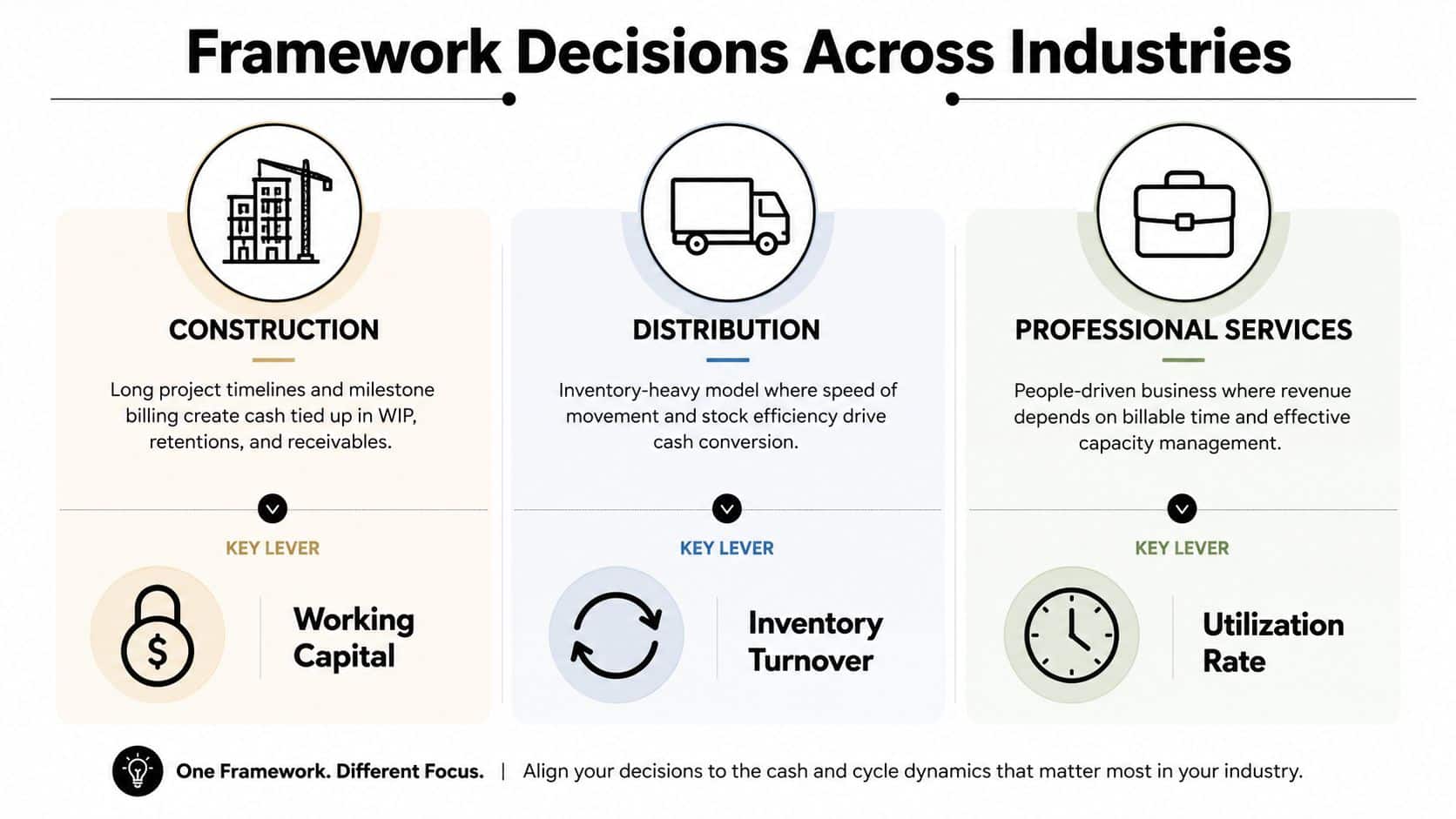
The same shareholder value maximization framework produces different priorities by industry. A construction owner shouldn't copy a distributor's inventory playbook, and a professional-services firm shouldn't manage utilization like a contractor manages equipment.
Construction
A contractor can report strong profits while cash remains trapped in work in progress, retainage, disputed change orders, and slow progress billing. The first priority is usually working-capital discipline, not chasing another low-margin contract.
A practical review starts with billing cadence, unapproved changes, retainage aging, and project-level cash forecasts. Reducing collection delays can release cash without adding revenue. Better project controls can also protect bonding capacity, which may allow the company to pursue a larger backlog without accepting weaker economics.
For estimating teams, Exayard construction estimating software can serve as one tool in a broader process for improving estimate consistency and connecting bid assumptions to project economics. The value lever remains management discipline. Software can't rescue pricing that ignores labor, equipment, overhead, or risk.
Distribution
Distributors often operate with thinner margins, so inventory turnover and gross margin per unit of warehouse capacity matter. The decision isn't to sell more. It's to move profitable inventory faster while reducing obsolete or slow-moving stock.
Prioritize SKU rationalization, supplier consolidation, purchasing discipline, and warehouse automation where the return is measurable. A small margin improvement or release of excess inventory can have a larger cash effect than a broad sales push that adds low-quality volume.
Professional services
For professional-services firms, utilization, realization, pricing, and delivery structure drive value. A senior employee spending time on work that a lower-cost team member could perform creates an expensive capacity problem. Discounting to win work can also weaken both current profit and the buyer's view of pricing power.
Improve the delivery pyramid, standardize repeatable work, price based on value and complexity, and track contribution by client. Growth funded by productive senior hires is stronger than growth funded by discounts and founder rescue work.
Quantify each industry's prioritized lever in your own model. Don't promise a generic value lift. Show the cash released, margin added, capacity created, or risk removed, then calculate how that change affects your actual earnings and likely deal structure.
Connecting Every Lever to Your Exit Three to Ten Years Out
Exit planning starts when you make an operating decision, not when you hire an investment banker. A buyer will underwrite the business you built, the evidence supporting its performance, and the risks that remain after you leave.
Strong free cash flow conversion gives a buyer more comfort that earnings can service debt, fund operations, and support distributions. Durable margins, demonstrated across a meaningful operating history, help defend earnings quality when the buyer tests customer concentration, pricing, labor, and supplier dependence.
How buyers read the four levers
Cash flow affects debt capacity, working-capital adjustments, and the buyer's confidence in post-close liquidity. Margin durability affects the quality of earnings and the credibility of forecasts. Growth quality matters when backlog, recurring revenue, repeat purchasing, or referral activity supports future performance. Capital allocation discipline reduces questions about unnecessary debt, underproductive equipment, owner expenses, and inconsistent reinvestment.
Two levers often deserve the earliest attention: margin durability and recurring or repeatable revenue. Margin improvement can increase earnings directly. Recurring demand can improve forecastability and reduce the risk attached to the earnings base. Neither should be pursued mechanically. A recurring contract with poor economics isn't valuable, and a margin increase caused by cutting essential capacity won't last.
A clean debt stack and documented investment logic also reduce due-diligence friction. The buyer can understand what the company owns, what it owes, which cash flows are reliable, and why management made its capital decisions. That clarity can influence financing terms, seller financing discussions, earn-out design, and the amount of risk the buyer leaves with the seller.
Use this exit planning guide to treat the exit as a cumulative scorecard. Your objective isn't to create a perfect company. It's to create a company whose cash generation, management depth, and growth logic a buyer can verify.
Three Misconceptions That Quietly Shrink Your Exit Check
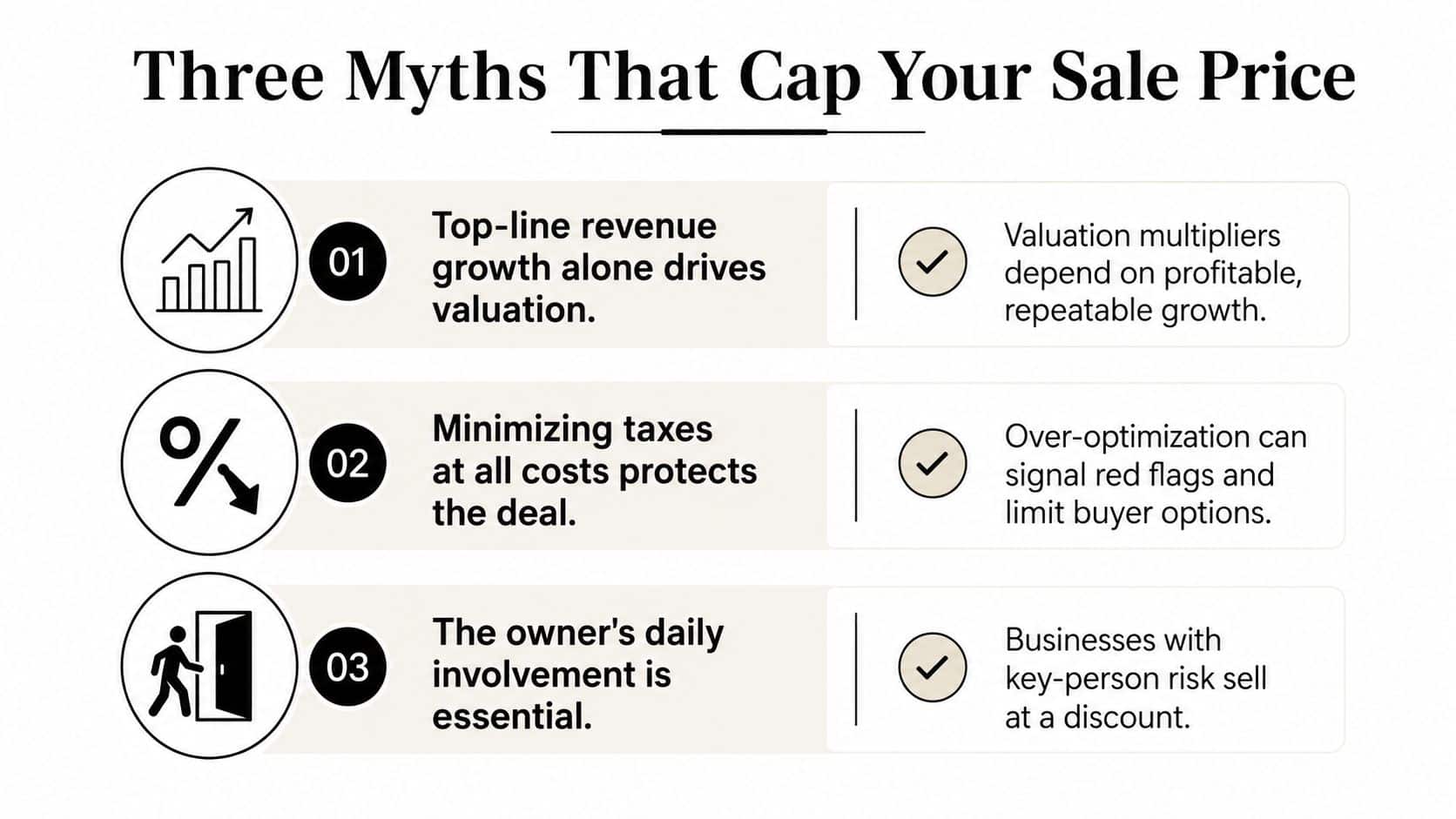
Founders usually don't lose value because they lack ambition. They lose it because they optimize the wrong number for too long.
Revenue growth alone drives valuation
Revenue without margin and cash quality can make the company harder to finance and harder to buy. A buyer will test whether sales are profitable, repeatable, diversified, and deliverable without excessive working capital.
Sharper rule: Grow the revenue that improves future cash generation. Reject volume that consumes capacity and produces weak contribution.
Minimizing taxes at all costs protects the deal
Tax planning matters, but aggressive expense decisions can obscure operating performance and create diligence questions. Buyers want to distinguish legitimate add-backs from recurring costs disguised as adjustments.
Sharper rule: Keep clean, defensible EBITDA and maintain documentation. A transparent earnings story gives buyers more confidence and gives you more transaction flexibility.
The owner must remain indispensable
If the founder approves every quote, owns every customer relationship, solves every delivery problem, and controls every key decision, the buyer is purchasing a job with transition risk. That risk can appear in the structure of the transaction, including earn-out exposure and extended transition expectations.
Sharper rule: Build management depth, documented processes, and customer relationships that survive your absence. Your goal is to become strategically useful, not operationally unavoidable.
Delaware law illustrates why the distinction between ordinary operations and a sale matters. Directors and officers owe fiduciary duties to the corporation and its stockholders, and recent Delaware Chancery guidance describes other interests as considerations that must promote stockholder welfare, as summarized in this analysis of Delaware shareholder primacy. The Revlon doctrine creates a more specific sale-of-control trigger. Once a board decides to sell control in a cash transaction or a transaction transferring control, directors must seek the best value reasonably available for shareholders, according to this Harvard Law School Forum analysis.
For private owners, the operating lesson is direct. Build value before the sale process begins, because deal-time cleanup can't fully repair years of weak margins, founder dependence, or poor cash conversion. A buyer can see the difference.
Your 30-Day Shareholder Value Action Plan
You don't need a new department to begin. You need a focused baseline, a capital review, and a decision about the largest gap between today's business and the business a buyer would want.
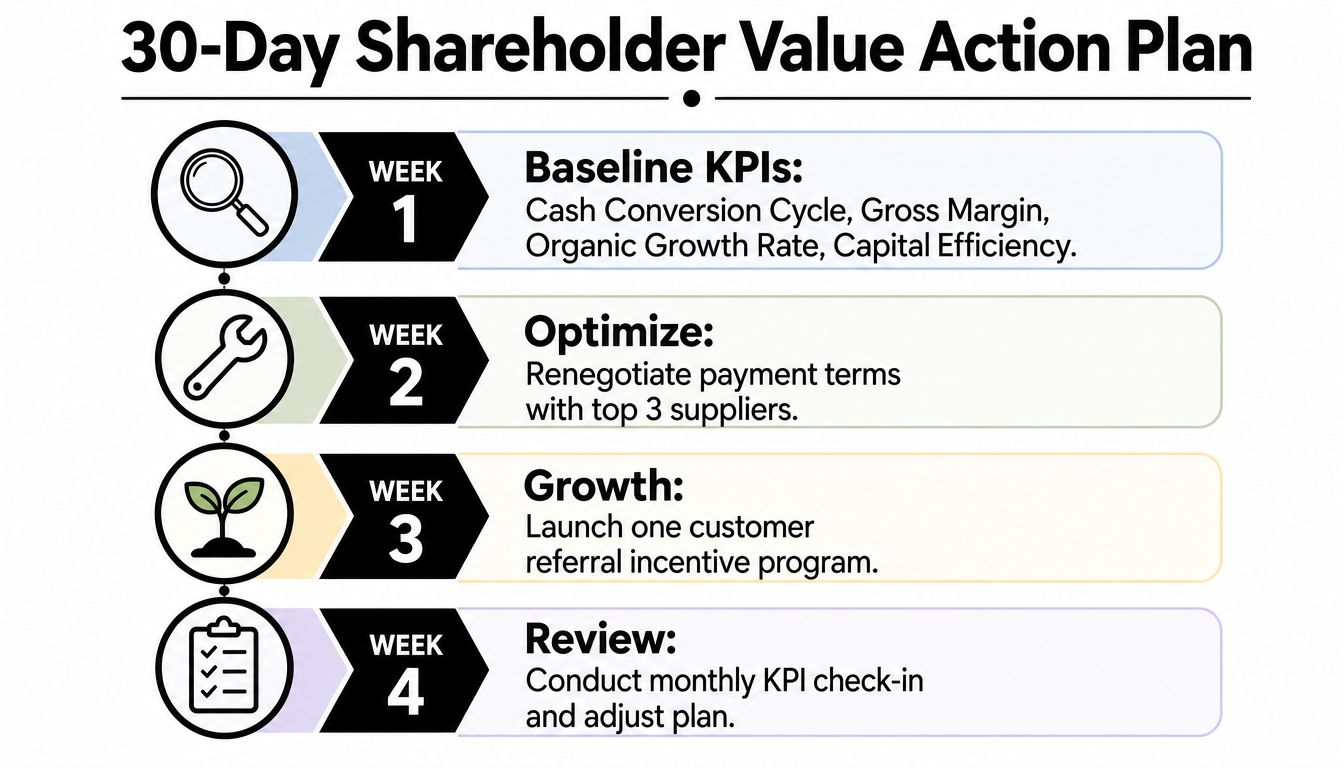
Week one, establish the baseline
Pull the last available monthly financial data and calculate:
- Cash conversion cycle: Identify whether receivables, inventory, or supplier terms consume cash.
- Gross margin: Break it down by job, customer, product, or service line.
- Organic growth rate: Separate repeatable customer demand from acquisitions, price increases, and one-time work.
- Capital efficiency: Review ROIC, capex-to-revenue, debt service, and the return expected from major investments.
Don't debate the numbers before agreeing on definitions. A dashboard with inconsistent definitions creates false confidence.
Week two, challenge every capital use
Separate essential reinvestment from discretionary spending. Review equipment purchases, hiring plans, owner distributions, inventory commitments, marketing programs, and debt repayment.
For the top decisions, write down expected cash benefit, timing, risk, owner dependency, and the alternative use of the funds. Renegotiate payment terms with your top three suppliers where the commercial relationship supports it, and don't trade away pricing or reliability for a short-lived cash benefit.
Week three, compare the business with buyer expectations
Map your current metrics against the standards relevant to your industry and deal type. Identify the three issues most likely to reduce buyer confidence: weak margin visibility, concentrated customers, inconsistent cash conversion, undocumented processes, or founder dependence.
Choose one operating improvement and one reporting improvement. Execution beats a long list of unfinished initiatives.
Week four, pressure-test the plan
Have an outside financial advisor challenge your assumptions, forecast, and exit timeline. A fractional CFO engagement should connect cash flow management, profitability improvement, forecasting, KPI reporting, and exit readiness rather than produce disconnected reports.
Don't wait until a buyer requests a quality-of-earnings review. Start building the evidence now. The Delaware framework also recognizes that directors may consider employees, customers, and communities when those actions are rationally related to shareholder benefit, as explained in this analysis of enlightened shareholder primacy. In practical terms, good workforce, customer, and community decisions belong in the value plan when you can connect them to durable cash flow, risk reduction, or enterprise strength.
AmbitionCFO provides fractional CFO support for founder-led businesses, including 13-week cash flow modeling, margin analysis, forecasting, KPI dashboards, and exit planning for owners preparing a transition. Visit AmbitionCFO to schedule a conversation about the operating gaps that could affect your shareholder value and exit outcome.