
You're looking at a current-asset line called costs in excess of billing and trying to answer one practical question: when will this become cash, and should you be worried? The balance usually means your team has performed work, incurred costs, or earned revenue before it could invoice the customer. Your profit-and-loss statement may look healthy while your bank account absorbs the financing burden.
That's why I treat underbilling as a cash-conversion problem, not an accounting curiosity. The sections below translate the term into journal entries, show how it affects margin and working capital, compare construction, distribution, and professional-services scenarios, and give you a monthly diagnostic process. You'll also get a remediation checklist and a way to carry work-in-progress assumptions into a 13-week cash forecast.
Table of Contents
- The Balance Sheet Line That Quietly Steals Your Cash
- What Costs in Excess of Billing Actually Means
- How Underbilling Hits Margin, Working Capital, and Cash Flow
- Real Examples from Construction, Distribution, and Professional Services
- Diagnostic Checks That Tell You When Underbilling Is a Red Flag
- Fixing the Problem with Billing Cadence, Change Orders, and WIP Reviews
- Forecasting Underbilling and Your Next Step This Week
The Balance Sheet Line That Quietly Steals Your Cash
You open the balance sheet and find $480,000 under current assets, labeled costs in excess of billing. The controller calls it normal WIP. Project managers say the work is progressing. The P&L reports profit.
Your bank account carries the more urgent message. Payroll, subcontractors, freight, and supplier invoices have been paid, while the customer has not been invoiced for the related work. That $480,000 is not profit in the bank. It represents a timing gap between performance and billing, as described in SEC contract accounting disclosures.
Founder rule: Treat underbilling as a financing decision. Until the balance becomes an invoice and gets collected, your company is funding someone else's project.
The balance can be reasonable when the contract allows billing after a milestone, approval, or defined passage of time. It becomes a cash problem when billing lags because teams submit invoices slowly, project records fall behind actual progress, or change orders remain unapproved. Ask three questions: which customer owes you, why do they owe you, and when will you bill them?
What you'll be able to do with the balance
Separate ordinary timing from collection risk. Review the contract, compare work completed with cumulative billings, and classify each balance as approved work, a pending claim, or an unapproved change. Under ASC 606, a contract asset can reflect revenue recognized over time that is not yet billable, as well as costs associated with claims and unapproved change orders. Procore's explanation of overbilling and contract accounting provides useful construction-accounting context.
Then convert the accounting balance into a cash decision. Accrual statements show performance, while a cash view shows whether the company can fund the next payroll cycle, accept another contract, or negotiate supplier terms. Use this guide to convert accrual accounting to cash reporting when you need to connect WIP balances with actual cash movement.
Your systems also affect the answer. If purchasing data, project costs, and payment activity sit in separate systems, reconciliation takes longer and errors become harder to spot. A resource on accounting integration for prepaid cards explains how operational spending data can flow into accounting records, although it does not replace contract-level WIP review.
Finish the review with five concrete outputs: a shared definition, an industry-specific explanation, a red-flag test, a billing-remediation plan, and a forecast line showing when trapped costs should convert into cash.
What Costs in Excess of Billing Actually Means
Your crews can be working, your costs can be posted, and your bank balance can still lag behind the project. Suppose a contractor has completed three weeks of work but sent only one invoice. Labor, materials, and overhead are recorded, while the next billing milestone or its supporting documentation remains unfinished.
That is costs in excess of billing. The company has incurred contract costs and may have recognized earned revenue, yet cumulative billings have not caught up. SEC reporting language describes the balance as contract costs and earnings in excess of amounts billed. It is classified as a current asset when the company expects the amount to become billable under the contract terms.
Why the account appears as an asset
An asset represents an expected economic benefit, not cash in the bank. Here, the benefit is the right to bill or collect for work already performed, subject to the contract's billing terms and any customer approval requirements.
The balance can reflect ordinary timing. A project may advance faster than its scheduled application for payment. It can also reflect claims or unapproved change orders, which require closer review because recovery depends on negotiation or approval rather than waiting for the next billing date, as shown in a SEC filing describing contract assets and unapproved changes.
The journal entries make the sequence clearer:
| Event | Debit | Credit |
|---|---|---|
| Record job costs incurred | Construction in Progress or WIP | Raw materials, labor, and overhead |
| Recognize earned revenue under the contract method | Construction in Progress or WIP, when applicable | Revenue |
| Costs and earned amounts exceed billings | Costs in Excess of Billings, or contract asset | WIP or contract accounting adjustment |
| Send the invoice when the amount becomes billable | Accounts Receivable | Revenue and WIP, based on the company's contract accounting entries |
| Collect the invoice | Cash | Accounts Receivable |
Your ledger design and revenue-recognition workflow determine the exact posting mechanics. The economic sequence remains the same: project costs and performance accumulate, billing follows, and the asset reverses when the company issues the invoice. Treat the balance as a cash-conversion queue, not as available liquidity.
Don't confuse an asset with wealth
A contract asset can support reported earnings while operating cash flow remains weak. Deloitte describes costs in excess of billings as the legacy GAAP presentation resembling an ASC 606 contract asset, because the entity has transferred goods or services before payment is due or before it can bill under the contract terms. The label has changed in many financial statements, but the management question is unchanged: how quickly can this balance become collectible?
Answer that question by project and billing cycle. Separate routine timing from amounts tied to disputed claims or unapproved changes. Then use job costing to connect project costs, contract value, progress, and billings. If labor, materials, or overhead data arrives late, the balance-sheet line rests on assumptions instead of a reliable cash forecast.
How Underbilling Hits Margin, Working Capital, and Cash Flow
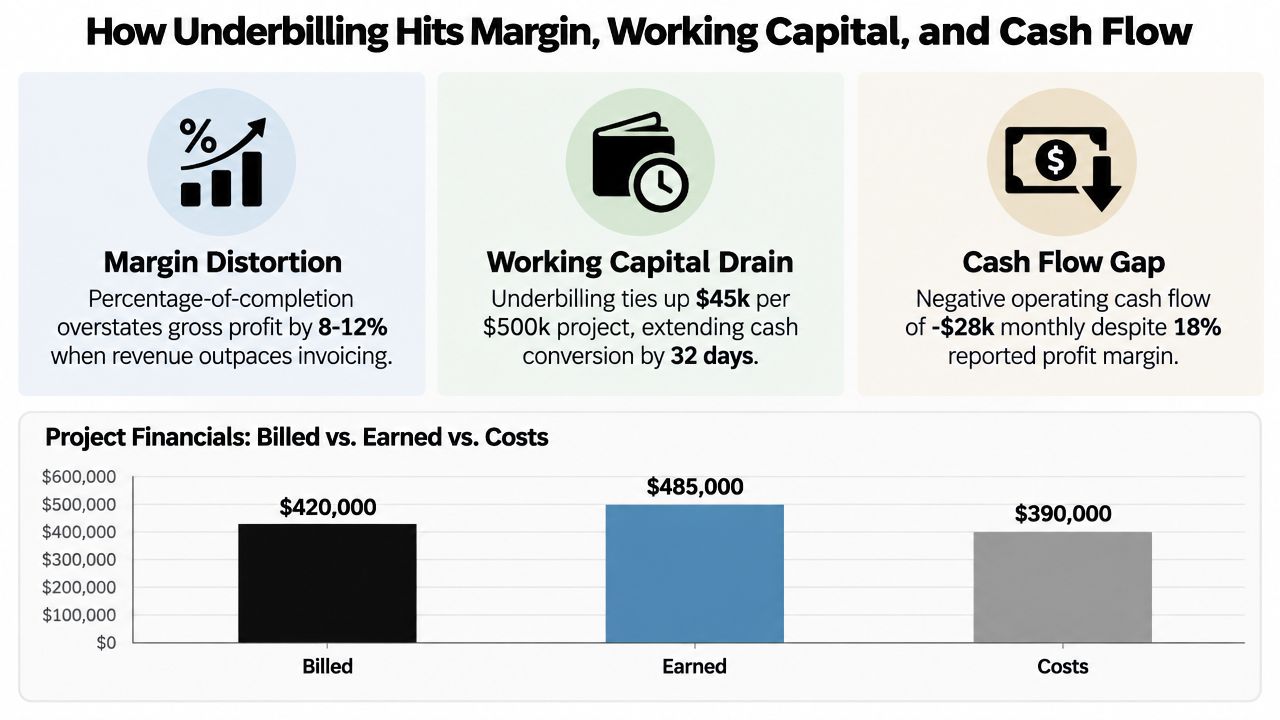
Underbilling is a cash-conversion problem, not an accounting curiosity. It can make reported margin look stable while the bank balance falls, inflate working capital with an asset that cannot fund payroll today, and conceal how much cash operations are absorbing.
Under percentage-of-completion accounting, revenue may be recognized as work advances even when invoicing trails performance. That treatment is not automatically an error, but it can temporarily improve gross-margin presentation while operating cash flow weakens until billing catches up. The management question is direct: when will this balance become billable, collectible cash?
A numerical walkthrough
Consider a $2 million job that is 40% complete. The company has incurred $800,000 in costs but billed $700,000. On these simplified facts, the company is $100,000 underbilled.
That $100,000 has already funded labor, materials, subcontractors, or other project spending. It sits on the balance sheet as an asset rather than in the bank. Earned revenue can still support an acceptable reported margin because the contract method recognizes performance, while operating cash flow shows the funding gap immediately.
A $600,000 underbilled position creates the same problem at a larger scale. It extends the cash-conversion cycle because the money is tied up until a billing event and collection occur. Exclude that balance from cash available for hiring, equipment purchases, distributions, or new contract commitments.
Why ratios can mislead
Current assets include the contract asset, but lenders and operators usually focus on assets that can become cash without another approval, supporting document, or billing event. Underbilling can therefore raise reported working capital while weakening the practical quick-ratio picture. The balance still has value, provided it has a defensible basis, an expected bill date, and a credible collection path.
Construction leaders should review the construction payment process explained resource to connect payment applications, approvals, supporting documents, and milestones to cash timing. Across industries, apply working-capital optimization by matching billing cadence with payroll, supplier payments, receivables, and project growth.
Set a firm review threshold: investigate any balance that cannot be tied to a specific invoice, approval, or milestone in the next billing cycle. Escalate older items to the project owner and finance lead rather than carrying them as routine timing.
Your monthly review should answer three questions:
- Margin: Did earned revenue advance faster than invoices, and do current job costs still support the margin?
- Liquidity: How much cash has the company funded through underbilling?
- Conversion: What exact invoice, approval, or milestone will turn the asset into receivables?
Real Examples from Construction, Distribution, and Professional Services
The same accounting reality wears different clothing across industries. A contractor may be waiting on a payment application, a distributor may be waiting on a milestone certificate, and a services firm may be waiting on a signed scope change. In each case, the company has spent resources before billing caught up.
Three operating vignettes
A construction company has a $1.2 million fixed-price remodel. Its team has incurred 65% of expected costs, but only 50% of the contract has been billed under the AIA G702/G703 process. The resulting $180,000 underbilling means the contractor is financing work already performed. The finance team should reconcile the payment application, confirm stored-material and progress support, and submit the next billable amount. The cash bridge is: underbilled WIP, then accounts receivable, then customer cash.
A distributor is supplying equipment under a custom-installation contract with progress milestones of 25%, 50%, and 25%. The second milestone slips by 30 days, while equipment and freight costs remain unbilled for two quarters. That balance may begin as a milestone-timing issue, but the aging now demands contract review, customer confirmation, and a decision about whether the cost is recoverable under the existing terms. The journal-entry path is: inventory or project cost, then contract asset, then receivable when the milestone is approved. The cash bridge depends on milestone acceptance, not merely on goods leaving the warehouse.
A professional-services firm runs a 12-month implementation engagement billed monthly against a time-and-materials cap. Senior-consultant hours push actual cost beyond the amount billed under the current scope. The recoverable amount can convert to a change order once the scope letter is signed. Until then, the company has funded delivery without a corresponding invoice. The journal entry records service costs and earned revenue under the applicable method, while the cash bridge runs through signed scope, invoice, receivable, and collection.
Use this comparison to assign ownership:
| Industry | Billing Model | Trigger for Excess | Balance Impact | Remediation Move |
|---|---|---|---|---|
| Construction | Progress applications and contract milestones | Field progress or approved work outpaces billed applications | Current contract asset and weaker operating cash | Reconcile WIP to payment support and bill the completed scope |
| Distribution | Milestone billing for equipment and installation | Milestone acceptance slips after costs are incurred | Unbilled cost remains trapped until acceptance | Confirm delivery evidence, acceptance status, and invoice rights |
| Professional services | Monthly time-and-materials billing against a cap | Hours exceed the approved scope or cap | Recoverable work awaits authorization | Route a signed scope change before continuing unpriced work |
The accounting doesn't tell you which operational failure caused the balance. Your project, sales, and finance leaders must identify whether the problem is cadence, documentation, pricing, approval, or contract design.
For a deeper view of profitability by customer, project, or service line, use a disciplined segment margin formula. Underbilling often exposes an account that appears profitable in aggregate but consumes cash because its billing terms don't match delivery economics.
Diagnostic Checks That Tell You When Underbilling Is a Red Flag
Treat underbilling as a cash conversion KPI, not a balance-sheet curiosity. Review its size, age, concentration, and movement at every monthly close. The finance lead should discuss material changes with the person who controls the invoice, approval, or supporting documentation.
These thresholds are operating rules for management, not universal accounting requirements. They give construction, distribution, and professional services leaders a clear escalation point instead of relying on instinct. The accounting definition is outlined in the construction accounting glossary from Foundation Software.
Four monthly tests
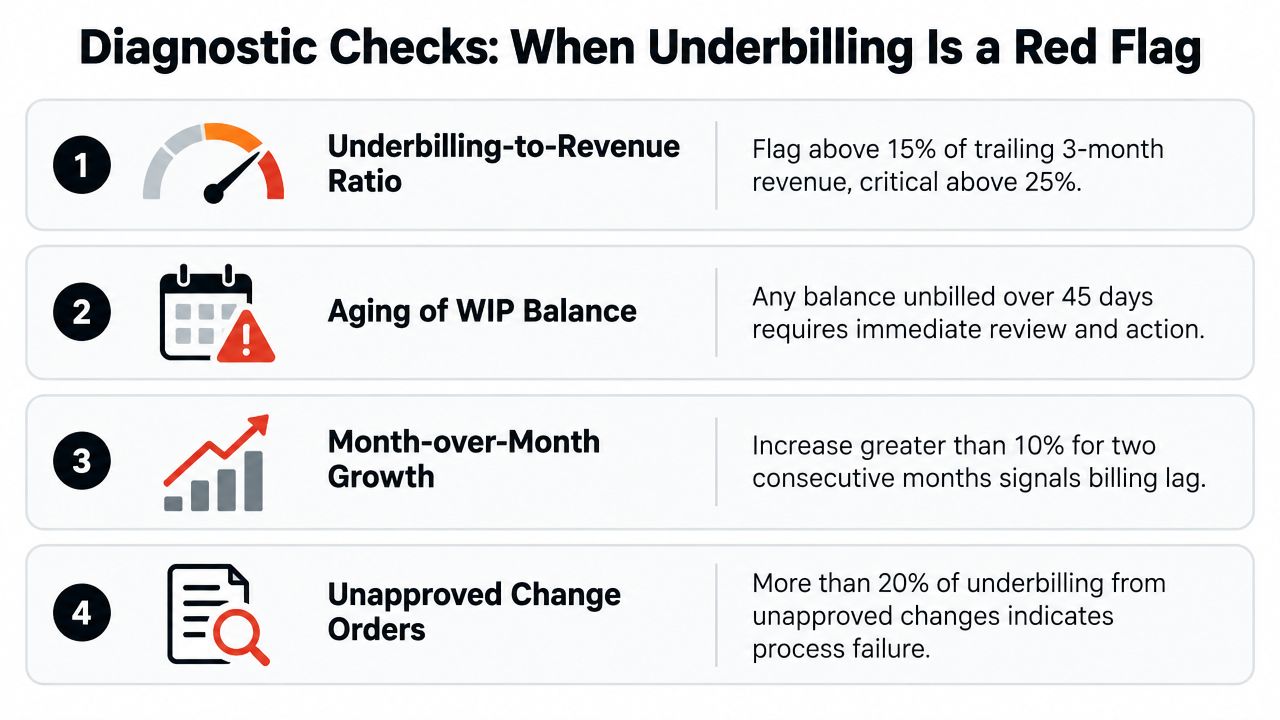
Underbilling-to-revenue ratio: Divide costs in excess of billing by trailing-twelve-month revenue for project businesses, or by the relevant service revenue base. Flag project businesses above 8% and services businesses above 4%. At those levels, require an explanation by customer, contract, cause, and expected bill date. A construction or distribution leader should connect the balance to the next application or milestone invoice. A services leader should identify the approved scope or authorization needed to bill.
Aging of the contract asset: Separate amounts expected to become billable in the current cycle from amounts outside the normal billing window. Compare the older group with unbilled receivables aging past 60 days. A stale balance tied to a claim or unapproved change order needs a recovery assessment and possible write-down review. If the next billing event is unclear, treat the balance as a cash risk.
Active-job concentration: Divide active jobs with negative over or underbilling positions by total active jobs. This shows whether one unusual project drives the balance or whether billing discipline is failing across the portfolio. A rising share month after month points to a process problem, even when the total remains manageable. Concentration also sets the priority: repair the largest job first, then test whether the same cause appears elsewhere.
WIP-to-billings spread: For each job, compare the WIP schedule value and earned position with cumulative billings. Reconcile the difference to approved applications, pending milestones, retainage, disputed amounts, and unapproved changes. Keep any unexplained spread open on the close checklist until an owner and expected resolution date are recorded.
The close-binder checklist
- Tie out the ledger: Reconcile the contract-asset balance to the WIP schedule.
- Name the cause: Label every material balance as timing, documentation, approval, claim, or error.
- Age the amount: Record the expected bill date and days outstanding.
- Assign ownership: Put the project manager, billing lead, or executive sponsor beside each exception.
- Review recovery: Escalate amounts dependent on disputed or unapproved work.
- Track movement: Explain why the balance increased, converted, or remained open.
A timing difference has a contract trigger and credible conversion date. A red flag has no owner, no documentation, or no plausible route to an invoice. That distinction determines whether the balance is a scheduling issue or cash trapped in unfinished billing.
Fixing the Problem with Billing Cadence, Change Orders, and WIP Reviews
Underbilling is a cash-conversion failure. Repair the billing process before buying software. Start with the oldest and largest balances, then assign a specific action, owner, and conversion date to each one.
A five-step remediation playbook
Tighten billing cadence. Replace quarterly billing with monthly or milestone billing where the contract allows. Set a 48-hour SLA from period close or work completion to invoice issuance. The billing owner should receive a complete field package, resolve missing support, and issue the invoice without waiting for the general close.
Control change orders before cost starts. Require written scope, price, and approval before work outside the original contract begins. Set project-manager authority limits and send exceptions to an executive. A digital change order eSignature workflow can reduce approval friction when it preserves enforceable records and clear pricing.
Run a weekly WIP review. Each Friday, the project manager and finance lead should compare incurred costs, estimated total cost, progress, billings, pending applications, and change-order status. Record the variance explanation in the job file. Monthly reporting should reflect these operating decisions, not substitute for them.
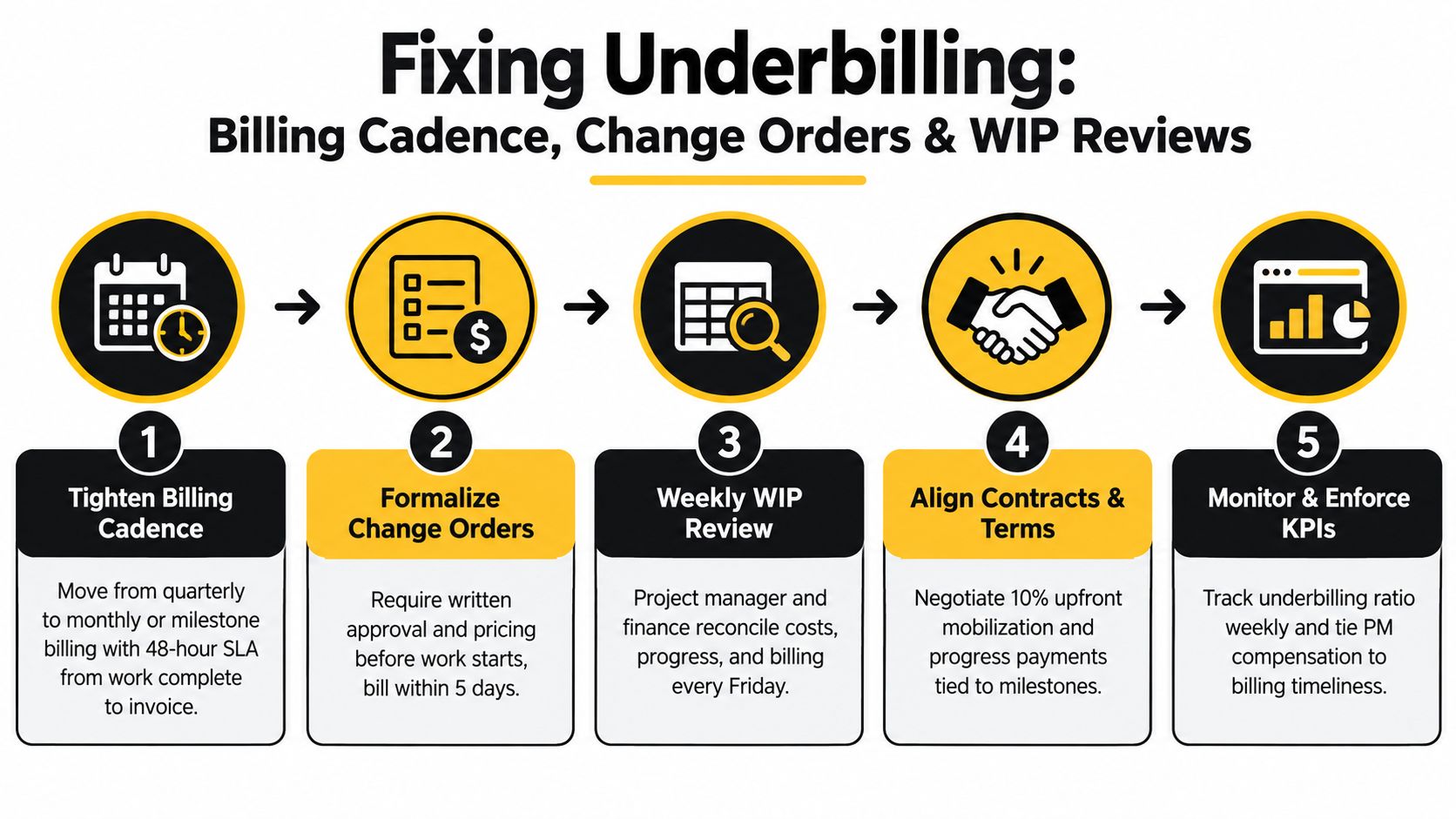
Align contracts with delivery. Negotiate mobilization and progress payments that cover the cash cost of starting and advancing the work. Define milestones objectively, document evidence requirements before work begins, and remove avoidable administrative barriers to billing.
Put movement on the leadership dashboard. Show opening underbilling, new additions, converted billings, write-downs, and ending balance. Review the trend weekly. Hold leaders accountable for billing timeliness and recovery quality, not aggressive revenue estimates.
Use this 30-day deployment plan:
- Week one: Export every active contract, its costs, billings, WIP position, and expected invoice date.
- Week two: Hold a project-owner review and classify each balance.
- Week three: Submit every supportable invoice and escalate approval-dependent items.
- Week four: Add underbilling movement and expected conversion to the cash forecast.
Forecasting Underbilling and Your Next Step This Week
Underbilling is a cash-conversion problem. If project costs are already paid but the related invoice has no firm date, your forecast is overstating available liquidity. Build the forecast around the events that turn project costs into invoices, then into collectible cash.
For each project, update the expected conversion using current percent complete, billing milestones, approved change orders, and your observed billing cycle. Plan within 30 to 90 days when that matches your operating history. If the bill date keeps slipping, move the receipt in the forecast immediately. Do not count the balance as cash until the customer can be invoiced and collection timing is credible.
A simple forecast dashboard
| Project | Costs Incurred YTD | Billed to Date | Underbilling Balance | Expected Bill Week | Forecast Cash Receipt |
|---|---|---|---|---|---|
| Project A | [enter amount] | [enter amount] | [calculate] | [week] | [enter amount] |
| Project B | [enter amount] | [enter amount] | [calculate] | [week] | [enter amount] |
| Project C | [enter amount] | [enter amount] | [calculate] | [week] | [enter amount] |
Review the dashboard beside AR aging every Friday. Apply the 13-week cash flow framework to separate three events: the underbilled amount becomes an invoice, the invoice becomes collectible, and approval delays push cash later.
Take your largest open contract today. Refresh its WIP schedule, record the billing trigger, and submit the next supportable progress billing within five business days. Then add that expected invoice and collection date to the cash forecast. This converts trapped project costs into receivables and gives leadership a receipt date based on documented work, not assumption.
AmbitionCFO helps founder-led construction, distribution, and professional-services companies turn WIP, billing delays, and contract economics into clear cash forecasts and operating decisions. Visit AmbitionCFO to discuss 13-week cash flow modeling, margin analysis, KPI dashboards, and fractional CFO support for your next stage of growth.