

You're looking at a profitable year on paper, yet your bank balance keeps tightening. The annual budget approved the hires, equipment, and growth plan. The forecast should answer the harder question: given what you know today, can the business safely make those decisions now?
That's the practical difference in budget vs forecast. A budget sets the commitment. A forecast updates the expected outcome. A 13-week cash model shows whether you can pay people and suppliers while the longer-term plan unfolds.
For founder-led companies, confusing these tools creates expensive decisions. Owners approve spending because the budget supports it, then discover that delayed receivables have turned a profitable month into a cash emergency. The answer isn't choosing one document. You need all three views, each assigned to the decision it can best support.
Table of Contents
- The Cash Crunch That Proves the Distinction Matters
- Budget and Forecast Defined in Plain English
- Side by Side Comparison of Budget vs Forecast
- Top Down, Bottom Up, and Rolling Forecast Methods
- How the Choice Changes Hiring Capex and Cash Decisions
- Building a Budget Plus Rolling Forecast That Actually Drives Decisions
- Why Founder Led $10M to $100M Businesses Use Fractional CFOs for Both
- Your Next Step and a Planning Checklist
The Cash Crunch That Proves the Distinction Matters
A specialty contractor has a strong year mapped out. The annual budget shows healthy revenue, acceptable margins, and enough projected profit to support two new hires and a six-figure equipment purchase in the first quarter. The owner approves both because the P&L supports the plan.
By week nine, the operating account tells a different story.
A major customer hasn't disputed the invoice or canceled the project. The customer stretched payment from 45 to 95 days. Revenue still appears in the accounting reports when earned. Gross profit still looks reasonable. The budget hasn't changed because it was never designed to change.
Payroll, however, arrives on schedule.
The owner sees a profitable business and a dangerously thin bank balance at the same time. The finance question isn't whether the project is profitable. It's whether cash will arrive before payroll, equipment deposits, insurance, and supplier payments leave the account.
Practical rule: Profit explains whether work creates value. Cash timing determines whether the business can keep operating long enough to collect it.
A rolling forecast would have updated expected collections as the receivable aged. It could have shown the likely payroll-week shortfall weeks earlier, giving the owner time to accelerate collections, delay the equipment purchase, arrange a short-term line draw, or review receivables financing. A 13-week cash flow model makes that near-term pressure visible instead of burying it inside an annual profit plan.
The emotional pressure is familiar. You're not trying to grow recklessly. You're asking whether a profitable company can afford the next decision. The budget says, “We planned for this.” The forecast asks, “Does the current evidence still support it?”
That distinction drives every recommendation that follows. Keep the annual budget as the benchmark, refresh the forecast as conditions change, and use the cash model to protect the operating account.
Budget and Forecast Defined in Plain English
A budget is a fixed, formally approved financial plan for a defined period, commonly one fiscal year. It sets expected revenue, expenses, headcount, capital spending, and profit targets, then gives you a stable benchmark for comparing actual results. Oxxon Advisors defines a budget as a fixed plan used to measure actual results against the approved period plan.
A forecast is your current estimate of what the business expects to happen. It uses actual results, new sales information, staffing changes, customer behavior, and operating assumptions. Unlike the budget, it changes when the facts change. A useful forecast isn't a disguised target. It's an honest estimate of the likely outcome.
You can explain the difference to a non-finance co-founder in one sentence:
The budget is the promise. The forecast is the plan based on what we now know.
The four operating differences
Purpose. The budget controls resources and establishes accountability. It answers whether the team delivered against the approved plan. The forecast supports course correction. It answers whether current assumptions still justify hiring, spending, pricing, or investment decisions.
Time horizon. The budget normally covers a fixed fiscal year. A rolling forecast maintains a constant forward-looking horizon by dropping the completed period and adding a new one at the far end. IBM describes rolling forecasts as a continually refreshed outlook that keeps visibility ahead of the business.
Ownership. The CFO or finance lead coordinates the budget with department heads because each leader must own revenue, payroll, and spending assumptions. The forecast requires finance, sales, operations, and the owner to update what has changed. Sales owns pipeline reality. Operations owns capacity and delivery assumptions. Finance turns those inputs into an expected financial outcome.
Cadence. Teams usually review the budget during formal monthly or quarterly performance discussions without changing its baseline. The forecast should be refreshed monthly when demand, hiring, or cash pressure moves quickly. Quarterly updates may work for a stable company, but they're too slow for a business making frequent operating decisions. See the distinction between related planning terms in this guide to projection versus forecast.
Don't revise the budget every time performance changes. That destroys accountability. Keep it intact, explain the variance, and revise the forecast so leadership can decide what to do next.
Side by Side Comparison of Budget vs Forecast
| Dimension | Budget | Forecast |
|---|---|---|
| Cadence | Fixed annual plan, reviewed against actuals during the year | Updated monthly or quarterly, often on a rolling forward horizon |
| Flexibility | Locked baseline for accountability | Recalibrated as actual results and assumptions arrive |
| Accountability | Grades department and manager performance against commitments | Informs hiring, capital, cash, and operating decisions |
| Accuracy expectations | A practical annual baseline, with meaningful variance analysis | Tighter visibility in near months, less certainty farther out |
| Best use cases | Board reporting, lender covenants, annual incentive targets | Cash planning, hiring timing, capex decisions, and scenarios |
| Founder question | “Did we deliver what we approved?” | “What should we do next based on current evidence?” |
The first implication is accountability. Actual versus budget tells you whether the company achieved the commitment. If revenue missed, gross margin fell, or a department overspent, the variance deserves an explanation tied to an owner and a driver.
The second implication is action. Forecast revision tells you what management should do next. If the forecast now shows weaker demand, you might slow hiring, adjust purchasing, or protect cash. If the forecast improves, you might reinvest in capacity or accelerate a planned project.
The third is model discipline. Don't keep a budget in one spreadsheet, a forecast in another, and cash planning in a third file with different assumptions. Put the budget and forecast in the same model, then layer the cash view onto the operating drivers. That lets you compare actuals to budget and current expectations without switching versions or arguing over whose spreadsheet is correct.
Forecast accuracy also deserves a precise definition. A budget can be “accurate” in the accountability sense when the team meets its target. Forecast accuracy measures how closely the estimate matches the eventual actual result. FP&A guidance distinguishes those two meanings and commonly uses variance analysis to focus attention on material deviations.
For annual revenue forecasts, historical research found a mean absolute forecast error of 15.05% and a median of 9.48% of forecasted revenue. Firms that prepared budgets had absolute forecast errors averaging 2.85 percentage points lower, described by the authors as roughly a 17.0% lower error rate. The peer-reviewed study provides that benchmark and notes that budgeting discipline improved accuracy more than accounting report preparation alone.
Top Down, Bottom Up, and Rolling Forecast Methods
Forecasting method determines who owns the assumptions and how much operational detail reaches the final number. Founder-led companies commonly use three approaches.
Top-down forecasting
Leadership starts with the revenue ambition and works backward into expense ceilings, hiring capacity, and profit expectations. It's fast and useful for board-level goal-setting. If the owner wants a particular growth outcome, the top-down model shows the financial scale the company must reach.
Its weakness is accountability. A leadership target doesn't explain which customers will generate the revenue, which salespeople can close it, or whether operations can deliver the work. Use top-down forecasting to set direction, not to pretend that direction is already a likely outcome.
Bottom-up forecasting
Bottom-up forecasting builds from operating evidence. Sales contributes pipeline and conversion assumptions. Operations contributes capacity and delivery timing. Human resources or department heads contribute planned hires. Finance adds pricing, unit economics, collections, expenses, and the timing of cash movement.
The process takes longer, but it exposes the assumptions that matter. A contractor can connect revenue to booked jobs, labor availability, and expected billing milestones. A distributor can connect sales to customer orders, inventory purchases, margins, and collection behavior. Department leaders also have less room to disown the numbers because they helped build them.
Rolling forecasting
A rolling forecast keeps a constant forward-looking horizon. When one month closes, the team removes that completed month and adds a new future month at the far end. IBM's overview of rolling forecasts describes this structure as a way to preserve visibility instead of allowing a fixed annual forecast to shrink as the year progresses.
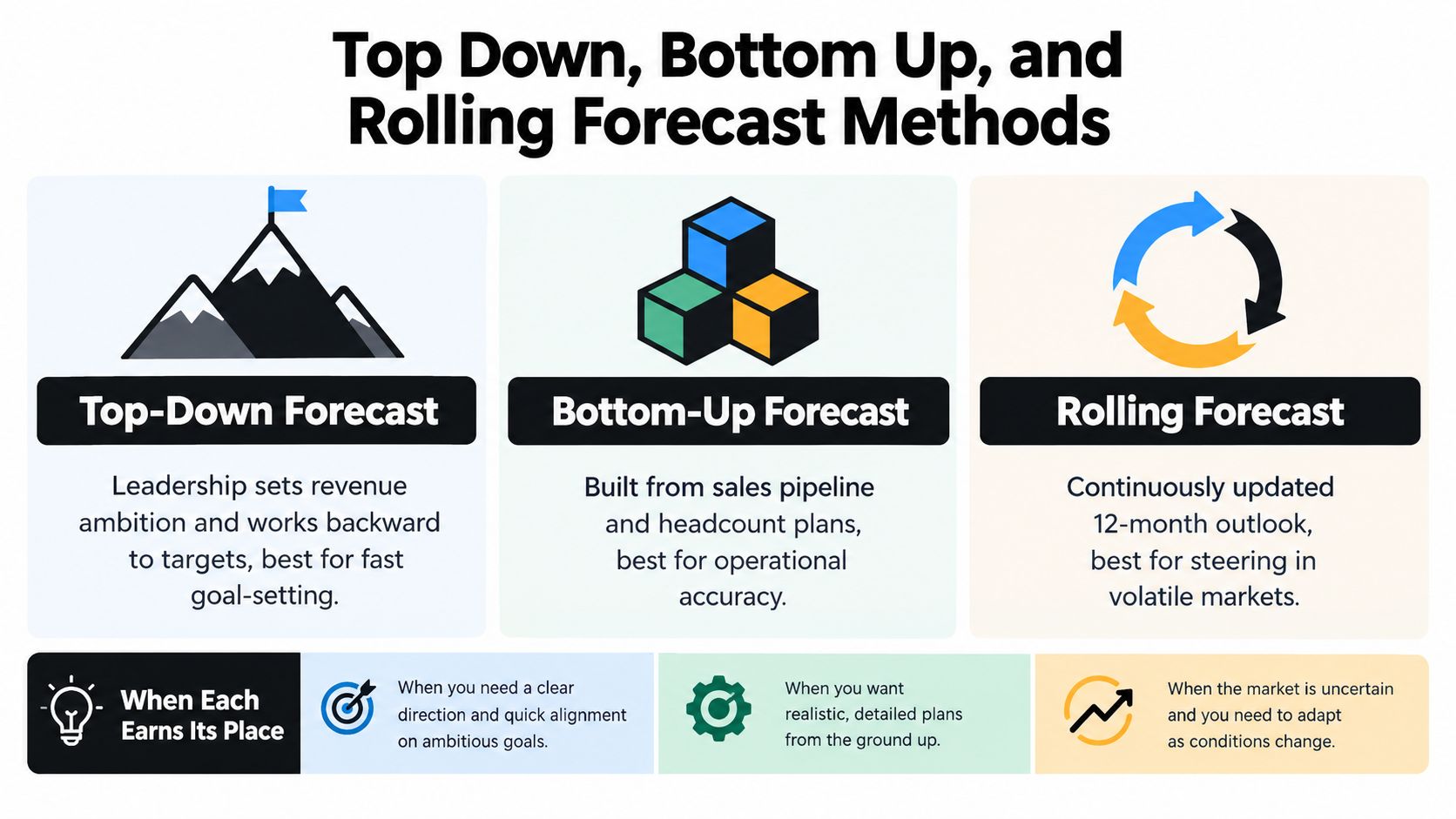
For most growth-stage owners, the right answer is a blend. Use a bottom-up annual budget anchored to a top-down growth target, then refresh the operating outlook monthly through a rolling forecast. The CFO or finance lead should issue the updated version with variance commentary, not just circulate a spreadsheet.
A benchmark cited by BPR Global says companies using rolling forecasts can achieve forecast accuracy within 5% of actual results, while static budget-only organizations often show 10% to 15% variance. The same guidance recommends measuring forecast quality with MAPE, targeting under 5% revenue error at a one-month horizon and under 10% at three months. BPR Global explains those rolling forecast accuracy measures and targets.
For a practical perspective on cash timing, Dealmaker Wealth Society's discussion of cash flow forecasting is useful because it keeps the conversation focused on liquidity rather than profit alone. You can also review forecasting accuracy practices before choosing the level of detail your team can maintain consistently.
How the Choice Changes Hiring Capex and Cash Decisions
The budget establishes permission. The forecast decides whether the permission still makes sense.
Consider a distributor with two large customer receivables moving into the 60- to 90-day range. The annual budget still shows profit because the sales were made and the gross margin remains intact. The rolling forecast updates collection dates, sees the pressure on the payroll week, and changes the recommendation before the account becomes an emergency.
The owner now has choices. Call the customer's finance team, tighten credit terms on new orders, draw an existing line, or review receivables financing. The forecast doesn't solve the collection problem. It creates enough warning to act while choices remain available.
A professional services firm faces a different decision. Its static budget supports a senior hire and a $180,000 software and equipment investment. The third-quarter pipeline softens, so the rolling forecast tests utilization and cash timing again. The business can delay the hire until the next quarter's start and split the capital purchase into two tranches tied to actual utilization.
| Decision | Budget Says | Rolling Forecast Says | Recommended Action |
|---|---|---|---|
| Aging customer receivables | Annual revenue and profit remain on plan | Collections may miss the payroll window | Escalate collections and review short-term liquidity before the gap opens |
| Senior hire | Planned headcount fits the annual target | Near-term utilization and pipeline don't support immediate cost | Move the start date to the next quarter and define the trigger to proceed |
| Software and equipment | Capital purchase is approved | Demand and utilization have weakened | Phase the purchase and tie each tranche to measurable usage |
| New contract | Revenue target supports acceptance | Delivery labor and cash requirements may strain capacity | Reprice, renegotiate billing milestones, or defer the commitment |
The budget should not disappear when the forecast changes. It remains the guardrail for evaluating whether the company delivered against its intent. But a founder who uses the budget alone will approve decisions based on old assumptions.
Cash timing deserves its own model because profitability and liquidity answer different questions. OneSafe's explanation of a 13-week cash flow model offers a useful reference for organizing weekly receipts, payments, and ending cash. For construction, distribution, and project-based professional services, that short horizon often gives the owner more decision value than a full-year P&L view when a payment delay is already developing.
Building a Budget Plus Rolling Forecast That Actually Drives Decisions
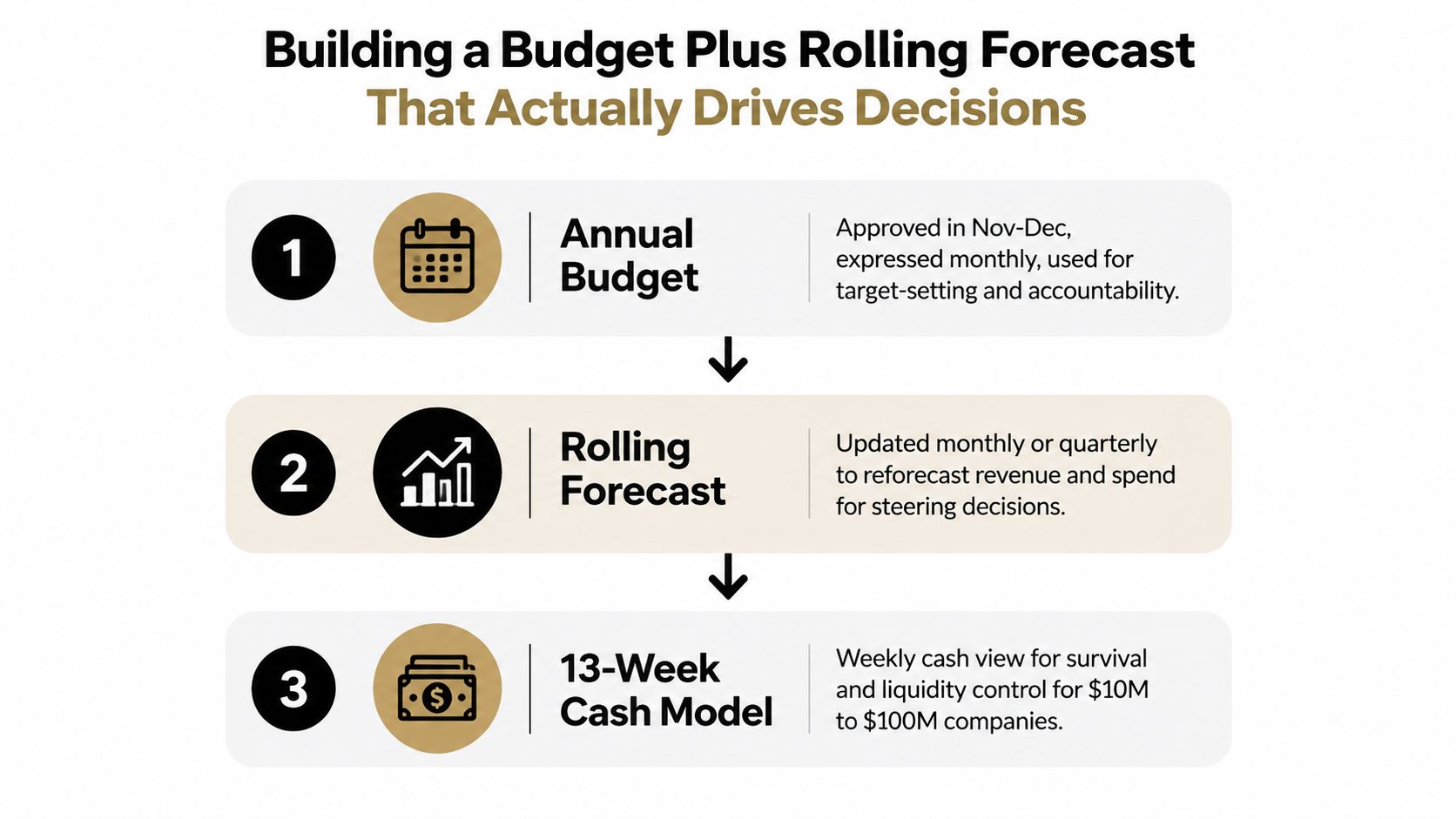
A workable planning stack has three layers. Each layer has a different purpose, owner, and refresh cadence.
Layer one, the annual budget
Approve the annual budget before the year begins and express it by month. Use it for compensation plans, board targets, lender reporting, and covenant tests. Assign revenue, gross margin, payroll, operating expenses, and capital spending to named owners.
Don't use the annual budget as a live prediction. Lock the baseline so the team can explain performance against a stable commitment.
Layer two, the rolling forecast
Refresh the rolling forecast during the first week of each month, after the close provides reliable actuals. Keep the forward-looking horizon constant and maintain three scenarios:
- Base case: The most likely outcome using current sales, delivery, hiring, and collection assumptions.
- Downside case: The result if demand weakens, customers pay later, margins compress, or planned hires become unavoidable.
- Stretch case: The outcome if pipeline converts, capacity expands, and the team can execute without disrupting service.
Finance owns the model. Sales and operations own the assumptions. The founder makes the decision when the updated forecast changes hiring, pricing, purchasing, or investment.
Layer three, the 13-week cash model
Update the cash model weekly during tight periods. Show opening cash, expected AR collections, AP payments, payroll, debt service, taxes, capital spending, and ending cash. Keep collections tied to realistic dates, not invoice due dates that customers regularly ignore.
Set a fixed monthly FP&A meeting. The agenda should compare actuals to budget, actuals to forecast, and the updated full-year forecast to budget. Easy Financial Models describes this three-view reporting cadence as a way to separate commitment, improving assumptions, and expected year-end performance.
Write down the triggers that force a conversation. Your internal rules might include revenue more than 10% off plan for two consecutive months, gross margin compression over 200 basis points, or cash falling below 8 weeks of runway. Those are management thresholds, not universal standards. The point is to decide them before pressure makes the conversation political.
Use a consistent variance note for every material gap:
- What changed?
- Why did it change?
- Is the change temporary or structural?
- Who owns the response?
- What decision is required this month?
The forecast should end with decisions, not observations. Review financial modeling best practices if your current model lacks clear ownership, scenario logic, or links between operating drivers and financial results.
A short visual walkthrough can help your leadership team align on the process:
Why Founder Led $10M to $100M Businesses Use Fractional CFOs for Both
A founder-led company can outgrow its bookkeeping process before it can justify a full-time finance executive. The business needs a disciplined budget, monthly forecasting, cash modeling, and decision support, but the owner doesn't necessarily need a permanent CFO payroll commitment.
That's where a fractional CFO fits. The role isn't to close the books or prepare tax returns. It's to turn financial information into operating decisions.
A fractional CFO can:
- Build the annual budget: Work with the owner and department leaders to connect targets, headcount, margins, and capital plans.
- Run the variance review: Explain why actual results differ from budget and assign corrective actions.
- Refresh the rolling forecast: Update revenue, expenses, collections, hiring, and investment assumptions each month.
- Stress-test cash: Review the 13-week model before payroll, major supplier payments, debt service, and equipment commitments.
- Prepare decision materials: Give the owner and leadership team a clear view of what changed and what requires a decision.
The value appears in operating rhythm. Leaders get earlier warning on cash pressure, board-ready numbers, a more disciplined close-to-review cycle, and clearer evidence for lender or investor conversations. The owner still owns the business. The finance leader owns the model, the cadence, and the quality of the analysis.
Some owners compare this role with cloud CFO services for SMEs when evaluating outsourced finance leadership. The important question isn't the label. It's whether the provider will participate in the monthly decisions, maintain the forecast, and connect the model to cash.
AmbitionCFO works with founder-led companies on budgeting, forecasting, 13-week cash flow modeling, profitability improvement, and exit planning. The firm serves construction, distribution, and professional services businesses nationally, while the owner retains authority over the commercial decisions. Read when to hire a fractional CFO if your controller or bookkeeper is already carrying decisions that require senior financial judgment.
Your Next Step and a Planning Checklist
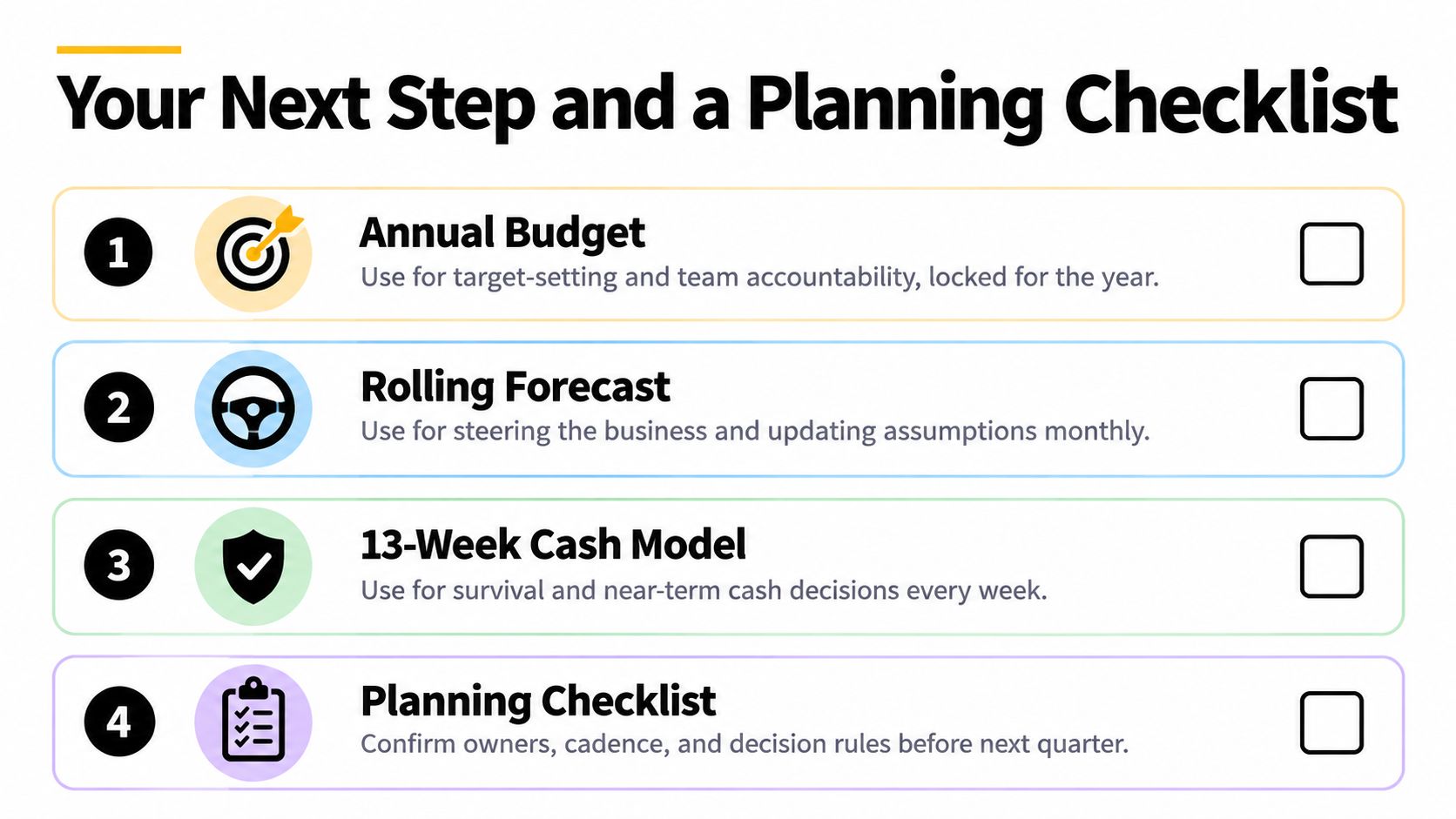
Use each planning tool for the decision it can support:
- Annual budget: Set targets, spending authority, compensation expectations, and accountability.
- Rolling forecast: Steer the company using current assumptions and expected outcomes.
- 13-week cash model: Protect payroll, supplier payments, debt service, and near-term liquidity.
Run this checklist during your next planning cycle:
- Confirm the budget is locked. Keep the baseline stable so performance remains measurable.
- Name an owner for every major assumption. Sales owns pipeline, operations owns capacity, and finance owns model integrity.
- Schedule the monthly variance review. Compare actual versus budget, actual versus forecast, and the updated forecast versus budget.
- Roll the forecast forward every 30 days. Remove the completed period and add a new future period.
- Refresh the cash model weekly during tight periods. Update collection dates, supplier payments, payroll, debt service, and ending cash.
- Document decision triggers. Decide in advance when a revenue miss, margin decline, or cash reduction requires leadership action.
If any item is missing, or if every decision still depends on you personally, don't hire another bookkeeper to solve a leadership problem. Bring in a fractional CFO who can own the planning cadence and give you a reliable basis for action.
Start this week by pulling your current budget, latest forecast, and bank activity into one review. Mark every assumption that has changed, assign an owner, and decide whether you need a worksheet-based rebuild or a 30-minute fractional CFO conversation.
AmbitionCFO helps founder-led businesses build annual budgets, rolling forecasts, and 13-week cash flow models that support real hiring, capex, and liquidity decisions. Visit AmbitionCFO to discuss where your planning process is breaking down and what the next finance rhythm should look like.