

You're staring at a bank balance, a board email wants updated burn, and a vendor wants net-30 terms you're not sure you can meet. That's usually the moment founders realize bookkeeping isn't the same thing as financial leadership. CFO services for startups exist to turn messy, backward-looking numbers into runway, hiring, pricing, and capital decisions you can act on.
The mistake is waiting until the company feels “big enough.” By then, the cash problem has already started, and the fix costs more. A better benchmark is whether you need someone to connect the dots between cash, metrics, and decisions before the next board call, financing event, or hiring round. If you want a practical framing of finance leadership for $500K–$20M firms, the team at Jumpstart Partners has a useful overview in their guide to finance leadership for $500K–$20M firms, and this discussion of business performance improvement shows how financial discipline turns into operating efficiency.
Table of Contents
- Why Founders Need CFO Services Before They Think They Do
- What CFO Services for Startups Actually Mean
- The Core Service Menu and What Each One Delivers
- Engagement Models and Pricing Compared
- When to Hire a CFO and How to Sequence the Engagement
- KPIs, Templates, and Performance Standards
- Three Founder Stories and the ROI of Getting It Right
- Your Selection Checklist and Next Steps
Why Founders Need CFO Services Before They Think They Do
The founder's week usually looks the same right before the gap opens. Cash is tighter than expected, the board wants a cleaner explanation of burn, and the team is asking whether hiring can still move forward. That's not a bookkeeping problem. It's a decision problem.
The real job is control, not reporting
Senior financial leadership in a startup isn't about producing prettier statements. It's about converting accounting output into a forward view of cash, runway, and capital needs. The market has already normalized that shift, with startup CFO packages commonly built around 13-week cash planning, rolling 12–24 month forecasts, KPI dashboards, variance analysis, and board-ready reporting as standard components rather than extras, according to fractional CFO package expectations.
That matters because the cost of flying blind is usually bigger than the retainer. Current market guides place startup CFO services around $2,500 to $15,000 per month, while a full-time CFO is often cited at $400,000+ per year fully loaded, which is why the fractional model is often far cheaper for startups that need strategic leadership, not a permanent executive seat, as outlined in startup CFO pricing guides. In plain English, you're not buying a title. You're buying better decisions before cash gets tight.
Practical rule: if you can't answer how long your cash lasts after a hiring freeze, a slower collection cycle, or a missed deal, you need CFO help sooner than you think.
What the next decision path looks like
Founders usually need to sort three questions fast. What do I need, how do I pay for it, and when does it become essential? The rest of this guide answers those questions in the order I'd use in a real founder meeting.
- Define the bottleneck first. Cash visibility, board reporting, pricing, fundraising prep, or acquisition readiness each calls for a different scope.
- Match the model to the stage. A lean advisory layer makes sense earlier, while a retained fractional CFO makes more sense once the business has recurring complexity.
- Buy the deliverable, not the menu. If a provider can't name the report, cadence, and owner, the engagement is probably too vague.
The point is simple. CFO services for startups are not a luxury reserved for late-stage companies. They're the layer that stops founders from making expensive decisions with incomplete numbers.
What CFO Services for Startups Actually Mean
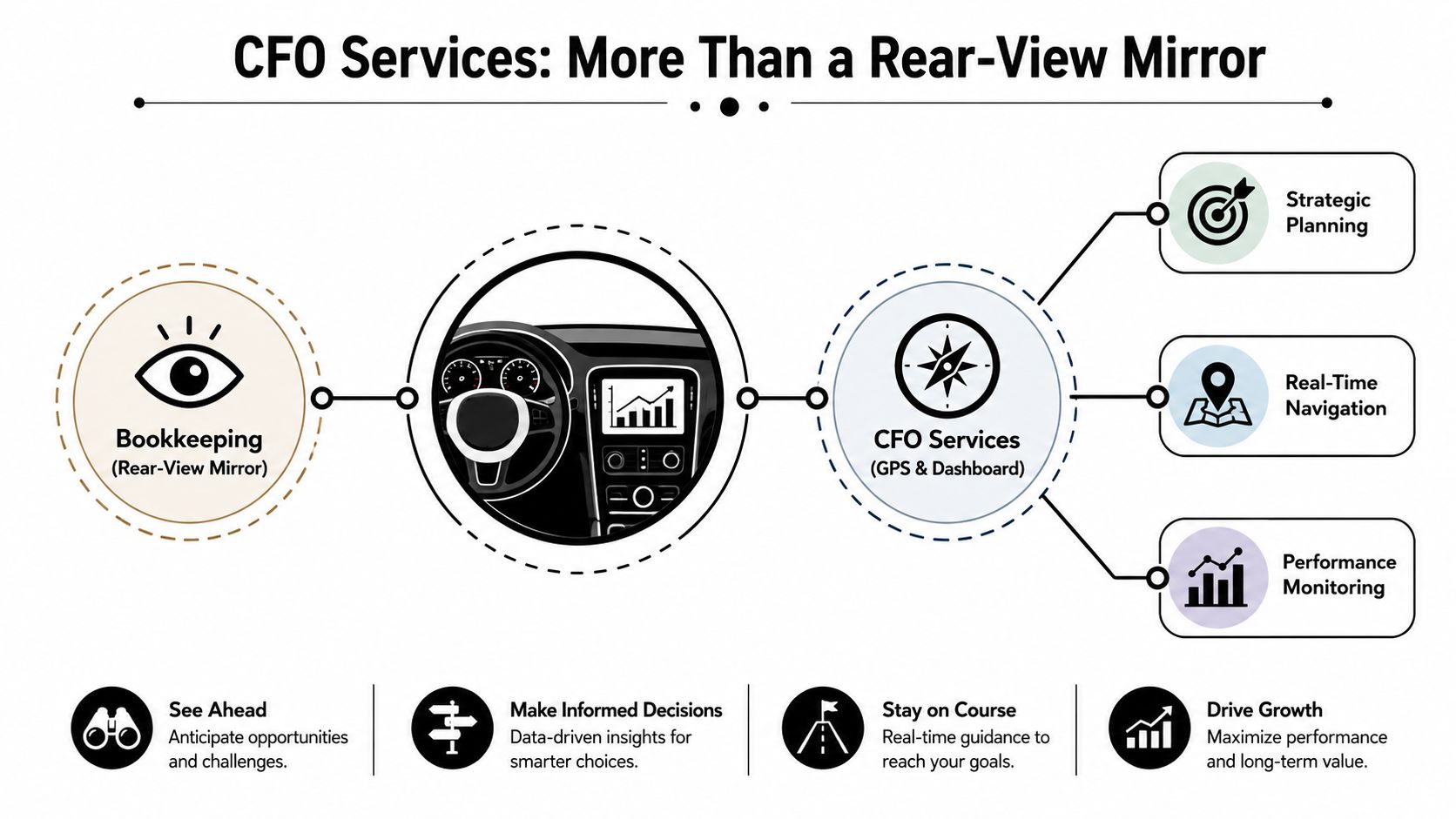
Bookkeeping is your rear-view mirror. CFO services are the GPS and dashboard at the same time. One tells you where the car's been, the other tells you where it's going, how fast, and whether you're about to run out of fuel.
Bookkeeper, controller, and CFO are not the same role
A bookkeeper categorizes transactions and keeps the books moving. A controller focuses on accuracy, controls, and a clean close. A CFO turns those numbers into decisions about cash, pricing, hiring, financing, and expansion. That distinction is the biggest source of confusion in the market, and it's why founders often buy the wrong level of help.
The simplest way to test the difference is cadence. If you need transactions cleaned up, you're in bookkeeping and controller territory. If you need weekly liquidity control, forecast updates, and board-level interpretation, you're in CFO territory. The internal distinction matters because founders often blame “finance” when the actual issue is that they bought reporting when they needed decision support.
The difference shows up in the deliverable. A controller closes the books correctly. A CFO asks what the close means for runway, margin, and the next hiring decision. That's the shift from accuracy to strategy, and it's where startup finance starts paying for itself.
The main operating models
Fractional CFO services usually mean a senior finance leader embedded part-time on a recurring basis. Virtual CFO services often describe the same general model, but with more remote delivery and less face-time. Project-based CFO work is narrower, tied to a discrete outcome like a model, a board deck, or diligence support. Each model can work, but each solves a different bottleneck.
Here's the short diagnostic I use with founders:
- Revenue is still uneven. You probably need forecasting and cash planning before anything else.
- Runway is getting tighter. You need liquidity control, not a prettier monthly package.
- Headcount is rising. You need budget discipline and variance analysis.
- Board expectations are increasing. You need investor-grade reporting and scenario thinking.
A startup doesn't need a “bigger finance team” as much as it needs the right finance question answered at the right cadence.
For a visual on how accounting and finance leadership split, this overview of FP&A vs accounting is a clean companion. If you place your company on that spectrum, the next section becomes a lot easier to use.
The Core Service Menu and What Each One Delivers
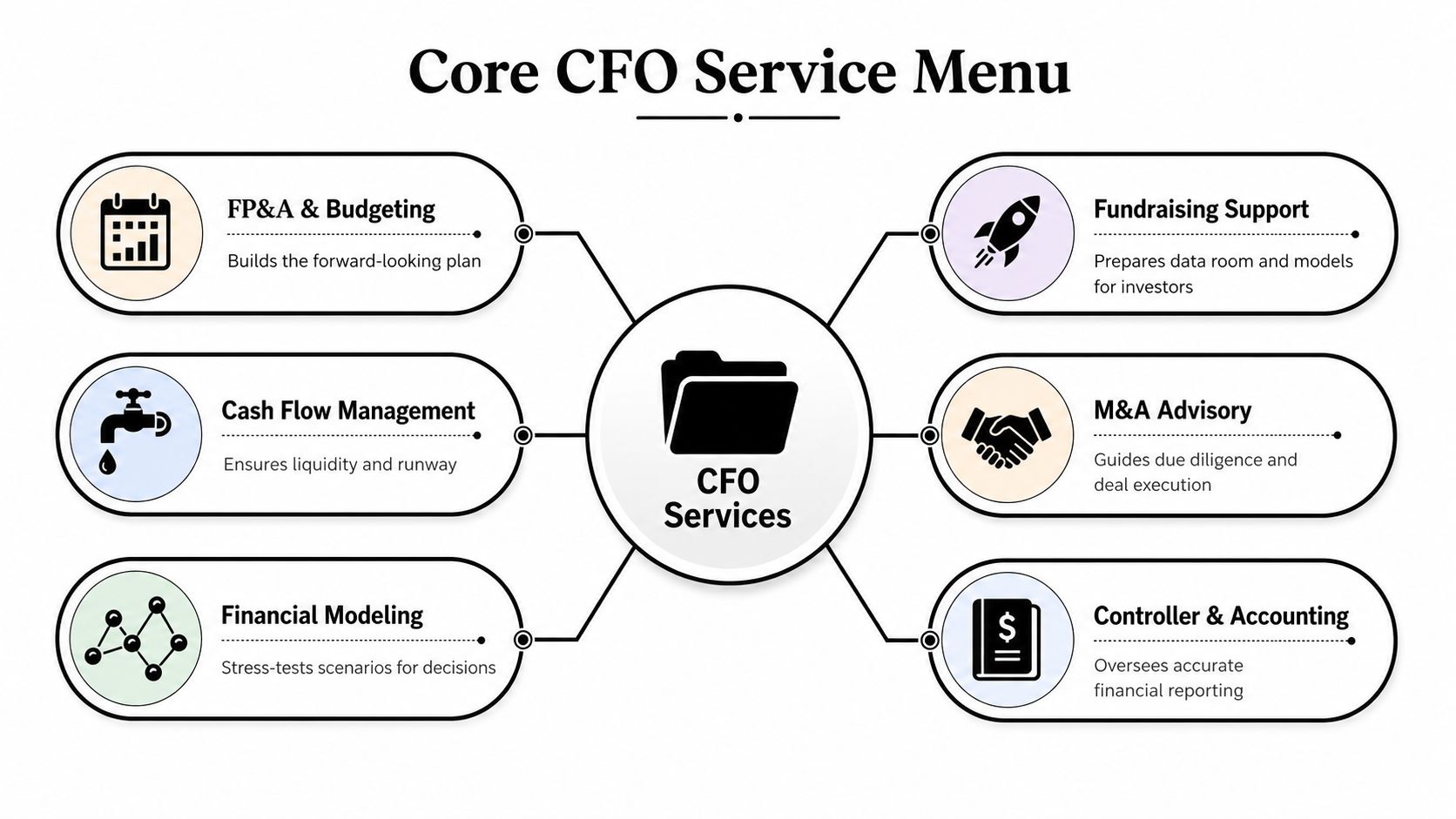
The CFO menu looks broad because startups hit different bottlenecks at different times. Founders waste money when they buy the whole menu just because it sounds complete. Buy the service that removes the constraint sitting on cash, growth, or decision speed right now.
FP&A and budgeting
FP&A stands for financial planning and analysis. The job is to turn a messy operating plan into a forecast you can run the business against, then compare what happened to what you said would happen. The right deliverable is a budget built on stated assumptions, plus regular updates when those assumptions change. That removes blind spending, which is how teams hire too early, miss their real burn, or starve the channel that deserves more capital.
A good FP&A process also forces tradeoffs into the open. If a founder wants faster growth, the budget should show what has to give up margin, runway, or headcount to make that growth real.
Cash flow management
Cash flow problems show up before P&L problems in most startups. The deliverable you should expect is a 13-week cash forecast updated on a steady cadence, plus scenario work around collections, payroll timing, and vendor terms. Current service guidance treats this as a core part of fractional CFO work, and that matches what operators need when runway is tight and every timing decision matters. For a deeper operator's view, how to accelerate invoice payments is worth reading if receivables are stretching your runway.
This service is not about prettier reporting. It is about keeping the company out of avoidable cash surprises and making sure the team knows when a timing issue turns into a hiring freeze, a delayed vendor payment, or a tougher fundraise.
Financial modeling
Financial modeling is where you pressure-test decisions before you spend the money. The output should show how hiring, pricing, product changes, or a new contract affect revenue, margin, and cash. It removes guesswork, which gets expensive fast when a founder is deciding on a launch, a raise, or a fixed-cost commitment that will live on the books for a long time.
The best model is not the prettiest one. It is the one leadership can use to compare options quickly and see which assumption moves runway or gross margin.
Fundraising support
Fundraising support prepares the financial story investors will pick apart. It usually includes model cleanup, metric definitions, a data room, and diligence responses. The bottleneck it removes is sloppiness under pressure, which is how good companies lose time and credibility during a raise.
This work also includes reporting discipline. Investors want numbers they can trust and a story that holds together from the board deck to the model, so the finance package has to match what management says in every meeting. For a useful reference point on financial reporting best practices, use the standards that make reporting easier to defend when diligence starts.
M&A and transaction advisory
This service matters when a founder is buying, selling, or evaluating a strategic deal. The deliverable is financial readiness for diligence, a deal model, and help weighing structure against terms. It removes the bottleneck of being too slow or too unprepared when a transaction window opens.
It also keeps founders from treating deal price as the whole story. Terms, timing, integration risk, and cash impact matter just as much, and a decent transaction process forces those tradeoffs onto the table before anyone signs.
Exit and succession planning
This is long-horizon work. It connects valuation drivers, cash generation, and owner transition goals so the business can move toward a clean handoff or sale. If you are already thinking about a transition, the financial work has to begin long before the exit date.
Exit planning often gets ignored because it feels distant. That is a mistake. The companies that handle it well are the ones that build clean records, predictable reporting, and a capital structure that does not scare off a future buyer or successor.
Each service should map to one constraint, one deliverable, and one decision. That is the filter that keeps CFO services useful instead of decorative.
Engagement Models and Pricing Compared
The wrong engagement model burns cash fast. A startup that needs monthly cash control should not buy a one-off cleanup. A company facing diligence should not sign up for light advisory and hope it covers the gap. Match the model to the bottleneck, or pay for work that does not change the next decision.
The pricing reality
Pricing should follow scope, cadence, and decision pressure. Early-stage founders usually see lower-cost retained support when the work centers on close discipline, board reporting, and cash forecasting. As the business gets more complex, the price rises because the work shifts from checking numbers to shaping capital allocation, scenario planning, and lender or investor support. For a useful reference on outsourced CFO services cost, look at how providers price recurring support versus project work and ask what deliverables are included.
A plain hourly quote is not the same as a retained relationship. Fractional CFOs often price by monthly access, while project engagements are tied to a specific deliverable such as a model build, diligence prep, or cleanup of a messy reporting stack. Full-time hires belong later, when the cost of delay is higher than the cost of a permanent executive seat.
CFO engagement models at a glance
| Model | Typical Hours / Month | Monthly Cost | Best Fit Stage | Key Tradeoff |
|---|---|---|---|---|
| Fractional Retainer | Light to moderate recurring support | Usually priced as a monthly retainer, based on scope and cadence | Seed through growth, when the business needs ongoing financial leadership without a full-time seat | Less daily availability than an in-house hire |
| Project-Based | Scoped to a single deliverable | Fixed fee or milestone pricing, depending on complexity | Cleanup, model builds, diligence, one-time planning | No continuity once the project ends |
| Virtual or Hybrid | Remote-heavy, recurring or on-demand | Often priced like a retainer or scoped package | Teams that want flexibility and lower overhead | Can feel less embedded in the operating rhythm |
| Full-Time In-House CFO | Full leadership role | Materially higher than fractional support, with salary, bonus, and overhead | Larger or more complex organizations | Highest fixed commitment and cost |
What I'd choose in practice
If the problem is board reporting, runway control, or pricing discipline, buy a retained fractional CFO and define the weekly or monthly cadence up front. If the company is preparing for a transaction or a funding process, buy project support that is built around that event. If the books are still unreliable, do not start with strategy decks. Start with close discipline, cash visibility, and a cleaner operating rhythm.
The decision should be tied to output, not title. A credible provider should tell you what gets delivered, when it gets delivered, and who owns the follow-through. If collections are a recurring drag on cash, ask for a plan that addresses how to accelerate invoice payments, because slow cash collection changes runway faster than most founders admit.
Rule of thumb: the right quote comes with scope, cadence, and a named deliverable. If it only says “finance support,” keep looking.
When to Hire a CFO and How to Sequence the Engagement
The question isn't “Can we afford CFO support?” The better question is “What breaks next if we don't have it?” Once you answer that, the sequence gets obvious. Different stages need different minimum scopes, and the trigger is usually an event, not a calendar date.
Stage triggers that make CFO support non-negotiable
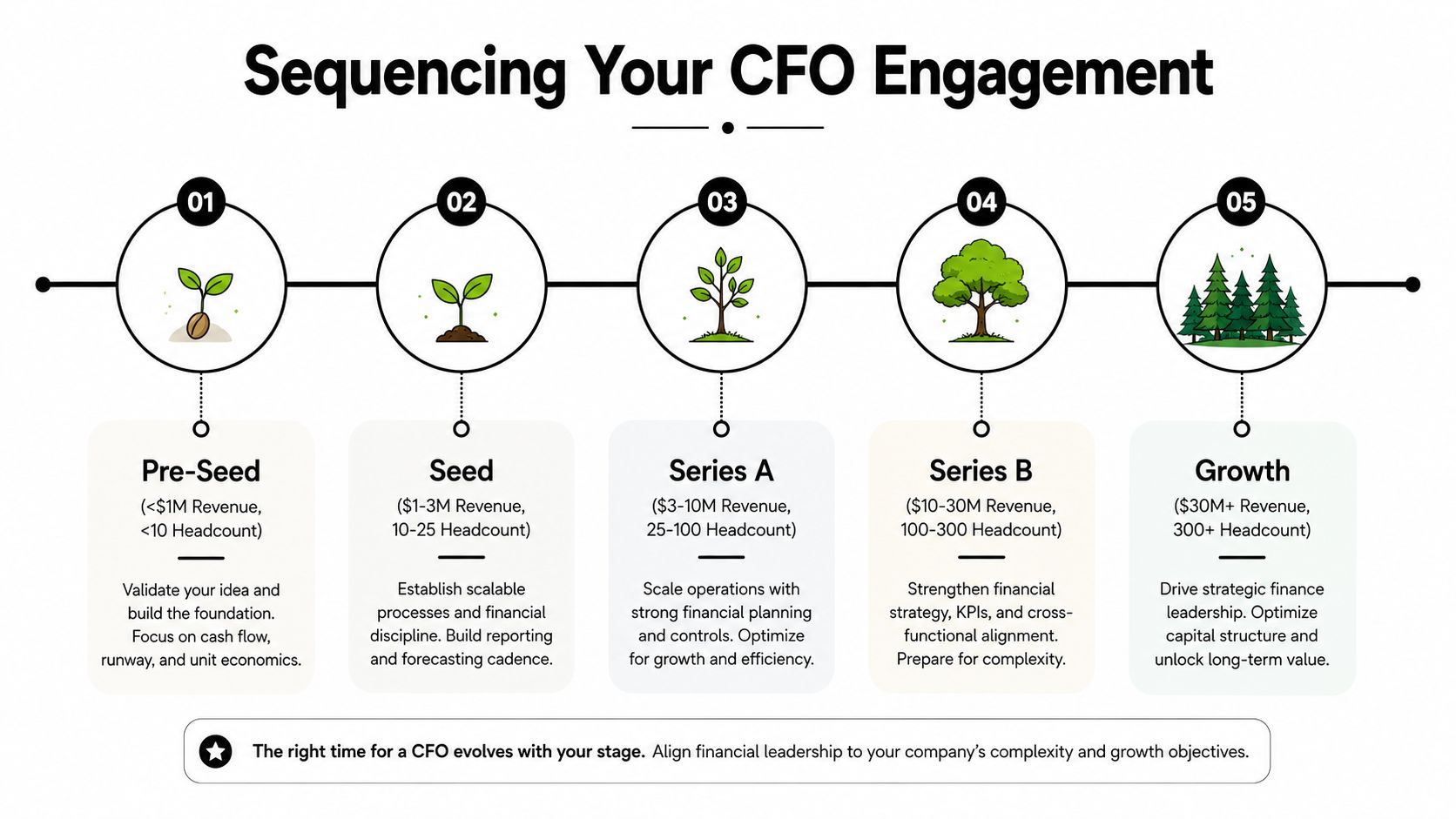
Pre-seed companies need help when cash visibility is weak and the first hires create real burn. Seed-stage teams need it when they're building repeatability and need forecasts that investors can believe. Series A companies usually need it before a priced round, before a major hiring wave, or when complexity starts outrunning the founder's spreadsheet. Series B and growth-stage businesses need it when reporting, capital allocation, and board expectations become too complex for ad hoc finance.
The stage labels below are a practical internal map, not a universal law. Use them to match the level of support to the size and complexity of the business.
A simple 30-60-90 day onboarding sequence
Week one should focus on data access, cash visibility, and the actual decision calendar. Month one should produce a stable close rhythm, a cash forecast, and a first pass at the board pack. By the end of the quarter, the company should be running on a repeatable reporting cadence, with scenario work tied to real operating choices.
The first 30 days should reduce confusion. The next 60 should reduce surprises. By day 90, the founder should be making cleaner decisions with less stress.
If your team is actively timing a hire or raise, line the CFO engagement up before the event, not after. That sequencing is how you avoid rushing the build while the business is already under pressure.
For a stage-by-stage hiring lens, when to hire a CFO is a useful complement. The principle is simple, bring in the finance layer before the next decision becomes irreversible.
KPIs, Templates, and Performance Standards
Founders do not need more finance jargon. They need operating rules they can hold someone accountable to. A CFO engagement should make the company easier to run, and that only happens when the work shows up in measurable outputs that the founder can inspect without translation.
The eight metrics that matter most
A strong startup CFO cadence should track cash runway in weeks, net burn, gross margin, forecast variance, days sales outstanding, CAC payback, board-deck turnaround, and close cycle time. Those are the numbers that show whether the business is getting steadier or more fragile. For investor-ready reporting, the standard pack should tie the cash flow statement, burn rate, runway, budget-vs-actuals, and unit economics into one story, as described in board-level reporting standards.
Cash runway tells you how much time you have. Net burn and gross margin tell you whether the business model is improving or just growing louder. Forecast variance shows whether management can trust the plan. Days sales outstanding, CAC payback, board-deck turnaround, and close cycle time show whether the finance function is keeping pace with the business or slowing it down.
Performance standards worth putting in the contract
A data-backed guide for Series A SaaS CFO engagements recommends sub-5% forecast variance within 90 days, board-deck turnaround under 72 hours, and variance alerts within 90 seconds of general-ledger sync. Those targets matter because they turn a vague promise into an operating standard, and they belong in an engagement letter, not just a sales call, per fractional CFO criteria.
I want the cash line at the top of every dashboard, followed by burn, margin, and runway. Under that, collections speed, forecast accuracy, and board-readiness should be visible without extra explanation. If a provider cannot show those numbers quickly and cleanly, the engagement is too weak for a founder who needs answers, not decoration.
Templates to ask for on day one
- 13-week cash model. This should show weekly inflows, outflows, and the cash-out date under different assumptions.
- Monthly close checklist. This keeps the close consistent and stops the reporting process from drifting.
- Board deck template. This should tie financial performance to the decisions management needs to make next.
- Scenario planner. Hiring, pricing, and pipeline changes get tested here before money is spent.
A founder should also expect a clear close process, a defined review cadence, and board materials that are built from the same numbers every time. That consistency matters because it cuts the noise between finance and operations. If the reporting stack changes every month, management spends its time reconciling versions instead of managing the company.
The best finance teams also document who owns each number, when it gets updated, and what action gets triggered when it moves. That is the difference between reporting that informs decisions and reporting that only fills a board packet.
Three Founder Stories and the ROI of Getting It Right
The ROI of CFO services shows up fast when the right problem gets solved. You don't need a perfect model to prove the point. You need one concrete decision that would've cost more without financial leadership.
A construction startup and a bad equipment lease
A construction founder was ready to sign a lease on equipment that looked manageable on a monthly basis but would've strained working capital for the next several months. A fractional CFO modeled the payment structure against job timing, pushed the vendor for a better schedule, and the company avoided a cash squeeze that would've forced a short-term borrowing scramble. The takeaway is simple, expensive fixed commitments need cash timing, not just gross margin logic.
A distribution business and late-paying customers
A distributor had decent sales but kept running tight because customers were slow to pay. The CFO tightened invoice follow-up, adjusted terms for a few accounts, and worked with operations to shorten the cash gap. That freed enough working capital to keep purchasing inventory without leaning as hard on emergency financing. The lesson, if collections are sloppy, runway is shorter than the income statement suggests.
A professional services firm and underpriced work
A services founder had several profitable-looking clients on paper, but the margin was being eroded by work that took too many senior hours. The CFO rebuilt client profitability by account, showed where the time was going, and helped reprice the weak accounts. The result was margin recovered without adding headcount, which is usually the cleanest kind of win.
If your company has one contract, one customer group, or one asset decision that feels “probably fine,” that's usually the place to model first.
The common thread across all three cases is restraint. A good CFO doesn't add complexity for its own sake. They remove the guesswork from the one decision that is making the business vulnerable.
Your Selection Checklist and Next Steps
Founders buy better CFO support when they ask better questions. If a provider can't answer these clearly, move on. The right fit is about scope, stage, and execution, not just polished slides.
The checklist to use in every sales call
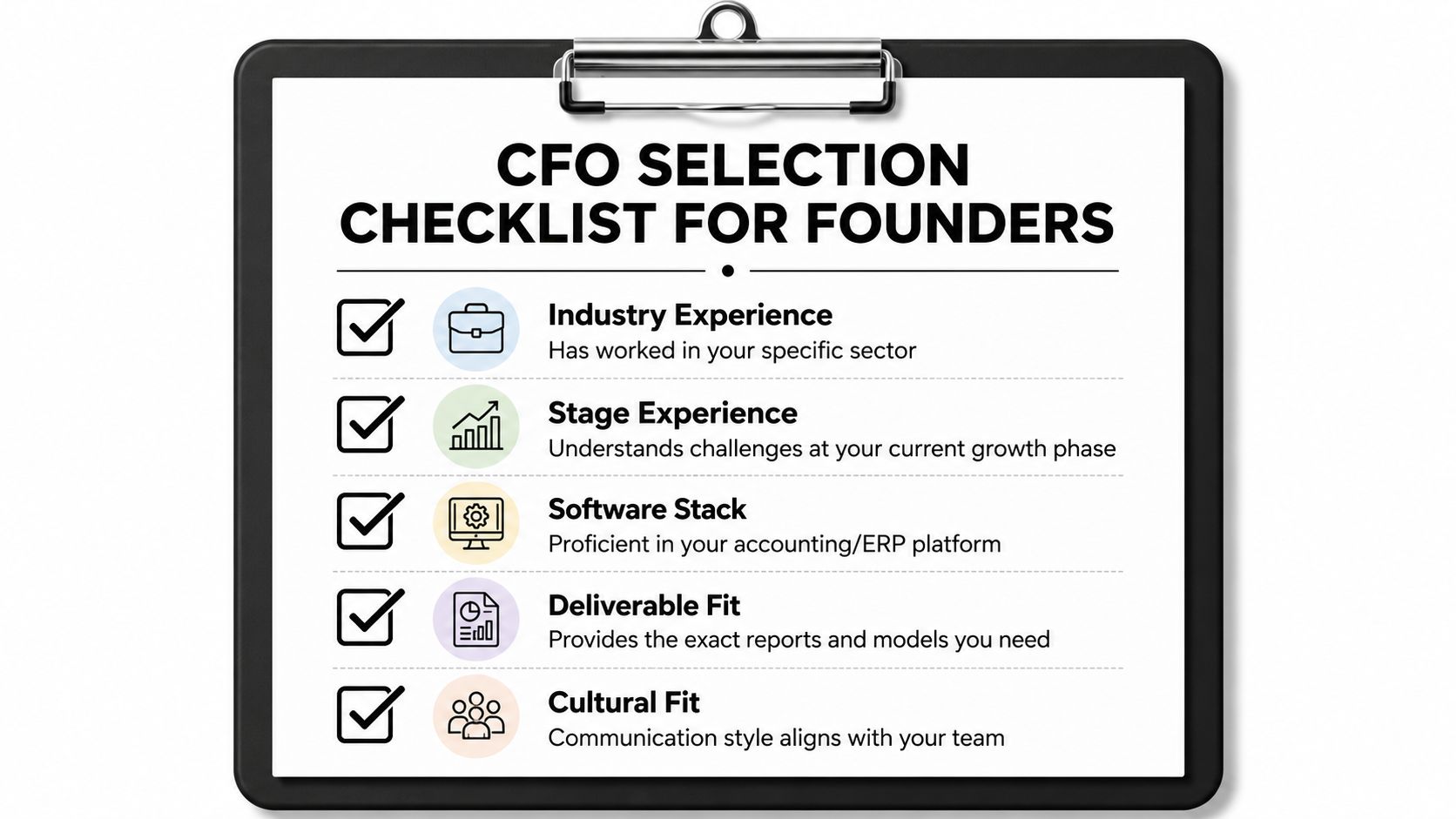
- Industry experience. Has the provider worked in your sector and understands your revenue logic?
- Stage experience. Do they know what's different about your growth phase?
- Software stack compatibility. Can they work inside your accounting and ERP setup without friction?
- Deliverable fit. Will they produce the exact reports, models, and cadences you need?
- Cultural fit. Can they communicate with your team in a way that keeps decisions moving?
What I'd ask before signing
Ask for the monthly cadence, the named deliverables, the response time for urgent issues, and the exit terms if the scope changes. Ask who owns the forecast, who updates the board pack, and what happens when the business becomes more complex. If the answers stay vague, the relationship will stay vague too.
A simple 30-60-90 day plan
In the next 30 days, identify your biggest finance bottleneck and collect the reports that prove it. In the next 60, interview providers against that bottleneck and ask for a written scope. In the next 90, put the first reporting cadence in place and judge the engagement on whether the business is easier to run.
AmbitionCFO works with founder-led businesses that have outgrown basic accounting and need embedded financial leadership around 13-week cash flow modeling, margin analysis, financial reporting, budgeting and forecasting, KPI dashboards, and Certified Exit Planning for owners planning a transition within 3–10 years. If your business is in construction, distribution, or professional services and you want a fractional CFO partner instead of a full-time hire, that's the kind of operating model to look for.
If your startup is past basic bookkeeping and you need sharper cash control, better forecasting, or board-ready financials, AmbitionCFO can help you build the finance cadence that matches your stage. Reach out if you want a fractional CFO who focuses on runway, margins, and decision support instead of generic finance overhead.