

You're wealthy on paper and stuck in practice. The business pays you well, the balance sheet looks strong, and yet nearly every important relationship, estimate, credit decision, and customer save still runs through you. That's the question worth answering first. Can someone else own this company and get the same results without you in the chair every day?
If the answer is no, you don't have an exit problem yet. You have a transferability problem, and no buyer, child, or management team can price around that for long.
Table of Contents
- The Moment Most Owners Realize Selling Is Harder Than Building
- What Exit Planning Certification Actually Covers
- Certification as an Operating-Readiness System
- How Advisors Earn and Keep the Designation
- Choosing the Right Transition Path for Your Business
- Mapping Certification to a 3–10 Year Owner Timeline
- The Math Behind the Headline Price
- Choosing and Working With a Certified Advisor
The Moment Most Owners Realize Selling Is Harder Than Building
Take a $40M distribution owner I've seen in different forms many times. He's in his early sixties, wants out in five years, and assumes strong revenue will carry the sale. Then a buyer asks simple questions. Which customers produce real margin after delivery costs? Who can approve a large credit line? Why does inventory keep rising while cash stays tight?
He knows the answers. His team doesn't, at least not in a system anyone can test.
Why exits stall for predictable reasons
Buyers and successors don't just buy historical earnings. They underwrite durable cash flow, management depth, customer concentration, documented systems, and how much the owner personally holds together. Weakness in any one of those areas changes price, structure, timing, or whether a deal happens at all.
That's why exit planning certification exists. Done right, it's not a broker credential and it's not a retirement seminar. It's a multidisciplinary readiness discipline that forces financial, operational, legal, tax, valuation, and personal decisions into one sequence while you still have time to fix what you find.
Practical rule: If your business can't run, report, and sell without you for a sustained stretch, you're not ready to negotiate your exit. You're ready to build readiness.
You'll get the most from a certified advisor if you know what the credential certifies, what outputs it should produce inside your company, how it maps to a realistic 3 to 10 year timeline, and how to vet the person carrying it. You'll also need to face an uncomfortable possibility early. The best outcome for your family, employees, and bank account may not be a conventional third-party sale.
Start with this working definition and hold every advisor to it. Exit planning is the coordinated process of making a business transferable, aligning the transfer with the owner's financial and personal goals, and choosing a path the business can support.
What Exit Planning Certification Actually Covers
Think of a hospital care team, not a single surgeon. A surgeon performs one critical intervention. A care team decides what's wrong, sequences specialists, manages risk before the procedure, and plans recovery after it. Exit planning certification trains an advisor to coordinate that kind of team for an ownership transition.
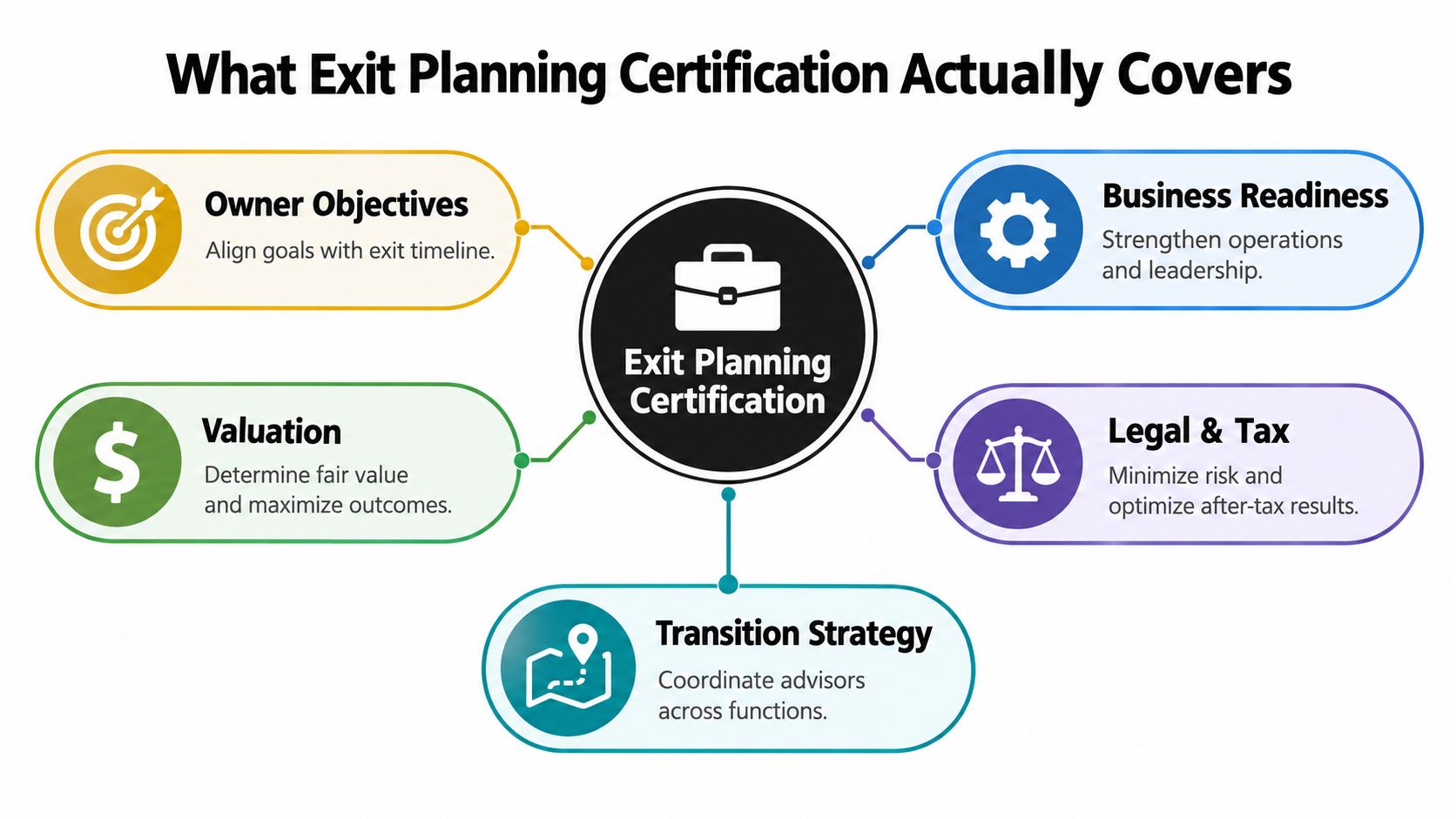
The AICPA Business Exit Planning Guide frames effective planning around the integration of financial analysis, operational readiness, legal and tax structuring, valuation, owner objectives, and post-transition considerations, positioning the discipline as cross-functional rather than transactional. That's the standard you should repeat back to any advisor. If the conversation starts and ends with finding a buyer, you're hearing transaction advice, not exit planning.
The five jobs a certified process should coordinate
- Owner objectives: Your target date, income needs after exit, role during transition, and what you want life to look like once you step back.
- Business readiness: Management depth, systems, customer risk, owner dependence, and whether performance survives your absence.
- Valuation and transferability: What the business may be worth today, what drives that value, and which gaps a buyer or successor will discount.
- Legal and tax structure: Entity, estate, employment, and deal-structure questions that must be settled before terms harden.
- Transition strategy: Sale, succession, internal transfer, employee ownership, staged liquidity, or continued ownership with a redesigned role for you.
The credential draws a broad professional base for a reason. In the first six months of 2021, the Exit Planning Institute reported 516 newly credentialed CEPAs from 327 companies across eight countries, with financial advisors and wealth managers representing approximately 65% of new designees, according to its Certified Exit Planning Advisor program overview. CPAs, attorneys, consultants, coaches, and fractional CFOs also earn it because no single specialty owns the whole problem.
Here's your one-sentence test. A certified exit planner should assemble the right specialists, in the right order, to make your business transferable and your personal outcome achievable. If an advisor can't explain who else belongs at the table and why, the letters after the name aren't doing much work.
Certification as an Operating-Readiness System
A $10M–$100M business can look successful and still depend on its owner for every consequential decision. A certification earns its place when the advisor turns exit preparation into operating changes you can verify, not a binder or a valuation range. Judge the work by what the company can do without you.
Set the test early. Within the first year of serious work, you should be able to point to evidence in your reports, management meetings, and delegation tests. If the advisor cannot name the operating result each workstream should produce, the credential is not translating into readiness.
Start with one customer, one month, and one absence. Can you see whether that customer is profitable? Do managers close the month and explain results on schedule? Can the company keep running while you are away? Those answers reveal more than a readiness label.
Track progress through a small set of operating measures:
- Reliable monthly reporting: Statements close on a predictable schedule, and leaders use forecasts to make decisions.
- Normalized cash flow and EBITDA: Owner perks, unusual expenses, and compensation above or below market are identified and documented for diligence.
- Margin visibility: Profit by customer, job, product line, or service team is clear enough to guide pricing and resource choices.
- Documented decision rights: Named people have defined limits for pricing, hiring, capital spending, credit, and customer concessions.
- Leadership depth: Managers can run operations, explain results, and solve problems without waiting for your approval.
- Owner-dependence reduction: Key relationships, technical knowledge, and approvals are transferred to people and systems, then tested while you are away.
These improvements matter even if you never sell. In the 2025 U.S. Bank survey of 1,000 small-business owners, 64% of owners with a succession plan reported significant recent growth, compared with 50% without one. Treat that as a management signal: transferable systems can support a stronger business under current ownership, too.
A credential signals training. Your operating records, management team, and calendar show whether the company is ready.
Before hiring an advisor, score each measure red, yellow, or green and attach the evidence behind your rating. Compare the gaps with this checklist for selling a business, then require a dated schedule for addressing the red items. The right outcome may be a sale, a succession, or a business that works without forcing you to exit. If the advisor cannot connect recommendations to measurable operating changes, keep looking.
How Advisors Earn and Keep the Designation
The Certified Exit Planning Advisor, or CEPA, requires more than attending a short seminar. Use the structure as a screening tool. You're not trying to become an expert in the curriculum. You're checking whether the person asking for your trust completed a defined program and stays current.
Candidates must complete a five-day virtual educational program and pass a closed-book, proctored final examination, with one week after the program to complete the exam and a maximum of three attempts total, as described in the Exit Planning Institute CEPA frequently asked questions. Each retake costs $50 under those same program terms. Those details matter because they separate formal training from general succession marketing.
CEPA Credential at a Glance
| Requirement | Standard | Renewal Note |
|---|---|---|
| Eligibility | At least 18 years old | Confirm identity and issuing body |
| Education | Five-day structured virtual program with preparation sessions | Ask for completion date |
| Examination | Closed-book and proctored, completed within one week after the program | Maximum three attempts, $50 per retake |
| Renewal cycle | Credential renewed every three years | Record the next renewal date before you engage |
| Professional standing | Continued adherence to professional-conduct standards and annual membership | Ask how compliance is maintained |
Renewal is where many owners stop asking questions, and that's a mistake. Maintaining the CEPA designation requires at least 40 hours of exit-planning continuing education every three years, or 30 hours of continuing education plus 10 hours of qualifying leadership, authorship, or teaching activity, according to the Exit Planning Institute member renewal requirements.
Treat a current credential as weak but useful evidence. It suggests the advisor remains engaged with current practice. It doesn't prove industry judgment, ethical alignment, or experience with a company your size.
Add four fields to your advisor-selection worksheet today. Write down the certification date, next renewal date, continuing-education status, and two owner references in your revenue band. Then check conflicts of interest, especially if the advisor also earns transaction fees. Verification is one input. It should never be your final filter.
Choosing the Right Transition Path for Your Business
Don't default to a sale. That's the most expensive assumption in exit planning. Your business may support a third-party buyer beautifully, or it may produce a better after-tax, lower-risk outcome through family succession, a management buyout, employee ownership, staged partial liquidity, or several more years under your ownership with a stronger operator in place.
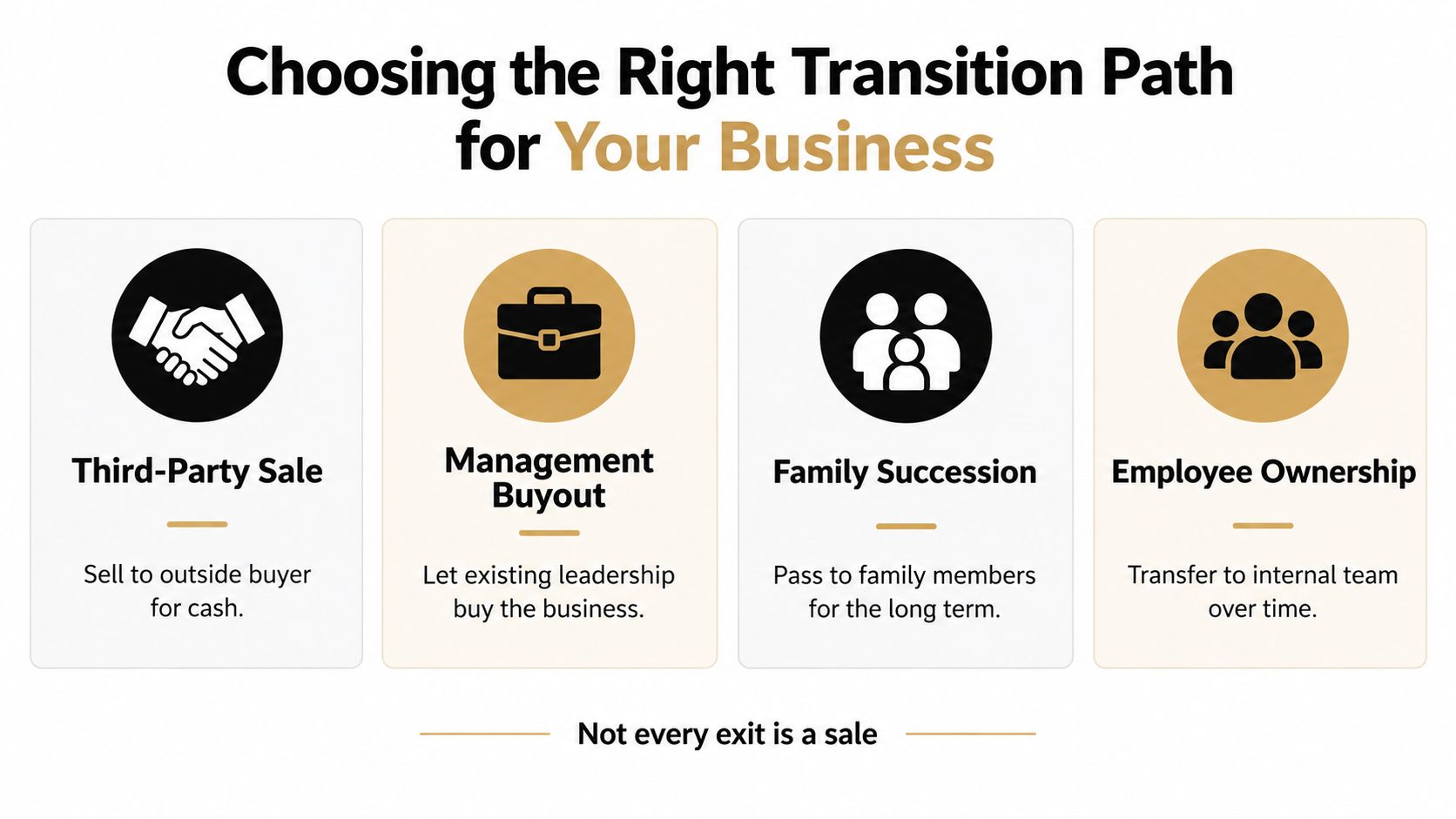
Owners already think this way, even if advisors don't always present it clearly. The 2025 Bank of America Business Owner Report found that 70% of surveyed owners were not focused on an exit within five years, while 60% said they had a plan, and among those plans 32% expected a family-member transition versus 38% a sale. A plan, in other words, doesn't automatically mean an external buyer.
Compare paths against the same criteria
| Path | Best fit when | Main constraint to test |
|---|---|---|
| Third-party sale | Transferable earnings, deep management, clean reporting | Buyer diligence, tax structure, and your post-close role |
| Management buyout | Trusted team with operating credibility | Financing capacity and whether cash flow can service acquisition debt |
| Family succession | Capable next generation with real authority | Competence, fairness among family members, and governance |
| Employee ownership | Broad employee commitment matters and leadership is stable | Financing design, administration, and successor management |
| Continue owning | Business needs redesign before any transfer works | Your energy, risk tolerance, and willingness to hire true operators |
Score each path on value, control, tax exposure, financing, employee impact, timing, and successor readiness. Don't score from hope. A management team that can't borrow, or a child who hasn't carried a P&L, isn't a path yet. It's a development project.
Bring legal structure into that comparison before you fall in love with an option. Owners weighing purchase and sale mechanics can use Lein Law Offices business counsel as background on the legal side of buying and selling a business, then bring specific questions to their own attorney. Pair that review with a broader look at exit planning strategies for different ownership goals and force each option into the same one-page model.
Direct recommendation: Pick the path your cash flow, team, and family can support, not the path with the loudest headline price.
Mapping Certification to a 3–10 Year Owner Timeline
A $40M professional services firm may look ready to sell until diligence reveals that its two founders still control the biggest client relationships. That gap is exactly what a timeline should expose early. Use certification as an operating-readiness system: assign owners to the work, track evidence of progress, and review it alongside financial results. A credential can structure the process, but it cannot make an unprepared company transferable.
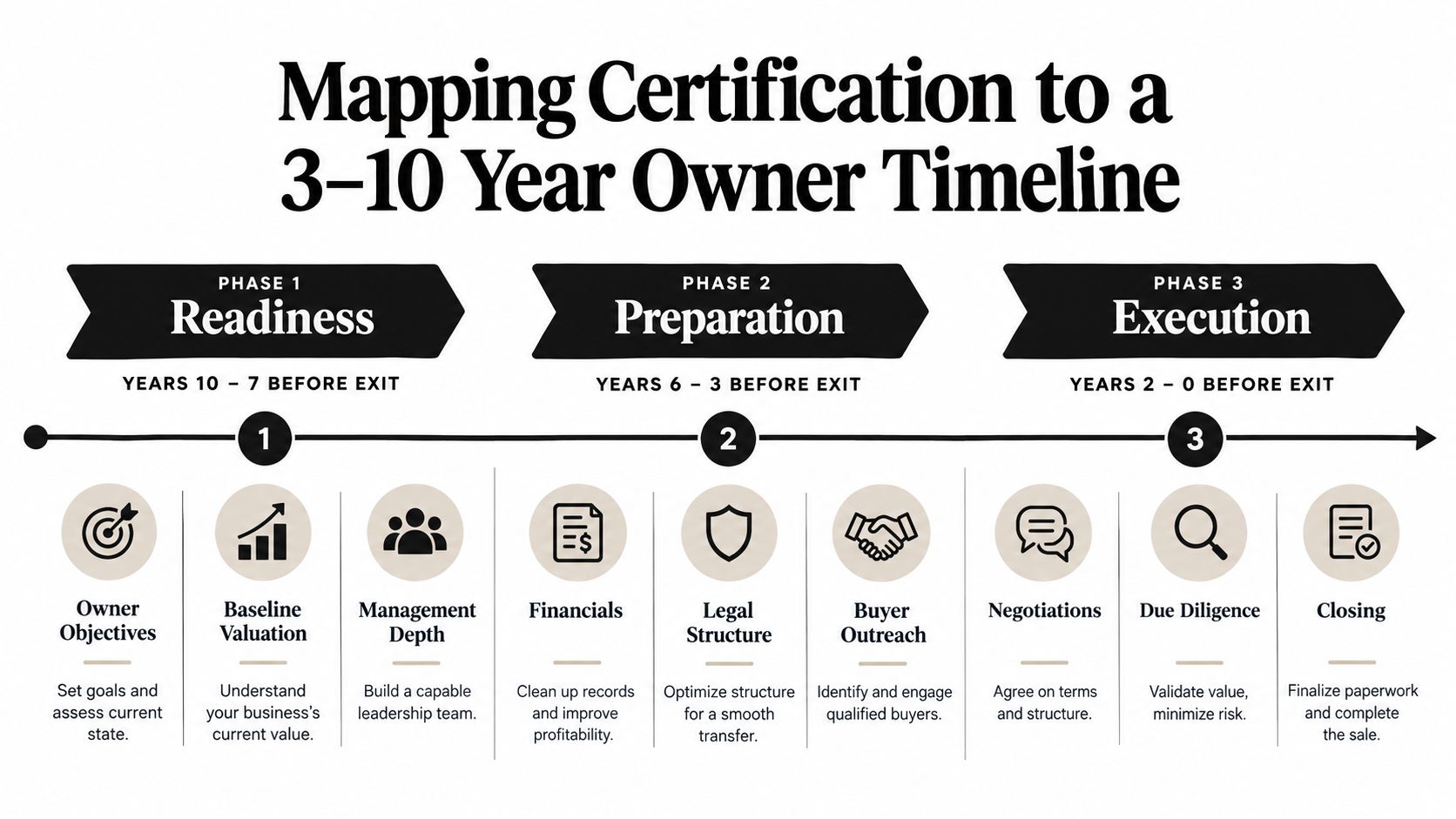
The time to start is often earlier than owners expect. MassMutual's 2022 Business Owner Perspectives Study found that only 35% of surveyed owners had started exit planning, and just 8% of those had completed it. Only 17% had set a timeline. Set a target date this quarter, then work backward from the readiness the business must demonstrate.
Build the schedule around three phases, but measure progress through operating changes rather than calendar milestones alone. Early in the process, clarify personal income needs and the owner's desired role, establish a baseline valuation, assess management depth, and identify plausible transition routes. In the middle years, install KPI dashboards, normalize EBITDA, improve working-capital discipline, document decision rights, and give successors authority they can exercise. As a transaction approaches, organize diligence files, test buyer or successor fit, settle tax and legal structure, and rehearse the handoff.
The work differs by industry. Construction companies need credible backlog, disciplined work-in-progress reporting, bonding capacity, and control of project margins. Distributors should focus on inventory turns, working capital, vendor terms, and customer concentration. Professional services firms need clear utilization and realization data, recurring revenue, and proof that client relationships will hold when the founder steps back.
For the $40M firm, the founders can use the early phase to identify their client concentration risk. During the build phase, they introduce client teams, track utilization and engagement margins, and give practice leaders pricing authority. By transaction preparation, diligence can demonstrate client revenue that transfers beyond founder relationships. That is measurable readiness, not a résumé credential.
Set timing based on market conditions, owner readiness, and the company's ability to transfer. Review when to sell a business against all three. If the company is not ready, extend the timeline or reconsider the route. A sale is not the only successful outcome; continuing ownership may be better if the business needs more time or a different leadership structure.
The Math Behind the Headline Price
A buyer offers a strong headline price, but part of it is deferred, tied to future performance, or backed by a guarantee. Your decision should rest on cash you keep, the risks you accept, and the time you remain involved. Model those terms before negotiating the multiple.
Use the visual below to separate purchase price from proceeds.
In an SBA-backed deal, the financing details can change what the offer is worth to you. Under the 2025 SBA rules summarized by BizBuySell, buyers must contribute at least 10% equity. Seller financing can cover no more than half of that contribution, typically 5%, and a seller note used for that portion must remain on full standby for the life of the SBA loan. A portion of the price may therefore produce no payments for years.
The size of your seller note also affects your exposure. A seller retaining less than 20% financing generally guarantees the loan for two years. A note above 20% can require a guarantee for the full loan term. You may remain as a non-managerial consultant for up to 12 months, without decision-making authority. Price the guarantee and time commitment into your decision.
Rather than rely on a single forecast, compare three deal structures:
- Buyer-funded: Cash at closing, tax timing, working-capital adjustment, and earnout risk.
- Seller note below 20%: Payment schedule, standby period, guarantee length, and default remedies.
- Seller note above 20%: Guarantee exposure, delayed liquidity, and whether the higher price justifies years of risk.
Apply the same return analysis you would use for a major capital decision. Foundation's ROI calculation guide offers a framework for comparing upfront cost with long-term return. Use that discipline to evaluate deal terms, not just the headline figure.
A stronger valuation needs evidence a buyer can verify. Review the value drivers that support a stronger valuation and connect each one to diligence-ready proof. Then compare the all-cash offer with seller financing after accounting for taxes, timing, and risk. The better choice depends on the numbers in your deal.
Inspect every term in a schedule before you sign. The image below reinforces a simple discipline: calculate proceeds, not just price.

Accepting a structure you have not modeled can be the most expensive decision in your exit.
Choosing and Working With a Certified Advisor
Turn everything above into a worksheet you can use this week. Don't interview advisors with general questions about philosophy. Verify facts, inspect outputs, and watch how they talk about your team, your numbers, and paths that don't involve a sale.
Five verification steps
- Confirm the credential and issuing body: Get the exact designation, not language like exit specialist or succession consultant.
- Ask for the initial certification date: Experience after certification matters more than the ceremony.
- Confirm the next renewal date: An expired or soon-to-lapse credential needs an explanation before you sign anything.
- Request the current continuing-education log: You're checking engagement, not collecting paperwork for its own sake.
- Check owner references in your band: Ask for owners in a similar revenue range and industry, then ask those owners what changed inside the business.
Then ask three questions that expose readiness thinking. What will I be able to measure in six months? Which transition paths should we rule out, and what evidence would change your mind? Where does your role end, and which valuation, tax, legal, or transaction specialists will you bring in?
Hiring test: A strong certified advisor talks about transferability, decision rights, and your life after the deal before talking about buyers.
Pay attention to scope boundaries. A fractional CFO can operationalize forecasts, normalized EBITDA analysis, KPI reporting, and working-capital controls, while regulated or specialized work belongs with the appropriate professionals. If you're comparing support models, review how transaction advisory services differ from ongoing readiness work so you don't hire closing help when you need three years of preparation.
Book a 30-minute readiness review and bring three items. Bring your completed worksheet, a current P&L, and a one-page statement of owner objectives with your target date and income needs. Leave with dated red, yellow, and green readiness scores and one named owner for each gap.
The credential starts due diligence. It doesn't finish it, and any advisor who suggests otherwise has told you something important.
If you're planning a transition in the next 3 to 10 years, bring your worksheet, current P&L, and owner-objectives one-pager to a readiness conversation with AmbitionCFO, where fractional CFO support and Certified Exit Planning help $10M to $100M owners improve transferability, reporting, and cash flow before a sale or succession. You'll leave with clear readiness gaps, a practical sequence for fixing them, and a path that fits your business instead of a generic promise to start early.