

You're trying to answer a harder question than “How do we pay down debt fastest?” You're asking how much debt your company can carry while still funding growth, protecting payroll, satisfying lenders, and presenting a clean story to a buyer.
That question usually surfaces when the founder of a growing company is juggling equipment loans, a revolving credit line, working-capital financing, and a term loan with a covenant that suddenly feels much tighter. Revenue may be rising, but cash still feels constrained. A lender wants updated projections, an acquisition opportunity needs funding, and someone on the board asks how the debt will affect valuation.
A generic payoff tactic won't solve that problem. A high-growth company preparing for an exit needs a debt management strategy that connects borrowing to cash conversion, operating risk, covenant capacity, refinancing windows, and buyer expectations. This guide gives you a practical framework for building that system.
Table of Contents
- Why Debt Management Matters for Your Growth Journey
- Building Your Debt Inventory and Cash Flow Baseline
- Evaluating Debt Restructuring and Refinancing Options
- Creating a Scenario-Based Cash Flow Model
- Quantifying Debt Risk and Impact on Valuation
- Implementing Controls and Key Performance Indicators
- Your Next Steps Toward Financial Freedom
Why Debt Management Matters for Your Growth Journey
A founder I'll call Daniel runs a distribution business with strong demand and several large customer contracts. The company has grown quickly, but its financing has grown in fragments. An equipment loan sits with one lender, a line of credit with another, and short-term borrowing covers receivables that arrive later than expected. Every payment is technically manageable. The combined structure is not.
Daniel's problem isn't just the amount owed. It's the lack of coordination. Maturities cluster together, one covenant uses a different earnings definition than another, and the company has no clear answer to how much liquidity remains after debt service. A buyer reviewing the business would see financing risk before seeing the growth story.

Debt becomes strategic when growth accelerates
Debt can fund equipment, inventory, hiring, acquisitions, and contract mobilization. It can also magnify operating weaknesses when collections slow or margins compress. The right borrowing structure gives you optionality. The wrong one turns normal volatility into a lender event.
Public-sector debt management offers a useful historical lesson. In a World Bank sample of 117 countries, only 60% had a formal debt management strategy. Among those with a strategy, 77% made the details public, 76% used strategic targets, 71% grounded the strategy in quantitative analysis, and about 80% published the strategy, according to the World Bank's debt management strategy study.
The business translation is straightforward. A debt strategy isn't a list of balances. It's a medium-term plan for achieving a suitable debt portfolio while balancing cost and risk. For a founder, that means deciding what debt should fund, which obligations deserve priority, how much liquidity must remain untouched, and what a buyer will inherit.
Practical rule: Never approve new debt without documenting its purpose, repayment source, maturity risk, covenant impact, and exit implications.
The framework that follows moves from visibility to action. You'll build an inventory, establish a cash-flow baseline, compare restructuring options, model stress scenarios, quantify valuation risk, and install controls. If personal guarantees or legal exposure complicate the picture, a resource such as Morgan & Morgan Attorneys P.C. debt help can help you identify questions for qualified legal counsel.
Building Your Debt Inventory and Cash Flow Baseline
You can't manage debt you can't see. Start with a single schedule that captures every obligation, including facilities that don't appear as conventional loans.
Build the inventory
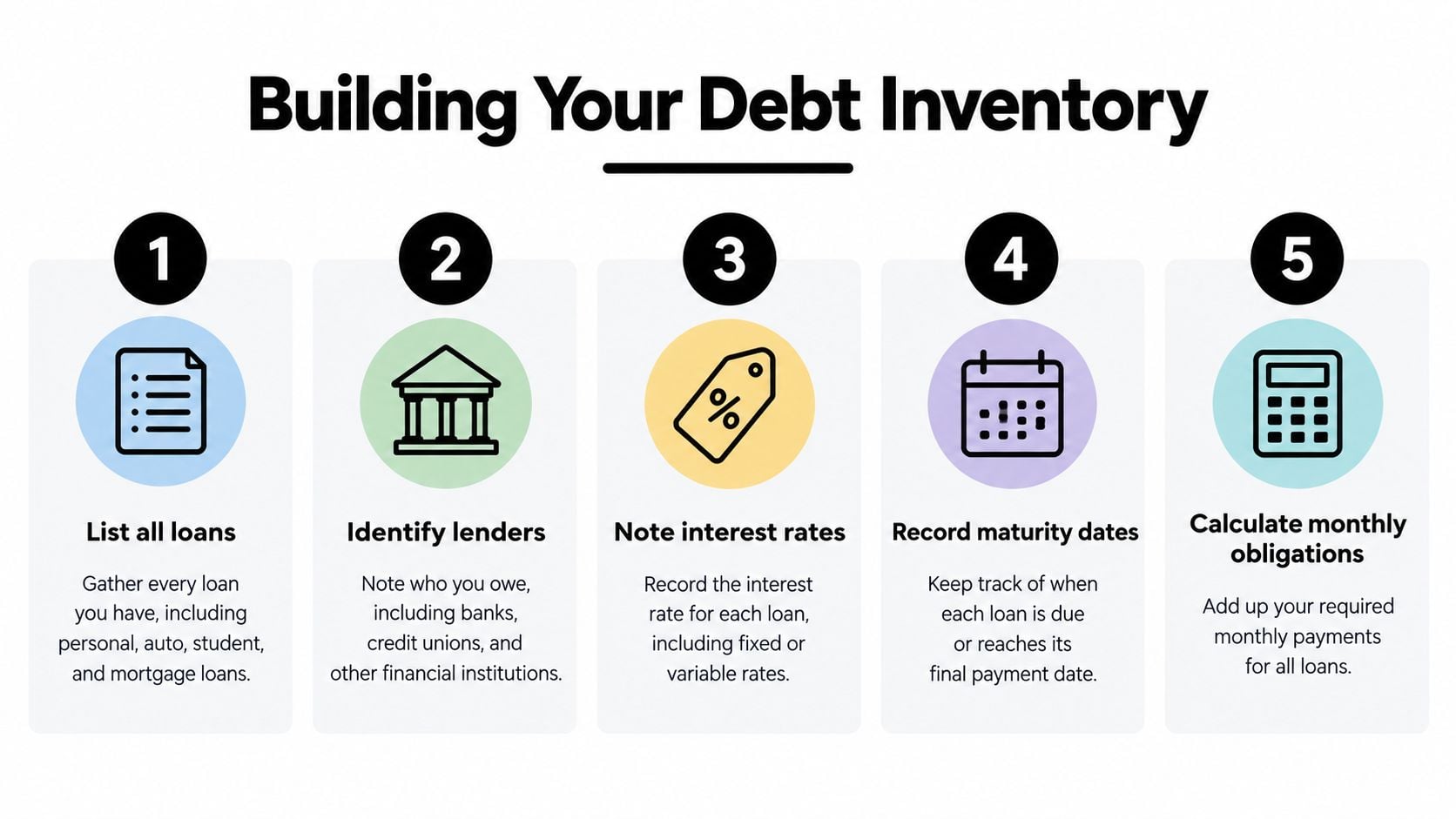
Create a spreadsheet with one row per facility. Pull the signed agreement, latest lender statement, amortization schedule, and covenant certificate before entering data.
List every obligation: Include term loans, equipment finance, credit cards, lines of credit, merchant cash advances, leases with financing characteristics, shareholder loans, tax arrangements, and earnout obligations.
Identify the lender and security: Record the lender, guarantors, collateral, personal guarantees, borrowing-base rules, and whether the facility is senior, subordinated, or unsecured.
Capture pricing: Note the interest rate, reference rate, spread, fees, default pricing, unused-line fees, and any prepayment penalty. Don't use one blended rate. You need to know which facility becomes expensive when conditions change.
Record timing: Enter original maturity, renewal date, amortization profile, next principal payment, interest-only period, and any balloon payment. A loan that looks affordable monthly may still create a serious refinancing risk at maturity.
Document restrictions: Add debt tests, fixed-charge coverage tests, minimum liquidity requirements, reporting deadlines, distribution limits, and restrictions on additional borrowing.
The final column should show monthly debt service, separated into principal and interest. That distinction matters. Interest affects earnings and cash. Principal affects cash without reducing reported expense in the same way.
Establish the cash baseline
Reconcile the debt schedule to actual bank activity. Then build a rolling cash view that starts with opening cash, adds expected collections, subtracts payroll, suppliers, taxes, capital spending, and debt service, and ends with projected liquidity.
Use a cash-based view alongside your accrual statements. The guide on converting accrual to cash is useful when reported profit doesn't explain why the bank balance keeps tightening.
Calculate DSCR, or debt-service coverage ratio, as cash available for debt service divided by required principal and interest payments. Current SMB guidance treats DSCR below 1.25 as an actionable warning threshold and recommends a debt-service reserve to reduce liquidity shocks, as outlined in business debt management guidance.
Cash rule: Protect the cash required to operate the business before using surplus cash for aggressive prepayments.
For a $10M to $100M company, the inventory should become a monthly management document. Assign an owner, update it after every financing change, and review maturities far enough in advance to maintain strong negotiating positions. Guidance on strategic financing for S-corps and LLCs can add useful context when ownership structure and cash-flow planning intersect.
Evaluating Debt Restructuring and Refinancing Options
Once the inventory is complete, choose the financing action that solves the actual problem. Don't refinance because a lender offers a lower headline rate. A new facility can reduce interest and still worsen your maturity concentration, collateral restrictions, or exit flexibility.
A useful comparison looks like this:
Debt Restructuring Options Comparison
| Option | Best For | Potential Benefit | Key Consideration |
|---|---|---|---|
| Refinancing | A stable company with expensive or poorly timed debt | Lower cost, longer maturity, or better amortization | Fees, new covenants, collateral requirements, and reset risk |
| Consolidation | Multiple obligations creating payment and reporting complexity | One payment date, one lender relationship, and potentially lower financing cost | The new term may extend repayment or increase total interest |
| Covenant renegotiation | A business facing temporary pressure but retaining operating strength | More time, revised testing, or additional headroom | Lenders may require fees, reporting, collateral, or tighter controls |
| Maturity extension | A company with a cash-flow timing mismatch | Avoids a forced payoff during an investment or collection cycle | Delays the problem if the underlying cash generation isn't fixed |
| Creditor settlement | A distressed business with limited repayment capacity | May reduce immediate payment pressure | Credit, legal, tax, and stakeholder consequences require careful review |
Business debt consolidation means combining multiple debts into one new loan with a single monthly payment. The operational benefit is simplification, but consolidation only works if the new structure matches the company's repayment capacity. If old facilities are paid off and the company immediately redraws them, the transaction has created paperwork rather than progress. The mechanics and tradeoffs are summarized in this small-business debt consolidation guide.
Match the option to the cash problem
Use refinancing when the business can support the debt but the current pricing or maturity is inefficient. Use consolidation when administrative complexity and fragmented payment dates create avoidable risk. Ask for covenant relief when the breach risk comes from a temporary event, such as delayed project completion, rather than a permanently weak model.
A covenant is a contractual financial or operating condition imposed by a lender. Before negotiating, calculate compliance under the lender's exact definitions, not your internal EBITDA. This debt covenant explanation can help your team distinguish testing mechanics from broader solvency analysis.
For merchant cash advances or similarly expensive obligations, don't improvise. Review step-by-step MCA settlement strategies as background, then have counsel and your CFO assess the legal and economic consequences before contacting creditors.
The decision should be based on cash conversion, not optimism. A lender will respond more constructively to a credible 13-week forecast, a specific repayment source, and clean reporting than to a general promise that sales will improve.
Creating a Scenario-Based Cash Flow Model
A static annual budget hides debt risk. It assumes one path, while your company operates through delayed collections, project changes, hiring decisions, price pressure, and unexpected repairs.
Build a rolling scenario model that shows what happens to cash when the assumptions change. The model doesn't need to be elaborate, but it must connect operating drivers to debt obligations.
Start with operating drivers
Use weekly columns for the near-term view and monthly columns for the longer planning horizon. Separate assumptions from calculations so management can change a driver without rewriting formulas.
Include:
- Collections: Expected receipts by customer, invoice age, contract milestone, and probability of delay.
- Revenue timing: Signed work, likely work, and speculative pipeline. Keep these categories separate.
- Gross margin: Model margin by job, client, or service line where the business mix creates different cash outcomes.
- Payroll and suppliers: Include hiring dates, wage changes, payment terms, and concentration among key vendors.
- Capital spending: Separate essential replacement spending from discretionary expansion.
- Debt service: Pull principal, interest, fees, and scheduled maturities directly from the debt inventory.
The cash-flow forecasting model guide provides a useful structure for turning these inputs into a management forecast.
Create three decisions, not three stories
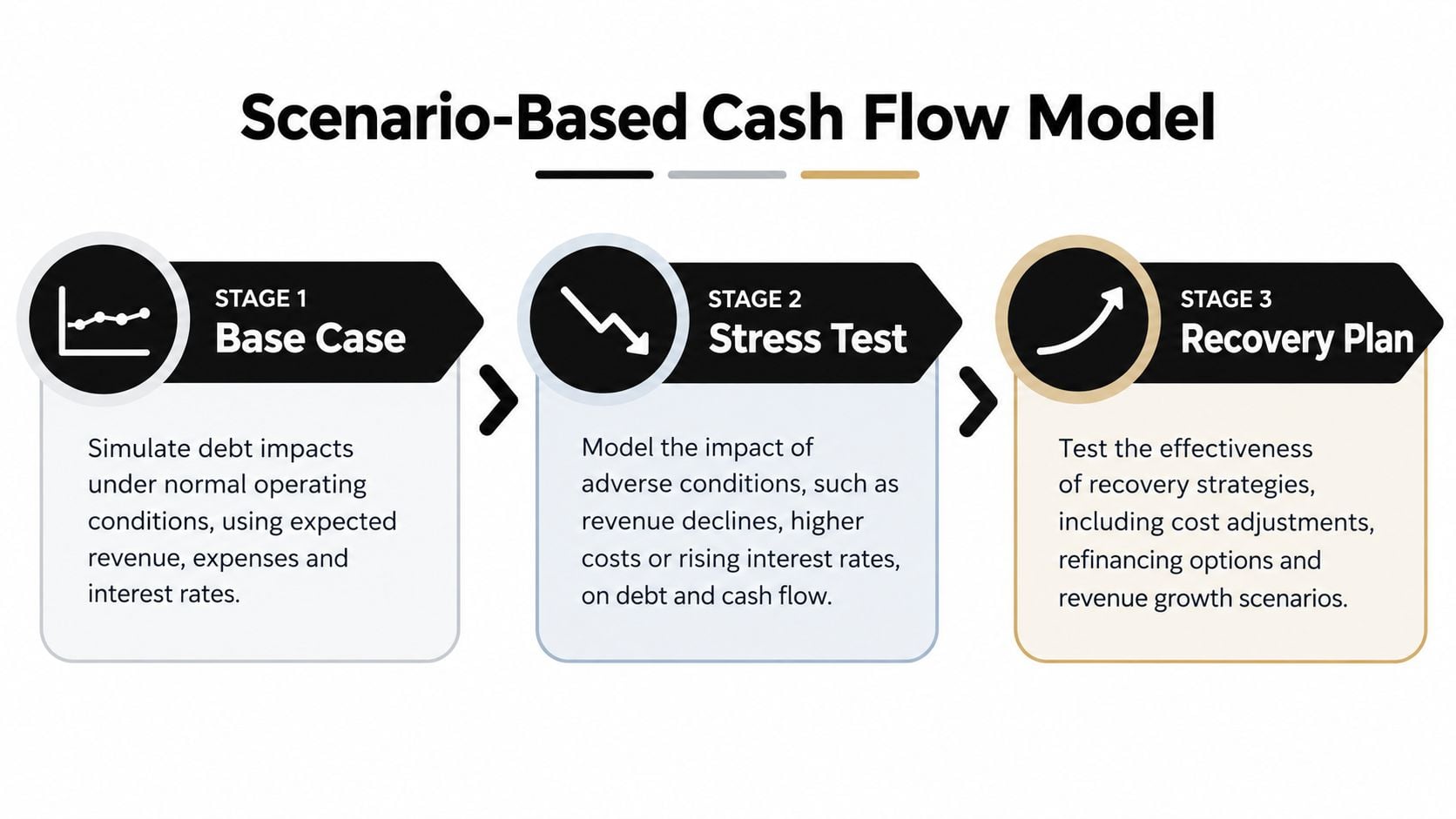
The base case should reflect signed work, realistic collections, known expenses, and current debt terms. It isn't your sales team's aspiration. It's the operating plan the leadership team can defend.
The stress case should reduce collections, compress margins, delay a project, increase an input cost, or remove a major customer receipt. Apply stresses that resemble your actual business risks. A construction company might model a delayed draw. A distributor might model inventory arriving before customer cash. A professional-services firm might model a utilization decline and slower billings.
The recovery plan specifies the action triggered by each breach of your cash threshold:
- Protect liquidity: Freeze discretionary capital spending, slow owner distributions, and preserve payroll and critical suppliers.
- Create capacity: Accelerate collections, renegotiate vendor timing, reduce low-margin work, and use undrawn facilities only when repayment is visible.
- Engage lenders early: Share the forecast, explain the variance, and request a defined amendment rather than waiting for a missed payment.
A 13-week model should show the lowest projected cash point, debt-service coverage, borrowing-base availability, covenant headroom, and the date each refinancing conversation must begin.
Use this short video as a visual aid for the modeling process:
Modeling test: If the worst credible case leaves you unable to fund payroll, essential suppliers, or secured debt, the current debt structure is too aggressive.
Quantifying Debt Risk and Impact on Valuation
Buyers don't evaluate debt only by looking at the outstanding balance. They examine whether the company can service it, whether the terms restrict future decisions, and whether the buyer will inherit a refinancing problem immediately after closing.
For an exit-ready company, separate four exposures:
- Cash-service exposure: Required principal, interest, fees, and mandatory amortization.
- Covenant exposure: The distance between current performance and each lender's testing threshold.
- Maturity exposure: Debt that must be renewed, refinanced, or repaid before the business can complete its growth plan.
- Rate exposure: The effect of changing rates on interest expense and cash available for reinvestment.

Turn debt risk into buyer-ready analysis
Calculate debt service under the base and stress cases. Show the buyer which obligations are secured, which are assumed or repaid at closing, and which require lender consent. Then document the business reasons for each facility. Equipment debt tied to productive capacity tells a different story from short-term borrowing used to cover recurring operating losses.
A clean debt schedule also improves the quality of normalized earnings analysis. If the company has deferred maintenance, underfunded working capital, or unusual owner distributions, a buyer may adjust the price or demand additional protection. The value of a private company depends on more than an earnings multiple. Cash conversion, transferability, risk, and financing requirements all shape the buyer's view.
A structured debt management strategy can improve exit readiness by reducing surprises. It gives your transaction team evidence that management understands liquidity, has controlled maturities, and can explain why debt supports the operating plan.
For public debt, the urgency of formal frameworks increased as global borrowing expanded. The IMF reported total global debt at 256% of global GDP in 2020, while debt in emerging market and developing economies reached 198% of GDP, as reported in its global debt analysis. The business lesson isn't to copy government financing. It's to recognize that disciplined debt management becomes more valuable as borrowing and complexity rise.
Implementing Controls and Key Performance Indicators
Debt management fails when the schedule becomes a document instead of a control system. Assign responsibility for updating the schedule, reviewing lender requirements, and escalating exceptions.
Start with a monthly debt review attended by the owner, CFO, controller, and operating leader. Compare actual cash flow with the forecast, update the lowest cash point, and review every covenant and maturity that could affect decisions.
Track the measures that change behavior
- DSCR: Divide cash available for debt service by scheduled principal and interest. Treat below 1.25 as an actionable warning threshold, based on current SMB guidance linked earlier. Don't wait for a formal breach before changing the plan.
- Interest coverage: Compare operating earnings with interest expense. Watch the direction and understand which margin or rate assumption is driving the change.
- Loan-to-value: Divide outstanding secured debt by the value of pledged collateral. A rising ratio can limit refinancing flexibility even when earnings appear healthy.
- Maturity concentration: List obligations by due date and flag clusters. A company can show strong annual profit and still face a liquidity crisis if several facilities mature together.
- Liquidity headroom: Track unrestricted cash plus available committed borrowing, then subtract minimum operating reserves and near-term obligations.
Set thresholds that trigger specific actions. A falling DSCR might require a pricing review or hiring pause. A shrinking borrowing base might trigger faster collections. A maturity inside the planning horizon should launch lender outreach, not a last-minute scramble.
A focused KPI dashboard design framework can help management put these measures beside operating indicators such as gross margin, backlog, utilization, days sales outstanding, and inventory turns. Debt KPIs only matter when they connect to the operating decisions that move cash.
Your Next Steps Toward Financial Freedom
Take these actions this week.
Build the debt inventory: Gather agreements, statements, amortization schedules, collateral details, covenants, rates, and maturities. Reconcile the schedule to the general ledger and bank activity.
Find the pressure point: Calculate DSCR, identify the lowest projected cash balance, and flag the obligation with the highest cost or nearest maturity. Don't spread attention evenly. Fix the risk that can interrupt operations first.
Model the decision: Run base, stress, and recovery cases. Decide in advance when you'll cut discretionary spending, accelerate collections, negotiate with vendors, or contact lenders.
Prepare for the exit: Create a buyer-ready debt schedule showing purpose, terms, security, repayment source, and treatment at closing.
Debt management is a recurring leadership discipline, not a one-time cleanup project. Review the model monthly and update it whenever you add financing, change the operating plan, or move closer to a transaction.
AmbitionCFO helps founder-led companies build 13-week cash-flow models, analyze debt service capacity, review covenant exposure, and connect financing decisions to growth and exit planning. Visit AmbitionCFO to discuss your debt management priorities and determine the next financial model your leadership team needs.