

A rolling forecast is a continuously updated projection that keeps a fixed forward horizon, usually 12 to 18 months, by replacing each closed month with actual results and adding a new future month.
Your income statement looks healthy, but you're hesitating over a hire because a customer hasn't paid and an equipment deposit is due. The question isn't whether you met the budget. It's whether today's commitments leave enough cash for tomorrow's obligations.
That's the useful answer to “what is rolling forecast?” It's a way to make decisions with a current view of the business, rather than assumptions you approved before conditions changed.
Table of Contents
- What a Rolling Forecast Is and How the Window Moves
- Rolling Forecast, Rolling Budget and Static Budget Compared
- How Rolling Forecasts Improve Cash Visibility and Decisions
- Pairing a 13-Week Cash Model With a 12-Month Forecast
- A Distributor's 18-Month Roll in Practice
- How to Build Your Rolling Forecast in Six Steps
- Start Your First 13-Week Cash Review This Month
What a Rolling Forecast Is and How the Window Moves
A budget loses forward visibility as the year progresses. A rolling forecast keeps the same distance ahead, giving owners a current view of expected cash needs, commitments and operating results. Use it to make decisions, not just to refresh a budget.
Watch the window move
For a concrete example, a 12-month forecast covering February 2026 through January 2027 adds February 2027 once February closes. Replace February's estimate with actual results, then update the remaining months using what has changed in customer orders, staffing and collections. The horizon stays steady while the assumptions improve.
The moving window makes the distinction visible:
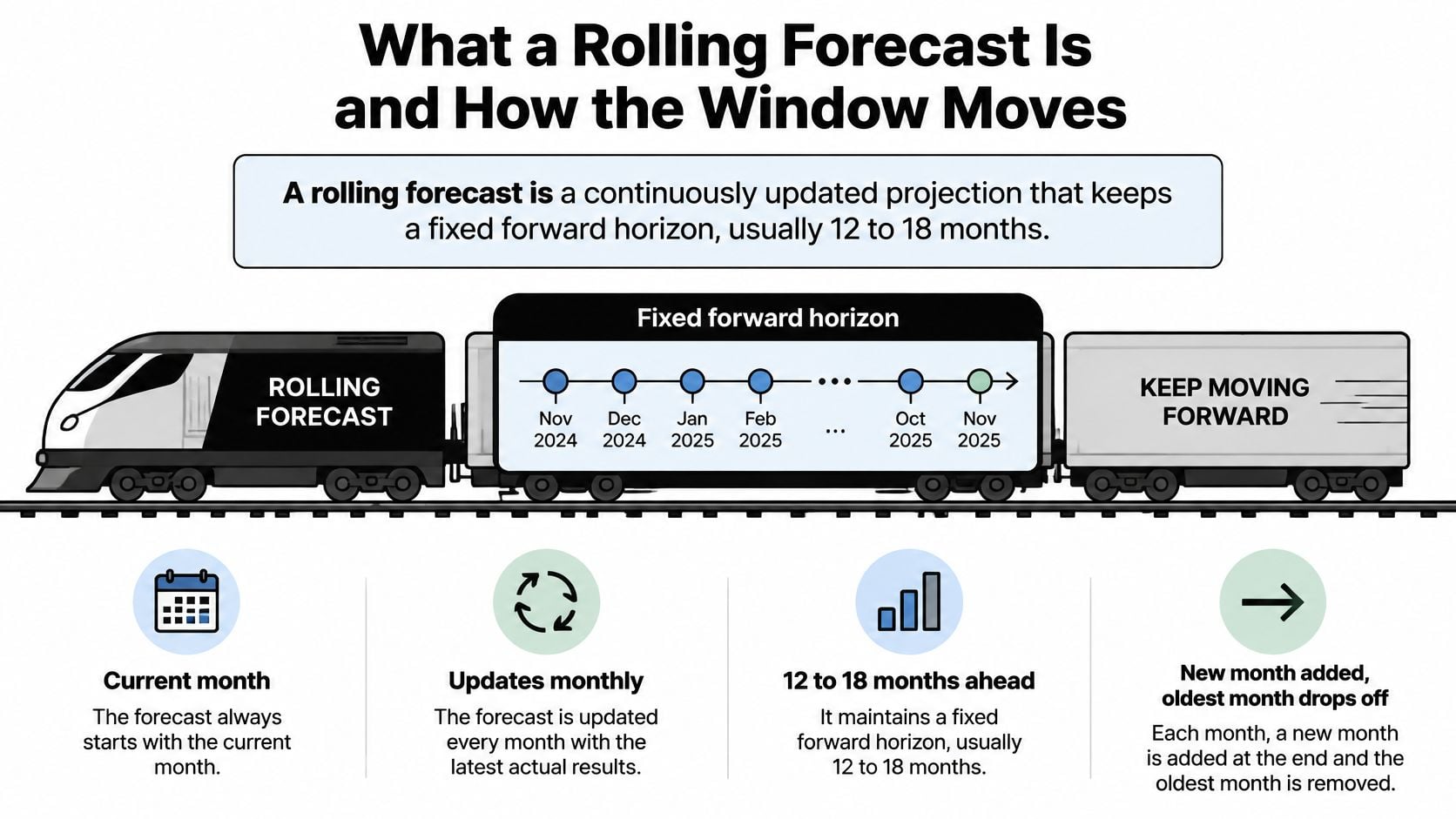
A LUT University thesis on rolling forecasting describes a common horizon of 12 to 18 months, updated monthly or quarterly to preserve forward visibility. Update cadence alone does not make a forecast rolling. The defining practice is extending the horizon as each period closes.
Know what you're updating
Use these terms consistently with your leadership team:
- Horizon: How far into the future the model reaches.
- Actuals: Closed, reported results, not estimates awaiting reconciliation.
- Variance: The difference between a forecast and the result.
- Driver: An operational input, such as backlog, labor hours or payment timing, that changes financial outcomes.
At each update, review backlog, labor availability, pricing, customer demand, payment timing, equipment purchases and debt service. Keep an assumption only when it still reflects a deliberate judgment. An untouched spreadsheet cell is not a decision.
Build the starter model with monthly columns and rows for revenue, gross margin, operating expenses, net operating cash flow and ending cash. Label completed columns Actual and future columns Forecast. Keeping history beside the forward view makes changes easier to explain and gives cash decisions a clear basis.
Adoption isn't universal: the 2024 FP&A Trends Survey reported that 49% of surveyed organizations used rolling forecasts, while 45% still relied on static planning methods.
Practical rule: Explain the forecast as your current estimate of what lies ahead, including when the business will need cash. Keep that estimate honest by separating it from the target you want to hit.
Rolling Forecast, Rolling Budget and Static Budget Compared
| Feature | Static budget | Rolling budget | Rolling forecast |
|---|---|---|---|
| Planning horizon | Ends at fiscal year-end, such as January to December | Fixed 12 to 18 months, extended each period | Fixed 12 to 18 months, extended each period |
| Update cadence | Usually annual, with occasional reviews | Monthly or quarterly | Monthly or quarterly |
| Core question | What performance do we commit to? | What targets should we hit next? | What is the most likely outcome given current information? |
| Accuracy measure | Budget attainment | Target attainment | Forecast error against actuals, by line item and horizon |
| Best use | Approvals, baseline commitments | Performance targets and incentives | Cash, hiring, capital spending and risk decisions |
| Main risk | Goes stale by mid-year | Can bias forecasts when used as targets | Becomes a disguised budget if targets leak into the forecast |
A target expresses what you want. A forecast estimates what you expect. Don't force those numbers to match.
A rolling budget extends the target-setting process into future periods. That can help maintain spending discipline, but moving the calendar doesn't make the targets realistic forecasts.
Keep ambition out of the base case
Management-control research published in the Journal of Management Control identifies a risk of bias when companies use a forecast version to set targets. If managers believe a realistic forecast will become their next quota, they have a reason to negotiate the number rather than improve the estimate.
Owners can create the opposite problem by insisting that forecasts match growth ambitions. Sales managers then enter orders they hope to win, while operations assumes capacity will somehow become available.
You lose the warning you needed.
Keep separate layers:
- Base case: The most likely outcome, supported by current operating assumptions.
- Management targets: The performance you're asking the team to achieve.
- Downside and upside scenarios: Alternative outcomes with explicit changes in demand, margins, timing or capacity.
The budget versus forecast guide helps clarify which conversations belong in performance management and which belong in planning.
Use each tool for the right decision
Say a construction owner approves a budget in January. By June, project starts have slipped, subcontractor commitments remain, and customer approvals are delaying billings.
The annual revenue target may still motivate the team. It doesn't establish whether the company can fund the delayed work.
The rolling forecast should reflect the revised project schedule and collection dates. If projected cash falls below the owner's operating reserve, the response might be to delay equipment purchases, slow hiring or negotiate milestone billing.
Keep accountability intact. Ask managers both why performance missed the commitment and what they now expect, but don't require identical answers.
The trade-off is maintaining distinct views instead of a single convenient number. That's worthwhile because you can challenge performance without corrupting your estimate of available resources.
Use the budget for accountability. Use the forecast for decisions. Don't punish someone for identifying a problem early.
For a quick test, list the decisions due this quarter. Mark each as a commitment question, an expected-outcome question or both. Approving a departmental spending limit needs a budget; deciding whether to release an equipment deposit needs the forecast and current cash outlook.
How Rolling Forecasts Improve Cash Visibility and Decisions
In an APQC survey summarized by CFO University, 94% of organizations using rolling forecasts described their business analysis as effective, compared with 50% of organizations that didn't; the same article reports that a 2021 FSN survey found 42% of rolling-forecast users predicted revenue within plus or minus 5% of actual results, compared with 38% of non-users.
These findings support the process, not a promise of automatic accuracy. Leaders still need reliable inputs and the discipline to investigate errors.
A dashboard is useful when the team can trace each output to its assumptions:
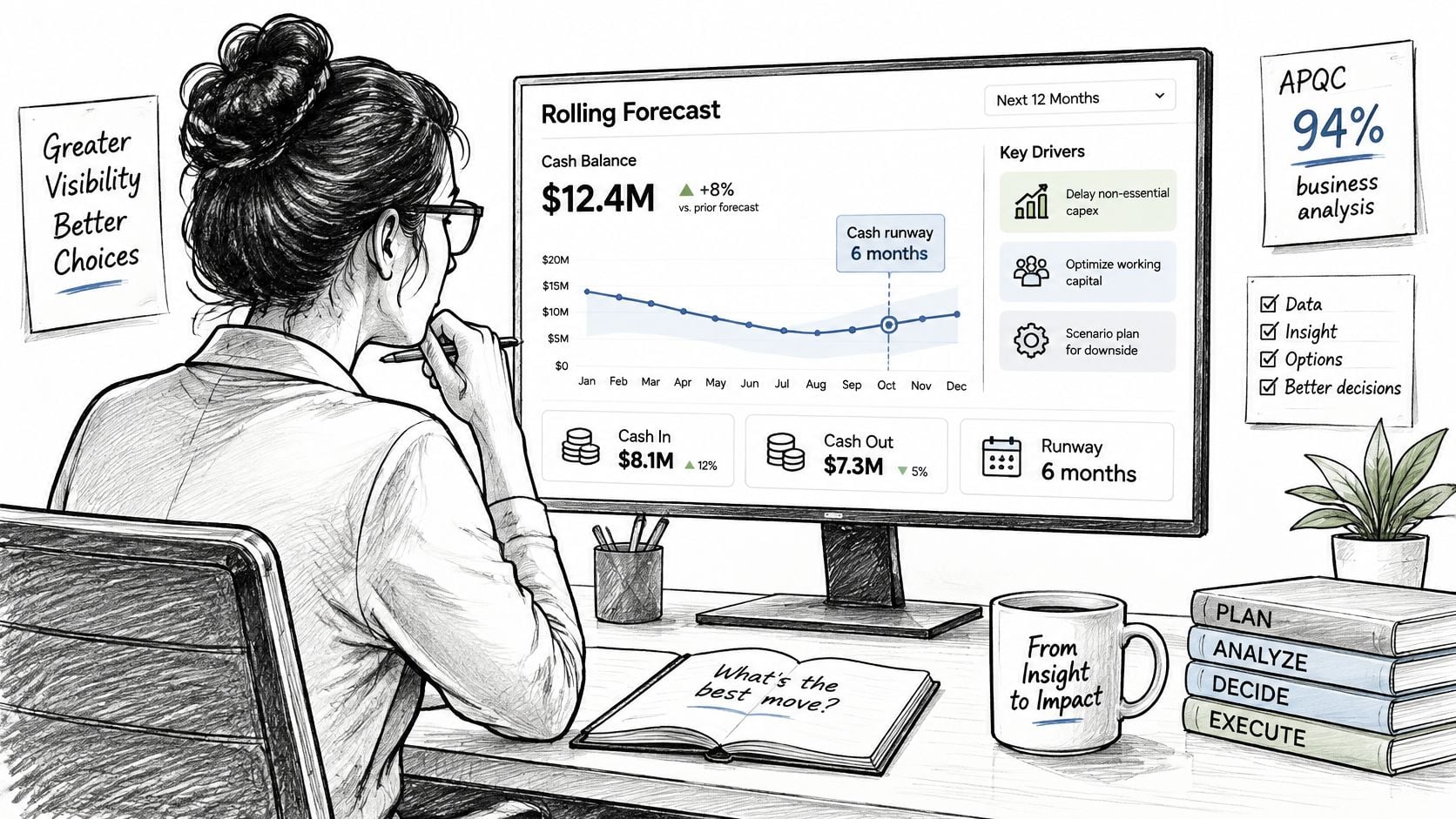
Turn uncertainty into choices
For an illustrative $20 million company, reducing revenue forecast error from 10% to 5% narrows the error amount from roughly $2 million to $1 million. That doesn't mean the difference becomes available cash. It means leadership has a clearer basis for sizing commitments.
The most useful decisions are specific:
- Hiring timing: Tie a start date to booked work, delivery capacity and cash availability, rather than an annual headcount allowance.
- Equipment purchases: Compare deposits and financing payments with expected receipts before signing.
- Contract acceptance: Test whether the margin compensates for the working capital needed to deliver the job.
- Borrowing: Identify a funding need while there's time to discuss terms, rather than when payroll is approaching.
A profitable contract can still be unaffordable under its proposed payment schedule. Seeing that early gives you room to renegotiate instead of declining good work outright.
Make the inputs trustworthy
Each cycle should expose where expectations and results separated. A sales shortfall caused by delayed shipment needs a different response from one caused by lower demand.
When departments bring conflicting figures to meetings, agree on definitions and reconcile the underlying records before debating the outlook. Spreadsheet Upgrade's guide to trustworthy decision data is a useful resource for resolving those disagreements.
For a complementary explanation of rolling forecasting, use this video:
Accuracy depends on linked actuals, owned inputs and a fixed review cadence. Finance should maintain the model, but operating leaders must explain the assumptions they control.
Use scenario planning to test alternatives without changing the base case just because an outcome feels uncomfortable. Which decision next quarter would change if you considered a plausible range instead of a single number?
Pairing a 13-Week Cash Model With a 12-Month Forecast
A 2025 Bluevine survey of 774 U.S. small-business owners found that approximately 39% had less than one month of operating expenses in cash reserves. For an owner with limited reserves, payment timing deserves more attention than another refinement to annual profit.
Your profit and loss statement, or P&L, measures revenue and expenses. It doesn't show precisely when customers pay, inventory consumes cash or loan principal leaves the bank.
Give each model a distinct job
| Model layer | Horizon | Refresh | Question it answers | Typical owner |
|---|---|---|---|---|
| 13-week cash flow model | 13 weeks | Weekly | Can we meet payroll, suppliers and debt service on time? | CFO or controller |
| Rolling P&L and balance sheet forecast | 12 to 18 months | Monthly | Are we profitable and financed for the next year? | Finance lead with department heads |
| Driver assumptions | 3 to 7 drivers | Monthly, with weekly collections data | Which inputs move cash and profit the most? | Operating owners |
Profit is the destination; cash is the timing. You need both views, but they shouldn't become disconnected spreadsheets maintained by people using different assumptions.
A contractor may recognize revenue before collecting retainage, the amount a customer withholds until contractual conditions are met. A distributor may buy inventory well before selling it, while a services firm may add payroll before its new client pays.
Those gaps explain why growing businesses can run short of cash.
Reconcile receipts, payments and operating assumptions
Start the weekly model with reconciled available cash. Refresh expected customer collections, supplier payments, payroll dates, debt service and tax payments.
Don't spread receipts evenly across the month. Use invoice-level collection expectations for material balances, and distinguish a customer's promised payment from an unsupported assumption.
Apply the same discipline to outflows:
- Collections: Assign a responsible person to overdue invoices and disputed balances.
- Payables: Show contractual due dates and separately identify any negotiated changes.
- Payroll: Include actual payment dates and the effect of approved hires.
- Debt and taxes: Enter scheduled obligations rather than treating them as residual expenses.
The owner should personally approve assumptions about pricing, hiring pace and collection terms. Finance can calculate the consequences, but it shouldn't make commercial commitments.
AmbitionCFO builds 13-week cash flow models alongside rolling forecasts for founder-led firms in construction, distribution and professional services; an internal finance lead or fractional CFO can coordinate the same weekly-to-monthly reconciliation.
When profit rises and cash falls, check billing and collection timing before cutting costs.
Reconcile the weekly ending cash balance to the monthly forecast at the relevant month-end. Investigate differences in receipts, payments and financing instead of entering an unexplained adjustment.
The payoff is practical: you can decide whether to accelerate collections, negotiate terms or change the timing of an investment before the bank balance forces your hand.
A Distributor's 18-Month Roll in Practice
Consider a hypothetical distributor with about $45 million in annual revenue and an 18-month forward forecast. Its owner wants to increase stock availability without borrowing against inventory that won't move.
At the March review, the controller locks February actuals, compares them with the prior forecast and updates the operating assumptions. Sales volumes are holding, but customers are taking longer to pay.
The controller raises the receivable-days assumption by five days. In this scenario, the projected August cash low moves earlier, prompting a review of inventory purchases before the next closing.
Separate the annual view from the forward horizon
Pigment's rolling forecast overview recommends focusing on three to seven key drivers and describes a 3+9 format, combining three months of actual results with nine months of projections.
That annual presentation isn't itself an 18-month forward horizon. The distributor can use it for fiscal-year reporting while maintaining a separate, continuously extended forecast for longer-term purchasing and financing decisions.
The timeline helps distinguish the reporting view from the longer planning window:
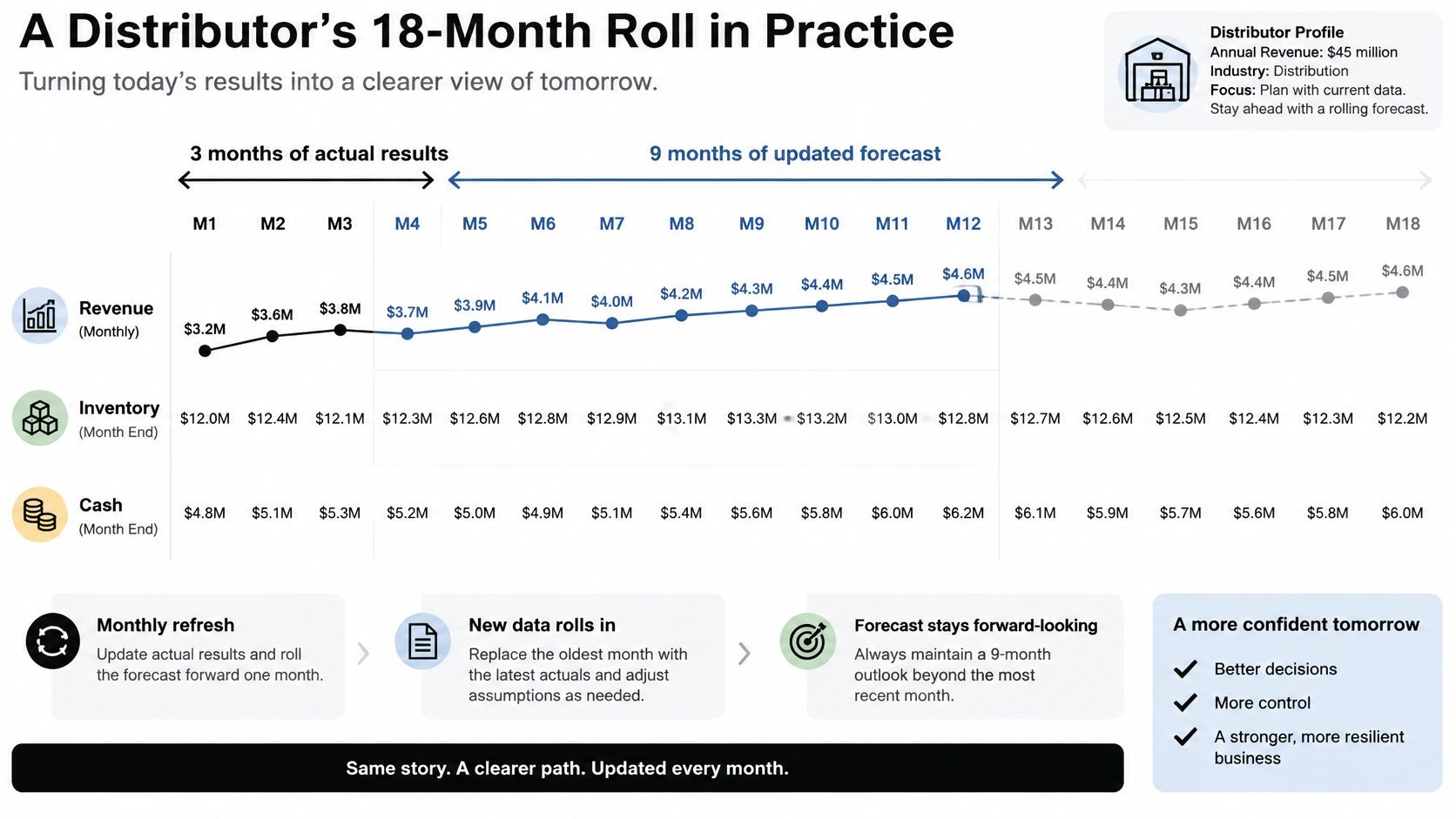
The team updates unit volume, average selling price, inventory turns, supplier lead times and receivable days. Unit volume multiplied by selling price determines revenue; purchasing and collection assumptions help determine the cash consequences.
Inventory turns measure how quickly the business sells and replaces inventory. Receivable days estimate how long customer balances remain uncollected. Both matter because the owner must finance stock and unpaid invoices.
Follow the collection delay through the model
The slower collections don't necessarily reduce reported revenue. They increase receivables and leave less cash available for incoming inventory.
The controller checks whether the company would need additional borrowing and whether that borrowing would reduce covenant headroom, the cushion before a loan agreement's financial limit is breached. The purchasing lead then identifies orders that can be deferred without compromising customer commitments.
The owner doesn't cancel inventory indiscriminately. Fast-moving items remain available; speculative replenishment receives closer review.
Use this worksheet as a starting point. The thresholds below are illustrative management rules, not industry benchmarks.
| Driver | Last actual | Forecast assumption | Variance trigger | Owner |
|---|---|---|---|---|
| Unit volume | Enter shipped units | Enter expected shipments | Below plan for two consecutive months | Sales lead |
| Average selling price | Enter realized price | Enter expected net price | Price down more than 2% from assumption | Sales lead |
| Inventory turns | Enter calculated turns | Enter expected turns | Turns fall below assumption for one quarter | Operations lead |
| Supplier lead time (days) | Enter observed days | Enter confirmed lead time | Lead time rises by 5 days or more | Purchasing lead |
| Receivable days | Enter calculated days | Enter collection assumption | Up 5 days or more from assumption | Controller |
Adjust triggers to your margins, reserves and supplier commitments. A trigger should initiate a named decision, not merely turn a cell red.
Prepare the first review
Bring the last three months of actuals, the top five drivers, a named owner for each and one trigger that would change a decision. Ask each owner to explain the evidence supporting their assumption.
Use the financial forecasting models guide to choose a structure that connects operating inputs to financial statements. Excel or Google Sheets can support a controlled starting model, provided someone owns formulas, access and version history.
The distributor's improvement isn't a more elaborate workbook. It's an earlier purchasing decision based on the cash consequences of customer behavior.
How to Build Your Rolling Forecast in Six Steps
A University of Turku thesis on rolling forecasting describes forecast quality as something evaluated against actual results. Build a process you can inspect, not just a projection you can present.
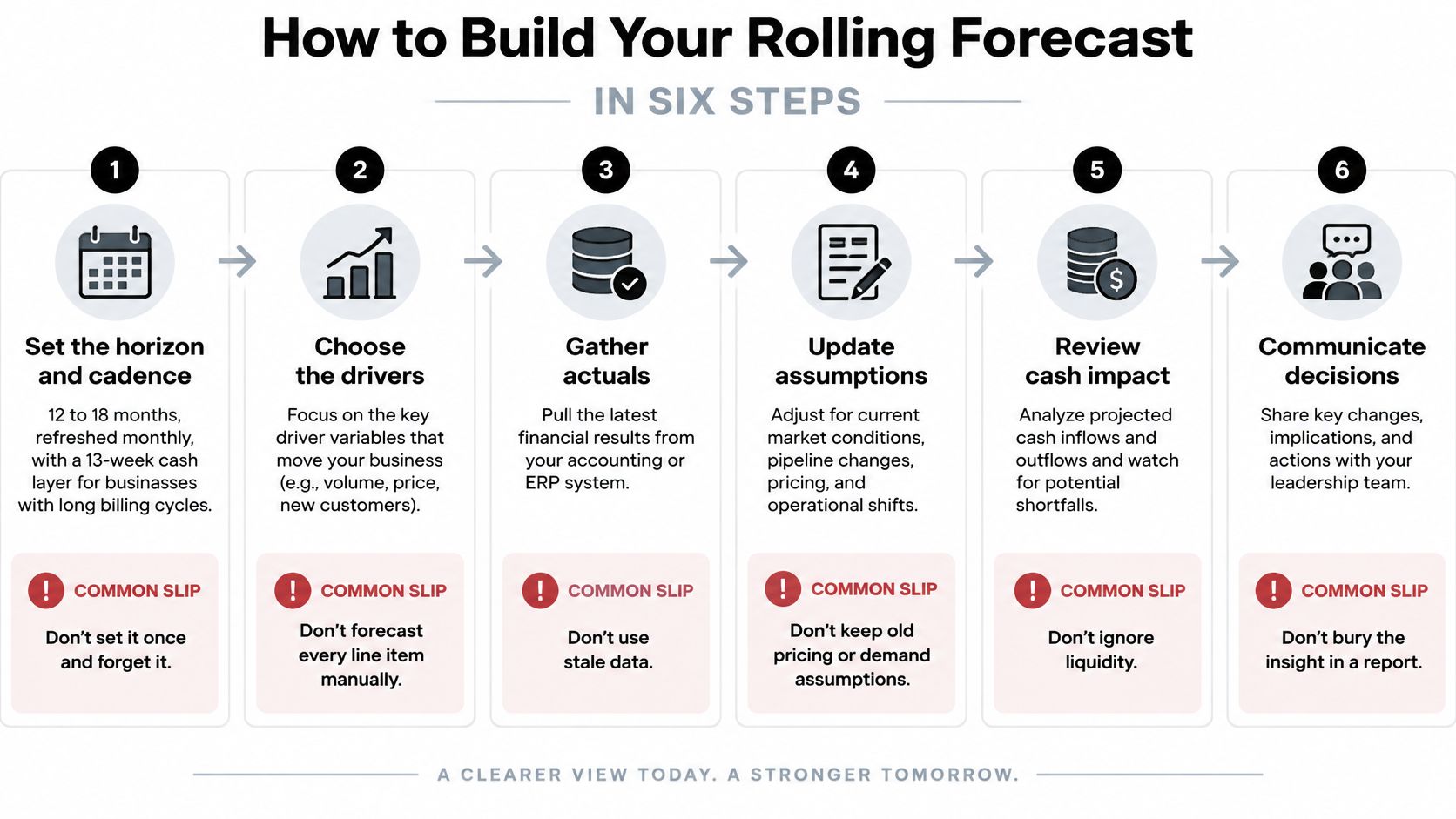
Set the horizon and cadence. Use a monthly 12-to-18-month forecast, with a 13-week cash layer for long billing cycles. Avoid a horizon that shrinks toward year-end.
Choose the drivers. Start with three to seven meaningful inputs, such as backlog, labor hours, margin, collections and subcontractor costs. Don't manually forecast every ledger line.
Link closed actuals. Fix the monthly close date and reconcile the starting balances. Avoid versions built on unfinished accounts.
Separate the planning layers. Maintain the base case, management targets and alternative scenarios. Never derive expected results from what you want managers to achieve.
Lock and test each version. Date it, preserve it and compare predictions with actuals by line item and horizon. Split differences into volume, price, mix, productivity, timing and one-off effects; arbitrary overrides hide errors.
Assign decisions and owners. Set cash triggers for equipment, hiring and payment terms, then hold a standing monthly review. A warning without a responsible decision-maker won't protect cash.
Use the process graphic as a meeting checklist:
Track forecasting accuracy alongside the actions taken. Six months later, you should be able to retrieve a dated version and explain what management knew, what changed and why it acted.
Start Your First 13-Week Cash Review This Month
Pick a decision due in the next 90 days: a hire, an equipment purchase, a large contract or new debt. Build the cash view around that commitment before trying to perfect the entire financial model.
Start with cash because a missed payment becomes urgent before an annual profit shortfall does. You can improve the longer-range forecast while using the weekly view to manage immediate obligations.
Gather the records you already have
Use your accounting system, bank records and accounts receivable aging to assemble a practical starting file:
- Export cash activity: Gather the last 13 weeks of receipts and payments, separating recurring activity from unusual transactions.
- Schedule obligations: List payroll, supplier commitments, debt payments and taxes by payment date.
- Investigate collection delays: Identify the three largest delays and record the customer's expected payment date, dispute status and responsible contact.
- Set alternative assumptions: Build a base case and one downside case that reflects a plausible delay or operating setback.
The 13-week cash flow guide provides a useful foundation for organizing that review. Keep the starting model understandable enough that your controller can update it without rebuilding formulas.
After one week, aim to have a projected cash low point, the date it occurs and a decision trigger tied to it. Identify what you'll do if cash approaches the operating reserve, rather than waiting to decide under pressure.
Keep advisory work separate from compliance
For owners seeking outside support, the firm is led by John Myklusch, CPA, CEPA, and embeds with founder-led businesses with $10M–$100M in annual revenue. The work includes building weekly cash models and longer-range forecasts with a standing monthly review.
It doesn't provide bookkeeping, tax preparation, audit, business valuation or fundraising support. Keep your CPA and other appropriate specialists for those needs, while assigning financial planning and decision support explicitly.
Your first review doesn't need a polished presentation. It needs a reliable opening balance, defensible payment dates and someone authorized to act.
AmbitionCFO offers embedded fractional CFO support to connect your cash outlook, operating assumptions and financial decisions. Visit AmbitionCFO to book a review of your 13-week cash view before the next month-end close.