

You have a quote on your desk, a loan officer waiting for an answer, and a forecast that says the decision is profitable. It might be a $600,000 excavator, a new warehouse, or a contract that'll stretch crews and credit lines for months. Profit alone won't tell you if cash survives the down payment, the first loan payments, and the wait to get paid.
That's the job of a pro-forma balance sheet. Build it before you sign, and you'll see whether the business still has liquidity after the deal, not just whether the totals balance on paper.
Table of Contents
- What a Pro-Forma Balance Sheet Shows Your Business
- The Four-Column Template and a Worked Example
- How to Build the Model in Six Steps
- Linking Assumptions to Assets, Liabilities and Equity
- Industry Adjustments for Construction, Distribution and Services
- Timing Traps and Checks Before You Trust the Numbers
- Confirm the Model Against Cash Before You Commit
What a Pro-Forma Balance Sheet Shows Your Business
A pro-forma balance sheet shows your financial position as it would look after a specific event, such as buying equipment, taking a new loan, funding a large contract, or acquiring another company. It's a before and after picture built from your latest actual balance sheet.
Three definitions hold the whole model together.
- Assets: what the business owns, including cash, receivables, inventory, and equipment
- Liabilities: what it owes, including payables, loans, and accrued payroll
- Equity: the owner's stake left after liabilities
Every version must satisfy one rule: assets equal liabilities plus equity. If that equation doesn't hold, you've missed an entry.
Why Profit Is Not Enough
A forecast P&L shows whether you'll make money. The pro-forma balance sheet shows whether cash, debt, and equity can absorb the decision. Say a construction firm buys a $600,000 excavator. First year profit may barely move after depreciation and interest, yet cash drops by the down payment and debt rises at once. The P&L looks calm. The balance sheet shows the strain.
Public companies use the same logic for disclosure. Under the framework summarized in Deloitte's guide to SEC Regulation S-X Article 11, pro-forma information generally includes a condensed balance sheet, condensed income statements that reflect other income and expense, and explanatory notes, starting from historical figures and adding transaction adjustments for acquired assets, assumed liabilities, financing, purchase consideration, and equity changes. That's a reconstruction of a historical position, not a forecast of future operating performance.
You don't need an SEC filing to use the discipline. You'll build three things from your latest statements and a 12 month P&L: a four-column balance sheet template, a driver table for working capital, and a timing check that pairs the snapshot with cash flow. Start with the decision in front of you, not a theoretical model.
The Four-Column Template and a Worked Example
Keep the layout simple enough to run in Excel or Google Sheets. You need four columns: line item, opening balance, adjustment, and pro-forma balance.
The short video below walks through the structure before you apply it to your own numbers.
Worked Example for an Equipment Purchase
Say a construction firm buys a $600,000 excavator, pays $150,000 from cash, and finances $450,000 with an equipment loan. Cash falls, equipment rises, and debt rises. Equity doesn't change on day one because the firm traded cash and new debt for an asset of equal value.
Pro-forma template with an equipment purchase
| Line item | Opening balance | Adjustment | Pro-forma balance |
|---|---|---|---|
| Cash and equivalents | $500,000 | -$150,000 | $350,000 |
| Accounts receivable, net | $900,000 | $0 | $900,000 |
| Equipment, net of depreciation | $1,970,000 | +$600,000 | $2,570,000 |
| Total assets | $3,370,000 | +$450,000 | $3,820,000 |
| Accounts payable | $600,000 | $0 | $600,000 |
| Equipment loan | $700,000 | +$450,000 | $1,150,000 |
| Owner's equity | $2,070,000 | $0 | $2,070,000 |
| Total liabilities and equity | $3,370,000 | +$450,000 | $3,820,000 |
Notice what the owner learns in ten seconds. Cash drops from $500,000 to $350,000. Total debt on equipment rises to $1,150,000. Assets and the other side of the balance sheet both land at $3,820,000, so the model proves, but liquidity is thinner.
That visibility is the point. An SEC-filed pro-forma example reflected $20.0 million of Series E PIPE proceeds, issuance of 1,131,856 common shares, 20,000 preferred shares, and more than 114 million warrants of each of two series, plus an $18.0 million payment for acquired assets and transaction costs. Your private company version won't have warrants, but the rule transfers directly: one line for every source of funds and one line for every use.
Controls That Keep the Template Honest
Keep an adjustment register beside the template. For each entry, record the source document, date, amount, and reason. Record loan fees, title costs, and delivery charges as separate lines instead of burying them in equipment cost, because buried fees distort depreciation and hide cash out the door.
A line that changes without a matching entry means stop and find the missing posting.
I wouldn't send this to a lender until every adjustment traces to a document. A clean template invites good questions. A plug invites a declined loan.
How to Build the Model in Six Steps
Build in order and don't skip the proof at the end. Each step protects you from a specific error that shows up in owner-built spreadsheets.
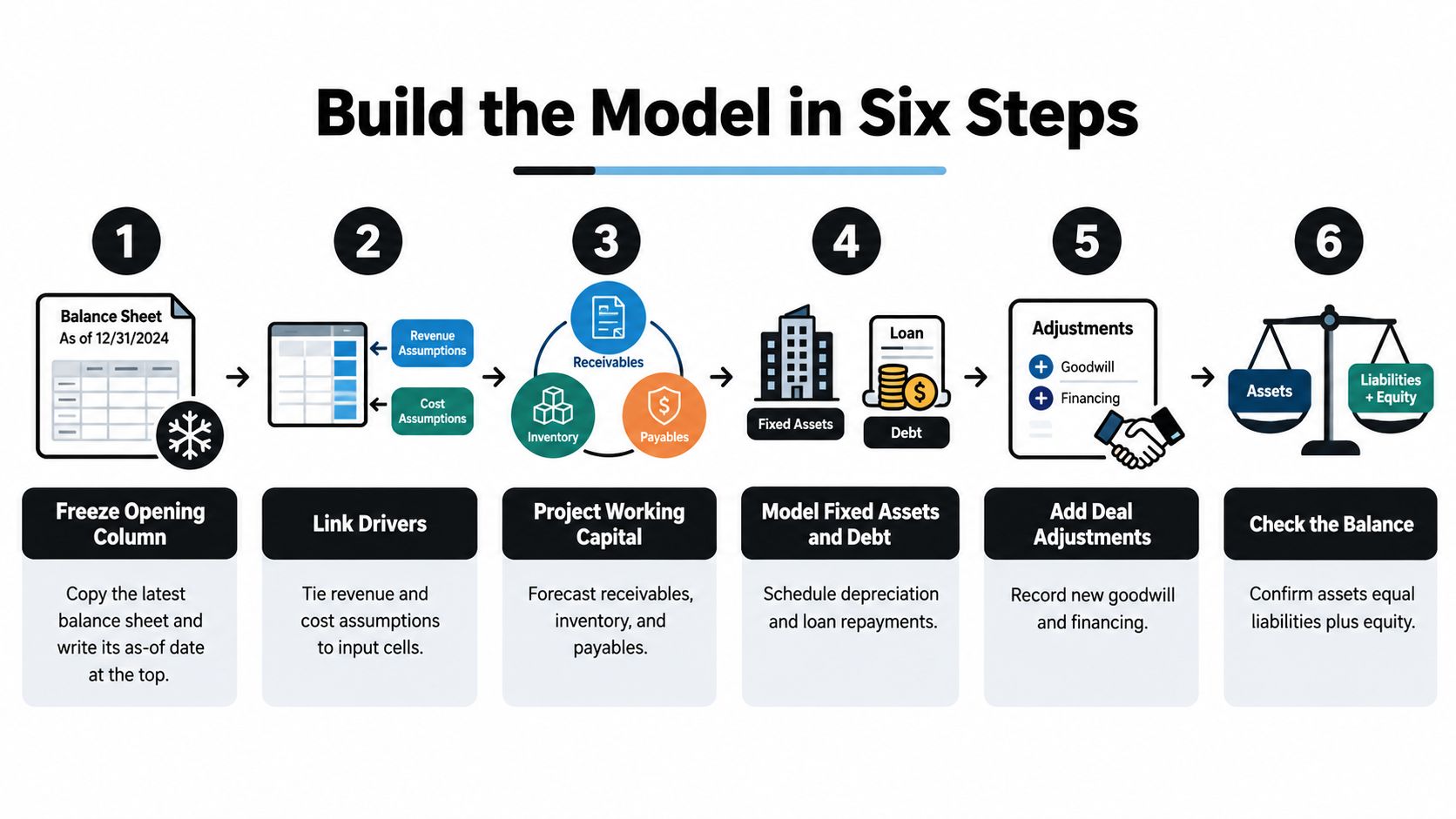
Steps One to Three
1. Freeze the opening column. Copy your latest balance sheet exactly and write its as-of date at the top of the sheet. Every later number depends on that date. The common slip is mixing a month-end balance sheet with bank balances from today.
2. Align the basis. Confirm every entity or asset you add uses the same accounting method and reporting date, and that cash basis and accrual items aren't mixed. If you're acquiring a business, normalize its books to your basis first. Skipping this creates receivables or payables that don't exist.
3. List each event as adjustments. Write down purchase price, cash used, new debt or equity, fees, assumed liabilities, and any equity elimination. Keep operating hopes, such as future savings or price increases, on a separate supplemental tab. Blending hoped-for savings into the opening balance sheet makes a weak deal look funded.
This controlled, columnar approach mirrors the method described in the SEC Financial Reporting Manual on pro-forma presentation, where the balance sheet starts with the latest historical figures, normalizes the other entity to the same basis and date, adds transaction-specific adjustments, and reconciles total assets to total liabilities plus equity. It also limits adjustments to those directly attributable to the transaction, not broad operating forecasts.
Steps Four to Six
4. Attach a source to each adjustment. Use a signed contract, loan term sheet, vendor invoice, or board approval. Write the document name in the register next to the amount. If you can't name a source, label it an estimate and give it an owner and a date to confirm.
5. Post adjustments into columns. Keep opening balances in one column, then add one column per adjustment category, such as purchase accounting, financing, and fees, before the pro-forma total. Don't type over the opening column. You'll lose the audit trail lenders want to see.
6. Prove the model. Confirm total assets equal total liabilities plus equity. Check that every adjustment touches at least two accounts, for example cash down and equipment up, or debt up and cash up before payment. Investigate any plug before you use the result. A plug usually means debt, working capital, or equity treatment is incomplete.
Sign-off rule: The owner approves the adjustment register, with tax assumptions and debt terms noted, before the numbers go to a lender or buyer.
If you're building this inside a broader forecast, this guide to building financial models shows how the balance sheet connects to the P&L and cash flow statement. Keep the pro-forma balance sheet as a distinct output, not a tab you overwrite each month. Save a dated copy for each decision so you can compare what you expected with what closed.
Linking Assumptions to Assets, Liabilities and Equity
A transaction snapshot tells you day one. A forecasting model needs drivers for month two and beyond. Each line should come from an assumption you can defend, not a round number you typed because it looked reasonable.
Drivers that feed each balance sheet line
| Balance sheet line | Driver assumption | Formula | Starting point |
|---|---|---|---|
| Accounts receivable | Days sales outstanding (DSO) | Revenue ÷ 365 × DSO | Trailing 12-month revenue and AR aging |
| Inventory | Days inventory on hand (DIO) | COGS ÷ 365 × DIO | Trailing 12-month COGS and inventory count |
| Accounts payable | Days payable outstanding (DPO) | COGS ÷ 365 × DPO | Supplier terms and AP aging |
| Equipment, net | Capital spending and depreciation schedule | Prior net book value + capex − depreciation | Fixed asset register |
| Debt | Repayment schedule and planned draws | Prior balance − scheduled principal + new draws | Loan agreements and term sheets |
| Owner's equity | Net income and owner distributions | Prior equity + net income − distributions | Monthly P&L forecast |
| Cash | Net cash flow from the cash flow statement | Prior cash + net cash flow | 13-week cash flow forecast, not a plug |
Working Capital Drivers in Plain Numbers
Say a business has $8 million of revenue and collects in 52 days. Receivables should be about $1.14 million, calculated as $8 million divided by 365, times 52. If your model shows $800,000, you've assumed faster collections without saying so.
For a distributor, say cost of goods sold is $7.5 million and inventory sits for 60 days. Inventory is about $1.23 million. Payables on the same cost base at 35 days are about $719,000. That gap between inventory plus receivables and payables is cash you've funded yourself, which is why disciplined working capital management matters more than squeezing one extra point of margin.
Start each driver with a trailing 12 month average. Then adjust only for known changes, such as a new customer paying in 60 days instead of 30, or a supplier shortening terms. Write down why each driver differs from history, in one sentence, beside the input cell.
Roll-Forwards for Assets, Debt, Equity, and Cash
Equipment doesn't jump. It rolls forward: prior net book value, plus capital spending, minus depreciation. When you're deciding whether to buy or lease, model both paths through this roll-forward and the debt schedule. For a practical comparison of owning versus leasing operating equipment, Simply Hospitality's kitchen equipment cost comparison lays out cost categories you can adapt to your own asset register, even outside hospitality.
Debt follows the amortization schedule in the loan agreement, plus planned draws and minus scheduled principal. Don't model interest only payments unless the term sheet says so. Equity rolls from prior equity, plus net income from your P&L forecast, minus owner distributions. If distributions stay flat while profit falls, equity will tell that story quickly.
Cash must come from the cash flow statement: prior cash plus operating, investing, and financing cash flow. Never plug cash to force the balance sheet to balance. The balance check only proves something if cash is linked independently.
Industry Adjustments for Construction, Distribution and Services
The same template works across industries, but the line that breaks your cash plan differs. Name that line first and build it with the most detail.
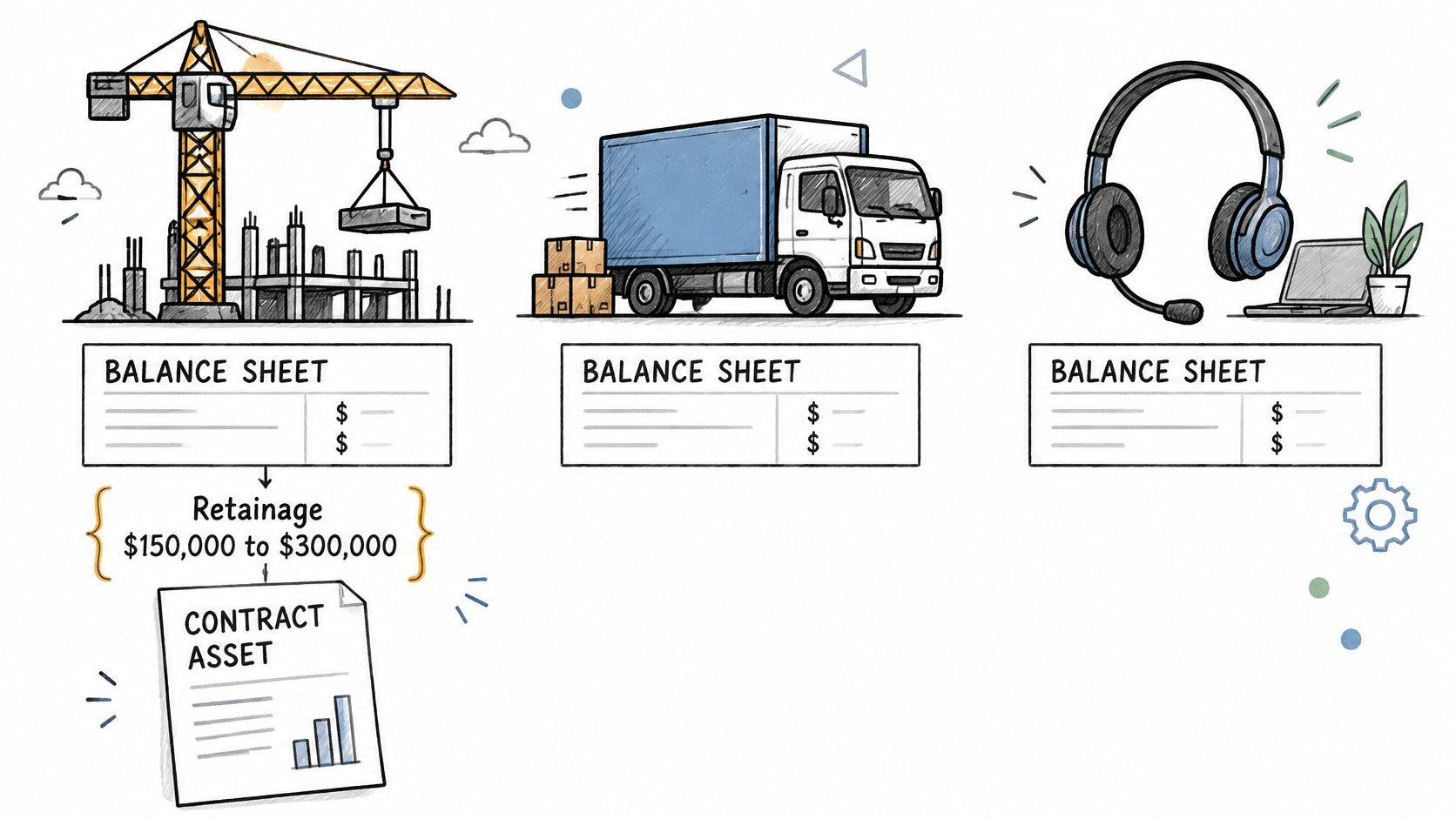
The illustration captures the practical split: iron and contracts in construction, stock and trucks in distribution, people and receivables in services.
Balance sheet lines that move most by industry
| Industry | Line that moves most | Adjustment to model | Worked example |
|---|---|---|---|
| Construction | Retainage receivable and contract assets | Hold 5% to 10% retainage and model billings against costs | $3 million job holds $150,000 to $300,000 until completion |
| Construction | Equipment and equipment loans | Separate purchase, down payment and loan lines | $600,000 purchase, $150,000 cash, $450,000 loan |
| Distribution | Inventory and accounts payable | Drive inventory by DIO and supplier terms, and add seasonal buildups | $7.5 million COGS at 60 days DIO equals about $1.23 million inventory |
| Distribution | Revolving credit draw | Compare the borrowing base against inventory and receivables each month | Draw needed when the base falls below the month's payables |
| Professional services | Accounts receivable and unbilled work in progress | Model DSO and unbilled hours separately | $6 million firm at 60 days DSO carries about $986,000 of receivables |
| Professional services | Accrued bonuses and payroll | Accrue on a schedule, not when paid | Bonus accrual builds through the year and clears in one payment |
Construction and Distribution
Construction runs on contract assets and retainage. On a hypothetical $3 million job, 5% to 10% retainage holds $150,000 to $300,000 until completion. Model billings against costs each month, because underbillings sit on the balance sheet as assets you're financing for the customer. If that concept is new, this explanation of costs in excess of billings shows how job costing lands on the balance sheet.
Distribution lives in inventory and the revolver. Model inventory by month, not by year, because a seasonal buildup can consume your borrowing base before sales arrive. Compare eligible receivables and inventory to the line limit each month. Show the revolver draw as its own liability line when payables come due before collections land.
Professional Services
Services firms have little inventory, so receivables and unbilled work carry the risk. A hypothetical $6 million firm at 60 days DSO carries about $986,000 of receivables. Add unbilled hours and you may have funded two months of payroll before an invoice exists.
Accrue bonuses and payroll taxes monthly, even if you pay them quarterly or annually. Otherwise December looks profitable and January looks like a crisis, when both were predictable in March.
Build the line that moves most in your business first, at monthly detail, and let the stable lines stay simple.
Timing Traps and Checks Before You Trust the Numbers
A balanced pro-forma can look safe while cash runs out in month four. The snapshot assumes the transaction, financing, and closing all happen on one date. Real deals don't work that way.
Guidance summarized in EY's technical update on pro-forma financial information reflects the SEC convention that the balance sheet is generally as of the latest annual or interim reporting date, with the acquired business on a comparable date, and that a separate pro-forma balance sheet may not be required if the transaction is already reflected in that latest statement. That convention serves disclosure. It doesn't automatically show the cash trough between closing and stabilization, seasonal working capital needs, delayed synergies, earn-outs, seller notes, or integration costs.
Name your decision first. A disclosure document, a lender package, an acquisition pricing model, and a capacity plan can all carry the pro-forma label while needing different dates and assumptions. The lender cares about covenant headroom at closing. You should care about the lowest cash week after closing.
Pro-forma symptoms, causes and fixes
| Symptom | Likely cause | Fix |
|---|---|---|
| Totals do not balance | One side of an adjustment was posted without the other | Trace the entry using the proof step in the six-step build |
| Cash goes negative in a later month | Seasonal receivables build or timing of debt draws | Move to a 13-week cash flow and test the revolver |
| A large other line keeps growing | A plug is forcing the balance | Replace the plug with a named driver and a source |
| Equity drifts from the P&L | Net income or distributions are not linked | Roll equity forward from the P&L every month |
| Model looks safe, bank sees tight liquidity | Opening balances are from a different date than the closing | Reconcile opening pro-forma balances to actual closing balances |
Checks to Run Before You Commit
Pair the balance sheet with a 13-week cash flow model for the next quarter and a 12 to 24 month monthly forecast for the longer swing. Then reconcile opening pro-forma balances to actual closing balances within a week of closing. Variances you catch in week one are explanations. Variances you catch in month three are surprises.
Timing discipline outside finance helps too. Owners in project businesses often underestimate how schedule slips move billings and collections, a risk explored in this resource on keeping architectural projects on schedule. A two week delay can push a billing milestone past month end and pull your cash trough lower.
Re-run the model whenever a driver moves enough to change a covenant or your cash cushion. That habit is central to improving forecasting accuracy over time, because you replace stale assumptions before they become missed payments. I would rather see a rough model updated monthly than a polished model built once for the bank and shelved.
Confirm the Model Against Cash Before You Commit
Pick the decision on your desk this week: an equipment purchase, a contract that needs working capital, a key hire, or a sale of part of the business. Don't model all four. Model the one you'll sign first.
Within the next 30 days, do three things. Copy the four-column template. Fill it with your latest balance sheet and that decision's adjustments. Run a 13-week cash flow beside it, using a cash flow forecasting Excel template if you don't have one, and find the lowest cash point.
If that low point falls below the cushion your lender or board expects, change the timing or financing before you sign. Increase the down payment schedule, stage the purchase, or negotiate supplier terms. For capital projects with automation or equipment savings attached, it also helps to calculate payback for automation projects so the balance sheet test and the payback test agree.
Owners who want this built and maintained can work with AmbitionCFO, a fractional CFO firm serving businesses with $10M to $100M in revenue in construction, distribution, and professional services, led by John Myklusch, CPA, CEPA. The firm embeds with leadership to build the driver model, the 13-week cash flow, and the closing reconciliation. It doesn't provide bookkeeping, tax preparation, or valuation, so bring your latest balance sheet and decision date and expect a focused modeling review.
If a major purchase, contract, or acquisition is on your desk, AmbitionCFO can build your pro-forma balance sheet, driver assumptions, and 13-week cash flow into one model your lender and leadership team can trust. Bring your latest balance sheet and the date you need to decide, and visit AmbitionCFO to start the conversation.